

Why Is Seattle Keeping Her From Cleaning Up Trash?
Since 2020, We Heart Seattle has picked up over 2 million pounds of trash. In response, the state government is investigating the group for improper handling of materials.
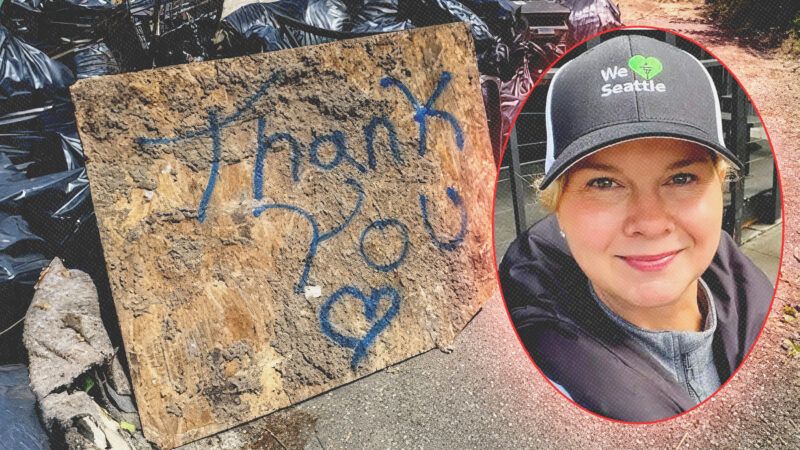
Many major American cities struggle with homelessness, and with no single clear or obvious solution, it's unlikely the problem will be solved anytime soon.
The issue also has spillover costs. Take, for example, the Evergreen State.
"Washington state is experiencing the fifth-highest per-capita rate of unsheltered homelessness in the nation," the Washington Department of Ecology warned in 2020. "On any given night, 10,000 Washington residents are living outside or in places unfit for human habitation." And while the encampments can pose a danger to nearby residents, their presence "also impacts the environment. Illegal disposal of garbage and human waste can contaminate the environment, spread disease, and attract vermin."
So when a Seattle resident took it upon herself to clean up public spaces in her city, why did the state feel the need to stand in her way?
Like most of us, Andrea Suarez found herself with a lot of free time during the COVID-19 pandemic. But when she took walks near her home in downtown Seattle, she didn't like what she saw: used needles, garbage, and homeless people experiencing drug addiction and untreated mental illness.
"Tourism was no longer camouflaging the crisis in our city," she tells Reason.
She wasn't alone. Writing for The Seattle Times in 2021, Sara Jean Green noted that the city's once-vibrant downtown was now marked by "open-air drug use, lawlessness and filth."
When her complaints to local officials went nowhere, Suarez took matters into her own hands: "I went to Home Depot and I bought pinchers and vests and garbage bags and a little red wagon," she says. With all the new equipment, she went out and picked up trash in Denny Park—which KOMO, Seattle's ABC affiliate, said at the time was "riddled with crime, drugs and homelessness."
Suarez would ultimately put $25,000 into starting We Heart Seattle, a nonprofit dedicated to cleaning up the city's public spaces and assisting the homeless. She announced upcoming cleanups on the group's Facebook page and asked for volunteers. Over time, the operation grew, and she now manages more than 1,000 volunteers.
We Heart Seattle takes no public money, relying solely on private donations. The organization brags that it has picked up more than 2 million pounds of trash from public spaces and helped 365 people off the street in just the six years in operation.
But in July, Suarez received a "notice of alleged safety or health hazards" from the Washington State Department of Labor & Industries (L&I) Division of Occupational Safety and Health. The notice alleged "improper handling and collection of hypodermic needles and fentanyl paraphernalia."
In an accompanying letter, the department indicated that We Heart Seattle would be subject to a "review as part of the inspection process."
The review apparently resulted from an anonymous civilian complaint, alleging that the people doing cleanup were not handling sensitive and dangerous items correctly. (Reason asked for a copy of the complaint last month; L&I's Public Records Unit responded on August 26 that "due to high volume of requests," it may take until October to comply.)
The letter required Suarez to submit a number of documents within 48 hours, such as copies of the organization's safety training materials, employee training completion logs, and any "safety related employee disciplinary records" from the past six months.
But according to We Heart Seattle's IRS filing, Suarez is its only employee. All the work at cleanup sites is conducted by volunteers, overseen by Suarez and a couple of site supervisors.
Still, "we have certification for hazmat and bloodborne pathogen training," she notes. On its website, We Heart Seattle provides extensive information about what volunteers can expect at a cleanup, including safety information and waivers. It also notes that "gloves, grabbers, rakes and garbage bags" will be provided.
"From day one," Suarez says, "we've always used the red sharps containers," as well as the county needle exchange's recommendation for the proper collection and disposal.
The problem was all the other requirements, she says, that felt like overkill.
Indeed, when someone is willing to shoulder the burden of clearing out so much trash from public spaces, why make it that much harder for them to do so?
It seems part of the problem is that the state doesn't quite know how to classify We Heart Seattle, a nonprofit that is technically just a one-person operation. Suarez says that's intentional: "I don't want to scale. I don't want infrastructure. The whole point of We Heart Seattle is to be nimble and mighty. I'm private funded, so I can't just start bringing on people without the guarantee of revenue."
Now, Suarez must contend with a state inspection, which an L&I spokesperson told Reason "can take up to 180 days" to complete. In the meantime, Suarez has the threat of financial penalties hanging over her head, as violations could result in fines, or worse.
"The whole purpose of nonprofits is to supplement the work of the government," she says. But the L&I investigation "puts you in a position to not want to do the work or be fearful of doing the work, that you could be fined or shut down."
How does Washington state thank @weheartseattle for picking up over 2 million pounds of trash? By launching an investigation into their work. Reason's @BessByers shares more. pic.twitter.com/nYQIWHUixU
— reason (@reason) September 29, 2026




