For centuries, the common law writ of habeas corpus has safeguarded the liberty rights of human beings by providing a means to secure release from illegal custody. The question before us on this appeal is whether petitioner Nonhuman Rights Project may seek habeas corpus relief on behalf of Happy, an elephant residing at the Bronx Zoo, in order to secure her transfer to an elephant sanctuary. Because the writ of habeas corpus is intended to protect the liberty right of human beings to be free of unlawful confinement, it has no applicability to Happy, a nonhuman animal who is not a "person" subjected to illegal detention. Thus, while no one disputes that elephants are intelligent beings deserving of proper care and compassion, the courts below properly granted the motion to dismiss the petition for a writ of habeas corpus, and we therefore affirm….
That legislative bodies have extended various statutory protections to nonhuman animals does not inexorably create a common law or constitutional right to liberty. Nor can the judicial displacement of a carefully crafted state and federal statutory and regulatory legal framework governing animal care be justified by the views of some individuals that zoos purportedly confine wild animals solely for "human entertainment" (Rivera, J. dissenting op)—a characterization of the purpose and mission of zoos to which the Bronx Zoo, operated by a renowned wildlife organization that advances scientific research and educational conservation efforts worldwide, would undoubtedly strenuously object.
Judges Wilson and Rivera dissented. From Judge Wilson's dissent, with which Judge Rivera apparently largely agrees:
From Klement v. Kofsman, decided March 30 by the Florida Court of Appeal (Chief Judge Mark Klingensmith, joined by Judges Martha Warner and Spencer Levine); note that Kofsman was the plaintiff here, and Klement was the defendant:
The parties were next door neighbors whose daughters attended the same daycare center and became friends. [Kofsman] alleged that acrimony developed between the two families due to some religiously bigoted [anti-Semitic] statements, leading Klement to refuse permission for her daughter to play with A.K. Klement purportedly told A.K. on at least five occasions that "my daughter doesn't want to play with you," causing the child to cry. This led to a text message exchange between Klement and [Kofsman]'s wife with the latter asking Klement to "please stop harassing my child, husband and me," and Klement in return calling her a "horrible person."
In another alleged incident, A.K. was having an outside playdate with another child in the neighborhood when Klement approached and instructed her daughter to give a gift to the other child. When A.K. attempted to say hello to Klement's daughter, Klement allegedly began screaming, "Stop approaching my children," and "I'll call the police if you say hi to my child."
During other episodes in this simmering conflict, [Kofsman]'s wife called the police a few times to report Klement. On one occasion, she called the police non-emergency line because Klement had placed a "please honk your horn for a birthday" sign in front of their homes. After eight hours of hearing horns honking about every fifteen minutes, [Kofsman]'s wife contacted the police, who sent an officer to the Klement home for a report about a disturbance to the neighborhood.
Another event involved [Kofsman]'s decision to hang a swing on a tree behind their house for A.K. Three days after hanging the swing, [Kofsman] found it had been removed. The neighborhood's homeowner's association informed [Kofsman] that it removed the swing because Klement had notified it that the swing was on her property. Eventually, [Kofsman] and his family rented out their townhouse and moved to a different location.
[T]he principle contended for by the State [which would allow the punishment of Cohen for wearing a jacket saying "Fuck the Draft"] seems inherently boundless. How is one to distinguish this from any other offensive word? Surely the State has no right to cleanse public debate to the point where it is grammatically palatable to the most squeamish among us.
Yet no readily ascertainable general principle exists for stopping short of that result were we to affirm the judgment below. For, while the particular four-letter word being litigated here is perhaps more distasteful than most others of its genre, it is nevertheless often true that one man's vulgarity is another's lyric. Indeed, we think it is largely because governmental officials cannot make principled distinctions in this area that the Constitution leaves matters of taste and style so largely to the individual.
As discussed in my forthcoming book Classified, contrary to popular belief, racial and ethnic classification in the US is not solely a matter of personal choice. The federal Office of Management and Budget created a classification scheme in 1978 to be used by all federal agencies, and barely amended since. The classifications you see on employment forms, applications for mortgages, applications for university admission, and so on, are taken from the official federal classifications. Importantly, while these forms rarely include instructions, the OMB classifications have official, legally binding definitions.
With that background, let's try a series of quizzes to see how well you know how these classifications are defined. Let's start with the Hispanic/Latino category. All quiz answers are based on the official OMB definitions. Note that a few federal agencies use slightly different classifications, and states have their own classification schemes, particularly for affirmative action in government contracting, that can differ, though not dramatically.
(1) A couple immigrates from Spain. Their son Bram is born in the US. Is he a member of the Hispanic/Latino category?
(2) Same scenario as the first example except the couple is from Brazil. Is Bram Hispanic/Latino?
(3) Binyamin Goldberg immigrates to the US from Israel. His father's family came to Israel from Poland, but his mother's Turkish family traces their ancestry to Sephardic Jews who fled from Spain in 1492. They stopped speaking Ladino, the Spanish-based language of Sephardic Jews, several generations ago. Is Binyamin Hispanic/Latino?
(4) Juan Castro immigrates to the US from Peru. Despite his Spanish-sounding name, his parents trace their ancestries only to members of the Inca tribe. Not only that, but Juan grew up in the Peruvian Amazon speaking only an indigenous language, he only knows a few words of Spanish. If he has to fill out a form, should he check Hispanic/Latino or Native American, or both?
(5) Jose Acarda was born to a poor, black single mother, and adopted by the Acarda family, immigrants from Argentina of Spanish descent. Is Jose Hispanic/Latino?
An intermediate position A might also be untenable if it is burdensome to administer. One obvious burden might be the effort required to make and review decisions under a nuanced, fact-intensive rule: for instance, the Supreme Court came within one vote of slipping—for better or worse—down the slope to eliminating the obscenity exception, partly because of the perceived difficulties of administering the obscenity test. Another burden may be the risk of error in applying a complex rule, especially when the rule needs to be applied by many lower courts or executive officials.
The decisions that proposal A would require might also prove burdensome if they are seen as too arbitrary or as involving too much second-guessing of others' judgments. Carving out an exception from a criminal procedure rule for especially serious crimes may at first seem appealing; but because courts are properly hesitant to disagree with legislative judgments that various crimes are serious, they may ultimately apply the rule to more and more offenses.
Likewise, a rule that legislatures may set prices only when a business is "affected with a public interest" may sound appealing in principle, but it might require so many contestable judicial decisions that judges may eventually choose to abandon the rule altogether, and give legislatures a free hand. And once a law punishes the display of vaguely defined "pornography"—for instance, on the grounds that such displays constitute sexual harassment—it becomes likely that this law will be applied to "legitimate art" as well.
Similarly, the broad Free Exercise Clause protection established by Sherbert v. Verner and Wisconsin v. Yoder was developed in cases where people wanted to engage in well-established religious groups' traditional practices that were seen as central to their belief systems and as consistent with the groups' other religious tenets. But over the years, the Court extended the potential zone of free exercise protection to cover even idiosyncratic, seemingly not fully consistent beliefs, as well as beliefs that may not be central to people's religions, partly because the Justices concluded that secular courts cannot properly inquire into the religious beliefs' centrality and consistency.
Among the five opinions the Supreme Court released yesterday was Denezpi v. United States, in which the Court held that the Double Jeopardy Clause does not bar successive prosecutions of distinct offenses arising from a single act, even if a single sovereign prosecutes them. Justice Barrett wrote for the Court. Justice Gorsuch dissented, joined (in part) by Justices Sotomayor and Kagan.
As Marcia Coyle notes in the National Law Journal, this is the third case so far this term in which Justice Barrett has written the majority opinion and Justice Gorsuch dissented. Unmentioned by Coyle, the two young justices also authored dueling opinions in a case last term as well, which means that Justices Barrett and Gorsuch have gone toe-to-toe in four cases so far, a particularly interesting fact given they share interpretive philosophies and were appointed by the same President.
Justice Barrett wrote for the Court in Patel v. Garland, holding that federal courts lack jurisdiction to review claims the Attorney General's decision to deny discretionary relief for an alien subject to removal. In Patel, Justice Gorsuch dissented for himself and the Court's three liberal justices.
Justice Barrett also wrote for an eight justice majority in Babcock v. Kijakazi, concerning when civil service payments constitute payments based on "service as a member of a uniformed service." Justice Gorsuch dissented alone.
These three cases are not the first three instances in which Justices Barrett and Gorsuch have crossed swords. they disagreed last term in HollyFrontier Cheyenne Refining, LLC v. Renewable Fuels Association, in which Justice Gorsuch wrote for the Court to expand eligibility for hardship exemptions from federal renewable fuel mandates. Justice Barrett dissented, for herself and Justices Sotomayor and Kagan.
As we saw in the 1950s when President Roosevelt's appointees split on criminal procedure and civil rights cases, just because two justices were appointed by the same President, we should not always expect them to agree.
[Note: Yes, I initially wrote "Justice Roosevelt" when I meant "President Roosevelt." Homer nods.]
In a post yesterday, I introduced a series on The Fair Notice Rationale for Qualified Immunity, a paper that will be published by the Florida Law Review. The paper explores the extent to which fairness to officers supports the doctrine of qualified immunity. (For a primer on the doctrine, see my post yesterday.)
The first step of the argument requires a relatively deep dive into jurisprudence to explore the principle of prospectivity and its application to adjudication. What makes retroactive laws unfair? Are adjudications—decisions by courts—ever unfair in the same way, and if so, what makes them unfair? My discussion of this issue contributes to the literature on legal theory—it may not be right in every detail, but it poses some important questions that deserve answers.
The principle of prospectivity—that laws should ordinarily apply only prospectively, not retroactively—is a basic requirement of the ideal of the rule of law. Most people have an intuitive sense that it is unfair to be punished for something you could not have known was forbidden. The norm isn't only theoretical—its deeply ingrained in our law. The Ex Post Facto Clauses and Contract Clauses of the US Constitution prohibit some kinds of retroactive laws and statutes affecting private rights are presumed to apply prospectively.
Over the past month, critics of the Dobbs draft have thrown every conceivable attack at Justice Alito's opinion. Perhaps the most unexpected attacks were directed at the ancient writers that Alito cites. For example, there was an attempt to cancel Henry de Bracton, a thirteenth century English jurist. Others excoriated Alito for citing Matthew Hale, a seventeenth-century English jurist. Of course, Hale had been recently cited by Justices Kagan and Breyer. But whatever, Dobbs.
Has this inane criticism of Sir Matthew Hale permeated the unscalable fences on First Street? Justice Barrett's opinion in Denezpi suggests the answer is no. She favorably cites Hale to interpret the word "offense."
And Sir Matthew Hale could say of a man who breaks into a house and steals something: "[I]f indicted for the burglary and acquitted, yet he may be indicted of the larciny, for they are several offenses, tho committed at the same time." 2 History of the Pleas of the Crown 245–246 (1736).
I did a quick search of the briefs, and none of the briefs in Denezpi cited this passage, or "History of the Pleas of the Crown" for that matter. If my research is correct, Justice Barrett did this research on her own.
I hate reading between the lines, but this citation--which was not stripped out of the majority opinion--suggests ACB said IDGAF to critics. Good for her. Who the Hale cares what they think?
On the current Court, Justice Gorsuch is the most unpredictable justice. The other members of the Court are more-or-less predictable, but Justice Gorsuch continually surprises me with how he disposes of cases--not in the outcomes he reaches, but how he gets there. Two opinions from Monday illustrate this dynamic.
First, in Kemp v. United States, Justice Thomas wrote an opinion for 8 justices about the meaning of "mistake" in FRCP 60(b)(1). He observed that there is a "longstanding disagreement" on this issue in six circuits. Does Justice Gorsuch join this sound textualist opinion that resolves a circuit split, and narrows the scope of habeas relief? Nope. Gorsuch would have DIG'd the case so Rule 60(b)(1) can be amended pursuant to the Rules Enabling Act.
Respectfully, I would have dismissed the writ of certiorari as improvidently granted. Not only does this case fail to meet our usual standards for review. See Supreme Court Rule 10. At bottom, this dispute presents a policy question about the proper balance between finality and error correction. Should a district court be able to clean up a legal error through a collateral proceeding on any reasonable timeline within a year of judgment? Or do Rule 59(e) and the appellate process provide the necessary corrective measures in ordinary cases, with Rule 60(b)(6) as a last, narrow avenue to relief? Questions like these are best resolved not through a doubtful interpretive project focused on a pronoun dropped in 1946, but through the rulemaking process.There, policy interests on both sides can be accounted for and weighed in light of the "collective experience of bench and bar." Mohawk Industries, Inc. v. Carpenter, 558 U. S. 100, 114 (2009).
This outcome was not on my SCOTUS bingo card. And as best as I can tell, Gorsuch asked zero questions at oral arguments, so this analysis came out of the blue. Classic Gorsuch.
Kemp gave us restrained Gorsuch. But Denezpi v. United States involved double jeopardy, criminal justice, and an Indian tribe from Colorado (!). The stage was set for a reprise of McGirt, and Gorsuch would not disappoint. But how would he do his thing?
Footnote 2 of Justice Barrett's majority opinion may as well have included a face-palm emoji.
2The dissent, unwilling to accept Denezpi's framing of the case, asserts that his first conviction was for a federal offense because CFR court regulations assimilated the Tribe's assault and battery ordinance. Post, at 6–9 (opinion of GORSUCH, J.). The dissent is right that we do not address that point. Instead, we take the case as it comes to us: No party pressed the assimilation argument, here or below, and no lower court addressed it. Moreover, the answer to the question is not as obvious as the dissent claims. For example, while the dissent says that the relevant regulations "could not be plainer," post, at 6, they are much less clear than the Assimilative Crimes Act, which makes a person who violates a state law on a federal enclave situated in that State "guilty of a like offense and subject to a like punishment." 18 U. S. C. §13(a). Nor, despite the dissent's argument to the contrary, is it dispositive that the Assistant Secretary must approve a tribal ordinance before it can be enforced in CFR court— the Secretary of the Interior had to approve the Tribal Code at issue in Wheeler too. 435 U. S., at 327. In short, the assimilation question is complex, making it particularly imprudent to raise and resolve it sua sponte as the dissent proposes to do.
ACB added another face-palm emojis in Footnote 3:
3At times, the dissent suggests that the source of the trial court's power, rather than (or perhaps in addition to) the source of the prosecutor's power, matters in the dual-sovereignty analysis. See post, at 10–11. Again the dissent strays from Denezpi's argument, which has focused on the source of the prosecutor's authority. See, e.g., Tr. of Oral Arg. 9–11.
Truth be told, I found Gorsuch's dissent in Denezpi more persuasive than I thought it would be, even assuming that Gamble was correctly decided. The line between federal law and assimilated tribal law is fuzzy. Moreover, Part II--which Justices Sotomayor and Kagan did not join--teed up an important separation of powers issue for future cases.
By anyone's account, the Court of Indian Offenses is a curious regime. When instructing agency officials to create the Court of Indian Offenses, neither Secretary Teller nor anyone else pointed to any Act of Congress authorizing the project. On the contrary, from the beginning, federal officials recognized that these "'so-called courts'" rested on a "shaky legal foundation." W. Hagan, Indian Police andJudges: Experiments in Acculturation and Control 110(1966). Even more than that, one might wonder how an executive agency can claim the exclusive power to define, prosecute, and judge crimes—three distinct functions the Constitution normally reserves for three separate branches. See, e.g., United States v. Brown, 381 U. S. 437, 442–443 (1965). In these proceedings, however, Mr. Denezpi has not questioned whether the Court of Indian Offenses is statutorily authorized. Nor has he questioned whether the Constitution permits executive officials rather than a judge and jury to try him for crimes. Accordingly, those questions—long lingering and incredibly still unanswered—remain for another day.
Coming soon to a cert petition near you. Still, advancing an argument that none of the parties argued is very problematic. And this engaged approach is so much at odds with the proposed DIG in Kemp.
Justice Gorsuch is like a box of chocolates. You never know what you are going to get.
Update: In George v. McDonough, Justice Barrett once again accuses Justice Gorsuch of raising arguments that none of the parties advanced:
2The principal dissent claims that this conclusion conflicts with the governing statute's present-tense statement that a VA decision " 'is subject' to later 'revision' " on collateral review. Post, at 5 (opinion ofGORSUCH, J.). But it would make little sense for Congress to pass a statute stating that a decision "was" subject to revision. The statute's use of the present tense refers to the time at which relief may be sought. It says nothing about the scope of the category of clear and unmistakable errors meriting relief, as fixed by the regulatory history. So we think there are good reasons why neither George nor any of his amici makes this argument.
On Monday, the Supreme Court handed down five decisions, four of which focused on statutory interpretation.
First, Justice Sotomayor wrote the majority opinion in Johnson v. Arteaga-Martinez. She emphatically rejected the Third Circuit's interpretation of Section 1231(a)(6):
The question presented is whether §1231(a)(6) requires bond hearings before immigration judges after six months of detention in which the Government bears the burden of proving by clear and convincing evidence that a noncitizen poses a flight risk or a danger to the community. Section 1231(a)(6) provides that certain noncitizens who have been ordered removed "may be detained beyond the removal period and, if released, shall be subject to [certain] terms of supervision." This text, which does not address or "even hin[t]" at the requirements imposed below, directs that we answer this question in the negative. . . Here, there is no plausible construction of the text of §1231(a)(6) that requires the Government to provide bond hearings before immigration judges after six months of detention, with the Government bearing the burden of proving by clear and convincing evidence that a detained noncitizen poses a flight risk or a danger to the community.
Second, Justice Alito wrote the majority opinion in Garland v. Aleman Gonzalez. This opinion also interpreted Section 1231(a)(6), and emphatically rejected the Ninth Circuit's interpretation. Here, Alito relied on "ordinary meaning."
With one exception that we will discuss momentarily, the critical language in this provision strips lower courts of "jurisdiction or authority" to "enjoin or restrain the operation of " the relevant statutory provisions. The ordinary meaning of these terms bars the class-wide relief awarded by the two District Courts.
Justice Sotomayor's dissent in Gonzalez countered with "plain meaning":
The essence of statutory interpretation is to review the plain meaning of a provision in its context. The Court's analysis, by violating several interpretive principles, ultimately fails in that endeavor. I respectfully dissent.
Third, Justice Thomas wrote the majority opinion in Kemp v. United States. He distinguished between "ordinary meaning" and "legal meaning" in FRCP 60(c):
The ordinary meaning of the term "mistake" in Rule 60(b)(1) includes a judge's legal errors. When the Rule was adopted in 1938 and revised in 1946, the word "mistake" applied to any "misconception," "misunderstanding,"or "fault in opinion or judgment." Webster's New International Dictionary 1383 (1914) (Webster's); see also Funk & Wagnalls New Standard Dictionary of the English Language 1588 (1944) (Funk & Wagnalls) (defining "mistake" as an "error in action, judgment, or perceptions," including, e.g., "a mistake in calculation"). In ordinary usage, then, a "mistake" was not limited only to factual "misconception[s]"or "misunderstanding[s]," or to mistakes by non-judicial actors. Webster's 1383. Likewise, in its legal usage, "mistake" included errors "of law or fact." Black's Law Dictionary 1195 (3d ed. 1933) (Black's). Thus, regardless whether"mistake" in Rule 60(b)(1) carries its ordinary meaning or legal meaning, it includes a judge's mistakes of law.
Fourth, Justice Barrett wrote the majority opinion in ZF Automotive U. S., Inc. v. Luxshare, Ltd. This case turned on the meaning of the phrase "foreign or international tribunal" in 28 U. S. C. §1782(a). It is a thoroughly textualist opinion.
So a §1782 "tribunal" need not be a formal "court," and the broad meaning of "tribunal" does not itself exclude private adjudicatory bodies.1 If we had nothing but this single word to go on, there would be a good case for including private arbitral panels.
This is where context comes in. "Tribunal" does not stand alone—it belongs to the phrase "foreign or international tribunal." And attached to these modifiers, "tribunal" is best understood as an adjudicative body that exercises governmental authority.2 Cf. FCC v. AT&T Inc., 562 U. S. 397, 406 (2011) ("[T]wo words together may assume a more particular meaning than those words in isolation").
My colleague James Phillips co-authored a corpus linguistics analysis of "foreign or international tribunal" that reached the same result as did the Court.
Four textualism opinions. None cited Bostock, which seems to have already passed its expiration date. I'll turn to the fifth case, and Justice Gorsuch in another post.
This episode of the Cyberlaw Podcast is dominated by things that U.S. officials said in San Francisco last week at the RSA conference. We summarize what they said and offer our views of why they said it.
Bobby also notes an FBI analysis of the NetWalker ransomware gang, an analysis made possible by seizure of the gang's back office computer system in Bulgaria. The unfortunate headline summary of the FBI's work was a claim that "just one fourth of all NetWalker ransomware victims reported incidents to law enforcement." Since many of the victims were outside the United States and would have had little reason to report to the Bureau, this statistic undercounts private-public cooperation. But it may, I suggest, reflect the Bureau's increasing sensitivity and insecurity about its long-term role in cybersecurity.
Michael sees complaints about a dearth of incident reporting by the private sector as one of the themes emerging from the government's RSA appearances. A Department of Homeland Security Cybersecurity and Infrastructure Security Agency (CISA) executive also complained about a lack of ransomware incident reporting, a strange complaint considering that CISA can solve much of the problem by publishing an incident reporting rule that Congress authorized last year.
In a more promising vein, two intelligence officials underlined a commitment on the part of intel agencies to sharing security data more effectively with the private sector. Michael sees that as the one positive note in an otherwise downbeat cybersecurity report from Avril Haines, Director of National Intelligence. And David Kris points to a similar theme offered by National Security Agency official Rob Joyce, who believes that sharing of (lightly laundered) intelligence is increasing, thanks in part to the sophistication and cooperation of the cybersecurity industry.
Michael and I are taking with a grain of salt the New York Times' claim that Russia's use of U.S. technology in its weapons has become a vulnerability due to U.S. export controls. We think it may take months to know whether those controls are really hurting Russia's weapons production.
Bobby explains why the Department of Justice (DOJ) was much happier to offer a "policy" -- instead of a legislative amendment -- to protect good-faith security research from prosecution under the Computer Fraud and Abuse Act. That's understandable, but the DOJ policy doesn't protect researchers from civil lawsuits, so DOJ may yet find itself forced to look for a statutory fix. (If it were up to me, I'd be tempted to dump the civil remedy altogether.)
Michael, Bobby, and I dig into the ways in which smartphones have transformed both the war and, perhaps, the law of war in Ukraine. The change is driven by a Ukrainian government phone app that lets every Ukrainian civilian direct artillery fire onto Russians they encounter in the street. That's probably enough for the Russians to shoot all the civilians they encounter, but for armies that care about the law of armed conflict, the answer is surprisingly complicated and unsatisfying.
Finally, David, Bobby and I dig into a Forbes story, clearly meant to be a shocking expose, about the United States government's use of the All Writs Act to monitor an indicted Russian hacker's travel reservations for years until he finally headed to a country from which he could be extradited. We remain unshocked.
You can subscribe to The Cyberlaw Podcast using iTunes, Google Play, Spotify, Pocket Casts, or our RSS feed. As always, The Cyberlaw Podcast is open to feedback. Be sure to engage with @stewartbaker on Twitter. Send your questions, comments, and suggestions for topics or interviewees to CyberlawPodcast@steptoe.com. Remember: If your suggested guest appears on the show, we will send you a highly coveted Cyberlaw Podcast mug!
The views expressed in this podcast are those of the speakers and do not reflect the opinions of their institutions, clients, friends, families, or pets.
It looks like it was intended to cover unwanted sexual images sent to a particular person, but its text seems broad enough to potentially cover even posting things on your own site.
Texas Penal Code § 21.19(b) ("Unlawful electronic transmission of sexually explicit visual material") makes it a crime to
knowingly transmit[] by electronic means visual material that:
(1) depicts:
(A) any person engaging in sexual conduct or with the person's intimate parts exposed; or
(B) covered genitals of a male person that are in a discernibly turgid state; and
(2) is not sent at the request of or with the express consent of the recipient.
Most of those open to evidence already know that Trump tried to reverse the outcome of an election he legitimately lost. Reaching the rest is likely to be extremely difficult, at best.
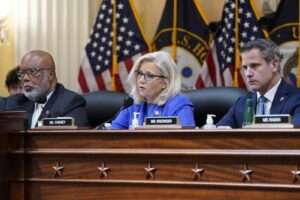
Many have analogized the currently ongoing January 6 Committee congressional hearings to the 1973 Watergate hearings. There are indeed some obvious parallels, such as the fact that both cases involve investigations into an incumbent president's efforts to subvert the electoral process. But there is also a key difference. Richard Nixon was smarter and less brazen than Donald Trump. He therefore tried to cover up his nefarious activities. Thus, the Watergate hearing exposed inside information about Nixon's involvement that was previously unavailable to the public.
By contrast, Trump's efforts to reverse the result of the 2020 election and illegally retain power were largely out in the open. And most of the evidence against him has also long been known. To the extent that many people still deny it, it isn't because the truth is unavailable, but because they are ignoring it or actively rejecting it. Jeff Greenfield nicely brings out this contrast in an article in Politico:
The core premise of this hearing was that the images from that day, accompanied by the comments and testimony of key players in Donald Trump's orbit, would galvanize a national audience.
It's too easy — and more importantly, unfair — to dismiss the presentation as "political theater." The interviews with insurrectionists, the blunt comments from former Attorney General William Barr that Trump's beliefs were "bullshit" — were effective tools in trying to communicate what happened on Jan. 6 and in the days and weeks before. Rep. Liz Cheney (R-Wyo.), in her role as chief prosecutor, skillfully summarized the evidence to come, which promised to paint a damning portrait of a president and a coterie of aides and acolytes, determined to retain power "by any means necessary," including the wholesale abandonment of constitutional norms….
But looming over Thursday's event, and the hearings to follow, is one key fact: In the broadest sense, we know what happened. We may learn compelling details, and we may see a clear, coherent picture of what happened, but we know the sitting president of the United States oversaw an attempt to overturn an election and seize power the voters denied him. We know he embraced the sentiments of the rioters who stormed the Capitol. And it is this fact that so contrasts this proceeding with what happened almost half a century ago.
If you think back (inevitably) to the Senate Watergate hearings in 1973, every dramatic moment in those proceedings came in words spoken by witnesses, unadorned by visuals and made-for-TV moments….
The old-fashioned, methodical parade of witnesses during the Watergate hearings was powerful not because of what we saw, but because of what we heard: We were learning facts we did not know, and that was, over time, causing minds to change….
Now consider what we heard Thursday. Smoking guns? Enough to arm a platoon; but essentially the same smoking guns we have seen and heard for a year and a half. We saw and heard the president and his accomplices openly call for the election to be overturned. We saw and heard demands that legitimate votes be discarded, that state legislatures seize control of electoral votes. We saw key advisers and allies of Trump urge — at meetings in the White House — that the military seize ballot boxes, that rogue electors be certified. We've known since the days after the election that there was no voter fraud of any consequence…..
But the people who refuse to accept this reality — or (in the case of many GOP officials) pretend to refuse — are locked into this alternate reality by conviction or political necessity. Nothing that has happened in the year and a half since has shaken this stance; indeed, the percentage of Republicans who believe the election was stolen remains undiminished, since Trump left office.
Part of the problem here is a matter of simple ignorance. For mostly rational reasons, many people devote little or no time to seeking out political information, and thus are often ignorant of even very basic political information, such as the names of the three branches of government. No doubt, some people remain ignorant of the truth about the 2020 election, for such reasons. But the biggest problem in this case isn't just simple ignorance, but the combination of ignorance with bias in the evaluation of political information.
Many voters - particularly committed partisans - evaluate political information in a highly biased way, overvaluing anything that supports their preferred party or ideology, and discounting or rejecting anything that cuts the other way. When the leader of the Republican Party claims the election was "stolen" from him, such people tend to believe him, even if those claims have no basis in reality. I have written about this problem in previous posts about January 6 and Trump's Big Lie about the 2020 election, such as here and here:
Why do so many Republicans believe blatant falsehoods about the 2020 election? The answer is rooted the broader problem of political ignorance. Because there is so little chance that any one vote will make a difference to the outcome of an election, most people are "rationally ignorant" about politics and government policy. They spend little time seeking out relevant information, and are often ignorant of even basic facts about the political system, such as the names of the three branches of government. Such ignorance makes people more susceptible to lies and conspiracy theories, including those about the 2020 election….
In [my book] Democracy and Political Ignorance, I described how belief in conspiracy theories is partly fueled by general public ignorance about government and public policy. Most of the public has little understanding of government and political institutions. They thus underestimate the extreme difficulty of planning, coordinating, and covering up large-scale conspiracies. Birtherism, trutherism, and Covid conspiracy theories are all more prevalent among people with relatively low levels of education and political knowledge. The less you know about government, the easier it is to believe that events are controlled by a shadowy cabal of ultra-competent evil-doers who can skillfully cover up their misdeeds.
But the popularity of conspiracy theories is also boosted by partisan and ideological bias. In assessing political information, most people act not as objective truth-seekers, but as "political fans" who tend to overvalue any claims that cohere with their preexisting views, and downplay or ignore any that cut against them. Much like sports fans, who tend to be biased in favor of their preferred team and against its rivals, political fans are highly biased in favor of their preferred party and ideology, and against its opponents.
Thus, it is not surprising that trutherism was especially popular among Democrats (many of whom hated George W. Bush), birtherism appealed primarily to Republicans (many of whom hated Obama), and Trump's election conspiracy theories appeal almost exclusively to his own supporters. Particularly in an era of severe polarization, partisan bias has a big impact on voters, leading many to believe ludicrous claims they might otherwise reject.
As I have also emphasized in previous writings about 2020 and January 6, such ignorance and bias is far from unique to Trump voters, Republicans, and right-wingers. There are lots of parallel examples on the left. Social science evidence indicates that bias in evaluation of political information is widespread among both liberals and conservatives, with neither being significantly better or worse than the other, on average.
But the persistence of the Big Lie about the 2020 election may be more dangerous than most otherwise similar examples. The risk is that it could lead to actions that gravely undermine the basic structure of liberal democracy. If you believe that the 2020 election was "stolen" from Trump, you are probably predisposed to believe similar claims about future elections, and to support the use of illegal and violent means to forestall such injustice. Ironically, in the name of preventing an electoral "steal," Big Lie believers could end up facilitating the very evil they think they are preventing. That risk makes Trump's Big Lie more dangerous than a deception that "merely" facilitates the enactment of a specific dubious policy, such as the lies that Barack Obama used to help push through the Affordable Care Act.
Overcoming this bias is likely to be extremely difficult. Even the best-designed hearing may not dent strong partisan biases, especially if many of the partisans are inclined to just dismiss the hearings out of hand, or not even bother to watch. The problem is exacerbated by the reality that those who still believe in the Big Lie have now gone on doing so for some 18 months. It's often psychologically more difficult to give up a long-held belief than one you arrived at just recently.
The January 6 hearings might still have some beneficial impact on public understanding. Some number of voters are merely ignorant of the facts rather than biased. That may be especially true of swing voters, who generally know less about politics and pay far less attention than committed partisans. Of course, people who have paid little or no attention to these issues so far are also unusually likely to ignore the hearings.
The hearings - and accompanying investigation - can also shed new light on the role of various less significant figures than Trump. For example, it has uncovered evidence indicating that legal scholar John Eastman - who promoted various ridiculous legal theories intended to help Trump overturn the election - may have been even more reprehensible than previously thought. But, just as Nixon was the central figure in the Watergate investigation, so too with Trump and the effort to overturn the 2020 election. For obvious reasons, wrongdoing by the president is a far bigger deal than the misdeeds of lawyers and other underlings, though the latter also deserve their share of opprobrium.
There is some evidence that GOP voters' commitment to the Big Lie may be receding. For example, Georgia Gov. Brian Kemp and Secretary of State Brad Raffensperger -both of whom famously resisted Trump's efforts to pressure them into manipulating the vote count in their state - recently easily staved off Trumpist challengers in their respective primary elections. But Big Lie advocates have won some other key GOP primaries.
There is a long way to go before the Big Lie is stripped of its potency. One possible way to speed the process may be for more prominent conservatives and Republicans to condemn it, as Kemp, Raffensperger, and former Attorney General Barr have done, among others. People are more likely to reconsider a political commitment if urged to do so by leaders on "their" side of the political spectrum. But, for obvious reasons, most GOP leaders don't want to alienate a former president who remains popular with the party's base, and could potentially win the party's 2024 nomination.
In the meantime, however, I fear that the Committee hearings are likely to have only a modest impact on the prevalence of the Big Lie. We will likely have to cope with its menace for some time to come.
The court concludes that the federal "cyberstalking" statute covers only speech intended to "put the victim in fear of death or bodily injury" or to "distress the victim by threatening, intimidating, or the like."
From U.S. v. Yung, decided today by the Third Circuit, in an opinion by Judge Stephanos Bibas, joined by Judges Felipe Restrepo and Jane Roth:
Congress enacted the cyberstalking law in 2006 and broadened it in 2013. As amended, it makes a defendant a cyberstalker if he checks three boxes:
An act. The defendant must "use[] the mail, any interactive computer service or electronic communication service or … system …, or any other facility of interstate or foreign commerce" at least twice. 18 U.S.C. § 2261A(2); see also 2266(2).
An intent. He must have acted "with the intent to kill, injure, harass, intimidate, or place under surveillance with intent to kill, injure, harass, or intimidate another person." § 2261A(2).
A result. Finally, his actions must cause some emotional response. They must either put the target "in reasonable fear of … death … or serious bodily injury," or "cause[ ], attempt[] to cause, or … be reasonably expected to cause substantial emotional distress." § 2261A(2)(A), (B). Because Yung pleaded guilty to the emotional-distress result element, we focus on that one….
[I]f we can, we must read the statute narrowly enough to avoid constitutional problems. And here, a narrow reading of the statute's intent element is plausible….
By itself, the act element does not prevent overbreadth…. [W]e reject the government's position that the cyberstalking "statute focuses on conduct, not speech." Rather, it reaches a lot of speech: it targets emails, texts, and social media posts ….
The result element does little to confine the law to unprotected speech. The law, for instance, punishes people for acting in a way that "causes, attempts to cause, or would be reasonably expected to cause substantial emotional distress." True, the "[s]ubstantial" emotional distress must be "fairly large," more than mere annoyance.
Even so, the law captures much speech, in part because it does not require that emotional distress be objectively reasonable. Though we hope that Americans can discuss sensitive issues without taking offense, that is not always so. And the law penalizes speech even when a listener's distress is unexpected or idiosyncratic.
As our readers doubtless know, I'm appalled by the Russian invasion of Ukraine, and wish the Ukrainians the best. But on one matter I don't go along with what at least some Ukraine supporters argue: That we need to switch from "Kiev" to "Kyiv," and from saying "the Ukraine" to "Ukraine." If people want to do it, to show support for the Ukrainians or for some other reason, that's fine. But I don't think there's any obligation to do so, as a matter of linguistic rules or of good manners.
Likewise, the government of Turkey can certainly ask the UN to call the country "Türkiye," as it has recently done, and I can see why it might dislike the association with the bird, or with the figurative meaning "flop." But whatever the UN may choose to do for diplomatic reasons, I don't think any of us have an obligation to go along.
[1.] Let's start with the capital of Ukraine. We can say three things about it:
In Russian, it's pronounced more or less "Kiev" ("Kee-ehv"), and written in a way that would normally be transliterated "Kiev" in English.
In Ukrainian, it's pronounced more or less "Kyiv" (with the "y" sounding like the "y" in "crypt," though further back in the mouth), and written in a way that would normally be transliterated "Kyiv" in English.
But in English, it has historically been pronounced more or less "Kiev," and written "Kiev," doubtless because it was borrowed into English from Russian.
After all, in English we have our own names for many foreign places. We write and say "Moscow" and not "Moskva," "Russia" and not "Rossiya," "Ukraine" and not "Ookraina," "Florence" and not "Firenze," "Spain" and not "España." Indeed, sometimes our names are far indeed from the original: "Germany" and not "Deutschland," "Albania" and not "Shqiperia," "Georgia" and not "Sakartvelo."
Multi-peaked slippery slopes can happen when a significant group of people prefers both extremes to the compromise position. One such situation is when A without B seems unfairly discriminatory. Consider the following example:
Position 0 is no school choice: the state funds only public schools.
Position A is secular school choice: the state funds public schools but also gives parents vouchers that they can take to private secular schools but not to religious schools. (Note that I published this in 2003; this very month, the Supreme Court appears poised to rule that this position is unconstitutionally discriminatory against religion, but let's set that aside for now, and focus on the pure legislative-legislative slippery slope, in which future voters or legislators consider whether to shift from A to B even without a court decision so ordering.)
Position B is total school choice: the state funds public schools but also gives parents vouchers that they can take to any private school, secular or religious. (As it happens, that's my personal preference, but I'm not talking here about what's best normatively—just about whether one's endorsing a move from 0 to A may indeed increase the likelihood of others pushing things further from A to B.)
And let's say that voter preferences break down just as in the previous example:
Group
Most prefers
Next preference
Most dislikes
0→A
A→B
0→B
Attitude
Voting strength
1
0
A
B
"As little school choice as possible"
10%
2
0
B
A
+
"No school choice is best, but better total school choice than discriminatory exclusion of religious schools
20%
3
A
0
B
+
"Secular school choice is better than none, but definitely no inclusion of religious schools"
20%
4
A
B
0
+
+
"Secular school choice is best, but we can live with including religious schools"
10%
5
B
0
A
+
+
"Total school choice is best, but better no school choice than discriminatory exclusion of religious schools"
10%
6
B
A
0
+
+
+
"As much school choice as possible"
30%
Because 30% of the voters (groups 2 and 5) have multi-peaked preferences driven by their hostility to discrimination against religious schools, there is an equality slippery slope. Total school choice would have gotten only 50% of the vote (groups 4, 5, and 6) if it had been proposed without the intermediate step of secular school choice. But proceeding one step at a time, we have a 60% vote for secular school choice (groups 3, 4, and 6), and then a 60% vote for total school choice (groups 2, 5, and 6), driven largely by group 2's strong preference for equality.
Once the system has gone all the way to total school choice, group 3 will likely regret its original support for A (secular school choice). Total school choice is the worst option from group 3's perspective, and yet it was group 3's support for the halfway step of secular school choice that made total school choice possible.
Qualified immunity is a beleaguered doctrine, and for good reason. The doctrine protects government officials from suits for money damages when they violate the Constitution in a way that was not "clearly established" at the time. In some cases, this leaves victims of official misconduct without compensation and vindication. The Supreme Court has said that the doctrine is necessary to prevent the threat of liability from deterring officials from zealously enforcing the law, but a series of empirical studies cast doubt on the assumptions underlying that rationale. So, what's the justification for the doctrine?
In a new law review article, The Fair Notice Rationale for Qualified Immunity, forthcoming in the Florida Law Review, I explore another rationale the Supreme Court has traditionally offered for qualified immunity: fair notice to officers. The Court has claimed that it would be unfair to hold officers liable for conduct that was not clearly unconstitutional at the time. This rationale tracks an intuitive notion: we ordinarily think it is unfair to punish someone when they could not have known their conduct was forbidden. But this intuition has been underexplored as applied to qualified immunity. My paper explores the conceptual foundations of the fairness rationale to see whether it actually supports qualified immunity—in its current form or, perhaps, in a different one.
This week, in a series of blog posts, I will discuss my findings and their implications for qualified immunity and, more tentatively, for some other legal doctrines. In short, based on the view of fairness I present in the article, the current form of the doctrine of qualified immunity overprotects officials. The fairness rationale supports limits on unpredictable constitutional liability, but the current doctrine protects officials in many cases where they could have easily predicted liability, either because they acted with bad intent, or because a reasonable person would have known that an existing legal rule would have applied to the officer's conduct. On the other hand, and more tentatively, the paper's fairness analysis suggests that some civil and criminal defendants, in some cases, may deserve more protection from unpredictable liability.