The Volokh Conspiracy

Mostly law professors | Sometimes contrarian | Often libertarian | Always independent | Est. 2002

The Volokh Conspiracy

Joe Biden

Biden's Student Loan Debt Cancellation is a Trumpian Abuse of Emergency Powers

Like Trump's policy, it's an illegal usurpation of Congress' power of the purse under a dubious emergency power pretext.

|

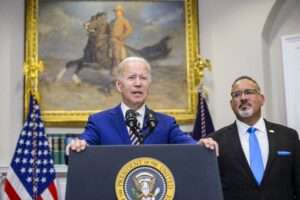
Biden cancels some student loan debt.
Biden cancels some student loan debt. (Bonnie Cash - Pool via CNP / MEGA / Newscom)


In 2019, then-President Donald Trump used a dubious emergency declaration to try to divert funds to build his border wall, despite the fact Congress had repeatedly refused to authorize any such expenditure. As I wrote at the time, Trump's emergency declaration was bogus because there was no genuine emergency, the relevant statutes didn't give him the power to transfer military funds even if he could declare an emergency, using eminent domain to build a border wall would cause grave harm to Americans as well as migrants, and Trump's actions could set a dangerous precedent, if allowed to stand. Liberal Democrats also condemned Trump's border wall diversion, citing many of these same considerations. Then-candidate Joe Biden was among them.

Several court decisions ruled against Trump on the merits (see my analysis here and here), though other courts rejected challenges to the border wall diversion on procedural grounds. Ultimately, the issue was resolved when President Biden ended the border wall diversion upon taking office, and Congress enacted legislation preventing future shenanigans of this type.

Unfortunately, President Biden's recent decision to cancel up to $600 billion in student loan debt for borrowers earning up to $125,000 per year ($250,000 for married couples) has much in common with Trump's border wall diversion. It too uses a dubious assertion of emergency powers to circumvent Congress' power of the purse in order to promote a harmful policy the president could not have pushed through otherwise. As Elizabeth Goitein, a leading liberal expert on emergency powers, points out in the Washington Post, in both instances the president was using emergency powers to "to get around Congress, when Congress has considered a course of action and rejected it."

As policy, Biden's loan cancellation plan is every bit as dubious as Trump's border wall. It's likely be a huge waste of resources at a time when we are already facing a looming fiscal crisis. It is highly regressive (especially, if as progressive Washington Post columnist Catherine Rampell points out, you consider beneficiaries' likely lifetime earnings, as well as their current incomes). Economist Jason Furman, former Chair of President Obama's Council of Economic Advisers, argues that it will make inflation worse. It also creates perverse incentives for universities and future college students, both of whom will face less pressure to cut already bloated education costs. For these reasons, the left-liberal Washington Post editorial board is right to decry the loan cancellation as a "regressive, expensive mistake."

Like Trump's wall-building project, Biden's loan cancellation plan is a policy beloved by the president's base, but likely to inflict grave harm on innocent people for no good reason. In one case, the victims are property owners and migrants. In the other, taxpayers and low-income workers hurt by inflation.

Biden has, however, managed to outdo Trump in the sheer scale of his raid on the treasury. Whereas the "former guy" (as Biden calls him) sought to  divert about $10 billion in Pentagon and drug interdiction funds to the border wall, Biden's loan forgiveness plan exceeds that sum many times over, possibly shelling out as much as $600 billion. Biden is making executive usurpation of Congress' spending power great again - indeed, even greater than under Trump!

Admittedly, Trump's plan might still have been even worse, if you consider the non-pecuniary costs, such as losses to property owners and migrants, as well as costs to the Treasury and taxpayers. But that's damning Biden's plan with very faint praise, indeed.

The legal justification for Biden's plan also rivals Trump in its bogus reliance on emergency powers. The Justice Department's legal rationale for the plan relies on a provision of the 2003 HEROES Act, enacted in the wake of the 9/11 attacks, which gives the secretary of education the authority to "waive or modify any statutory or regulatory provision applicable to the student financial assistance programs" in order to ensure that, as a result of a war or national emergency "recipients of student financial assistance under title IV of the Act who are affected individuals are not placed in a worse position financially in relation to that financial assistance because of their status as affected individuals."

The statute defines "affected individuals" as anyone who is "(A) is serving on active duty during a war or other military operation or national emergency; (B) is performing qualifying National Guard duty during a war or other military operation or national emergency; (C) resides or is employed in an area that is declared a disaster area by any Federal, State, or local official in connection with a national emergency; or (D) suffered direct economic hardship as a direct result of a war or other military operation or national emergency, as determined by the Secretary." The administration's argument is that most beneficiaries of the loan forgiveness plan come under D, in the sense that they have suffered "direct economic hardship" as a result of the Covid-19 pandemic, the "national emergency" in question. It also claims that virtually everyone in the United States qualifies under C, because, in March 2020, then-President Trump declared the entire country a "disaster area" because of Covid.

But whether they are "affected individuals" under C or D, loan debt cancellation is still only permissible if the pandemic put them "in a worse position financially in relation to that financial assistance." For the overwhelming majority, there is simply no proof that Covid is preventing them from paying back their loans or even making it significantly harder to do so. As the Washington Post points out, the unemployment rate for college graduates is just 2 percent. Only a small minority of loan recipients actually suffered anything like sufficient "economic hardship" as a result of Covid to significantly affect their ability to repay their loans. Ditto for the proportion who had trouble repaying merely because they were present in a "disaster area" (defined here as the entire country).

The HEROES Act might reasonably be interpreted to allow the administration to reduce the loan burdens of borrowers who suffered prolonged unemployment during the pandemic, or whose ability to work was seriously impaired by getting the disease. But that's a far cry from giving it the authority to indiscriminately cancel loans for vast numbers of people, most of whom cannot plausibly claim to be unable to pay their loans because of Covid, or even that Covid has made it meaningfully harder for them to do so.

In reality, the administration's emergency rationale here is blatantly pretextual, much like Trump's emergency power rationale for the border wall diversion. Under the guise of addressing the Covid emergency, Biden is seeking to achieve a longstanding left-wing policy goal that he couldn't push through Congress. Trump tried to do the much the same thing, but for the right-wing objective of building the wall.

Fordham law Professor Jed Shugerman, a progressive sympathetic to Biden's move on policy grounds, nonetheless takes issue with the emergency power rationale:

As a progressive who was deeply disturbed by the Trump administration's abuse of power and executive power and invoking emergency powers, like building a wall, it seems too convenient now for progressives to embrace emergency power references by a new president, when we were so troubled a few years ago. What's good for the goose is good for the gander. We should be tired of the use of emergency powers.

I am no progressive myself. But I too was "deeply disturbed" by Trump's border wall diversion (which I forcefully criticized), and I too am "tired of the use of emergency powers." If we want to prevent Trump  - or any future GOP president - from circumventing Congress and raiding the Treasury for partisan purposes, we should not let Biden get away with it, either.

Shugerman points out that the Administration's ultra-broad interpretation of the power delegated to the executive under the HEROES Act runs afoul of the Supreme Court's recent rulings on the "major questions" doctrine, which requires Congress to "speak clearly when authorizing an [executive branch] agency to exercise powers of "vast economic and political significance." If the statute is ambiguous, courts must presume that Congress have not given the agency the power in question.

The Court has recently used the major questions doctrine to strike down dubious Covid-related uses of emergency powers by the Trump and Biden administrations in the CDC eviction moratorium and OSHA vaccine mandate cases. Much the same logic applies here. The authority to cancel hundreds of billions dollars in student loan debt held by people whose claims to be victims of the Covid pandemic are highly tenuous, is pretty obviously a power with "vast economic and political significance." And, at the very least, it is far from clear that the HEROES Act really gives the executive that power.

Even if the Act were clear on this subject, such broad delegation might violate constitutional nondelegation requirements, which limits Congress' power to transfer legislative powers to the executive. Several recent decisions,  including the vaccine mandate ruling, suggest that the Court may be interested in reviving nondelegation.

Shugerman and others have argued that the Biden administration should instead rely on section 432(a) of the Higher Education Act of 1965, which authorizes the Secretary of Education to "enforce, pay, compromise, waive, or release any right, title, claim, lien, or demand, however acquired, including any equity or any right of redemption," related to loans authorized by the Federal Direct Loan Program. I will take up that argument in a future post.

So far, the administration does not seem to be relying on this sweeping theory - which would give the executive the power to cancel any and all federal student loan debt at any time, even in the absence of a national emergency. But that could change if the loan forgiveness program is challenged in court, and the emergency power rationale starts to look like a loser.

It may be that  the loan cancellation plan cannot be challenged in court, because no one will have standing to do so. This issue creates yet another potential parallel with Trump's border wall funding diversion. The Trump administration also relied on standing and other procedural arguments to try to prevent courts from considering the merits. Perhaps Biden will imitate Trump's strategy on this point, as well. This is another issue I plan to take up in a future post.

For now, I will end by reiterating Shugerman's point about the need to curb pretextual abuses of emergency powers. Those who rightly objected when the Republican goose did it, should equally condemn similar behavior by the Democratic gander.

UPDATE: I have modified this post to take account of the administration's reliance on two different definitions of "affected individuals" under the HEROES Act, not just one.

UPDATE #2: Since I wrote the above, Jed Shugerman has outlined his critique of the administration's legal justification for the policy in greater detail, in an article for The Atlantic.

UPDATE #3: I criticize the alternative Higher Education Act rationale for the debt cancellation policy here.
Congratulations to Winning Lawyers

|

A few months ago, I started congratulating winning lawyers in many of the cases I note. I don't do this because I necessarily agree with the lawyers; I do it because I want to tip my hat to fellow professionals who have successfully served their clients.

Maybe they served the greater good or improvement of the law as I see it, and maybe they didn't. But their job isn't to serve humanity or America or justice writ large; it's to serve their clients, and they succeeded at their job.

I especially feel that because my job is to teach law students, and to teach law students to do a good job for their clients; if some law students read these cases and see me congratulating people with whose positions the students suspect I disagree, all the better. And to the extent it's pleasant for people to see their names in e-print, well, I'm happy to give them such pleasure, which I think they've earned through their efforts (again, regardless of whether I agree with them).

Now sometimes I won't congratulate the winning lawyers, for instance because I don't have the time to look up the details, or because I forget, or because the result is complex enough that I'm not sure it's quite a victory. And perhaps there might be a position that's so remarkably odious that I can't bring myself to congratulate someone who successfully litigated it (though I don't recall this ever happening since I started the practice I'm discussing here). But my general plan here is to acknowledge the professional successes of my fellow lawyers regardless of my views on their position.

(Note that some of this is a bit of an oversimplification; for instance, prosecutors' job is to serve their clients—the public—by seeing justice done, not just by securing convictions, though presumably prosecutors who do win a case generally believe that they were indeed properly serving the public, whether or not I agree. But it's still a pretty good general guide to my thinking on the matter.)

Law & Government

Our Constitution: "Well-Regulated Democracy," "In Its Principles … Purely Democratical"

I keep hearing the same (pointless, I think) claims that America is a republic, not a democracy. It's both a republic and a democracy.

|

But don't take my word on it; the quotes in the title are from James Wilson and John Marshall, then-future Supreme Court Justices, speaking in state conventions that ratified the Constitution in 1787 and 1788. (Wilson was also a principal drafter of the Constitution.) Wilson defended the Constitution in the Pennsylvania convention by speaking of the three forms of government being the "monarchical, aristocratical, and democratical," and said that in a democracy the sovereign power is "inherent in the people, and is either exercised by themselves or by their representatives." He added,

Of what description is the Constitution before us? In its principles, it is purely democratical: varying indeed in its form in order to admit all the advantages, and to exclude all the disadvantages which are incidental to the known and established constitutions of government. But when we take an extensive and accurate view of the streams of power that appear through this great and comprehensive plan … we shall be able to trace them to one great and noble source, THE PEOPLE….

Chief Justice John Marshall—who helped lead the fight in the Virginia Convention for ratifying the U.S. Constitution—likewise defended the Constitution in that convention thus:

Read More

Free Speech

Cyberstalking Conviction for E-Mails to Nebraska Legislature Candidate Reversed

The Eighth Circuit tries to rein in the criminalization of the intentional infliction of emotional distress tort.

|

From U.S. v. Sryniawski, decided yesterday by the Eighth Circuit (Judge Steven Colloton, joined by Judge Bobby Shepherd and Chief Judge Lavenski Smith):

Dennis Sryniawski was charged with federal offenses of cyberstalking and extortion after he sent a series of e-mails to a candidate for the Nebraska legislature. A jury acquitted Sryniawski of extortion but convicted him of cyberstalking, in violation of 18 U.S.C. § 2261A(2)(B)…. We conclude that the evidence was insufficient under a proper interpretation of the cyberstalking statute, and therefore reverse the conviction….

Section 2261A(2)(B) is potentially quite broad, on its face something like the criminalization of the intentional infliction of emotional distress tort, limited to electronic communications, but with no exception for speech on matters of public concern (even though the Court held in Snyder v. Phelps and Hustler v. Falwell that speech on matters of public concern is protected against emotional distress liability by the First Amendment):

A defendant is guilty of cyberstalking if he (1) "with the intent to … harass [or] intimidate," (2) uses "any … electronic communication system of interstate commerce … to engage in a course of conduct," that (3) "causes, attempts to cause, or would be reasonably expected to cause substantial emotional distress to" the victim or his immediate family.

The court concluded (I think generally correctly, see pp. 185-189 of this article) that the statute must be read narrowly to avoid First Amendment problems:

The mens rea element, as charged in this case, requires that a defendant act with the intent to "harass" or "intimidate." If these terms are construed in their broadest sense, however, they would infringe on rights protected by the First Amendment. Broadly defined, "harass" can mean simply "to vex, trouble, or annoy continually or chronically." "Intimidate" can mean "to make timid or fearful."

Even where emotional distress is reasonably expected to result, the First Amendment prohibits Congress from punishing political speech intended to harass or intimidate in the broad senses of those words. The Free Speech Clause protects a variety of speech that is intended to trouble or annoy, or to make another timid or fearful. In Snyder v. Phelps (2011), for example, the Supreme Court held that protestors at a serviceman's funeral had the right to display signs that read, "Thank God for Dead Soldiers," "God Hates Fags," and "You're Going to Hell." In R.A.V. v. City of St. Paul (1992), the Court declared unconstitutional a criminal ordinance that prohibited the display of burning crosses, Nazi swastikas, and other symbols that the perpetrator had reasonable grounds to know would arouse "anger, alarm or resentment in others on the basis of race, color, creed, religion or gender." Hustler Magazine, Inc. v. Falwell (1988), held that the First Amendment protected a parody that depicted a prominent minister having drunken sex with his mother. See also Saxe v. State Coll. Area Sch. Dist. (3d Cir. 2001) (Alito, J.) ("There is no categorical 'harassment exception' to the First Amendment's free speech clause."). For this reason, the cyberstalking statute cannot be applied constitutionally to a defendant who directs speech on a matter of public concern to a political candidate with intent merely to trouble or annoy the candidate.

Read More

Regulation

The Biden Administration Finally Taps a Regulatory Czar

Noted environmental law scholar Richard Revesz will be nominated to head the White House Office of Information and Regulatory Affairs

|

Yesterday, the White House announced that President Biden will nominate Professor Richard Revesz to be Administrator for the Office of Information and Regulatory Affairs (OIRA) in the White House Office of Management and Budget, a position often referred to as "regulatory czar." It is, by some accounts, the most government important job you may may not have heard of before.

This is a long-awaited, and quite significant, announcement.  OIRA is the White House office that oversees the development and promulgation of new federal regulations and ensures that federal agencies comply with applicable Executive Orders on the issuance of regulations. Among other things, OIRA makes sure agencies conduct adequate cost-benefit analyses and consider the likely consequences of proposed regulations, and that agency regulations are as consistent with administration policy as relevant statutes allow.

Given OIRA's responsibilities, Revesz was always an obvious choice for this position. As the former Dean of the NYU School of Law and Director of the American Law Institute, he is immensely well respected, and much of his scholarship has honed in on issues central to OIRA's responsibilities. Among other things, he co-authored two books making a progressive defense of cost-benefit analysis (which I reviewed here and here), and he founded NYU's Institute for Policy Integrity, which focuses on many regulatory process issues and hosts conferences and produces reports buttressing the analytical case for more aggressive federal environmental regulations.

Some preliminary news reports suggest the Revesz nomination represents a triumph of the "establishment" over the progressive wing of the Democratic party. The Biden Administration had apparently considered another legal academic for the position, Vanderbilt law professor Ganesh Sitaraman, a former Elizabeth Warren staffer who was favored by progressives, but who could not be assured of attracting the support of all fifty Democratic Senators. It seems efforts to corral fifty votes for a potential Sitaraman nomination were one reason for the delay.

I was hardly privy to any of the internal debates, but I would think progressive organizations should be happy with the Revesz pick. If the goal is to have an OIRA administrator who supports an aggressive regulatory agenda, but will also force agencies to conduct rigorous analyses and bulletproof new rules from legal challenges, it would be hard to do better. Indeed, I suspect that if Revesz had been in the position a year ago, some Biden Administration efforts might have fared better in court. One thing is for sure, those hoping to challenge Biden Administration regulations will have a harder time once Revesz is confirmed.

"The Pleading Needs More Hemingway, Less Faulkner"

"Clocking in at 443 words and almost one-and-one-half pages in length, Paragraph 14 is a series of run-on sentences and sentence fragments ...."

|

From today's opinion in Doe v. Univ. of Iowa, by Judge Stephen Locher (S.D. Iowa.), discussing the Complaint (written by lawyers, not by a pro-se litigant):

Plaintiff alleges Defendants discriminated against him during their investigation into his purported sexual assault of a female student. His pleading, however, contains confusing and overly verbose paragraphs that are unreasonably difficult for Defendants to admit or deny. The Court therefore GRANTS Defendants' Motion to Dismiss without prejudice and directs Plaintiff to amend his Complaint to conform to the requirements of Fed. R. Civ. P. 8, which require a pleading to provide "a short and plain statement of the claim showing the pleader is entitled to relief." …

The Court agrees the Complaint does not satisfy Fed. R. Civ. P. 8. It further agrees that Paragraph 14 is illustrative of the problem. Clocking in at 443 words and almost one-and-one-half pages in length, Paragraph 14 is a series of run-on sentences and sentence fragments that alternates between the investigation into Plaintiff's actions and speculation about investigations into the conduct of other, unnamed "male students," all while using vague terms like "investigators" that may or may not include Defendants. Paragraph 14 also includes unnecessary asides—e.g., "really, one simply can't make this up"—and fails to provide the "simple, concise, and direct" allegations required by Fed. R. Civ. P. 8(d). And all to allege something that could have been captured in one sentence: Investigations into sexual misconduct are tainted by sex and/or gender bias in which female witnesses are found credible for the same reasons male witnesses are found non-credible.

Similar flaws are found in other paragraphs. Paragraph 13, for example, contains perhaps the longest single sentence (178 words) the Court has ever seen in a pleading:

Read More

Politics

Short Circuit: A Roundup of Recent Federal Court Decisions

Mean teachers, bad warrants, and merest coincidences.

|

Please enjoy the latest edition of Short Circuit, a weekly feature written by a bunch of people at the Institute for Justice.

New cert petition: The IRS wants to impose a $2.17 mil civil penalty on an octogenarian from Massachusetts, and she wants to argue that it's a violation of the Excessive Fines Clause. But earlier this year, the First Circuit said there's no need to consider whether the penalty (for failing to timely file a bank-account form) might be a tad excessive because—said the court—the penalty "is not a 'fine'" under the Eighth Amendment. Boom. Case closed. This week, IJ asked the Supreme Court to tell the First Circuit and the IRS (and a bevy of trial courts) to start taking the Excessive Fines Clause seriously. Click here to learn more about the case.

Big Sky friends, Short Circuit Live! is heading to the University of Montana on September 15th for a live recording at the law school. Co-hosted by the Federalist Society and the American Constitution Society, the event will focus on the Montana Supreme Court and will feature Natasha Prinzing Jones of Boone Karlberg P.C. (who argued on behalf of amici in a case you may remember from last week's roundup), Colin Stephens of Stephens Brooke P.C., and Rylee Sommers-Flanagan of Upper Seven Law. Hope to see you there!

  • In 2016, the Department of Housing and Urban Development issued a new rule prohibiting the use of lit tobacco products in public housing. The group NYC Citizens Lobbying Against Smoker Harassment sues, alleging that the rule is unauthorized, arbitrary, and multifariously unconstitutional. D.C. Circuit: But it isn't any of those things, so case dismissed.
  • After President Biden took office, he ordered OSHA to consider whether any emergency temporary standards (ETS) were necessary to combat COVID-19. OSHA issued an ETS related to healthcare workers, but this soon took a backseat to a second ETS that required vaccination or weekly testing at all large employers. After the Supreme Court struck down the vaccination requirement, OSHA realized it couldn't comply with the required notice-and-comment period on the healthcare ETS and withdrew it. Nurses' unions sought a writ of mandamus, demanding the ETS be reinstated until a permanent rule could be enacted. D.C. Circuit: We don't have that power; after all, OSHA could ultimately decide that no rule is necessary.
  • Two brothers convicted of making illicit marijuana available to the good people of Rochester, N.Y. object to marijuana's status as a Schedule I drug with no legitimate medical uses. Feds: You have to petition the DEA to reschedule the drug; no fair trying to do that in a criminal case. Second Circuit: On the contrary, they can bring their constitutional defenses. Unfortunately for them though, they get rational-basis review, so it doesn't matter if there are indeed legitimate medical uses for marijuana. Their four- and two-year sentences are affirmed.
  • In 2014, a Pennsylvania man shoots two state troopers, killing one. During the 48-day manhunt, police seize the man's parents' guns. Police don't claim that the parents or their guns were involved in the crime and never use the guns as evidence against the son. Nevertheless, police refuse to return the guns, now eight years after the crime and after the son lost his last direct appeal. Third Circuit: Which is an unconstitutional taking as well as an infringement on the parents' Second Amendment right to keep arms.
  • Allegation: "That's a nice medical testing business you have there. Would be a shame if someone told the FTC about these patient records you leaked. But hey, if you pay for our cybersecurity services, this can be our little secret." "We didn't leak these files—you stole them!" "So that's the way you want to play it?" Third Circuit: The now-defunct testing company's defamation claim against the cybersecurity firm can go forward.
  • A putative class action alleges that the Virgin Islands gov't has been systematically withholding tax refunds (except from the politically connected) as a way to save money. But! Through merest coincidence, the only named class representative gets her tax refund in the midst of the litigation. Is this crazy, inexplicable and definitely totally random turn of events a class-killer? Third Circuit: Maybe not!
  • Allegation: Biloxi, Miss. hospital adds a surcharge to every emergency room patient's bill without any disclosure beforehand. Patient: If I'd known I was going to get hit with the $2.2k surcharge (reduced to $770 after discounts), I would have sought care elsewhere. Fifth Circuit: Our best guess is that under Mississippi law, the hospital did have a duty to disclose. Case undismissed.
  • "Imagine if Texas—a state that prides itself on promoting free enterprise—passed a law saying that only those with existing oil wells in the state could drill new wells. It would be hard to believe. It would also raise significant questions under the dormant Commerce Clause." Fifth Circuit: Texas's 2019 law limiting the building of interstate electrical transmission lines to the owners of existing facilities raises similar questions under the dormant Commerce Clause. (Though, naturally, it raises no questions under the Contracts Clause, because that one doesn't mean anything anymore.)
  • After trial and two previous trips to the Fifth Circuit, ExxonMobil is slapped with a $14 mil penalty for thousands of Clean Air Act violations at its massive Baytown, Tex. complex. Fifth Circuit: And this time there's nothing to reconsider. Dissent: It might be tedious to require plaintiffs to show how the harms they suffered were caused by particular violations on particular days, but that's what the law requires. And, except for approx. 40 days of the thousands they alleged, plaintiffs did not make that showing.
  • Under Texas law, scrap dealers must promptly submit reports of scrap-metal transactions to the Texas Department of Public Safety. Houston scrap dealer fails to submit two dozen reports, is arrested, and ultimately acquitted. He sues the police officer who prepared the supporting affidavit. Claim: The officer omitted from his affidavit the fact that my scrap-metal-reporting software ("Scrap Dragon") was glitchy. Fifth Circuit: No dice. Even if that information had been included, there still would have been probable cause that you violated the reporting law, since you knew of the glitch but didn't bother to submit your reports through a different medium.
  • Allegation: Cheatham County, Tenn. officer conducting welfare check at night (at home where someone called 911 twice and hung up) does not identify himself as law enforcement but does shine his headlights at the house and unholsters his gun. When a resident says that he is armed (he's not) and opens the door, the officer fires eight times (hitting no one). Sixth Circuit: A jury might think that was excessive force. No QI. Dissent: Shooting at someone and missing isn't a "seizure" under the Fourth Amendment unless the person submits, which this guy didn't, yelling profanities at the officers and wandering around after.
  • After the Supreme Court ruled that sentences of life without parole are unconstitutional for juvenile offenders, Missouri began to allow such offenders to apply for parole after serving 25 years. Eighth Circuit (sitting en banc): And those parole proceedings are not a sham. Dissent: The proceedings are constitutionally deficient. Hearing officers don't give adequate reasons for denying parole, inmates' parole files are secret, and inmates are sharply limited about what they can speak about (for instance, no talking about their rehabilitation)—and part of the majority's reasoning is based on an argument the state didn't make.
  • To get an initiative on the ballot in Nebraska, you must get a minimum number of signatures statewide, but you also must satisfy a signature-distribution requirement: Your signatories must "be so distributed as to include five percent of the registered voters of each of two-fifths of the counties of the state." Marijuana-legalization group: That requirement violates the Equal Protection Clause by devaluing the signatures of people in more populous counties relative to those in less populous ones. Eighth Circuit: No preliminary injunction for you. The signature-distribution requirement has a rational basis. Dissent: Seems to me strict scrutiny might be a better fit.
  • Libertarians/goldbugs of the nation, rejoice! The Eighth Circuit has just struck down Minnesota's registration and surety requirement for bullion traders for violating the dormant Commerce Clause. Can the return of Liberty Dollars be far behind? (Yes, it can.)
  • San Jose, Calif. public high school student group requires leadership to abide by a statement of faith, which includes belief that sex is only okay between a husband and wife. School: That's discrimination, we're pulling your official status. Group: Hey, but you don't enforce your anti-discrimination policy against these other groups who screen for gender and ethnicity. Ninth Circuit: Yeah, that's pretty messed up school, you targeted these guys because of their religious beliefs. Here's a preliminary injunction. Concurrence: I just wanna add that some of the faculty were super mean. Like, unconstitutionally mean. Dissent: Standing?
  • Superior, Ariz. officers show up at house with search warrant for a motel room. (They got oral permission from a judge to search the house (after a search of the motel room didn't turn up the drug cache they were looking for) but neglected to physically update the warrant.) Ninth Circuit: So searching the house was unconstitutional, but (over a dissent) that wasn't clearly established until now. Qualified immunity.
  • In Voltaire's famous satire Candide, the optimistic Dr. Pangloss espouses the Leibnizian philosophy that "all is for the best in this best of all possible worlds." Philosophically questionable, but true enough for the Candide Group, which successfully invokes California's anti-SLAPP law against CoreCivic, one of the largest operators of private prisons and immigrant detention centers in the United States. A Ninth Circuit panel holds that previous circuit cases applying the California law in federal court are not so irreconcilable with Supreme Court precedent that they must be overturned.
  • Atlanta-area federal task force officers shoot suspect and then ignite a flashbang grenade near his body, which he does not react to. Officers: And after that we stopped shooting. He pointed a gun at us, so good shoot. But wait! Audio (from a bystander filming outside the home) reveals an officer fired off an additional burst after the flashbang ignited. Eleventh Circuit: It's a clearly established constitutional violation to shoot an unconscious suspect. No qualified immunity for the post-grenade burst that a jury might find you lied about. (Ed.: No mention of whether one even can sue federal agents for violating the Constitution, something which the Supreme Court has recently thrown into doubt.)
  • Allegation: From 2010 to 2018, Burger King franchisees agreed not to hire employees from other Burger King restaurants for at least six months after they left their previous job. Eleventh Circuit: Which might be an antitrust violation. Case undismissed.

Last year, New Yorker Serafim Katergaris discovered that the city had fined him $1k for missing paperwork about a 2013 boiler inspection. One problem: He bought the home in 2014 after the boiler had been removed, so the paperwork would've been required of a previous owner. Serafim explained this, but the city declined to waive the fine. The city also refused to give him a hearing or a chance to appeal. Instead, the city simply demanded that he pay. Unfortunately, this is a common practice for NYC, which frequently demands penalties for supposed violations of its property codes without providing an opportunity to be heard. So this week, Serafim teamed up with IJ to challenge the city's brazen violation of his due process rights. After all, no process cannot be due process. Learn more here.

Free Speech

New #TheyLied Libel-by-Implication Case, Related to Firing of Service Employees International Union Official

|

From Fells v. SEIU, decided yesterday by the D.C. Court of Appeals in an opinion by Judge Joshua Deahl, joined by Judges Corinne Beckwith and John Fisher; not as colorful as the inimitable Memphis Pub. Co. v. Nichols (Tenn. 1978), but still an interesting modern example of the libel-by-implication doctrine:

Kendall Fells was a high-level employee within the Service Employees International Union (SEIU). After his seemingly forced resignation, SEIU issued a press statement tying his departure to an "ongoing investigation" that was triggered by another executive's sexual misconduct, namely, sleeping with subordinates. In announcing Fells' departure, the statement explained that Fells' own "abusive behavior towards … predominantly female staff" was brought to light by that investigation. Fells sued SEIU for defamation and related claims. He contends that SEIU's statement falsely implied that he was forced out due to sexual misconduct, when in fact, there is no dispute that Fells' departure was not related to any sexual misconduct….

We conclude, contrary to the trial court's view, that a reasonable jury could find SEIU's statement falsely implied that Fells was ousted for sexual misconduct….

The core facts are not in dispute. Kendall Fells held various staff and leadership roles over the course of his thirteen-year career with SEIU. At the time of his resignation, Fells was interim President of the National Fast Food Workers' Union, a labor organization within SEIU that grew out of the "Fight for $15" minimum wage movement that he championed. While Fells was in that role, SEIU's President, Mary Kay Henry, began actively encouraging employees to report sexual harassment and abuse amid the #MeToo movement. As a result of several accusations involving inappropriate sexual relationships with subordinates, SEIU suspended its Executive Vice President, Scott Courtney, who resigned shortly thereafter. SEIU's spokesperson told BuzzFeed News that Courtney engaged in "sexual misconduct and abusive behavior," as revealed through a still-ongoing "internal investigation launched to look into … sexual misconduct and abusive behavior towards union staff."

Ten days later, Fells resigned, seemingly under threat of termination. SEIU's spokesperson issued a statement to multiple news outlets regarding Fells' and another employee's contemporaneous departure, indicating that those "personnel actions" were the result of its aforementioned "ongoing internal investigation" and pertained to "serious problems related to abusive behavior towards staff, predominantly female staff." The statement in its entirety read as follows:

As a result of information that has come to light through our ongoing internal investigation, today SEIU took action on two senior staff. These personnel actions are the culmination of this stage of the investigation, which brought to light the serious problems related to abusive behavior towards staff, predominantly female staff. We know that progress does not stop with these personnel actions alone. [SEIU] President Henry has taken important steps toward ensuring that our workplace environment reflects our values, and that all staff is respected, their contributions are valued, and their voices are heard.

Several media outlets then published articles connecting Fells' and Courtney's resignations and, in at least one instance, expressly attributing Fells' ouster to sexual misconduct allegations. In fact, as SEIU concedes, Fells' departure was not related to any claims of sexual misconduct….

Read More

Religion and the Law

First Amendment Protects Catholic Archidocese's Pressuring Catholic School to Fire Same-Sex-Married Teacher

|

From a two-Justice opinion in the Indiana Supreme Court case Payne-Elliott v. Roman Catholic Archdiocese of Indianapolis, Inc., written by Justice Geoffrey Slaughter and joined by Justice Mark Massa. Justices Christopher Goff and Derek Molter concurred in the judgment (without a separate opinion), and Chief Justice Loretta Rush didn't participate, so Justice Slaughter's opinion is not a majority, but it's likely to prove influential:

Joshua Payne-Elliott sued the Roman Catholic Archdiocese … for intentional interference with his contract and employment with Cathedral High School, a Catholic school in Indianapolis….

More specifically, he alleges as follows. Cathedral, founded in 1918, was initially owned by the archdiocese, which later turned over care of Cathedral to the Brothers of Holy Cross. Cathedral was incorporated in 1972 "for the sole purpose of maintaining and operating a Roman Catholic secondary school." In substance, Cathedral's bylaws state as follows: "the essential Holy Cross character of Cathedral as a Catholic high school shall be at all times maintained and [ ] a mission priority is to be an educator in the faith." The archdiocese exercises "significant control" over Cathedral, including "its recognition of Cathedral as a Catholic school."

From 2006 until June 2019, Cathedral employed Payne-Elliott as a world-language and social-studies teacher under a contract that was renewed annually. Payne-Elliott, "a homosexual male," married his same-sex spouse in 2017; his spouse teaches at Brebeuf Jesuit Preparatory School, also in Indianapolis. Cathedral continued renewing Payne-Elliott's teacher contract through May 2019 for the 2019–2020 school year. The archdiocese knew about Payne-Elliott's contract with Cathedral.

In June 2019, Brebeuf announced that despite pressure from the archdiocese, it would not fire Payne-Elliott's spouse. Brebeuf explained it declined the archdiocese's directive that Brebeuf dismiss the spouse "due to the teacher being a spouse within a civilly-recognized same-sex marriage." The next day, Archbishop Charles C. Thompson issued a decree stating that, after extensive dialogue between the archdiocese and Brebeuf, the archdiocese no longer recognizes Brebeuf as a Catholic institution. The decree states that, in accord with Canon 803 of the 1983 Code of Canon Law, Brebeuf, "by its own selection, can no longer use the name Catholic and will no longer be identified or recognized as a Catholic institution by the Archdiocese of Indianapolis nor included in the listing of The Official Catholic Directory." The decree explains that the archbishop accepted and respected a school's right and responsibility to make decisions, but that it is his "canonical responsibility to oversee faith and morals as related to Catholic identity within the Archdiocese of Indianapolis" and that Brebeuf "ha[d] chosen not to implement changes in accord with the doctrine and pastoral practice of the Catholic Church[.]"

Read More

Religion and the Law

Protecting People from Their Own Religious Communities: Other Community Members' Political Interests

|

This new article of mine will be coming out next year in the Journal of Law and Religion, and I thought I'd serialize it here; there's still plenty of time for editing, so I'd love to hear people's feedback. I posted several excerpts last week (you can read them in the PDF, if you'd like), and want to finish it up this week; here's the last substantive part, IV.B, and the Conclusion.

[* * *]

Providing pseudonymity or anonymity here affects not just the other community members' religious interests, but also their political interests: their rights to monitor what is happening in their communities, to better understand not just their coreligionists' actions but also government processes.

Consider, for instance, pseudonymity in litigation. The right to public access to information in government records is generally framed as a right to "oversee and monitor the workings of the Judicial Branch."[1] Indeed, as noted above, the right of access to court records[2]—and, in the view of many courts, the right of access to parties' names—is a "clear and strong First Amendment interest."[3]

Indeed, if a community member is suing a community leader or a community institution,[4] other members might especially want to monitor the judicial system to make sure the defendant is being treated fairly. "Public confidence" in the judiciary, courts say, "cannot long be maintained where important judicial decisions are made behind closed doors and then announced in conclusive terms to the public, with the record supporting the court's decision sealed from public view."[5] That may be especially true for minority religious communities' confidence in the secular judiciary, since many minority religions and denominations might have special reasons to distrust the majority's legal system.[6]

Read More

Democracy

Not Everything Bad is "Anti-Democratic" - and that which is Democratic isn't Always Good

Tyler Cowen explains why it's a mistake to conflate democracy with what is good and just.

|

In a recent Bloomberg column, my George Mason University colleague Tyler Cowen - a prominent economist - warns against the growing tendency to conflate "democracy" with good and just policy, and describe anything we oppose as "anti-democratic":

One of the most disturbing trends in current discourse is the misuse of the term "anti-democratic." It has become a kind of all-purpose insult, used as a cudgel to criticize political and intellectual opponents. Not only is this practice intellectually lazy, but it threatens to distort the meaning and obscure the value of democracy.

The advantages of democracy are obvious, at least to me, and deserve greater emphasis:

  • Democracy helps produce higher rates of prosperity and economic growth.
  • Democratic governments are more likely to protect human rights and basic civil liberties.
  • As philosopher Karl Popper stressed, democracy helps societies escape the very worst rulers, by voting them out of office and in the meantime constraining them with checks and balances.

Of course democracy is not perfect. First, a lot of individual democratic decisions are not very good…. Second, there are periods when some countries might do better as non-democracies, even though democracy is better on average…

Too much commentary ignores these nuances….

The danger is that "stuff I agree with" will increasingly be labeled as "democratic," while anything someone opposes will be called "anti-democratic." Democracy thus comes to be seen as a way to enact a series of personal preferences rather than a (mostly) beneficial impersonal mechanism for making collective decisions….

[M]any on the political left in the US have made the charge that the Supreme Court's decision to overturn Roe v. Wade was "anti-democratic." It is fine to call Dobbs a bad decision, but in fact the ruling puts abortion law into the hands of state legislatures. If aliens were visiting from Mars, they simply would not see that move as anti-democratic….

By conflating "what's right" with "what's democratic," you may end up fooling yourself about the popularity of your own views. If you attribute the failure of your views to prevail to "non-democratic" or "anti-democratic" forces, you might conclude the world simply needs more majoritarianism, more referenda, more voting.

Those may or may not be correct conclusions. But they should be judged empirically, rather than following from people's idiosyncratic terminology about what they mean by "democracy" — and, by extension, "anti-democratic."

The conflation of what is "democratic" with what is right and just has a number of unfortunate consequences. First, it promotes intellectual confusion. Second, and more importantly, it essentially defines away the possibility that democracy - understood, more reasonably, as a majoritarian political process - should be constrained in order to protect other values, and counter various predictable pathologies of democratic government, such as widespread voter ignorance and oppression of minority groups.

All too often there are trade-offs between democracy and other values, such as liberty, equality, and justice. We shouldn't let terminological confusion blind us to that reality.

I have made similar points about the need to avoid conflating democracy with good and just policy in previous writings, such as here:

Admittedly, the term "democratic" is sometimes used as just a kind of synonym for "good" or "just," rather than in the more narrow sense of referring to governance by majoritarian political institutions. By that standard, such policies as school segregation, cruel punishments, and laws banning same-sex marriage are inherently "undemocratic," no matter how much political support they enjoy. Whatever the linguistic merits of this usage, it is not analytically helpful. If anything good is by definition also democratic and anything democratic is by definition also good, then democracy ceases to be a useful concept for constitutional theory, or any other type of intellectually serious analysis.

Recognizing that democracy isn't inherently good and that not all evil and harmful policies are anti-democratic doesn't by itself tell us how much democracy should be constrained and in what way. But it does help remove conceptual confusion that impedes clear thinking on the subject.

Democracy

Guardrails of Democracy, Extended: Comparing Notes On The Team Libertarian Report

Fifth post in the symposium on the National Constitution Center "Restoring the Guardrails of Democracy" project. Walter Olson of Team Libertarian comments on similarities and differences between the three reports.

|

One of the fun conditions of this project is that the three teams did not in any way collaborate with each other or get an advance look at what the others were going to say. As a result some recommendations overlap between teams in a positive way, some conflict, and many others simply don't engage one way or the other. For example, we at Team Libertarian reached very similar conclusions to Team Progressive on reforming the Electoral Count Act, but a mostly opposite conclusion (as Prof. Foley has noted) on whether government should seek to regulate false statements about elections. And although Team Conservative's comments on restricting presidential emergency powers both dovetail with ours and add useful detail, few of our other recommendations engage.

Although we and Team Conservative may have marched off in different directions, I and many Cato Institute colleagues are on board with much of what they say. Runaway administrative agencies usurping legislative power? Yes, a big problem. Congressional abdication of power stretching over for a half-century or more, shifting responsibility to the President and the judiciary? Definitely.  I agree too that there's a decent case for making it at least a bit easier to amend the U.S. Constitution. (Here's a Cato fellow writing in 2011 proposing a modest reduction in the threshold number of states needed for proposing and ratifying an amendment.)  The need to move past a broken primary system in which candidates with independent and crossover appeal get knocked out because they can't appease their party's most zealous base voters? Right again.

On the topic of elections, we're also in agreement with Team Conservative's observation that campaign finance reforms have backfired and that we should be repealing such laws rather than adding more. But let's also get real: the election world wasted much of 2021 in a battle over whether Democrats would succeed in ramming through an omnibus package expanding these laws yet further. As I've argued, this package, the so-called For The People Act, 1) put its thumb in the eye of libertarian and constitutionalist principle, and 2) was supremely irrelevant to the distinctive challenges of the events leading up to Jan. 6. Shouldn't we focus on reform efforts that have a chance of doing relevant good between now and the next grave election crisis down the road – which we might find ourselves in the middle of by a date as early as, say, 2024?

Which brings me to some policy disagreements with Team Conservative. I can't say I'm persuaded by the idea of letting Congress override presidential vetoes by simple majority vote, as Tennessee does. The Founders meant to establish serious checks and balances against the dangers of hasty legislation, and gutting the power of the president's veto would knock out one of the most important of those checks. (For what it's worth, my home state of Maryland sets its veto-override threshold at three-fifths rather than two-thirds – not that I'm recommending that, either.) On bringing back the legislative veto, I share the misgivings about that innovation expressed by Antonin Scalia, then editor of Regulation, many years ago.

Now on to Team Progressive. On one major point we agree strongly: it's incredibly dangerous when a controlling faction of one of the two great political parties wrongly contends that honest and correctly tabulated elections were stolen or rigged. The Progressive report gives this problem a central place in its analysis, and that seems right to me.

Yet there are differences of mood and terminology in our approaches as well. As I commented on Twitter the other day, I continue to search for phrases other than "Big Lie" and "election denier" that would let us criticize both these things without using terminology associated with you-know-what. Millions of persons sincerely believe the false claims in question. They are truly convinced that they, not we, are doing the right thing and standing up for fair and free elections. There are some genuine villains out there feeding them lies, as well as crazies irresponsibly stoking mass delusion. But the ordinary believers are also our friends, our relatives, and our neighbors. We cannot stop being those things to them if America is to gather back its wits and turn back down the road toward some semblance of unity.

As to policy, I'm a convinced advocate of ranked-choice voting, but I'd caution that its advantages are relatively subtle; it won't put out the fire of public disbelief in election results. The fact is that in some key states, election fabulists may presently be popular enough to win, or at least put up a strong contest, under whichever set of rules is used. (I also think the plain-vanilla version of RCV, sometimes called instant-runoff voting, is better suited to today's America than the more complex "round-robin" variant that Foley recommends.)

We and Team Progressive likely part company on some issues of federalism and decentralization. Ned Foley and Ilya Somin have already discussed this a bit as to foot voting, and I suspect that our teams may also diverge on to what extent the federal government should play a greater role in supervising the states in election administration; we caution against this at several points.

Also on the Foley-Somin exchange linked above, I'll mention for what it's worth that I'm probably a little more positive about civics education than Ilya is.  Still, I do recognize there can be difficult problems in legitimately educating the public about how the electoral system works, on the one hand, while avoiding the specter of taxpayer-funded propaganda campaigns, on the other. (As an example of the challenges involved, here's how the Nebraska Secretary of State set about refuting myths and rumors about the 2020 count.)

Thanks to the National Constitution Center for making possible this summer's exchange of views with writers and scholars we respect, and to the Volokh Conspiracy for hosting this shorter symposium this week.

Cloudflare Says Its Online Security Services Won't Be Canceled Based on a Site's Ideology

"Just as the telephone company doesn't terminate your line if you say awful, racist, bigoted things, we have concluded ... that turning off security services because we think what you publish is despicable is the wrong policy. To be clear, just because we did it in a limited set of cases before doesn't mean we were right when we did. Or that we will ever do it again."

|

Posted by Cloudflare yesterday; I think this is the right decision, in part for reasons I sketch in my Reverse Spiderman Principle article (and see also this Twitter thread from Daphne Keller (Stanford)):

Giving everyone the ability to sign up for our services online also reflects our view that cyberattacks not only should not be used for silencing vulnerable groups, but are not the appropriate mechanism for addressing problematic content online. We believe cyberattacks, in any form, should be relegated to the dustbin of history.

The decision to provide security tools so widely has meant that we've had to think carefully about when, or if, we ever terminate access to those services. We recognized that we needed to think through what the effect of a termination would be, and whether there was any way to set standards that could be applied in a fair, transparent and non-discriminatory way, consistent with human rights principles.

This is true not just for the content where a complaint may be filed  but also for the precedent the takedown sets. Our conclusion — informed by all of the many conversations we have had and the thoughtful discussion in the broader community — is that voluntarily terminating access to services that protect against cyberattack is not the correct approach.

Avoiding Abuse of Power

Some argue that we should terminate these services to content we find reprehensible so that others can launch attacks to knock it offline. That is the equivalent argument in the physical world that the fire department shouldn't respond to fires in the homes of people who do not possess sufficient moral character. Both in the physical world and online, that is a dangerous precedent, and one that is over the long term most likely to disproportionately harm vulnerable and marginalized communities.

Read More

Some "Classified" Events

Some upcoming events, plus a new review and a podcast.

|

An update regarding my book Classified: The Untold Story of Racial Classifications in America:

The Federalist Society's Civil Rights Practice Group will be hosting a teleforum on Tuesday, Sept. 6, at 1pm. You can register here.

The Cato Institute will be hosting a book forum/luncheon on Wednesday, Sept. 7, at noon, with commentary from Jane Coaston, host of The Argument at the New York Times, and Robert Cottrol, Professor of Law, George Washington University Law School. Wally Olson of Cato will moderate. You can register for in-person or virtual attendance here--the virtual program will start at approximately 12:20.

For those of you in the Bay Area, I will be speaking at Berkeley Law School on Wednesday, Sept. 14 at 12:50 PST. I don't know the room yet.

I will also be speaking at the University of Toledo Law School on Monday, September 19, at noon, and, for those of you in Philly, Temple Law School on Thursday, October 6, at noon.

Some other Classified news:

ONU Law Professor Scott Gerber reviewed the book in Law & Liberty.

And here's a podcast I recorded with Ed Morrisey of Hot Air.

Finally, Bill McGurn at the Wall Street Journal quotes from an amicus brief that was based on my research for the book:

Even so, one of the more persuasive friend-of-the-court briefs argues that such a decision would still leave unfinished business. Filed by David Bernstein of George Mason University's Antonin Scalia Law School, it suggests that not only are racial preferences arbitrary, unfair and unconstitutional, so are the racial boxes the schools use to classify students.

Take "Asian," a label that covers 60% of the world's population—lumping Indians with Chinese and Cambodians and Koreans. They have almost nothing in common, from religion to language to culture.

Same with "Hispanic." Harvard and UNC, Mr. Bernstein writes, can't "explain why white Europeans from Spain, people of indigenous Mexican descent, people of Afro-Cuban descent, and South and Central Americans who may be any combination of European, African, and indigenous by descent are grouped together as 'Hispanic.' "

Religion and the Law

Protecting People from Their Own Religious Communities: Other Community Members' Religious Interests

|

This new article of mine will be coming out next year in the Journal of Law and Religion, and I thought I'd serialize it here; there's still plenty of time for editing, so I'd love to hear people's feedback. I posted several excerpts last week (you can read them in the PDF, if you'd like), and want to finish it up this week; here's Part IV.A.

[* * *]

Let's say that some members of a religious community don't deny that community members who act in particular ways are shamed by the community. Rather, those members think that such shaming is an important and valuable feature of their religious life, and indeed of their exercising their First Amendment rights.[1]

We believe that stripping, premarital sex, taking disputes to outsiders ("lashon hara," to Orthodox Jews[2]), drinking, gambling, or lending or borrowing money with interest, they might say, is contrary to God's will. One way we deter breaches of these norms is through the threat of social shaming—much as many secular institutions threaten social shaming for what they view as immoral behavior, such as racism or sexism or hostility to homosexuality. This threat helps encourage members to stay on the right path, and helps protect people from the harms that straying can cause. And instances of such shaming also serve as "teaching moments" for reminding community members about these norms.[3]

Someone suing as a John Doe (to give a pseudonymous litigation example) now claims that he's a member of our community, which condemns interest-bearing lending; and because of that he wants to sue pseudonymously over such a loan, so that we, his fellow community members, don't learn about his conduct. Normally, he wouldn't be entitled to sue pseudonymously in such a situation,[4] but here he seeks pseudonymity precisely because he fears the stigma of being labeled as a sinner by our community. But by shielding his identity, you're deliberately denying us information because you think we'll use the information illegitimately, by shaming him for his religious transgression, and perhaps being less likely to trust him.[5] You are thus preferring his preferences (and yours) over ours.

Read More

More