From Euronews: "Khosta-2: Scientists warn Russian bat virus could infect humans and resist COVID vaccines." It cites to PLOS Pathogens:
An ACE2-dependent Sarbecovirus in Russian bats is resistant to SARS-CoV-2 vaccines
Spillover of sarbecoviruses from animals to humans has resulted in outbreaks of severe acute respiratory syndrome SARS-CoVs and the ongoing COVID-19 pandemic. Efforts to identify the origins of SARS-CoV-1 and -2 has resulted in the discovery of numerous animal sarbecoviruses–the majority of which are only distantly related to known human pathogens and do not infect human cells. The receptor binding domain (RBD) on sarbecoviruses engages receptor molecules on the host cell and mediates cell invasion. Here, we tested the receptor tropism and serological cross reactivity for RBDs from two sarbecoviruses found in Russian horseshoe bats. While these two viruses are in a viral lineage distinct from SARS-CoV-1 and -2, the RBD from one virus, Khosta 2, was capable of using human ACE2 to facilitate cell entry. Viral pseudotypes with a recombinant, SARS-CoV-2 spike encoding for the Khosta 2 RBD were resistant to both SARS-CoV-2 monoclonal antibodies and serum from individuals vaccinated for SARS-CoV-2. Our findings further demonstrate that sarbecoviruses circulating in wildlife outside of Asia also pose a threat to global health and ongoing vaccine campaigns against SARS-CoV-2[.]
Please enjoy the latest edition of Short Circuit, a weekly feature written by a bunch of people at the Institute for Justice.
State constitutions don't have enumerated powers like the U.S. Constitution. On the one hand, that's a dangerous thing. On the other, state constitutions try to compensate by guaranteeing rights even more strongly than the federal version. And a key aspect of that guarantee is judicial engagement. So says IJ's Anthony Sanders in his review, over at Duke Law's Judicature, of the book Who Decides? by Sixth Circuit Chief Judge Jeffrey S. Sutton.
Friends, if you only read one article today about the FBI and U.S. attorneys lying to a judge and seizing over $100 mil. in cash, precious metals, and jewelry from hundreds of people's safe-deposit boxes over unknown crimes and without any probable cause whatsoever, we hope you'll read this one from the Los Angeles Times.
Allegation: New York regulator threatens insurers who have relationships with the NRA that she'll come down hard on them unless they sever their ties with the gun-rights organization. NRA sues, claiming First Amendment retaliation for its First Amendment protected activities. District court: This case can go forward. Second Circuit: Qualified immunity. It was kind of a threat, but not like a threat threat.
Allegation: Warren County, N.C. couple live in the woods a mile from the nearest paved road, but the tranquility of their rural existence is shattered in 2017 when an ATV racetrack and recreation park opens on their nearest neighbor's property. District court: Ooh, bummer, but since you want to sue the county over the 2011 changes to its noise ordinance that allowed for the racetrack and the statute of limitations is three years, it's too late. Fourth Circuit (unpublished): On the contrary, there was no injury in 2014; the couple's claims didn't accrue until 2017 at the earliest. Case undismissed.
Back in 1980, the Supreme Court held that California could prohibit shopping centers from excluding pamphleteers, the state having determined that malls had replaced town squares as an "essential and invaluable forum" for exercising First Amendment rights. Fifth Circuit: Twitter's monopoly on tweets makes them the shopping mall of the twenty-first century. Thus, the Texas law requiring Twitter to host tweets it finds objectionable is un-enjoined.
Plaintiffs challenging Harris County, Tex.'s felony-bail system can't sue state judges—they're barred from doing so by sovereign immunity. That's fine, say the plaintiffs, we'll just take third-party discovery from the judges. Fifth Circuit: No dice. Although sovereign immunity is generally invoked by state defendants, a major purpose of the doctrine is to "prevent the indignity of subjecting a state to the coercive process of judicial tribunals at the instance of private parties." Having to comply with a subpoena is one such indignity.
"That federal officers who refuse to identify themselves can spontaneously, and unprovoked, beat an individual nearly to death and be entirely free from civil liability simply because the individual chooses not to waste judicial resources on a frivolous appeal is not compatible with notions of an ordered and civilized society." So writes Judge Clay, dissenting from a Sixth Circuit holding that not appealing the dismissal of one set of claims (which were not considered on the merits) means an entirely different set of claims are barred. It's "a profound and frightening miscarriage of justice." (This is an IJ case. We made a podcast about it. We're going to appeal.)
Male Wisconsin inmate, a practicing Muslim, is strip searched in view of a transgender male prison guard. He asks that future strip searches be conducted and witnessed only by biological males, alleging that there will be (literal) hell to pay if he allows his nether regions to be viewed by a woman other than his wife. Seventh Circuit: For RLUIPA purposes, all that matters is the sincerity of the inmate's belief. And since he is sincere and an accommodation would be easy, the inmate wins.
Courthouse News Service is renowned for reporting on civil litigation, suing court clerks to get immediate access to newly filed complaints, and demolishing arguments about Younger abstention. Just wrecking them. In the Fourth Circuit. In the Ninth Circuit. (Not in the Seventh Circuit.) And as of this week, in the Eighth Circuit as well. (Younger abstention is so pernicious we did a podcast about it.)
Des Moines, Iowa police officers, sued after a suspicionless traffic stop: "[T]here is no clearly established right to drive with a nervous passenger through a high crime neighborhood with a temporary tag that is unable to be read by officers following the vehicle." Eighth Circuit: No dice. And no qualified immunity.
District court: It was unconstitutional excessive force for an Edmond, Okla. officer to shoot a man three more times after the officer's initial shot stopped the man from barreling towards him. (The man dies.) Tenth Circuit: But not every reasonable officer would have known that. Qualified immunity.
Pretty much the entire internet has capsule-sized views on the Eleventh Circuit's grant of a stay in the Trump-document-seizure case. All said takes are hereby incorporated by reference.
Man spends night in Fulton County, Ga. jail after court employees leave some papers in the wrong pile and charges that had been resolved are referred for prosecution. Georgia Supreme Court: Which was an administrative foul up, not a judicial one, so the employees are not shielded by quasi-judicial immunity.
And in amicus brief news, IJ is asking the Supreme Court to finally take a keen look at something it has presumed—absolutely wrongly and to the great detriment of the republic—to be true for 70 years: that Congress meant to incorporate the common law into Section 1983 notwithstanding unambiguous language to the contrary.
If you enjoyed the podcast's trip to Montana last week, you'll surely be bowled over to learn that one of the cases featured on the show is now the State Con Law Case of the Week. In a voting rights case, the Montana Supreme Court heartens, tantalizes, and emboldens fans of judicial engagement everywhere by declining to apply federal constitutional standards to the state's constitution—for now. Click here to learn more.
GOP governors' ploy highlights the value of giving states the power to issue their own migration visas. It can simultaneously ease labor shortages, reduce disorder at the border, enable more migrants to escape poverty and oppression, and help restore the original meaning of the Constitution.
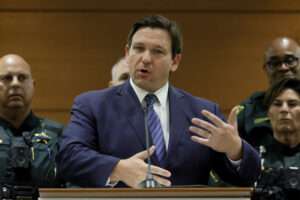
Florida Gov. Ron DeSantis. (Amy Beth Bennett/TNS/Newscom)
The Republican governors of Arizona, Florida, and Texas have been busing recently arrived Latin American migrants to Democratic "sanctuary" jurisdictions. Florida Governor Ron DeSantis even had 50 Venezuelan migrants flown to the Massachusetts island of Martha's Vineyard. So far, this policy has mostly amounted to political theater, using migrants as props. But, despite the cynical motives of the Republican governors, the idea of giving migrants a chance to go to states that welcome them is a good one that could alleviate many flaws of America's immigration policy.
Liberal sanctuary states support expanded immigration to such an extent that they refuse to cooperate with most federal efforts to deport undocumented migrants. More conservative state governments often prefer a more restrictive immigration policy.
Both red and blue states can benefit from a policy allowing state governments to issue visas and work permits to immigrants not otherwise eligible for legal entry under federal law. State-based visas would enable state governments to take in immigrants who can fill needed slots in the economy, refugees fleeing poverty and oppression, and anyone else whom they might wish to welcome. Particularly at a time of massive labor shortages in many parts of the economy, such added migration would be a great boon to receiving states. Even some red states have recognized the need for additional immigrant labor in areas of their economies. For example, GOP members of Congress from rural states have sought to pass a bill increasing guest-worker visas for agricultural laborers.
A system under which states could grant visas without federal approval would enable them to swiftly secure as much labor as they wish – and also to help people fleeing oppression. The present US refugee system is slow to the point of sclerosis, admitting a record-low of 11,411 refugees in fiscal year 2021. Letting states do their own refugee admissions would enable far more people to escape poverty and tyranny, especially if states could partner with private organizations, along the lines of Canada's successful private refugee-sponsorship program.
Some conservatives claim the negative reaction of destination states to Republicans' busing of migrants proves that sanctuary jurisdictions are hypocritical, and don't really want immigrants to come. But the very fact that they embraced sanctuary policies is strong evidence to the contrary. Such laws deliberately make undocumented immigrants more difficult to deport, and thus increase the size of the migrant population. Many sanctuary jurisdictions demonstrated their commitment to their policies by fighting prolonged (and mostly successful) legal battles to defend them during the Trump administration.
Moreover, most of the blue-state outrage over the busing is not about the presence of the migrants themselves (whom charities and local residents mobilized to help) – but over the use of migrants as political pawns and the ways in which some were deceived about where they were going, and enticed with false promises of work permits. A state-based visa system could mitigate such problems by automatically granting work permits and leaving migrants in no doubt about where they are going. Sanctuary jurisdictions and others genuinely want more immigrants, and state-based visas could help them achieve that goal.
Conservative border states and others who seek to alleviate disorder at the border could also achieve some of their goals by such a policy. If state governments could issue their own migration, work, and refugee visas, many migrants would have no reason to cross the southern border in the first place. They could instead go directly by plane or ship to the states that grant them entry. Those that do cross the southern border would not need to do so illegally or cause any disruption. They could use legal ports of entry, and then quickly get on their way to their final destinations. Most of the disorder, violence, and death at the border is caused by the lack of legal pathways to entry, which forces people fleeing poverty and oppression into the black market. State visas could greatly mitigate that problem. A state-based visa system would also channel immigrants to states that want them, thereby reducing undocumented migration to those that don't. As Wall Street Journal columnist Jason Riley points out in a recent article, a system of state-based visas would simultaneously ease labor shortages, and reduce disorder at the border.
State-based visas also alleviate the harms caused by a situation where large numbers of migrants wait many months to have their asylum claims adjudicated, while also being ineligible to work legally, and thereby having to subsist on charity, welfare, or the black market. A state visa program can incorporate immediate work authorization, which would simultaneously benefit the migrants themselves, enable them to immediately start contributing to the US economy, and minimize reliance on public funds. Immigrants with work permits can swiftly begin to support themselves and their families.
State-sponsored visas are not a new idea. They have, in the past, been advocated by politicians from both parties. In 2017, Republicans Sen. Ron Johnson (Wisc.) and Rep. Ken Buck (Colo.) proposed a bill that would enable states to issue work visas for up to three years, and later renew them (though Buck later backed out). More recently, Utah Republican Rep. John Curtis advanced a similar plan. In 2019, then- Democratic Presidential candidate Pete Buttigieg (now Secretary of Transportation under President Biden) proposed a system of "place-based" visas under which communities seeking additional labor could sponsor visas for migrants who would have to remain there for three years, before becoming eligible for permanent residency anywhere in the United States. The Biden administration later put forward a version of this proposal. Visas granted by subnational governments have also been successfully used by Canada and Australia. For a more detailed overview of the Canadian and Australian systems, and various US proposals for state-issued visas, see here. But none of these ideas have made much progress in Congress, so far.
Increasing state control over immigration policy should also appeal to conservatives and others who seek a return to the original meaning of the Constitution. As James Madison, the "father of the Constitution," Thomas Jefferson, and other key Founders argued, the text and original understanding of the Constitution did not give the federal government any general power to restrict immigration. For the first hundred years of American history, immigration policy was largely under the control of the states. It may not be possible to fully restore that approach. But a system of state-issued visas would be a step in the right direction.
State-based visas are by no means perfect. Depending on how such a program is structured, immigrants who receive them might - at least initially - be confined to a particular state, thereby sometimes missing out on valuable job and educational opportunities. That could also reduce their potential contributions to the US economy, if a given immigrant could be most productive in a state other than the one that granted the visa. From a moral standpoint, it would be preferable to completely eliminate laws under which where people are allowed to live and work is restricted by arbitrary circumstances of parentage and place of birth.
But, as always, the best should not be the enemy of the good. For migrants fleeing poverty and oppression like the Venezuelans flown to Martha's Vineyard at the behest of Ron DeSantis, the right to live and work in even one American state would be a vast improvement over being barred from all. And pro-immigration states can further mitigate the problem by granting reciprocal access to each others' state-based visa holders.
Ron DeSantis has rightly said that Venezuela's socialist government "is responsible for countless atrocities and has driven Venezuela into the ground." If he and other Republicans mean what they say about the evils of socialism, they should stop using migrants as pawns, and instead support a system that makes it easy for victims of repressive regimes to find freedom in American states that want them. Progressives, libertarians, and others should also recognize that such a system would be a major advance over the status quo.
Wednesday, the California Supreme Court denied review in this case (for more on the lower court case, see this post by Jonathan Adler and this one by Ilya Somin); Chief Justice Tani Cantil-Sakauye, joined by Justices Carol Corrigan and Joshua Groban:
Our denial of a petition for review does not communicate any particular view regarding the merits of the issues presented in the petition. Thus, all should understand that our decision to deny review in this case is not an endorsement (nor is it a rejection) of the statutory analysis undertaken by the Court of Appeal, which determined that bumble bees, a nonaquatic invertebrate, are susceptible to being listed as endangered under the California Endangered Species Act (Fish & G. Code, § 2050 et seq.; CESA) because that statute applies to fish (Fish & G. Code, §§ 2062, 2067 & 2068), and "invertebrates" are included within what the Court of Appeal deemed to be the applicable definition of "fish" (id., § 45) ["Fish" means a wild fish, mollusk, crustacean, invertebrate, amphibian, or part, spawn, or ovum of any of those animals -EV]. (Almond Alliance of California v. Fish & Game Com. (2022) 79 Cal.App.5th 337, 341.)
Yet if experience is any guide, our decision not to order review will be misconstrued by some as an affirmative determination by this court that under the law, bumble bees are fish. A better-informed observer might ask: How can the court pass up this opportunity to review the Court of Appeal's interpretation of the Fish and Game Code, which seems so contrary to common knowledge that bumble bees are not a type of fish? Doesn't this clear disconnect necessarily amount to "an important question of law" (Cal. Rules of Court, rule 8.500(b)(1)) warranting this court's intervention, because the Legislature could not possibly have intended such a result?
Each new entry on the Supreme Court's emergency docket brings twists and turns. The latest lesson comes in Yeshiva University v. YU Pride Alliance. On June 24, the New York Supreme Court (the trial court) entered a permanent injunction, requiring YU to recognize the LGBT club. On August 23, the New York Appellate Division (the intermediate court) denied a motion to stay the trial court's permanent injunction. On August 25, the New York Appellate Division denied an emergency motion for leave to appeal the denial of the stay. That same day, the New York Court of Appeals (the state court of last resort) denied an emergency motion for leave to appeal the denial of the stay. Four days later, on August 29, YU filed an emergency application for a stay with the Supreme Court. This move, as I noted earlier this month, should have come as no surprise. YU's counsel, the Becket Fund, pursued every possible path in the lower court before going upstairs--or did they? (Disclosure: I've collaborated with Becket on several matters over the years.)
On September 14, a five-member majority of the Supreme Court issued an unsigned order, suggesting that YU could make two more moves in the New York judiciary.
The application is denied because it appears that applicants have at least two further avenues for expedited or interim state court relief. First, applicants may ask the New York courts to expedite consideration of the merits of their appeal. Applicants do not assert, nor does the Appellate Division docket reveal, that they have ever requested such relief. Second, applicants may file with the Appellate Division a corrected motion for permission to appeal that court's denial of a stay to the New York Court of Appeals, as the Appellate Division clerk's office directed applicants to do on August 25. Applicants may also ask theAppellate Division to expedite consideration of that motion.
Because YU failed to make those moves, the Court denied relief.
Justice Alito dissented, joined by Justices Thomas, Gorsuch, and Barrett. They were skeptical either of these paths could even work. And they repeated the charge of cowardice--that the Court is unwilling to act when doing so could occasion controversy.
Second—and more to the point—the majority seems to think that it is still possible for the University to persuade the Court of Appeals to grant a stay. Of course, the Court of Appeals has already denied Yeshiva's application for interim relief, but the majority interprets a case comment written by a court clerk employed by the Appellate Division to mean that the Court of Appeals may give Yeshiva a second bite at the apple notwithstanding its previous denial. That interpretation is dubious, yet the majority seizes upon it as dispositive. I doubt that Yeshiva's return to state court will be fruitful, and I see no reason why we should not grant a stay at this time. It is our duty to stand up for the Constitution even when doing so is controversial.
When I first read the Supreme Court's per curiam order, I immediately checked the Respondents' brief to see if they raised these procedural points about how to expedite the appeal. They did not. And they had no amici. And based on my cursory research, Justice Alito is right that these proposals are "dubious." A colleague flagged a 2002 article published in the Journal of Appellate Practice and Process, titled Freestyle Lawyering: Taking An Expedited Appeal In The New York State Courts. The very first paragraph explains how uncertain this process is:
New York's appellate courts normally hear cases on a first come, first served basis. Occasionally, however, when a party can show "urgency or good cause," a court will expedite the appeal process by granting a calendar preference and an expedited briefing schedule. Determining how to obtain that preference and expedited briefing schedule can often be difficult because New York's rules of civil procedure (the CPLR) provide only that "[p]references in the hearing of an appeal may be granted in the discretion of the court to which the appeal is taken." The statutory rules provide no guidance about how to seek a preference or what an application for a preference must show to be successful. Virtually no case law exists on the subject, and even the bible used by New York practitioners, Siegel's New York Practice, does not explain how to expedite an appeal. The sage advice of most experienced appellate attorneys is, then, the most helpful: "Call the clerk's office."
Forget the clerk's office. Better call John!
Where, then, did the majority discover these two procedural moves? It is doubtful that any of the law clerks actually took a class in New York appellate procedure. (I think Yale Law School has a standing policy to avoid any discussion of state courts in class.) Maybe Justice Sotomayor, who practiced law in New York, was familiar with the procedures. Who knows? But as best as I can tell, the Justices simply made it up.
Indeed, I think the votes may have flipped in this case. Here, the emergency application was filed on August 29, and the briefing concluded on September 3. On September 9, Justice Sotomayor entered a stay of the injunction "pending further order" of the Court. Why would she take this step if the Court was going to ultimately deny the stay? The Court could have done nothing. I think at that point, there was a majority prepared to stay the injunction, and a dissent was in the works. The majority did not want to wait any longer for the dissent to be written, so they settled on a single-Justice stay. But, then the votes flipped. Maybe the Chief persuaded Kavanaugh to agree to the procedural punt. Maybe it was Justice Kagan. Or maybe Kavanaugh came up with the idea himself. But something changed. And the votes ended up where they were.
Why would the Justices make up some random procedural steps? I think the answer lies in the final sentence of the Court's per curiam order:
If applicants seek and receive neither expedited review nor interim relief from the New York courts, they may return to this Court.
Let me translate that sentence for you to English from SCOTUSese. First, Becket, go ahead and file these motions with the state courts. Second, New York courts, if you don't grant the expedited relief we suggested, the Supreme Court will stay your ruling. Third, YU Pride Alliance, you are going to lose, so settle this case to avoid a landmark First Amendment ruling. In this way, the Supreme Court ruled in favor of Yeshiva University, even though it ruled against Yeshiva University. Or, as Ian Millhiser observed, "The justices, in other words, appear to be delivering a thinly veiled threat to New York's appeals courts: Grant Yeshiva the relief it seeks, or else the Supreme Court will." I would say "nudge," instead of threat, but Ian's point is well-taken.
I think we have a new facet of the Supreme Court's emergency docket. You've all heard of the "shadow docket," a term Will Baude coined nearly a decade ago. There is also the "rocket docket," a term that I think I coined. Let's try another term. The penumbra docket: when the Supreme Court uses the emergency docket to nudge the lower court, or the parties, to reach a certain result, without actually ordering any shadow docket relief. The Court lurks in the area outside the shadow docket--as Justice Douglas would explain, the penumbras emanating from the shadow docket.
The penumbra docket is consistent with the Chief Justice's so-called doctrine of one last chance (to use Richard Re's framing): I'm not actually going to rule for the conservatives, but I am going to make it absolutely damn clear what I will do in the next case, so you better fix this mess so I don't have to. (This doctrine doesn't actually work.) And in another prominent emergency case, Justice Kavanaugh has employed the penumbral approach. In Alabama Association of Realtors I, Justice Kavanaugh all but concluded that the eviction moratorium was unlawful, but declined to grant emergency relief because the policy was winding down. Then, when the Biden Administration extended the policy, Kavanaugh ruled against the policy in Alabama Association of Realtors II. Kavanaugh, like Roberts, was hoping that someone--anyone!-- would fix the mess. Alas, the Biden Administration called Kavanaugh's bluff, and got burned.
But in the Yeshiva University case, the penumbra docket worked. Four justices in dissent stated they would rule in favor of YU right away. And at least one member of the per curiam opinion signaled he would rule in favor of YU if the lower courts did not timely intervene--why else include the bit about returning to the Court? Four plus one equals stay.
What happened after the Court's nudge? Suddenly, the YU Pride Alliance agreed to a stay. A few weeks ago, the organization told the Court that a stay would expose them to "significant dignitary, social, emotional, and educational harm." Yet, after months of litigation, the organization decided that immediate recognition was not so important, and stipulated to a stay. The plaintiffs no doubt saw the writing on the wall. They would much rather let the case linger in New York state court for a few years, than generate a Supreme Court order finding that the First Amendment protects YU's right to exclude the club.
In this regard, the penumbra docket can be very effective. The Chief Justice, and perhaps Justice Kavanaugh, were able to reach the result they wanted to reach, without having to actually order that relief. In this regard, the penumbra docket is an antidote to the incessant criticism of the shadow docket: You don't like us ordering relief? Fine. We'll just nudge relief.
As I noted yesterday, I'm still trying to fully digest the Netchoice v. Paxton opinions, but I passed along two commentaries from top scholars on the subject, one entirely critical from Prof. Genevieve Lakier (Chicago) and one that's mostly critical from Prof. Alan Rozenshtein (Minnesota). I thought I'd also pass along are more positive commentary from Prof. Adam Candeub (Michigan State):
Last Friday in NetChoice v. Paxton, Judge Andy Oldham of the U.S. Court of Appeals wrote an opinion for the Fifth Circuit upholding H.B.20, Texas's law prohibiting social media platforms, such as Twitter and Facebook, from discriminating against users based on their viewpoints. The Texas law would require the internet platforms' content-moderation policies to employ viewpoint-neutral criterion, ending censorship of conservatives and dissenters from the internet.
Big Tech supporters on the left and libertarianright greeted the opinion with beating of breasts and gnashing of teeth. The Left worries that the platforms will be less able to stifle views it finds dangerous and undesirable. (Commenters on the Left have yet to square this view to their hostility to corporate First Amendment rights in Citizens United.) Libertarians decry the opinion as an intrusion on the internet platform's "editorial discretion" which they claim the First Amendment protects completely. Both sides smear the opinion as an act of judicial willfulness unmoored from precedent.
But Judge Oldham's opinion stands on firm ground. The opinion's critics argue that the First Amendment protects the act of exercising "editorial discretion": the right of platforms to control what content they transmit. But, critics forget that the First Amendment protects only expressive acts—a point made clear in the two Supreme Court case on which Big Tech (and Judge Oldham's critics) base all their critique: Miami Herald v. Tornillo and Hurley v. Irish American Gay, Lesbian, and Bisexual Group of Boston.
Even if most of the state statutes we reviewed end up being found to be constitutional, their enforcement will not eradicate lies and threats in elections, let alone eliminate the flow of misinformation that is polluting public discourse. The problem is simply too big. Any legislative approach to combatting election misinformation must be part of a broader strategy that seeks to reduce the prevalence of misinformation generally and to mitigate the harms that such speech creates.
Part of the challenge stems from the fact that we may be moving to what Richard Hasen calls a "post-truth era" for election law, where rapid technological change and hyperpolarization are "call[ing] into question the ability of people to separate truth from falsity." According to Hasen, political campaigns "increasingly take place under conditions of voter mistrust and groupthink, with the potential for foreign interference and domestic political manipulation via new and increasingly sophisticated technological tools." In response to these profound changes, election law must adapt to account for the ways our sociotechnical systems amplify misinformation. Furthermore, we must recognize that legislating truth in political campaigns can take us only so far; there are things that law simply cannot do on its own.
[A.] The Internet Blind Spot
One of the biggest challenges election-speech statutes face is the rise of social media, which have become the modern-day public forums in which voters access, engage with, and challenge their elected representatives and fellow citizens. Although political misinformation has been with us since the founding of the nation, it spreads especially rapidly on social media.
The bill is similar to that drafted by a bipartisan group of senators. Either version, or a reconciliation between the two, would be a major step forward relative to the status quo.
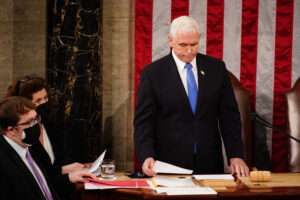
Then-Vice President Mike Pence oversees electoral vote count in Congress, January 6, 2021. (Jim LoScalzo - Pool via CNP/picture alliance / Consolidated News Photos/Newscom)
Either version of the bill would be a huge step forward relative to the status quo.
In a July post, building on the work of Andy Craig of the Cato Institute (a leading expert on ECA reform), I summarized the three main goals a reform bill achieve:
1. Preventing state governments from, in effect, changing the rules after election day, in order to reverse election results they don't like.
2. Preventing Congress from throwing out electoral votes for bogus reasons (as some GOP members of Congress sought to do after the 2020 election).
3. Making it more clear that the Vice-President does not have the power to invalidate electoral votes (a step then-VP Mike Pence rightly refused to take in January 2021, despite the urging of Donald Trump).
The House and Senate proposals both include major improvements on all three points. In a recent post at the Cato website, Andy Craig provides a helpful summary of the similarities and differences between the two bills, concluding that the House version is actually somewhat stronger:
The two bills are broadly similar in most respects, but with some key differences that will have to be reconciled. It is likely some of these changes will be reflected in amendments made to the Senate's bill, with amendments expected to bring the two closer together in at least some respects.
Broadly speaking, the new House bill reflects a more aggressive approach to constraining the various actors involved in the presidential election process: state legislatures, state governors and executive branch officials, the National Archives, the vice president, and Congress. In some respects, that makes it a more conservative and originalist bill, keen to limit the discretion of political actors in what is supposed to be a mandatory and fundamentally non‐discretionary constitutional process. To do this, PERA provides more specific and concrete limits in the law itself, and it also provides a somewhat more expansive role for the federal courts in enforcing those provisions.
Prominent election law scholar Derek Muller, who was part of a cross-ideological group of experts who endorsed and helped develop the Senate version, offers some potential reservations about one provision of the House bill, which creates a new legal cause of action challenging state officials' refusals to "tabulate" the vote of any person "who is entitled to vote under Federal law or is otherwise qualified to vote." But, as he emphasizes this part of the proposal could easily be severed from the rest of the bill. If it is included, its possible shortcomings strike me as a small price to pay for the major progress the bill makes on other fronts.
Partisan politics, notwithstanding, there is a high likelihood that some version of the bill will pass both houses before the end of the year. That's progress worth applauding. ECA reform will not fix all the problems that beset American democracy. But it can close some dangerous loopholes that were revealed in 2020.
Louisiana Rev. Stats. § 14:91.5. forbids "intentional use of a social networking website by a person who is required to register as a sex offender" who had been convicted of sex crimes against minors or of video voyeurism. The statute defines social network website, and excludes:
(i) An Internet website that provides only one of the following services: photo-sharing, electronic mail, or instant messaging.
(ii) An Internet website the primary purpose of which is the facilitation of commercial transactions involving goods or services between its members or visitors.
(iii) An Internet website the primary purpose of which is the dissemination of news.
(iv) An Internet website of a governmental entity….
Yesterday's Louisiana Court of Appeal decision in State v. McMahon (written by Judge Jeff Cox and joined by Chief Judge D. Milton Moore III and Judge Frances Jones Pitman) reasoned that the Louisiana statute differed from the similar North Carolina statute struck down by the U.S. Supreme Court in Packingham v. N.C., for two reasons:
An interesting observation from Prof. Freedman (Hofstra); I think that, if such a rule were adopted (and I don't advocate it), the result would often likely be Presidents and the Senate reaching a compromise on a truly centrist Justice—but I might be mistaken, and in any even the thought experiment is worth considering:
It doesn't take a lot of imagination to foresee a period in the near future in which Presidents only get to fill SCOTUS seats when their party controls the Senate. Both Senator McConnell and Senator Schumer have hinted at this possibility.
How would that play out? At minimum, this hardball paradigm would create a lot of lumpiness in the filling of seats. The number of sitting Justices would gradually dwindle during periods of divided control and then a President would get to fill a burst of them.
More troubling is the possibility that the number of Justices might dwindle to five. Then—because by law a quorum of the Court is six, 28 U.S.C. Sec. 1, S.Ct.R. 4—SCOTUS could not act at all. Essentially, the last word would be in the lower courts. See, e.g., Arunga v. Obama, 137 S.Ct. 2194 (2017); Jaffe v. Roberts, 137 S.Ct. 2192 (2017); 28 U.S.C Sec. 2109, and the discussion here.
I'm still trying to fully digest the Netchoice v. Paxton opinions (I've been slammed with several things the last few weeks, including an interesting and unexpected development which I hope to blog about in some detail next month). But for now, I thought I'd pass along two commentaries from top scholars on the subject, one entirely critical from Prof. Genevieve Lakier (Chicago) and one that's mostly critical from Prof. Alan Rozenshtein (Minnesota). Here's the opening of Prof. Lakier's (which is a Twitter thread):
There has been a lot of discussion about the opinion the Fifth Circuit released last Friday upholding Texas's new social media law. Lots of people have criticized the decision for getting the law wrong.
Indeed, the opinion engages in an unapologetic, dramatic, sometimes bizarre rereading of precedents we thought we knew. For First Amendment lawyers—well, for me—reading it feels like entering the upside down. But why exactly?
In this thread, I highlight a few of the really significant departures the opinion makes from established precedent. I focus on the non-discrimination provisions in the law because there's more (much more!) than enough there for a thread.
As someone who has argued for the constitutionality (and indeed desirability) of some government regulation of platform content moderation, I was hoping that the first judicial decision upholding such regulation would be a thoughtful and measured approach to what is indisputably a hard, even wicked, problem.
Unfortunately, the Fifth Circuit's decision, written by Judge Andrew Oldham, is decidedly not that. Although not without its good points, it is largely a crude hack-and-slash job that misstates the facts and the law and ignores the proper role of an intermediate court, all in a sneering tone that pretends that those who disagree with it are either stupid or evil. It's an extreme example of First Amendment absolutism: the insistence that the First Amendment has either nothing to do with content moderation or that it provides maximum constitutional protections to such practices. The opinion deserves to be swiftly overruled, either by the full Fifth Circuit or by the Supreme Court.
Forty-eight states and the District of Columbia have statutes that regulate the content of election-related speech. The statutes take one of two general forms: (1) statutes that directly target the content of election-related speech; and (2) generally applicable statutes that indirectly implicate election-related speech by prohibiting intimidation or fraud associated with an election. We analyze each of these statutory forms in the following sections, paying particular attention to how broadly or narrowly the statutes define the speech they target and what level of fault or intent they require for liability.
[* * *]
[A.] Statutes that Directly Target the Content of Election-Related Speech
Three states, Alaska, California, and Washington have statutes that prohibit false statements in political ads or campaign communications that constitute defamation. These statutes expressly state that liability for defamation applies in the context of political speech . . . These statutes are unlikely to raise novel questions of First Amendment law because their scope of coverage is limited to statements that meet the requirements of a defamation claim.
The Russian-language sign in this image says "exit."
Vladimir Putin's recent partial "mobilization" order mandating conscription of up to 300,000 people into the Russian military has sparked protests and led many Russians to try to flee the country. The latter trend is on top of the hundreds of thousands who have already left or tried to do so since Russia's brutal invasion began on February 24.
This situation further strengthens the case for opening Western doors to Russians fleeing the regime, and granting asylum to Russian troops who surrender. The mobilization policy was obviously brought on by Russian manpower shortages and accumulating setbacks on the battlefield. Thanks to the new order (and the possibility of future expansions of it), many of the people seeking to flee now might otherwise be forced into the Putin's military. Every one that manages to escape is one less potential pair of boots on the ground for Putin, at a time when his need for additional manpower is particularly dire. The prospect of saving people from being forced into becoming unwilling gun fodder for Putin also strengthens the purely moral case for accepting refugees, at least those who are potential draftees.
For the same reasons, it is imperative that the US and other Western nations offer asylum to Russian troops who surrender or desert. I described the potential advantages of this idea - first developed by economist Timur Kuran - early in the war; see here and here. At that time, I also explained why Western offers might be useful even as Ukraine makes similar ones.
The case for this approach is even stronger now, because Russia has a more serious manpower shortage (making the loss of troops even more damaging to their cause), and because Russian military morale - a problem since the start of the conflict - is likely even lower now, in the aftermath of recent Ukrainian victories. The policy can also be extended to cover Russians who evade military conscription.
We can and should exclude troops guilty of war crimes. Prisoners suspected of such can and should be tried for them. But Russia's horrible atrocities should not lead us to forego the advantages of granting refuge to surrendering troops who are not guilty of them. To the contrary, the atrocities are all the more reason to pursue this low-cost tactic to help end the war. The more Russian military manpower is depleted by surrender and desertion, the faster Putin can be defeated, and the fewer atrocities there will be.
These relatively new considerations in favor of offering refuge to Russians fleeing Putin's regime are in addition to the moral and strategic benefits I and others (such as Washington Post columnist Catherine Rampell), have pointed out in various writings since the beginning of the war. These include freeing people from tyranny, imposing a "brain drain" on Putin's war machine, and bolstering our own economies. For my previous pieces on this topic, see here, here, here, and here. In one of my earliest articles on the subject, I also described why we should not be deterred by fears that helping dissenters flee would actually help Putin.
And, for those keeping track, I have also consistently advocated opening Western doors to Ukrainian refugees from the war (e.g. here, here, and here) - an issue on which more progress has been made than that of Russian ones. In other earlier writings (e.g. here and here), I have responded to arguments that accepting Russian and Ukrainian refugees is unfair so long as we are less open to those fleeing war and oppression elsewhere. These are genuine iniquities. But they should be remedied by "leveling up," not "leveling down."
C-SPAN recently posted a video of the Cato Institute Constitution Day panel on 2021-22 term Supreme Court cases dealing with issues of "constitutional structure." Participants included fellow Volokh Conspiracy blogger Jonathan Adler (speaking on his Cato Supreme Court Review article about West Virginia v. EPA), my George Mason University colleague Jennifer Mascott (speaking on her article about Egbert v. Boule), and myself (speaking about my article about the OSHA and CMS vaccine mandate cases the Supreme decided in January.
This afternoon the U.S. Court of Appeals for the Eleventh Circuit granted the Department of Justice's request for a partial stay of the lower court order that had temporarily blocked the Department from analyzing and investigating documents seized from former President Donald Trump's residence at Mar-a-Lago.
The 29-page per curiam opinion on behalf of Judges Rosenbaum, Grant, and Brasher thoroughly rejects the bases upon which Judge Cannon had granted Trump's request to block Justice Department access and to appoint a special master. (For those who care about such things, two of the judges were appointed by Trump, and one was appointed by Obama.)
The opinion begins:
Following the execution of a search warrant at the residence of Plaintiff-Appellee, former President Donald J. Trump, Plaintiff moved for the appointment of a special master to review the documents that Defendant-Appellant United States of America seized. The district court granted that motion in substantial part. Now, the United States moves for a partial stay of the district court's order as it relates to the roughly one-hundred documents bearing classification markings. We decide only the narrow question presented: whether the United States has established that it is entitled to a stay of the district court's order, to the extent that it (1) requires the government to submit for the special master's review the documents with classification markings and (2) enjoins the United States from using that subset of documents in a criminal investigation. We conclude that it has.
Among other things, the court explained why former President Trump has no meaningful claim to the documents in question, whether or not (as some have suggested) Trump may have declassified some of the documents.
For our part, we cannot discern why Plaintiff would have an individual interest in or need for any of the one-hundred documents with classification markings. Classified documents are marked to show they are classified, for instance, with their classification level. Classified National Security Information, Exec. Order No. 13,526, § 1.6, 3 C.F.R. 298, 301 (2009 Comp.), reprinted in 50 U.S.C. § 3161 app. at 290–301. They are "owned by, produced by or for, or . . . under the control of the United States Government." Id. § 1.1. And they include information the "unauthorized disclosure [of which] could reasonably be expected to cause identifiable or describable damage to the national security." Id. § 1.4. For this reason, a person may have access to classified information only if, among other requirements, he "has a need-to-know the information." Id. § 4.1(a)(3). This requirement pertains equally to former Presidents, unless the current administration, in its discretion, chooses to waive that requirement. Id. § 4.4(3).
Plaintiff has not even attempted to show that he has a need to know the information contained in the classified documents. Nor has he established that the current administration has waived that requirement for these documents. And even if he had, that, in and of itself, would not explain why Plaintiff has an individual interest in the classified documents.
Plaintiff suggests that he may have declassified these documents when he was President. But the record contains no evidence that any of these records were declassified. And before the special master, Plaintiff resisted providing any evidence that he had declassified any of these documents. See Doc. No. 97 at 2–3., Sept. 19, 2022, letter from James M. Trusty, et al., to Special Master Raymond J. Dearie, at 2–3. In any event, at least for these purposes, the declassification argument is a red herring because declassifying an official document would not change its content or render it personal. So even if we assumed that Plaintiff did declassify some or all of the documents, that would not explain why he has a personal interest in them.
The panel also rejected the claim that the threat of future prosecution could constitute "irreparable harm" for purposes of an injunction.
No doubt the threat of prosecution can weigh heavily on the mind of someone under investigation. But without diminishing the seriousness of that burden, "if the mere threat of prosecution were allowed to constitute irreparable harm . . . every potential defendant could point to the same harm and invoke the equitable powers of the district court." United States v. Search of Law Office, Residence, and Storage Unit Alan Brown, 341 F.3d 404, 415 (5th Cir. 2003) (quotation omitted). If this concern were sufficient to constitute irreparable harm, courts' "exercise of [their] equitable jurisdiction would not be extraordinary, but instead quite ordinary." Id.
Overall, the opinion is quite thorough, and demonstrates why the district court completely bollixed this case.
We will see whether Trump tries to take this to the Supreme Court. I doubt any such filing will produce a different result (and would be quite surprised were the Supreme Court to respond quickly enough to matter).