
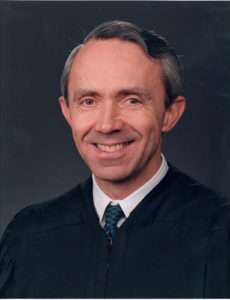
10/3/1990: Justice David Souter takes the oath.

Mostly law professors | Sometimes contrarian | Often libertarian | Always independent | Est. 2002
10/3/1990: Justice David Souter takes the oath.
We lost a legal legend.
Judge Laurence Silberman of the D.C. Circuit Court of Appeals died on Sunday. The Wall Street Journal has full coverage, including an obituary, house editorial, and op-ed by Paul Clement. (Indeed, I suspected something was up when the WSJ published Judge Silberman's Constitution Day address at Dartmouth.) He was a legal giant. Few today could ever scale to his height and influence. Here, I will include a short anecdote about my experiences with Judge Silberman.
In November 2021, I wrote about an unusual judicial misconduct issue. Judge Silberman alleged that Judge Sullivan (D.D.C.) should not be able to sit on the District of Columbia's judicial selection committee. Silberman's complaint was grounded in the separation of powers, as well as the code of conduct. Eventually, my post came across Judge Silberman's radar. In April 2022, his law clerk contacted me, and said that the Judge would be happy to chat with me about the matter. By chance, I was scheduled to be in D.C., and asked if we could meet in person. Judge Silberman obliged.
My brief hour with Judge Silberman is a time I will never forget. He explained why he was motivated to bring this complaint. There was noting personal against Judge Sullivan. Rather, he did not want judges getting involved in the political process. Judge Sullivan told me that when President George W. Bush asked him to co-chair the commission on the intelligence failures leading up to the Iraq War, Silberman considered resigning from the bench. However, he learned that he could simply stop all judicial business while performing his role for the executive branch. And so he did. For a period, Judge Silberman did not decide any cases or participate in any court business. Silberman couldn't even use his judicial clerks and staff during that time. Silberman explained that if Judge Sullivan really wanted to serve on this judicial selection committee, he could put on hold all of his court business.
Judge Silberman was also bothered by the fact that Congress drafted a statute that required a federal judge to serve on this commission. Now, that problem could be mitigated by having a senior judge who no longer hears cases to serve in that role. But in Silberman's view, it was troubling that Congress seemed to approve a clear violation of the Code of Conduct. And the various apparatchiks within the Judicial Conference seemed to defer to Congress's finding that this practice was valid. Silberman asserted that Congress could not deem unethical conduct as ethical. And he worried about what kind of precedent that could set. I asked him to spell out his thinking a bit more, because I didn't see the slippery slope here. He looked pensive, and said he would think about it. (More on this argument later.)
Then, Judge Silberman took me down a tour of memory lane. He talked about his work on In Re Sealed Case, which became Morrison v. Olson. Justice Scalia's famous dissent largely tracked Silberman's lead. He reminded me that he was the person who began the litigation that challenged Congress's denial of cost-of-living adjustments for federal judges. After he prevailed in that case, Judge Silberman emailed every federal judge in the country to let them know. There was no massive mailing list. His secretary simply compiled every individual address. Of course, Silberman decided Parker v. D.C., which became Heller. And he wrote the principled decision in Seven-Sky v. Holder, which upheld the Affordable Care Act as a valid exercise Congress's commerce powers. (Like Bruno, we do not talk about Justice Kavanaugh's "dissent" in that case.) I agree with WSJ that Silberman was more consequential than most Supreme Court justices.
Silberman told me some great stories about his time in the executive branch. One story stuck out, which he recounted in a 2012 Green Bag essay:
The group approved our proposal and Ehrlichman arranged a meeting with the President. That session in early 1970, according to one of the participants, was one of a very few meetings, perhaps the only one, the President had with an interdepartmental working group to discuss a domestic policy issue. As the accompanying picture shows, I am presenting the proposal to the President with the rest of the working group, as well as Ehrlichman and his deputy, Ken Cole, sitting around the table in the Cabinet Room. You will note that sitting next to the President is a white-haired older gentleman. It was apparent from the discussions that he was an ex-Congressman who had served with Nixon in the House when Taft-Hartley was passed in 1947. The President, after rather careful probing, enthusiastically endorsed the initiative. As I was walking out of the room, I asked Ed Morgan, one of Ehrlichman's assistants, "Who was the white-haired gentleman sitting on the President's side of the table?" Morgan replied, "George MacKinnon." I was taken aback: "You don't mean Judge MacKinnon." Morgan said, "Yes," at which point I pointed out that it was quite inappropriate to have a federal judge sitting in on a White House policy discussion. Morgan asked why, and I explained the judicial canon. I reminded him of what Abe Fortas had done during the prior administration and the ensuing brouhaha when he was nominated as Chief Justice. Late that day or the next, Morgan called me to say that it would never happen again, but he sent me the picture.
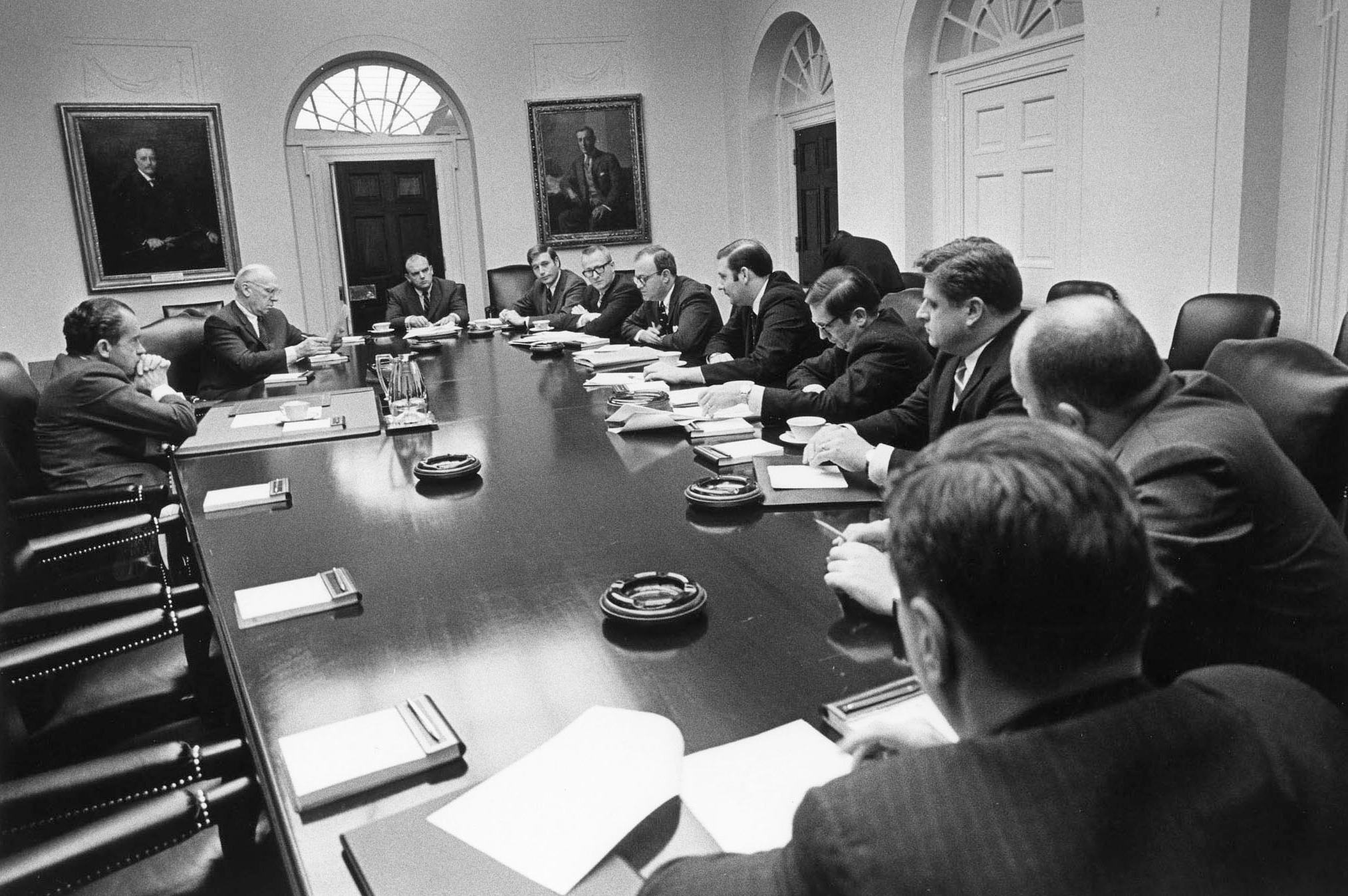
Judge Silberman mentioned a tidbit that did not make it into the Green Bag. Apparently Judge MacKinnon said that he would have recused from any case involving the new legislation, so there was no problem. No harm, no foul, right? Judge Silberman vigorously disagreed. Judges should not get involved with politics, even if there is some way to rationalize it.
Eventually, my session wrapped up with Judge Silberman. I told him I would likely write more about his complaint. (I did; he emailed me right away to point out some typos.) I then left Judge Silberman's chambers, and went to visit another judge in the building. About five minutes later, Judge Silberman barreled into chambers. The judge I was visiting thought Silberman was there to see him. No, Silberman was there to see me! Silberman said that he had figured out the slippery slope issue. If Congress could deem unethical conduct as ethical, then Congress could also deem ethical conduct as unethical. In other words, if Congress intervenes, even slightly, to give its imprimatur to dubious judicial behavior, then Congress could intervene to prohibit otherwise proper judicial behavior. He was exactly right.
What struck me was that a man of 86 years, a legend, thought enough to answer my question right away, and storm into another judicial chamber to tell me. I was in awe of how much care and attention he gave to this matter. But this is how Judge Silberman approached every facet of his life.
A few months later, I invited Judge Silberman to moderate a panel at the Federalist Society National Lawyers Convention. The theme was judges picking other judges. He immediately agreed. I regret that he will not be able to share his wisdom with us, one last time. Our panel will now be in his memory, which will be a blessing.
and some thoughts about judicial fearlessness
Tomorrow is the first Monday in October, which marks the start of the newest term at the Supreme Court. In the past few weeks, I've had various pieces of commentary on the Court that I thought I'd collect here.
First, and perhaps best in my book, there are the first two episodes of the newest season of Divided Argument, my "unscheduled, unpredictable Supreme Court podcast" with Dan Epps.
The first episode, Maoist Takeover, was recorded at William & Mary Law School as part of their Scalia-Ginsburg Collegiality Speaker Series, and focuses on how to engage with people across profound disagreement, as well as on the Supreme Court's shadow-docket decisions in Yeshiva University v YU Pride Alliance.
The second episode, Horse Sausage, just dropped today and it previews the extraterritoriality/dormant commerce clause case about California's pork regulations, National Pork Producers Council v. Ross.
But I've also found myself getting lured into some more general Supreme Court commentary. I appeared on this virtual panel at Harvard Law School on "Law and Politics in the Roberts Court" with Amanda Hollis-Brudsky, Adam Liptak, Leah Litman, and Janai Nelson, where I took the unpopular position that the Court tries to pursue a vision of law that is quite independent of politics, even though the Justices were put there by politics.
I also had some related and more wide-ranging discussion of the Court (and the state of our institutions more generally) with Bill Kristol on his show, Conversations with Kristol.
And finally, I gave an interview to Ruth Marcus of the Washington Post which resulted in this passage in her opinion essay on the coming Supreme Court term:
"Fearless." That's the adjective that University of Chicago law professor William Baude applies to this court, and in his view, that's not a bad thing. "The court's not sitting out the hard cases now," he said. "Change happens. New Justices were put in the court by politics, and that's how the court's supposed to work. Everybody understands that putting new justices on the court who are different from the old justices has consequences. That's never been something the court could or should try to immunize itself from."
This passage has gotten a lot of attention on Twitter, and to my mind the most interesting response is this thread from Richard Re, beginning:
Two kinds of judicial fearlessness: (1) doing what's right even when it's contrary to "elite" opinion; (2) doing what's right even when it will disappoint or frustrate your allies, or the people who put you on the bench. Folks seem to focus opportunistically on one or the other.
— Richard M. Re (@RichardMRe) October 2, 2022
and ending:
What is this obviously unplanned thread about? Maybe it's about how judges are praised or criticized in a partisan age, including by one another. A pat rhetorical structure is always available, stunting real thinking or engagement. It avoids facing EITHER the merits OR politics.
— Richard M. Re (@RichardMRe) October 2, 2022
Relatedly, there are Rick Pildes's and Orin Kerr's earlier posts about the concept of judicial courage. And also Scott Alexander's "Against Bravery Debates."
One upshot of all of these is that I think it's probably not helpful to try to characterize one Court or set of Justices as particularly more fearless than an another. Just as with the discussions of law and politics more generally, a lot of these characterizations may in the end reduce more fundamentally to legal disagreements, about what our law is and what it demands of our judges.
Anyway, that's enough of that kind of commentary for now. For some slightly more extended arguments about the Court's role, you can read my recent-ish articles on The Real Enemies of Democracy or on Supreme Court reform (Reflections of a Supreme Court Commissioner).
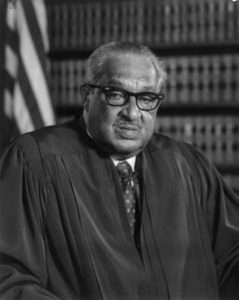
10/2/1967: Justice Thurgood Marshall takes the oath.
Ten years after their unanimous Supreme Court victory against the Environmental Protection Agency, the Sacketts return to One First Street for another round.
On Monday, the first day of the new Supreme Court term, the justices will hear oral argument in Sackett v. Environmental Protection Agency, in which the Sacketts are challenging the EPA's authority to regulate the use of their land under the Clean Water Act. Specifically, the Court will consider how courts should determine whether a given parcel is subject to regulation under the Clean Water Act (CWA) as a part of the "waters of the United States." The resulting decision could have dramatic implications for the scope of federal wetland regulation.
If the case name Sackett v. EPA sounds familiar, that is because it should. Ten years ago, the Supreme Court heard another case with that same name, involving the same litigants, and the same Idaho property. In the first Sackett case, the issue was whether the landowners could obtain judicial review of an EPA administrative compliance order, directing them to restore their property or face ruinous financial penalties. The Court ruled unanimously for the Sacketts, recognizing the profoundly unjust nature of the EPA's position. This time around, the question is whether the EPA has authority to regulate the Sacketts at all.
The precise question before the Court is whether the court below (in this case, the U.S. Court of Appeals for the Ninth Circuit) applied the proper standard when it concluded that the Sacketts' property contained wetlands, subject to regulation as part of the "waters of the United States," subject to regulation under the CWA. (I discussed the Ninth Circuit's decision here.)
The reason there is some uncertainty about the proper test is because the last time the Court considered this question, in Rapanos v. United States, the Court splintered 4-1-4. While a majority of the Court concluded that the federal government's was asserting regulatory authority beyond that which the CWA authorizes (as they had in SWANCC v. U.S. Army Corps), the majority could not agree on the proper test. Justice Scalia (joined by three other justices) concluded that "waters of the United States" only covered those waters and wetlands connected to navigable waters through a relatively continuous surface-water connection. Justice Kennedy, on the other hand, thought the proper test was to determine whether a given water or wetland has a "significant nexus" to waters of the United States.
In the current case, the Sacketts are asking the Court to embrace a test based upon Justice Scalia's Rapanos plurality. Such a test, they argue, is more consistent with the CWA's text, and ensures that federal regulation does not extend beyond the scope of Congress's power to regulate commerce among the several states (which is the purported basis for the CWA's regulations).
The Solicitor General, on the other hand, is asking the Court to embrace Justice Kennedy's concurrence. This latter position is itself notable, as the federal government seems to have abandoned the less bounded conception of federal regulatory authority it had pushed in Rapanos and SWANCC, and which had commanded the support of the Court's liberal justices in those prior cases. This is also notable because the Obama Administration had sought to define "waters of the United States" in a more expansive fashion, and reaffirms the impression that the Biden Administration is adopting a more restrained approach.
Should the Sacketts prevail, the EPA and Army Corps of Engineers will have greater difficulty asserting regulatory authority over properties that are not clearly connected to waters that are themselves connected to navigable waters. This would meant that a significant portion of the nation's wetlands would no longer be subject to federal regulatory control, though state governments would be free to adopt more expansive regulations, and federal agencies could still pursue wetland conservation through other means (such as through fiscal measures, land acquisition, and incentive programs).
Should the Court's decision provide greater certainty about the outer limits of federal regulatory authority, this would help clarify where federal authority ends and exclusive state regulatory authority begins. This would put the onus on state governments to adopt conservation measures within their jurisdiction, but would also make it easier for states to act.
Whether states would fill the conservation void is an interesting question. At present, half the states already protect wetlands and waters more broadly than does the federal government. The other half do not, and some have existing laws that constrain state agencies from adopting measures more stringently than federal law. Whether state legislatures would reform such laws is unclear, but it is interesting to note that State and local wetland regulation began a decade before wetlands were regulated under the CWA, and the pattern of state wetland regulation was the opposite of that predicted by "race to the bottom" theory (in that those states that would have been predicted to regulate last and least actually regulated first and most aggressively). (I surveyed this history in this article from 1999.)
Should the Sacketts prevail, another important question will be how a narrowing of "waters of the United States" affects the EPA's ability to enforce the CWA's traditional pollution-control provisions. The definition of "waters of the United States" will apply to the entire Act, but the EPA may retain broader authority to regulate traditional polluting activities on lands not otherwise subject to CWA jurisdiction given the Court's prior holding in County of Maui v. Hawai'i Wildlife Federation. As Robin Kundis Craig suggests , even if a given parcel (such as the Sackett's property) is not part of the "waters of the United States," activities on that parcel that result in pollution reaching regulated waters could be sufficient to subject such activities to federal regulation. In other words, a Sackett victory could deregulate wetland development at the federal level without deregulating much traditional water pollution control.
As some readers may know, the scope of federal regulatory jurisdiction has been a longstanding subject of interest for me, and I have published multiple papers on the subject. I will have more to say about the case after Monday's oral argument. In the meantime, those interested in learning more about the case and the issues involved should check out this webinar on Sackett sponsored by the Coleman P. Burke Center for Environmental Law at the Case Western Reserve University School of Law, featuring Professor Royal Gardner of Stetson and Jonathan Wood of PERC.
For those interested in my prior writings on the subject, here are a few:
Another way to understand the boycott of YLS grads.
A federal clerkship is a coveted position. Judges wield vast amounts of power in selecting their clerks--so vast that fear of reprisals have forced many clerks to stay quiet in the face of abuse. I even proposed eliminating clerkships as a way to eliminate this imbalance of power. But so long as federal clerkships remain, judges will still exercise nearly-unfettered discretion over who they hire.
At a minimum, clerk candidates should meet certain legal competencies: careful reading, clear writing, and sharp acumen. Beyond these checkboxes, the decision to hire one candidate over another will often come down to fit--the fit between the judge and the candidate; the fit between the candidate and other clerks in chambers; the fit between the candidate and clerks in other chambers (inter-chamber shuttle diplomacy is an undervalued attribute of clerking); and so on. Every judge will understand "fit" differently.
Some judges will also hire based on a candidate's potential for success in the future. We know all about the so-called "feeder" judges who hire clerks with an eye towards recommending them for the Supreme Court. When a Justice hires such a super-star, the "feeder" judge looks good! So "feeder" judges have every incentive to identify clerks--who often only finished 1 or 2 semesters of law school!--with the potential to go upstairs.
Fortunately, potential for success is not limited to One First Street. Many non-elect clerks will pursue distinguished careers in different fields: big law, public interest, criminal defense, academia, government, etc. I think it is very common for judges to give preferences to candidates who seek to enter one field over another. Some judges, for example, are known to feed clerks to the academy. So they may favor candidates who have published, and want to go into teaching. Other judges may have experience in public interest litigation, and provide a benefit to candidates who want to use the law degree to make the world a better place; those candidates who want to cash out in big law may be disfavored. And let's not be blind to the ideological screen. Some Democratic-appointed judges will only hire liberal clerks. Some Republican-appointed judges will only hire conservative clerks. Of course many judges (including my own) hired an ideologically heterogenous cohort. But many do not--and with the abolition of the filibuster, I suspect the number of ideologically-homogenous chambers will increase.
In short, judges evaluate a candidate based on a host of personal factors--dare one call it holistic. What has the candidate already done? And what might the candidate do in the future--or more precisely, what could the candidate accomplish if the clerkship is now on his/her resume? Yes, bestowing a clerkship on a candidate can be the key or his or her success. It opens up so many doors, including access to a clerk alumni network.
This background brings me to Judge Ho's plan to stop hiring graduates from Yale Law School. Judge Ho offered a host of reasons that support his decision, which I won't address here. Rather, I will offer another way of understanding this boycott.
Imagine you are a senior in college. You were accepted to Yale Law School, as well as several other top-tier schools. Mazal tov! Now you have a choice. How do you choose between Yale, Harvard, Columbia, Stanford, Chicago, and Virginia? Perhaps there are financial constraints--some schools may give more aid than others. There may also be personal constraints, such as the need to be close to family. More likely than not, neither of these factors would tip in favor of Yale. I doubt that YLS gives substantially more generous financial aid packages, and New Haven is a pain to get to. Instead, I think an applicant would choose Yale over those other schools because of prestige. Yale is the number-one ranked law school. It looks like Hogwarts. It has the top-ranked scholars. It pumps out circuit and SCOTUS clerks at a really high rate. Many applicants have a glide-path into academia. Your classmates will go on the highest ranks of government. And so on.
Now, imagine you are a right-of-center senior in college. More likely than not, you are familiar with recent episodes on campus, including the "Traphouse" imbroglio. And even if you are not familiar with it, you will find out. How? I am reliably informed that the Harvard Law School admissions office is working with the HLS FedSoc chapter to identify conservative applicants, and persuade them to choose Harvard over Yale. And others outside of Yale are giving similar messages:
https://twitter.com/edwhelaneppc/status/1575534099401699329?s=46&t=2aKGoxK7WwDAYeNPZcUbKA
Knowing how inhospitable Yale is to conservatives, why would an applicant still pick Yale over other more tolerant places? The answer, again, is prestige. And the desire to obtain that prestige trumps a commitment to values like free speech and academic openness.
How, then, should a judge assess a conservative applicant who chooses to go to Yale? This person knowingly walked into the traphouse for the sake of an elite degree. I think it is reasonable for a judge to conclude that the applicant exercised poor professional judgment. Indeed, the judge may not want to rely on someone who would sacrifice their principles for prestige. In this regard, the Judge would choose to not hire any conservative YLS graduates because they are unreliable, and maybe even untrustworthy. They have already sold out on their values to go to YLS, and will likely sell out in similar ways in the future. In this view, choosing to go to Yale, with full information, is a failure of moral character. Who needs them? Judge Ho's boycott directly punishes the students for the choices they made, and indirectly punishes the school for failing to address its deficiencies.
Judge Ho's idea isn't entirely new. I proposed a variant of it last year during the "Trap House" scandal. I wrote:
At this point, there is only one way to make YLS suffer: deny it the prestige it so desperately seeks. Specifically, conservative and libertarian 1Ls and 2Ls should transfer out en masse to ensure that other schools can take credit for their appellate and SCOTUS clerkships. Good luck placing clerks with only three of the nine Justices and half the federal judiciary. As a plus, students who transfer out may actually learn something about the law–a useful skill for any clerkship.
I do not know if any YLS students actually transferred out. If they did, I will shake their hands. Perhaps some students chose to stay at Yale as a way to reform the institution from the inside. Good luck to them. Maybe some students were unable to transfer for a host of personal reasons. I understand. But there is some sliver of students who said, "yeah, things are awful here, but I am this closes to a Yale JD and I am not going to throw it away." These are precisely the type people who Judge Ho would not want to hire. Ditto for future graduates who knowingly choose Yale over Harvard or Chicago.
Will Judge Ho's boycott catch on? To be effective, there must be a critical mass of federal judges who participate. I am reliably informed that some judges have quietly stopped hiring from Yale Law School. They are not willing to be as vocal as Judge Ho is. If you are a judge who stopped hiring those students who willfully go to YLS, and sacrificed principles for prestige, contact me. I can serve as an anonymous clearinghouse.
I don't think the risk of a boycott is limited to the judiciary. A future Republican administration can categorically label every YLS grad a squish. It is quite feasible for President DeSantis (a HLS grad) to simply boycott all Yale grads who matriculated after 2021. Good luck with explaining why you chose to stay at YLS for that shiny brass ring as some Chicago grad gets the nom.
At some point Dean Gerken will have to take note when the annual clerkship statistics tank--especially those coveted SCOTUS slots. Eventually, she will actually have to discipline those students who break the law school's rules. And I don't mean some slap on the wrist. Expulsion would get the message across. Then, law school applicants, and federal judges, can take a second look at Hogwarts.
How, if at all, should we try to be nice in an inherently not-nice occupation?
The discussion on the Doe v. Volokh thread struck me as quite interesting, and I was particularly intrigued by some commenters taking the view that, while I have the legal right to write about Doe, I shouldn't, because she's asked me not to. Here's one comment that I think captures this view particularly well:
So this woman contacts you and asks you to stop writing about her, and to remove your prior writings about her. You respond that you have a legal right to to write about her. She files suit against you, you prevail, and then you write about the whole affair, thus adding to your public writings on the woman who initially sought to have you not write about her.
You're such a classy person.
I don't think that's the right approach, but I think it's an important and difficult question, and one that is routinely faced by people who write about court cases, including newspaper reporters, magazine writers, academics, and bloggers. "Be classy" or "be kind" can't really capture the right analysis, I think, perhaps because news reporting (which I use broadly to cover also opinion and analysis related to news, litigation, and the like) is inherently an unkind phenomenon—or perhaps, in aiming to be good to people seeking information, it may necessarily be unkind to people seeking to conceal information. Still, it bears some deeper discussion.
The problem is that, for many court cases, one or both parties would very much prefer not to have the case be discussed. (I set aside the separate point that the case should be discussed accurately; I surely have no quarrel with that.) To give just the most obvious examples,
Often the concerns are about reputation and future employment prospects. But sometimes people might be worried that coverage of accusations against them (e.g., that they had raped someone, or that they had falsely accused someone, or that they had defrauded someone) might lead to harassing phone calls or e-mail, to threats, to vandalism, or even to physical attacks. Indeed, these risks are probably higher for mainstream newspaper articles than for blog posts (or certainly than for law review articles), just because such articles tend to have a higher readership.
What should a reporter, or a blogger, or an academic make of all this?
[1.] One possibility is to take the view that parties' names should be included only if it's "necessary." But in most situations, it's not actually strictly necessary to include the parties' names: We could just replace everyone's names with pseudonyms in our stories (even if the underlying cases aren't pseudonymized).
10/1/1924: Chief Justice Rehnquist's birthday.
My argument: "Petitioner Jane Doe—a frequent unsuccessful litigant—is asking this Court to impose unconstitutional prior restraint to prevent a law professor from writing about important, publicly available cases about pseudonymity."
I'm writing about this both because it strikes me as an interesting example of what litigants sometimes try to do (and occasionally succeed), and also because I thought our readers ought to see what the litigant accused me of—perhaps some of you may agree with her—and see my response. That's particularly so because some readers might view this as influencing my general views on harassment restraining order cases, which I'll doubtless blog about more in the future; I should note, though, that I've been writing and litigating about these matters extensively long before this petition was filed against me (see, e.g., this 2013 article and this 2021 article, plus too many blog posts and briefs to list here).
Several months ago, I wrote about a frequent litigant, in connection with a federal case of hers in in which (1) she was first allowed to proceed pseudonymously but then (2) was depseudonymized by the judge after evidence related to her past cases had emerged. I used her name in connection with that case, as the judge had, and also drew connections (based on public records) between that case and other cases that she had been litigating pseudonymously. [UPDATE: I used this in part to illustrate the difficulty that courts and defendants might have in tracking potential vexatious litigants, given that counting an adversary's past unsuccessful lawsuits may be much harder if they were all pseudonymous.]
Several weeks ago, the litigant filed Doe v. Volokh, No. 22STRO05198 (L.A. Superior Ct.), a petition for a "harassment restraining order" in California court. She stated in her declaration that,
From Illoominate Media, Inc. v. CAIR Florida, Inc., decided today by Judges Charles Wilson, Britt Grant, and R. Lanier Anderson III:
This suit over attorney's fees and costs stems from allegations that the CAIR Foundation and CAIR Florida, Inc. (CAIR) had a hand in convincing Twitter to ban Loomer's account. CAIR removed the first amended complaint to federal court on August 22, 2019. Counsel for Loomer and her corporation (Illoominate) moved for a remand to state court the next day. In its response two weeks later alleging fraudulent joinder of CAIR Florida, Inc., CAIR filed a sworn statement from Nathan Bernard. He explained that he pranked Illoominate by fabricating evidence to convince "Loomer that CAIR Foundation was the reason Twitter banned her account." In the interim, CAIR had filed a motion to dismiss in late August.
On October 2, 2019, CAIR sent Illoominate an "offer of judgment" proposing to settle the entire case for a nominal $1, including costs and attorney's fees. Illoominate had 30 days to respond. On October 22, the district court dismissed CAIR Florida from the suit and scheduled a hearing on CAIR's motion to dismiss for November 18. Nevertheless, Illoominate chose litigation over settlement. On October 31—shortly before the offer of judgment deadline—Illoominate filed a response to CAIR's motion to dismiss, where it voluntarily dismissed all its claims except Count II (for tortious interference with an advantageous business relationship). Once the deadline passed, the district judge dismissed the remaining claim at the November hearing, and this Court affirmed the dismissal in December 2020. On April 12, 2021, CAIR filed a motion seeking reimbursement from Illoominate pursuant to a Florida law requiring select parties who decline an offer of judgment to pay their opponent's reasonable costs and attorney's fees. Fla. Stat. § 768.79(1).
Padded cells, hidden cash, and official duties.
Please enjoy the latest edition of Short Circuit, a weekly feature written by a bunch of people at the Institute for Justice.
New cert petition: Anthony Novak was jailed for four days and prosecuted for making a fake Facebook page satirizing the Parma, Ohio police dept.—an obvious First Amendment violation! And yet the Sixth Circuit granted qualified immunity to the officers involved, so IJ is asking the Supreme Court to step in and settle a deep split among the circuits on what to do when probable cause rests on speech. Or, better yet, the Court could nuke the doctrine of qualified immunity into the sun. Read all about it at Cleveland.com.
In the nearly 10 years since Los Angeles entrepreneur Ryan Crownholm started MySitePlan.com, he's created over 40,000 informal maps, called site plans, to help people with a huge variety of projects—hotels looking to guide guests from the lobby to their rooms, homeowners and contractors showing local building departments where they'll build a fence or shed, and much more. Basically anytime someone needs a handy map, MySitePlan.com can make one using publicly available information. But California licensing officials are trying to shut Ryan down because they say he is illegally practicing land surveying. Which is madness. Ryan doesn't claim to be making the authoritative legal surveys necessary for bigger projects, and no one has ever been confused. Taken literally, the state's position would mean anytime someone hand-draws a map on a napkin, they'd risk criminal liability. So this week IJ and Ryan filed suit in federal court. Click here to learn more.
"For years, a Grey’s Anatomy writer told her personal traumas in online essays, and wove those details into the show’s plot—until a surprising email to Shondaland accused her of making it all up."
I had missed this story by Evgenia Peretz when it came out in early May in Vanity Fair ("Scene Stealer: The True Lies of Elisabeth Finch," Part 1 and Part 2), and only saw it because of this MedPage Today (Emily Dwass) piece ("Was I Conned by a 'Grey's Anatomy' Writer? — Her alleged duplicity could make things tougher for female patients"). It's fascinating and chilling, and a reminder of how even people we're predisposed to trust are sometimes untrustworthy.
One item, by the way, from the MedPage piece:
I get why no one doubted her cancer journey—who would lie about having a deadly disease? According to Peretz, Finch was given time off from work whenever she requested it to take part in treatments and clinical trials at the Mayo Clinic in Minnesota.
What I can't wrap my head around is why Finch's colleagues apparently didn't question the escalating and extreme crises that tormented her. Peretz writes about the string of calamities that afflicted Finch, "some of which she chronicled for the world, some of which she talked about in select company." There was a doomed pregnancy, a failing kidney, a friend murdered in the Tree of Life synagogue mass shooting (Finch claimed to help clean up the body parts), an abusive brother who attempted suicide. Peretz's article calls into question whether any of these things actually occurred.
How was it possible that no one at "Grey's Anatomy" saw these catastrophes as red flags that something was off, and that Finch needed some kind of mental health intervention?
It seems to me the answer is clear: It's naturally always hard to accuse someone of lying, especially about circumstances to which most people are normally inclined to react with sympathy. But when skepticism and failure to #Believe… is often condemned as a moral failing, who wants to "question"?
Readers of the blog know what side I support in the Russia-Ukraine war, so unsurprisingly most of the songs of the war that I've blogged have been pro-Ukrainian, since they're the ones that most struck me. (Here's an exception.) Still, my point in these posts is to pass along things that may offer some indirect insight into the sentiments of the people who are actually in this war, so I think it would be a mistake to omit the other side's perspective.
Here, then, is "Pig-Sticker" ("Свинорез"), which I believe refers to a knife in Russian as well as in English; it's billed as a song of the Private Military Company (PMC) Wagner (ЧВК Wagner), and I assume that it's an authorized recruiting video, which reflects what Wagner thinks its target audience wants to hear. In various copies it's amassed about 1.5M views in the last six days, so I take it that it's resonated with some people; again, these are not my sentiments, but I thought they were worth observing. (Naturally, the Russian lyrics are rhymed and metered, and from a technical perspective strikes me as quite effectively done.)
https://www.youtube.com/watch?v=wxlkY7aSfsQ
9/30/1857: Justice Benjamin Robbins Curtis resigns from the Supreme Court after Dred Scott v. Sandford (1857).
The Biden Administration keeps moving the goal posts to block legal challenges.
To date, I have not written about President Biden's student loan forgiveness initiative. Why? Because the rule doesn't actually exist! There has been no notice in the Federal Register. Rather, we are left with a series of press releases, fact sheets, and the like. Government by blog post, as I've called it, is not new. The Obama Administration would often modify regulatory regimes, such as the Affordable Care Act, through FAQs and other subregulatory guidance documents. But as best as I can recall, the Obama Administration did not deliberately avoid publishing a new rule to frustrate legal challenges. Yet it seems that the Biden Administration is doing exactly that. Indeed, the Administration appears to be making changes to the policy on the fly for the express purpose of blocking law suits.
Consider the case brought by the Pacific Legal Foundation on September 27. What was the theory of standing? Frank Garrison (a lawyer for PLF) claimed he would face an increased tax burden if his debt was automatically cancelled. When the suit was filed, Garrison did not have to take any steps--the debt would be cancelled automatically. PLF obviously recognized that this policy could be changed. Steve Simpson of PLF told the New York Times:
If borrowers can opt out, Mr. Garrison's claim "will be a harder case for us," said Steve Simpson, a senior attorney at Pacific Legal, which is representing Mr. Garrison. "It would be harder to argue that he's harmed any more."
Lo and behold, the Biden Administration would make just that change. On September 28, the Department of Education filed a notice with the court:
In his motions for temporary restraining order and preliminary injunction, Plaintiff challenges a federal student loan cancellation policy announced by the U.S. Department of Education ("Department"), and claims that he will be harmed if the Department automatically cancels $20,000 of his federal student loan debt. Defendants submit this notice in advance of tomorrow's scheduled conference to inform the Court that the Department updated its website today to confirm that any borrower who qualifies for automatic debt relief—i.e., relief without filing an application—will be given an opportunity to opt out. See U.S. Dep't of Educ., Federal Student Aid, One-Time Student Debt Relief, https://perma.cc/Z6H5-2QYN (last visited Sept. 28, 2022) ("If you would like to opt out of debt relief for any reason, including because you are concerned about a state tax liability, you will be given an opportunity to opt out."). Upon receiving this lawsuit and reviewing Plaintiff's filings, the Department has already taken steps to effectuate Plaintiff's clearly stated desire to opt out of the program and not receive $20,000 in automatic cancellation of his federal student loan debt, and so notified Plaintiff's counsel today.
Within 24 hours, the Department updated its website, and opted Garrison out of cancellation, thus mooting the suit. This filing almost sounds giddy. You can't stop us! We're the government! And, by the way, you're stuck paying the $20,000 debt. Sorry, Frank. Emily Bremer flagged the change:
Because the Department has not yet published a notice of or rule governing the program (the final agency action everyone seems to be waiting for), the program remains malleable even as its implementation is already underway. Indeed, the Department's guidance to borrowers changed just this week (compare this snapshot from Monday, September 26 to this snapshot from today). "Nearly 8 million borrowers may be eligible to receive relief automatically," changed to "[n]early 8 million borrowers may be eligible to receive relief without applying–unless they choose to opt out."


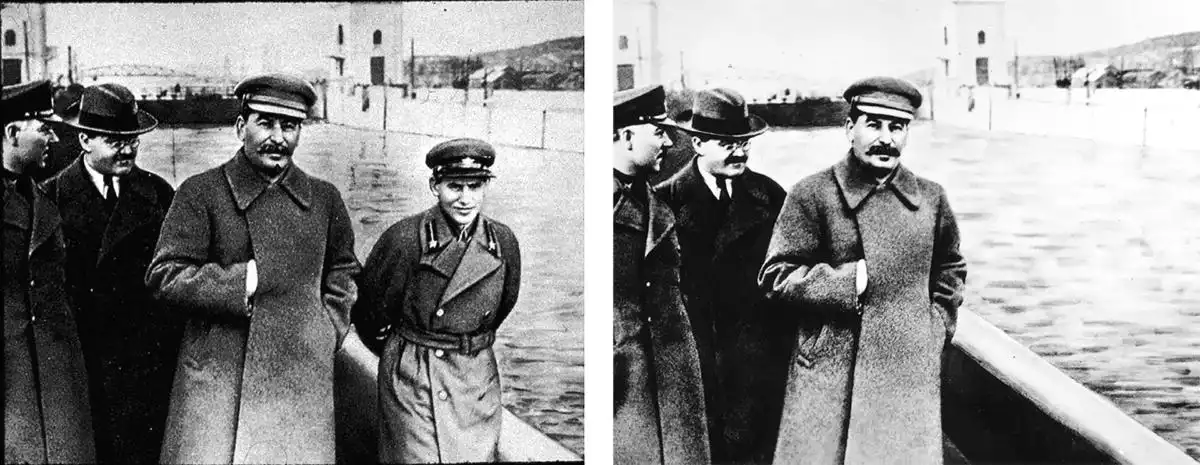
The word "automatically" was simply airbrushed away, like a photo of Stalin.
And on September 29, the district court denied relief because of the change:
Following a change in the student loan debt relief plan at issue (Filing No. 13), the court, in view of the fact the Department of Education exempted Plaintiff from receiving debt relief, finds Plaintiff cannot be irreparably harmed as is required for preliminary relief. Pursuant to the parties' agreement, the motions for a temporary restraining order (Filing No. 4) and preliminary injunction (Filing No. 5) are DENIED without prejudice.
Notice that the court refers to a "student loan debt relief plan." Not a rule or regulation or anything of the sort. A "plan," whatever that is.
On September 29, we saw yet another attempt to block litigation. Missouri and several other states challenged the not-yet-released policy. Missouri's Higher Education Authority asserted standing based on servicing Federal Family Education Loans (FFELP):
104. The Mass Debt Cancellation has created an enormous incentive to consolidate FFELP loans not held by ED (which are not currently eligible for cancellation) into DLP loans (which are eligible for cancellation). The inevitable result is that FFELP loan borrowers will likely consolidate into DLP loans en masse.
105. The consolidation of MOHELA's FFELP loans harms the entity by depriving it of an asset (the FFELP loans themselves) that it currently owns.
106. The consolidation of MOHELA's FFELP loans harms the entity by depriving it of the ongoing interest payments that those loans generate.
This argument may have been valid when the complaint was filed. But sometime on September 29, the Education Department excluded the FFEL loans from the loan forgiveness policy. Poof! NPR described the reversal as "remarkable."
Today, according to federal data, more than 4 million borrowers still have commercially-held FFEL loans. Until Thursday, the department's own website advised these borrowers that they could consolidate these loans into federal Direct Loans and thereby qualify for relief under Biden's debt cancellation program.
On Thursday, though, the department iss. The guidance now says, "As of Sept. 29, 2022, borrowers with federal student loans not held by ED cannot obtain one-time debt relief by consolidating those loans into Direct Loans."
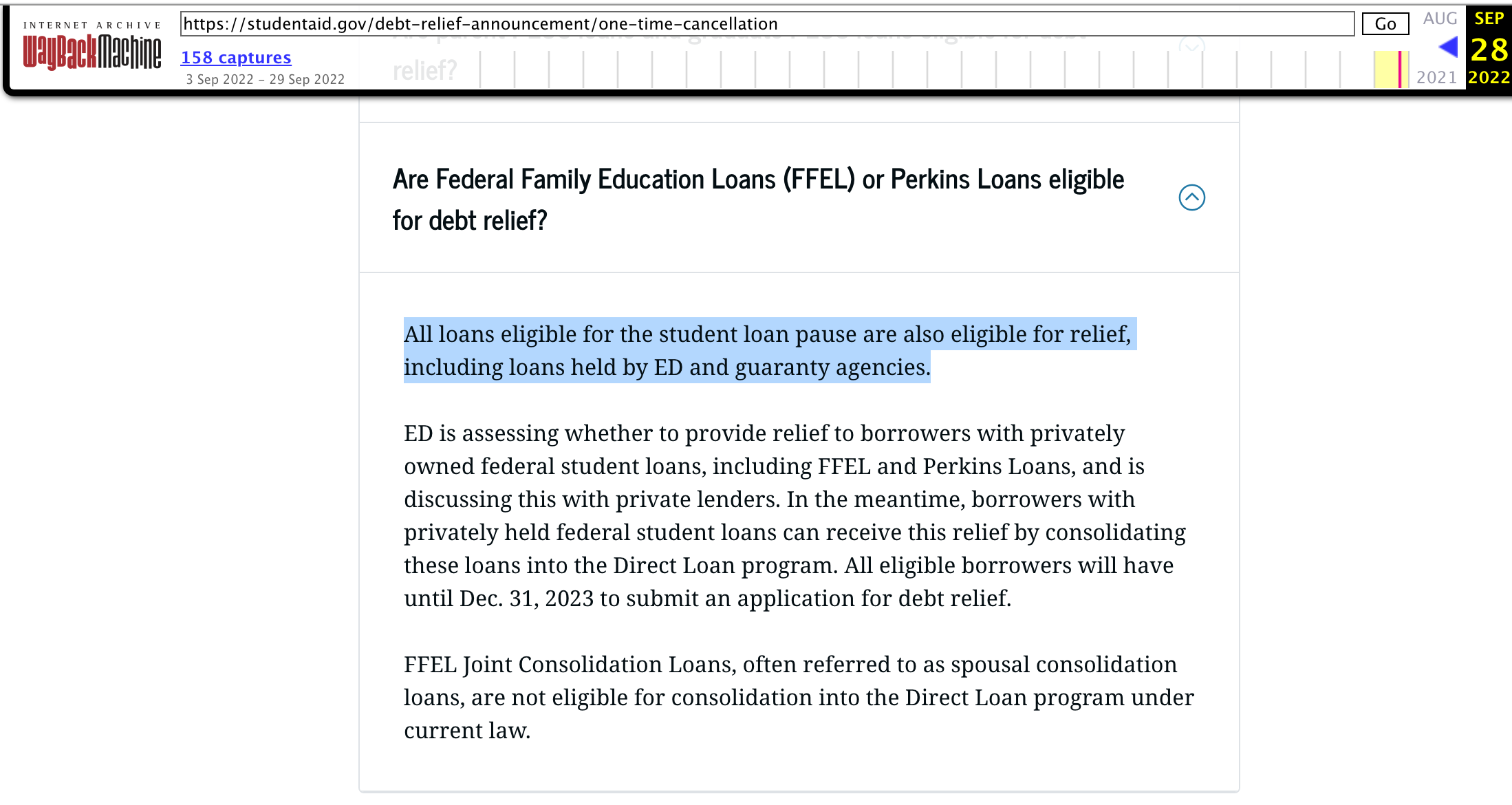
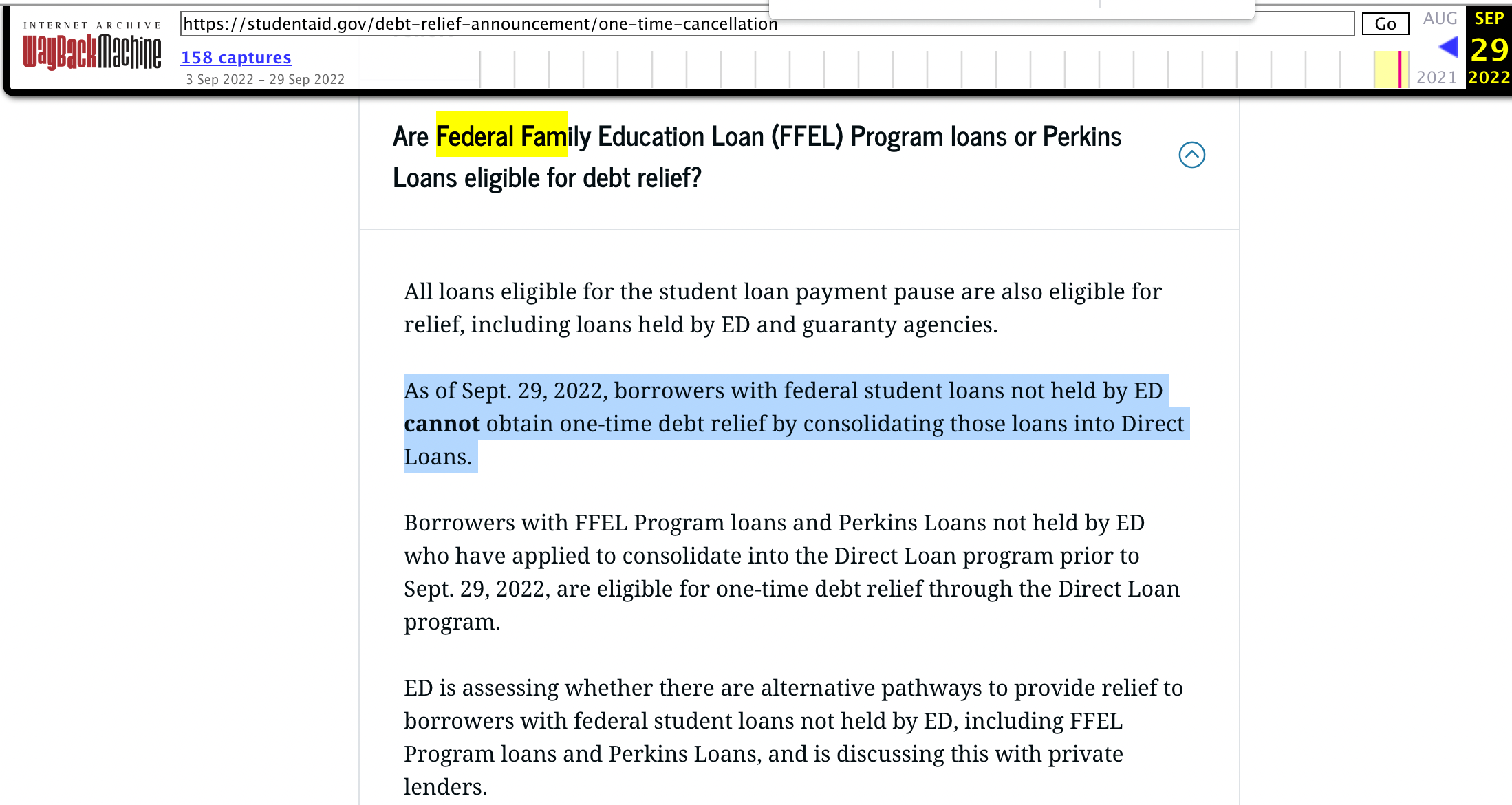
If only the Internet Archive was around to index the missing eighteen minutes from the Watergate Tapes!
The Department of Education excluded nearly 800,000 borrowers with FFEL loans. Why? It seems that the government is trying to block Missouri's suit. To be sure, Missouri has several other theories of standing. (I was impressed with how thorough the injury section was.) But the government's behavior here is clear as day: modify the policy on the fly to knock out any viable theories of standing, even if doing so excludes people from loan forgiveness.
Emily Bremer offers a more charitable take:
This change presumably was made in response to the lawsuit filed earlier this week challenging the program's legality, to defeat the plaintiff's standing (and prevent others from having such standing).
This raises a troubling possibility: that the Department of Education has not published a notice or rule establishing the loan forgiveness program (as § 1098bb requires) precisely because the absence of a final agency action makes a legal challenge more difficult. Maybe a notice or rule will be forthcoming–perhaps when the first borrowers receive the promised loan forgiveness. If so, millions of borrowers might be granted relief before a court could consider a challenge to the program's lawsuits. And perhaps that, too, is the goal.
How do you challenge a rule that doesn't exist, and that constantly changes with every new blog post? The Biden Administration keeps moving the goal posts to block legal challenges.
I have no doubt lawyers in DOJ planned each and every step here: they would wait till a suit was filed, then update the website with a "revision" to try to moot the litigation. (Congressional Republicans should exercise their oversight power here to investigate.) And, for all we know, the Department will finally publish the rule when it looks like things are getting risky in court--maybe hope for a remand without vacatur. (Recall the various iterations of the travel ban that were issued.) But by that point, millions of Americans will already benefit from the rule, and the Administration will have prevailed.
We should all think back to the census litigation. The Chief Justice, in particular, was incensed with how the Trump Administration played fast and loose with the rules, and modified explanations on the fly during the course of litigation. Here, we have an inchoate policy that is about to spend hundreds of billions of dollars, without an actual rule in print. And, the plan is being altered for the blatant purpose of blocking litigation. I suspect this gamesmanship will not be received well. If one or more circuits enjoin the policy, do not expect the Supreme Court to stay the injunction on the emergency docket.
A federal judge denied PLF's motion to block implementation of the policy. But denial is "without prejudice," and PLF can quickly refile the case.
On Wednesday I wrote about the case challenging Biden's student loan debt cancellation program filed by the Pacific Legal Foundation (PLF) on behalf of attorney Frank Garrison, who is himself a PLF employee. For details about the case and its novel strategy for getting around the procedural constraint of "standing" see my earlier post.
Yesterday, federal district court Judge Richard Young issued an order denying the plaintiff's motion for a temporary restraining order and preliminary injunction blocking the policy. But the order is "without prejudice," which means Garrison and PLF can quickly refile the case. And, in fact, the judge's order gives them until October 10 to file an amended complaint, in which he urges them to consider the following two issues:
1. Whether [Garrison] (and any additional plaintiffs) have standing. Particularly, whether their injury is caused by and fairly traceable to the debt relief program or to the Indiana Tax Code. See Segovia v. United States, 880 F.3d 384, 388–89 (7th Cir. 2018).
2. Whether the Department of Education has taken sufficient action for the case to be ripe for adjudication. Plaintiff's allegations speculate about the terms of the program. But as evidenced by the Government's recent addition of an opt-out provision, the plan is still evolving.
The first question relates to "causation," which is one of the requirements of standing. As I see it, the cause of Garrison's injury is the combination of the Biden plan and the Indiana Tax Code's refusal to exempt this type of loan forgiveness from taxation (even as it does exempt the type of loan forgiveness he would get in the absence of the plan). But the fact that the Biden plan causes the injury in conjunction with actions by others doesn't necessarily defeat standing, so long as the injury would still be avoided in the absence of the administration's actions. There are previous cases where an injury like this was enough to qualify for standing. Most famously, in Massachusetts v. EPA (2007), the Supreme Court ruled that Massachusetts and other states had standing to challenge the EPA's refusal to regulate to prevent global warming, despite the fact that the claimed injuries were not solely caused by the EPA's refusal to act, but by the combination of that and continuing emissions by various polluters.
As the judge notes, the administration has said that it plans to create an opt-out from its loan forgiveness plan that Garrison and others like him can take advantage of. Judge Young cites this change in the plan as the basis for denying the motion for an injunction, holding that there is - at least at the moment - no "irreparable harm" justifying such a measure. But whether the opt-out defeats standing may depend on how it works, and how costly it is to get one. If doing so has even a small cost, that in itself might qualify as an "injury" sufficient for standing, even if a small one (a very small injury can be enough).
I will leave the ripeness issue to others with greater relevant expertise on that subject. But I expect that problem will soon become irrelevant, because the administration plans to begin implementing the plan in the near future (probably in October).
In sum, the opt-out ploy could potentially derail this lawsuit. Whether it does or not depends in part on how the opt-out is structured. The causation issue is also one to watch, though it strikes me as a weaker argument for the government than the other.
Meanwhile, the significance of this lawsuit has diminished over the last 24 hours, because of the filing of another suit challenging the loan forgiveness plan, by six state governments. This one has a more conventional and stronger basis for standing, that seems likely to succeed.
NOTE: The Pacific Legal Foundation—the public interest firm litigating the Garrison case—is also my wife's employer (though she herself is not working on the case). My interest in this issue—and other similar separation of powers matters—long predates PLF's involvement.
The lawsuit has a more conventional - and stronger - basis for standing than that filed yesterday by the Pacific Legal Foundation.
Earlier today, six GOP-controlled state governments filed a lawsuit challenging the legality of President Biden's massive student loan forgiveness program. This development is notable because at least some of the states have a very strong argument for "standing," the biggest procedural obstacle to getting legality of the program considered in court.
The Congressional Budget Office estimates that the administration's plan will cost some $400 billion. Other estimates differ. But it's clearly a massive expenditure of federal funds regardless. The Justice Department claims that the loan forgiveness plan is authorized by a provision of the 2003 HEROES Act. For reasons discussed in a previous post, the Biden plan goes far beyond what the statute authorizes, and is also at odds with the "major questions" doctrine and nondelegation constraints on executive power. The loan forgiveness plan is a major executive usurpation of Congress' spending power, similar to Donald Trump's attempt to divert military funds to build his border wall.
The substantive legal arguments made in the states' lawsuit are similar to those I and other critics of the program have been making since it was announced, and also to those put forward in the Pacific Legal Foundation (PLF) lawsuit filed yesterday. But the biggest significance of the state case is that the plaintiffs have a particularly strong case for standing, one that is harder to counter than that advanced in the PLF case (filed on behalf of Frank Garrison, an attorney who would end up with a higher state tax liability as a result of the loan forgiveness policy).
As I explained in an earlier post, Supreme Court precedent requires plaintiffs in federal cases to prove "standing," which includes demonstrating that they have suffered or are likely to suffer an "injury" because of the law or policy they are challenging. That injury cannot be based merely on the plaintiff's status as a taxpayer who might have to bear a higher fiscal burden as a result of the challenged program's expenditure of government funds.
At least two of the state plaintiffs (Missouri and Arkansas) meet this burden because they have state government agencies that act as servicers for federally funded student loans of the type that would be forgiven under the administration plan. In my previous post on standing and student loans, I explained how such organizations qualify for standing to challenge the Biden plan:
[Loan servicers] collect student loan payments on behalf of the government, and the size of the fees they get depends in part on how much money is owed, whether the loan is delinquent, and how long the borrower takes to repay it. If loan forgiveness reduces delinquency rates, enables some borrowers to repay faster, or otherwise affects the amount servicing firms get paid, they pretty obviously suffer an injury in fact, and would have standing to sue.
The idea that loan servicers have standing to challenge the Biden plan is widely accepted by lawyers and legal scholars. Indeed, I have yet to see any serious argument to the contrary. It is obvious that the administration's plan to cancel loan debt owed by many millions of people will cost the Nebraska and Arkansas state student loan servicing agencies at least some money. And, under Supreme Court precedent, even a very small loss ($1 is enough!) qualifies as an injury sufficient for standing.
In a move likely intended to make it more difficult for opponents of the plan to find potential plaintiffs who can get standing, the Biden Administration has exempted loans held by private lenders - many of them contracted under the Federal Family Education Loan Program (FFELP) - from its debt cancellation policy. Administration officials may have thought that private lenders are more likely to sue than loan servicers who have ongoing relationships with the Department of Education, and therefore may be reluctant to bite the hand that feeds them.
The administration's decision to exempt the FFELP loans (thereby excluding some 770,000 potential beneficiaries of the loan forgiveness program) strikes me as a sign of weakness. If they were confident of prevailing on the merits, they would not be so eager to sacrifice hundreds of thousands of program beneficiaries merely to reduce the odds of facing a lawsuit by a plaintiff with standing.
Regardless, this move is unlikely to stop the state lawsuit. In addition to servicing FFELP loans, the Higher Education Loan Authority of the State of Missouri (MOHELA) also (according to the states' complaint) services conventional Direct Loan Program (DLP) student debt. These DLP loans are enough to give Missouri standing, even if the FFELP loans it services are exempt.
As I noted in an update to my post about the PLF lawsuit, the administration plans to block standing in that case by allowing Garrison and others like him to opt out of the loan forgiveness plan. Whether this strategy succeeds may depend on how the opt-out is structured, and how difficult it is to get one.
But even if the opt-out defeats standing in the PLF case, the administration doesn't have a similar way to get around it in the state case. Exempting DLP loans from the the debt cancellation program would essentially gut the entire plan, as these are the vast majority of the loans potentially covered by it.
The Administration could potentially exempt only those DLP loans serviced by MOHELA or those held by state-controlled loan servicers generally. But such a move would only invite additional lawsuits by other loan servicers. If the latter see that filing a lawsuit is an easy path to getting exempted from the plan, that increases the potential benefit of suing, and reduces the risk. Loan servicers could even band together to file a class action lawsuit, thereby reducing the risk that the Department of Education will retaliate against them (it cannot easily refuse to deal with the entire industry).
The PLF lawsuit can also be attacked on standing grounds because the injury in that case is partly caused by the structure of state tax law (an issue on which the judge in that case has asked for additional briefing). That question does not arise in the case filed by the six states.
For these reasons, the filing of the state lawsuit significantly increases the likelihood that standing issues will not prevent courts from addressing the underlying legality of the Biden loan forgiveness plan. Standing problems may stymie some potential plaintiffs. But they probably won't block all of them.
Critics may justifiably attack the GOP politicians behind the state lawsuit as hypocrites. Where were these people when Trump similarly tried to use emergency powers to raid the treasury for his border wall? The same charge also applies to the many Democratic politicians who condemned Trump's border wall diversion, but cheer on Biden's loan forgiveness plan. Just as there are "fair weather federalists," there are also fair weather champions of separation of powers.
But the hypocrisy of many of the politicians involved doesn't undermine the legal validity of their case. Many important cases have been won by litigants with highly impure motives. So it may prove here.
But, for those who care, I take this opportunity to reiterate that I forcefully opposed Trump's border wall diversion, too (see, e.g., here, here, and here). Of course, consistency on such matters is easier to achieve if you're not a politician and have no desire to become one!
As with the PLF lawsuit, a victory for the plaintiffs may not automatically result in an injunction barring the program as a whole. How broad the resulting injunction would be is an issue that is itself likely to be fought in court, should the states prevail on the merits. Potential options include a nationwide injunction stopping the entire plan, an injunction limited to borrowers residing in the plaintiff states, and perhaps other possibilities, as well.
NOTE: The Pacific Legal Foundation—the public interest firm litigating the Garrison case—is also my wife's employer (though she herself is not working on the case). My interest in this issue - and other similar separation of powers matters - long predates PLF's involvement. I do not have any connection to the lawsuit filed by the six states.
As a university professor, I actually stand to benefit from Biden's plan, if courts uphold it, because loan forgiveness essentially subsidizes the consumption of the services universities and their faculty provide.
UPDATE: Oliver Dunford of the Pacific Legal Foundation has pointed out to me that PLF filed an amicus brief supporting one of the lawsuits challenging Trump's border wall diversion, and thus - to their credit - has taken a consistent position on these sorts of issues, regardless of the partisan valence of the particular program in question.
Thoughts in response to Judge Ho's recent announcement.
Fifth Circuit Judge James Ho recently announced that he will be taking on cancel culture through his law clerk hiring practices. Judge Ho believes that the most significant cancel culture problems in legal education today are at Yale Law School. He has therefore decided that, in his capacity as a United States judge, he will no longer hire any Yale Law graduates as law clerks. And he is encouraging other judges to join him.
As I understand things from David Lat's useful coverage, Judge Ho's goal is to change the culture of law schools. By imposing a boycott, and by getting as many other conservative judges as he can to join him, he might discourage conservative applicants from enrolling at Yale Law School. That might pressure Yale Law School to change its culture. And that in turn might cause a shift in the culture at other schools.
This a bad idea, and I hope other judges do not adopt it. Given our blog's traditional readership among conservative judges and clerks, I thought I would take a minute here to say why.
First, some context. I think it's fine if federal judges want to express their personal opinions about law school cultures. Judges can give public talks in their personal capacity, and they can write op-eds in their personal capacity. They can write books, go on podcasts, upload TikTok videos, or whatever. We all have opinions, and judges do, too. If they want to express them, I don't have a problem with that.
I also think it's fine for judges to decide not to hire graduates from a particular law school because they don't expect clerks from that school to work out well. Federal judges pretty much have their choice of clerks. In choosing which applicants to hire, it's natural for judges to favor some schools, and to disfavor others, because the judges think they're likely to have better or worse experiences hiring clerks from there. That's all fine, too.
What Judge Ho is doing seems different, though. He is trying to use his position as a government official, and the accompanying power to direct taxpayer dollars to employ staff, in a way that maximizes his personal agenda outside of his government work.
Some will agree with that agenda, and others won't. But whatever your views on that, I think this 'boycott' crosses an important line. It's the line between judges expressing their personal views in an effort to persuade (which is fine), and judges harnessing their power as government officials to create pressure on private institutions to further their personal agendas (which is not fine, in my view).
Judge Ho has anticipated at least part of this objection. David Lat reports:
To those who'd say he should "stay in his lane" and stop telling law schools (and law school deans) how to go about their business, [Judge Ho would] argue that judges are already expressing preferences of all sorts—e.g., judges who promise oral argument if litigants let younger lawyers do the arguing, judges who take race and sex into account when appointing class-action or multi-district litigation counsel, etc.
That doesn't seem like much of a justification to me. Two wrongs don't make a right. That is, Judge Ho presumably disagrees with those other judges who have tried to use their official powers to advance their personal agendas as it relates to law firm staffing. I disagree with the decisions of those judges, too, for the same reason I disagree with Judge Ho's plan. But the fact that some judges are "already" doing something does not justify doing a lot more of it. Some judges wrongly crossing a line does not remove that line for everyone else.
Celebrate your independence with a subscription to Reason magazine, your most trusted source of honest, insightful news and analysis.




