From Doe v. City of N.Y., decided Wednesday by Judge Laura Taylor Swain (S.D.N.Y.):
Courts within this Circuit have tended to treat a motion to seal as a judicial document that is entitled to a strong presumption of public access. McGill v. Univ. of Rochester, No. 10-CV-6697, 2013 WL 5951930, at (W.D.N.Y. Nov. 6, 2013), aff'd, 600 F. App'x 789 (2d Cir. 2015) (summary order); see also SEC v. Ahmed, No. 3:15-CV-0675, 2020 WL 8812199, at *3-4 (D. Conn. July 10, 2020) (denying request to seal unredacted version of motion to seal); Vineyard Vines LLC v. MacBeth Collection, L.L.C., No. 3:14-CV-1096, 2019 WL 12024583, at n.6 (D. Conn. Apr. 1, 2019) (Merriam, M.J.) ("The motion to seal itself should be filed on the public docket and not under seal.") (emphasis in original); cf. Doe v. Public Citizen, 749 F.3d 246, 272 (4th Cir. 2014) (noting Fourth Circuit's requirement of "provid[ing] public notice of the sealing request and a reasonable opportunity for the public to voice objections to the motion"); Allegiant Travel Co. v. Kinzer, No. 2:21-CV-1649, 2022 WL 2819734, at (D. Nev. July 19, 2022) ("A motion to seal itself should not generally require sealing or redaction because litigants should be able to address the applicable standard without specific reference to confidential information.") (Koppe, M.J.); United States v. Savage, No. 16-CR-0484-34, 2020 WL 7770982, at (D. Md. Dec. 30, 2020) ("By filing the motion to seal itself under seal, Petitioner has prevented [the] public notice function that filing on the public docket normally provides. The motion and exhibits will be unsealed."); Szany v. City of Hammond, No. 2:17-CV-0074, 2019 WL 3812492, at (N.D. Ind. Aug. 14, 2019) ("The motion to seal itself … is presumptively public because it is a motion that the Court considered and ruled upon.").
We have a new article, The Official Story of the Law, forthcoming in one of the top peer-reviewed legal philosophy journals, the Oxford Journal of Legal Studies. Here is the abstract:
A legal system's 'official story' is its shared account of the law's structure and sources, which members of its legal community publicly advance and defend. In some societies, however, officials pay lip service to this shared account, while privately adhering to their own unofficial story instead. If the officials enforce some novel legal code while claiming fidelity to older doctrines, then which set of rules—if either—is the law? We defend the legal relevance of the official story, on largely Hartian grounds. Hart saw legal rules as determined by social rules accepted by a particular community. We argue that this acceptance requires no genuine normative commitment; agreement or compliance with the rules might even be feigned. And this community need not be limited to an official class, but includes all who jointly accept the rules. Having rejected these artificial limits, one can take the official story at its word.
We hope that this is both a contribution in analytic jurisprudence and in constitutional law.
As a matter of analytic jurisprudence, the piece makes two arguments furthering the basic insights of H.L.A. Hart -- exploring what it is to "accept" legal rules, and the kind of community who must do the accepting. (In this vein, among other things, the piece responds to and builds on previous work in the OJLS by Mikolaj Barczentowicz and Adam Perry.)
As a matter of constitutional law, our argument responds to a recurring question about how to think about "our law" of constitutional interpretation. Suppose one thinks that judges systematically invoke one set of considerations in their official legal reasoning, while being motivated behind the scenes by something else. (For instance, one might think that courts publicly reason in terms consistent with original law originalism, while actually trying to promote some set of non-legal policy goals.) The Official Story explains why the rules of our legal system are evidenced by the former rather than the latter.
Missouri Law Review just released its new issue featuring a symposium on the law and politics of the impeachments of President Donald Trump. It includes an all-star cast of contributors, including Frank Bowman, Rep. Jamie Raskin, Sen. Dick Durbin, Michael Gerhardt, Gene Healy, Brian Kalt, Michael McConnell, Victoria Nourse, and me.
Measured by any yardstick, it is hard to think that the first impeachment of President Donald Trump was particularly successful. But there are important broader questions raised particularly by the first Trump impeachment that have significance for how we think about the impeachment power moving forward. If future impeachment efforts are to be more successful, or even useful, Congress will have to understand the nature of the constitutional task that it is undertaking.
As the House contemplates making use of the impeachment power and the Senate contemplates whether to convict an officer in an impeachment trial, there are some basic questions that must be asked in any impeachment episode. What is an impeachable offense? Is this kind of behavior impeachable? Does this instance of misconduct justify impeachment? It should not have been hard for the House to answer the first two questions in regard to the first Trump impeachment. The third question was the more challenging to answer, and the House struggled to answer it.
This essay argues that abusing the powers of the presidency for the sake of purely personal interests is well within the traditional scope of the impeachment power. In order to assess whether an officer has abused power in that way, members of Congress must take care to deliberate across the political aisle so as to identify and resolve possible good-faith explanations for an officer's behavior. A House that does not bother to curb its own partisan instincts risks abusing its own constitutional authority by rushing headlong into an impeachment that does not meet the constitutional standard of high crimes and misdemeanors. Even after the House and the Senate have come to an understanding of the scope of impeachable offenses and each has satisfied itself that an officer has committed deeds that fall within that scope, they must still decide whether an impeachment and a conviction and removal is warranted. Those decisions are necessarily political judgments about what risks the country faces and how they are best navigated. If Congress is to contemplate pursuing an impeachment, it should have a clear view of what it is trying to accomplish and why impeachment is the best path to getting there.
In the interest of full transparency, the Court notes that Romeril [a litigant in an earlier case that the court cited -EV] was represented on his petition for certiorari by Floyd Abrams, my father. Rare though it may be, occasionally we must acknowledge when our parents happen to get it right.
From SEC v. Moraes, decided today by Judge Ronnie Abrams (S.D.N.Y.):
In its normal practice of settling enforcement actions, the SEC routinely demands that defendants sacrifice the ability to ever deny the allegations against them—indefinitely silencing them from speech otherwise protected by the First Amendment. The threat held over the head of defendants by this so-called "No-Admit-No-Deny Provision" (the "Provision") is not easily overstated. Should they ever publicly refute the accusations against them, or even so much as "create the impression" that the SEC got something wrong, the Commission may reopen their cases or seek to hold them in contempt, thereby subjecting them to the risk of enormous financial and professional penalties, if not imprisonment. Truth is no defense. No matter how weak, or strong, the allegations in the complaint may be—indeed, even if the testimony of key witnesses proves to be false—if defendants ever consider publicly defending themselves, the No-Admit-No- Deny Provision prevents them from doing so.
Unsurprisingly, then, the non-negotiable inclusion of the Provision in consent decrees by an arm of the federal government is as rare as it is severe. Of all the federal agencies that broker settlements, the SEC stands nearly alone in its requirement, as a matter of agency policy, that defendants agree to the Provision in order for an enforcement action to be dismissed. And because nearly every one of the hundreds of cases brought by the SEC each year is settled, the Commission relies on the Provision with alarming frequency.
Perhaps most concerning, the federal judiciary is made complicit in this practice— normalizing lifetime gag orders in the process. Courts are called upon to turn a blind eye to First Amendment rights being used as a bargaining chip; to endorse consent decrees, giving No-Admit- No-Deny Provisions the imprimatur of judicial sanction; and to enforce them should defendants ever step out of line. This is troubling indeed. "There is no greater safety valve for discontent and cynicism about the affairs of Government than freedom of expression." This "has been the genius of our institutions throughout our history," and it is "one of the marked traits of our national life that distinguish us from other nations under different forms of government."
Before the Court is one such Consent Agreement containing the Provision, which Defendant has willingly signed. Consistent with Second Circuit precedent, see SEC v. Romeril (2d Cir. 2021), the Court will approve the Agreement, but it will not do so silently….
The contentious events surrounding the 2020 presidential election sparked an onslaught of speculation related to the validity and legitimacy of the electoral process. One such theory gained significant online prominence following the release of the 2000 Mules film. Primarily based on anonymized cellphone location data, the film tells the story of a shadowy network of "ballot mules" working to influence the 2020 election outcome by collecting fraudulent absentee ballots and strategically depositing them in early voting drop boxes throughout key electoral states. {In relation to this, Arizona law prohibits a person from collecting voted or unvoted early ballots from another person, with some exceptions. }
Inspired by the film, Ms. Jennings founded CEUSA and formulated a plan of action—#Dropboxinitiative2022—with the purpose of deterring so called "ballot mules" from using drop boxes. Using social media, Ms. Jennings encouraged supporters and affiliates to gather near drop boxes in groups of "[n]o less than 8 people" to track and deter these supposed "mules."
In the last several days, three separate Maricopa County voters filed formal complaints relating to voter intimidation near both early voter drop boxes. Both drop boxes are in parking lots and are positioned to allow voters to deposit ballots from their vehicles, drive-up style. The first complaint alleges that a group of individuals gathered near the Mesa, Arizona ballot drop box photographed and accused the voter and his wife of being mules. The voter further alleges that these individuals got in their vehicle and briefly followed him out of the parking lot to photograph his vehicle's license plate.
The second complaint reported that individuals took photographs of a voter and his vehicle's license plate while depositing mail-in ballots. The third complaint described a group of five or six men standing in the Mesa ballot drop box parking lot taking photographs of the voter's vehicle and license plate. In addition to these formal complaints, the Maricopa County Sheriff's Office was dispatched to the Mesa drop box location to investigate armed and masked observers wearing body armor. All the while, Ms. Jennings used her social media account to publicize the work of her volunteers and recruit others….
Please enjoy the latest edition of Short Circuit, a weekly feature written by a bunch of people at the Institute for Justice.
"The Onion may be staffed by socialist wackos, but in their brief defending parody to this Court, they hit it out of the park." So writes The Babylon Bee, a "'dangerous,' 'far-right misinformation site,'" whose staff is also urging the Supreme Court to take up Novak v. Parma and tell police everywhere that you can't arrest people for making fun of the police. Click here to read the Bee's amicus brief. Or click here to read their other brief in support of the police.
Plaintiff: Your reporter defamed me by claiming that I was among the Trump supporters present at the January 6 riot at the U.S. Capitol. Defendant: But you were among the Trump supporters who were present at the January 6 riot at the U.S. Capitol. Plaintiff: Well, sure, I was with them, but I wasn't, like, among them among them. First Circuit: Case dismissed.
Voter-registration orgs say Texas's new residency rules for voters have forced them to spend more money registering voters in Texas. Can they sue? Fifth Circuit: It seems like over a dozen new voter-registration laws in Texas have forced you guys to spend more money there, so you don't have standing to sue about just the one.
Allegation: After inmate altercates with guard, he's taken in handcuffs to part of an Ohio prison without cameras, and a group of guards kick, stomp, punch, and pepper spray him. Then he's put into solitary confinement and told, among other misrepresentations, there are no forms available with which to file a formal grievance. Sixth Circuit (over a dissent): So he might be excused for failing to exhaust his administrative remedies. Case undismissed.
Springfield, Ill. city water meter reader is fired for "curbing meters," the practice of recording a meter read without actually reading the meter, at seven homes. Former water meter reader: But the city did not fire this other water meter reader, who skipped out of work for hours at a time and who lied about his criminal conviction on his job application. Seventh Circuit (over a dissent): The two men's offenses are of comparable seriousness, and so the former water meter reader's reverse discrimination claims should not have been dismissed.
Circuit split alert! Assuming that San Diego parking officers' routine "chalking" of car tires is a Fourth Amendment search, is it nonetheless constitutional under the "administrative search exception"? If a dragnet is okay to nab drunk drivers, says the Ninth Circuit, it's okay to preserve parking spots. Plus, c'mon, who really cares about the chalk? Dissent: "[T]he City's interests in perpetuating its parking enforcement regime don't chalk up." (We discussed the Sixth Circuit's contrary ruling last year on the podcast.)
Allegation: Some users of Reddit post explicit images of children. When the victims and their parents ask Reddit to take them down, it does so haphazardly and doesn't take other actions that could help to stop the practice. Does Section 230 shield Reddit from liability? District court: Immune, dismissed. Ninth Circuit: There is an exception to Section 230 immunity under recent legislation, but only if the service provider itself violated federal trafficking law. Reddit didn't, so affirmed.
In 2015, the Center for Medical Progress began releasing videos secretly recorded with abortion providers at Planned Parenthood clinics and at various conferences. Uh oh! CMP's founders signed a bunch of confidentiality agreements in order to gain access to these places. Planned Parenthood sues and is eventually awarded nearly $2.5 mil in damages. Ninth Circuit: And they get to keep almost all of it. CMP et al. had no First Amendment right to break the laws they broke.
Over the last 25 years, Florida has repeatedly amended its sex-offender-registry law to require more information, more frequent updates, and more in-person meetings. The most recent amendments, from 2018, require registrants to report any absence from their permanent residence, for any reason, that lasts more than three days. And any failure to comply with the registry is a third-degree felony. Seven registrants, all of whom committed their crimes more than 25 years ago, sue. Eleventh Circuit: And most of their claims can go forward; because the registration requirements inflict an ongoing injury, they are not barred by the statute of limitations.
The "bad faith" exception to Younger abstention is something of a rara avis. But in this lawsuit alleging that the Attorney General of Alabama seized a guy's $240k bank account as part of a feud with the guy's brother—Jefferson County, Ala. Sheriff Mark Pettway—the district court espied this South Philippine Dwarf Kingfisher of fed-courts doctrine. Younger abstention denied. Qualified immunity granted. Eleventh Circuit: The district court was right not to abstain (though for far more mundane reasons than the lower court relied on). But it does Brother Pettway no good. The AG gets qualified immunity.
Harris County, Ga. deputy pulls woman over, forces her to perform oral sex. When she files a complaint, the sheriff reaches out to everyone the deputy pulled over for six months, which turns up other victims. (The deputy is now serving an eight-year prison term.) Can the woman sue the sheriff? The Eleventh Circuit says no. The deputy may have kneeled on a handcuffed suspect's neck (resulting in the suspect's death), and he may have followed his ex-wife around in his patrol car, but neither of those things put the sheriff on notice he'd sexually assault women.
And in en banc news, the Fifth Circuit will not reconsider its decision that the SEC's system of in-house judges is unconstitutional thrice over.
And in more en banc news, nor will Ninth Circuit reconsider its decision to preliminarily enjoin future private enforcement suits against California businesses for failure to comply with Prop 65, which requires warning stickers—that may or may not be misleading—about the dangers of acrylamide in foods and beverages. Five judges dissent.
For years, septuagenarian Norma Thornton has fed hot, nutritious, homecooked meals to the needy in a Bullhead City, Ariz. park, always leaving the area cleaner than when she arrived. But this spring, she was arrested and prosecuted for violating a new law that bans sharing food "for charitable purposes" without a permit, which are hard to come by and only available once per month. (After Norma rejected a plea deal, prosecutors dismissed the charges, but the city has made clear she'll go to jail if she continues to serve in the park.) But criminalizing charity is unconstitutional, so this week Norma is fighting back with a federal lawsuit. Click here to learn more. Or click here for some plucky local journalism.
Last month, the Michigan Court of Appeals ruled that the Fourth Amendment doesn't apply in civil code enforcement proceedings, so it's no problem that Long Lake Township officials flew a drone over Todd and Heather Maxon's backyard taking high-res photos and videos without a warrant for over a year. That can't be right, and IJ asking the Michigan Supreme Court to say so. Click here to learn more.
Not to be outdone by The Onion's amicus brief in Novak v. City of Parma, The Babylon Bee filed an amicus brief in support of the parodist as well. Check out the URL; it starts with "https://www.supremecourt.gov/." Here's the opening of the Summary of Argument:
Truth is stranger than fiction. And fiction is illegal. At least in the Sixth Circuit. That court's decision—depriving Petitioner Anthony Novak of any opportunity to hold accountable those who searched his home, arrested him, and jailed him because the parody he wrote was too effective—should be reviewed by this Court on the merits.
First, parody plays an invaluable role in a free society. When parody is imperiled, citizens are deprived of one of their most effective means of criticizing the government.
Second, the Sixth Circuit's ruling will allow the state to punish vast swaths of speech erstwhile protected by the First Amendment. The Bee and its writers could be held criminally liable for many, if not most, of the articles The Bee publishes. Good grief, The Bee could even be on the hook for publishing this brief's doppelganger.
Third, the prospect that an individual or entity charged with a speech crime might ultimately be vindicated at a criminal trial does little, if anything, to temper the speech-chilling effects of the decision below….
The Babylon Bee also did not file, but nonetheless published, a different amicus brief opposing the parodist (which I think is even funnier than the real brief). Here's the Summary of Argument of that one:
When the staff of The Babylon Bee were alerted to the pendency of this case, they immediately realized the importance of filing a brief in support of the Parma Police Department and City of Parma. It is essential to protect those with coercive power who wield it for self-preserving ends. Plus, The Babylon Bee just really likes police officers, what with their badges and guns and stuff. They're so cool.
Moreover, deeper philosophical and constitutional issues are also at stake:
In Tatel v. Mt. Lebanon Sch. Dist. (W.D. Pa.), decided yesterday, Judge Joy Flowers Conti concluded that the Third Circuit (the federal appellate court that covers Pennsylvania) recognizes some parental rights over the control of their children's education even in public schools:
{[P]arents, not schools, have the primary responsibility to inculcate moral standards, religious beliefs, and elements of good citizenship in their children. With respect to important matters that strike at the heart of parenting (such as inculcation of religious beliefs or teachings contrary to the parents' religious beliefs), the fundamental rights of parents might override the interests of a public school; the school would need to show its actions are narrowly tailored to achieve a compelling interest.
At issue here are whether Parents have a right to expect that first-grade teachers will not expose their impressionable young children to sensitive gender identity topics against the parents' instructions; will not tell children that parents make mistakes about important matters such as their children's identity; will not tell children the teacher would never lie (implying that their parents may lie about a child's identity); will not advise children they may dress or be groomed as a different gender; and will not tell children not to talk to their parents about what they learn in school about those topics.}
I'm skeptical about claims of parents' constitutional right to opt out from parts of public school curricula (and about K-12 teachers' claims of a constitutional right to include in their teaching things that the school doesn't want them to include); I think all those decisions should generally be left to the political process. (Establishment Clause precedents make this complicated when it comes to religious speech, and there's some First Amendment right for students to be free from some kinds of compelled speech, such as pledges of allegiance and the like, but those are separate matters.) Still, I think this is an important decision that's worth noting. From the court's discussion of the facts:
[Non-party Jane] Roe's earlier reports of sexual assault by Plaintiff John Doe prompted Defendant TCU's institution of Title IX disciplinary proceedings against him and, in turn, gave rise to this suit…. [Doe subpoenaed Roe] to appear for deposition.
Roe argues that requiring her to appear for an in-person deposition would produce only irrelevant, duplicative testimony, given that she has already testified exhaustively on the record produced in the Title IX disciplinary proceedings. She argues that any information she possesses has no bearing on any of Doe's claims—erroneous outcome, selective enforcement, or gender bias—and that the Court's consideration should be confined to the disciplinary record. Second, Roe claims that compelling her testimony would impose an undue burden in the form of "significant emotional harm and trauma" by forcing her to relive the experiences giving rise to her sexual assault allegations.
Doe argues that it is essential to depose Roe—who is designated as a key witness by both parties to the suit—because she has personal knowledge and information "relevant to the fairness and thoroughness of the process from its inception to its end," including information about the myriad interviews, meetings, and investigation that TCU conducted prior to and during the proceedings to which she was a party or witness; and information shedding light on her own credibility, including her motives for and manner of reporting. Doe also claims that Roe's evidence that compelling her testimony would impose an undue burden is insufficient and that she must therefore be deposed….
Judge Benjamin J. Beaton of the U.S. District Court for the Western District of Kentucky would prefer not to be known as "Your Honor." In a recent speech, Judge Beaton detailed his "guerilla campaign" to end the practice of referring to judges as "Your Honor." As he apparently remarks to lawyers in his courtroom "Counsel, enough with this 'Your Honor' stuff. Please just call me Judge."
From the speech:
As a descriptive matter, of course, "Your Honor" is aspirational at best. As a matter of basic English usage, we'll generously say it's non-standard, if not ungrammatical. Why are you addressing only my honor (whatever abstract portion that might represent) and not the man in full?
For goodness sakes, this country fought a war and wrote a Constitution to blot out titles of nobility. It's right there in Article 1, Section 9, Clause 8: "No Title of Nobility shall be granted by the United States."
Titles, Ben Franklin warned, posed a risk to our new republic. They could render their holders "proud, disdaining to be employed in useful arts, and thence falling into . . . servility and wretchedness." That may go a bit too far: I don't see any judge here who disdains the useful arts.
But I do think many of you would agree that a daily dose of honorifics can't help but affect any judge, and not necessarily in a good way. . . .
And so, he would prefer to just be called "judge":
[I]f we're going to use titles and names to carry out these official duties, then "Judge" seems like the least risky option. It has historical pedigree and linguistic precision on its side: While Your Honor is a term of nobility that English judges apparently borrowed from French hereditary aristocrats, "judge" is a title that we find in the Old Testament, which used the term to describe the leaders who were not kings. The role rotated and was not inheritable. And although I'm no Hebraic scholar, my understanding is that the ancient writings used the term judge more as a verb rather than a noun, much less a title or honorific. As in: "Tola the son of Puah, the son of Dodo, a man of Issachar . . . judged Israel twenty-three years."
And that distinction—between a professional duty and a personal rank—is the one I'm trying to highlight. Judges aren't the law, despite whatever Yale might be teaching these days. And what judges say and write doesn't supplant the actual law as written down in the Constitution and code books. What judges say only really matters if it's necessary to resolve an ongoing dispute. So maybe the country would be better off if the legal profession devoted less attention to the status of judges and more attention to the act of judging.
In December the Supreme Court will hear argument in Moore v. Harper, in which the justices have been asked to determine whether state courts may revise and redraw congressional districts to ensure compliance with state constitutional requirements. The petitioners argue such actions by state courts infringe upon the authority of state legislatures under Article I, section 4 of the Constitution. This argument, relying on what is often referred to as the "independent state legislature doctrine," has sparked concern that (Republican) state legislatures could adopt restrictive voting laws and extreme gerrymanders, even where doing so could transgress state constitutions (or, at the very least, state court interpretatins of state constitutional requirements).
The Times, Places and Manner of holding Elections for Senators and Representatives, shall be prescribed in each State by the Legislature thereof; but the Congress may at any time by Law make or alter such Regulations, except as to the Places of chusing Senators.
(There is also similar language concerning the selection of electors in Article II, section 1.)
Most of the debate over (and briefing in) Moore v. Harper focuses on the first part of Article I, section 4, and the reference to the power of the state legislature. Less attention as been focused on the remaining text, which grants power to Congress, and how this may hold the key to resolving Moore v. Harper and perhaps avoiding the need for the Court to resolve whether there is an independent state legislature doctrine and, if so, what it would entail.
Iowa law professor Derek Muller makes this argument in an amicus brief he has filed in Moore, in which he suggests that the easiest way to resolve Moore is to focus on how Congress has already exercised its Article I, section 4 power.
Here is the summary of his argument:
The petition for certiorari in this case presents the question whether the phrase "Legislature thereof" in the Elections Clause of the Constitution bars state courts from regulating the contours of Congressional redistricting pursuant to state constitutions. But Congress has spoken, too. It has regulated the manner of drawing congressional districts by federal statute. See 2 U.S.C. § 2c. Congressional redistricting in a State now takes place pursuant to this federal statutory directive, which contemplates a role for state courts applying state constitutions. This case, therefore, can and should be resolved by analyzing § 2c as a proper exercise of Congress's power under Article I, § 4 of the Constitution. The lower court did not address that question, which would obviate the need to address the broader issue raised by the petition. The North Carolina Supreme Court's decision should be affirmed on this alternative ground.
Resolving Moore on these grounds would enable the Court to avoid resolving a weighty constitutional issue unnecessarily, which the Court usually prefers to do. Among other things, it would enable the Court to sidestep the thorny question of how to understand the proper relationship between state legislatures and state courts in the context of election law. While there are serious questions as to whether Article I, section 4 should be understood to allow state legislatures to act independently of state constitutional constraints, there are also serious questions as to whether state constitutions were understood to empower state courts to enforce such limitations on state legislatures (as Muller discusses in this post). After all, Baker v. Carr and its state analogs can hardly be said to reflect originalist impulses.
If the Court resolves Moore on statutory grounds, as Muller suggests, the result may be anticlimactic, but that might be a feature, not a bug.
In Grutter v. Bollinger (2003), Justice O'Connor wrote, "We expect that 25 years from now, the use of racial preferences will no longer be necessary." I never took this sentence--or really anything Justice O'Connor wrote--very seriously. And even if she was serious about that point, no one who joined her majority opinion remains on the Court. Yet, in the New York Times, Justin Driver suggests that the quarter-century countdown may provide affirmative action with a six-year stay of execution. For the reasons Ed Whelan explains, I find this possibility extremely unlikely.
Yet, there was one paragraph in Driver's column that caught my eye. He suggests that Justice Barrett's adopted children may affect her views on affirmative action:
Justice Barrett may also be less reflexively hostile to affirmative action than is widely assumed. Is it at least possible that her experience adopting and raising two Black children has made her more intimately attuned to the ugly persistence of racial discrimination than some of her colleagues? Although this notion may initially sound reductive, sophisticated empirical scholarship has demonstrated that judges who have daughters are more receptive to women's rights claims than judges who have only sons. It would hardly be astonishing if a similar, perhaps subconscious, dynamic applied to jurists with Black children and claims of racial justice. In fact, Prof. Maya Sen, one of the authors of the study on judges and their children, said in an interview that adopting a child may affect a jurist's worldview.
I have made this exact point in several Supreme Court term previews. To my knowledge, Judge Barrett was never called upon to decide any cases involving racial preferences. And, as best as I can recall, her legal scholarship did not touch on this issue. But Barrett did talk about race during her confirmation hearing. She recalled how she discussed George Floyd's death with her children.
"Senator, as you might imagine, given that I have two Black children, that was very, very personal for my family," Barrett told Senate Minority Whip Dick Durbin (D-Ill.), who had asked whether she had seen the video. The judge explained that while her husband had taken her sons on a camping trip that weekend, she and Vivian "wept together in my room" as outrage over Floyd's death mushroomed and consumed the country.
Barrett noted that Floyd's death and the ensuing unrest were also difficult for her 10-year-old daughter, Juliette, who is white.
"I had to try to explain some of this to them," she told the committee. "I mean my children — to this point in their lives — have had the benefit of growing up in a cocoon where they have not yet experienced hatred or violence. And for Vivian to understand that there would be a risk to her brother or the son she might have one day of that kind of brutality has been an ongoing conversation."
I flagged this record in 2021 after Barrett GVR'd a George-Floyd-like case. At the time, I wrote:
Justices are not automatons. These sorts of issues can have a bearing on their rulings. Indeed, I'm not sure that Justice Barrett will vote with the Court's conservative on affirmative action. The 3-3-3 Court is still forming.
Here, Driver seems to echo my point.
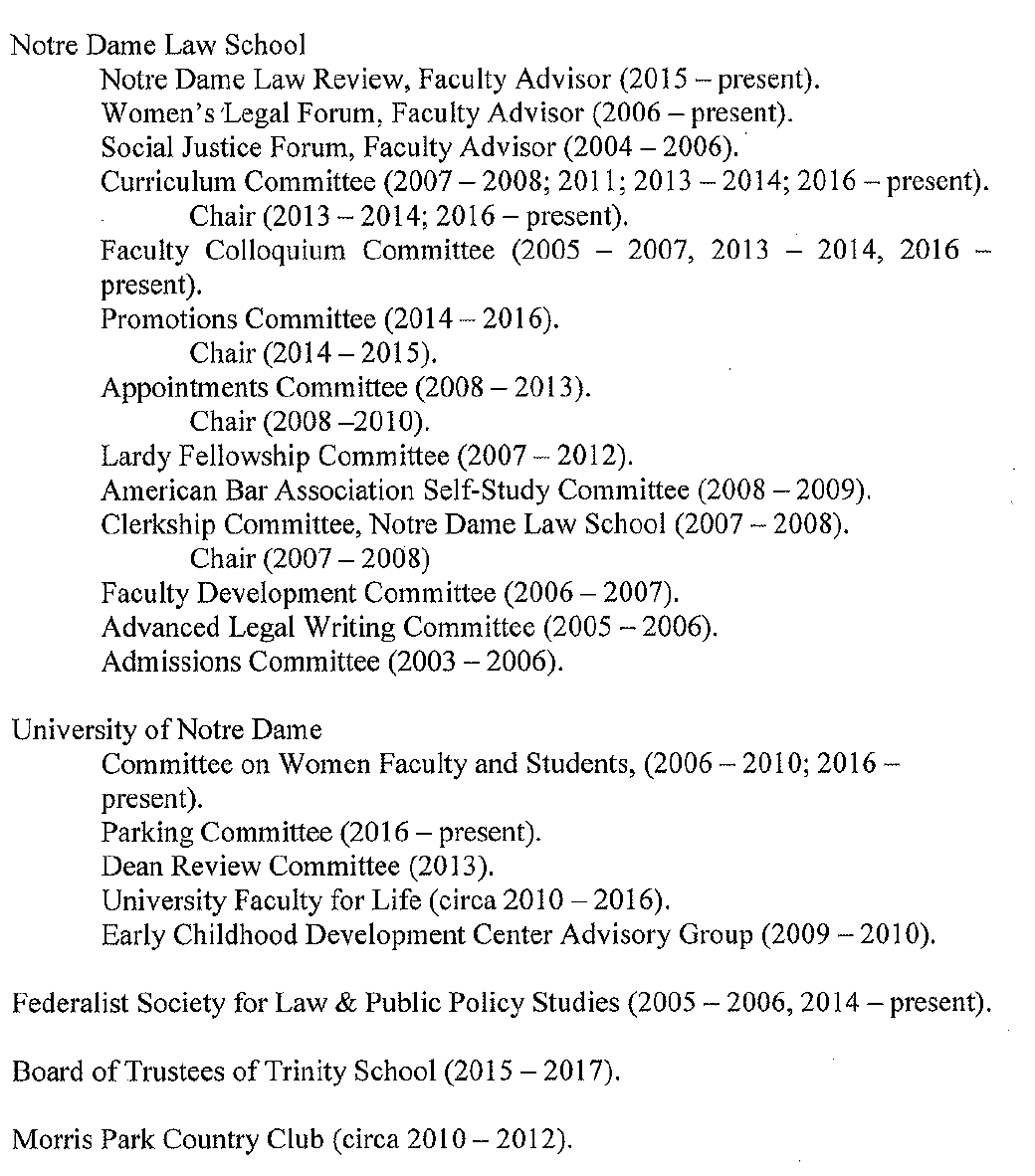
Moreover, Barrett was an academic for a decade. Diversity and inclusion touch every facet of our profession. According to her Senate Judiciary Committee questionnaire, during her time at Notre Dame, she served on the Admissions Committee from 2003-2006. No doubt she gained some insights into how racial preferences operate in higher education. (I served on the Admissions Committee once, and only once, due to my views on affirmative action.)
Barrett's views on Students for Fair Admission may be affected by her personal experiences. Don't presume she lines up with Clarence Thomas.
Now is it proper for me and Driver to draw these inferences? To be sure, we are not acting on any inside information, other than Barrett's public statements and her well-known personal story. But much of what Supreme Court pundits do is amateur psychoanalysis. We take bits and pieces of data that we know, and use that information to make predictions about how a Justice will decide a case. That process can also be retrospective as well. We take bits and pieces of data that we know to explain why a Justice decided a case the way he did.
Short of having a sit-down with a Justice, or reviewing their papers, we are stuck with the written opinion. To fill this void, punditry speculates. Take it for what you paid.