The Volokh Conspiracy

Mostly law professors | Sometimes contrarian | Often libertarian | Always independent | Est. 2002

The Volokh Conspiracy

Maryland Joins Most Other States in How It Names Its Courts

|

By nearly 75%-25%, Maryland voters approved a constitutional amendment that renames the "Maryland Court of Appeals" to "Maryland Supreme Court" (since it's the highest court in the state), and the "Maryland Court of Special Appeals" to "Maryland Appellate Court" (since it's the intermediate appellate court).

I know of no plans for New York to change its approach, which has caused much confusion. West Virginia calls its high court the court the "Supreme Court of Appeals"; Maine and Massachusetts call theirs the "Supreme Judicial Court"; and Texas and Oklahoma have a "Supreme Court" that's the highest court for civil cases and a "Court of Criminal Appeals" that's the highest court for criminal cases.

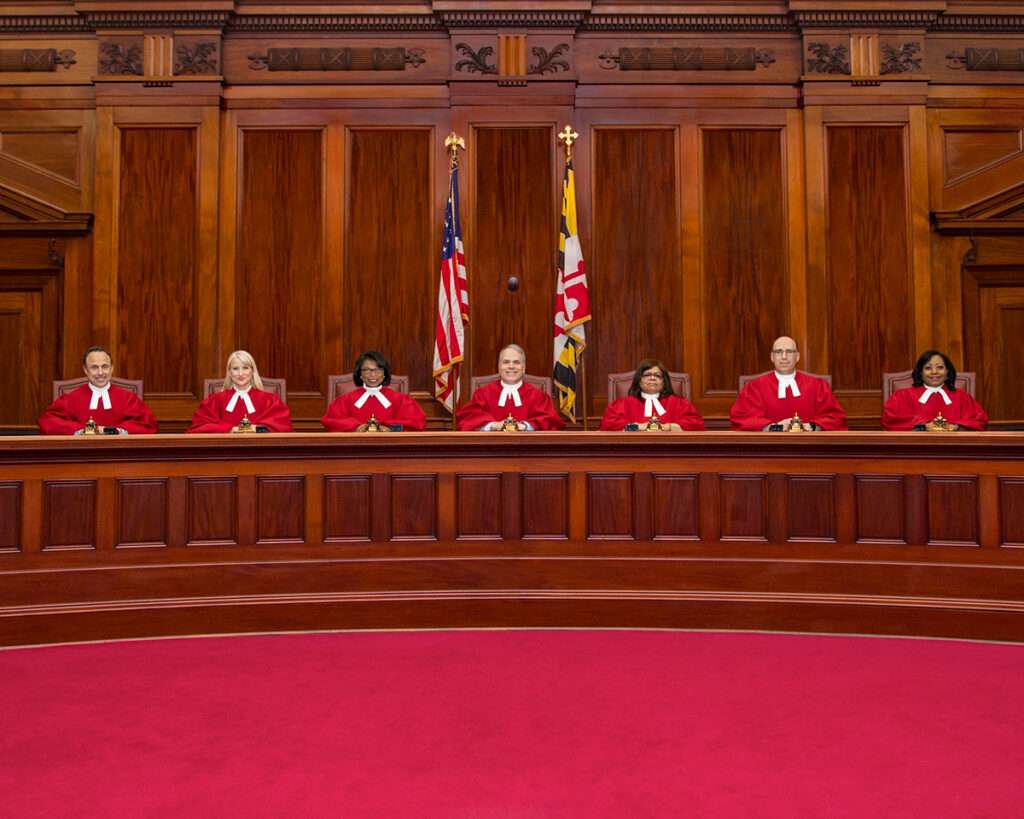
No word on whether there are plans to dye Maryland judicial robes the more familiar black, instead of this:

Source: Maryland Courts site

Thanks to Michael Rosman for the pointer.

UPDATE: @JackGFla points out that I'm behind the times—West Virginia now has an Intermediate Court of Appeals, which was authorized in 2021. Note, though, that the Supreme Court of Appeals web page seems to be also behind the times, still saying that "West Virginia is one of only nine jurisdictions with a single appellate court" (unless I'm misinterpreting that line).

Free Speech

Journal of Free Speech Law: "Hate Speech, Holy Prophets, and Human Rights: The Struggle for Free Speech from 1945–2021,"

by Jacob Mchangama (Justitia), Heini Skorini (Univ. of Faroe Islands) & Mathias Meier (Justitia).

|

Just published, at 1 Journal of Free Speech Law 675 (2022); here's the Abstract:

This article examines how the right to freedom of expression in inter­na­tional human rights law has been a constant source of conflict and poli­tic­al power struggles since the adoption of the Universal Declaration of Hu­man Rights (UDHR) in 1948. Applying both the UN arena as well as the Hel­sinki Process as institutional frameworks, the article examines how prohibitions against hate speech, incitement to hatred, blasphemy, and related legal restrictions have served as a recurrent source of conflict in international diplomacy and in the making of international free speech norms in the postwar period. From the drafting history of the UDHR and the subsequent International Covenant on Civil and Political Rights (ICCPR) to the Helsinki Final Act and contemporary UN resolutions, the article provides an overview and outlines some of the main conflicts and issues regarding the right to communicate freely about cultural, religious, and political issues in the postwar period.

Censorship and repression predate debates surrounding the prohibi­tion of hate speech in international human rights law. And while authori­ta­rian states are likely to use such methods to punish dissent regardless of inter­national standards, this article nonetheless argues that obligations to ban specific categories of speech under human rights law provide formal legitimacy, or at least a façade of legitimacy, to authoritarian restrictions of free expression.

The Annie Leibovitz Limiting Principle for 303 Creative

The ACLU inadvertently explains how Lorie Smith could prevail.

|

On Monday morning, David Cole published a guest essay about 303 Creative in the New York Times. If you thought the legal director of the ACLU would defend the First Amendment rights of Lorie Smith, you obviously have not been paying attention for the last decade. But Cole did defend another artisan's First Amendment rights. Of all people, the photographer Annie Leibovitz! Cole explains that Leibovitz is in a different position than Smith, because her business is not open to the public. Rather, the world-renowned photographer chooses her clients. Therefore, Leibovitz is free to discriminate. Here is Cole's position:

First, no artist has to open a business to the public in the first place. Most writers, painters and other artists never do; they pick their subjects and leave it at that. The photographer Annie Leibovitz, for example, does not offer to take photographs of anyone who offers to pay her fee but chooses her subjects. She is perfectly free to photograph only white people or only Buddhists.

But if Ms. Leibovitz were to open a portrait photography business that offered to take portraits on a first-come, first-served basis to the public at large, as many corporate photography studios do, she could not turn away subjects just because they were Black or Christian. Her photographic work would be just as expressive. But the choice to benefit from the public marketplace comes with the legal obligation to equally serve members of the public. And requiring businesses that offer expressive services in the public marketplace to follow the same rules as all other businesses does not violate the First Amendment.

The Leibovitz example bespeaks how out of touch the ACLU has become. 99.9% of artists cannot afford to "pick their subjects and leave it at that." In order to eat and pay the rent, most artists take whatever work comes to them. And that process invariably means you open your business up to the public. Perhaps when an artist reaches stratospheric heights, like Leibovitz, she can be more choosy with her commissions. But virtually all artists will need some mechanism to advertise their services to the public--whether it is a storefront, a website, or even an Instagram page. And that advertisement would place them squarely in the confines of most public accommodation statutes.

This example also echoed another case pending before the Court this term: Andy Warhol Foundation v. Goldsmith. In the 1980s, Andy Warhol created a series of his distinct silk-screen paintings of the musician Prince. Warhol's prints were made using a photograph taken by photographer Lynn Goldsmith. Most people have heard of Andy Warhol, who has a similar cultural cache as Annie Leibovitz. But few people are familiar with the work of Goldsmith--even though you likely have seen her work. She has photographed some of the most iconic musicians, including Prince, Bob Marley, Bruce Springsteen, and others. Goldsmith contends that a ruling for Warhol would be based, in part, on Warhol's superstardom. Her brief explains:

AWF's [Andy Warhol Foundation's] contention (at 50-51) that "Warhol's unique style is the very thing that gives the Prince Series its distinct message" would treat any "difference in style" as transformative, "weaken[ing] the protection of copy-right." Campbell, 510 U.S. at 599 (Kennedy, J., concur-ring). Under AWF's test, every Warhol-style silkscreen conveys a different message from the original photograph. That "logic would inevitably create a celebrity-plagiarist privilege; the more established the artist and the more distinct that artist's style, the greater leeway that artist would have to pilfer the creative labors of others." Pet.App.27a; see AIPLA Br. 27-28. No one doubts Warhol's artistic innovations. But Warhol charged for his art and AWF will continue profiting, including by vigorously asserting Warhol's copyrights. Fame is not a ticket to trample other artists' copyrights.

And fame is not a ticket for special First Amendment exemptions. Under Cole's arguments, the only artists that could receive a carve-out from the public accommodation laws would be those artists so famous that business falls in their lap. I would never have expected such an elitist argument from the ACLU. Starving artists apparently don't need their constitutional rights.

Yet, implicit in Cole's essay is a rationale why Lorie Smith should prevail. Anne Leibovitz is an artist of one. She is the creative genius that celebrities around the world seek out. If Vanity Fair commissioned Lebovitz to photograph the Vice President, and she offered the contract to a junior associate at the JCPenney Portrait Studio, Vanity Fair would probably decline. In other words, there is only one person on team Leibovitz who has the artistic skill to make the photograph happen. (In fairness, my family takes their portraits at JCPenney's, and is very pleased with the quality of work.)

Now, back to 303 Creative. Lorie Smith has not achieved the superstardom of Annie Leibovitz. It's okay. Most people never will. But Smith still seeks to ply her digital design skills to tell the stories of married couples. Art is art. I'm sure Smith would appreciate the market power in which she could pick and choose her commissions, like Leibovitz does. That's not going to happen. Still, in a way, Lorie Smith resembles Annie Leibovitz: both are the principal artisans in their firm. And if they do not take the job, no one else at the firm would do it.

This dynamic is familiar. Virtually every case involving a wedding service provider involves a small, close-knit company. Elane Photography was owned by a husband and wife. Masterpiece Cakeshop was owned by a husband and wife. Telescope Media was owned by a husband and wife. And 303 Creative has a single employee--Lorie Smith.

The amicus brief for the Jewish Coalition for Religious Liberty, which I co-authored with Howie Slugh, makes an observation:

An obvious pattern emerges from this litigation. These disputes involve not just closely-held companies—like Hobby Lobby—but close-knit companies. There are usually one or two owners, often members of the same family. In Hobby Lobby, only the owners shared religious beliefs, while employees had a wide range of faiths. But for these close-knit firms, the artists who actually perform the creative work share the same religious beliefs, and object to creating a specific wedding-related product. And, in these close-knit firms, the creative work cannot be passed onto another in-house artist with different religious beliefs. Indeed, these artists of faith likely work in such religious-centric businesses precisely so they can follow their beliefs while plying their trade.

In honor of David Cole, let's call it the Annie Leibovitz limiting principle: whatever rule the Court adopts can be limited to such closely-knit firms in which the only artisan(s) who perform the creative services objects to speaking, and no one else at the firm can create those bespoke products. I think this limiting principle would capture almost 100% of the wedding service provider cases of late, which all involve closely-knit firms. And this limiting principle would avoid almost the entire parade of horribles that Colorado and the United States warned about.

I realize that Part I of the JCRL brief made headlines for some humorous hypothetical questions, but Part II, which explains this limiting principle, may prove even more useful.


Free Speech

Journal of Free Speech Law: "When Teachers Misgender: The Free Speech Claims of Public School Teachers," by Prof. Caroline Mala Corbin (Miami)

|

Just published, at 1 Journal of Free Speech Law 615 (2022); from the Introduction:

This Article argues that public school teachers do not and should not have a free speech right to deliberately misgender students in the classroom. Transgender students are already a vulnerable at-risk population, and studies show that misgendering at school increases that risk. Misgendering also deprives trans­gender students of an equal educational opportunity. For a teacher to intentionally misgender students subject to their authority is not only unprofessional but potentially unlawful under federal and state laws banning discrimination in education.

As a matter of doctrine, how teachers address their students in the classroom during class should be considered speech pursuant to their official teaching duties. Under Garcetti, it is essentially government speech with no free speech protection. Granted, the Garcetti Court acknowledged the possibility of an academic freedom exception, but as a descriptive matter it is unlikely that academic freedom covers elementary and high school teachers' deliberate misgendering of the students in their care. As a normative matter, the cloak of academic freedom should not protect classroom speech that is tangential, inaccurate, and harms students, particularly marginalized ones.

In any event, misgendering speech fails the other two requirements for a government employee speech claim: While questions of gender identity are issues of public concern, the teacher's use of pronouns to address a specific student is not a discussion of it. Finally, a teacher's deliberate misgendering is highly disruptive to the school's responsibilities and goals. It is a hindrance to both educating students in the designated curriculum and training them for citizenship. Moreover, the additional responsibilities a school has with regard to the young impressionable students entrusted to its care and captive to their teachers' speech means that its interests in providing an environment where those students can learn and thrive outweigh the slight free speech value of the teacher's misgendering.

We have many more articles coming in the next several weeks.

Free Speech

"Protection of a Defendant's Reputation Is Not a Sufficient Reason to Prevent Public Access to the Docket"

|

From Sela v. Blanshay, decided last week by Justice Arlene Bluth of the New York trial court:

This action arises out of an unpaid debt. Plaintiff and defendant … allegedly entered into a loan agreement for an unspecified amount that went unpaid purportedly due to a debilitating illness…. [Defendant's son] allegedly took over her business and attempted to settle the remaining $30,000 debt with plaintiff. On April 29, 2021, plaintiff filed this motion for summary judgment in lieu of a complaint against defendants based upon defendants' failure to comply with the terms of a loan.

The suit was dismissed by this Court on May 21, 2021 because no affidavit of service was submitted. A separate action was subsequently commenced against all the defendants except Mr. Blanshay.

Mr. Blanshay brings this motion to seal stating he has no affiliation with his mother's jewelry company and has never signed any documents implicating him in this loan agreement. Mr. Blanshay contends that this dismissed action interferes with his ability to conduct business as it defames his name and credibility. He insists the dispute does not involve him. Mr. Blanshay never moved to dismiss the case against him on the merits (although there was no proof that he was ever served before it was dismissed, either).

Read More

Free Speech

Free Speech Rules, Free Speech Culture, and Legal Education: More Responses to Objections

|

I was invited to participate in a Hofstra Law Review symposium on free speech in law schools, which will be happening in February, and I thought I'd serialize my current draft article; there's still plenty of time to improve it, so I'd love to hear people's comments. Here are some responses to possible objections to my general thesis (see the Introduction for a quick summary), though you can read the whole PDF, if you prefer:

[* * *]

B. Vulnerability of Powerless Minority Groups

Some might argue that the presence of certain views or speakers in the law school (or in law school classes) is particularly harmful for powerless minority groups who feel hated or even threatened by the powerful. If the speech is allowed by the institution, then those groups will also feel unwanted and disrespected by the institution.

But of course speech suppression isn't generally targeted at the truly powerful, since if the targets were so powerful, they would be easily able to defeat the suppression. Rather, the targets of the suppression I describe here are invariably speakers that have comparatively little power in law schools—speakers whose views are sharply at odds with the views endorsed by the administration.

Conversely, the suppression takes place precisely because the groups that the suppression is meant to protect have powerful allies—either vocal student advocacy organizations, or often the administration itself. Perhaps outside the law school, the suppressed groups may indeed have political power. But in the law school, the speech restrictions fit well with the story of speech restrictions throughout history: The comparatively powerful are trying to suppress the speech of the comparatively powerless.

Read More

Those Confusing New Yorkers: A Reminder That the New York Supreme Court Is the Trial Court

|

From NBC News' article, Herschel Walker's Loss Is Just More Bad News for Trump:

Two Trump companies were found guilty of criminal tax fraud in New York's highest court Tuesday.

The verdict did happen in the Supreme Court in New York, but that's not the highest court in New York; rather, it's a trial court. Above that is the Appellate Division, which is the intermediate court, and then the Court of Appeals, which is indeed New York's highest court. Worth remembering.

Thanks to Bruce Wessel for the pointer.

Free Speech

Computer Code Can Be Regulated Because of What It Does, Even If Not Because of What It Says

The D.C. Circuit rejects a First Amendment challenge to the Digital Millennium Copyright Act's anticircumvention and antitrafficking provisions.

|

From today's D.C. Circuit decision in Green v. U.S. Dep't of Justice, written by Judge David Tatel and joined by Judges Judith Rogers and Justin Walker:

In this digital age, when content creators choose to make their copyrighted materials—like books, movies, and music—available online, they employ computer code to block unauthorized access, copying, and use. To fortify the protection offered by that code, Congress enacted the Digital Millennium Copyright Act, which makes it unlawful to bypass such technological measures. The question in this case, which comes to us at the preliminary injunction stage, is whether the statute is likely to violate the First Amendment rights of two individuals who write computer code designed to circumvent those measures. The district court answered no, and we agree….

[T]he Digital Millennium Copyright Act (DMCA) … "back[s] with legal sanctions the efforts of copyright owners to protect their works from piracy behind digital walls such as encryption codes or password protections." … First, the statute's anticircumvention provision prohibits "circumvent[ing] a technological measure that effectively controls access to a [copyrighted work]." A "technological measure," also called a "technological protection measure," effectively controls access to a work if it, "in the ordinary course of its operation, requires the application of information, or a process or a treatment, with the authority of the copyright owner, to gain access to the work." For example, Netflix requires a password to access its digital movie catalog, and electronic books contain code that prevents readers from copying the book into another format. Circumvention occurs when someone descrambles a scrambled work, decrypts an encrypted work, or otherwise avoids, bypasses, removes, deactivates, or impairs a technological measure, without authority from the copyright owner.

The statute's second principal provision—the antitrafficking provision—works together with the anticircumvention provision to target the technological tools that facilitate circumvention. It prohibits "manufacturing, importing, offering to the public, providing, or otherwise trafficking in any technology, product, service, device, component, or part thereof" if it (1) "is primarily designed or produced for the purpose of circumventing a technological measure that effectively controls access to a [copyrighted] work;" (2) "has only limited commercially significant purpose or use other than to circumvent;" or (3) "is marketed … for use in circumventing." Those who violate either the anticircumvention or antitrafficking provision are subject to civil actions and criminal sanctions….

Read More

Free Speech

Ninth Circuit Orders Press Pass for The Gateway Pundit, Pending Appeal

The press pass is for election-related events connected to Maricopa County's ongoing ballot counting; the panel concluded that The Gateway Pundit was likely to succeed on its claim that the denial was unconstitutionally based on its viewpoints.

|

From the Ninth Circuit's order yesterday in TGP Communications, LLC v. Sellers; the order was issued by the merits panel that will hear the case (though it's not signed by particular judges because the panel has not yet been publicly identified), so it offers an important (though not definitive) clue as to the judges' likely eventual conclusions:

On November 8, 2022, the United States held its mid-term elections. Nearly a month later, Maricopa County continues to count those cast ballots. As a result, press attention remains fixed on Arizona, the election results and the ballot counting. To balance the demand for access with logistical and security requirements, Maricopa County began requiring members of the press to obtain a press pass to enter its facilities to cover election-related events. Jordan Conradson, a reporter for The Gateway Pundit, the trade name of TGP Communications, LLC …, sought a press pass to attend press briefings about the election. Maricopa County and individual Appellees denied Conradson a press pass because, in their view, he is not a reputable journalist under their press-pass guidelines and had reported false information about Arizona elections.

Plaintiffs sought a temporary restraining order, arguing that the press-pass criteria were unconstitutional. They sought, among other forms of relief, access to the County press briefings. After an evidentiary hearing, the district court denied injunctive relief.

The court granted an injunction pending appeal, largely because "At least at this preliminary stage, Appellants have shown a likelihood of success on the merits":

Read More

Free Speech

Prof. Michael McConnell (Stanford) on 303 Creative (the Web Site Designer / Same-Sex Wedding Case)

|

Prof. McConnell is one of the top First Amendment law scholars in the country, and I was delighted that he passed along this item:

Much of the commentary on today's argument in 303 Creative starts from the premise that the case pits free speech (or maybe religious freedom) against LGBTQ rights. The headline in The Economist reads: "A new Supreme Court case may dampen protections for LGBT people." Anyone listening carefully to the argument will discover that this framing is off the mark. Both sides in the argument were peppered with hypotheticals—some of them bizarre—about other possible scenarios if the Colorado law that has been interpreted to require a web designer to use her talents to celebrate a same-sex wedding is upheld. Or struck down. The hypotheticals involved all manner of speech on one side or the other of questions related to discrimination of one sort or another—religious discrimination, political belief discrimination, pro-LGBT advocacy, and any other messages you can imagine that involve one group favored over another.

One thing is clear from the argument: 303 Creative is not about whether protections for LGBT people will be dampened. The decision will apply across the board. The question is whether civil rights protections properly include the suppression of speech that disagrees with legal norms, or compels speech that celebrates those norms. Alternatively: do artists (including web designers) have the freedom to depict what subjects they wish, and how—even if they take money for doing it, and even if their perspective is hurtful (to some people)?

One of the most telling exchanges during the argument involved a hypothetical from Justice Barrett, who asked the Deputy Solicitor General Brian Fletcher (whom I consider a friend: full disclosure), supporting the Colorado law, what would happen if the shoe were on the other foot—i.e., what if a gay web designer declined to create a custom website for a Christian organization that advocates for traditional marriage? Could the state compel such a person to design such a website?

Read More

Consumer Financial Protection Bureau

The Federal Government Can't Seem to Decide How the CFPB Is Funded

The Solicitor General's brief defending how the CFPB is funded contradicts what the agency and others have said in the past.

|

A recent decision by the U.S. Court of Appeals for the Fifth Circuit concluded that the funding mechanism for the Consumer Financial Protection Bureau is unconstitutional because it makes the agency too independent from the political branches. Specifically, the Fifth Circuit concluded that it was unconstitutional to allow a regulatory agency to bypass the appropriations process and, in effect, set its own budget.

As expected, the Solicitor General has filed a petition for certiorari with the Supreme Court seeking review of the Fifth Circuit's decision. Among other things, this brief argues that the CFPB's budget is properly appropriated. Yet as Adam White notes in the Wall Street Journal, this contradicts what the CFPB, its creators and others have said about the CFPB's funding in the past.

[The SG's] petition, filed Nov. 14, makes a remarkable claim: that the CFPB's self-funding power is constitutional because Dodd-Frank itself satisfies the Constitution's requirement. The CFPB and the Justice Department argue that the statute's grant of perpetual funding, in the amount determined each year by the CFPB director, "indisputably establishes an appropriation under the long-accepted understanding of that term." . . .

But in making its argument to the court, the CFPB and Justice Department's joint brief left out a crucial point: Throughout its entire history, the CFPB itself has consistently declared that its funding doesn't come from "appropriations":

  • The CFPB's first director, Richard Cordray, testified to Congress in 2012 that the CFPB's revenues were "non-appropriated funds."
  • The CFPB's 2013 strategic plan asserted that by "providing the CFPB with funding outside of the congressional appropriations process," lawmakers had ensured the bureau's "full independence." . . .
  • Since 2013, the CFPB's financial reports consistently called the bureau "an independent, non-appropriated" agency. The most recent such report states: "The Dodd-Frank Act explicitly provides that Bureau funds obtained by or transferred to the CFPB are not government funds or appropriated funds." That report was released Nov. 15, the day after the bureau filed its Supreme Court petition. . . .

The CFPB isn't alone in describing its funding as something other than "appropriations." When Congress designed the agency, a Senate Banking Committee report found that a guarantee of "adequate funding, independent of the Congressional appropriations process," would be "absolutely essential" to the agency's "independent operations." That theme has persisted among the CFPB's advocates in Congress. In 2018, 40 Democratic senators opposed a proposal to return the bureau to Congress's appropriations power. They wrote that "the CFPB receives its funding from the Federal Reserve, rather than from the Congressional appropriations process" to "ensure its independence."

In short, the CFPB and its advocates have always understood that its money didn't come from "appropriations." This was a feature, not a bug—until it became clear that such "full independence" from Congress's power was an invitation to constitutional scrutiny.

I suspect that these prior characterizations will be featured in the opposing briefs and will be raised in oral argument if (as I expect) the Supreme Court grants certiorari. As White notes, the whole point of this funding structure was to make the CFPB more independent. Yet these efforts to make this powerful agency independent of both Congress and the President are precisely what raises constitutional concerns.

Just because the CFPB has an unusal funding structure does not necessarily mean that it is unconstitutonal. Other federal entities, including the Federal Reserve, are funded in a somewhat similar fashion. Further, as Will Baude noted here, Zach Price has argued that the Fifth Circuit was wrong, and that the CFPB's funding structure is misguided, but constitutional. But it is one thing to argue that the CFPB is funded in a constitutional manner. It is quite another to claim the CFPB is not funded the way everyone has always understood.

Free Speech

First Amendment Retaliation Claim by Virginia Tech Player Who Didn't Kneel for "Unity Statement" Can Proceed

|

From Hening v. Adair, decided Friday by Judge Thomas Cullen (W.D. Va.):

Plaintiff Kiersten Hening, a former member of the Virginia Tech women's soccer team, filed this suit under 42 U.S.C. § 1983 against her former coach, Charles "Chugger" Adair. Specifically, Hening alleges that, after she refused to kneel in support of social-justice initiatives, including Black Lives Matter ("BLM"), prior to the team's 2020 season opener against the University of Virginia ("UVA"), Adair retaliated against her in violation of the First Amendment. According to Hening, as a direct result of her refusal to kneel while a "Unity Statement" was read over the loudspeakers, Adair berated her at halftime in front of her teammates, and again at a film-review session the following week, for "bitching and moaning" and "doing [her] own thing."

{On September 3, 2020, the Atlantic Coast Conference's ("ACC") Committee for Racial and Social Justice announced that, in addition to creating an ACC Unity Symbol and implementing mandatory "diversity and inclusion training for student-athletes" focused on "anti-racism," a Unity Statement would be read before every ACC event. This Unity Statement provided: "We, the ACC, are committed to seeing each other as equals, supporting each other, and treating each other with respect and dignity at all times, recognizing that our differences don't divide us, but they make us stronger." As this Unity Statement was read prior to the UVA game, all but three of the players and coaches from both teams kneeled in an apparent show of support. Hening and two of her teammates declined to kneel.}

Adair, on the other hand, claims that he was unaware until after the UVA game that Hening had declined to take a knee and that his vocal criticism of Hening at halftime and the following week—during which he never directly mentioned the Unity Statement or her refusal to kneel—was based solely on her poor play. Hening, who had been a major on-field contributor for two years prior to the 2020 season, also asserts that Adair removed her from the starting lineup for the next two games and drastically reduced her playing time in those games because she had engaged in this protected First Amendment activity. As a result, Hening resigned from the team after the third game of the season….

It is well-established that the First Amendment's protection of freedom of speech includes "both the right to speak freely and the right to refrain from speaking at all." As a necessary corollary to protect that fundamental right, the "right of free speech includes … the right to be free from retaliation by a public official for the exercise of that right." To establish a claim for First Amendment retaliation, Hening must put forth sufficient evidence that: (1) she engaged in protected First Amendment activity; (2) Adair took some action that adversely affected her First Amendment rights; and (3) there was a causal relationship between her protected activity and Adair's actions.

Read More

Free Speech

Free Speech Rules, Free Speech Culture, and Legal Education: Responses to Objections

|

I was invited to participate in a Hofstra Law Review symposium on free speech in law schools, which will be happening in February, and I thought I'd serialize my current draft article; there's still plenty of time to improve it, so I'd love to hear people's comments. Here are some responses to possible objections to my general thesis (see the Introduction for a quick summary), though you can read the whole PDF, if you prefer:

[* * *]

To be sure, speech has costs as well as benefits. My point so far has been that exposing law students to important mainstream views, even ones that many students find to be offensive or downright evil, has benefits that are even more substantial than normal for speech to the public at large. But beyond that, the costs of doing so are less substantial than normal.

A. Student Upset (Especially as to Views That Are Seen as Derogatory of Their Identities)

Many students may doubtless be upset by certain kind of speech, especially if they view it as derogatory towards their identities. Gay and lesbian students, for instance, may understandably take personally speech that (say) proposes a rejection of same-sex marriage, a return to "Don't Ask, Don't Tell" in the military, or a return to Bowers v. Hardwick. Transgender students, or their family, friends, and other supporters may take personally speech that urges excluding transgender athletes from women's sports. Immigrant students may be upset by speech that criticizes immigration, especially immigration from their own countries of origin. Many students, and especially black students, may be upset at speech that they see as unfairly criticizing Black Lives Matter, or that they see as unfairly exaggerating the magnitude of black-on-black crime.[1]

Many Muslim students may be upset at speech that they see as unfairly condemning Islam, or even at speech that they see as blasphemous towards Islam, such as reproduction of the Mohammed cartoons. Many women may be upset at criticism of abortion rights, which they see as promoting the subordination or even enslavement of women.[2] Black and Hispanic students may be upset at criticism of race- and ethnicity-based affirmative action, which they may see as an implied suggestion that they (or many others like them) don't deserve to be at the law school.

Likewise, conservative Christian students may be upset at speech that calls their religious views bigoted or irrational. Students whose families come from Israel, or even many Jewish students more broadly, may be upset at speech that they view as unfairly targeting Israel for criticisms that aren't levied at other countries.[3] Children, siblings, or spouses of police officers may be upset at speech that they see as unfairly suggesting that all police officers are racist or brutal (and especially at speech that defends the propriety of violence against police officers).[4]

People who see themselves as survivors of abortion[5]—perhaps because they know their mothers had almost decided on abortion, or because they know that their mothers had terminated pregnancies that would otherwise have produced their brothers or sisters—may be upset at hearing abortion rights praised. Cuban-Americans may be upset at people who praise (or, worse still, represent) the regime that their parents had to flee, or that had killed their family members.[6]

Read More

Politics

Did You Like The First Edition of 100 Cases? Please Leave a Comment for the Second Edition.

Amazon, alas, does not carry over our 1,000+ positive comments from the first edition to the second edition.

|

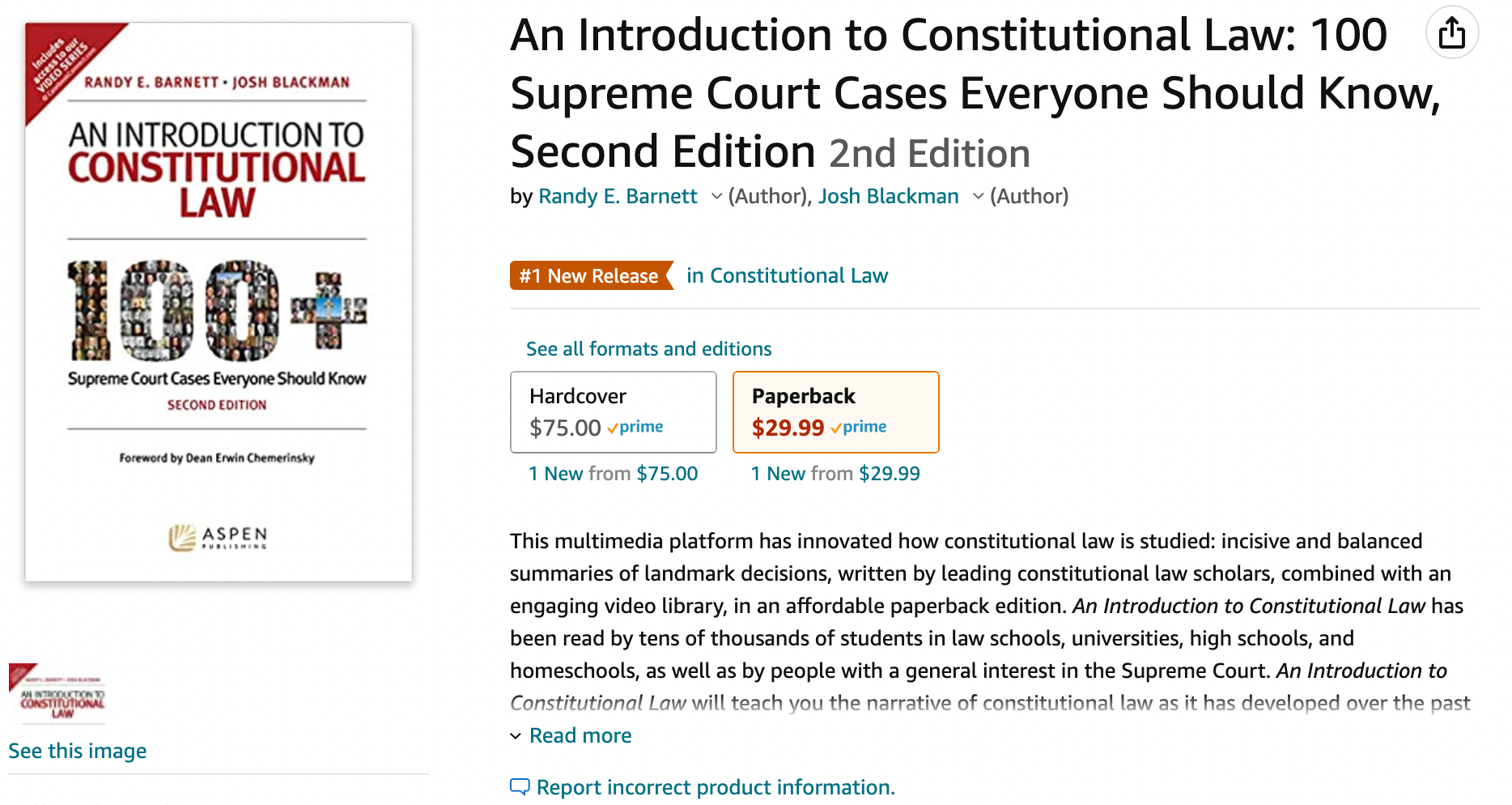
The Second Edition of An Introduction to Constitutional Law is now shipping on Amazon. It has been the top-seller in the Constitutional Law category since its release. Alas, the book currently has no reviews. Amazon does not carry over the feedback from one edition to the next, even though the book is substantially similar.

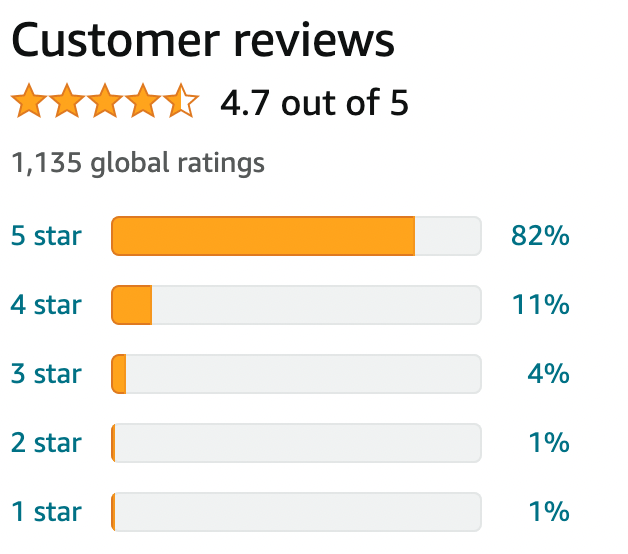
The First Edition, released in 2019, has 1,135 reviews, which averaged 4.7.

Can I ask a favor? If you left a review on the First Edition, could you leave the same review for the Second Edition? To make the process simple, you can see all of the reviews you left on the First Edition with your profile page. Thanks!

Free Speech

Rep. Khanna on Twitter, Free Speech, and the Hunter Biden Story

A Democratic member of Congress laments how Twitter handled the New York Post's reporting on Hunter Biden's laptop.

|

Last Friday, Twitter released internal e-mails and other files related to the company's decision to suppress the New York Post's reporting about on the contents of Hunter Biden's recovered laptop in advance of the 2020 election. The materials were released through a Twitter thread by independent writer Matt Taibbi,

In today's WSJ, Democratic Representative Ro Khanna explains why he laments Twitter's handling of the controversy, even though it may have benefitted his political party.

Twitter's suppression [of the Hunter Biden story] violated the First Amendment principles Brennan articulated in [New York Times v.] Sullivan. Twitter banned links to the story and suspended accounts that shared it, including President Trump's press secretary and the New York Post itself—arguing that the story violated company policy because it contained information obtained through illegal means. Under the same logic, they'd have to suspend any account that posted the Pentagon Papers, which is protected by New York Times Co. v. U.S. (1971), or the story of Mr. Trump's leaked tax returns.

As Silicon Valley's representative in Congress, I reached out to Twitter at the time to share these concerns. In an email meant to be private, but recently made public by Matt Taibbi's "Twitter Files" thread, I wrote to Twitter's general counsel that the company's actions "seemed to be a violation of First Amendment principles." Although Twitter is a private actor not legally bound by the First Amendment, Twitter has come to function as a modern public square. As such, Twitter has a responsibility to the public to allow the free exchange of ideas and open debate.

Unlike many who comment on such controversies, Rep. Khanna recognizes that whether a company like Twitter is legally obligated to respect free speech principles is a seprate question from whether it is desirable or beneficial for it to do so. That Twitter is not required to provide a robust forum for divergent views and perspectives does not mean it should not do so. Put another way, pointing out that Twitter is not bound by the First Amendment is no answer to criticism of Twitter for selectively suppressing speech or information that is disagreeable or disfavored.

More from Rep. Khanna:

I agreed with Twitter's decision to take down explicit photos of Hunter Biden and to prevent algorithmic amplification of the Post story. But there's a difference between sharing and artificially amplifying. Social-media companies shouldn't have bots that amplify speech in the first place—they add chaos to the dialogue. They certainly shouldn't be abusing people's data by using it to target them with sensational content. We need to uphold the sovereign right to our data. Even so, the story itself shouldn't have been censored, and those who shared it shouldn't have been suspended. That went too far.

To the extent Twitter makes value decisions on the forum—types of conspiracy theories or hate-inciting content that gets removed or isn't promoted—the company should have clear and public criteria. Elon Musk has said Twitter will be "more aggressive than ever, using technology to reduce the reach of hateful Tweets and prevent their amplification." Transparency into how decisions are made, including some recourse to appeal, is crucial—with some independent committee or board that will thoughtfully consider a complaint of censorship.

A robust defense of First Amendment principles online is more important than ever. Citizens in our polarized country need to have conversations with each other based on mutual respect. Suppressing speech we don't like leaves us blind to alternative perspectives that help us see the whole, complex truth.

Location, Location, Location

Episode 433 of the Cyberlaw Podcast

|

This episode of the Cyberlaw Podcast delves into the use of location technology in two big events – the surprisingly widespread lockdown protests in China and the January 6 riot at the U.S. Capitol. Both were seen as big threats to the government, and both produced aggressive police responses that relied heavily on government access to phone location data. Jamil Jaffer and Mark MacCarthy walk us through both stories and respond to my provocative question: What's the difference? Jamil's answer (and mine, for what it's worth) is that the U.S. government gained access to location information from Google only after a multi-stage process meant to protect innocent users' information, and that there is now a court case that will determine whether the government actually did protect users whose privacy should not have been invaded.

Whether we should be relying on Google's made-up and self-protective rules for access to location data is a separate question. It becomes more pointed as Silicon Valley has started making up a set of self-protective rules penalizing companies that assist law enforcement in gaining access to phones that Silicon Valley has made inaccessible. The movement to punish such law enforcement access providers has moved from trashing companies like NSO, whose technology has been widely misused, to punishing companies on a lot less evidence of wrongdoing. This week, TrustCor lost its certificate authority status mostly for looking suspiciously close to the National Security Agency and Google outed Variston of Spain for ties to a vulnerability exploitation system. Nick Weaver is happy to hose me down.

The UK is working on an online safety bill, likely to be finalized in January, Mark reports, but this week the government agreed to drop its direct regulation of "lawful but awful" speech on social media. The step was a symbolic victory for free speech advocates, but the details of the bill before and after the change suggest it was more modest than the brouhaha suggests.

The Department of Homeland Security's Cyber Security and Infrastructure Security Agency (CISA) has finished taking comments on its proposed cyber incident reporting regulation. Jamil summarizes industry's complaints, which focus on the risk of having to file multiple reports with multiple agencies. Industry has a point, I suggest, and CISA should take the other agencies in hand to reach agreement on a report format that doesn't resemble the State of the Union address.

It turns out that the collapse of FTX is going to curtail a lot of artificial intelligence (AI) safety research. Nick explains why, and offers reasons to be skeptical of the "effective altruism" movement that has made AI safety one of its priorities.

Today, Jamil notes, the U.S. and EU are getting together for a divisive discussion of U.S. subsidies for electric vehicles (EV) made in North America but not Germany. That's very likely a World Trade Organization (WTO) violation, I offer, but one that pales in comparison to thirty years of European WTO-violating threats to constrain data exports to the U.S. When you think of it as retaliation for the use of EU privacy law to attack U.S. intelligence programs, the EV subsidy is easy to defend.

I ask Nick if we learned anything new this week from Twitter coverage. His answer – that Elon Musk doesn't understand how hard content moderation is – doesn't exactly come as news. Nor, really, does most of what we learned from Matt Taibbi's review of Twitter's internal discussion of the Hunter Biden laptop story and whether to suppress it. Twitter doesn't come out of that review looking better. It just looks bad in ways we already suspected were true. One person who does come out of the mess looking good is Rep. Ro Khanna (D., Calif.), who vigorously advocated that Twitter reverse its ban, on both prudential and principled grounds. Good for him.

Speaking of San Francisco Dems who surprised us this week, Nick notes that the city council in San Francisco approved the use of remote-controlled bomb "robots" to kill suspects. He does not think the robots are fit for that purpose.

Finally, in quick hits:

Download the 433rd Episode (mp3)

You can subscribe to The Cyberlaw Podcast using iTunes, Google Play, Spotify, Pocket Casts, or our RSS feed. As always, The Cyberlaw Podcast is open to feedback. Be sure to engage with @stewartbaker on Twitter. Send your questions, comments, and suggestions for topics or interviewees to CyberlawPodcast@steptoe.com. Remember: If your suggested guest appears on the show, we will send you a highly coveted Cyberlaw Podcast mug!

The views expressed in this podcast are those of the speakers and do not reflect the opinions of their institutions, clients, friends, families, or pets

More