The Volokh Conspiracy

Mostly law professors | Sometimes contrarian | Often libertarian | Always independent | Est. 2002

The Volokh Conspiracy

Free Speech

Misdemeanant / Senate Candidate Don Blankenship Loses Appeal Over News Outlets' Calling Him "Felon"

|

From Blankenship v. NBCUniversal, LLC (4th Cir.), decided Wednesday by Chief Judge Roger Gregory, Judge Paul Niemeyer, and District Judge Patricia Tolliver Giles (E.D. Va.):

Following an unsuccessful campaign for one of West Virginia's U.S. Senate seats, Don Blankenship sued numerous media organizations and individual journalists [including Fox News, CNN, MSNBC, ABC, the Washington Post, and more], alleging defamation, false light invasion of privacy, and civil conspiracy. Blankenship's claims arise from misstatements of his criminal record: he was convicted and served one year in prison for a federal conspiracy offense that is classified as a misdemeanor, but Defendants made statements describing him as a "felon." …

At the outset, Defendants argue that we can affirm the district court's decisions [in favor of defendants] on the alternative ground that none of the challenged statements were actionably false. The district court, of course, reached the opposite conclusion. But Defendants contend that a "felony" is often understood to refer colloquially to serious crimes, and that there is no question Blankenship's conviction and sentence were serious. Here, we will simply assume that Defendants' statements satisfy the falsity element because we can instead resolve Blankenship's claims based on the actual malice element….

Read More

Criminal Law

Having Jury Deliberate During Start of COVID Pandemic Didn't Deprive Murder Defendant of Fair Trial

The mentally ill defendant "testified and described how shooting white people was part of his divine, preordained mission to establish 'a kingdom of infinite peace and progress.'”

|

From People v. Muhammad, decided Wednesday by the California Court of Appeal, in an opinion by Justice Kenneth Yegan, joined by Justices Arthur Gilbert & Hernaldo Baltodano:

Here we hold that allowing a jury to deliberate during the COVID pandemic is not coercive and does not deprive a defendant of the due process of law.

A jury convicted appellant Kori Muhammad of [murder and other charges]…. The trial court sentenced appellant to a total determinate term of 61 years in prison plus an indeterminate term of 145 years to life…. Appellant murdered four people during a 2017 shooting spree in Fresno. The People charged him with first degree murders and initially sought death penalty. Defense counsel conceded appellant committed the crimes but claimed he did so while suffering from symptoms of paranoid schizophrenia, including auditory, visual, and olfactory hallucinations. His trial took place over 31 days in February, March, and April of 2020.

Defense experts testified how mental illness skewed appellant's perception of his environment and caused him to fixate on racial tensions. Appellant testified and described how shooting white people was part of his divine, preordained mission to establish "a kingdom of infinite peace and progress."

Appellant's trial occurred during the COVID pandemic. The trial court directed jurors to sit farther apart and to isolate themselves as much as possible when they returned home each day after trial. When the defense rested on March 17, the trial court ordered jurors to return for closing argument on March 19 and assured them it would secure a spacious room for deliberations. Counsel and the trial court agreed to distribute an anonymous questionnaire gauging jurors' willingness to proceed during the perceived health crisis. All of the jurors responded that they preferred to finish the trial. Statewide court closures, however, required the trial court to halt deliberations after just one day.

Read More

Justice Sotomayor: Summary Reversal on the "Shadow Docket" Caused A "Significant Change" In Federal Law

Justice Barrett countered that the SumRev "did not change the content of federal law."

|

On Wednesday, the Supreme Court decided Cruz v. Arizona. The posture here is a bit complicated. Simmons v. South Carolina (1994) held that during sentencing, the judge must notify the jury that a defendant would be ineligible for parole. For some time, the Arizona courts held that the state's sentencing scheme did not trigger application of Simmons. In Lynch v. Arizona (2016), the Supreme Court summarily reversed the Arizona Supreme Court, holding that the failure to apply Simmons was an error.

Cruz filed a motion for state postconviction relief based on Arizona Rule of Criminal Procedure 32.1(g). Cruz argued that Lynch caused "a significant change in the law that, if applicable to the defendant's case, would probably overturn the defendant's judgment or sentence." The Arizona Supreme Court, relying on Rule 32.1(g), held that Lynch did not cause a "significant change in the law."

On appeal, the United States Supreme Court held that the Arizona Supreme Court was wrong about Lynch, which did cause a "significant change" in the law. Moreover, the state court's interpretation of its rule could not be deemed an "adequate and independent state-law ground for the judgment." (Abbreviated in the lingo as an AISG) The vote here split 5-4. The Chief Justice and Justice Kavanaugh allowed Justices Sotomayor, Kagan, and Jackson to form a majority opinion. Justice Barrett wrote a dissent, which was joined by Justice Thomas, Alito, and Gorsuch.

Based on my quick read, I am inclined to agree with Justice Barrett's dissent. In the past, the bar for finding an AISG was quite high. The dissenters would let state courts perform their own role. Let 51 imperfect solutions bloom. Alas, the members of the majority tend to favor federal judicial supremacy.

My interest here focuses on a narrow aspect of the opinion: Lynch was a summary reversal. A so-called "SumRev" occurs when the Supreme Court, in one fell swoop, grants a petition for writ of certiorari, vacates/reverses the lower court judgment, and remands the case for further proceedings. A SumRev is decided without the benefit of oral argument, and the majority opinion is generally signed per curiam.

Justice Thomas dissented in Lynch, joined by Justice Alito. (Justice Scalia had passed away three months earlier.) Thomas faulted the Court for deciding the case as a SumRev:

Today's decision—issued without full briefing and argument and based on Simmons, a fractured decision of this Court that did not produce a majority opinion—is a remarkably aggressive use of our power to review the States' highest courts.

We are incessantly told that the Supreme Court should not make "significant changes" in the law on the so-called "Shadow Docket." Yet, the holding of Cruz is that Lynch--a per curiam case decided without the benefit of oral argument and full-dress briefing--caused a "significant change" in the law. Indeed, in Lynch, the Supreme Court overruled many decisions from the Arizona Supreme Court. Moreover, Lynch was decided with an in forma pauperis petition. There were not even any amicus briefs filed!

Justice Sotomayor explained:

The dissent argues that this case did present a new context because the Arizona Supreme Court had never before applied Rule 32.1(g) to a summary reversal. There was no reason, however, to treat this case any differently than past cases. Whereas the Arizona Supreme Court had previously looked to the effect of an intervening federal or state decision on Arizona law, supra, at 9–10, here it focused exclusively on whether there had been a change in federal law. The court thus disregarded that Lynch overruled "previously binding case law" in Arizona, the "archetype" of a significant change in the law.

The shadow docket! It slices! It dices! It makes julienne fries! Is there anything a SumRev cannot do?

Justice Barrett disagreed. She countered that Lynch did not "change any legal doctrine."

Cruz's case, however, raised a question of first impression: whether a "significant change" occurs when an intervening decision reaffirms existing law, but rectifies an erroneous application of that law. That was the effect of Lynch v. Arizona, 578 U. S. 613 (2016) (per curiam), which corrected the Arizona Supreme Court's application of Simmons v. South Carolina, 512 U. S. 154 (1994) (plurality opinion), and its progeny. An intervening decision like Lynch, which undisputedly did not change any legal doctrine, has no analog in Arizona's Rule 32.1(g) jurisprudence. . . . Lynch, by contrast, did not change the content of federal law and therefore did not change the law in Arizona. 

There you have it.

On Wednesday, I did a debate on the Second Amendment at the University of Texas with Steve Vladeck, my old sparring partner. Steve mentioned that his new book about the "Shadow Docket" will soon go to press. It may be too late, but Cruz v. Arizona may warrant a mention.

Crime

Victims' Families File Petition in the Fifth Circuit Seeking to Enforce Rights in the Boeing Case

The families argue that they should have been given an opportunity to confer with prosecutors under the Crime Victims' Rights Act before Boeing's deferred prosecution agreement was finalized.

|

Earlier today, I filed a Crime Victims' Rights Act (CVRA) petition in the Fifth Circuit for families whose relatives were killed in two Boeing 737 MAX crashes. The petition argues that the U.S. District for the Northern District of Texas (O'Connor, J.) erred in ruling that it could not provide a remedy for the Justice Department's failure to confer with the families before the Department finalized its deferred prosecution agreement (DPA) with Boeing. I've blogged about this case previously - including posts about the initial CVRA challenge, the district court's ruling finding "victim" status, and the district court's recent ruling finding that the families could not enforce their rights. In this post, I summarize the arguments in the petition for overturning the district court's recent ruling.

As discussed in earlier posts, the case arises from the Justice Department secretly negotiating a DPA with Boeing, immunizing it from prosecution for its crime of concealing safety information about the 737 MAX from the FAA. The district court had previously ruled that the families represented "crime victims" under the CVRA, because Boeing's crime  directly and proximately caused the  two Boeing 737 MAX crashes. (If you're interested in the topic of how to define a "victim" in the CVRA and other enactments, I've just released a co-authored law review article on the issue.) And the court had previously ruled that the Justice Department had violated the families' CVRA right to confer with prosecutors by secretly cutting the deal. But two weeks ago, in a thirty-page opinion, the district court ruled that it could not enforce the families' rights.

In the petition, I argue that the district court was, indeed, empowered to enforce the families' rights. Here's the introduction (some citations removed):

This case arises out of "the deadliest corporate crime in our nation's history." As the district court found, Boeing's conspiracy to defraud the FAA directly and proximately killed 346 people—leaving behind 346 grieving families. Congress gave those families rights under the Crime Victims' Rights Act. But the Government cared more about protecting Boeing's reputation than the families' rights.  It misled the families as to whether a criminal investigation existed and then secretly cut a deferred prosecution deal without informing the families at all.

Among the rights that Congress protected was a victim's "reasonable right to confer" with prosecutors. 18 U.S.C. § 3771(a)(5). And in 2015, Congress reinforced this right, by mandating that a victim has "[t]he right to be informed in a timely manner of any . . . deferred prosecution agreement." 18 U.S.C. § 3771(a)(9). And Congress has broadly protected crime victims' rights "to be treated with fairness." 18 U.S.C. § 3771(a)(8).

The reason Congress established these rights is straightforward. As this Court explained in In re Dean, 527 F.3d 391 (5th Cir. 2008), "[i]n passing the Act, Congress made the policy decision—which we are bound to enforce—that the victims have a right to inform the plea negotiation process by conferring with prosecutors before a plea agreement is reached." Id. at 395 (emphasis added).

In this case, the victims' families were denied these promised rights—as the district court specifically found. But then, the district did nothing. In doing nothing, the district court failed to discharge its CVRA obligation that it "shall ensure that . . . crime victim[s] are afforded the rights described in [the CVRA]." 18 U.S.C. § 3771(b)(1) (emphasis added). Rather than follow the CVRA's plain language requiring it to "ensure" that the families were afforded their rights, the district court held that meaningless, post hoc "listening sessions" could substitute for the meaningful, pre-charging conferral that Congress mandated.

The district court abdicated its CVRA responsibility to "ensure" that the victims' families were afforded their rights. In the CVRA, Congress promised the families that they would have the opportunity to take part in shaping the scope of Boeing's DPA by conferring with prosecutors before they finalized the DPA. This Court should grant the families' petition and enforce Congress's command.

The argument section to the petition then explains each of the three CVRA rights that the Justice Department violated: (1) the right to confer; (2) the right to timely notice of a DPA; and (3) the right to be treated with fairness. The district court had ruled that the Department violated each of these three rights.

The petition then sets out why the district court was empowered to enforce these rights by (for example) excising from Boeing's DPA the "immunity provisions" so that the victims' families could confer with the Justice Department about prosecuting Boeing:

The primary statutory authority that the families cited was the CVRA's judicial enforcement provision, 18 U.S.C. § 3771(b)(1). That provision directly requires that a district court "shall ensure" that the victims' families are "afforded the rights described in the [CVRA]." See United States v. Atl. States Cast Iron Pipe Co., 612 F.Supp.2d 453, 458 (D.N.J. 2009) (the CVRA specifically "places responsibility on the [district] court for its implementation, requiring that 'the court shall ensure that the crime victim is afforded [those] rights'" (emphasis added)). Indeed, as the CVRA's Senate co-sponsor explained, "it is the clear intent and expectation of Congress that the district . . . courts will establish procedures that will … giv[e] meaning to the rights we establish." 150 Cong Rec. 22953 (Oct. 9, 2004) (statement of Sen. Kyl). See, e.g., Kenna, 435 F.3d at 1017 (when a victim is denied his right to speak at a sentencing hearing, "the only way to give effect to [the victim's CVRA] right to speak . . . is to vacate the sentence and hold a new sentencing hearing").

The petition also reviews the CVRA's "statutory history" (which is different than legislative history)--a history that demonstrates Congress's intent to create enforceable rights in the CVRA:

The CVRA's statutory history demonstrates this provision's broad sweep. See In re Crocker, 941 F.3d 206, 213 (5th Cir. 2019) (noting legitimacy of looking to "[e]nacted revisions in the wording of statutes"). Congress crafted the CVRA to replace the ineffective Victims' Rights and Restitution Act of 1990 (VRRA). See Paul G. Cassell, Recognizing Victims in the Federal Rules of Criminal Procedure: Proposed Amendments in Light of the Crime Victims' Rights Act, 2005 BYU L. Rev. 835, 844-52. The VRRA contained a list of rights similar to those contained in the CVRA—including a right to "confer with [the] attorney for the Government in the case." 42 U.S.C. § 10606(b)(5) (replaced by CVRA in 2004). But those rights proved to be unenforceable in court in the Oklahoma City bombing case. See United States v. McVeigh, 106 F.3d 325, 335 (10th Cir. 1997) ("[t]he district court judge, a judicial officer not bound in any way by [the VRRA] … [rights], could not violate the Act.").

Seven years later, Congress enacted the CVRA and rejected McVeigh. The CVRA was "meant to correct, not continue, the legacy of the poor treatment of crime victims in the criminal process" by replacing "cases like the McVeigh case, where victims of the Oklahoma City bombing were effectively denied the right to attend the trial …." 150 Cong. Rec. S4260-01 (Apr. 22, 2004) (statement of Sen. Feinstein). Thus, the CVRA moved victims' rights directly into Title 18 and added specific language—the judicial enforcement provision—obligating district courts to enforce CVRA rights. 18 U.S.C. § 3771(b)(1). The plain and mandatory language of that provision—"shall ensure"—reflects Congress's understanding that courts "will be responsible for enforcing [the CVRA] rights." 150 Cong. Rec. S4269 (Apr. 22, 2004) (statement of Sen. Feinstein in colloquy with Senator Kyl).

These are some of the main arguments in the petition.  You can read the whole things here.

While a briefing schedule has yet to established, if the Fifth Circuit calls for a response from the Department and Boeing, we have agreed to a stipulated schedule where they will have 30 days to respond and then we will have 21 days to reply.

Obviously, I hope that the Fifth Circuit will grant the petition. As I explained in the conclusion to the petition: "This case may be the most important in the CVRA's nearly twenty-year history." If the Government can get away with violating the 346 families' CVRA rights in this case, "then Congress enacted a dead letter."

Federalism

Two GOP Governors Endorse State-Sponsored Immigration Visas

The idea has limitations, but would be a major improvement over the status quo.

|

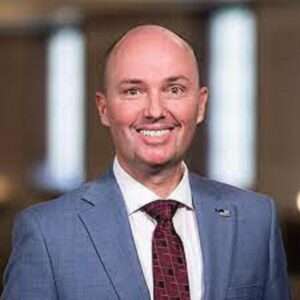
Gov. Spencer Cox (R-Utah).


In a recent Washington Post op ed, Spencer Cox and Eric Holcomb - GOP governors of Utah and Indiana, respectively - endorse the idea of giving states the power to issue their own immigration visas:

Indiana has about 220,000 open jobs right now and Utah has 107,000, according to the most recent federal data — more than 6 percent of all jobs in both states. With strong business and tax environments, we like our chances in the competition for job-seekers moving from other states. But they won't be enough to fill all of those vacancies. We also need immigrants who are ready to work and help build strong communities…

At home, we see more ordinary stories of immigrants contributing to our state economies. Julian Diaz entered the United States in search of work in the 1990s. His son Juan now employs four other Hoosiers in a successful landscaping business, while Juan's son studies computer science in college. Bassam Salem, born in Egypt, came to the United States more than 30 years ago with his parents and grew up in Utah. He eventually secured permanent residency, became a U.S. citizen and founded two successful technology start-ups that have contributed millions to the economy.

Rapidly declining birthrates and accelerating retirements across the United States mean that our states' already wide job gaps will grow to crisis proportions without more families such as these — causing our growth engines to sputter. Many of these jobs require high-level skills and entrepreneurship. But states are also awash in unfilled entry-level, low-skill roles — essential in agriculture, health care and the service industries.

So, count us as supporters of immigration sponsorship by the states. Under such authority, similar to what employers and universities have already, each state could make its own decisions. They could sponsor no visas or many visas each year, up to a limit set by Congress, for the specific sorts of jobs they need to fill.

Immigration sponsorship would give states a dynamic means to attract new residents, both from a pool of new applicants from abroad and from the ranks of current asylum seekers. The policy would also expand the states' responsibility for the contributions and success of these folks in American life.

I don't agree with everything the two governors say in their op ed. And I wish they were more clear about exactly what kind of state sponsorship system they advocate. For example, will participating immigrants be allowed to move to other states if they wish, and will they eventually be eligible for citizenship?

But it's significant that two GOP governors have endorsed this idea. Their approach is far preferable to that of many other Republicans who reflexively pander to xenephobia and seek to restrict immigration as much as possible. And I certainly agree with the bottom-line point that giving states the power to issue their own immigration visas is a good idea, and would be a major improvement over the status quo. I summarized some of the reasons why in a September 2022 post:

Both red and blue states can benefit from a policy allowing state governments to issue visas and work permits to immigrants not otherwise eligible for legal entry under federal law. State-based visas would enable state governments to take in immigrants who can fill needed slots in the economy, refugees fleeing poverty and oppression, and anyone else whom they might wish to welcome. Particularly at a time of massive labor shortages in many parts of the economy, such added migration would be a great boon to receiving states. Even some red states have recognized the need for additional immigrant labor in areas of their economies. For example, GOP members of Congress from rural states have sought to pass a bill increasing guest-worker visas for agricultural laborers….

A system under which states could grant visas without federal approval would enable them to swiftly secure as much labor as they wish – and also to help people fleeing oppression….

Conservative border states and others who seek to alleviate disorder at the border could also achieve some of their goals by such a policy. If state governments could issue their own migration, work, and refugee visas, many migrants would have no reason to cross the southern border in the first place. They could instead go directly by plane or ship to the states that grant them entry. Those that do cross the southern border would not need to do so illegally or cause any disruption. They could use legal ports of entry, and then quickly get on their way to their final destinations. Most of the disorder, violence, and death at the border is caused by the lack of legal pathways to entry, which forces people fleeing poverty and oppression into the black market. State visas could greatly mitigate that problem….

Increasing state control over immigration policy should also appeal to conservatives and others who seek a return to the original meaning of the Constitution. As James Madison, the "father of the Constitution," Thomas Jefferson, and other key Founders argued, the text and original understanding of the Constitution did not give the federal government any general power to restrict immigration. For the first hundred years of American history, immigration policy was largely under the control of the states. It may not be possible to fully restore that approach. But a system of state-issued visas would be a step in the right direction.

My 2022 post also highlights how visas issued by subnational governments have generally worked well in Australia and Canada.

Despite my general enthusiasm for state-based visas, I also noted some potential shortcomings of such a policy:

State-based visas are by no means perfect. Depending on how such a program is structured, immigrants who receive them might—at least initially—be confined to a particular state, thereby sometimes missing out on valuable job and educational opportunities. That could also reduce their potential contributions to the US economy, if a given immigrant could be most productive in a state other than the one that granted the visa. From a moral standpoint, it would be preferable to completely eliminate laws under which where people are allowed to live and work is restricted by arbitrary circumstances of parentage and place of birth.

But, as always, the best should not be the enemy of the good. For migrants fleeing poverty and oppression…, the right to live and work in even one American state would be a vast improvement over being barred from all. And pro-immigration states can further mitigate the problem by granting reciprocal access to each others' state-based visa holders.

Copyright

Copyright Office: No Copyright Protection for Certain AI-Generated Works

Law from the dawn of the dawn of the AI age.

|

From a letter sent Tuesday:

The United States Copyright Office has reviewed your letter dated November 21, 2022, responding to our letter to your client, Kristina Kashtanova, seeking additional information concerning the authorship of her work titled Zarya of the Dawn (the "Work"). [Zarya itself means "dawn" in Russian, which seems likely to be one of Ms. Kashtanova's primary languages. -EV] Ms. Kashtanova had previously applied for and obtained a copyright registration for the Work, Registration # VAu001480196. We appreciate the information provided in your letter, including your description of the operation of the Midjourney's artificial intelligence ("AI") technology and how it was used by your client to create the Work.

The Office has completed its review of the Work's original registration application and deposit copy, as well as the relevant correspondence in the administrative record. We conclude that Ms. Kashtanova is the author of the Work's text as well as the selection, coordination, and arrangement of the Work's written and visual elements. That authorship is protected by copyright. However, as discussed below, the images in the Work that were generated by the Midjourney technology are not the product of human authorship. Because the current registration for the Work does not disclaim its Midjourney-generated content, we intend to cancel the original certificate issued to Ms. Kashtanova and issue a new one covering only the expressive material that she created….

Read More

New in WSJ: On Judicial Supremacy in America and in Israel

"The fundamental question in any system of government is: Who decides?"

|

The Wall Street Journal published my letter-to-the-editor concerning current debates about the Israeli judiciary. I tried to draw parallels between judicial supremacy in Israel, and in the United States.

Here is the opening (with all due credit to Judge Sutton):

The fundamental question in any system of government is: Who decides? America's founders framed a Constitution that carved out three branches of government that would check and balance each other. By contrast, the founders of Israel didn't frame a constitution at all. Yet somehow, in both countries, judicial supremacy took root ("God Save This Honorable Court, but Not That One" by Ruth Wisse, op-ed, Feb. 17).

The U.S. and Israeli Supreme Courts have both asserted the power to write the final word on any legal question (and, in Israel, nonlegal questions too). In the U.S., perhaps this power can be grounded in Article III of the Constitution. But in Israel any claim to judicial supremacy rests only on a house of cards.

You can read the rest here.

Parental Rights

COVID Vaccination, Gender Fluidity, and Family Law

|

I don't quite know what to make of all this, but it seems like an interesting case, and I thought I'd pass it along. From Anaya-Alvarado v. Anaya-Alvarado, decided last week by the Nevada Court of Appeals; the ex-wife now "identifies as gender fluid/transgender and prefers masculine or androgynous pronouns" and goes by Jasper and the ex-husband is Carlos. They "were married from 2013 until 2017" and have two children, "S.A., born in 2014, and A.A., born in 2016." Here's an excerpt from the opinion:

After their divorce, the parties filed a joint stipulation and order in October 2017 granting Jasper sole legal and physical custody of the children. Then, in June 2019, the parties filed a joint stipulation and order permitting Jasper and their new husband to relocate to Hampton, Virginia, with the children.

In January 2021, Carlos filed a motion to modify custody that was based, primarily, on his concerns about the children's gender fluidity and Jasper's decision to support the use of some strong psychiatric medications that had been prescribed to S.A. in 2020. {The record reflects that Carlos was aware of the children's gender fluidity before he agreed to the June 2019 stipulation and order.}

On May 16, 2021, the district court entered a temporary order granting Carlos joint legal custody that directed Jasper to "keep [Carlos] apprised of the children's medical treatments." … In the fall of 2021, Jasper and Carlos had a disagreement over whether to vaccinate the children against COVID-19. Jasper wanted to vaccinate the children; Carlos did not. In addition, the controlling June 2019 physical custody order entitled Carlos to parenting time with the children in Las Vegas for Christmas 2021; but Jasper was concerned about the children visiting Carlos and his new wife, … because they were both unvaccinated.

Read More

Free Speech

No Sealing of Record to Protect Reputation of Defendants

|

From Liberty Mutual Fire Ins. Co. v. Maple Manor Neuro Center Inc., decided Tuesday by Judge Linda Parker (E.D. Mich.):

This dispute arises from no-fault insurance benefits that Plaintiffs … paid to Defendants … for the treatment of [Plaintiffs'] insureds pursuant to Michigan's No-Fault Act. Plaintiffs are insurance companies providing no-fault insurance coverage in Michigan…. Plaintiffs filed a Complaint alleging that Defendants engaged in a scheme to submit false and fraudulent medical records, bills, and invoices through interstate wires, which sought payment for treatment and services from an unlicensed healthcare provider. Plaintiffs allege that Defendants conduct violates the federal Racketeer Influenced and Corrupt Organizations Act ("RICO"), 18 U.S.C. § 1962(c) and (d), and state law.

On or about December 16, 2022, the parties entered into a good faith Settlement Agreement and Mutual Release …. On December 22, 2022, Defendants filed a motion to seal the entire record, which Plaintiffs consented to as part of the Settlement….

Defendants argued "that Plaintiff's complaint has 'zero merit' due to a recently issued Michigan Court of Appeals opinion, thus warranting the sealing of the entire record"; the court disagreed:

Read More

How Often Do Justices Refer To "My Law Clerk"?

Justices Breyer and Sotomayor did it a lot.

|

In my earlier post, I recalled that Justice Kagan had asked hypotheticals about her law clerks during oral argument in King v. Burwell and in 303 Creative. I remember the former example because I was seated in the Court for oral argument. The latter argument was more recent. For a lark, I searched the term "my law clerk" in the Supreme Court oral argument database on Westlaw. There were a lot of hits. I never quite considered how often the Justices give their clerks a shout-out during oral arguments.

Here are all of the hits over past few terms, all from Justices Breyer and Sotomayor.

  • JUSTICE BREYER: But, look, there are four circuits, it's the same question. From what we can tell, my law clerks looked this up, the Second, Sixth, Seventh, and Eleventh say that basically, 60(b)(1) authorizes, based on relief, based on a legal mistake, as long as the time to appeal hasn't run. Kemp v. United States (2002).
  • JUSTICE SOTOMAYOR: Mr. Bond, my law clerk tried to explain my simple thinking when I was reading this provision, and I'm not sure I fully understand her response, and perhaps you can explain it to me. Boechler v. CIR (2022) Read More

Justice Barrett's Delightfully Nerdy Opinion in Bartenwerfer v. Buckley

The former professor's opinion reads like an impromptu lecture.

|

For the longest time, I considered Justice Scalia the best writer on the Court, with a two-way tie for second between the Chief Justice and Justice Kagan. Since Scalia's passing, I have leaned towards Kagan as my favorite writer. She writes in a plain style that reads conversational, without having to try too hard. When humor is called for, she uses it subtly. When she has to drop the hammer, she bludgeons brutally. And there is never any doubt what she is saying. The prose is clean. When the Chief writes alone, it is a joy to read. You can tell he is really having fun. I thoroughly enjoy his annual addresses, because they are pure, unadulterated, Roberts, without the filter of his judicial role. Alas, in contested cases, the Chief, far too often, obfuscates his own writing to make his reasoning malleable. And his tortured reasoning (see Dobbs concurrence) masks his superior legal acumen.

Who is currently number three on the list? Justice Barrett may be the Court's fastest writer, by a large margin. She is also climbing up my ranks for the Court's best writer. I had the joy today of reading Bartenwerfer v. Buckley. And I truly mean, joy. It was a joy to read. The substance would usually make my eyes glaze over: the Bankruptcy Code. But Barrett wrote a crisp, fun, unanimous opinion. It read like an impromptu lecture the former professor would have delivered in her statutory interpretation class. And it involves a nerdy analysis of grammar, with a relatable hypothetical.

The case turned on whether debt for money that was "obtained by . . . fraud" was dischargeable in bankruptcy proceedings. The statute was framed in the passive voice. So who does it apply to? Just the person who committed the fraud? Or also to the fraudster's business partner? Barrett framed the issue cleanly:

The provision obviously applies to a debtor who was the fraudster. But sometimes a debtor is liable for fraud that she did not personally commit—for example, deceit practiced by a partner or an agent. We must decide whether the bar extends to this situation too. It does. Written in the passive voice, §523(a)(2)(A) turns on how the money was obtained, not who committed fraud to obtain it. 

Counselor for Petitioner offered an example to argue the partner was not covered by the statute:

To illustrate, she offers the sentence "Jane's clerkship was obtained through hard work." According to Bartenwerfer, an ordinary English speaker would understand this sentence to mean that Jane's hard work led to her clerkship. Brief for Petitioner 20. Section 523(a)(2)(A) supposedly operates the same way:An ordinary English speaker would understand that "money obtained by fraud" means money obtained by the individual debtor's fraud. Passive voice hides the relevant actor in plain sight.

In the abstract, this hypothetical is pitch-perfect. The Justices know a lot about law clerks and can relate. Indeed, Justice Kagan asked hypos about her law clerks in King v. Burwell and in 303 Creative v. Elenis. What could go wrong?

Alas, Barrett turned the hypo around on the petitioner, and explained that obtaining a clerkship is not necessarily due to Jane's hard work. Other people are involved.

We disagree: Passive voice pulls the actor off the stage. At least on its face, Bartenwerfer's sentence conveys only that someone's hard work led to Jane's clerkship—whether that be Jane herself, the professor who wrote a last-minute letter of recommendation, or the counselor who collated the application materials.

Indeed, as everyone in the game knows, a reference often goes much further than the applicant's actual accomplishments. See Yale Law School.

The rest of the opinion considers the canons of construction (including noscitur a sociis), the passive voice, and various policy arguments. Plus, there are many snazzy lines with imagery, alliteration, and word-play:

[Petitioner argues that] Passive voice hides the relevant actor in plain sight. We disagree: Passive voice pulls the actor off the stage.

This argument earns credit for color but not much else.

And while Bartenwerfer paints a picture of liability imposed willy-nilly on hapless bystanders, the law of fraud does not work that way.

Barrett doesn't use Scalia's sharp elbows, but can pull out the flair when needed.

Plus there is a detour to Swift v. Tyson:

3 Bartenwerfer asserts that we should ignore Strang because, as a product of the Swift v. Tyson era, it turned on the Court's understanding of the general common-law rule rather than its interpretation of the statutory text. 16 Pet. 1 (1842). This argument is a detour we need not take. Whatever Strang's rationale, it constituted an important part of thebackground against which Congress drafted the current discharge exception for fraud.

Oh boo. We all really want to know what Barrett thinks about Swift v. Tyson.

You should read the entire opinion.

Immigration

Why Congress Should Pass a Ukrainian Adjustment Act

Giving recent Ukrainian refugees the right to permanent residency in the US will avert potential tragedy for them, and benefit the US economy.

|

The US has done much to open its doors to Ukrainian refugees fleeing the brutal Russian invasion  that began almost exactly one year ago. Since that time, over 113,000 Ukrainians have entered the United States under the innovative Uniting for Ukraine private refugee sponsorship program (with many more granted permission to come, but not yet arrived). Some 154,000 have been admitted by other pathways, many of them before Uniting for Ukraine began in April 2022.  Granting refuge to Ukrainians fleeing war and oppression is simultaneously a moral imperative, a way to bolster the US economy, and a win for the United States in the war of ideas against Vladimir Putin and other despots.

But unless we act soon, this success may be seriously compromised. The vast majority of Ukrainians admitted over the last year have so far been given only a temporary right to live and work in the United States. When their time limits expire, they could be subject to deportation, or at least be unable to work legally.

Ukrainians admitted under the Uniting for Ukraine program are granted residency and work rights for two years after arrival. For the earliest program participants, those rights will expire in April or May 2024. More will lose legal status thereafter. Ukrainians who reached the US before April 11, 2022 have been given Temporary Protected Status (TPS), which offers similar residency and work permits. But TPS for Ukrainians is currently scheduled to expire on October 19 of this year.

President Biden could potentially extend both the TPS and Uniting for Ukraine deadlines by executive action. But if he does not, hundreds of thousands of Ukrainian migrants fleeing Vladimir Putin's war will be left in legal limbo, potentially subject to deportation. Even if few are actually deported, constant fear of that prospect is painful in itself, and makes it difficult to have anything approaching a normal life. Moreover, loss of work authorization will make many employers reluctant to hire the Ukrainians. That, in turn, would consign them to unemployment or to the black market economy.

In addition to the obvious harm inflicted on the Ukrainian migrants themselves, loss of legal status would also curtail their potential contributions to our economy and society. A population living illegally in "the shadows" is much less likely to assimilate effectively. And people barred from working legally cannot make as big an economic contribution as they would otherwise. Among other things, they are unlikely to engage in entrepreneurship and scientific innovation of the kind to which immigrants disproportionately contribute, thereby creating major benefits for America and the world.

When I described this issue to Ukrainian refugee Ruslan Hasanov, a member of my sponsoree family in the Uniting for Ukraine program, he wondered whether the US government  had given any thought to what would become of program participants when the two years are up. It's a good question!

One possible reason why the Biden Administration set such short deadlines is they might have expected the war in Ukraine to be over by 2024, thereby enabling refugees to return home. But it is increasingly clear the war might well last much longer than that. Moreover, experience with past refugee crises shows that many migrants are - for good reason - unable or unwilling to return to their countries of origin even when the war ends. For example, it is far from clear that Ukrainians will be able to return to places like Mariupol, where their former homes and places of employment have been completely destroyed.

Biden could potentially extend the Uniting for Ukraine and TPS deadlines through unilateral executive action. That would be much better than simply waiting for them to expire. But such an executive fix would still leave refugees vulnerable to the whims of whoever sits in the White House. If Biden or a future president found it politically convenient to do so, he could easily terminate their rights, or just let them expire again.

The best solution for this problem is for Congress to pass a Ukrainian Adjustment Act, giving Ukrainian migrants who have entered the US during the war the right of permanent residency and work status. That would give them a secure status no longer subject to the vagaries of politically driven executive discretion.

Such adjustment acts have been repeatedly enacted for migrants fleeing war and tyranny admitted under previous exercises of the presidential parole power used to create Uniting for Ukraine, beginning with Hungarian refugees fleeing the 1956 Soviet invasion. Congress could easily do the same in this case. But it may need to act swiftly. Significant legislation of any kind is far less likely to be enacted during the 2024 presidential election year.

One possible argument against a Ukrainian Adjustment Act is that it would be unfair to migrants fleeing similar war and oppression elsewhere. I agree the latter deserve permanent refuge, as well. For example, Congress should also enact an Afghan Adjustment Act giving permanent refuge to refugees fleeing the cruel Taliban regime that seize power after the US withdrawal in 2021. During the current war, I have also advocated giving refuge to Russians fleeing Vladimir Putin's increasingly repressive regime. That refugee, too, should be permanent.

But if it turns out that it is only politically feasible to enact an adjustment act for  Ukrainians (because Ukrainian refugees enjoy broader political support than those from most other countries), that is better than refusing to enact such legislation for anyone until we can do it for everyone. The best should not be the enemy of the good. The right approach to such problems is "leveling up," not "leveling down." A Ukrainian Adjustment Act could even become a model for similar laws covering other groups, just as the Uniting for Ukraine approach was recently expanded to cover migrants fleeing oppression and violence in four other nations.

Free Speech

Libel Suit by Gen. Michael Flynn's Sister Against CNN Dismissed

|

I'm too slammed today to comment in detail on it, but I just thought I'd note the decision handed down today by Judge Mary Scriven (M.D. Fla.) in Valerie Flynn v. CNN:

Plaintiff, a citizen of Florida, is a private individual and sister to Retired General Michael Flynn. Plaintiff's suit against Cable News Network, Inc. … arises from CNN's publication on February 4, 2021, of an exclusive report by correspondent Donie O'Sullivan … entitled "CNN Goes Inside A Gathering Of QANON Followers" …. The Publication includes a clip of a video posted to Twitter by General Flynn on July 4, 2020 …. According to Plaintiff, General Flynn posted the Original Video, which was filmed during a Fourth of July barbeque at Plaintiff's sister-in-law's home in Newport County, Rhode Island. In the Original Video, Plaintiff and others present at the July Fourth barbeque, "took the Oath to the United States Constitution" and "[a]fter finishing the Oath," General Flynn stated, "where we go one, we go all." Plaintiff repeated the phrase, but claims "[s]he did not know that some people considered it to be a QAnon slogan."

CNN aired the Publication on February 4, 2021. Plaintiff claims that in Defendant's broadcast, CNN falsely accused her of being what she describes as a "'follower' of the 'dangerous', 'violent', 'racist', 'extremist', 'insurrectionist', 'domestic terrorism' movement—QAnon." Plaintiff claims the Publication "juxtaposed a picture of [Plaintiff] (and other members of the Flynn family) with [pictures of] numerous known QAnon adherents." The Publication includes footage of what Plaintiff describes as an "insurrectionist mob storming the United States Capitol[,]" and a clip—"selectively edited and altered by CNN"—of the Original Video. Plaintiff claims that "CNN used [Plaintiff's] picture and emblazoned the edited clip with chyron that endorsed the defamatory meaning of CNN's statement" and that "[t]he tone of the whole [Publication] was that everybody that CNN was showing its audience is a 'QAnon Follower'." The chyron beneath the video stated: "CNN GOES INSIDE A GATHERING OF QANON FOLLOWERS" ….

CNN's alleged statement that Plaintiff is a QAnon follower is not inherently injurious but is only injurious "as a consequence of extrinsic facts," such as the January 31, 2021 CNN Special Report and House Resolution 1094 relied on by Plaintiff to explain the defamatory nature of the Publication. This additional contextual material falls outside the "four corners" of the Publication. As explained, a per se defamation claim [under Florida law] includes words that "upon their face and without the aid of extrinsic proof [are] injurious." Defamation per se statements are "so obviously defamatory" they do not require references to extrinsic evidence. As such, the Court finds that Plaintiff fails to state a claim for defamation per se.

Read More

Supreme Court

Has Justice Barrett Replaced Justice Ginsburg as the Court's Quickest Opinion Writer?

Justice Barrett has produced two majority opinions before most of her colleagues have produced one.

|

Justice Ruth Bader Ginsburg was "notorious" for many things, including being one of the fastest opinion writers on the Court. Justice Ginsburg was often the first justice to issue an opinion in an argued case, and almost always got at least one opinion out during the Fall of any given term (a feat that only one justice on the Court was able to accomplish this term).

Justice Amy Coney Barrett, who replaced Justice Ginsburg on the Court, may also be filling Justice Ginsburg's role as the most proficient opinion writer. Justice Barrett was the author of the Court's first majority opinion of the term, a brief, unanimous opinion in Arellano v. McDonough.  This opinion was the one-and-only opinion for the Court in an argued case issued last fall. (The Court also issued a one-line per curiam in In re Grand Jury, dismissing that case as improvidently granted.)

Today Justice Barrett issued her second opinion for the Court in Bartenwerfer v. Buckley, another unanimous opinion for the Court. Justice Sotomayor wrote a brief concurrence, joined by Justice Jackson.

But that is not all. Justice Barrett also authored the dissent in Cruz v. Arizona, which was also released today, and joined by Justices Thomas, Alito, and Gorsuch. Accordingly Justice Barrett has issued three opinions in argued cases before four of her colleagues have managed to issue a single one. (The only other justices to issue majority opinions in cases so far this term are Justices Sotomayor, who had the majority in Cruz, and Justice Kagan, who wrote for the Court in Helix Energy Solutions Group, Inc. v. Hewitt, over dissents by Justice Gorsuch and Justice Kaganaugh, joined by Justice Alito.

Supreme Court

Another Dissent from Denial of Certiorari from Justice Jackson

For the second time, Justice Jackson dissents from the Supreme Court's refusal to hear a case.

|

Yesterday the Supreme Court did not grant certiorari in any new cases. There is at least one case, however, that two justices wanted the Court to hear. Justice Ketanji Brown Jackson dissented from the denial of certiorari in Davis v. United States, joined by Justice Sonia Sotomayor.

Although Justice Jackson has not yet written an opinion in an argued case, this is the second time she has dissented from a denial of certiorari, and her third dissenting opinion overall. She previously dissented from the denial of certiorari in Chinn v. Shoop, and dissented from the denial of a stay of execution in Johnson v. Missouri. In both of these opinons she was joined by Justice Sotomayor. As previously noted, Justice Jackson is also the most active justice at oral argument, and Justice Barrett is the only justice to have written a majority opinion in an argued case so far this term.

In Davis, Justice Jackson believes the Court should have taken the opportunity to clarify what is necessary for a criminal defendant to demonstrate ineffective assistance of counsel in the context of plea negotiations. Her brief dissent reads:

Our criminal justice system today is "for the most part a system of pleas, not a system of trials." Lafler v. Cooper, 566 U. S. 156, 170 (2012). Against this backdrop, this Court has recognized that the loss of an opportunity for a favorable plea offer due to an attorney's deficient performance can violate the Sixth Amendment right to effective counsel. Id., at 169–170; see also Missouri v. Frye, 566 U. S. 134 (2012). Petitioner Quartavious Davis alleged, and the Eleventh Circuit did not dispute, that he satisfied the first prong of the Strickland ineffective-assistance-of-counsel standard because his attorney failed to initiate plea negotiations with the Government. The question presented, then, is how can a defendant like Davis show "prejudice" as a result of this failure? See Strickland v. Washington, 466 U. S. 668, 687 (1984) (ineffective assistance of counsel requires a showing of both deficient performance and prejudice).

The Circuits appear to be at odds with respect to this important question. Under our case law, in order to demonstrate prejudice when defense counsel's deficient performance causes the defendant to forgo an advantageous plea deal, the defendant must show there was "a reasonable probability" that the relevant parties—the prosecution, defendant, and the court—would have accepted the plea. Frye, 566 U. S., at 147. But some Circuits have held that this showing can be made without proof that the Government had put a plea offer on the table, see Byrd v. Skipper, 940 F. 3d 248, 252, 255–256 (CA6 2019); United States v. Pender, 514 Fed. Appx. 359, 360–361 (CA4 2013) (per curiam), while others seem to impose a threshold requirement that a defendant cannot show prejudice if "the government never extended . . . a formal plea offer" to the defendant, Ramirez v. United States, 751 F. 3d 604, 608 (CA8 2014); see also Byrd, 940 F. 3d, at 264 (Griffin, J., dissenting) (collecting cases to support the proposition that ineffective assistance of counsel in this context "require[s] proof of a plea offer").

In this case, the Eleventh Circuit joined the debate. The District Court concluded that Davis's allegations in his 28 U. S. C. §2255 motion were insufficient, even if true, because he had not alleged "that a plea offer was made but not communicated to [him]." The Eleventh Circuit affirmed, concluding that Davis was not entitled to an evidentiary hearing to prove his allegations because "Davis did not allege in his §2255 petition that the government even offered a plea deal," which, in the Eleventh Circuit's view, meant that Davis had insufficiently pleaded prejudice.

The instant case not only implicates a divergence of circuit opinions, but also is an ideal vehicle to evaluate the Eleventh Circuit's bright-line rule that an adequate showing of prejudice requires an actual plea offer. That important legal question is isolated here; since the Eleventh Circuit assumed deficient performance, so can we. See Lafler, 566 U. S., at 163. And because the lower courts denied Davis's motion without an evidentiary hearing based solely on the pleading deficiency, the sole question before us is whether a defendant must allege (and then ultimately show) that an actual plea offer was made.

Moreover, under the circumstances presented here, it was exceedingly likely that Davis would have prevailed with respect to the prejudice prong if the Eleventh Circuit had not applied that threshold requirement. Davis's allegations established that a favorable plea agreement was a strong possibility, even though no offer actually materialized, because each of Davis's five codefendants had lawyers who negotiated favorable plea agreements with respect to the same series of armed robberies. And while Davis (who was 18 or 19 years old at the time the crimes were committed) received a sentence of approximately 160 years of imprisonment after his attorney took him to trial, all of Davis's codefendants received sentences of less than 40 years of imprisonment due to plea agreements that enabled the District Court to impose a sentence below the mandatory minimum. The District Court's statements at sentencing were also noteworthy: The judge specifically asserted that, while he thought the appropriate sentence for Davis was 40 years, he was bound by the consecutive mandatory minimums.* [FN: *The mandatory minimums that applied to Davis were subsequently revisited—and revised—by Congress. See 18 U. S. C. §924(c)(1)(A). Davis asserts that, if sentenced today, he would face a mandatory minimum of 35 years of imprisonment.]

The Eleventh Circuit gave short shrift to these alleged facts, and others, which suggest that Davis was harmed by his counsel's failure to initiate plea negotiations because it applied a bright-line rule that prejudice cannot be shown in the absence of a plea offer. This petition presents the Court with a clear opportunity to resolve a Circuit split regarding whether having an actual plea offer is an indispensable prerequisite to making the necessary showing of prejudice. I would grant certiorari to resolve that issue.

More