On the first Sunday of this month, the pastor of a Scripps Ranch church brought in a guest speaker who talks about how she came to believe being gay is wrong.
The venue was San Diego Unified's Marshall Middle School, where the church has held its services for the better part of two decades.
The speaker was Patti Height of Out of Egypt Ministries, who told her audience she used to consider herself gay but now believes that was a "false identity." According to her website, her work aims to help Christians minister to LGBTQ people, believing that being gay is incompatible with being Christian….
Scripps Ranch residents and Marshall Middle parents are among more than 600 people who have signed a petition calling for San Diego Unified to terminate its rental agreement with Canyon Springs, contending that the church is violating the district's anti-discrimination policy by endorsing anti-LGBTQ speech. A Marshall Middle parent filed a complaint with the district, also asking the district to end its contract with the church.
Even though the church holds its events outside of school hours and the church is separate from Marshall Middle, some parents and activists argued that students could still be affected by the knowledge that their school had provided a forum for somebody who condemns homosexuality….
The petition appears to be here; but I don't think the school can act on it by excluding such speech from events on its property, given the First Amendment.
On Thursday, the U.S. Court of Appeals for the D.C. Circuit heard oral argument in a potentially important Speech or Debate Clause case concerning whether the Justice Department can obtain access to the contents of Congressman Scott Perry's cell phone as part of its January 6 investigation. Most of the arguent was public and can be heard here. Judges Katsas and Rao actively probed both sides' arguments so for those interested in these issues it is definitely worth a listen. (Judge Henderson is also on the panel, but asked few questions as she was participating remotely.)
On Friday, district court judge Beryl Howell released a redacted version of her decision rejecting Rep. Perry's Speech or Debate Clause claim was released to the public. (It had previously been under seal.) After conducting in camera review of over 2,000 documents on Rep. Perry's phone, Judge Howell concluded that most were not covered by the Speech or Debate Clause's protection. Wrote Judge Howell:
What is plain is the clause does not shield Rep. Perry's random musings with private individuals touting an expertise in cybersecurity or political discussions with attorneys from a presidential campaign, or with state legislators concerning hearings before them about possible local election fraud or actions they could take to challenge election results in Pennsylvania,
It was hard to get a read on how the D.C. Circuit will weigh Perry's assertion of privilege. While their questions suggested some discomfort with the breadth of the Justice Department's position, which Judge Howell largely adopted, they also seemed resistant to Rep. Perry's equally broad claims pushing in the other direction and accepted that privilege could be waived by communications with those outside of the legislature.
At the same time the courts are considering Rep. Perry's claims, debate is swirling over whether former Vice President Mike Pence can invoke the clause's protections to refuse to testify before a grand jury about his activities on January 6. Pence wants to claim that the he can invoke this privilege because the Vice President serves as President of the Senate, and has a legislative-related role in counting electoral votes. (It also turns out that the Vice President's office is paid for as part of the legislature's budget, not that of the White House.) As noted by Glenn Reynolds (and flagged in Eugene's post below), how to characterize the Vice President's role, and how that affects a Vice President's ability to invoke this privilege in particular circumstances, is a legitimately difficult question.
One reason this is the central question is because Speech or Debate Clause immunity, where it applies, is generally understood to be "absolute." The text reads:
They shall in all Cases, except Treason, Felony and Breach of the Peace, be privileged from Arrest during their Attendance at the Session of their respective Houses, and in going to and returning from the same; and for any Speech or Debate in either House, they shall not be questioned in any other Place.
Courts have interpreted this language, and the admonition that members "shall not be questioned" as a prohibtion on even questioning members of Congress about activities related to core legislative functions. Accordingly, the various cases probing and applying this immunity turn on whether the activities at issue are covered, not on the weight of the interest that would justify disclosure.
For this reason, I think that some of the claims made by Judge Michael Luttig about whether Pence can claim Speech or Debate clause immunity are wrong. In a recent Twitter thread, for instance, Luttig wrote:
If there are privileges and protections enjoyed by a Vice President when he or she serves as the President of the Senate during the Joint Session to count the electoral votes, those privileges and protections would yield to the demands of criminal process as -- if not sooner than -- do the Speech or Debate Clause privileges and protections for Senators and Representatives, and the Executive Privilege for Presidents of the United States.
Even if a vice president has speech or debate clause protections, they will yield to a federal subpoena to appear before the grand jury.
I do not believe these claims are accurate. If the Vice President is covered by the speech or debate clause when participating in the counting of electoral votes, they will not "yield to the demands of criminal process." The privilege includes a testimonial privilege ("shall not be questioned"), and is generally understood as absolute, if it applies. [Again, the key question is whether it applies, not whether it can yield.] Further, it is also not true that Executive Privilege necessarily "yields to the demands of criminal process." As U.S. v. Nixon makes clear, this depends, in part, on the reasons for which Executive Privilege is being invoked, as such reasons must be balanced against the needs of criminal process.
While I accept that the Vice President is, for some purposes, a part of the legislative branch, I am skeptical that his largely ceremonial role in the electoral count act is covered by the Speech or Debate Clause. I further wonder whether any such privilege that Pence could claim has been waived because some of his staff have already testified on these matters. But if Pence is unable to claim privilege here, it is not because the Justice Department is conducting a criminal investigation, but rather because the particular information the Justice Department seeks is not that which the privilege actually covers.
Prof. Glenn Reynolds (Tennessee, Instapundit) has an item on his Substack about the Vice President Mike Pence / Speech or Debate Clause controversy, based on a Northwestern University Law Review article that he wrote on the Vice President's role in 2008. An excerpt:
Pence, now, is arguing that by presiding on January 6, 2021, he was serving as a legislative official, and thus that his actions and words are covered by the Speech and Debate Clause, making it improper for the special prosecutor to question him. This argument may or may not be correct, but it is not at all crazy, and even in the context of an oped that is more about politics than the law, [former Fourth Circuit Judge Mike ] Luttig should have taken it more seriously.
There are arguments both ways. Textually, the Clause applies only to "Senators and Representatives"—its actual language is "The Senators and Representatives shall receive a Compensation for their Services, to be ascertained by Law, and paid out of the Treasury of the United States. They shall in all Cases, except Treason, Felony and Breach of the Peace, be privileged from Arrest during their Attendance at the Session of their respective Houses, and in going to and returning from the same; and for any Speech or Debate in either House, they shall not be questioned in any other Place."
However, presiding over the Senate is surely a legislative function par excellence. In other cases involving governmental immunity, the Court has taken a functional approach: If you're acting as a judge or a prosecutor in an administrative proceeding, for example, you're entitled to the absolute immunity accorded to judges and prosecutors, regardless of your job title. Under this approach, Speech and Debate protection for the Vice President seems like a no-brainer. And the Supreme Court, in Gravel v. United States, held that an aide who functions as an alter ego to a legislator can qualify for legislative immunity, which illustrates that the text's limitation to Senators and Representatives is not absolute.
On the other hand, the Supreme Court has, somewhat bizarrely, taken a narrower view of legislative immunity, which is mentioned in the text of the Constitution, than it has taken with regard to the qualified immunity of government officials generally, and the absolute immunity of prosecutors and, ahem, judges, though the latter is entirely a judicial creation, without any constitutional or statutory roots. It is thus entirely possible that it will be a stickler for textual analysis in this case—though to be fair, where the judicially-invented immunities are concerned, there is no text at all to worry about….
In these companion cases, advocacy groups supporting legalized abortion have sued an opponent of it, claiming that he legally defamed them by making statements that equate abortion to murder and by characterizing those who provide or assist in providing abortion, including the plaintiffs, as "criminal" based on that conduct. The speaker responded that his statements represent his opinion about that conduct as part of his advocacy for changes in the law and its interpretation. {The events giving rise to these two lawsuits occurred in the years preceding the United States Supreme Court's decision in Dobbs v. Jackson Women's Health Organization (2022).}
Two courts of appeals considered whether the speaker's statements could be defamatory and reached opposite conclusions. One court of appeals placed the statements in the context of the ongoing moral, political, and legal debate about abortion. It concluded that the statements are political opinions that voice disagreement with the legal protections afforded to abortion providers. That court of appeals ordered the suit dismissed.
The other court of appeals examined whether a court could legally verify the speaker's statements—in other words, it asked whether abortion met the legal definition of murder under the Texas Penal Code at the time. Concluding that the speaker's statements were inconsistent with the Penal Code, that court of appeals permitted the defamation suit to continue.
We granted review to resolve the conflict between the two courts. We hold that the challenged statements are protected opinion about abortion law made in pursuit of changing that law, placing them at the heart of protected speech under the United States and Texas Constitutions. Such opinions are constitutionally protected even when the speaker applies them to specific advocacy groups that support abortion rights….
At the end of January, Florida Governor Ron DeSantis held a press conference to announce a package of higher education reforms. I noted at the time that the details would matter, but that there was cause for concern.
We now have some details in the form of House Bill 999. If anything, the current bill is worse than the bullet points the governor outlined a few weeks ago. The text of HB 999 can be found here. Hopefully the bill will be improved before its seemingly inevitable final passage.
On Wednesday, the Supreme Court decided Helix Energy Solutions Group, Inc. v. Hewitt. The vote in Hewitt was 6-2. Justice Kagan wrote the majority opinion, joined by the Chief Justice and Justices Thomas, Sotomayor, Barrett, and Jackson. This is a heterodox majority opinion that split left and right, much like the heterodox Fifth Circuit en banc majority.
Justice Gorsuch voted to dismiss the case as improvidently granted, known in the lingo as a DIG. In Gorsuch's view, the Court granted review on one question, but after the cert grant, the Petitioner pivoted to focus on another question. Gorsuch also raised the question of whether the regulations were consistent with the statute.
Another reason counsels hesitation, too. Helix Energy does not just dispute the proper application of various regulations. It contends those regulations are inconsistent with and unsustainable under the terms of the statute on which they are purportedly based. While §541.601, §541.602, and §541.604 focus on an employee's salary, Helix Energy submits, the statute requires attention to the employee's duties. See Tr. of Oral Arg. 32–38, 46–47; Brief for Petitioners 41–44; Reply Brief for Petitioners 20–24; seegenerally 29 U. S. C. §213(a)(1). Understandably, the Court refuses to entertain this larger statutory argument because Helix Energy failed to raise it earlier in the litigation. Ante, at 7, n. 2. But the fact that Helix Energy forfeited such a foundational argument seems to me all the more reason to leave any question about §541.602 to another day.
However, in Justice Gorsuch's view, the petitioner forfeited this issue, so it was not proper to resolve the question. Gorsuch seems to DIG a lot. Last term he would have DIG'd in Kemp v. United States and Shoop v. Twyford.
Justice Kagan replied that Gorsuch's DIG concern had merit, but found that the question resolved was a "necessary 'predicate'" to the question presented. Therefore, this case was appropriate to resolve on the merits.
3We appreciate JUSTICE GORSUCH's concern that the question we ask and answer is not quite the one Helix's petition for certiorari urged upon us. . . . Resolution of that §602(a) issue is a necessary "predicate to an intelligent resolution of the question presented."Caterpillar Inc. v. Lewis, 519 U. S. 61, 75, n. 13 (1996). Indeed, Helix's counsel urged us to answer it—even assuming Helix would lose—rather than dismiss this case as improvidently granted. See Tr. of Oral Arg. 39–40 ("I would prefer that you just answer the question"—even if "adversely"—"because I don't think there's a basis for a DIG"). And our resolution of that predicate issue itself reveals the answer to Helix's initial formulation of the question presented.
What about the statutory argument? Kagan likewise found the issue was forfeited:
At argument in this Court, Helix suggested that the salary-basis component of the regulations is an impermissible extrapolation from the statutory exemption for workers "employed in a bona fide executive . . . capacity." 29 U. S. C. §213(a); see Tr. of Oral Arg. 33–37. But Helix did not raise that argument in the courts below.
So there was no need to decide the question here.
Then, there was Justice Kavanaugh. Let me ask you to make a prediction. What do you think Justice Kavanaugh did in this case? (A) found the issue was forfeited and let it go; (B) found the issue was forfeited and said the Court should resolve it in the appropriate case; (C) found the issue was forfeited but opined on it anyway. If you picked (C), you have been paying attention to Justice Kavanaugh's five years on the Court.
Here is the final paragraph of Kavanaugh's dissent:
One last point: Although the Court holds that Hewitt is entitled to overtime pay under the regulations, the regulations themselves may be inconsistent with the Fair Labor Standards Act. See, e.g., Brief for State of Mississippi et al. as Amici Curiae 7–10; Ante, at 1–2 (GORSUCH, J., dissenting). Recall that the Act provides that employees who work in a "bona fide executive . . . capacity" are not entitled to overtime pay. 29 U. S. C. §213(a)(1). The Act focuses on whether the employee performs executive duties, not how much an employee is paid or how an employee is paid. So it is questionable whether the Department's regulations—which look not only at an employee's duties but also at how much an employee is paid and how an employee is paid—will survive if and when the regulations are challenged as inconsistent with the Act. It is especially dubious for the regulations to focus on how an employee is paid (for example, by salary, wage, commission, or bonus) to determine whether the employee is a bona fide executive. An executive employee's duties (and perhaps his total compensation) may be relevant to assessing whether the employee is a bona fide executive. But I am hard- pressed to understand why it would matter for assessing executive status whether an employee is paid by salary, wage, commission, bonus, or some combination thereof. In any event, I would leave it to the Fifth Circuit on remand to determine whether Helix forfeited the statutory issue. But whether in Hewitt's case on remand or in another case, the statutory question remains open for future resolution in the lower courts and perhaps ultimately in this Court.
This is a classic Kavanaugh paragraph. Take an issue which the parties didn't actually present, signal strongly what you think (using words like "questionable," "dubious," and "hard-pressed"), and hope the lower courts follow the lead. This paragraph is in keeping with the Kavanaugh concurrences in Dobbs and Bruen. Again, there is nothing moderate or restrained about this approach. Kavanaugh has this fixation to reach out and touch questions that are not necessary to decide.
Justice Kagan dealt with this aspect of the dissent with a vicious parenthetical.
. . . Helix did not raise that argument in the courts below. Following our usual practice, we therefore decline to address its merits. See, e.g., Kingdomware Technologies, Inc. v. United States, 579 U. S. 162, 173 (2016); see post, at 2 (GORSUCH, J., dissenting) (agreeing that Helix "failed to raise" the argument, and also declining to express a view of its merits); but cf. post, at 4–5 (KAVANAUGH, J., dissenting) (recognizing that the argument may be forfeited, but opining on it anyway).
I think this parenthetical can be added to just about any Kavanaugh separate writing: (issue is irrelevant, but opining on it anyway).
Once again, Gorsuch practiced judicial minimalism. Kavanaugh practiced judicial maximalism. Justice Alito should have joined the bulk of the dissent, with the exception of the last paragraph. Let Kavanaugh stand alone on these frolics and detours.
[T]he Court will grant [Texas AG Ken] Paxton's motion to dismiss and grant the preliminary injunction in part. Specifically, the Court finds that while Paxton has enforcement authority under H.B. 1280, the statute does not regulate abortions that take place outside the State of Texas and cannot even be arguably read to do so.
By contrast, the pre–Roe laws do arguably proscribe Plaintiffs' desired conduct, and the Court finds that Plaintiffs have standing to sue the local prosecutors tasked with enforcing those laws. However, turning to the preliminary injunction, the Court finds that the pre-Roe laws have been repealed by implication [citing Judge Edith Jones' opinion in McCorvey v. Hill (5th Cir. 2004)] and will grant the motion in part to enjoin the named local prosecutors from enforcing the pre-Roe laws.
Part of the court's rationale for preliminary enjoining the pre-Roe laws (under the "balance of equities" prong of the preliminary injunction analysis) was that they restrict speech and fundraising about abortions and not just actually performing abortions:
Please enjoy the latest edition of Short Circuit, a weekly feature written by a bunch of people at the Institute for Justice.
For over 150 years, Vermont parents have been able to use a tuition stipend to send their kids to the K-12 school of their choice, private or public, if their local school district doesn't provide instruction for their child's grade-level—a unique program to address the costly problem of educating children in rural areas. Some parents even send their kids to Canada! And this month, a federal judge signed off on a consent decree that allows families to—once again—use the stipends at religious schools. Mazel tov! Click here to learn more.
On Wednesday, the Supreme Court decided Helix Energy Solutions Group, Inc. v. Hewitt. The facts of the case are straightforward enough: does a "tool-pusher" who makes more than $200,000 per year, while working on an offshore oil rig, qualify for overtime pay? The law is, admittedly, complex. There is an intricate statutory and regulatory framework at play. I won't try to summarize those twists and turns here. But underlying these legal issues is a normative question: should someone making so much money be eligible for overtime? How would a liberal vote here? How would a conservative vote here?
By a 6-2 vote, the Supreme Court ruled that the employee was not paid on a "salary basis," and was thus eligible for overtime. Justice Kagan wrote a characteristically lucid decision parsing a difficult textual conflict. It is a breeze to read. Justice Gorsuch would have DIG'd the case (more on later). Justice Kavanaugh wrote a short dissent, which was joined by Justice Alito (more on that later as well).
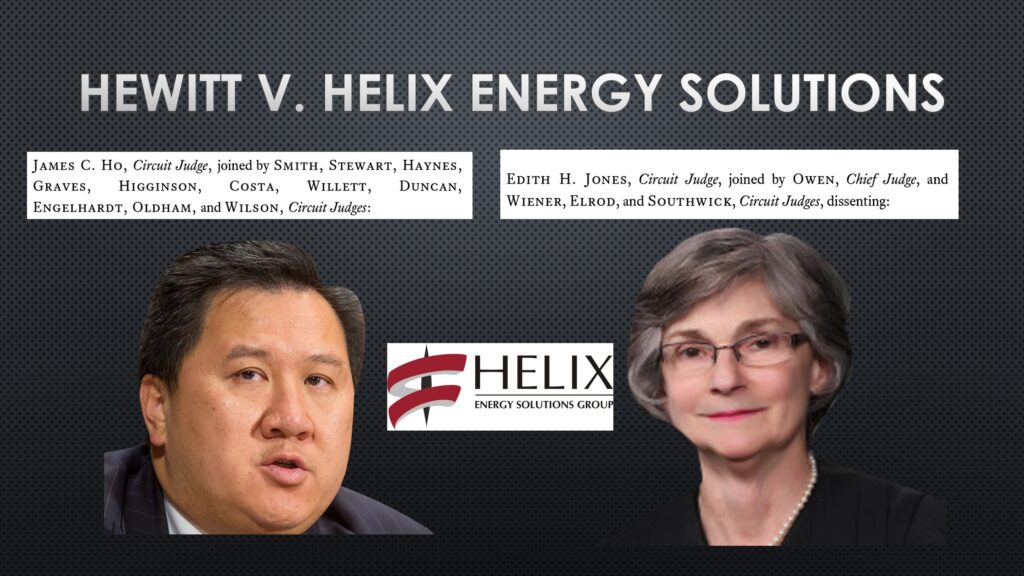
I have been tracking this Texas case for several years as it wound its way through the Fifth Circuit. And I think it is worthwhile to note that six Justices affirmed a a decision of the en banc Fifth Circuit. And that opinion was written by--so we're told--one of the biggest hacks in the judiciary: Judge Jim Ho. Indeed, the Hewitt en banc majority had a heterodox makeup: Ho, Smith, Stewart, Haynes, Graves, Higginson, Costa, Willett, Duncan, Engelhardt, Oldham, and Wilson. In dissent were Judges Jones, joined by Owen (now Richman), Wiener, Elrod, and Southwick. The Fifth Circuit truly is the most interesting circuit. I flagged this case in my State of the Fifth Circuit Address from last year.
Justice Kagan favorably quotes Ho's opinion:
So as the Court of Appeals remarked, nothing about today's decision should "come as a surprise." 15 F. 4th, at 296.
While Kagan referred to Jones's dissent as "more expansive":
Six judges dissented in two opinions. The more expansive dissent argued that Hewitt's compensation "satisfied the salary basis test" of §602(a). Id., at 307 (opinion of Jones, J.). It further concluded that §604(b) is not applicable at all to high-income employees— i.e., those falling within the HCE rule because they earnover $100,000. See id., at 309.
Judge Ho departed from Judge Jones, whom I labelled as the Court's standard measure of judicial conservatism. Perhaps Justice Kagan's affirmance of Judge Ho's opinion bolsters that departure in this case, where judicial conservatism and textualism are in tension.
Finally, I would like to flash-back to Judge Wiener's en banc dissent:
I concur in Judge Jones's thorough dissent. But, as the panel dissenter and one of today's en banc dissenters, I write separately—and at times repetitively—to emphasize how common sense and a reasonable reading of the law combine to demand a result opposite the one reached originally by the panel majority and today by the en banc majority. Frankly, I cannot fathom how a majority of the active judges of this court can vote to require Helix to pay overtime to Hewitt, the supervisor of 12 to 13 hourly, hands-on workers, when he was already paid more than twice the cap of $100,000 per annum for overtime eligibility. And, if that is not incomprehensible enough, keep in mind that Hewitt worked for Helix no more than half of the days during the calendar years at issue!
I hope Judge Wiener can now "fathom" how six Justices of the Supreme Court, conservative and liberal alike, can reach this conclusion.
Just published as part of the "Non-Governmental Restrictions on Free Speech" symposium; here's the start of the Introduction and the Conclusion (the article is here):
The political cultures of some private universities and corporations are criticized as intolerant. There is a dominant political ideology, the thought goes, and those who hold it are intolerant of others who hold different views. One form of alleged intolerance is political discrimination in hiring and promotion: Those known to hold contrary views are not hired or promoted for this reason. But what is the virtue of tolerance and what attitude toward those who disagree with us does it require? Here I appeal to Scanlon's account of tolerance in order to identify a relatively clear sense in which political discrimination in hiring and promotion is intolerant, and to identify some bad things about it. It does not follow, however, that this kind of intolerance violates anyone's rights or that it should be illegal. So although this essay identifies a sense in which political discrimination in hiring and promotion is intolerant, it leaves questions of permissibility unanswered.
Central to the question of political intolerance on campus and in the workplace is disagreement about racial and gender proportionality as a social goal. This goal is that the proportion of faculty and students at private universities who are nonwhite or female and the proportion of corporate officers and managers at private companies who are nonwhite or female roughly matches the proportion of nonwhites and females in the general population. Is it a serious institutional failing if, compared to the general population, university faculty and corporate officers and managers are disproportionately white or male? Those committed to diversity, equity and inclusion—as the slogan goes—believe this is a serious failing urgently in need of being addressed. Others disagree. For convenience I refer to the first group as "DEI advocates" and to the second group as "DEI nonadvocates." A charge of intolerance might be directed at DEI advocates on the grounds that they discriminate in hiring and promotion against nonadvocates. Imagine, then, that you are a DEI advocate. What attitude toward nonadvocates in hiring and promotion does the virtue of tolerance require of you?
Just published as part of the "Non-Governmental Restrictions on Free Speech" symposium; here's the start of the Introduction and the Conclusion (the article is here):
A lot of people praise free speech, but no one really wants it. We don't want people to be able to follow us down the street at night yelling death threats. We don't want vital military secrets being revealed to our enemies. We don't want newspapers to write long articles about our private lives that are false, or even print pictures of us naked in the bathroom that are painfully accurate. We want certain kinds of speech, and not others. We want some free speech—but as soon as we say "some," that means we want speech that isn't really free, but rather that conforms to certain standards that we as a society have set. The question, then, is not whether speech should be truly free, but in what ways we think it should be controlled.
In what follows I will be addressing the morality of restricting certain forms of speech in educational institutions. There are different values at play in the university than in the state, and different goods that come from allowing or disallowing speech. But just as governments can rightly set guidelines as to what is permissible, so too can educational institutions. My argument is simple. Colleges and universities have one goal: education. That is what they are for, and that is just what it is to be a college or university—what could be termed their essence, their defining feature. So as long as we are acting qua members of an educational institution, enhancing education is the only goal that should guide us in this case.
If you were active in the conservative legal movement in the 1990s and early 2000s, Mike Luttig was a legal giant. He was a prominent circuit judge who was a SCOTUS short-lister. But I started law school in 2006. The first time I ever heard of Luttig was at the IJ Summer Boot Camp after my 1L year. Someone mentioned that Luttig had stepped down from the Fourth Circuit to become the general counsel of Boeing. I didn't give it much thought at the time. Over the next decade, I largely forgot about Luttig. He faded into legal obscurity. Indeed, I never saw him at a single Federalist Society meeting. If you graduated law school during the Obama years, there was no need to know who Luttig was, unless you skimmed an old Jeff Toobin or Jan Crawford book.
Then came Trump. Suddenly, Luttig, and some other stalwarts of the Reagan/Bush era, came to the forefront to criticize the Republican president. The media gladly gave their claims attention, because it was right-on-right action. Luttig's apex came in the run-up to January 6, 2021. As we all heard, over and over again, Luttig advised Vice President Mike Pence. Luttig also told Pence to disregard the views of John Eastman (who had clerked for Luttig). Some claimed Luttig saved the Republic! Alas, Luttig's moment in Pence's corner have come to an end.
The former-Vice President will resist the Special Counsel's subpoena based on the Speech or Debate Clause. I was skeptical of this claim as a textual matter, though Reb Brownell make a strong case based on judicial and congressional precedent. I'll concede this is a question on which the Supreme Court has not directly opined, and that Pence has a right to raise the argument as an institutional prerogative.
Luttig disagrees. He took to the New York Times with a piece titled, Mike Pence's Dangerous Gambit. The tenor of the piece is unexpected. We do not get a sober analysis of the text and history of the Speech or Debate Clause. Instead, Luttig repeatedly criticizes Pence's lawyers for giving the former Vice President bad advice. Luttig also calls out how much money Pence's lawyers are earning. Unsurprisingly, Luttig thinks these lawyers are leading Pence astray.
If Mr. Pence's lawyers or advisers have told him that it will take the federal courts months and months or longer to decide his claim and that he will never have to testify before the grand jury, they are mistaken. We can expect the federal courts to make short shrift of this "Hail Mary" claim, and Mr. Pence doesn't have a chance in the world of winning his case in any federal court and avoiding testifying before the grand jury.
Inasmuch as Mr. Pence's claim is novel and an unsettled question in constitutional law, it is only novel and unsettled because there has never been a time in our country's history where it was thought imperative for someone in a vice president's position, or his lawyer, to conjure the argument.
Mr. Pence undoubtedly has some of the finest lawyers in the country helping him navigate this treacherous path forward, and they will certainly earn their hefty fees. But in cases like this, the best lawyers earn their pay less when they advise and argue their clients' cases in public than when they elegantly choreograph the perfect exit in private — before their clients get the day in court they wished for.
Mr. Pence's lawyers would be well advised to have Jack Smith's phone number on speed dial and call him before he calls them. The special counsel will be waiting, though not nearly as long as Mr. Pence's lawyers may be thinking. No prosecutor, least of all Mr. Smith, will abide this political gambit for long. And Mr. Pence shouldn't let this dangerous gambit play out for long. If he does, it will be more than he wished for.
Let me translate Luttig's column: "Mike Pence wouldn't listen to me, so let me blast his lawyers in the N.Y. Times."
Luttig argue that Pence is undermining his legacy, undermining his role on January 6:
The former vice president should not want the embarrassing spectacle of the Supreme Court compelling him to appear before a grand jury in Washington just when he's starting his campaign for the presidency; recall the unanimous Supreme Court ruling that ordered Richard Nixon to turn over the fatally damning Oval Office tapes. That has to be an uncomfortable prospect for Mr. Pence, not to mention a potentially damaging one for a man who — at least as of today — is considered by many of us across the political spectrum to be a profile in courage for his refusal to join in the attempt to overturn the 2020 election in the face of Donald Trump's demands. And to be clear, Mr. Pence's decision to brand the Department of Justice's perfectly legitimate subpoena as unconstitutional is a far cry from the constitutionally hallowed ground he stood on Jan. 6.
Pence would be well advised to follow his legal counsel, and disregard the New York Times.
One final note. Luttig is often promoted as a "legal conservative." Luttig may have been an active member of the conservative legal movement in the 1990s and early 2000s, but he has been MIA for about fifteen years. Indeed, in recent years, he has consistently taken positions that are conducive to progressives, such as his brief on the Second Amendment. As far as I can tell, he did not say a word about Dobbs, the crowning moment of success for the conservative legal movement. I think there should be a statute of limitations for calling a person a legal conservative. Show me what you've done lately.
Today is the one-year anniversary of the start of Vladimir Putin's brutal effort to conquer Ukraine. While Russian aggression against Ukraine dates back to the seizure of Crimea and parts of the Donbass in 2014, last year's invasion vastly escalated the conflict, and led to large-scale death and destruction, and - even worse - extensive atrocities committed by Russian forces.
In this post, I compile links to my writings about the conflict over the last year. Most focus on the enormous refugee crisis it has triggered (the biggest in Europe since World War II, and one of the largest anywhere in the world since that time), as that is the aspect most closely related to my areas of expertise. But I have also written on a few other issues related to the conflict. In the first part of this post, I compile writings on refugee and immigration issues stemming the from the war. In the latter part, I compile other pieces. Unless otherwise noted, all of these works were published right here at the Volokh Conspiracy blog. I list them in chronological order.
"We Sponsored Refugees Under a New Biden Program. The Results Were Astonishing," Washington Post, Jan. 3, 2023 (non-paywall version here). This was probably my second-most influential piece on issues related to the war. It apparently led over 100 people to sign up as refugee sponsors in the Uniting for Ukraine program, according to data compiled by the Welcome.US sponsor matching site.
I have also done a variety of podcasts and broadcast media interviews on migration and refugee issues arising from the war. For examples, see here,here, and here.
II. Writings on Other Issues Related to the War
"Law, Justice, and the Russia-Ukraine Conflict," Feb. 23, 2022 (post written just as the Russian attack began; I think it's still a helpful summary of the moral and legal issues at stake in the war).
"Two Illiberal and Unjust Zelensky Policies the West Should Force Him to End," April 1, 2022. This drew more negative reactions than anything else I have written about the war. Still, I stand by it. Zelensky's government is vastly better than Putin's and deserves Western support in the war. But that doesn't justify overlooking its wrongs.
I hope the war soon ends in a decisive Ukrainian victory, thus obviating the need to add many more items to this list. But I fear I may be compiling another list like it a year from now.
Many have called the war between Russia and Ukraine a conflict between liberal democracy and authoritarianism. President Biden certainly has. For his part, Vladimir Putin is a longtime enemy of Western liberal values - which he considers pernicious and obsolete - and has often framed the war as a struggle against them. This framing is largely accurate. And it strengthens the case for pushing for the most decisive possible Ukrainian victory.
The most obvious implication of the vast moral chasm between the two sides is that a Ukrainian victory is necessary to prevent further horrific atrocities and repression. If Ukraine is forced to leave any of its territory in Russian hands, the people trapped there will be subjected to further cruel oppression. They are likely to be much better off under Ukrainian rule, even if the latter is by no means ideal.
A less obvious implication is the potential impact of a Ukrainian or Russian victory on world opinion. The former could give a worldwide boost to liberal democratic ideology. The latter would likely have the opposite effect.
Historically, victory in war has often boosted support for the ideology of the winners. The triumph of the American Revolution increased support for Enlightenment liberalism on both sides of the Atlantic, in the process advancing causes such as democratization and the abolition of slavery. The Bolshevik Revolution and subsequent Communist victories in the Russian Civil War and World War II greatly increased worldwide support for Marxism. Similarly, Mussolini and Hitler's early successes won new adherents for fascism.
By contrast, the crushing defeat of the Axis in World War II led to a collapse of support for fascist ideology, including even in Germany and Italy. The Soviet Union's defeat in the Cold War (admittedly only partly military) and subsequent collapse greatly weakened the appeal of communism.
Both of these lists can easily be extended. Throughout human history, ideologies have risen and fallen in part based on success and failure in military and geopolitical conflict.
Much of this reflects irrational factors in public opinion formation. Victory in war doesn't actually tell us much about the merits of the winner's ideology. Might does not make right.
If Germany had won World War II, that would not have somehow proven that Nazism is good and just. It would simply have enabled the Nazi regime to perpetrate even greater evil. The communist victory in Russia set the stage for decades of massive oppression in every nation that tried to imitate the Bolshevik experiment.
But in a world where public opinion is heavily influenced by ignorance and bias, people routinely use crude information shortcuts to make political judgments. One such shortcut is the presumption that it's good to be on winning side. If adherents of an ideology prevail in a high-profile war, there must be something to their ideas! Such biases may be reinforced by the fallacious, but widespread assumptions that it's necessarily good to be "on the right side of history" and that the "arc of the moral universe bends towards justice." If so, one way of telling which side has a just cause is by looking to see who wins!
Given this dynamic, a decisive Ukrainian victory is likely to give a strong boost to liberal ideology, while a Russian one would boost authoritarian nationalism. More so than any other major conflict since the Cold War, this one is widely (and in large part correctly) perceived as a clash between these ideologies. A Ukrainian victory could even help discredit authoritarian nationalism within Russia itself, just as defeat in World War I discredited the ideology of the czars, and defeat in the Cold War helped undermine Communism. If so, we might end up with a more liberal and less menacing Russia. That would be a great boon to Russians, Ukrainians, and Westerners alike.
The unexpected success of Ukrainian resistance and the poor performance of Russian forces has already weakened the appeal of Putin's ideology, at the margin. Before the war, some Western conservatives, such as Sen. Ted Cruz, liked to contrast Russia's supposedly manly army with the allegedly "woke" and "enmasculated" US military, filled with "pansies." Western admirers of Putin's Russia were often attracted to its seeming strength - a perception boosted by Putin's seemingly triumphant seizure of Crimea and parts of the Donbass in 2014. Such attraction is far less common today, and might disappear almost completely if Ukraine prevails in the current conflict.
It doesn't follow that pursuing military victory is the exclusive means of winning the war of ideas against Putin's nationalist authoritarianism. We should also do what we can to differentiate between the Russian government and ordinary Russians, avoiding imputations of collective ethnic guilt. Along similar lines, we should welcome Russians fleeing Putin, which can boost Western prospects in both the ideological and military struggle. But helping Ukraine prevail on the battlefield is nonetheless crucial. History strongly suggests there is likely to be an ideological impact that goes far beyond the nations most immediately involved.
The considerations covered above aren't the only factors that should be considered in determining Western policy regarding the war. Obviously, there are also questions about the cost and likelihood of achieving any given degree of victory. I cannot properly assess those issues here, and will not even try. The world has enough armchair generals already.
But Ukraine's impressive battlefield performance so far suggests that it might achieve further success. And the ideological and moral dimensions of the conflict at least strengthen the case for pushing for a more sweeping Ukrainian victory than we might want to pursue otherwise.
This bonus episode offers an interview of Bruce Schneier, the prolific security guru, about his latest book, A Hacker's Mind: How the Powerful Bend Society's Rules, and How to Bend Them Back. As usual with Bruce's books, it is a good read, technically up to date and approachable. Much of the book, and of the interview, explores Bruce's view that hacking – subverting the intent of a system of rules without actually breaking the rules – has much in common with lawyering. Finding ways to subvert a Microsoft program, Bruce argues, is not much different from exploiting loopholes in airline mileage programs or finding ways to count cards at a casino without letting the casino know what you're doing. And those exploits are not really so different from what lawyers do when they hunt for unexpected tax loopholes to shelter income.
The analogy only goes so far, as Bruce admits. It is often hard to actually define the "intent" that is being subverted, or to draw a line between subversion within the rules and just plain rule-breaking. And hacking, for all its underdog-beats-The-Man romance, is just a tool, available to everyone, including The Man. The world's best computer hackers mostly work for governments or corporations these days, and the same is true for the world's best legal hackers.
Still, exploring the parallels opens new ways of thinking for those of us who work at the intersection of tech and law. Among the new insights are the development of software programs that diagram statutory and regulatory codes and the likelihood that artificial intelligence will someday soon be red-teaming legislation in real time.
You can subscribe to The Cyberlaw Podcast using iTunes, Google Play, Spotify, Pocket Casts, or our RSS feed. As always, The Cyberlaw Podcast is open to feedback. Be sure to engage with @stewartbaker on Twitter. Send your questions, comments, and suggestions for topics or interviewees to CyberlawPodcast@steptoe.com. Remember: If your suggested guest appears on the show, we will send you a highly coveted Cyberlaw Podcast mug! The views expressed in this podcast are those of the speakers and do not reflect the opinions of their institutions, clients, friends, families, or pets.