As many VC blog readers know, several state legislatures have passed or are considering passing legislation to restrict or abolish tenure for professors at public universities. Among them is Texas, which recently weakened tenure protections and is seeking to pass further restrictions on what professors can teach.
To give VC blog readers a more personal perspective on the impact of these policies, I interviewed patent law scholar Professor Sapna Kumar on her decision to leave the Texas public university system. Until recently, Professor Kumar held the John Mixon Chair in Law at the University of Houston Law Center. She is now the Henry J. Fletcher Professor of Law at the University of Minnesota Law School.
What first drew you to Houston and to teaching at a public university there?
I grew up in the Houston area, and I have both family and close friends there. So I knew that Houston had a lot to offer in terms of culture, restaurants, and an affordable cost of living.
I also really liked the idea of working for a public university. I am not religious and was therefore reluctant to join a religiously-affiliated private university. I also view public law schools as being more financially stable compared to most private ones, given that state funding can allow a public school to weather downturns in the economy. Working for the University of Houston seemed like a smart choice.
What was your time at the University of Houston Law Center like?
UHLC was a great choice for me. They have a large intellectual property program with several professors in my field who provided mentoring. I had a lot of financial support to attend conferences and to conduct research abroad. I also appreciated the politically diverse faculty, with professors who have a range of viewpoints.
After Lt. Gov. Dan Patrick vowed to abolish tenure in Texas in 2022, the faculty started getting nervous about what the impact would be. Many of us were concerned that the state would interfere with the content of our classes and would limit what we could research and publish. I became aware of faculty both at UHLC and at other Texas public universities who were looking for jobs out of state. That's when I started considering leaving Texas.
Were there other political developments that influenced your university's ability to recruit or retain people?
Yes, when the U.S. Supreme Court issued the Dobbs decision, striking down Roe v. Wade, a number of restrictive abortion laws took effect in Texas. This immediately impacted our ability to hire younger professors. Friends at other Texas universities reported similar difficulties as well. Even though jobs were well compensated and tenure-track positions are hard to come by, positions in Texas law schools went unfilled. Read More
The 38th episode (Apple Podcasts link here and Spotify link here) of Strangers on the Internet with co-host and psychologist Michelle Lange delves into whether it's wise to matchmake your friends and how to minimize the risks to your own friendships if you're going to do it.
Michelle Lange
How do you choose whom to match? Should you remain involved after the initial introduction? We dish about how we ourselves have been matchmade (but both only sort of) and what would make us reluctant to matchmake others. We also discuss the problem of flakiness in people being matchmade and beyond. Join the conversation!
I had asserted the contrary, arguing that the state allowance of pseudonymity in trying to get removal from the list didn't justify pseudonymity in a federal court lawsuit seeking damages for such placement; but the court disagreed.
From Doe v. Volokh, decided today by the First Circuit, in an opinion by Judge William Kayatta, joined by Judges Gustavo Gelpí and Lara Montecalvo:
Intervenor Eugene Volokh challenges the district court's decision to allow a former New Hampshire police officer to proceed pseudonymously in challenging the inclusion of his name on New Hampshire's "Exculpatory Evidence Schedule" (EES)…. Because Doe's reasons for proceeding pseudonymously place his case within the category of "exceptional cases in which party anonymity ordinarily will be warranted," Doe v. MIT (1st Cir. 2022), we affirm the district court's exercise of its discretion in denying Volokh's motion….
The EES is a list maintained by New Hampshire's Department of Justice identifying law enforcement officers "who have engaged in misconduct reflecting negatively on their credibility or trustworthiness." … New Hampshire's Supreme Court classified the EES as a public record that did not fall into the disclosure exemption carved out for police personnel files. However, that holding did not require the public disclosure of the names of officers with pending challenges to their listing.
A year later, New Hampshire enacted a statute that more or less codified the status quo in the wake of the decisions by New Hampshire's highest court. In this manner, New Hampshire sought to provide the public with important information concerning police misconduct while also affording officers notice and an opportunity to show that they should not be included on the list before their inclusion is made public.
From Marriage of Cochener & Metcalfe, decided yesterday by the Washington Court of Appeals (Judge Ian Birk, joined by Judges Stephen Dwyer & Janet Chung):
Metcalfe challenges a provision of the parenting plan that reads in part: "No parent will put down Christianity to or in front of the children, or allow other members of their household to put down either parents' spirituality." Metcalfe argues the trial court's wording of the religious upbringing provision violates the First Amendment.
The provision was not discussed until a posttrial hearing. Cochener's counsel stated, "Ms. Cochener just wants to be sure that Mr. Metcalfe does not have the ability to block her from teaching the children about her religion." The Court inquired as to the parents' religious practices. Cochener identified herself as "a practicing Christian," and Metcalfe stated, "I don't identify with any particular religion." Metcalfe stated it would not be a problem for him to teach the children to respect Cochener's religion, and "I think we should both expose the kids to different things so they can find their own way in life and be respectful to the other's views." Cochener stated, "[M]y only concern is that my children have expressed that they have been told denigrating things about Christianity in their dad's house. … I have no concern about raising my children with a respect for all religions and beliefs and non-beliefs."
The Court responded, "So any negative comments about Christianity made to the children or in front of the children … will be adequate cause to change the position to sole decision-making." The trial court subsequently incorporated Metcalfe's and Cochener's agreements in the written order: "Parents have agreed to raise their children to affirm all religious traditions, appreciate the good in the practice of other faiths, and respect those who have no religious preference. No parent will put down Christianity to or in front of the children, or allow other members of their household to put down either parents' spirituality."
People may be able to successfully sue based on allegedly false and defamatory statements about themselves, or about very small groups of people that include themselves—but not based on statements about whole countries or ethnic groups.
From Otto v. Chicago Public Media, Inc., decided Friday by the Appellate Court of Illinois, in an opinion by Justice Mathias Delort, joined by Justices Freddrenna Lyle and David Navarro:
The factual allegations of the complaint, which we take as true for the purposes of this appeal, are straightforward. Plaintiffs alleged that in 2021, defendant Neil Steinberg wrote an article published in the Chicago Sun-Times. The piece contrasts Black History Month with recent Polish governmental censorship of certain historical perspectives of atrocities committed against Jews in Poland in World War II. The key language in the article at issue in this appeal reads:
"Poland has a long history of anti-Semitism. It was anti-Semitic before World War II…. During the war, while there was certainly heroism — the unprepared Polish Army did charge German tanks on horseback — there was widespread collaboration in the form of killing off Jews, including my grandfather's entire family and his brother Zalman. The above paragraph is true, and the whole truth is far worse. Poles were killing Jews after the war, out of habit, when they tried to return to their villages."
In response to this piece, plaintiffs filed a two-count complaint which contained detailed factual allegations of brave and valiant acts taken by Poles to fight against Nazi Germany and prevent the genocide of Jews in World War II. Count I was a claim for defamation per se, focusing on this sentence: "[P]oles were killing Jews after the war, out of habit, when they tried to return to their villages."
The plaintiffs alleged that they lived in Poland during World War II and did not take part in any atrocities against Jews. In fact, they claimed, they witnessed Poles taking heroic actions to help Jews during that time. Accordingly, they contend, Steinberg's article defamed them in their roles as Polish nationals living in Poland during the relevant time period. The second count was a claim of false light based on the same operative facts….
Here's a slightly edited version of my post on the decision below, which the Fifth Circuit affirmed last week without a detailed opinion, on the afternoon of the day the case was argued. (My First Amendment Amicus Brief Clinic students Valentino Gorospe, Katarina Rusinas, and Asim Zaidi and I filed an amicus brief supporting plaintiff, who ultimately prevailed.) Plaintiff is represented by William Most and Hope Phelps of Most & Associates.
[* * *]
Louisiana's criminal libel law was repealed in 2021, but even before that it had been held unconstitutional as to prosecutions for libels of public officials, and more broadly as to prosecutions for libels on matters of public concern. Judge Jane Triche Milazzo's opinion in Rogers v. Smith (E.D. La.) held that an arrest for allegedly libeling a police officer violated the Fourth Amendment (and also allowed a First Amendment retaliation claim and some other claims to move forward):
This case arises out of the arrest of Plaintiff Jerry Rogers for criminal defamation. Defendants are St. Tammany Parish Sheriff Randy Smith, Chief Danny Culpeper, and Sergeant Keith Canizaro in their individual and official capacities. Plaintiff alleges that he worked for the St. Tammany Parish Sheriff's Office ("STPSO") from 1998 to 2009 before leaving for other employment. On July 14, 2017, Nanette Krentel was murdered in St. Tammany Parish, and her murder remains unsolved. Plaintiff followed the news coverage of the murder investigation and, based on his personal experience, became critical of some of the actions taken by the STPSO. He began communicating with Krentel's family members by email about his concerns. Specifically, Plaintiff was critical of the lead investigator, Detective Daniel Buckner.
At some point, the STPSO became aware of the emails and began investigating their source. Plaintiff alleges that upon discovering that Plaintiff was the author of the emails, the STPSO sought the advice from the district attorney's office ("the DA") and was advised that Louisiana's criminal defamation law, Louisiana Revised Statutes § 14:47, had been declared unconstitutional as to public officials and therefore charges against Plaintiff would be unconstitutional. Despite this, Defendants arrested Plaintiff for criminal defamation anyway.
8/16/1933: President Roosevelt adopts the Code of Fair Competition for the Governance of the Petroleum Industry. The Supreme Court declared those codes unconstitutional in Panama Refining Co. v. Ryan (1935).
Yesterday's Georgia state indictment against Donald Trump for his efforts to overturn the 2020 election in that state includes charges similar to those in the recent federal indictment filed by special counsel Jack Smith. But it also breaks considerable new ground. To the extent that the charges deal with similar issues, Georgia is - in my view - well-justified in prosecuting Trump, for much the same reasons as the federal government is. But some of the charges raise technical legal issues I prefer to leave to commentators with greater relevant expertise.
Some of the charges against Trump and 18 other defendants in the Georgia indictment are similar to recently filed federal charges. For example, both feature charges of fraud related to Trump's scheme to replace Georgia's electors with slates of fake electors, and pressure state officials into falsifying vote counts. While some technical details diverge, there legal case against Trump on these issues is strong (see my discussion of the relevant federal issues here and here), and there is a strong rationale for prosecution based on the need for retribution and deterrence.
As in the federal case, the relevant Georgia fraud statutes (which focus on defrauding the government and election fraud) are not confined to property crimes. And, as in that case, Trump is not being prosecuted merely for claiming he won the election or that fraud occurred. Rather, the indictment details a long list of schemes to substitute fake electors for real ones and otherwise coerce and defraud state officials.
Some might wonder why state officials can prosecute Trump for much the same as crimes as the feds. After all, the Double Jeopardy Clause of the Fifth Amendment bars defendants from being twice "put in jeopardy" for "the same offence." Part of the answer is that Trump has not yet been tried (much less convicted or acquitted) on the federal charges.
But in addition, the Supreme Court has long held that there is a "dual-sovereignty" exception to the double jeopardy clause - a rule recently reaffirmed by the Court in its 7-2 decision in Gamble v. United States (2019). Because states and the federal government are separate sovereigns, the Court reasoned, they are permitted to each try the same person for what is substantively the same offense.
In my view, there is a lot of merit to Justice Ruth Bader Ginsburg's and Neil Gorsuch's dissenting opinions, in Gamble, arguing that the dual-sovereignty doctrine is wrong. But the Court is unlikely to overturn that rule anytime soon. Thus, Georgia and the feds can both prosecute Trump (and perhaps others) for similar election-related offenses. If Trump gets acquitted in one proceeding, that doesn't give him a pass on the other. Conservatives and others who don't like that can blame the Supreme Court.
Along with these similarities to the federal charges, there are also key differences. Many of the counts against Trump and other defendants are under Georgia's state Racketeer Influenced and Corrupt Organizations Act (RICO). I am sure there are lots of newly minted RICO experts commenting away on Twitter and elsewhere. But I'm not going to pretend to be one of them, and so will have to leave this issue to others.
Perhaps the biggest difference between the federal and Georgia indictments is that the latter features 19 defendants, while the former is limited to Trump (though the feds may well file charges against others in separate proceedings).
Some of the Georgia co-defendants are the same people as Trump's unindicted co-conspirators from the federal indictment, most notably Rudy Giuliani, Jeffrey Clark, John Eastman, and Sidney Powell. Others are lesser-known figures, including some whose involvement in election skullduggery appears to have been limited to Georgia. The inclusion of 19 total defendants is likely to make for a longer and more complicated trial and appellate process. Jack Smith may have chosen to charge Trump separately to avoid such problems.
If time permits, I may have more to say about some of Trump's co-defendants in future posts. One of them - Eastman - is a person I knew for many years in his capacity as a law professor; but I should emphasize (in case prosecutors are reading this!) that I have no inside knowledge of his involvement in Trump's schemes to overturn the election.
Experts are divided on whether Trump can potentially force the removal of the Georgia case to federal court. If he can do so, he might potentially get a more favorable jury pool, and also possibly claim immunity to some or all of the charges on the grounds that he was just engaged in his official duty. I highly doubt the latter gambit will work, even if the former succeeds. Trump was pretty obviously acting to advance his private interests as a candidate, not discharge his official responsibilities. But this too is an issue best left to those with greater expertise.
In sum, the Georgia case against Trump deepens his legal jeopardy, and at least some of the charges seem compelling. On others, I must defer to the assessment of commentators with greater expertise.
Judge Jeffrey M. Brown's opinion in James E. Arnold & Associates, LPA v. Croce(Ohio Ct. Com. Pl. Franklin County, July 12), notes that the professor had given his then-lawyers a promissory note, secured by the house. Retraction Watch reports:
A law firm that holds a mortgage on the house of Carlo Croce, a cancer researcher at The Ohio State University, may foreclose on the property, a judge has ruled.
Croce hired James E. Arnold and Associates to represent him in a libel case against the New York Times and a defamation case against David Sanders, a professor of biological sciences at Purdue University who became something of a public nemesis for the Ohio scientist after pointing out problems in Croce's published work. Croce also needed representation for Ohio State's research misconduct investigation, and a suit attempting to stop the university from removing him as chair of the department of cancer biology and genetics.
Croce lost each case. Ohio State's investigation found problems with how he managed his lab that did not amount to research misconduct.
Arnold and Associates was the second firm Croce hired, after his original lawyers at Kegler Brown Hill & Ritter dropped his cases and sued him because he wasn't paying his bills. Last December, a judge ordered Croce to pay Kegler Brown nearly $1.1 million. To enforce the judgment, Ohio State has been garnishing his wages, and Kegler Brown has filed a motion for the court to allow Sotheby's to handle the sale of pieces from Croce's collection of Renaissance artwork, which the county sheriff seized….
See also this 2021 post on the Sixth Circuit opinion rejecting Croce's libel claim. Thanks to the Media Law Resource Center (MLRC) MediaLawDaily for the pointer.
Is the output of generative AI entitled to First Amendment protection? We're inclined to say yes. Even though current AI programs are of course not people and do not themselves have constitutional rights, their speech may potentially be protected because of the rights of the programs' creators. But beyond that, and likely more significantly, AI programs' speech should be protected because of the rights of their users—both the users' rights to listen and their rights to speak. In this short Article, we sketch the outlines of this analysis.
This is an employment discrimination case. Plaintiff has worked for the DOE since 2012. Plaintiff alleges that she is "psychologically disabled" and was subjected to discrimination, harassment, and unlawful retaliation at work….
[Plaintiff] contends that the "primary purpose" of the motion is to protect her minor child, who has "learning disabilities and ongoing mental health issues." Specifically, Plaintiff "seeks to shield her minor child from any discriminatory harm that may be caused by a record of her mental health issues when she was a minor," particularly given her child's "interest in pursuing a career in the military." Plaintiff also expresses concern that, if she litigates this case using her real name, Defendants will further retaliate against her. Finally, Plaintiff contends that making her name public would put her "future employment prospects … at immense risk" because she fears developing a "reputation associated with suing her employer." …
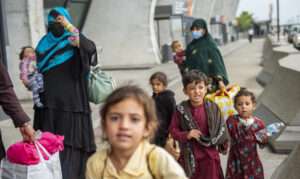
Afghan evacuees arrive at Dulles International Airport in September 2021 (Rod Lamkey - CNP/Polaris/Newscom)
Today is the second anniversary of the fall of Kabul and the loss of Afghanistan to the oppressive Taliban regime. In the aftermath of the fall, the US took in thousands of Afghans fleeing the brutal new government, including many who had fought on the side of the US or worked to promote human rights. Unfortunately, to this day, the US government still has not granted permanent residency to Afghans who entered the US based on executive "parole." As a result, most of the Afghans remain in legal limbo, making it difficult for them to fully integrate into American society. That's bad for both them and the US economy.
Congress can easily fix the problem by passing an Afghan Adjustment Act - legislation that would grant Afghan parolees permanent residency and work permits. But, so far, they haven't found the political will.
Mahnaz Akbari was supposed to be one of the lucky ones.
The former commander of an Afghan military all-female special ops team, Akbari was among the 77,000 U.S. allies successfully evacuated to the United States when the Taliban retook her country. An additional 200,000 or so are trappedabroad, awaiting processing by the U.S. government.
But her place in the country that took her in is precarious.
"I'm in a legal limbo," she says. That's because, almost two years after the United States withdrew its last forces from Afghanistan, Congress has failed to deliver on the promises made to our allies in America's longest war…..
The U.S. government pledged to protect those who aided our military and diplomatic interests. But it never fully developed the legal and administrative capacity to do so. Most of those we hastily evacuated from Afghanistan ended up coming here through a sort of short-term workaround measure, full of temporary and uncertain extensions, called "humanitarian parole…."
Akbari remains immensely proud of her service to her country. She is eager to resume serving by joining the U.S. military but cannot do so until she gets a green card. Which, for the foreseeable future, is unavailable.
Like many other Afghans who entered through parole, she has applied for asylum — a separate, convoluted and notoriously backlogged process. It's supposed to be expedited for Afghan parolees, but only a tiny sliver of Afghan applicants have been successfully adjudicated, with the rest stuck in what could bea years-long queue…..
Akbari fears that, by the time her asylum application is settled and she subsequently becomes eligible to apply for a green card, she will be too old to serve in the U.S. military.
In the meantime, she says she's grateful for opportunities she has been granted in the United States, including many facilitated by U.S. service members she once worked alongside. But she finds it difficult to plan a future, because many prospective employers are reluctant to hire someone whose ongoing work eligibility remains uncertain.
The Biden Administration has eased the situation somewhat by giving Afghan parolees the opportunity to apply for a two year extension to their initial two year parole period. But this is just a temporary reprieve. And people like Akbari remain barred from opportunities (including military service) that are only open to permanent residents. Moreover, like the initial grant of parole, the extension rests entirely on executive discretion. What Caesar giveth, he (or a successor) can taketh away.
Passing an adjustment act can fix these problems. Historically, Congress has in fact enacted such legislation for other parolees fleeing war and oppression, including Hungarians and Cubans fleeing communism, and - most closely analogous to the Afghan situation - Vietnamese fleeing the fall of South Vietnam. It should do the same thing here.
In an August 2021 post, I went over the many reasons why the US should grant refuge to Afghans fleeing the Taliban. They include general moral considerations against barring refugees fleeing violence and oppression, the unusually heinous nature of the oppression Afghans face under Taliban rule (worse than most "ordinary" dictatorships), national security interests, and the US government's significant share of responsibility for the Taliban's return to power (both the Trump and Biden administrations deserve hefty shares of blame).
I won't go over these points again here. I will merely note that all of them justify granting permanent, not just temporary refuge. The oppression the parolees face if forced to return is just as bad now as two years ago. And granting permanent refuge will serve US national security and foreign policy interests better than a mere temporary reprieve. People who aid US forces in war and help promote human rights in alliance with us should know that we will give them permanent refuge, if needed, not just a brief stay of execution.
As I have previously pointed out, many of the same considerations also justify granting permanent residency to Cuban, Venezuelan, Ukrainian, and other parolees. In addition to the Afghan Adjustment Act, Congress is also now considering a Ukrainian Adjustment Act and a Venezuelan Adjustment Act.
All should be enacted. But if political constraints allow passage of some but not others, that's still much better than nothing. As always, the best should not be the enemy of the good.
The District allowed "Black Lives Matter" protestors to violate the city's defacement ordinance, but enforced the law against groups with a different political message.
Today the U.S. Court of Appeals for the D.C. Circuit revived a lawsuit against the District of Columbia for selective enforcement of the district's defacement ordinance in violation of the First Amendment. Judge Rao wrote for the court in Frederick Douglass Foundation v. District of Columbia, joined by Judge Childs, reversing the district court's dismissal of the Foundation's First Amendment claim, but affirming dismissal of an Equal Protection claim. Judge Wilkins concurred in the judgment.
Judge Rao's opinion for the court summarizes the case and decision as follows:
The First Amendment prohibits government discrimination on the basis of viewpoint. "To permit one side … to have a monopoly in expressing its views … is the antithesis of constitutional guarantees." City of Madison Joint Sch. Dist. No. 8 v. Wis. Emp. Relations Comm'n, 429 U.S. 167, 175–76 (1976). The protection for freedom of speech applies not only to legislation, but also to enforcement of the laws. This case concerns a constitutional challenge to the selective enforcement of the District of Columbia's defacement ordinance against some viewpoints but not others.
In the summer of 2020, thousands of protesters flooded the streets of the District to proclaim "Black Lives Matter." Over several weeks, the protesters covered streets, sidewalks, and storefronts with paint and chalk. The markings were ubiquitous and in open violation of the District's defacement ordinance, yet none of the protesters were arrested. During the same summer, District police officers arrested two pro-life advocates in a smaller protest for chalking "Black Pre-Born Lives Matter" on a public sidewalk.
The organizers of the smaller protest, the Frederick Douglass Foundation and Students for Life of America (collectively "the Foundation"), sued. The Foundation alleged violations of the First and Fifth Amendments, conceding the defacement ordinance was facially constitutional, but arguing the District's one-sided enforcement of the ordinance was not. The district court dismissed the complaint. Concluding the First Amendment and equal protection claims were essentially the same, the district court held the Foundation had failed to adequately allege discriminatory intent, which the court considered a necessary element of both claims.
We affirm the district court's dismissal of the Foundation's equal protection claim because the Foundation has not plausibly alleged invidious discrimination by District officials. Discriminatory motive, however, is not an element of a First Amendment free speech selective enforcement claim. The First Amendment prohibits discrimination on the basis of viewpoint irrespective of the government's motive. We hold the Foundation has plausibly alleged the District discriminated on the basis of viewpoint in the selective enforcement of its defacement ordinance. We therefore reverse the dismissal of the Foundation's First Amendment claim and remand for further proceedings.
Judge Rao notes that selective enforcement claims are hard to substantiate, but that the Foundation plausibly alleged such selective enforcement here.
Selective enforcement claims must clear a high hurdle. Because the lawful exercise of prosecutorial discretion does not violate the Constitution, disparate enforcement of a neutral ordinance based on viewpoint is unlawful only when the prosecutorial factors are similar, and "unlawful favoritism" remains the predominant explanation for the government's targets. . . . The Foundation has plausibly alleged that when chalking the "Black Pre-Born Lives Matter" message, its advocates were similarly situated to advocates who painted and marked the "Black Lives Matter" message. . . .
Viewpoint discrimination, whether by legislative enactment or executive action, violates the First Amendment. "Once a forum is opened up to assembly or speaking by some groups, government may not prohibit others from assembling or speaking." Police Dep't of Chi. v. Mosley, 408 U.S. 92, 96 (1972). We hold the Foundation has plausibly alleged the elements of a free speech selective enforcement claim. We may reasonably infer from the Foundation's complaint, first, that its members were similarly situated to other protesters who were not arrested and, second, that the District engaged in viewpoint discrimination by enforcing the defacement ordinance against individuals chalking "Black Pre-Born Lives Matter" but not against individuals painting and chalking "Black Lives Matter."
And from her concluding paragraphs:
The First Amendment prohibits the government from favoring some speakers over others. Access to public fora must be open to everyone and to every message on the same terms. The District may act to prevent the defacement of public property, but it cannot open up its streets and sidewalks to some viewpoints and not others. During the summer of 2020, the District arrested individuals chalking "Black Pre-Born Lives Matter" on the sidewalk, while making no arrests against the many individuals marking "Black Lives Matter" on sidewalks, streets, and other property. The Foundation has plausibly alleged that its members were similarly situated to individuals against whom the defacement ordinance was not enforced, and that the District discriminated on the basis of viewpoint when enforcing the ordinance. Because the Foundation has failed to adequately allege animus on the part of the District, however, its equal protection challenge fails.
From Ford v. Norton, decided Friday by Judge Noel Hillman (D.N.J.):
Plaintiff …, presently incarcerated in the Hudson County Jail in Kearny, New Jersey, filed a Complaint against several police officers and Cumberland County prosecutors. On January 5, 2023, the Court dismissed the Complaint without prejudice in accordance with 28 U.S.C. § 1915(e)(2) because it failed to state a claim. The Court denied leave to amend as futile because Plaintiff's illegal search and false arrest claims were barred by the statute of limitations and his malicious prosecution claims were premature.
On July 10, 2023, the Court received a letter from Plaintiff that asked the Court to "take the case down entirely" or to change his name to a pseudonym. He states the complaint concerned his activity as a confidential informant and put him "in extreme danger." The Clerk docketed the letter as a motion to modify or correct the Court's order and filed it under temporary seal pending the Court's review. Plaintiff later filed a motion to seal raising the same concerns as his prior letter.
"It is well-settled that there exists, in both criminal and civil cases, a common law public right of access to judicial proceedings and records." "The public's right of access extends beyond simply the ability to attend open court proceedings. Rather, it envisions a pervasive common law right to inspect and copy public records and documents, including judicial records and documents." However, "[t]he public's common law right to access judicial records is not absolute. Instead, when the right exists, there is a strong presumption that the public may view the records."
In a piece at the Lawfare website, Harvard law Prof. Jack Goldsmith responds to critics of his New York Times article arguing that the dangers of prosecuting Donald Trump for trying to overturn the 2020 election may exceed the benefits. One of the critiques he addresses is my own. In this post, I will offer a rejoinder. But note that both Goldsmith's analysis and mine are focused on the federal indictment of Trump filed by special counsel Jack Smith. We do not address the more recent Georgia indictment.
Here's the part of Goldsmith's response that addresses my critique:
I agree that "letting Trump off the hook" might be far worse than prosecuting him. My main point is that we cannot now know, and the answer is not obvious, at least to me, especially in light of our broken politics, the novelties and uncertainties in the legal case against Trump, the weight of past Justice Department mistakes and excesses in investigating Trump, and (to add a point not in my piece) Eric Posner's reminder that "trials in which legal proceedings are used to remove political opponents from power or prevent them from taking it … have a long and storied history of backfiring on their perpetrators." If Trump is convicted, and the trial is and seems fair, and the Supreme Court upholds its validity, Smith may well be a triumphant savior of American democracy, especially if Trump self-destructs in ways that diminish him politically. But what if only a few of these things happen, or none of them?
Somin says, for example, that if Trump is not prosecuted, future presidents will be emboldened to repeat his experiment. Maybe, but maybe not, in light of the financial and reputational costs Trump has suffered. The larger point, however, is that the prosecution might go off the rails in ways that make things worse. Somin's argument appears to assume that conviction is assured. What if Trump is acquitted (including via jury nullification), or his conviction is thrown out? What if it becomes clear that what he did was not unlawful, as may well happen? What if Trump wins the presidential election and perceived overkill by the Biden Justice Department is seen as a contributing cause? These outcomes might well embolden a future Trump more, perhaps much more, than non-prosecution. Very hard to say. In assessing the upsides and downsides of the prosecution, one must think in terms of all plausible futures and counterfactuals. Yes, as I said in the opening, the future may be such that non-prosecution would be worse, perhaps much worse, than prosecution. But the opposite might be true as well. We cannot be confident now.
I appreciate Goldsmith's thoughtful response, and am flattered he devotes more space to my piece than any of the others addressed. But I remain unconvinced that the risks of prosecution outweigh the benefits, or even that this is a close question.
Goldsmith is right that Trump could potentially get away with his crimes and be emboldened to further wrongdoing, even if he gets prosecuted (e.g. - he might be acquitted). But if he's not prosecuted at all, that possibility becomes a virtual certainty.
I do not, in fact, believe conviction is certain. But I do think there is a high likelihood of it, given the strength and seriousness of the charges against Trump. I discussed some of the reasons for that legal assessment here and here. I see little chance that a conviction would be reversed, given that the prosecution's position on most relevant legal issues is backed by longstanding Supreme Court precedent, and the Court has a strong presumption (recently reaffirmed) against overturning statutory precedent.
The risk of jury nullification is harder to gauge. But I think it, too, is relatively modest, given that strong partisans are likely to be removed for cause from the jury pool and jurors generally do a better job of controlling bias and evaluating issues fairly than voters (admitted a low standard of comparison). Moreover, the case will probably be tried in Washington, DC, where the jury pool is unlikely to include many hard-core Trump supporters.
If the chance of getting a conviction were very low or nonexistent, that would be a good reason not to prosecute. But that's pretty obviously not the situation here.
Goldsmith suggests future politicians might not be emboldened to repeat Trump's experiment, if he escapes prosecution, because of the "the financial and reputational costs Trump has suffered." It seems to me any such costs are greatly outweighed by the ways in which his Big Lie has enabled Trump to remain the lead contender for the GOP nomination, and avoid the kind of political repudiation usually suffered by presidents who lose their reelection bids.
I'm also skeptical the prosecution will somehow catapult Trump to victory in the 2024 election. It's possible the various indictments helped in him the GOP primary. But his lead over his rivals there is so large (consistently at 20-30 points or more over the last several months) that any marginal boost from this indictment is unlikely to be decisive. By contrast, survey data consistently show that indictments and conviction are likely to harm him with general election voters. If the election is close, even a small shift against Trump could be significant.
I'm not convinced that electoral calculations should play any significant role in decisions to indict and prosecute Trump. Ultimately, they should be guided by the severity of the crime, and considerations of retribution and deterrence. But for those who disagree, the available evidence suggests prosecution is more likely to harm Trump's electoral prospects than help him.
Finally, I agree we should consider "all plausible futures and counterfactuals." But there should be a heavy presumption against giving a president guaranteed impunity for the heinous crime of trying to use force and fraud to stay in power after losing an election. The scenarios and risks posited by Goldsmith are nowhere near sufficient to overcome that presumption. Indeed, they are much less grave than those on the other side of the ledger.
An encouraging sign for the future of American higher education has been the emergence of local faculty groups organizing themselves to advance free speech principles at their particular institution. The latest is the Cornell Free Speech Alliance at Cornell University.
Of particular interest is their new report on policy recommendations for universities. The key points can be found here. The full report is here.
Although motivated by the specific situation at Cornell, the policy recommendations are not specific to that university. The report makes for useful reading and lays out a valuable agenda for faculty across the country.