The Volokh Conspiracy

Mostly law professors | Sometimes contrarian | Often libertarian | Always independent | Est. 2002

The Volokh Conspiracy

The President's Civil Liberties Oversight Board's report on section 702 of FISA

The board agrees it should be renewed but splits three ways on proposals for reform

|

I summarize the President's Civil Liberties Oversight Board (PCLOB) report on section 702 of FISA in this Lawfare article.  Quick summary:

"The PCLOB report is a gold mine of authoritative information about Section 702, and evaluating the recommendations is a good way to refine one's view of what reforms are needed. Whether the report will have much impact on the debate over renewal, however, is less clear. The unanimous support for renewal may be influential in the sense that it confirms a sentiment that already seems widespread in Congress, despite the FBI's travails. The report's inability to agree on more than that will dissipate its influence, particularly because understanding the dueling proposals for 702 reform requires working through hundreds of dense pages."

A Requiem For SCOTUSBlog

A slow farewell to a venerable institution.

|

The first Monday in October brought some deeply disappointing news. Tom Goldstein announced there would be some changes to SCOTUSBlog. Now, there will be a "smaller team running the blog's day-to-day operations." For more than a decade, for every merits case, there would generally be two or three separate posts: a preview before oral argument, a review of oral argument, and an overview of the published decision. These posts would be written by scholars and other subject matter experts. This was an invaluable resource whenever I needed to get up to speed on an case outside my area of expertise. But now, SCOTUSBlog "will no longer have full coverage of every merits case." Instead of this granular approach, the blog will cover "broader themes and threads."

Goldstein also announced that the blog "scaled back our statistical coverage" and "will no longer publish our annual Stat Pack." I already noticed this shortfall last Term. Indeed, in June, I contacted the blog to inquire about when the Stat Pack would be published. I was told that it would not be published. This was my go-to resource to understand trends on the Court. I was gobsmacked. I'm sure I was not alone. (Adam Feldman should start a Substack--I would subscribe.)

There were other noticeable cutbacks. One of my favorite features was Mark Walsh's "View from the Court." Mark would recount the visuals from inside the chamber, including fun interactions that would not be reflected in the transcript or recording. Those posts seem to have stopped. (Mark should start a Substack--I would subscribe.) I also noticed there were fewer symposiums on important cases. That deep coverage seemed to trickle down to a halt. Apparently the SCOTUSBlog podcast was on hiatus, but you all know my policy on podcasts. (You know it was really important for me to listen to this podcast--well, to be precise, I transcribed it, and jumped around to the relevant parts.)

The writing was on the wall for this change. In March 2023, Goldstein retired from Supreme Court advocacy. While SCOTUSblog originally began as something of a marketing vehicle for Goldstein's firm, it over time evolved into a venerable institution. SCOTUSBlog won journalism awards and was essential on handdown days--especially with NFIB v. Sebelius. But I had an inkling that once Goldstein had left the world of Supreme Court advocacy, his interest, and support of the site would diminish. Moreover, for the past few years, Casetext was a sponsor of SCOTUSBlog. (You may have noticed that links to opinions direct to Casetext, rather than to SupremeCourt.gov.) Well, Casetext was acquired by ThomsonReuters, and I suspect that sponsorship may have drawn to a close. As of today, I see nothing on the site about CaseText.

We all took SCOTUSBlog for granted for far too long. Countless authors wrote for free, knowing how influential the site was. But a slow farewell begins. It is the predictable arc of blogs: sites that are updated less are read less and have less impact.

Is there some other institution that could maintain SCOTUSBlog, and bring it back to its former heights? I am hopeful, but doubtful. Far too many people get their SCOTUS news from partisan podcasts and extemporaneous X posts. We are all worse for it.

Thank you SCOTUSBlog for making coverage of the Court that much better.

Laphonza Butler Better Hope Other Senators Are Textualists

The residency requirement for Senators applies to those who are "elected," and not "appointed."

|

The distinction between elected and appointed positions is hardwired into the Constitution. This distinction arises in many contexts: the Foreign Emoluments Clause, Section 3, and now the qualifications for the Senate.

Article I, Section 3, lists three qualifications to serve in the Senate:

No Person shall be a Senator who shall not have (i) attained to the Age of thirty Years, and (ii) been nine Years a Citizen of the United States, and (iii) who shall not, when elected, be an Inhabitant of that State for which he shall be chosen.

The first two requirements apply when the Person "shall be a Senator." That is, when the person actually seeks to hold the position. But the third requirement applies at a very specific time: "when elected." In modern times, that would mean on election day. But in 1788, there were no senatorial elections. Under the original design of the Constitution, Senators were not directly elected by the people. Rather, they were chosen by the state legislatures. Still the Constitution uses the language of "elected" in Article I, Section 3. The Constitution also uses the language of "elected" to refer to Senators in the Ineligibility Clause:

"No Senator or Representative shall, during the Time for which he was elected, be appointed to any civil Office under the Authority of the United States, which shall have been created, or the Emoluments whereof shall have been [i]ncreased during such time."

Indeed, that provision uses both the language of "elected" and "appointed."

Moreover, under the original design of the Constitution, if a Senate vacancy arose when the state legislature was in recess, "the Executive thereof may make temporary Appointments until the next Meeting of the Legislature, which shall then fill such Vacancies." Notice the language: "appointments," and not "elections."

The Seventeenth Amendment changed the method by which senators were chosen. Now, senators would be "elected by the people." But the Seventeenth Amendment still allowed the state executive "to make temporary appointments."

In 2021, Seth Barrett Tillman and I discussed the Governor's powers to fill Senate vacancies in an article about insurrection:

"The Constitution authorizes a governor to temporarily fill a senate vacancy by appointment. In these situations, it is not clear that the inhabitancy qualification applies, as temporary senators are not 'elected.'"

As often happens, Seth and I write about obscure textualist issues that only become relevant much later. And so it has come to pass, once again.

Co-blogger Steve Sachs describes the latest controversy from California:

According to his official website, California Gov. Gavin Newsom on October 1 appointed Laphonza Butler to the Senate, to complete the term of the late Sen. Dianne Feinstein. Butler was apparently a Maryland resident as of very recently, but according to Newsom's office she plans to re-register to vote in California before her Wednesday swearing-in. . . .

Until recently, Butler wasn't an inhabitant of California. She lived there much of her life and apparently still owns a home there. But since then she moved to Maryland, where she made political donations and worked for a political committee.

Newsom's office has suggested that it'll be enough for Butler to re-register to vote in California before being sworn in on Wednesday

Steve suggests that the residency requirement attaches to both Senators who are elected by the people, and appointed by the Governor:

 The phrase "when elected" is broader than that, because it was adopted as part of the 1788 Constitution, when each state's senators were "chosen by the Legislature thereof" (Art. I, § 3, cl. 1), usually one legislative house at a time. So "elected" here means a whole process of official choice, not only some first-past-the-post vote by the general citizenry. . . .

The Seventeenth Amendment was adopted "in lieu of" the "chosen by the Legislature" requirement, as well as "so much of paragraph two of the same section as relates to the filling of vacancies." But it left the qualification requirements in Clause 3 intact. So the "when elected" requirement is still good law, and its most natural reading would include whatever form of official choice establishes a person as a putative senator.

I disagree. Elected means elected. And appointed means appointed. Both types of language (elected and appointed) language were used in the Constitution of 1788, and in Seventeenth Amendment.

And Seth offers an explanation for why the Framers may not have imposed the residency requirement on temporary Senate replacements:

It is not difficult to understand why the Framers of both the original Constitution of 1788 and the Seventeenth Amendment made this choice. The nation was geographically vast. It would take time to hold an election and, similarly, it would take time for a temporary appointee from one's home-state to physically move to the national capital. The capital itself, over time, would become the home to many former representatives, former senators, and other former senior government officials. It would make sense for states to be able to draw on these individuals as a temporary matter to fill vacancies—even where such appointees had no home-state residence. Where a candidate was filling a full six-year term, one wanted him to have home-state connections. But where a candidate was filling a temporary trust, it would make sense to loosen residence requirements so that a state could immediately have senate representation. For similar reasons, the strictures of the Ineligibility Clause applies only to elected members, and not to temporary senators holding short appointments.

Once again, a textualist reading of constitutional qualifications may lead to results that some view as unsatisfying. Of course, such consequentialism begins with a specific starting point: qualifications should be enforced rigidly. There is a different potential starting point: qualifications should not be enforced rigidly, but rather the democratic process should prevail. (Hint, hint, Section 3, Section 3). Let us not forget that the Senate has issued oaths to several members who were under the age of 30. Seth and I make this point in our tome on Section 3:

History supports this understanding of congressional practice. William Claiborne of Tennessee, who was born in 1775, was elected to and then began serving his two-year House term in 1797. He was only 22 years old. The House did not disqualify him. Claiborne was re-elected in 1799, when he was still not yet twenty-five. It was only some time during his second term that he finally reached the age of twenty-five.

Other examples abound. In 1806, Henry Clay of Kentucky was elected to the Senate by his state legislature. He took the oath, and he began serving while he was still twenty-nine years old. In 1816, the Senate administered the oath to Armistead Mason of Virginia, who was elected by the state legislature to a Senate term to fill a vacancy. The unexpired term would stretch about a year. At the time of Mason's election, he was twenty-eight years old. His elected term ended in March 1817, and he was still several months shy of his thirtieth birthday when his term ended. In 1818, the Senate administered the oath to John Henry Eaton of Tennessee. At the time, Eaton was only twenty-eight years old. According to the Senate Historical Office, "Apparently no one asked John Eaton how old he was."

Laphonza Butler better hope that the other Senators are textualists like Tillman and me. Or perhaps no one asks where she lives.


Academia

Academics Pick their "Most Underappreciated" Articles [Updated]

Econ Journal Watch asked academics with high citation counts to pick their most underappreciated article. I participated in the project, along with a number of prominent scholars from various disciplines.

|

NA

Econ Journal Watch recently asked scholars with at least 4000 total citations to their works listed on Google Scholar to submit a description of their most "underappreciated" article. The work in question had to have a publication date prior to 2012 and a citation count on Google Scholar lower than the author's H-Index on that site; it also could not have been incorporated into a book. I have just under 4400 Google Scholar citations, so I qualify.

Therefore I submitted my pick: "What if Kelo v. City of New London Had Gone the Other Way?," Indiana Law Review 45 (2011): 21-39. Econ Journal Watch published my summary of what the article is about, along with entries by other qualifying scholars:

The article challenges the conventional wisdom on the impact of one of the Supreme Court's most controversial modern rulings, which held that government could take property for private "economic development." Some have suggested that, because defeat led to a major political backlash against eminent domain abuse, the decision actually aided the cause of property rights protection. I argue that property rights advocates would have been better off had they won the case. In addition, I develop a more general framework for using counterfactual analysis to assess the impact of court decisions. The latter is relevant far beyond the specific context of the Kelo case.

Why is the article underrated? The biggest reason, I think, is that most people ignored the more general framework for counterfactual analysis of the impact of court decisions, which has relevance far beyond Kelo. In addition, the article was overshadowed by my own other, better-known works about Kelo and eminent domain, including my book on that subject. Another factor is that it was published in a symposium in a non-top tier law journal.

While this is, in my view, my most underrated article that fits the criteria, my truly most underrated article is probably this one, which missed the cut because it was published in 2014, and was later partly incorporated in a book.

The Econ Journal Watch underrated articles compendia (see here and here), include many interesting nominations by prominent scholars, including Nick Bostrom, Andrew Gelman, Sam Peltzman, Richard Wagner, Bryan Caplan, Alex Tabarrok, and many others. Because EJW is run by economists, there are more submissions from that field than others. But there are still some from other fields, including my own contribution.

UPDATE: Cynics might ask whether I think I have any overrated articles. Indeed, I do! The most overrated is probably this one. The catchy title ("Knowledge About Ignorance") may explain how it got so much attention.

Politics

Is Sen.-to-be Butler Eligible to Represent California?

The residence question is closer than it might appear.

|

According to his official website, California Gov. Gavin Newsom on October 1 appointed Laphonza Butler to the Senate, to complete the term of the late Sen. Dianne Feinstein. Butler was apparently a Maryland resident as of very recently, but according to Newsom's office she plans to re-register to vote in California before her Wednesday swearing-in.

For various reasons, though, that might not be enough, and the Senate will have a real constitutional question to face. As far as I can tell—and I'd be happy to be corrected—if Butler hasn't traveled back to her home in California since deciding to take the job, and if Newsom doesn't wait until she does to make (or re-make) the appointment, she can't represent California, and the Senate can't seat her yet.
Read More

Supreme Court

Justice Kavanaugh Really Wants to Hear More (Patent) Cases

Not all of the justices are happy about the Court's stingy approach to certiorari.

|

The Supreme Court granted certiorari in a dozen cases Friday, but still has quite a small docket -- smaller than at this point in any of the past decade. While a majority of the Court is presumably happy with this state of affairs (it takes only four justices to grant certiorari), not all of the justices think the Court's dwindling docket is a good thing.

Speaking at the Sixth Circuit Judicial Conference last month, Justice Kavanaugh noted that the Court will struggle to grant 50 cases this term, and expressed the view that the Court could (and should) hear more like 75 cases per term.

Today's Order List from the long conference noted that Justice Kavanaugh would have granted certiorari in one case his colleagues passed on: CareDx, Inc. v. Natera, Inc., a patent case presenting the question "whether a new and useful method for measuring a natural phenomenon, that improves upon prior methods for measuring that very same phenomenon, is eligible for patent protection under Section 101."

This is not the first time Justice Kavanaugh his noted his disagreement with his colleagues refusal to grant certiorari. It's not even the first time he's noted his desire to grant certiorari in a patent case. Last May, an order list noted two other patent cases in which Justice Kavanaugh would have granted certiorari, but his colleagues did not.

I will confess I am not particularly eager for the Court to hear more patent cases, but I agree with Justice Kavanaugh that the Court can and should hear more cases than it does and it would be great if at least three of his colleagues agreed.

Politics

The 12th Annual Harlan Institute-Ashbrook Virtual Supreme Court

Teams of two HS students will write a brief and present oral arguments on Moody v. NetChoice.

|

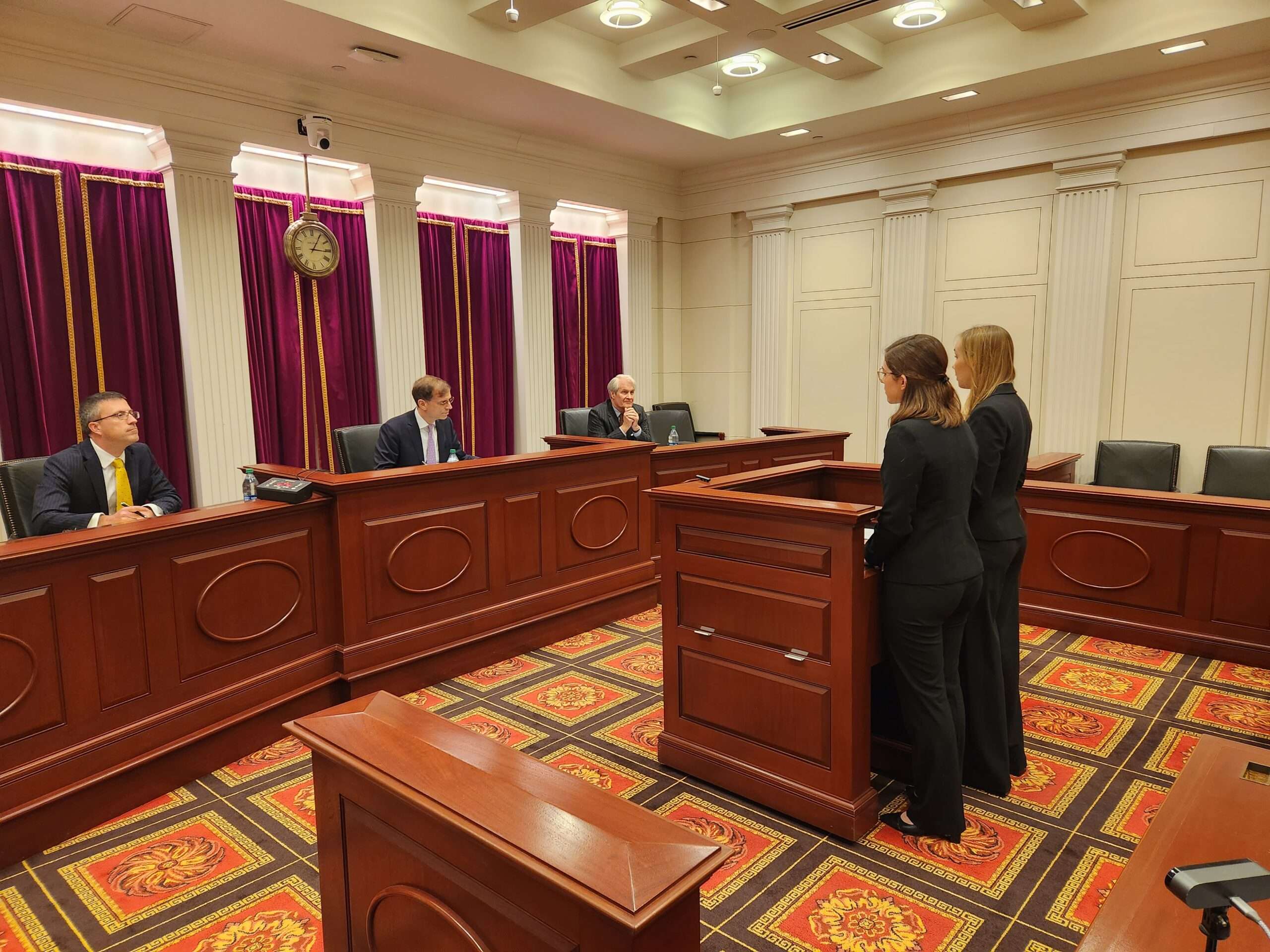
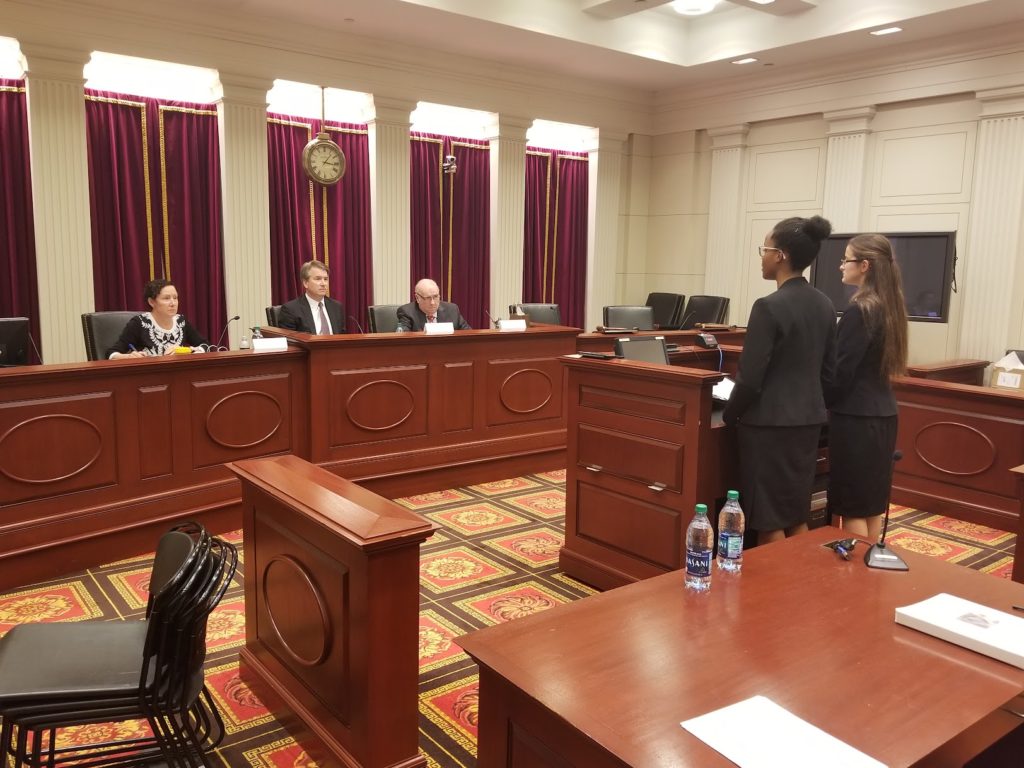
The Harlan Institute and Ashbrook are pleased to announce the Twelfth Annual Virtual Supreme Court Competition. This competition offers teams of two high school students the opportunity to research cutting-edge constitutional law, write persuasive appellate briefs, argue against other students through video chats, and try to persuade a panel of esteemed attorneys during oral argument that their side is correct. This year the competition focuses on Moody v. NetChoice.

The competition is endorsed by the Center for Civic Education's We The People Competition:

The Virtual Supreme Court Competition helps students gain the skills they need to understand, synthesize, and advocate for reasoned legal positions on timely and relevant constitutional issues, and in doing so deepens their commitment to the rule of law. The program directly supports the highest goals of the Center for Civic Education to develop enlightened and responsible members of our society, and it is a privilege to be a part of this important work. Christopher R. Riano President, The Center for Civic Education Member Board of Advisors, The Harlan Institute

Tournament Instructions

Teams of two high-school students will write an appellate brief, and present oral arguments, addressing these questions:

  • These cases concern laws enacted by Florida and Texas to regulate major social media platforms like Facebook, YouTube, and X (formerly known as Twitter). The two laws differ in some respects, but both restrict platforms' ability to engage in content moderation by removing, editing, or arranging user-generated content; require platforms to provide individualized explanations for certain forms of content moderation; and require general disclosures about platforms' content moderation practices.
  • The questions presented are:
    • 1. Whether the laws' content-moderation restrictions comply with the First Amendment.
    • 2. Whether the laws' individualized-explanation requirements comply with the First Amendment.

Petitioners will argue that laws' content moderation restrictions and individualized-explanation requirements do comply with the First Amendment.

Respondents will argue that laws' content moderation restrictions and individualized-explanation requirements do comply with the First Amendment.

Phase 1 - Research and Write Your Brief

Coaches can register their teams at the Institute for Competition Sciences (ICS). ICS will generate a number for each team.  Odd-numbered teams will represent the Petitioners and even-numbered teams will represent the Respondents.

Teams will research and write their briefs. Carefully review the lesson plan. The brief must be a minimum of 2,000 words. Please download this template. The brief should have the following sections:

  1. Table of Cited Authorities: List all of the original sources, and other documents you cite in your brief.
  2. Summary of Argument: State your position succinctly in 250 words or less.
  3. Argument: Structure your argument based on at least five Supreme Court precedents. The more authorities you cite, the stronger your argument will be–and the more likely your team will advance.
  4. Conclusion: Summarize your argument, and argue how the Supreme Court should decide this issue.

Be sure to proofread your work. The work must be yours, and you may not seek help from anyone else–including attorneys or law students. Students who submit plagiarized briefs will be disqualified.

Please review the winning submissions from previous years:

Phase 2 - Virtual Mentoring

Teams that register before November 3, 2023 will be invited to participate in a virtual mentoring session. These sessions will be hosted during the week of November 27, 2023. The Harlan Institute will match each class with a mentor from our network. These sessions will be helpful to finalize your briefs and prepare your preliminary round arguments.

Phase 3 - Preliminary Round

For the preliminary round, each team must prepare a YouTube video. The argument must be at least 15 minutes in length. Coaches will ask their students ten questions from the lesson plan.

Teams will upload a PDF of their brief, as well as a link to their YouTube video to the Institute of Competition Sciences. The deadline for the preliminary round will be December 15, 2023. The brief and preliminary round video will be scored based on this rubric.

Phase 4 - Virtual Rounds

We will hold the Virtual Rounds over Zoom:

  • 2/19/24, 2/20/24, 2/21/24: Semifinal Round
  • 3/4/24 and 3/5/24: Round of 8
  • 3/18/24 and 3/19/23: Round of 4

The virtual rounds will be scored based on this rubric. This video offers five tips to prepare for oral argument:

Phase 5 - Championship Round Rounds

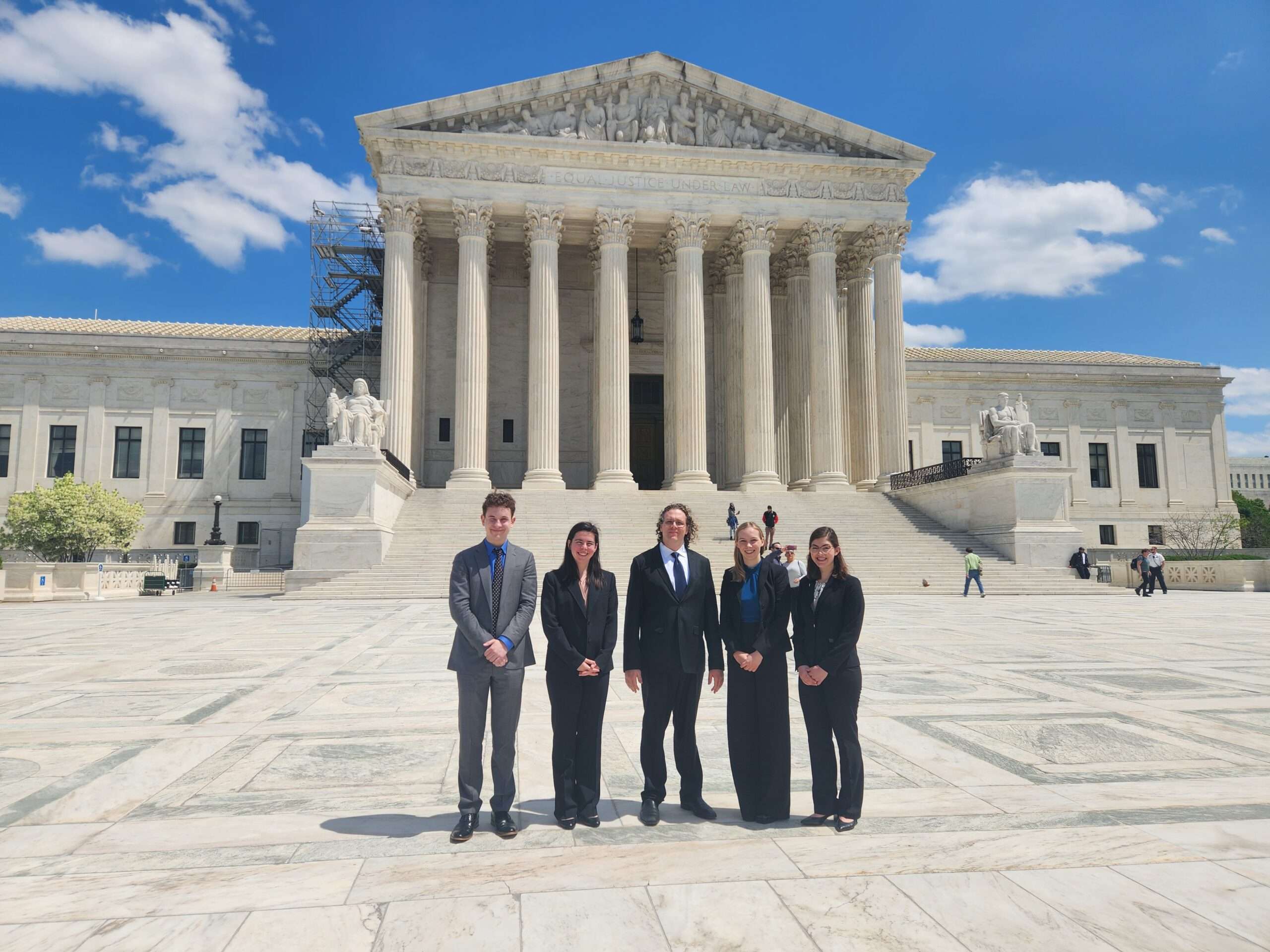
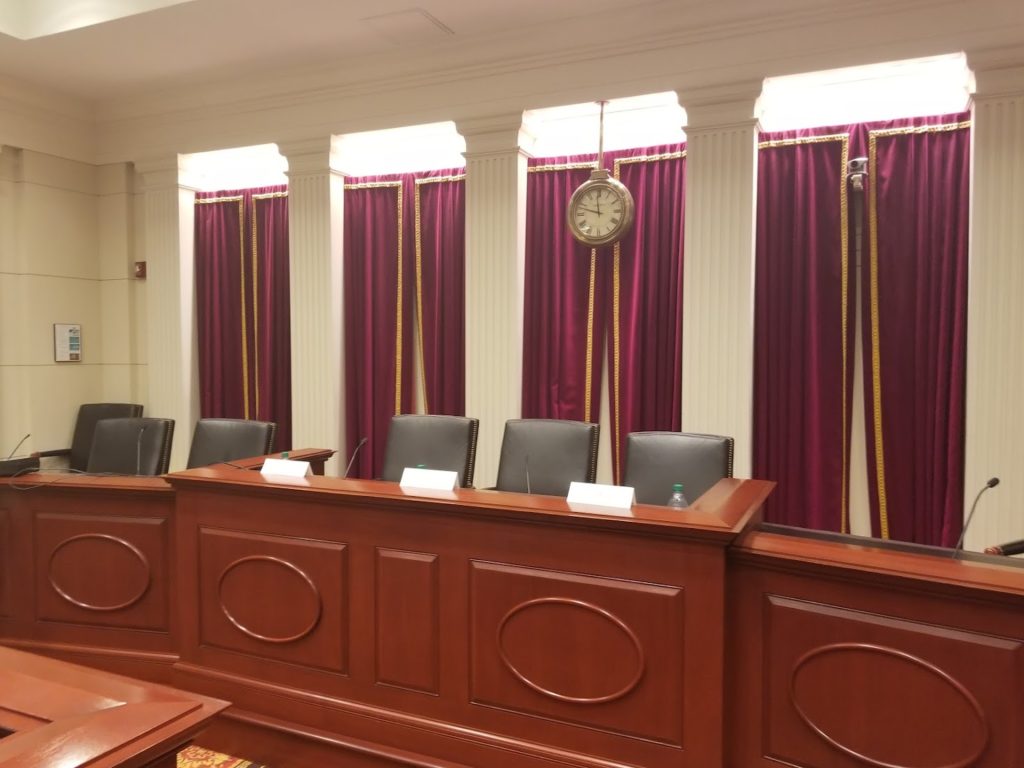
The top teams will receive a free trip to Washington, D.C. to argue the championship round before federal judges the week of April 29, 2024. 

Read More

Politics

Oyez! Oyez! Oyez! The October Term 2023 of FantasySCOTUS is now in session

Predict all of the biggest cases at the Supreme Court.

|

I am honored to open up the 15th Season of FantasySCOTUS. I launched the site back in 2009 when I was still clerking. Now, more than decade later, thousands of Court watchers have made their predictions. Sign up today at FantasySCOTUS.net to predict the outcome of all the blockbusters this term, including CFPB v. CFSAA, Alexander v. SC State Conference of the NAACP, O'Connor-Ratcliff v. Garnier, Vidal v. Elster, United States v. Rahimi, Moody/Paxton v. NetChoice, Moor v. United States, SEC v. Jarkesy, and others.

Sixth Circuit

Sixth Circuit Reverses Preliminary Injunctions Against TN & KY Laws Restricting Gender Dysphoria Treatments for Minors (Updated)

After a divided ruling, laws limiting such treatments in Tennessee and Kentucky will go into force.

|

[See updates below]

In July, a divded panel of the U.S. Court of Appeals for the Sixth Circuit stayed a preliminary injunction against a Tennessee law barring pharmaceutical and surgical gender-affirming care for minors diagnosed with gender dysphoria. A similar case arose out of Kentucky. On Thursday, a divided panel of the U.S. Court of Appeals for the Sixth Circuit reversed the preliminary injunctions issued in both cases. Chief Judge Sutton wrote the majoirty opinion in Skrmetti v. L.W., joined by Judge Thapar, rejecting both due process and equal protection challenges to the laws. Judge White dissented.

In his opinion, Chief Judge Sutton stresses the high hurdle plaintiffs must clear to justify a preliminary injunction, explains why the plaintiffs cannot show that the Tennessee and Kentucky laws are clearly precluded under existing precedent, and makes the case that judges should tread cautionsly before expanding existing constitutional guarantees to preclude state-level experimentation with emerging issues.

The claimants face several initial headwinds in obtaining relief. First, they do not argue that the original fixed meaning of the due process or equal protection guarantees covers these claims. That prompts the question whether the people of this country ever agreed to remove debates of this sort—over the use of innovative, and potentially irreversible, medical treatments for children—from the conventional place for dealing with new norms, new drugs, and new public health concerns: the democratic process. Life-tenured federal judges should be wary of removing a vexing and novel topic of medical debate from the ebbs and flows of democracy by construing a largely unamendable Constitution to occupy the field.

Second, while the challengers do invoke constitutional precedents of the Supreme Court and our Court in bringing this lawsuit, not one of them resolves these claims. In each instance, they seek to extend the constitutional guarantees to new territory. There is nothing wrong with that, to be certain. But this reality does suggest that the key premise of a preliminary injunction—a showing of a likelihood of success on the merits—is missing. Constitutionalizing new areas of American life is not something federal courts should do lightly, particularly when "the States are currently engaged in serious, thoughtful" debates about the issue. Washington v. Glucksberg, 521 U.S. 702, 719 (1997).

Third, the States are indeed engaged in thoughtful debates over this issue, as the recent proliferation of legislative activity across the country shows. By our count, nineteen States have laws similar to those in Tennessee and Kentucky, all of recent vintage. . . . At least fourteen other States, meanwhile, provide various protections for those seeking treatments for gender dysphoria, all too of recent vintage. . . .

Most of this legislative activity occurred within the last two years. Failure to allow these laws to go into effect would start to grind these all-over-the-map gears to a halt. Given the high stakes of these nascent policy deliberations—the long-term health of children facing gender dysphoria—sound government usually benefits from more rather than less debate, more rather than less input, more rather than less consideration of fair-minded policy approaches. To permit legislatures on one side of the debate to have their say while silencing legislatures on the other side of the debate under the Constitution does not further these goals. That is all the more critical in view of two realities looming over both cases—the concept of gender dysphoria as a medical condition is relatively new and the use of drug treatments that change or modify a child's sex characteristics is even more recent. Prohibiting citizens and legislatures from offering their perspectives on high-stakes medical policies, in which compassion for the child points in both directions, is not something life-tenured federal judges should do without a clear warrant in the Constitution.

The opinion goes on to walk through the various due process and equal protection arguments and rejects the claims that the laws in question impermissibly infringe upon fundamental rights or violate equal protection, either by adopting an impermissible sex-based classification or discriminating against a suspect class.

Chief Judge Sutton's opinion concludes:

No one in these consolidated cases debates the existence of gender dysphoria or the distress caused by it. And no one doubts the value of providing psychological and related care to children facing it. The question is whether certain additional treatments—puberty blockers, hormone treatments, and surgeries—should be added to the mix of treatments available to those age 17 and under. As to that, we return to where we started. This is a relatively new diagnosis with ever-shifting approaches to care over the last decade or two. Under these circumstances, it is difficult for anyone to be sure about predicting the long-term consequences of abandoning age limits of any sort for these treatments. That is precisely the kind of situation in which life-tenured judges construing a difficult-to-amend Constitution should be humble and careful about announcing new substantive due process or equal protection rights that limit accountable elected officials from sorting out these medical, social, and policy challenges.

For these reasons, we reverse the preliminary injunctions issued in these cases and remand them for further proceedings consistent with this decision.

As noted, Judge White dissented, concluding that the laws violate both due process and equal protection. Her dissent begins:

The statutes we consider today discriminate based on sex and gender conformity and intrude on the well-established province of parents to make medical decisions for their minor children. Despite these violations of the Equal Protection and Due Process Clauses of the Fourteenth Amendment, the majority concludes that the statutes are likely constitutional and reverses district court orders enjoining the statutes. . . .

And her dissent concludes:

As the majority notes, the heated political debate over gender-affirming care has yielded varying laws in Tennessee, Kentucky, and throughout our country. In the normal course, the Constitution contemplates the states acting as laboratories of democracies to resolve the controversies of the day differently. See New State Ice Co v. Liebmann, 285 U.S. 262, 311 (1932) (Brandeis, J., dissenting).

But when a fundamental right or freedom from discrimination is involved, experimentation has no place. "The very purpose of" our constitutional system "was to withdraw certain subjects from the vicissitudes of political controversy, to place them beyond the reach of majorities and officials and to establish them as legal principles to be applied by the courts." W. Va. St. Bd. of Ed. v. Barnette, 319 U.S. 624, 638 (1943). Our "fundamental rights may not be submitted to vote; they depend on the outcome of no elections." Id. Similarly, "[n]o plebiscite can legalize an unjust discrimination." Lucas v. Forty-Fourth Gen. Assemb., 377 U.S. 713, 736 n.29 (1964) (citation omitted).

Tennessee's and Kentucky's laws tell minors and their parents that the minors cannot undergo medical care because of the accidents of their births and their failure to conform to how society believes boys and girls should look and live. The laws further deprive the parents—those whom we otherwise recognize as best suited to further their minor children's interests—of their right to make medical decisions affecting their children in conjunction with their children and medical practitioners. For these reasons, I dissent.

Given the holding and the current composition of the Sixth Circuit, this is not a particularly strong candidate for en banc review. There is also no circuit split yet on this question. The only other federal appeals court to rule on this issue thus far -- the U.S. Court of Appeals for the Eleventh Circuit -- reached the same conclusion. Several district courts have gone the other way, however, making it possible that a circuit split could still emerge, precipitating Supreme Court review.

UPDATE: One potential source for a crcuit split could be two cases currently pending in the U.S. Court of Appeals for the Fourth Circuit -- Fain v. Crouch and Kadell v. Fowell -- which involve state refusals to cover gender reassignment surgery and some other treatments for gender dysphoria under Medicaid or other state-run health care plans. The Fourth Circuit heard both cases en banc earlier this month, and it seems possible the court will disagree with the Sixth Circuit, at least with regard to whether such restrictions violate the Equal Protection Clause.

SECOND UPDATE: There is arguably a circuit split already with the U.S. Court of Appeals for the Eighth Circuit (at least for now). Last year, in Brandt v. Rutledge, the Eighth Circuit affirmed a preliminary injunction against an Arkansas law barring gender transition treatments for minors. The court also denied a petition for rehearing en banc. Of note, five judges called for en banc rehearing, and three more noted they opposed en banc rehearing because of the interlocutory posture of the case, and not because they concurred with the panel opinion. (The Eighth Circuit has eleven judges in active service.) Now that the district court has enjoined the law and the case is now on appeal, Arkansas has petitioned for initial hearing en banc. Should this motion be granted, I suspect the Eighth Circuit will agree with the Sixth and Eleventh Circuits, thus eliminating the circuit split.

Upcoming Speaking Engagements

Fall 2023 lectures and panels on various subjects, but mostly climate change policy.

|

Unlike Ilya, I have been delinquent in posting information on upcoming speaking engagements. I forgot to let readers know about my talk to the University of Michigan Law School Federalist Society chapter on climate change policy (with a response by Prof. Rachel Rothschild), my presentation of my paper, "Standing without Injury" at the University of Chicago Constitutional Law Institute's Standing Doctrine Conference, and my participation in a panel on "Can Corporations Be Sued for Global Warming?" at the annual Cox Center for Internatinal Law Conference on "Climate Change and International Law at a Crossroad."

Perhaps most importantly, I neglected to note my participation in this year's "IronConLawProf" event sponsored by CWRU's Federalist Society chapter. This is a particularly fun event, in which professors are recruited to stage a mock oral argument for a case pending before the Supreme Court. What makes the event particularly fun (and inspired the name) is that the participating professors do not know which side they will have to argue until the start of the event. This year's case was Loper Bright Enterprises v. Raimando (the Chevron case), and I drew the government, so I had to do my best Elizabeth Prelogar impersonation. My colleague Prof. Jessie Hill was stuck arguing that Chevron should be overturned.

Here is a brief listing of public speaking engagements I have scheduled for the balance of the semester. (I'll update this list if additional events arise.)

On October 5, I'll be speaking at a Federal Bar Association, Northern District of Ohio Chapter CLE program at the, "Administrative Procedures Act Seminar: History, Interpretations, and Latest Rulings from the Bench." Other speakers include Profs. Emily Bremer of Notre Dame and Christopher Walker of Michigan. The event is 9am-1pm at the Carl B. Stokes Courthouse in Cleveland. Registration info is here.

On October 10, I will be speaking to the Federalist Society student chapter at Harvard Law School on "Environental Federalism: States as Laboratories of Environmental Policy." Prof. James Salzman will provide critical commentary. Details here.

On October 17, I will be speaking at mid-day to the Federalist Society student chapter at the University of Chicago on "Why the EPA Will Not Save Us from Climate Change."

On October 24, I will be making two Federalist Society chapter talks in Washington, D.C. First, at noontime, I will be speaking to the student chapter at George Washington University Law School again on "Why the EPA Will Not Save Us from Climate Change."

At 5pm that day, I will speak to the student chapter at the Georgetown University Law Center on the Roberts Court and my claim that the Court is (by historical measures) relatively restrained. Prof. Josh Chafetz will be on hand to heartily disagree.

On October 27, I will be a panelist on "State Constitutions and Climate Change" sponsored by the State Democracy Research Initiative at the University of Wisconsin Law School. Other speakers include Retired Justice Michael Wilson of the Hawaii Supreme Court, Dean Elizabeth Kronk Warner (S.J. Quinney College of Law), Professor Shelley Welton (Penn Carrey Law School), and Professor Miriam Seifter (Wisconsin).

Takings

Supreme Court Will Hear Case on Whether there is a "Legislative" Exception to the Takings Clause

The case will consider whether the government is exempt from takings liability for imposing exactions as a condition of development rights in situations where the exaction is imposed by legislation. Unlike many Supreme Court cases, this one can be resolved very easily by applying a basic principle of constitutional law.

|

NA

In addition to Devillier v. United States (which I discussed here), the Supreme Court yesterday decided to hear another Takings Clause case: Sheetz v. County of El Dorado. Here's the question presented in the case:

Whether a building-permit exaction is exempt from the unconstitutional-conditions doctrine as applied in Nollan v. California Coastal Commission and Dolan v. City of Tigard, Oregon simply because it is authorized by legislation.

In Nollan, Dolan, and some later cases, the Supreme Court has ruled that state and local governments sometimes violate the Takings Clause of the Fifth Amendment (which requires payment of "just compensation" when the government takes private property) when they impose exactions as a condition of letting property owners develop their land. Some lower courts - including the California Court of Appeal in this case - have held there is no Takings Clause liability for land-use exactions in cases where the requirement was imposed by legislation, rather than by executive officials or regulatory agencies.

Exaction takings cases pose many difficulties. Supreme Court precedent in this field is far from a model of clarity. In many situations, it is - under current precedent - genuinely hard to figure out whether taking has occurred or not.

But the issue raised by this case should be an easy one: there is not and cannot be any "legislative exception" to Takings Clause liability in cases where such liability would otherwise exist. The whole point of the Bill of Rights - including the Takings Clause - is to limit legislative impositions, no less than executive ones. As the Supreme Court emphasized in its famous First Amendment decision in West Virginia State Board of Education v. Barnette (1943), "The very purpose of a Bill of Rights was to withdraw certain subjects from the vicissitudes of political controversy, to place them beyond the reach of majorities and officials and to establish them as legal principles to be applied by the courts." Neither the Takings Clause generally nor exaction takings specifically are exceptions to this general principle.

The Cato Institute amicus brief urging the Court to hear this case goes over this key point in detail (unlike in some other recent takings cases, I was not involved in writing the Cato brief in this one). It also explains why we cannot rely on the democratic process to effectively protect property owners' rights in exaction/development cases.  I would add that many of the beneficiaries of new development are people who are priced out of a given area by restrictions on construction, but could potentially move there if developers are allowed to build new housing. That's the kind of group that often has little or no influence over local government political processes.

But the Court need not even consider such political economy issues. They can just rely on the basic principle that the whole point of constitutional rights is to impose constraints on the political process - including legislatures.

Free Speech

Supreme Court Will Consider Cases Challenging Florida and Texas Social Media Laws

The laws require major social media platforms to host content they disapprove of for substantive reasons.

|

Blocked Facebook page
Rafael Henrique | Dreamstime.com

Today, the Supreme Court decided to hear Moody v. NetChoice and NetChoice v. Paxton, cases challenging Florida and Texas state laws barring major social media firms from using most types of content moderation, thereby requiring them to host content they disapprove of. Eugene Volokh has additional details on the issues the Court will consider here.

In NetChoice v. Paxton, a 2-1 Fifth Circuit decision upheld the Texas law. Earlier, the 11th Circuit unanimously struck down the main provisions of the Florida law, in a decision written by conservative Trump appointee Judge Kevin Newsom.

In previous posts about these cases, I have explained why the Texas law is a threat to freedom of speech, criticized claims that states can and should treat major social media firms as "common carriers" (including critiquing analogies to phone service providers), and argued that these laws violate the Takings Clause of the Fifth Amendment, as well as the Free Speech Clause of the First Amendment (the takings issue is not before the Court).

Last year, the Supreme Court reinstated the trial court injunction against the Texas law, after it was lifted by the Fifth Circuit. In my view, this action may signal that the Court will rule against Texas (and Florida) on the merits, now that the issue is before them.

For those keeping track, I consistently opposed the Texas and Florida laws both before and after Elon Musk acquired Twitter (now called X). I didn't much like the content moderation policies of the pre-Musk management, and I like Musk's policies even less. But they nonetheless both have a First Amendment right to decide which speech they wish to host, and which they don't. If Musk wants to kick me off Twitter/X because he doesn't like my views, he should be entirely free to do so.

I am also one of the relatively few people who simultaneously support the Fifth Circuit's recent decision to bar the White House and other federal officials from coercing social media firms to take down content they deem "misinformation" and oppose that same courts' decision (with a different panel of judges) upholding the Texas social media law. The First Amendment bars government from both forcing social media firms to take down content the state disapproves of and forcing them to put up content the firms themselves object to. Hopefully, the Supreme Court will see things that way, too.

UPDATE: Although I am a former Fifth Circuit clerk, there are now two cases that the Court agreed to hear today where I hope the Court overrules the Fifth Circuit: NetChoice v. Paxton and Devillier v. Texas. I wrote about the latter case here.

Takings

Supreme Court Will Review Fifth Circuit Ruling that Creates a Catch-22 for Takings Claims Against State Governments

The badly flawed lower court ruling defies the Supreme Court's landmark 2019 decision forbidding such Catch-22 traps, and threatens the property rights of large numbers of people.

|

NA

Today, the Supreme Court agreed to hear Devillier v. Texas, an important takings case. Together with the Cato Institute, I filed an amicus brief urging the Court to take and reverse this terrible decision by the US Court of Appeals for the Fifth Circuit. I hope they will now do exactly that!

I previously wrote about the issues at stake in this case here:

In its important decision in Knick v. Township of Scott (2019), the the Supreme Court reversed Williamson County Regional Planning Commission v. Hamilton Bank, a 1985 decision that made it almost impossible to bring takings cases against state and local governments in federal courts….

In a forceful opinion for the Court, Chief Justice John Roberts denounced this "Catch-22" and emphasized that "[a] property owner has an actionable Fifth Amendment takings claim when the government takes his property without paying for it…."

Access to federal court is crucial to protecting constitutional rights against violation by state and local governments….

Unfortunately, a recent decision by the US Court of Appeals for the Fifth Circuit (which covers the states of Texas, Louisiana, and Mississippi) goes against the principles outlined in Knick and threatens to create a new Catch-22 keeping takings claims out of federal court.

In Devillier v. Texas,…. a Fifth Circuit panel ruled that federal courts have no jurisdiction to hear takings claims against state governments because the Fifth Amendment doesn't create such jurisdiction, and there is no federal statute establishing it either….

What the court says is simply false. The Fifth Amendment does indeed create a "direct cause of action" against state governments, no less than other provisions of the Bill of Rights do. Nothing in the text or original meaning of the Constitution suggests otherwise….

Even worse, the Fifth Circuit ruling creates precisely the kind of Catch-22 that Knick forbids. Indeed, it may be even worse! This case ended up in federal court in the first place, because—after the plaintiffs initially filed in state court—the state of Texas removed the case to federal court under 28 U.S. Code Section 1441, which allows defendants to remove to federal court "any civil action brought in a State court of which the district courts of the United States have original jurisdiction."

Under the approach adopted here by the Fifth Circuit, takings claims against state governments cannot be brought in federal court. And if they are instead brought in state court, the defendant state can remove them to federal court and then force their dismissal!….

This is actually even worse than the Williamson County regime, under which takings claims could at least be litigated in state court (though some lower courts did permit the kinds of removal shenanigans the Fifth Circuit blessed here).

If the Supreme Court upholds the terrible lower court ruling, it would essentially give state governments a ready-made path to taking private property without having to pay compensation, as the Fifth Amendment requires. They could simply follow Texas' example of removing Fifth Amendment takings cases to federal court and then getting them dismissed under 28 U.S.C. Section 1441.

The flaws of the Fifth Circuit ruling are covered in greater detail in my earlier post about this case, and in our amicus brief urging the Supreme Court to hear the case. The Cato Institute and I will likely be filing another amicus brief on the merits, now that the justices will be hearing the case.

Politics

Short Circuit: A Roundup of Recent Federal Court Decisions

Wedding officiants, teaser profiles, and administrative animals.

|

Please enjoy the latest edition of Short Circuit, a weekly feature written by a bunch of people at the Institute for Justice.

Happy Friday! IJ is going back to the big show! Read all about it. Or listen to a past episode of the Short Circuit podcast about the case.

And speaking of the Supreme Court: For the latest edition of the Short Circuit podcast, we head over to Stanford Law School to visit with some friends at the Supreme Court Litigation Clinic there.

Read More

Free Speech

S. Ct. Will Consider Constitutionality of Laws Limiting Social Media Platform Moderation Decisions

|

The Supreme Court has just agreed to hear these cases, limited to these questions (as articulated by the Solicitor General's brief for the federal government):

These cases concern laws enacted by Florida and Texas to regulate major social media platforms like Facebook, YouTube, and X (formerly known as Twitter). The two laws differ in some respects, but both restrict platforms' ability to engage in content moderation by removing, editing, or arranging user-generated content; require platforms to provide individualized explanations for certain forms of content moderation; and require general disclosures about platforms' content-moderation practices. The questions presented are:
1. Whether the laws' content-moderation restrictions comply with the First Amendment.
2. Whether the laws' individualized-explanation requirements comply with the First Amendment.

The Court declined to grant review on two other questions, though they might still indirectly play a role in the analysis of the first two questions:

Read More

More