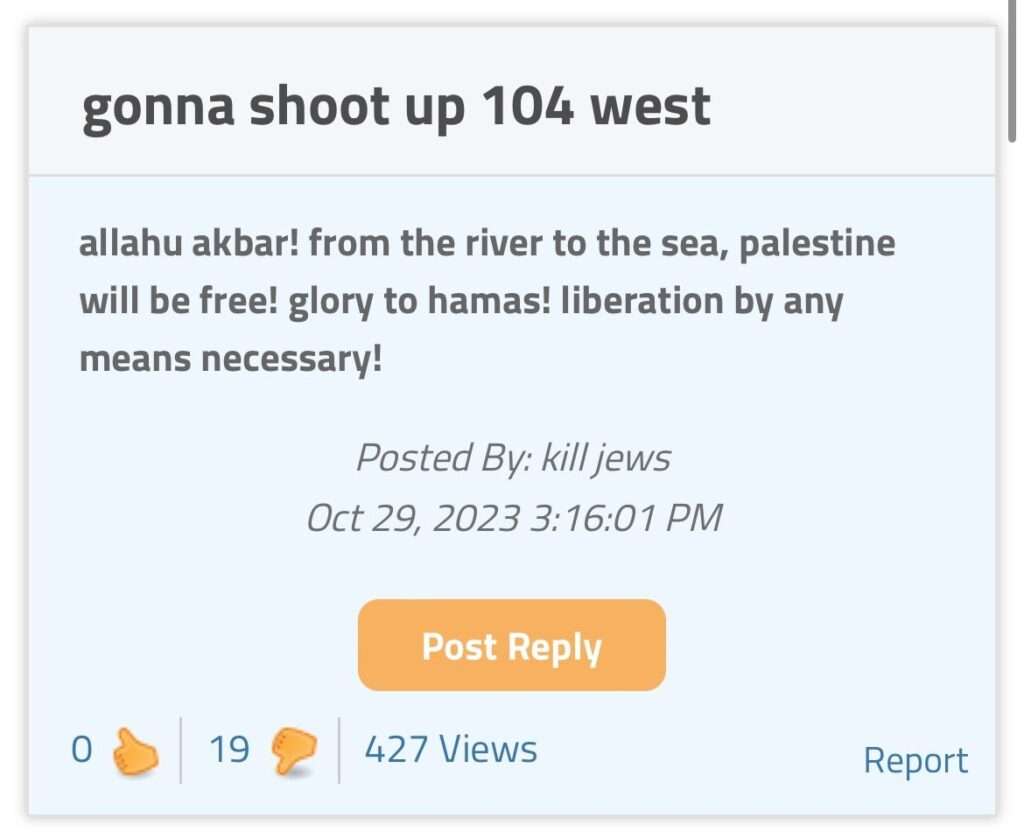
Federal prosecutors have announced an arrest in the Cornell threats case (see Sunday's post):
Patrick Dai, age 21, a junior at Cornell University who is originally from Pittsford, New York, was arrested today on a federal criminal complaint charging him with posting threats to kill or injure another using interstate communications….
The complaint alleges that Dai posted threatening messages to the Cornell section of an online discussion site, including posts calling for the deaths of Jewish people and a post that said "gonna shoot up 104 west." According to information provided by Cornell University Police and other public information, 104 West is a Cornell University dining hall that caters predominantly to Kosher diets and is located next to the Cornell Jewish Center, which provides residences for Cornell students.
In another post, Dai allegedly threatened to "stab" and "slit the throat" of any Jewish males he sees on campus, to rape and throw off a cliff any Jewish females, and to behead any Jewish babies. In that same post, Dai threatened to "bring an assault rifle to campus and shoot all you pig jews."
On November 7, the Supreme Court will hear oral argument in the only Second Amendment merits case this term, United States v. Rahimi. (Docket page.) In that case, twenty-one amicus briefs urged the Court to affirm the Fifth Circuit's decision. On October 25, the Solicitor General, who is asking the Supreme Court to overturn the Fifth Circuit, filed its reply brief. The reply brief addresses only a single one of the amici briefs, namely the one that I coauthored; the amici included the VC's Randy Barnett. Because the Solicitor General considered that amicus brief important enough to address, I thought that readers might be interested in some further analysis. In my view, the SG brief fails to address the unique constitutional infirmity of one of the statutory sections at issue.
Rahimi involves 18 U.S.C. 922(g)(8), which imposes a prison sentence of up to 15 years for firearm possession by everyone subject to certain domestic restraining orders. In the amicus brief, we wrote:
The statute bans firearms possession based on two different types of court orders:
"(C)(i) includes a finding that such person represents a credible threat to the physical safety of such intimate partner or child; or
(ii) by its terms explicitly prohibits the use, attempted use, or threatened use of physical force against such intimate partner or child that would reasonably be expected to cause bodily injury;"
Because (C)(i) requires a judicial finding of dangerousness, it does not infringe the Second Amendment. Subsection (C)(ii) does not require such a finding and is an infringement. Judicial orders that acrimonious domestic parties not do something illegal in the future is not equivalent to a judicial finding that there is "a credible threat" of illegal behavior. Congress could easily fix the problem by changing the "or" at the end of (C)(i) to "and." Alternatively, subsection (C)(ii) could be severed.
Here is the discussion from the footnote on page 15 of the Solicitor General brief:
* Amici Professors of Second Amendment Law accept (Br. 28-29) the validity of Section 922(g)(8)(C)(i) because it "requires a judicial finding of dangerousness" but reject Section 922(g)(8)(C)(ii) because it does not require a specific finding. That is wrong. History and tradition establish legislatures' authority to disarm dangerous or irresponsible categories of persons, and the category of individuals subject to protective orders specifically prohibiting the use of force against partners or children surely qualifies. In any event, any defect in subparagraph (C)(ii) would not assist Rahimi because his order included the finding required in subparagraph (C)(i). Gov't Br. 4-5.
From today's decision in Castro v. Warner, by Judge Irene Berger (S.D. W. Va.):
The Plaintiff, John Anthony Castro, brought this litigation seeking an injunction to prevent Secretary of State Andrew "Mac" Warner from placing Donald John Trump's name on the West Virginia Republican Primary ballot. He asserts that former President Trump is disqualified from serving as President pursuant to Section 3 of the Fourteenth Amendment of the United States Constitution. Mr. Castro asserts that he has competitor standing as a candidate for the Republican nomination for President and based on his intention to continue as a general election candidate.
The Defendants move to dismiss on various grounds, including lack of standing. The arguments asserted by each Defendant with respect to standing overlap. In short, they contend that Mr. Castro has not suffered a concrete injury because there is no indication that he is in genuine competition for voters in the Republican presidential primary contest. They further contend that any injury is not traceable to Mr. Trump's placement on the ballot or redressable by the relief sought, because there is no indication that third-party voters would choose to support Castro if Mr. Trump did not appear on the ballot. Mr. Castro opposes the motions to dismiss and maintains that he alleged sufficient facts to establish standing….
To establish standing, "[t]he plaintiff must have (1) suffered an injury in fact, (2) that is fairly traceable to the challenged conduct of the defendant, and (3) that is likely to be redressed by a favorable judicial decision." An injury in fact must be "an invasion of a legally protected interest that was concrete, particularized, and not conjectural or hypothetical." ... "At the pleading stage, general factual allegations of injury resulting from the defendant's conduct may suffice," but at summary judgment, "the plaintiff can no longer rest on such mere allegations, but must set forth by affidavit or other evidence specific facts."
Although the Defendants present their motions to dismiss as facial challenges, many of their arguments rest on whether the Plaintiff's allegations are plausible. For example, Mr. Trump's memorandum in support of his motion to dismiss argues that the "Plaintiff does not allege that he appears on any national polling" or "has secured a single dollar in campaign contributions," {The Defendant included reference to FEC campaign contribution records with respect to this argument} and that "there is no plausible claim that President Trump's inclusion on the ballot materially reduces Plaintiff's chances of being awarded West Virginia's delegates to the Republican National Convention." {The Court is aware that jurisdictional discovery and hearings have been conducted in similar case(s) filed by Mr. Castro. See, e.g., Castro v. Scanlan, et al., 23-cv-416-JL (D. N.H.). Accordingly, the Court anticipates that any necessary discovery can be completed in a brief period.} But the Plaintiff's polling position, campaign finance disclosures, and campaign activities are not part of the record in this matter.
This speech, which I gave at a Federalist Society conference, is now available in a written version on SSRN. It will be published by the Harvard Journal of Law and Public Policy.
In March, I gave a talk on "How Federalism Promotes Unity Through Diversity" at a panel that was part of the Federalist Society National Student Symposium. The Harvard Journal of Law and Public Policy asked me to convert the text into a short written article, which I was happy to do. It is now available for free download on SSRN. It will be published sometime in the next few weeks. Here is the abstract:
Does federalism promote unity? In one obvious sense, the answer is surely "no." Federalism necessarily reduces unity because it leads to divergence on at least some policy areas. If there were no significant policy differences between the various state and local governments, then there would be little point in having federalism in the first place.
But the diversity federalism creates can also help promote unity, by reducing the conflict that arises when the federal government has the power to impose one-size-fits-all policies throughout the country. Decentralizing authority can mitigate that conflict. It can also empower people to make better choices by "voting with their feet." As a result, more people can live under policies that they prefer, and the choices they make are likely to be better-informed. There are some limitations to the idea that federalism can promote unity and better decision-making through diversity. But it has tremendous value, nonetheless.
And here is the video of the panel on which I originally gave the talk. The panel was entitled "Does Federalism Lead to a More United or Disunited Democracy?" The other participants were Prof. Jud Campbell (Univ. of Richmond) and my George Mason University colleague Michael Greve. Judge Andrew Oldham (5th Circuit) moderated.
On November 7, the Supreme Court will hear oral argument in United States v. Rahimi. That's the case in which the Fifth Circuit unanimously held that 18 U.S.C. § 922(g)(8) violates the Second Amendment. Section 922(g)(8) is the federal statute that prohibits individuals who are subject to a state domestic violence restraining order (DVRO) from possessing any firearm. Under the federal law, they can be sent to prison for up to fifteen years if they do.
The Fifth Circuit faithfully applied the text and history methodology first deployed by the Supreme Court in District of Columbia v. Heller and then further prescribed in New York State Rifle & Pistol Ass'n v. Bruen, decided in 2022. The Fifth Circuit determined that the statute could not stand because the Government did not demonstrate that the statute's "restriction of the Second Amendment right fits within our Nation's historical tradition of firearm regulation," which is the Government's burden to prove under the express language of Bruen.
The Government submitted its reply brief to the Supreme Court on the merits on October 25. In that brief, Merrick Garland's Justice Department took an astonishing position: Bruen's methodology should essentially be ignored.
Bruen meticulously laid out detailed procedures and tests for evaluating whether a present-day statute comports with the Second Amendment. The first part of the inquiry is textual: "when the Second Amendment's plain text covers an individual's conduct," Bruen instructs, "the Constitution presumptively protects that conduct." The second part of the inquiry is historical: the presumption based on plain text may be overcome only if the Government can show through historical analogues that the firearm regulation is "consistent with the Nation's historical tradition of firearm regulation." Only then may a challenged regulation be upheld as constitutional, because it regulates conduct that falls outside the Second Amendment's "unqualified command."
Bruen outlines the methodology to implement that two-part approach in future cases (where the issue has not already been decided by the Court), and then applies that methodology to the concealed carry issues before it. "Interest balancing," such as levels of scrutiny, cannot be employed. Historical analogues to a challenged statute addressing a new societal problem must be "relevantly similar." For problems that have persisted since the Founding, the fit must be tighter—they must be "distinctly similar." Read More
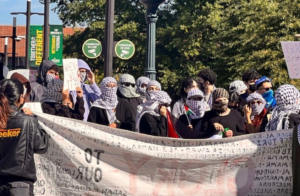
In the immediate aftermath of the atrocities of October 7--even before any Israeli counter-attacks began--a common refrain from progressives was "Both-Sidesism." In the same breath, elites would mourn the tragedies in Israel and immediately turn to the plight of Palestinians. Often this pivot happened in the same sentence. Jews didn't even get a period. Maybe a comma. These statements have become more common over the past few weeks. At this point, both-sidesism is performance art--virtue signaling at its worst. How can you indicate a normal human reaction to the rape, decapitation, burning, kidnapping, and torture of innocent civilians, and at the same time, how can you subtly draw a false parallel between medieval barbarism with a modern military taking steps to minimize civilian casualties in difficult urban warfare?
Lawyers, in particular, are taught to view like things alike, and different things differently. But when it comes to Israel, basic logic goes out the window. (Sort of like the revised LSAT.) Dean Erwin Chemerinsky, to his credit, took a stand. He called out anti-semitism in no uncertain terms. Those calling to free Palestine from the Jordan River to the Mediterranean Sea are advocating for an actual genocide of the Jewish people. (See David Bernstein's post from earlier today.) Protestors didn't shut down the Brooklyn Bridge to mourn the beheading of infants. They shut down the Brooklyn Bridge to call for the elimination of the Jewish state.
Why are so many students drawn to that worldview? For starters, I would wager that they are never taught about anti-semitism and Israel in the abstract. At most, they learn that Nazis were bad (the Holocaust), Catholics were bad (the Inquisition), Catholics were bad (the Crusades), and so on. Any instruction on Anti-Semitism focuses on how disfavored groups engaged in bad policies. The Jewish people are discussed, if at all, only through the lens of their oppressors. Generally CRT advocates argue that oppressed people can define their own narratives. Not us! Students are never taught about the timeless link between the Jewish people and the land of Israel. That link predates all other major world religions. The Jewish people were expelled from the Holy Land many times over the millennia. Next time you celebrate Indigenous Persons day, think of the Jews! In any objective pyramid of intersectionality that considers the full sweep of history, the Jewish people should be at the apex of Giza. But again, this history is not taught. Instead, students learn about a specific strand of Marxist ideology and colonialism that conveniently begins in 1948 or so.
Back to Dean Chemerinsky. Should he be so surprised, David Harsanyi and Glenn Reynolds ask? After all, last year student organizations at Berkeley banned "Zionist" (that is, Jewish) speakers. The writing has been on the wall for some time. In the past few weeks, I have talked to so many left-of-center colleagues who are shocked. I'm not. But more importantly, what comes next? Will this experience change anything? In other words, will the past three weeks affect approaches to hiring, curriculum development, DEI programming, and so on? Is the Manischewitz worth the squeeze? Or, will colleges continue with business as usual, and pretend that both sides really are equal here. Color me skeptical.
In this episode of the Cyberlaw Podcast, I take advantage of Scott Shapiro's participation to interview him about his book, Fancy Bear Goes Phishing – The Dark History of the Information Age, in Five Extraordinary Hacks. It's a remarkable tutorial on cybersecurity, told through stories that you may think you've already heard until you see what Scott has turned up by digging into historical and legal records. We cover the Morris worm, the Paris Hilton hack, and the earliest Bulgarian virus writer's nemesis. Along the way, we share views about the refreshing emergence of a well-paid profession largely free of the credentialism that infects so much of the American economy. In keeping with the rest of the episode, I ask Bing Image Creator to generate alternative artwork for the book.
Scott and I cover a great Andy Greenberg story about a team of hackers who discovered how to unlock a vast store of bitcoin on an IronKey but may not see a payoff soon. I reveal my connection to the story.
You can subscribe to The Cyberlaw Podcast using iTunes, Google Play, Spotify, Pocket Casts, or our RSS feed. As always, The Cyberlaw Podcast is open to feedback. Be sure to engage with @stewartbaker on Twitter. Send your questions, comments, and suggestions for topics or interviewees to CyberlawPodcast@gmail.com. Remember: If your suggested guest appears on the show, we will send you a highly coveted Cyberlaw Podcast mug! The views expressed in this podcast are those of the speakers and do not reflect the opinions of their institutions, clients, friends, families, or pets
Professor Robert Leider and I have a new article on the right to keep and bear arms available on SSRN. It is called The General Law Right to Bear Arms and it is part of a symposium in the Notre Dame Law Review. In brief, we argue that the Supreme Court's decision in NYSRPA v. Bruen has been misunderstood and therefore unfairly maligned. From the introduction:
New York State Rifle and Pistol Association v. Bruen marked an important methodological return to original legal principles. The legal issues in the case were whether the right to bear arms included the general right to carry handguns outside the home for self-defense, and if so, whether New York could restrict the carrying of handguns for self-defense to only those residents who had a special need for self-defense ("proper cause"). In answering these questions, however, the Court also made broad pronouncements about the correct way to decide the scope of the right to keep and bear arms, criticizing the methodological approach that had become common in the lower courts. Specifically, the Court emphasized the role of history and tradition, rather than what it called "interest balancing," and then proceeded to analyze the history of the regulation of arms-bearing for eighteen pages.
This was an attempt at an overdue doctrinal course correction. The Supreme Court first recognized an individual right to bear arms for self-defense in District of Columbia v. Heller. But since Heller, lower court judges had been "narrowing [Heller] from below." For example, in the name of intermediate scrutiny, lower courts had upheld laws that, in essence, prevented most citizens in those jurisdictions from exercising the right to bear arms at all.
Lower courts have since understood Bruen's text, history, and tradition test to require them to survey historical gun laws to determine whether modern laws have analogues in early American practice. And this presents a problem. The Framing era had few gun laws, and thus, few analogues from which to draw. Meanwhile, judges also complain that they are not historians, even turning to expert testimony to apply the Second Amendment post-Bruen.
In this Article, we argue that Bruen's intended methodological shift has been widely misunderstood by the bench and bar. This has led to confusion and misapplication in the lower courts, as well as much scholarly criticism of the test that is, we think, misdirected. As we will explain, Bruen calls for a form of legal originalism, applying a classical view of fundamental rights as a form of unwritten customary law. This is consistent with the text and history of the Constitution and leads to results that are less mechanical and more sensible than many lower courts have thought. Understanding Bruen's methodology requires three basic legal concepts: original-law originalism, constitutionalization of pre-existing rights, and the general law.
Original-law originalism maintains that our law today is a form of originalism. Like all forms of originalism, this looks to the past for evidence of today's constitutional law. Original-law originalism focuses more specifically on the law of the past. It holds that our law today is "the Founders' law, as it's been lawfully changed." This means that our law must trace a legal pedigree to the law of the founding and its own rules of legal change.
The constitutionalization of a pre-existing right means that sometimes, perhaps often, the Constitution's reference to a legal right must be understood by learning the historical customary law that defined and governed the right before its codification. Because the Constitution was not creating or defining these terms for the first time, but rather using the legal terminology and legal infrastructure of the day, one cannot entirely understand these rights just by parsing their semantic meaning. The "privilege of the writ of habeas corpus," to take a simple example, should be understood in light of centuries of law about the writ, not only by using a Latin-English dictionary to learn that "habeas" means "you have" and "corpus" means "the body." But the same may be true for many less simple examples, ranging from the right to due process, to the right to freedom of speech, to (indeed) the right to keep and bear arms.
The general-law approach to rights means that the scope of these pre-existing rights was sometimes defined by unwritten law that was neither state common law nor federal common law. Rather the general law – made famous by Justice Story's opinion about commercial law in Swift v. Tyson, and then made infamous by Justice Brandeis's opinion in Erie Railroad v. Tompkins – was a form of common law shared among Anglo-American jurisdictions, which could be expounded by any of them, but controlled by none of them. The general law approach applied not just to the law merchant or the law of torts, but to the fundamental rights of citizenship, and was an important part of the law of the Founding, as well as (one of us has argued) the original meaning of Section One of the Fourteenth Amendment.
These three legal concepts overlap and reinforce one another in important ways. The constitutionalization of pre-existing rights means that to understand the Constitution itself, we must understand the Constitution's legal background. Original law originalism tells us that we are bound by that original meaning of the Constitution, including the surrounding law, not just the semantic meanings of the words. And the general law approach tells us what kind of surrounding law that was, and how it might be applied over time to those bound by the Founders' law today.
While much of this apparatus was operating "under the hood" in Bruen, it shows what the Court was trying to say, and how the right to keep and bear arms should work today.
We also discuss the implications for 18 U.S.C. 922(g), which the Supreme Court will consider in United States v. Rahimi being argued next week: Read More
The Hamas massacre in Israel has revealed that the the DEI norms embraced by most American universities don't include protecting Jewish students from intimidation. Every day I hear new stories from friends about their college kids being threatened, ostracized, and bullied, because they object to the glorification of Hamas terrorists by other students. A good friend of mine, for example, has had to hire a civil rights attorney because other students in his daughter's program have taken to referring to her as "the little Jew bitch," and the program's administrators have not done anything about it.
At my own school, George Mason University president Gregory Washington has championed a variety of expensive, time-intensive, DEI measures. The goal, he wrote in an email to the university community in July 2023, is to ensure that "every student, faculty, and staff member is welcomed and respected as a full equal in this community of learning." He has, unfortunately, fallen far short of that lofty goal with regard to Jewish GMU students and faculty.
Just two days after Hamas's genocidal rampage in southern Israel, Mason Students for Justice in Palestine published a statement endorsing the actions of the Hamas terrorists, whom they described as "reclaiming land and seizing settlements considered illegal and a violation of international laws."
SJP then announced that it would be holding a rally on the university's main campus on October 12. In support of "the resistance," i.e., the perpetrators of the massacre, Hamas. SJP Mason also called for the destruction of the State of Israel, the "liberation of our homeland and our people, from the river to the sea. Show up and show out for Palestine, and let GMU know that we will rise against the occupation!" Moreover, SJP Mason suggested that students bring "face coverings or kuffiyehs" to hide their identities.
In short, SJP Mason was proudly organizing a pro-genocide rally, and, like other racist and antisemitic hate groups such as the KKK, sought to mask themselves. I, and I'm sure many others, urged President Washington and other university officials to make a statement condemning a recognized student group being poised to endorse genocidal terrorism, and expressing a commitment to protecting Jewish students' safety. I did not get any responses to my emails, nor did any university official say anything about the rally. Meanwhile, I understand that many Jewish Mason students were too frightened to be on campus during the masked hate-fest.
Anonymous
As of this writing, the only official GMU mention of the pro-genocide rally was an oblique reference in an October 17 email from President Washington, alluding in a morally neutral tone to a "quite visible [gathering], in the middle of the Fairfax Campus, in the middle of a day of classes."
I'm in favor of universities following the famous Kalven Report, which recommends that university leaders should rarely if ever opine on controversial matters, including publicly expressed opinions on hot-button issues by faculty and students. But such a policy must be consistently applied, and Kalven has not been George Mason University policy under President Washington. It has been ignored especially when it comes to DEI issues, and in particular when it comes to promoting an inclusive climate on campus.
Washington's silence about a pro-genocide rally on his own campus is in marked contrast to, among other examples, his multiple campus-wide emails in the wake the killing of George Floyd, and launched a flurry of initiatives to overhaul university policy to extirpate "racist vestiges" and "racial inequities." A mandatory DEI training at GMU calls discrimination a form of "violence" – and we can now see that those who call words violence, have no words for violence.
On October 18, sixteen Law School professors sent a letter to President Washington, asking that the university administration reconsider its silence on SJP hate rallies on campus. We have not received a response, or even an acknowledgement.
It seems that when it comes to DEI at GMU, Jews don't count.
From today's decision by Judge Keith Starrett (S.D. Miss.) in Favre v. Sharpe:
This dispute in this case arises from statements made by Shannon Sharpe, an NFL Hall of Fame tight end and the co-host of a daily sports debate show, "Undisputed," about retired NFL Hall of Fame quarterback Brett Favre and his widely-reported involvement in a Mississippi welfare fraud scandal. Favre has sued Sharpe for defamation over certain statements, and Sharpe moves to dismiss on the bases that the statements Sharpe made are protected from liability on two grounds and that Favre failed to comply with Mississippi's retraction statute….
The factual backdrop of this lawsuit is one of the largest public fund fraud scandals in Mississippi history. In or around October 2021, the Mississippi Office of the State Auditor determined, based on an independent forensic audit commissioned by the Mississippi Department of Human Services, that more than $77 million dollars in federal Temporary Assistance for Needy Families ("TANF") funds had been diverted from their statutory purpose and spent illegally.
This welfare scandal has resulted in significant criminal charges. To date, six individuals have pled guilty to state or federal felonies, or both, related to their involvement in the scandal, including the former Executive Director of the Mississippi Department of Human Services, four executives of non-profit organizations that received and spent welfare funds, and a retired professional wrestler. While Favre has never been criminally charged, the State of Mississippi's Department of Human Services ("MDHS") filed a civil lawsuit against Favre and his company, Favre Enterprises, along with many others, seeking to recover the misspent welfare dollars.
Shortly after the atrocities of October 7, I met students from my law school's Jewish Law Student Association chapter. They experienced a sentiment all-too-common among Jews around the word: isolation. My Jewish colleagues and I tried to assure the students that we were there to support them. One of the students said that he didn't even know that I was Jewish. I immediately sought to remedy that problem.
I installed a Mezuzah on my office door. What is a Mezuzah? You may be familiar with the biblical verse that "you shall inscribe [prayers] on the doorposts (mezuzot) of our house and on your gates." Jews follow that commandment literally. A Mezuzah is a small piece of parchment that includes some prayers in Hebrew. It is rolled into a scroll, and placed in a container. The Mezuzah is affixed on the right side of the door. (The rules for placing the Mezuzah are a bit complicated, as are most Jewish laws.)
Now, I hope that everyone who walks by my door recognizes that there is a Jewish professor in the building who can help. Indeed, I cancel class every year on Jewish holidays. Jewish students often tell me that I am the first professor who has ever cancelled a class on Jewish holidays. These acts are meaningful.
I hope other Jewish professors can do the same, and install mezuzahs on their doors. If you feel adrift, and don't know how to help your Jewish students, this simple symbol will tell everyone they are not alone. It is common enough for professors' doors to include Pride Flags, "Safe Spaces" signs, and indicia for various affinity groups. The Mezuzah should fit right in.
Since the horrific October 7 Hamas terrorist attack on Israel, there has been much shock and dismay about Western far-left support for Hamas, and tendencies to minimize or justify its atrocities. What is the cause of this moral deformation?
There is surely more than one. The most obvious culprit is anti-Semitism. There is undoubtedly anti-Semitism on the far left, as also on other parts of the political spectrum (including many parts of the right). But this overlooks the fact that the far left includes a substantial number of Jewish intellectuals and activists, and has had many such throughout its history, including some of the most famous far-leftists. Such extensive Jewish participation at least complicates the claim that anti-Semitism permeates the entire far left (though, as we shall see, the socialist left has its own distinctive type of anti-Semitism).
Prominent political scientist Yascha Mounk blames the rise of recent extreme forms of left-wing identity politics, with its focus on crude theories of "white privilege" and "colonialism." There is surely something to this, as well. But it implicitly assumes that far-left defenses of terrorism and mass murder are a relatively new phenomenon, coextensive with the rise of the new identity politics. That just isn't true. In reality, the Western far left has a long history of excusing or minimizing massive atrocities, including some on a vastly larger scale than anything Hamas has so far managed to do.
Before going further, it's worth clarifying the meaning of "far left." I do not use this term as a pejorative label for anyone to the left of me. Rather, I refer to people who seek a radical transformation of society towards socialism, with the end result being state control of all or most of the economy, for purposes of promoting egalitarian values.
Such radical socialists are distinguishable from those who merely seek a larger welfare state or more extensive regulation within a generally market economy. And the former are far more likely to defend or excuse Hamas than the latter. To take one dramatic example of the contrast, compare the forceful condemnation of Hamas by the relatively moderate current British Labor Party leader Keir Starmer with the views of Jeremy Corbyn, his radical socialist predecessor, who has a long history of praising Hamas and other similar movements.
For over a century, far-leftists have had to confront the reality that regimes attempting to implement their socialist ideals have committed massive, horrific atrocities in the process. In the first few years of the Bolshevik regime in Russia, Lenin's communist dictatorship banned all opposition parties, slaughtered many thousands of people in the Red Terror, and imposed a collectivization of agriculture that led to a famine that killed millions more. Lenin's successor, Joseph Stalin, accumulated an even larger death toll.
Subsequent radical socialist regimes were no better. With his Great Leap Forward, Mao Zedong managed to surpass Lenin's and Stalin's records by perpetrating the biggest mass murder in the entire history of the world, with an estimated 30 million dead or even more. Communist rulers of smaller nations could not match such totals. But Fidel Castro (some 100,000 dead out of a population of just 6 million), Pol Pot, and many others did still amass horrific death tolls relative to the much smaller populations of their respective countries.
Faced with this pattern, Western far-leftists had a number of options. They could 1) repudiate their previous ideals, 2) claim the regimes trying to implement them were not actually doing so (the "not real socialism" defense), 3) defend the regimes' atrocities, or 4) try to deny or minimize them. There are some prominent examples of 1; 2 has proven a popular choice at times (usually late in the history of the regime in question). But from the days of Lenin to the present, a great many chose option 3 or 4, or some combination of both.
In his classic book Political Pilgrims, sociologist Paul Hollander chronicles numerous examples of radical left-wing Western intellectuals praising Lenin, Stalin, Mao, Castro, and other communist mass murderers. Those who did this include prominent figures like Jean Paul Sartre, George Bernard Shaw, Sidney and Beatrice Webb, and many, many others. Some of these people focused primarily on option 4 - denying or minimizing their idols' atrocities. But others actually argued the Gulags, executions, and famines were justified as necessary means to achieving a greater good. The famous British Marxist historian Eric Hobsbawm, for example, defended Lenin and Stalin throughout his long life (he died in 2012) and said that killing 15 to 20 million people was a defensible price to pay for the achievement of a socialist Utopia.
The kinds of people who are willing to justify, minimize, or deny the slaughter of millions by the likes of Stalin and Mao are unlikely to blanch at Hamas' much smaller-scale atrocities. If you are willing to embrace the Great Leap Forward, Stalin's purges, or Lenin's Red Terror, there is probably no limit to what you will accept, so long as you think it is moving the world in the right direction.
There is, however, a notable distinction between Hamas and the likes of Mao and Stalin. The latter were pursuing left-wing socialist ideals. Hamas, pretty obviously, is not. They seek to establish a medieval Islamist theocracy, in the process oppressing women, religious minorities, and LGBT people, among others.
Why would Western far-leftists have any sympathy for such a movement? How could the likes of Jeremy Corbyn describe it as seeking "long-term peace and social justice"? The answer comes from the old adage that the enemies of our enemies are our friends.
For most far-leftists, the greatest evil in the world is capitalism. Abolishing it is their primary goal. And the great mainstays of capitalism are the US and other Western liberal democracies. This inclines many far-leftists to be sympathetic to any movement that is anti-American or anti-Western, more generally. There is a long history of them praising or at least looking favorably on such movements, even in cases where their ideology was far different from that of the Western leftists themselves.
The conflict between Israel and radical Islamists and Arab nationalists is one of the world's most visible confrontations between Western liberalism and opposing movements. While radical socialists would surely prefer to cheer for an anti-Western movement that fit their ideology closely, they are willing to support one that doesn't.
This tendency is reinforced by another development in radical leftist thought over the last century: the belief that the overthrow of capitalism is likely to emerge from the poor and underdeveloped parts of the world, through processes of "decolonization" and "national liberation." Karl Marx argued that socialist revolution would first emerge in the world's most advanced nations, through the growth of "class consciousness" in the working class. He even believed that the spread of European colonialism was, on balance, a good thing, because it promoted industrialization and thereby brought the coming of socialist revolution closer.
But Marx's expectations proved spectacularly wrong. Radical socialists have only managed to seize power in relatively poor and backward nations, beginning with Russia in 1917.
As a result, Western radical leftists have developed a special sympathy for anti-Western nationalist and anti-colonial movements in what we used to call the Third World. The conflict between Israel and the Palestinians fits this pattern well, even if the ideology of most of the latter is far from what Western leftists would ideally prefer.
Finally, far-left sympathy for Israel's enemies is augmented by the distinctive socialist brand of anti-Semitism, which differs somewhat from the more familiar right-wing version. Instead of focusing on the racial, ethnic, or theological characteristics of Jews, this one focuses on their economic role. A movement that seeks to abolish private property and capitalist economic transactions is likely to view with suspicion an ethnic group that is disproportionately represented in the worlds of entrepreneurship, trade, and finance.
It is often said that anti-Semitism is "the socialism of fools." Foolish socialists single out the Jews instead of focusing their ire on capitalists more generally. But even relatively non-foolish socialists often look askance at a group that seems disproportionately represented among what they see as the capitalist "exploiter" class.
Karl Marx's notorious 1844 essay "On the Jewish Question" exemplifies this tendency. In that work, he called for equal rights for Jews. But he also wrote this:
What is the worldly religion of the Jew? Huckstering. What is his worldly God? Money.…. Money is the jealous god of Israel, in face of which no other god may exist. Money degrades all the gods of man – and turns them into commodities…. The bill of exchange is the real god of the Jew…. The chimerical nationality of the Jew is the nationality of the merchant, of the man of money in general.
Marx further believed, as he wrote in 1856, that supposed Jewish control of the world of finance props up regimes he disapproved of and the capitalist system more generally. Of Jewish descent himself, Marx did not claim that Jews were inherently bad. He just thought they must be removed from their role in the capitalist system, and should give up elements of their beliefs he claimed were conducive to that role.
Such ideas persist in modern far-left thought, often transmuted into attacks on "Zionists," rather than Jews as such. Just as Marx denounced Jewish "moneychangers of our age enlisted on the side of tyranny," so some modern radicals claim that Zionists control finance and the media.
The economic focus of socialist anti-Semitism also explains how it can persist in a movement that has many Jewish members. By virtue of becoming radical socialists, the latter are viewed by their comrades as having rejected Jewish connections with capitalism, thereby making themselves kosher, so to speak.
Western socialists took a less negative view of Israel in its early years, when that country was dominated by the left-wing Labor Party, and Israel's image on the left was in significant part influenced by the small-scale socialist institution of the kibbutz. But as Israel has moved to the right, and even the kibbutzim have become more capitalist, far-left anti-Semitism has reemerged and focused its energies on Israel and its backers in the Jewish Diaspora.
The left-wing anti-Semitic element here is likely less important than the more general tendency to excuse or minimize atrocities by those radical socialists see as being on the right side of history. But it probably makes things worse at the margin.
In making these points, I do not mean to deny that there is also a horrific history of right-wing anti-Semitism, culminating in the Holocaust. I also fully recognize that many right-wingers have their own history of praising or minimizing horrific atrocities by movements they approve of.
It is also important to remember that radical leftists are far from the only types of people who sympathize with Hamas. It has plenty of supporters who are radical Islamists or Arab nationalists. Especially outside the West, these groups are likely a much larger proportion of Hamas backers than the radical socialists. Far-leftists, though, are especially prominent on college campuses and other intellectual institutions, where they are hugely overrepresented relative to their proportion of the general population.
Finally, it should go without saying - but nonetheless, in the current political environment, must be said - that I don't claim that any and all criticism of the Israeli government and its policies amounts to support of Hamas. I have been highly critical of some of those policies myself. But actual defenses of Hamas' terrorist attacks or attempts to minimize them, are a different matter.
Ultimately, right-wing (and radical Islamist) awfulness does not excuse that of the far left (and vice versa). And if my analysis is correct, much of the awfulness is deeply rooted in the ideology of radical socialism. It goes well beyond specific details of the current conflict.
I'm pleased to report that "Honesta homo" ("An honest person"), the short (< 3 min.) film about the Greek philosopher Diogenes made by me and my then-10-year-old son Mark, has won the Audience Choice award in the recent Esperanto film festival (the "5th American Good Film Festival"). (See here and here for my previous posts on this.) Thanks to you all for your support and your YouTube likes; to my various colleagues and students who appeared in the film itself; and to Alex Miller, who has organized the festival for the last few years. You can see all 50 submissions here.
Here's my film below; I'm no longer soliciting your "likes", but it's still fun to watch if you haven't done so already.
And here are some of my favorites from the film festival.
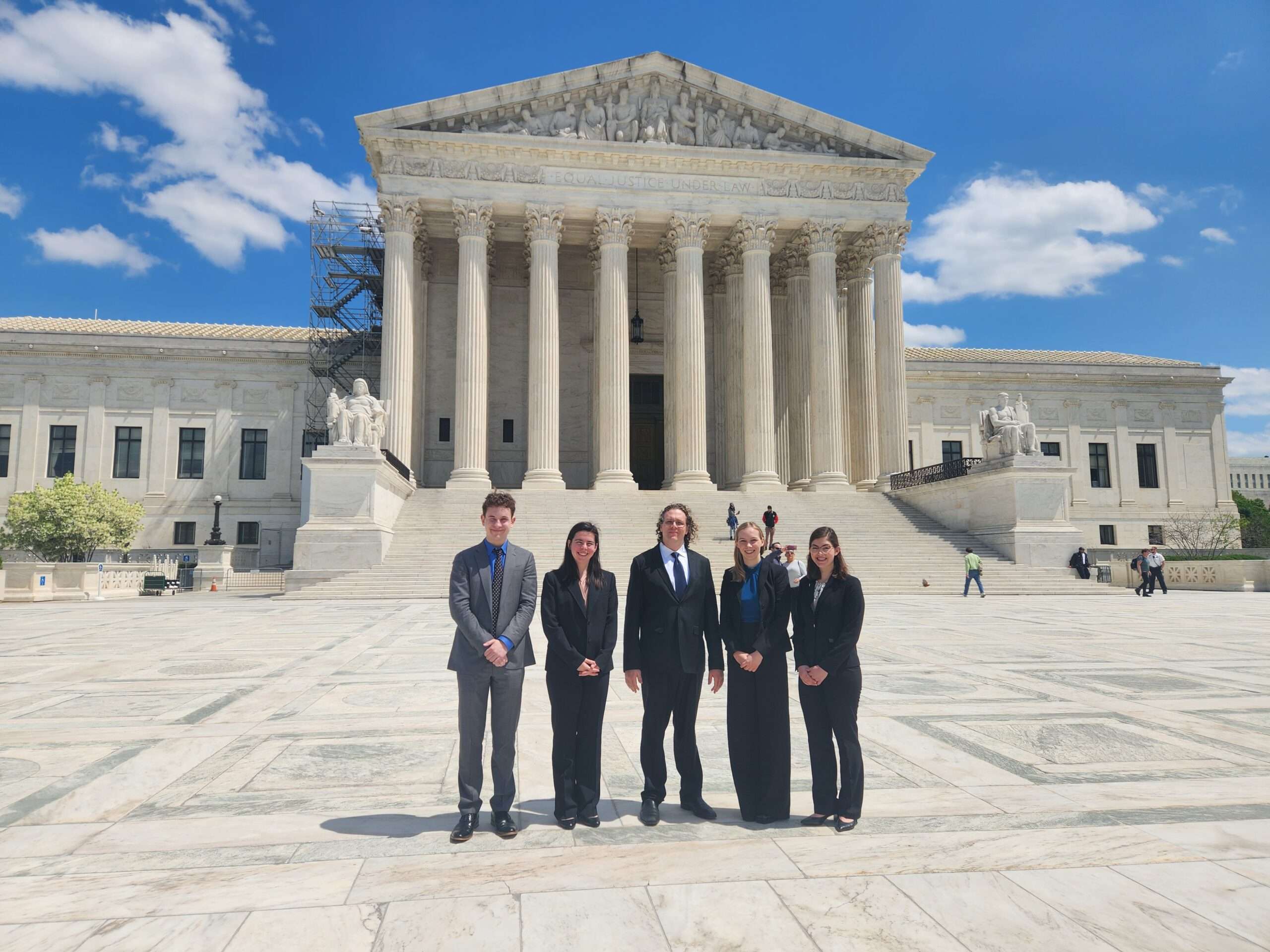
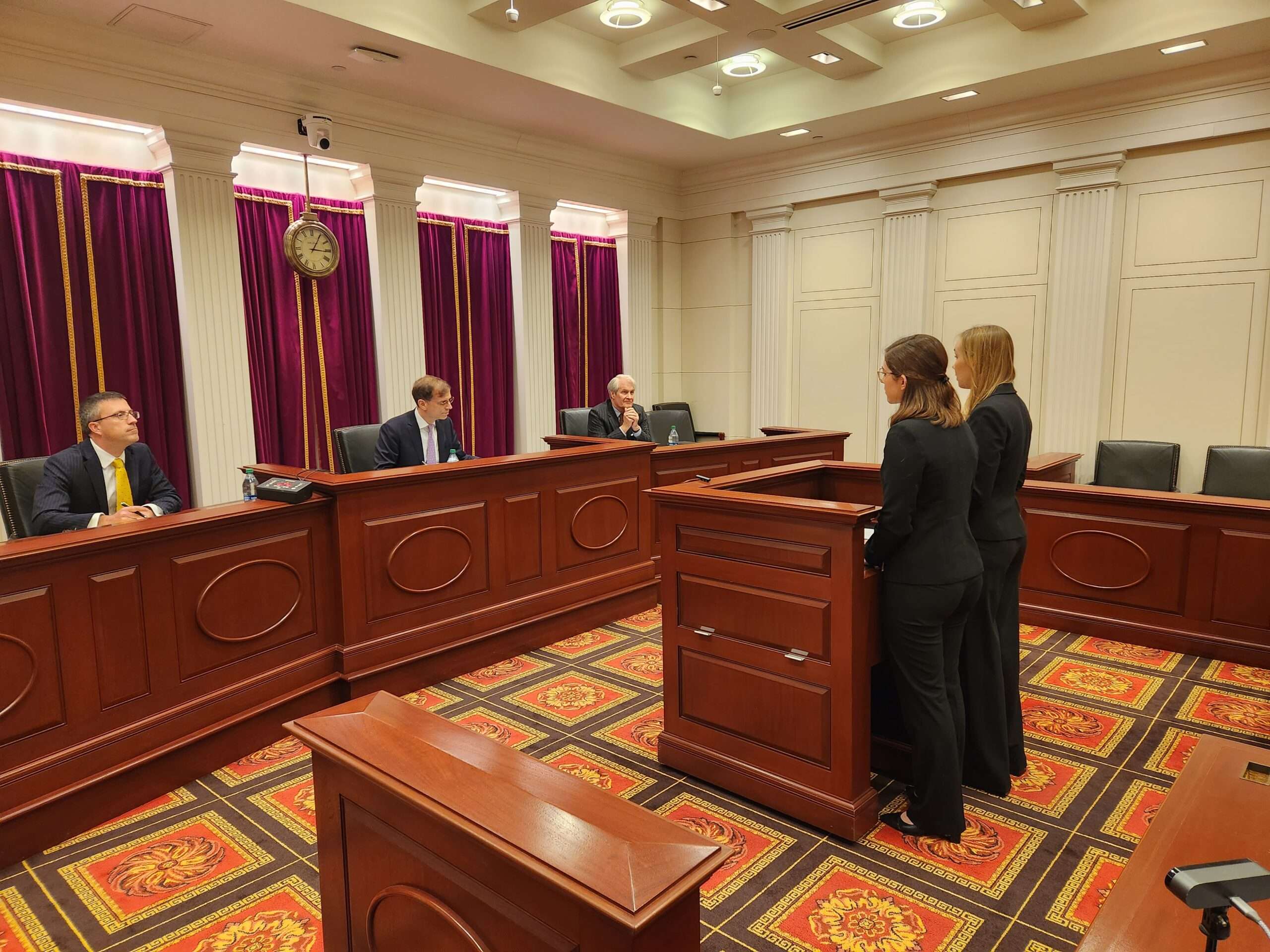
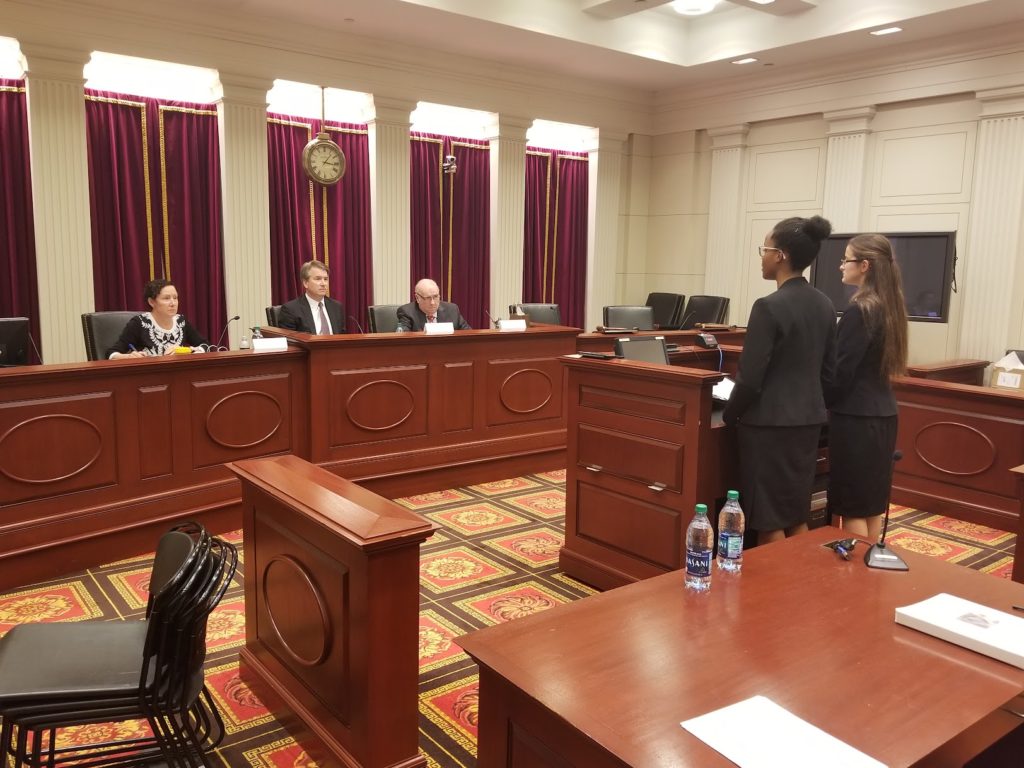
The Harlan Institute and Ashbrook are pleased to announce the Twelfth Annual Virtual Supreme Court Competition. This competition offers teams of two high school students the opportunity to research cutting-edge constitutional law, write persuasive appellate briefs, argue against other students through video chats, and try to persuade a panel of esteemed attorneys during oral argument that their side is correct. This year the competition focuses on Moody v. NetChoice.
The Virtual Supreme Court Competition helps students gain the skills they need to understand, synthesize, and advocate for reasoned legal positions on timely and relevant constitutional issues, and in doing so deepens their commitment to the rule of law. The program directly supports the highest goals of the Center for Civic Education to develop enlightened and responsible members of our society, and it is a privilege to be a part of this important work. Christopher R. Riano President, The Center for Civic Education Member Board of Advisors, The Harlan Institute
Tournament Instructions
Teams of two high-school students will write an appellate brief, and present oral arguments, addressing these questions:
These cases concern laws enacted by Florida and Texas to regulate major social media platforms like Facebook, YouTube, and X (formerly known as Twitter). The two laws differ in some respects, but both restrict platforms' ability to engage in content moderation by removing, editing, or arranging user-generated content; require platforms to provide individualized explanations for certain forms of content moderation; and require general disclosures about platforms' content moderation practices.
The questions presented are:
1. Whether the laws' content-moderation restrictions comply with the First Amendment.
2. Whether the laws' individualized-explanation requirements comply with the First Amendment.
Petitioners will argue that laws' content moderation restrictions and individualized-explanation requirements do comply with the First Amendment.
Respondents will argue that laws' content moderation restrictions and individualized-explanation requirements do comply with the First Amendment.
Phase 1 - Research and Write Your Brief
Coaches can register their teams at the Institute for Competition Sciences (ICS). ICS will generate a number for each team. Odd-numbered teams will represent the Petitioners and even-numbered teams will represent the Respondents.
Teams will research and write their briefs. Carefully review the lesson plan. The brief must be a minimum of 2,000 words. Please download this template. The brief should have the following sections:
Table of Cited Authorities: List all of the original sources, and other documents you cite in your brief.
Summary of Argument: State your position succinctly in 250 words or less.
Argument: Structure your argument based on at least five Supreme Court precedents. The more authorities you cite, the stronger your argument will be–and the more likely your team will advance.
Conclusion: Summarize your argument, and argue how the Supreme Court should decide this issue.
Be sure to proofread your work. The work must be yours, and you may not seek help from anyone else–including attorneys or law students. Students who submit plagiarized briefs will be disqualified.
Please review the winning submissions from previous years:
Teams that register before November 3, 2023 will be invited to participate in a virtual mentoring session. These sessions will be hosted during the week of November 27, 2023. The Harlan Institute will match each class with a mentor from our network. These sessions will be helpful to finalize your briefs and prepare your preliminary round arguments.
Phase 3 - Preliminary Round
For the preliminary round, each team must prepare a YouTube video. The argument must be at least 15 minutes in length. Coaches will ask their students ten questions from the lesson plan.
Teams will upload a PDF of their brief, as well as a link to their YouTube video to the Institute of Competition Sciences. The deadline for the preliminary round will be December 15, 2023. The brief and preliminary round video will be scored based on this rubric.
Phase 4 - Virtual Rounds
We will hold the Virtual Rounds over Zoom:
2/19/24, 2/20/24, 2/21/24: Semifinal Round
3/4/24 and 3/5/24: Round of 8
3/18/24 and 3/19/23: Round of 4
The virtual rounds will be scored based on this rubric. This video offers five tips to prepare for oral argument: https://www.youtube.com/watch?v=dtxQ8b1bwfM
Phase 5 - Championship Round Rounds
The top teams will receive a free trip to Washington, D.C. to argue the championship round before federal judges the week of April 29, 2024. https://youtu.be/EsCp4OI-Uqs?si=f9PkGvJIuX2Vl5V0
[UPDATE 10/30/2023 6:05 am: I originally linked last night to a tweet that contained this and three other items, but this morning I saw that the images weren't coming up, though they are visible in the original tweet. I have instead copied one of the images above.] Here is the Cornell president's letter (which describes "104 West" as "the home of the [Cornell] Center for Jewish Living"):