



The Volokh Conspiracy

Mostly law professors | Sometimes contrarian | Often libertarian | Always independent | Est. 2002

The Volokh Conspiracy

Immigration

Biden Administration Lets Migrants Who Entered Under Uniting for Ukraine Apply to Stay in the US For Another Two Years [Updated]

It's a step in the right direction. But a better solution would be for Congress to allow them to stay permanently.

|

Since April 2022, the US has admitted some 200,000 or more Ukrainian migrants under the Uniting for Ukraine (U4U) program, which enables US citizens and legal residents to sponsor Ukrainians fleeing Russia's brutal invasion to live and work in the United States for up to two years (I am myself a sponsor for two Ukrainian families). Although the program has many virtues and has been highly successful, the two-year time limit has been a major downside, from the beginning. Many of the Ukrainians will need a permanent refuge.  And giving it to them will also enable them to contribute more to our economy and society.

Yesterday, the Biden Administration began a program under which U4U participants can apply for "re-parole."  Those whose applications are accepted would be allowed to live and work legally in the US for an additional two years.

This is a step in the right direction. The war in Ukraine shows little sign of ending anytime soon. And many of the refugees may be unwilling or unable to return even after the fighting stops (e.g. - because their former homes have been destroyed by the Russian military). Past refugee crises show that it is often impossible and undesirable to force everyone to return to their original homes, even after the fighting is over.

But the re-parole process does have some downsides. One is that the relevant forms and application process seem unduly complicated, and some aspects of the system are unclear. For example, I cannot figure out whether the two-year extension is tacked on to the end of the original two years, or whether it begins as soon as USCIS accepts an application (in the latter case participants may end up with less than four years total) [see update for clarification on this issue]. The filing fees are also hard to determine, though they seem to be $575 per person, if I understand the USCIS website correctly. That goes well beyond any plausible administrative expenses and is a considerable burden for the many parolees who lost everything in the Russian invasion and may be employed at working-class jobs today. At the very least, the fees should be lowered.

In addition, the extension, like the original U4U program, is a matter of executive discretion. What Caesar giveth, he or his successor could taketh away - a very real danger, given the prospect of Donald Trump returning to the White House. It is not entirely clear whether the president could unilaterally strip U4U parolees of their status before their term ends. At the very least, the president could simply let the term expire and refuse to renew it.

Despite such limitations, the re-parole system is a useful step. Otherwise, many U4U participants will see their residency and work rights expire in 2024 or 2025. But, like the earlier grant of a right to apply for TPS status, this is not a substitute for giving Ukrainians permanent residency rights. Congress must pass an adjustment act to do that; I outlined the case for doing so here.  There is in fact a bipartisan Ukrainian Adjustment Act proposed by several members of Congress. But it doesn't seem likely to pass this year. Similar adjustment acts should be adopted to cover Afghans, Venezuelans, and others in similar straits, who fled war and oppression, entered the US through the use of presidential parole power, and now face arbitrary time limits on their residency and work rights.

If you are a U4U participant or a sponsor who needs help with the re-parole process, please let me know and I will see if I can get answers to your questions.

I have made inquiries with government officials and other experts to try to clear up some of the uncertainties noted above. If I learn anything useful,  I will update this post.

UPDATE: A USCIS official has now confirmed to me that Ukrainians who successfully apply for re-parole will get an additional two years on top of their full initial term. Thus, if someone's parole is expiring on April 25, 2024, they file for re-parole and USCIS grants it,  the re-parole period will be a full two years beginning on April 25, 2024 and ending on April 25, 2026. The official also indicated that agency will be prioritizing the re-parole of persons whose initial parole period expires earliest, to minimize the risk of anyone losing employment rights in the meantime.

Free Speech

"The Future of Censorship Is AI-Generated"

|

An interesting article by Jacob Mchangama and Jules White (Time); an excerpt:

The material of a long dead comedian is a good example of content that the world´s leading GenAI systems find "harmful." Lenny Bruce shocked contemporary society in the 1950s and 60s with his profanity laden standup routines. Bruce's material broke political, religious, racial, and sexual taboos and led to frequent censorship in the media, bans from venues as well as to his arrest and conviction for obscenity. But his style inspired many other standup legends and Bruce has long since gone from outcast to hall of famer. As recognition of Bruce's enormous impact he was even posthumously pardoned in 2003.

When we asked about Bruce, ChatGPT and Gemini informed us that he was a "groundbreaking" comedian who "challenged the social norms of the era" and "helped to redefine the boundaries of free speech." But when prompted to give specific examples of how Bruce pushed the boundaries of free speech, both ChatGPT and Gemini refused to do so. ChatGPT insists that it can't provide examples of "slurs, blasphemous language, sexual language, or profanity" and will only "share information in a way that's respectful and appropriate for all users." Gemini goes even further and claims that reproducing Bruce's words "without careful framing could be hurtful or even harmful to certain audiences."

Guns

Urinalysis Requirement for Gun Carry Permit Likely Unconstitutional

|

So held Nassau County (N.Y.) trial judge James P. McCormack last week in In the Matter of Kamenshchik, applying the Second Circuit's recent decision in Antonyuk v. Chiumento.

Antonyuk held (among other things) that "requiring applicants to disclose even pseudonymous names under which they post online imposes an impermissible infringement on Second Amendment rights that is unsupported by analogues in the historical record and moreover presents serious First Amendment concerns." The Kamenshchik court held that, though Antonyuk upheld some modest discretionary judgment on the government's part, "particularly in the area of good moral character or dangerousness, and in the nature of following-up on other information provided," that didn't extend to the urinalysis requirement. And the Kamenshchik court concluded that the urinalysis requirement wasn't otherwise authorized under the Supreme Court's Bruen decision:

If urinalysis is beyond the Licensing Officer's discretion [authorized by Antonyuk], then it can only be upheld if there is, in Bruen's parlance, a historical analogue. Not only is there no such historical analogue, but forcing an applicant to submit to urinalysis, in essence, requires them to give up their 4th Amendment rights against unlawful searches and seizures to exercise their 2nd Amendment rights. This court cannot imagine a scenario, under current 2nd Amendment jurisprudence, where that would be allowed. The court is therefore constrained to find the urinalysis requirement is unconstitutional, as applied to Kamenshchik in this matter.

Gun Control

Preview of Supreme Court Bump Stock Case

In Cargill v. Garland, the Court should apply the National Firearms Act text that Congress did enact, and not the text that gun control advocates wish had been enacted.

|

Tomorrow, February 28, the Supreme Court will hear oral argument in Garland v. Cargill; the case challenges the administrative prohibition on bump stocks imposed by the Trump and Biden administrations, via interpretation by the Bureau of Alcohol, Tobacco, Firearms and Explosives (BATFE). The Supreme Court docket is here.

I co-authored an amicus brief in the case. The brief is on behalf on 9 U.S. Senators, led by Cynthia Lummis (R-Wyo.), 10 law/history professors, and the Independence Institute (the Denver think tank where I work).

Garland v. Cargill v. is not a Second Amendment challenge. The case is about administrative law: is BATFE's new interpretation of the relevant federal statute (the National Firearms Act of 1934) correct?

Despite the procedural posture, some gun prohibition advocates have been sending frantic emails to prospective donors, warning that if Cargill prevails, all of the bump stock laws enacted by state and local governments will be overturned. This is false. Presuming that the state and local laws were enacted according to proper procedures by state legislatures or city councils, a decision in favor of Mr. Cargill would have no effect on these laws.

Read More

Free Speech

Requiring Public High School Student to Perform Monologue by Classmate May Be Unconstitutional Speech Compulsion

The monologue was sexually themed, but it's not clear to what extent the court's rationale might extend to situations where a student objects to the monologue for other reasons.

|

From Judge Jennifer Dorsey's decision today in Evans v. Hawes (D. Nev.):

In March 2022, Las Vegas Academy (LVA) drama teacher Kelly Hawes required her students to write a monologue that would then be performed by a fellow classmate. Hawes reviewed, edited, and approved each monologue, then printed all of them and instructed her students to pick one at random from the pile. Hawes told the students that they could not select their own monologue and "could only exchange a selected monologue one time."

R.E., the minor daughter of plaintiffs Terrance and Candra Evans, did not like the first monologue she picked, so she chose another. Her second pick was written from the perspective of "a girl coming out as a lesbian to her boyfriend." It contained sexually explicit language concerning the girl's interest in her female roommate and her disinterest in having sex with men. "Because R.E. had already used her one and only turn to exchange the first monologue she selected, R.E. believed she had no option but to study, memorize, and perform" the explicit monologue. The plaintiffs allege that R.E. knew Hawes had already edited and approved the monologue and that "her grade was conditioned upon her performing the monologue in front of the class." So R.E. performed the monologue, allegedly not understanding some of the sexually explicit content it contained.

About a month later, Candra discovered the written monologue and confronted her daughter about it. When she learned that it was a school assignment R.E. was required to perform, Candra hightailed it to her daughter's school and spoke to Assistant Principal Joshua Hager. He agreed that the monologue was inappropriate and told Candra that he wanted to meet with R.E. "to let her know that she could tell a teacher 'no'" if she felt uncomfortable with an assignment….

The Evanses sued on various grounds, including that the teacher's actions were an unconstitutional speech compulsion, and the court allowed that claim to go forward:

Read More

Free Speech

Netflix Wins Lawsuit Over 13 Reasons Why, on Statute of Limitations Grounds

The plaintiffs claimed that 15-year-old Bella Herndon committed suicide because of the film.

|

My UCLA School of Law students Aaron Boudaie, Eimile Nolan, and Simon Ruhland and I had filed an amicus brief, on behalf of the Foundation for Individual Rights and Expression (FIRE), PEN American Center, Inc. (PEN America), the National Coalition Against Censorship (NCAC), and the Student Press Law Center (SPLC), arguing that liability would violate the First Amendment. The court, though, avoided all that in its decision today (in an opinion by Judges Eric Miller, Bridget Bade, and Lawrence VanDyke), in concluding that the parents' lawsuit was filed too late under California law, and that the siblings' lawsuit failed because siblings weren't entitled to sue for wrongful death in such a situation.

For those interested in the First Amendment questions, here's our brief; I assume that the issues are likely to arise again in future cases:

Summary of Argument

Suicide is an enduring, though tragic, facet of human existence. Many great works of literature, history, and religion depict it, and those works are routinely taught to teenagers. For just some of the most famous literary examples, consider Shakespeare's Romeo and Juliet, Othello, and Julius Caesar, as well as the novels Anna Kare­ni­na, Madame Bovary, Les Miserables, The Catcher in the Rye, and The Great Gatsby. In political, scientific, and artistic history, consider any biography or history describing Cleopatra, Mark Antony, Hannibal, Vincent van Gogh, Alan Turing, Ernest Hemingway, Ma­ri­lyn Monroe, or Kurt Cobain. In mythology, consider the myths of Hercules and of Aegeas, the father of Theseus; in the Bible, Samson and Saul. And these are just the possibly sympathetic figures: For others, see the Bible's account of Judas, or any book noting the deaths of Hitler, Himmler, Goe­r­ing, or Goebbels.

Yet all the books, plays, and films that include such suicides are of course fully protected by the First Amendment, whether or not they include minors among their audience, and however they may be sold or marketed. None of them, from Shakespeare to the Bible, has to be distributed with a warning label. Publishers and distributors are free to promote them based in part on what they can infer about their target audience. And there is no First Amendment exception or California anti-SLAPP law exception for 13 Reasons Why.

Read More

Google's Gemini Tells Us Exactly What's Wrong with Silicon Valley

Episode 493 of the Cyberlaw Podcast

|

This episode of the Cyberlaw Podcast kicks off with the Babylon Bee's take on Google Gemini's woke determination to inject a phony diversity into images of historical characters: "After decades of nothing but white Nazis, I can finally see a strong, confident black female wearing a swastika. Thanks, Google!" Jim Dempsey and Mark MacCarthy join the discussion because Gemini's preposterous image diversity quotas deserve more than snark. In fact, I argue, they were not errors; they were entirely deliberate efforts by Google to give its users not what they want but what Google in its wisdom thinks they should want. That such bizarre results were achieved by Google's sneakily editing user prompts to ask for, say, "indigenous" founding fathers simply shows that Google has found a unique combination of hubris and incompetence. More broadly, Mark and Jim suggest, the collapse of Google's effort to control its users raises this question: Can we trust AI developers when they say they have installed guardrails to make their systems safe?

The same might be asked of the latest in what seems an endless stream of experts demanding that AI models defeat users by preventing them from creating "harmful" deepfake images. Later, Mark points out that most of Silicon Valley recently signed on to promises to combat election-related deepfakes.  In the 2010s, we all learned to hate the tech companies; in the 2020s, it seems, they've learned to hate us.

Speaking of hubris, Michael Ellis covers the State Department's stonewalling of a House committee trying to find out how generously the Department funded a group of ideologues trying to cut off advertising revenues for right-of-center news and comment sites. We take this story a little personally, having contributed op-eds to several of the blacklisted sites.

Michael explains just how much fun Western governments had taking down the infamous Lockbit ransomware service. I credit the Brits for the humor displayed as governments imitated Lockbit's graphics, gimmicks, and attitude. There were arrests, cryptocurrency seizures, indictments, and more. It was fun while it lasted. But a week later, Lockbit was claiming that its infrastructure was slowly coming back on line.

Jim unpacks the FTC's case against Avast for collecting the browsing habits of its antivirus customers. He sees this as another battle in the FTC's war against corporate claims that privacy can be preserved by "de-identifying" personal data.

Mark notes the EU's latest investigation into TikTok. And Michael explains how the Computer Fraud and Abuse Act relates to Tucker Carlson's ouster from the Fox network.

Mark and I take a moment to promote next week's review of the Supreme Court oral argument over Texas and Florida social media laws. The argument was happening while we were recording, but it was already clear that the outcome will be a mixed bag. Tune in next week for more.

Jim explains why the administration has produced an executive order about cybersecurity in America's ports, and the legal steps needed to bolster port security.

Finally, in quick hits:

 Download 493rd Episode (mp3)

You can subscribe to The Cyberlaw Podcast using iTunes, Google Play, Spotify, Pocket Casts, or our RSS feed. As always, The Cyberlaw Podcast is open to feedback. Be sure to engage with @stewartbaker on Twitter. Send your questions, comments, and suggestions for topics or interviewees to CyberlawPodcast@gmail.com. Remember: If your suggested guest appears on the show, we will send you a highly coveted Cyberlaw Podcast mug! The views expressed in this podcast are those of the speakers and do not reflect the opinions of their institutions, clients, friends, families, or pets.

Politics

Harlan Institute-Ashbrook Virtual Supreme Court Semifinalists

20 Teams of HS Students presented oral argument in Moody v. NetChoice

|

The topic for the 12th Annual Harlan Institute-Ashbrook Virtual Supreme Court competition is Moody v. Netchoice. Last week, twenty teams of high school students presented oral arguments in the semifinal round. The teams were superb. Truly, these high school students could compete in any law school moot court competition. The Round of 8 will be held the week of March 4, 2024.

Semifinal Match #1 (2/21/2024)

Team #16773

Semifinal Match #2 (2/21/2024)

Team #17038

Read More

Social Media

Supreme Court Seems Likely to Strike Down Florida and Texas Social Media Laws

The laws violate the First Amendment because they require social media sites to abjure most content moderation, and platform speech they disapprove of.

|

A smartphone screen with the logo for X (formerly Twitter).
Michele Ursi | Dreamstime.com

Yesterday, the Supreme Court heard oral arguments in NetChoice v. Paxton and Moody v. NetChoice, cases challenging Florida and Texas state laws barring major social media firms from using most types of content moderation, thereby requiring them to host content they disapprove of. The oral arguments suggest a clear majority of the justices believe these laws violate the First Amendment rights of social media providers. I agree with the assessment of my Cato Institute colleague Thomas Berry, who said "It appears that a majority of the Court is likely to find that the laws violate the First Amendment, at least when they force traditional social media sites like Facebook and X to change their moderation practices and disseminate speech they want to exclude."

Justice Elena Kagan summarized the issues best, when she noted, in the Florida argument, that, if social media firms have "content-based restrictions" on what kinds of speech they wish to host (e.g. - by keeping out what they consider "misinformation… [or] "hate speech or bullying") "why isn't that….a classic First Amendment violation for the state to come in and say, we're not allowing… you to enforce those sorts of restrictions even though… it's like an editorial judgment, you're excluding particular kinds of speech?"

Chief Justice John Roberts similarly emphasized that "[t]he First Amendment restricts what the government can do, and what the government is doing here is saying, you must do this, you must carry these people; you've got to explain if you don't,…[t]hat's not the First Amendment." Liberal Justice Sonia Sotomayor that the two states' laws are "so broad that they stifle speech just on their face."

If the New York Times or Fox News refuse to publish articles I submit to them because they disapprove of my views or even just because they think my writings will offend their audience, they surely have a First Amendment right to do so.  If I don't like Fox's editorial policies, I can submit my content somewhere else. The same reasoning applies to Twitter or Facebook.

The states argue big social media companies have a special status because they reach so many people. But the same is true of major traditional media firms. If the New York Times rejects an op ed I submit, and I end up publishing it in The Hill or the Boston Globe (such things have actually happened to me!), I am likely to reach a much smaller audience than if the piece was accepted by the Times.

As with NYT or Fox News, social media firms seek to create a curated forum that caters to the interests of their audience, and avoids unnecessarily annoying or offending them. Few users actually want a completely unmoderated social media environment, or one that accepts all content that isn't illegal. Sites with right-wing owners, such as Elon Musk's Twitter/X or Donald Trump's Truth Social nonetheless have content-based restrictions in their terms of service.

Samuel Alito and Clarence Thomas - the two justices most sympathetic to the states - repeatedly characterized social media content moderation as "censorship." Justice Brett Kavanaugh effectively responded to this trope:

When the government censors,  when the government excludes speech from the public square, that is obviously a violation of the First Amendment. When a private individual or private entity makes decisions about what to include and what to exclude, that's protected generally editorial discretion, even though you could view the private entity's decision to exclude something as "private censorship."

I think that's exactly right. If Fox News or the New York Times reject my content because they don't like my views, that is not censorship, but the exercise of their own First Amendment rights. The same goes if Elon Musk bars me from posting on his site. And that's true even if Fox, NYT, or Musk object to my content for dubious reasons, or even downright stupid ones. Ditto if they treat right-wing speech more favorably than the left-wing kind, or vice versa.

I think it's clear there are at least five or six justices who accept the distinctions made by Roberts and Kavanaugh, and therefore are inclined to rule against Florida and Texas on that basis.

In the Florida case, several justices suggested they might not be able to uphold the lower-court ruling against the law, because that state's legislation is so broad that it may cover websites that aren't expressive in nature at all, such as Uber or Etsy. The social media firm plaintiffs brought a facial challenge to the law, which may require them to prove that the law is unconstitutional in all or nearly of its applications. If the Court vacates the lower court decision on this basis, the case could be remanded, and the plaintiffs might have to amend their complaint to turn it into an "as applied" challenge focused on social media firms that exercise editorial discretion. Justice Sotomayor suggested they might remand the case, but also leave the preliminary injunction against the Florida law in place, in the meantime.

Fortunately, these kinds of procedural issues are much less significant in the Texas case, where the law in question is more clearly focused on big social media firms. In oral argument, Texas Solicitor General Aaron Nielson conceded his state's law does not cover firms like Uber and Etsy.

Thus, the Supreme Court could potentially vacate and remand the Florida decision, but rule against Texas. The precedent set by the latter ruling would govern any future litigation in the Florida case, and challenges to similar laws that might be enacted by other states.

The justices also discussed the states' argument that it can bar content moderation because social media firms are "common carriers." I think most of the Court did not find that theory persuasive. rightly. I criticized the badly flawed common carrier theory in some detail here.

Finally, there was much discussion of the issue of whether the tech firm plaintiffs' arguments that they are exercising editorial discretion somehow undermine their exemption from liability for posting user content under Section 230 of the Communications Decency Act. To my mind, this issue isn't really before the Court. And in any case, there is no real contradiction between holding that the tech firms are engaging in First Amendment-protected speech when they moderate content, and also holding that such speech is exempt from certain types of liability under Section 230. But I am no Section 230 expert, and I will leave this issue to commentators with greater knowledge of the relevant issues.

In sum, I am guardedly optimistic that the free speech will prevail in these cases, though procedural issues might lead to a remand in the Florida litigation.

In previous posts, I have explained why the Texas law is a threat to freedom of speech, and argued that these laws violate the Takings Clause of the Fifth Amendment, as well as the Free Speech Clause of the First Amendment (the takings issue is not before the Supreme Court).

For those keeping score on matters of ideological and jurisprudential consistency, I refer you to the relevant part of my September 2023 post about these cases:

I consistently opposed the Texas and Florida laws both before and after Elon Musk acquired Twitter (now called X). I didn't much like the content moderation policies of the pre-Musk management, and I like Musk's policies even less. But they nonetheless both have a First Amendment right to decide which speech they wish to host, and which they don't….

I am also one of the relatively few people who simultaneously support the Fifth Circuit's recent decision to bar the White House and other federal officials from coercing social media firms to take down content they deem "misinformation" and oppose that same courts' decision (with a different panel of judges) upholding the Texas social media law. The First Amendment bars government from both forcing social media firms to take down content the state disapproves of and forcing them to put up content the firms themselves object to.

Remembering the Proper Role of the Supreme Court, As Taught at Harvard in the 1990s

A thought on the old days.

|

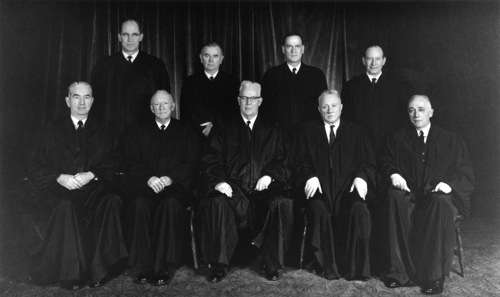
When I read reactions to the current Supreme Court from academics today, I'm often struck by the different way that the Supreme Court's proper role is spoken of today than when I was in law school from 1994 to 1997.  I thought it might be interesting, at least to some readers, to share more about how the Supreme Court was spoken of back then.

I realize this approach is impressionistic.  I'm going to discuss the prevailing sentiment as I encountered at one law school, Harvard Law School, at one period, in the mid-1990s.  There were surely others who had different experiences, especially at different places.  And I look forward to hearing about those experiences!  But I thought it still might be interesting to relay the experience I had.

First, some context.  When I was in law school, from 1994-97, the public law focus of the Harvard Law faculty was still largely about looking back at the Warren Court.  I don't mean that that there was exclusive focus on the period from 1953 to 1969. Rather, I just mean that the main cases and major doctrinal turns in many areas of law were from or were rooted in that period,  The Warren Court was still very much a presence.

Looking back on it, part of that dynamic reflected the faculty's experience. A typical middle-aged law professor in 1995 would have been in law school during the Warren Court.  That Court probably had an outsized influence on their worldview.   But it was also just a matter of doctrine.  A lot changed in the 1960s, and making sense of law in the 1990s often meant having a view of what the Supreme Court did in that busy 1960s period.

The common attitude I remember was one of great enthusiasm for creative Supreme Court lawmaking. "It is a Constitution we are expounding," the argument ran, citing Chief Justice Marshall in McCulloch: it is "intended to endure for ages to come, and consequently, to be adapted to the various crises of human affairs." The Supreme Court was at its best in devising creative new rules to meet the needs of our modern society. Precedents on the books reflected the old world, not the new. So it was exciting, and entirely commendable, when the Court would replace old rules with better ones that reflected more modern values.

The central hero of this narrative, at least in most tellings, was Justice William Brennan.  Justice Brennan was presented as a brilliant mastermind of the Warren Court for his uncanny ability to  get five votes for new directions.  With Brennan on the Court, especially in the 1960s, everything was on the table.  You could get lots of needed change and, and you could get it quickly.  This was an unalloyed good, the thinking ran.  Brennan's ability to get the law changed ensured that the law could change for the better.

What if you happened to favor stare decisis, or you if thought that the role of the Supreme Court should not generally be to try to make the law better?  The prevailing view was that these objections were wooden and narrow-minded. Any person of expected sophistication would realize that law is policy making; law is so flexible that it can mean anything.  So if you thought the Supreme Court should just "follow precedents," rather than overturn them and start fresh in new and exciting directions, you were missing the indeterminacy and delightfully open texture of law.   Such naive viewpoints, with their false sense of certainty, would be welcome at a Federalist Society chapter meeting.  But such views weren't generally advocated in the classroom.

The notion that the Federalist Society would be associated with legal determinacy may seem odd today. But I recall it as significant strain of thinking at the time.  Today, the Federalist Society is though to be largely about originalism.  But remember the Federalist Society's statement of its own principles: "It is founded on the principles that the state exists to preserve freedom, that the separation of governmental powers is central to our Constitution, and that it is emphatically the province and duty of the judiciary to say what the law is, not what it should be." Back in the 1990s, that idea in italics had real meaning: Saying that judges should follow the law and not engage in creative exercises of new rulemaking was a dissenting view from the academy as a whole.  It was an embrace of a view widely rejected as naive and small-minded.

My sense is that times have changed.  But I thought it might be interesting to recall that old set of views, from three decades ago, to help think through those changes.

Law & Government

Teaching Constitutional Law in a Crisis of Judicial Legitimacy

The real crisis seems to be in academia, not at the Court

|

Today's New York Times has a piece by Jesse Wegman on "The Crisis in Teaching Constitutional Law" that reflects the kinds of sentiments I've heard at conferences, lunch tables, and especially on social media - that it is hard to teach constitutional law today because the Supreme Court is doing such lawless stuff.

"Teaching constitutional law today is an enterprise in teaching students what law isn't," Leah Litman, a professor at the University of Michigan law school, told me.

Rebecca Brown, at the University of Southern California, has been teaching constitutional law for 35 years. "While I was working on my syllabus for this course, I literally burst into tears," she told me. "I couldn't figure out how any of this makes sense. Why do we respect it? Why do we do any of it? I'm feeling very depleted by having to teach it."

At least she's still trying. Larry Kramer, a widely respected legal scholar and historian who was my constitutional law professor at N.Y.U. 20 years ago, called it quits in 2008, on the heels of the Supreme Court's divisive decision in District of Columbia v. Heller, which struck down decades of precedent to declare for the first time that the Second Amendment protects an individual right to bear arms. Many observers felt that Heller's majority opinion, by Justice Antonin Scalia, intentionally warped history to reach a preordained result.

Professor Kramer was the dean of Stanford law school at the time, and after the Heller ruling, he told me recently, "I couldn't stand up in front of the class and pretend the students should take the court seriously in terms of legal analysis." First-year law students, he felt, "should be taught by someone who still believed in what the court did."

And so on. I have heard many others voice these concerns, and I worry that they demonstrate a lack of perspective that will dis-serve our students.

Last fall I presented at a conference on "Teaching in a Time of Change and Conflict" on some of these themes. I've now posted on SSRN my presentation: Teaching Constitutional Law in a Crisis of Judicial Legitimacy. I offer a quite different take. From the introduction:

The topic of our symposium is "Teaching in a Time of Change and Conflict" and my specialty is constitutional law, so as you can imagine I have some things to say. With recent developments in the Supreme Court, I regularly hear other professors, including colleagues and friends, ask: How can we teach constitutional law in such a crisis of judicial legitimacy? How can we still teach students that courts are a place to seek justice? . . . These sentiments reflect a real challenge for teaching constitutional law today. But I fear they demonstrate a lack of perspective. The things that today's law professors say about today's Supreme Court are things that others could have said, and sometimes did say, about the Supreme Court for many decades. The real crisis in teaching constitutional law today is not in the Supreme Court, but in legal academia: the question is whether we can maintain the perspective necessary to teach effectively about the Court and the Constitution.

From the argument:

There is a perception that there is something different, something more challenging, about teaching constitutional law today because the Supreme Court has been doing so many things, so quickly, that are so hard to justify.

This perception is wrong. You have always been teaching law in a time of a crisis of judicial legitimacy. The Supreme Court has never been the same thing as the Constitution. It has never been infallible at interpreting the Constitution. It has long been engaging in awe-inspiring power grabs. Dobbs, Bruen, and Bush v. Gore have nothing on Cooper v. Aaron, Miranda v. Arizona, Baker v. Carr and Reynolds v. Sims, Gideon v. Wainwright, The School Prayer Cases, The School Busing Cases, Roe v. Wade and Planned Parenthood v. Casey, Boumediene v. Bush, and Obergefell v. Hodges. If you were asking yourself just two years ago how we can still teach our students about constitutional law . . . then you have not been teaching them very well until now.

In sum, the Court has always been making questionable calls in high-profile cases, likely for a mix of political reasons and genuine differences of opinion about the nature of the Constitution. What has really changed is not that the Court is newly imperial, or newly lawless, or newly political. What has changed is that many more folks inside the Ivory Tower have noticed, and no longer see their values and ways of thinking represented as often by the Court. That reflects a change in what the Court thinks the law is, to be sure. But it does not reflect a change in whether the Court is doing law.

. . . .

I am not naïve enough to think that the solution to the legitimacy crisis will arrive anytime soon, and indeed I can't guarantee that anybody who needs to hear these admonitions will listen to them. But at least listen when I say this: There are lots of people, and even lots of law students, outside the bubble. And they can hear you.

And from the conclusion, with a great debt to C.S. Lewis:

Now let me tell you why we should not succumb to cynicism about constitutional law.

In 1939, C.S. Lewis preached a sermon called "Learning in War-Time." "A University is a society for the pursuit of learning," he began. But, "this seems to be an odd thing to do during a great war. What is the use of beginning a task which we have so little chance of finishing? Or, even if we ourselves should happen not to be interrupted by death or military service, why should we—indeed how can we—continue to take an interest in these placid occupations when the lives of our friends and the liberties of Europe are in the balance? Is it not like fiddling while Rome burns?"

Lewis's ultimate answer was that the war had not truly altered the human condition: "All the animal life in us, all schemes of happiness that centered in this world, were always doomed to a final frustration. In ordinary times only a wise man can realize it. Now the stupidest of us knows. We see unmistakably the sort of universe in which we have always been living, and must come to terms with it." If learning was worth doing in normal times, it was no less worthy during a time of war.

So, too, if constitutional law was worth learning and arguing about in 1964 or 1984, it is worth learning and arguing about in 2024. Once we realize that somebody has always been holding the short end of the Supreme Court, somebody has always been losing, somebody has always been having important decisions ripped away from them on contestable legal grounds, the task of the professor has not fundamentally changed.

It is not my place to tell you, let alone my students, how to feel about the Supreme Court, or whether to try to decimate it as an institution. But if we cannot understand it, if we cannot teach it, we have no business in this business.

For more, including a discussion of Scott Alexander's review of Martin Gurri's Revolt of the Public, a discussion of the methodological Turing test, and other concrete pedagogical suggestions, you can read the whole thing, only eight pages.

Free Speech

No Pseudonymity in Disability Discrimination Lawsuit

|

From today's decision by Judge Joshua Wolson (E.D. Pa.) in Doe v. Temple Univ.:

Courts are public. That's a foundational principle in American society. It means we give the public access to judicial records, we keep our courtrooms open for the public to watch the proceedings, and we require the parties litigating in court to disclose their identities. There are exceptions to all of these rules, but they are just that—exceptions. They get invoked sparingly, or we risk swallowing the general rule.

Plaintiff in this case seeks to invoke two exceptions to these rules. He wants me to let him proceed as a John Doe, rather than revealing his name, and he wants me to let him keep much of the material he submitted in support of his motion to proceed anonymously under seal. Plaintiff's request to proceed anonymously falls well short of the required showing, however.

He suffers from an autoimmune condition that others who came before him in federal court also suffered. Yet his predecessors disclosed their identities, as have thousands of other plaintiffs who have chronic conditions and who seek protection under the Americans With Disabilities Act. Plaintiff's case is not exceptional, and while I sympathize with his desire not to tell the world his name, he has not demonstrated that the fear that keeps him from doing so is a reasonable one. I will therefore deny his motion to proceed anonymously. I will also deny his motion to seal records that he submitted in support of the motion to proceed anonymously, with the exception of some documents that I did not consider in reaching my decision….

Read More

Free Speech

Free Speech Unmuted: Book Bans—or Are They?

I'm delighted to announce this new video/audio podcast series by Prof. Jane Bambauer (Florida) and me, and its first episode.

|

You can watch on YouTube, or subscribe on any podcast platform. It's put together by the Hoover Institution at Stanford University, where I'll be starting as the Thomas M. Siebel Senior Fellow in May.

The first episode (about 30 minutes) is about the First Amendment and public school libraries' removing books. Jane and I had a lot of fun recording this; hope you have fun watching or listening to it! And of course please spread it far and wide.

AI in Court

Has Law Become Stagnant?

|

My last post provided an overview of my draft article The Cost of Justice at the Dawn of AI and explained the basic logic of Baumol's cost disease for the practice of law. Just as in any other market, if the productivity of lawyers increases at a slower rate than the rest of the economy, legal services will become more expensive. And if a technology like artificial intelligence leads legal productivity to increase at a faster rate than the rest of the economy, then legal services will become cheaper.

In this post, I address the question whether law has stagnated – that is, whether legal services have become relatively more expensive as a result of low productivity increases. Legal actors and the law review literature usually ignore the cost disease. More broadly, legislators and other actors have almost entirely ignored my primary inquiry—how changes in legal productivity and thus costs over time might make the legal system more or less efficient and thus have implications for a wide range of legal doctrines and practices. But a few commentators have considered whether the law suffers from the cost disease, and all unanimously have concluded that it does. I tend to agree, but that the case may be more difficult to prove than they allow.

Bill Henderson, for example, carefully documents that indices of the costs of legal services have risen faster than the consumer price index. Similarly, Emery Lee and John Brooks have argued that Bureau of Labor Statistics data support the conclusion that the legal sector has stagnated. Eric Helland and Alex Tabarrok have argued that the cost disease has afflicted law, as well as "other labor-intensive, high-skill services." Various bloggers have concluded that law suffers cost disease without detailed evidence. With all this agreement, any believer in the Condorcet Jury Theorem would need to assign a fairly high probability to the proposition that law has stagnated.

The problem is that it is very difficult to measure changes in the quality of legal services over time, and quality changes that have occurred thus might not be reflected in the Bureau of Legal Statistics data. Even if billable hour rates have risen more than general inflation, if an hour of legal services accomplishes much more today than in the past, law could be a productive sector. Indeed, over the decades, lawyers have benefited from labor-saving technology such as word processing, online legal databases, and e-discovery software.

Moreover, the legal system itself develops ever more precedent. Maybe the accumulation of precedent means that a higher and higher proportion of problems that arise can be resolved easily. If so, the legal system as a whole is becoming more productive. But it's possible that new legal precedents generally create more issues for lawyers to argue. And even if precedents tend to clarify things, the accumulation of precedent might not keep up with the ever increasing complexity of our legal world.

What are the stakes in the question of whether law is stagnating? Stagnation implies that the machinery of the legal system is becoming ever less capable of affordably making relevant legal distinctions. An increasing number of cases will depend on the dynamics of negotiations in the shadow of the law, and while increasing costs will cause more cases to settle, bargaining outcomes may stray quite far from what a hypothetical inexpensive legal system would require. Meritorious defendants may pay nuisance settlements, meritorious plaintiffs may accept a small amount on the dollar, and variables such as relative risk aversion and status as litigation repeat players may greatly influence amounts paid.

These changes aren't easily measured. Data on how much cases settle for is not always readily available, and even if it were, one could not know what the results of such cases would be at trial. Some have imagined a system of random selection of some cases for trial, but in the absence of such a system, we cannot easily observe how much the high cost of litigation is introducing noise or error into adjudication. And any gradual increase in this noise could easily go unnoticed. In the first installment of this series, I noted that no previous scholar has even linked the "vanishing trial" to the cost disease. This highlights that the small amount of commentary on law and the cost disease has been siloed and that the possibility of stagnation has failed to penetrate the general legal consciousness. In my view, the vanishing trial is the strongest piece of empirical evidence for the cost disease, unless one believes that the law is rapidly becoming much clearer and easier to apply.

The legal system still features some trials, but their shadow is becoming ever larger and ill defined. Continued stagnation would have implications for class actions, arbitration, trial procedure, and the choice between rules and standards. But past trends toward stagnation do not establish that the law will continue to stagnate. In the next installment, I'll consider whether we should expect AI to reverse stagnation, if indeed the law has been stagnating, and after that, I will turn to the question of how the legal system can prepare for the possibility that productivity may move in one direction or the other.

More



