The Volokh Conspiracy

Mostly law professors | Sometimes contrarian | Often libertarian | Always independent | Est. 2002

The Volokh Conspiracy

Civil Procedure

Don't Forget Your First-Year Civil Procedure Lessons on Personal Jurisdiction

|

From Castro v. Doe, decided Monday by Judge Mark Pittman (N.D. Tex.):

John Anthony Castro filed this lawsuit on June 16, 2023, alleging that former President Donald Trump, among others, conspired to publish defamatory, verifiably false statements about him on his Wikipedia page. These supposedly false statements include the notion that Castro is a "sleazy tax attorney," did not serve in the military, and is under federal indictment. Castro believes Trump is targeting him as retaliation for the over thirty federal lawsuits Castro has lodged against Trump concerning Trump's actions on January 6, 2021.

The court upheld the Magistrate Judge's conclusion that Castro is a vexatious litigant:

Castro's June 2023 original complaint represented the tenth case he has filed in this District in the last five years, six of which have been filed since April 2021. And that says nothing of his dozens of other cases filed across the country in the last few years….

In his Objections, Castro explains, case by case, how each is meritorious and does not support a finding that he is clogging the judicial machinery with meritless litigation. Of note, roughly half of the cases … have suffered problems related to the same issue: jurisdiction, even to Castro's own admission. Even as recently as March 19, 2024, Judge Terry Means, also of the Fort Worth Division, made yet another finding that Mr. Castro brought a lawsuit that lacked personal jurisdiction….

The Court notices a pattern. Mr. Castro seems to pay no attention or care to where he files his lawsuits. Either he actively chooses to sue where he knows the Court lacks personal jurisdiction, or he fails to understand how jurisdiction and venue work, despite many orders informing him of the standard and explaining why he continuously falls short.

Read More

The Court Should Cast Doubt On Havens Realty "Diversion" Standing and Establishment Clause "Offended Observer" Standing

If Alliance for Hippocratic Medicine lacks standing, so should progressive groups.

|

On Tuesday, the Supreme Court heard oral argument in FDA v. Alliance Hippocratic Medicine, the mifepristone case. Much of the argument focused on whether AHM had standing to challenge the FDA's actions. From my vantage point, it looks like the plaintiffs will lose. Indeed, the writing has been on the wall since the Court granted a stay of the Fifth Circuit's decision back in April 2023. The question isn't whether AHM will lose; the question is how. I would humbly submit that the Court could take this opportunity to clean up several aberrations in standing law.

First, the Court should claw back so called "diversion of resource" standing based on Haven's Realty. As this theory has been interpreted by some lower courts, an organization can claim Article III standing simply by claiming that a government policy forces the organization to divert resources. In other words, the organization would usually spend their resources on X, but because of some state action, the organization now spends their resources to respond to the state action. That injury seems entirely self-inflicted, and is at odds with decades of standing law. Yet some lower courts accepted this theory in legal challenges to Trump policies. I had hoped that the Supreme Court could address Havens Realty in Acheson, but that case fizzled out on mootness grounds.

During oral argument in AHM, several Justices addressed Havens Realty standing. Earlier in the argument, Justice Barrett said that AHM's injury "sound[s] in the Havens Realty associational standing." Barrett added that these are the sorts of "allegations we see by immigration advocacy groups." They claim a "diversion of resources" in the form of "increased expenses that result from the complications of having to address" the state action. Barrett asked Solicitor General Prleogar to distinguish "diversion of resources" from Havens Realty.

Prelogar explained that in Havens, the civil rights group had a "direct and concrete demonstrable injury" apart from the diversion of resources. Specifically, the organization "organization had a contract to provide low-income housing" and "the racial steering practices directly interfered" the "contractual obligations." Prelogar said Havens Realty did not "bless[] a theory of standing that would allow an organization to assert a setback to its abstract social interests." The Solicitor General acknowledged that "in the immigration context," some "lower courts in particular have seemed to read Havens to endorse far broader theories of standing." Prelogar said "we would welcome an eventual clarification from this Court on organizational standing."

Erin Hawley, representing AHM, said that Havens Realty was "on all fours with this case." Hawley said there "was an impairment of the organization's mission" and "an expenditure of resources." That impairment, Hawley said, is sufficient for an injury-in-fact. Justice Thomas said that reading of Havens makes standing "easy to manufacture." The organization would just have to "us[e] resources to advocate their position in court" and say those expenditures "now causes an injury." Hawley acknowledged that "the lower courts have cabined Havens to say where you have sort of prelude to litigation types of activities." It is not enough to have a diversion of resources. Hawley said AHM's actions were "neither a prelude to litigation, nor would they have occurred but for FDA's unlawful conduct in this case." Justice Thomas did not return to the issue.

Justice Barrett turned to Havens with Hawley. She asked "what additional costs [AHM] might have incurred or how [AHM's] resources were diverted in a way that would satisfy Havens"? Barrett pointed to AHM's conducting and analyzing studies. Barrett replied, "Is that it?" Barrett, and Thomas, did not seem persuaded.

During the Solicitor General's rebuttal, Prelogar said that "clarify" that Havens Realty does not permit "every organization in this country . . . to challenge any federal policy they dislike." I suspect progressive lawyers who are keen to challenge future Trump immigration policies were gritting their teeth when Prelogar made this comment.

Second, the Court can cast some doubt on so-called "offended observer standing" under the Establishment Clause. I have long questioned how someone can claim standing to challenge a policy on Establishment Clause grounds based simply on being offended. Justice Gorsuch raised this issue in his American Legion concurrence. And Gorsuch pushed SG Prelogar on this issue. Prelogar attempted to deflect, and  "would put the Establishment Clause precedent and First Amendment precedent generally in its own bucket." Gorsuch pushed back. "Standing is standing." There is no First Amendment exception to Article III.

Gorsuch "was looking for some guidance" of how to "stitch it all together." Prelogar acknowledged that an "offense or distress type of injury" would "likely go far too much in the direction of allowing Article III courts to weigh in based on generalized grievances." But she said the Court has found an "cognizable" injury where "there is a kind of direct governmental action producing that type of injury." I'm not sure that distinction works. Article III is not satisfies because some "direct governmental action" offends a person. There has to be an actual, concrete injury in fact. Cases like Van Orden and American Legion are inconsistent with decades of standing doctrine.

Ultimately, there are probably more than enough votes to reverse the Fifth Circuit. It is tempting to write a 9-0 decision that finds a way to rule against AHM, without speaking to these broader issues. But it would be helpful if the Court, or at least a plurality of Justices, clamps down on the other standing theories at play in this case. There is some degree of unilateral disarmament when conservative litigants are thrown out of court but progressive groups can skate in under the radar. The Court can reject the broad reading of Havens Realty, and hold that mere emotional distress is insufficient to establish a concrete injury.

Free Speech

Inventing Anna Defamation Case Against Netflix Can Go Forward

|

From today's decision in Williams v. Netflix, Inc. by Chief Judge Colm Connolly (D. Del.), which denies Netflix's motion to dismiss (for more backstory, see here):

Plaintiff Rachel DeLoache Williams has sued Defendant Netflix, Inc. based on Netflix's portrayal of Williams in its docudrama series Inventing Anna…. Here, at least two sets of alleged defamatory statements are actionable at the motion to dismiss stage. Williams's 9th set of alleged defamatory statements reads as follows:

After several scenes about the problems with the credit cards at the Hotel and the private museum tour, there is a long scene in which Noah is shown meeting Williams and suggesting to her that they leave immediately because of the "bad situation." At first, Williams says that the problems are over and suggests that they stay but Noah persists, and she gives in. She finds Anna who is alone in her room, drinking heavily and depressed.

Williams tells her that they are leaving, making a bogus excuse. Sorokin begs her not to leave her, but Williams leaves anyway. She and Noah pack and leave the Hotel immediately, leaving Sorokin alone with a hotel guard stationed outside her room.

Williams's 10th set of alleged defamatory statements reads as follows:

NEFF: Please, Rachel abandoned Anna. Kicked her when she was down, and left her alone in some foreign country. Rachel's happy to call herself Anna's friend when it meant free shit, trips to Morocco, but as soon as times got tough … Some friend.

Williams plausibly alleges that both sets of statements are false statements of fact and defamatory. For falsity, she argues that Williams did not "abandon" Sorokin when Sorokin was "alone, depressed and in trouble" but rather that Williams told Sorokin she was leaving in advance, that Sorokin had company when Williams left, and that Sorokin did not appear to be upset. For defamatory meaning, Williams argues that she "is falsely portrayed as a fair-weather friend who abandoned Sorokin when she was alone, depressed and in trouble in Morocco, and needed help and support" and that "[t]hese are negative personal traits or attitudes that Williams does not hold."

Read More

Property Rights

Squatters' Rights Laws Violate the Takings Clause

Where these laws allow squatters to occupy houses without the owner's consent, they qualify as takings of private property that require payment of compensation under the Fifth Amendment.

|

Illustration: Lex Villena; Lev Kropotov

In recent weeks, there has been a lot of media coverage of squatters' rights laws that sometimes have the effect of blocking property owners from removing trespassers who occupy their houses without the owners' permission. Newsweek describes some highly publicized recent cases:

A recent string of incidents in Georgia, New York and Washington has brought squatting, the practice of occupying someone else's property without their consent, into the spotlight.

In Washington, a squatter named Sang Kim made headlines after preventing Jaskaran Singh, a landlord, from possessing his $2 million property following Kim's refusal to pay rent for two years.

Earlier in March, a New York property owner was arrested over unlawful eviction after confronting a group of alleged squatters who had taken over her deceased parents' home in Flushing, Queens, ABC 7 reported. While the woman held the property's deed, one man said he was on a lease for the house—which meant the property owner was barred from kicking him out [he, in fact, did not actually have a lease].

That same month, David Morris, a landlord in Atlanta, told Fox 5 of a group of squatters who were preventing him from building affordable housing on his nine-acre land and whom he was unable to remove because of a moratorium on evictions.

Morris told the outlet he had agreed to let four people stay on the land without paying rent about 10 years ago, but that he found the number of people occupying the property had grown to about "30 campers." Though the squatters were taken away from the land, Morris said he spent $10,000 to clean up their garbage.

John Stossel of Reason made a video focusing on the New York case.

As often happens when an issue attracts media attention, it is hard to tell from early reports how widespread the problem actually is. But even a few cases of successful squatting may be problematic, because they could incentivize imitation. Media attention could accelerate that process.

Ideally, state and local governments should make it easy for property owners to swiftly remove squatters, and should subject the trespassers to civil and criminal sanctions. But where they instead facilitate this violation of property rights, the laws that do so violate the Takings Clause of the Fifth Amendment, which requires payment of "just compensation" whenever the government takes "private property."

In Cedar Point Nursery v. Hassid (2021), the Supreme Court ruled that even temporary government-authorized physical occupations of private property are "per se" (automatic) takings. Thus, the Court struck down a California law requiring agricultural growers to give union organizers access to their land for three hours per day, 120 days per year. At least some state squatter rights' laws are considerably more egregious than that: They enable squatters to completely occupy the property for many weeks or months on end, totally excluding the owner in the process. That is particularly true of New York City's law, which gives squatters who claim to be tenants strong rights against removal if they have been on the property for at least 30 days. Landowners seeking to remove the squatters after that point must go through an eviction process, which can take as long as two years.

Chief Justice John Roberts' opinion for the Court in Cedar Point does outline some exceptions to the rule that state-mandated physical occupations qualify as takings. But squatter rights don't fall within any of them. For example, the squatters pretty obviously aren't government employees conducting health and safety inspections.

Squatters could perhaps argue that their activities fall within what the Court called "traditional common law privileges to access private property." The common law does recognize the right to claim property through "adverse possession." But traditional common law precedent permits that only after squatters have had continuous exclusive possession of the land for a long period of time (usually five years or more), and only if the owner made no effort to assert his or her rights during that time. The New York City law and others like it go way beyond that.

The Takings Clause may not be the best possible remedy for this situation. Filing and winning such a case could take many months. And if  property owners do prevail, they generally get only the "fair market value" of the rights lost, which may not fully compensate all of their losses. However, this avenue can provide at least some valuable redress; the longer the squatters remain, the greater the amount of compensation the government will have to pay. And fear of takings liability may incentivize state and local governments to repeal or tighten up the laws that cause the problem.

Legal issues aside, it's worth noting that squatters' rights laws end up harming the very people they are supposed to help: low-income tenants. If property owners have reason to fear that squatters can occupy their land without their consent, they will be less willing to rent property to begin with, charge higher rents, screen potential tenants more carefully (thereby potentially excluding those with low income, few or nor references, and the like), or some combination of all of these measures. They may also be incentivized to impose more costly and elaborate security restrictions on access to land (which in turn is likely to raise rents). All of this predictably reduces the availability of housing and increases its costs.

I hope property owners and public interest law firms give serious consideration to bringing takings challenges against these laws. They are not a panacea for the problem. But they could help.

UPDATE: Prominent takings expert Robert Thomas (Pacific Legal Foundation) comments on this post at the Inverse Condemnation Blog:

In other cases where the courts have upheld regulations and restrictions on an owner's right to recover possession from an actual tenant -- you know, someone with whom the owner actually and expressly agreed, and then transferred the right to exclude to the tenant -- the courts frequently note that "no one is forcing you to become a landlord."

Well here, the owner is being forced to become a landlord.

Professor Somin wraps by noting, "I hope property owners and public interest law firms give serious consideration to bringing takings challenges against these laws. They are not a panacea for the problem. But they could help."

Since we are part of a non-profit, pro bono, public interest law firm as the good professor describes, we shall note here that the welcome mat is out, and if the above-situation is your situation, let us know.

The Holy Roman Empire, Actual Malice, and Criminal Conversation

|

The Holy Roman Empire, it was famously put (by Voltaire, I think), was neither Holy, nor Roman, nor an Empire. Likewise, the First Amendment "actual malice" test isn't actually about malice, but rather about whether the speaker knew the statement was false or likely false (and indeed the Court has had to make clear that actual malice in the English sense of ill will or hostility doesn't suffice). And "criminal conversation" was (and in a few jurisdictions still is) a tort, not a crime, and it focuses on illicit sex, not conversation in the modern English sense of the word.

Hence this question: Are there other legalese phrases of two or more words, in which the modern English sense of every one of the words (perhaps excluding articles and prepositions) does not actually correspond to the legal term? To be sure, plenty of legal phrases involve meanings that go beyond the English words ("freedom of speech" may cover communication that wouldn't normally be labeled "speech," such as handwriting, flag waving, flag burning, and the like). Likewise, plenty aren't understood as being composed of English words at all (such as "res judicata" or "habeas corpus"). But I'm looking here for phrases that do use ordinary English words but use them in a sense quite different from the modern English meaning of each word.

Free Speech

Private Employee's Claim That She Was Fired for Peacefully Attending Jan. 6 Events Can Go Forward,

under California statutes that protect private employees' political activity; the plaintiff claimed that "[s]he listened to speeches being made and walked to the Capitol, and then she left," and "did not participate in any rioting."

|

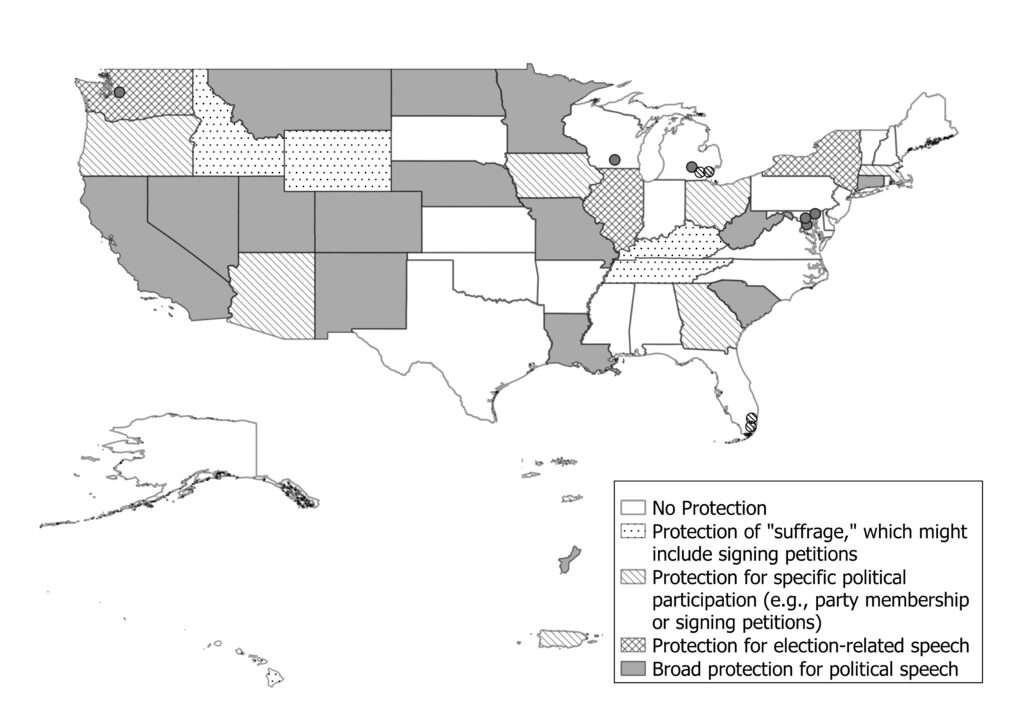
Map of private employee speech protections throughout the country.


I blogged about Snyder v. Alight Solutions, LLC (C.D. Cal.) on Jan. 27, 2021, when it was first filed, but hadn't heard until today that on Sept. 14, 2022 there was a decision on a motion for summary judgment (by Judge Cormac Carney); the case has since settled instead of going to trial:

Plaintiff Leah Snyder alleges that Defendant Alight Solutions, LLC wrongfully terminated her employment after she posted to a private Facebook page photos of herself at the Washington, D.C. Capitol building on January 6, 2021 and positive comments about the events that took place that day. In short, the parties' disagreement is this: Defendant argues that it lawfully terminated Plaintiff's employment because she violated laws proscribing where demonstrations may take place on Capitol grounds. Plaintiff alleges that this reason for her termination was pretextual, and that her employment was terminated for a political motive—specifically relating to her support of former President Donald Trump—or as retaliation for reporting harassment she experienced in response to her photos and comments on Facebook….

The court allowed the case to go forward to trial under California's statutes that protect private employees' political activity (for more on such statutes in various jurisdictions, see this article and this one):

In general, an at-will employee like Plaintiff may be terminated for an arbitrary reason, for an irrational reason, or for no reason at all. However, an employer may not terminate an at-will employee for an unlawful reason, or for a purpose that contravenes fundamental public policy. "When an employee is discharged in violation of 'fundamental principles of public policy,' the employee may maintain a tort action and recover damages traditionally available in such actions." California courts recognize four categories of public policy cases: "the employee (1) refused to violate a statute; (2) performed a statutory obligation; (3) exercised a constitutional or statutory right or privilege; or (4) reported a statutory violation for the public's benefit."

Plaintiff alleges that she was wrongfully terminated for exercising "constitutional rights to speak freely, peaceably assemble or petition her grievances to the Government," in violation of the public policy described in California Labor Code Sections 1101 and 1102. "Sections 1101 and 1102 … prohibit employers from interfering with 'the fundamental right of employees in general to engage in political activity.'" "[L]iability under §§ 1101(a) and 1102 is triggered only if an employer fires an employee based on a political motive."

{Section 1101 states: "No employer shall make, adopt, or enforce any rule, regulation, or policy … forbidding or preventing employees from engaging or participating in politics, or … controlling or directing, or tending to control or direct the political activities or affiliations of employees." Section 1102 states: "No employer shall coerce or influence or attempt to coerce or influence his employees through or by means of threat of discharge or loss of employment to adopt or follow or refrain from adopting or following any particular course or line of political action or political activity."}

Read More

Free Speech

More on Coercion, Social Media, and Freedom of Speech: Rejoinder to Philip Hamburger

Prof. Hamburger continues to conflate coercion and voluntary choice.

|

Professor Philip Hamburger has posted a response to my critique of his post on the social media free speech cases currently before the Supreme Court. The latter, in turn, responded to my earlier argument that courts should focus on coercion in Murthy v. Missouri. For those keeping track, this is now the fifth post in this series.

In his latest post, Prof. Hamburger accuses me of repeating my "errors." But I remain unrepentant. It is in fact Hamburger himself who has doubled down on his mistakes.

Most notably, he continues to neglect the significance of the fact that the First Amendment protects "freedom of speech." By its very nature, freedom is voluntary choice. Therefore, it cannot be restricted in the absence of some kind of coercion. That's true even if Prof. Hamburger is right (as he surely is) to describe the Free Speech Clause of the First Amendment as a "limit on government." The limit it imposes on government is preventing it from using compulsion to restrict speech. By contrast, it does not prevent the government from using persuasion to influence private speech, or from engaging in coordination with private speakers.

Prof. Hamburger continues to emphasize the fact that the First Amendment bans "abridging" of freedom of speech, as opposed to the ban on "prohibiting" freedom of religion. I agree this means free speech gets somewhat greater protection than religious freedom does. But the thing that it is protected against must still be some form of compulsion. Absent compulsion, there can be no restriction of freedom. the distinction in wording just means that relatively mild forms of coercion that may not rise to the level of "prohibition" might still qualify as "abridgement."

Hamburger claims my view would allow the government to "buy off" its critics. But conditioning government benefits on the exercise of constitutional rights (or refraining from exercising them) raises other constitutional problems. Among other things, it implicates the doctrine of "unconstitutional conditions," which prevents the government (at least in many instances) from discriminating on the basis of speech with respect to the distribution of government benefits. Thus, for example, the government cannot adopt a law restricting Social Security benefits to people who express support for the Democratic Party, or at least refraining from criticizing it. Activities like persuasion or "jawboning" do not qualify as such discrimination.

Prof. Hamburger also doubles down on the dubious claim that social media platforms don't have free speech rights over the material they post on their websites. But, as discussed in my previous post, platforms do in fact exercise editorial control over what speech they allow on their sites, through their terms of service. In that respect, they are similar to media entities like Reason or the New York Times.

Hamburger responds that the platforms sometimes took down speech even without changing their terms of service. But he is missing the point. The existence of terms of service with substantive limitations on the types of speech platforms allow on the site shows that it is not the case that they are "public squares" where anyone can say whatever they want. Rather, they are private property where the owners exercise editorial control over speech. They can do that through terms of service. But, unless prohibited by freely undertaken contractual obligations, they can also do that in other ways.

In his latest post, Prof. Hamburger continues to promote a double standard under which he has an extremely broad view of what is prohibited by the First Amendment when it comes to non-coercive government persuasion to bar social media posts, but a very narrow one with respect to Texas's and Florida's attempts to force social media firms to host speech they disapprove of. He now tries to justify this by claiming that social media platforms are "common carriers." This analogy is badly flawed for reasons I outlined here.

Social media firms have never been legally considered common carriers in the past. And state governments cannot make them so just by legislative fiat. If they could, the same strategy could be used to force other private entities to publish speech they disapprove of, by passing laws declaring them to be "common carriers," as well. Thus, they could force Fox News to air more left-wing views, compel the New York Times to publish more right-wing ones, and so on.

Prof. Hamburger accuses me of departing from libertarian principles, due to my focus on coercion. But the distinction between coercion and voluntary action is actually fundamental to libertarianism - and, indeed, to most other forms of liberalism. It is, in fact, usually opponents of libertarianism - particularly left-wing ones - that seek to efface the distinction between the two, thereby justifying government intervention to protect people against supposedly oppressive voluntary relationships. Such arguments are a standard justification for restrictive labor regulation, for example, where it is said that voluntary agreements to work more than certain amount of hours or for pay below the minimum wage are actually "exploitative" coercive.

Finally, Prof. Hamburger complains about my pointing out that speech can be a "public bad," and worries that it is somehow a justification for suppression. I think it is pretty obvious that at least some speech is a public bad, in so far as it can lead to horrific government policies. That was true of Nazi and Communist speech, for instance.

It doesn't follow that the government is justified in suppressing such speech. Even speech advocating awful ideas is still an exercise of an important individual liberty. And there is - to make an obvious  point - good reason to distrust government judgments about which speech is harmful and which is not. Thus, there should be at least a strong presumption against allowing the government to deal with this public bad through coercive censorship.

By contrast, the use of non-coercive suasion - whether by the government or private parties - doesn't pose anything like the same risks. Private entities who differ with the government's position will remain free to publish opposing views. And so long as there is a market demand for such views, there will be incentives to publish them.  If the government persuades, say, Twitter or Facebook, to take them down, that just creates a market incentive for others to publish them.

In sum, there is good reason to worry about government use of coercion to either suppress speech (as the Biden Administration may well have done in Murthy v. Missouri), or to compel it (as Texas and Florida are trying to do). But the First Amendment does not bar the government - or anyone else - from using non-coercive persuasion.

Religion and the Law

When Parties Agree to Religious Arbitration, Arbitrator's Religious Decision Is Enforceable

|

In S.I. v. M.I., decided Friday by the New Jersey appellate court (Judges Morris Smith and Lisa Perez-Friscia), an Orthodox Jewish couple divorced, and in the midst of the divorce proceedings agreed to religious arbitration as to whether the husband had to give the wife a "get" (the Jewish religious divorce that is required for a divorce to be viewed as valid within the Orthodox community). The arbitrator ordered the husband to give a get, but the state trial court refused to enforce the arbitrator's decree:

[P]laintiff moved to confirm the arbitration award…. [T]he judge denied the motion[], finding the court lacked "jurisdiction to confirm an award which would in effect order somebody to give a get—a religious divorce in the Jewish faith." He reasoned "the effect of that confirmation [would] … put the State of New Jersey Superior Court['s] stamp on an arbitration award telling one person they have to do something that … in their religion that is really beyond." Further, the judge found no precedent "would compel [him] … to order anyone of the Jewish faith to give another person of the Jewish faith a get."

No, said the appellate court:

Read More

Free Speech

Hamburger Responds: Prof. Somin Repeats His Errors

Round 3 in the debate between Hamburger and Somin over the First Amendment and Murthy

|

Philip Hamburger, a professor at Columbia, is the CEO of the New Civil Liberties Alliance, which represents most of the individual plaintiffs (mostly scientists) in Murthy v. Missouri.

Hamburger wrote the following post to respond again to Ilya Somin in their ongoing debate (here and here) over Freedom of Speech and coercion. 

[It was edited for tone about 3 hours after original posting, with the changes not shown. --JL]

________________________________

 I am grateful to Prof. Somin for his defense of his coercion vision of the First Amendment. He thereby clarifies where we differ.

Text. Prof. Somin's response is strangely indifferent to the First Amendment's text. Prohibiting is a matter of coercion. The First Amendment deliberately distinguished abridging from prohibiting. If as he suggests, the amendment makes coercion the yardstick for the freedom of speech, why did it speak of abridging the freedom of speech? He would have us believe that although it carefully spoke of abridging the freedom of speech, that textual indication should just be ignored.

Prof. Somin concedes that "[t]here may indeed be a meaningful distinction between 'abridging' and 'prohibiting.'" Nonetheless, he persists in introducing a coercion standard by treating freedom as simply the discretion or choice of individuals speakers. But the word freedom should not be interpretated to undermine the distinction between abridging and prohibiting clearly drawn in the text.

Limit on Power. Prof. Somin also persists in treating rights as tradeable commodities, not legal limits on government. To be precise, the First Amendment's freedom of speech was a limit on government, not just a right. Indeed, the First Amendment makes this explicit by beginning: "Congress shall make no law . . ." This conception of rights as limits on power was hinted at in 1785 in the Symsbury Case—a Connecticut decision holding a legislature could not take property even with consent or acquiescence, apparently because that "was Not in the power of the General Assembly Constitutionally to Do."

In other words, private consent cannot relieve the government of the First Amendment's limit on power. Although Prof. Somin is surely correct that an individual can choose not to exercise the freedom of speech, no amount of consent can give government the power to abridge that freedom.

Protected Sphere of Liberty. Prof. Somin also fails to recognize that the First Amendment's speech clauses protected a sphere of liberty, the same for everyone, which government was barred from abridging. This conception of the freedom of speech is evident from the founding era theory about freedom of speech as a natural right. See Philip Hamburger, Natural Rights, Natural Law, and American Constitutions 908-09. The point is not that anyone needs to believe in natural rights, but that government was barred from reducing a protected sphere of liberty, whether by coercion or consent.

One of the dangers of Prof. Somin's vision of freedom of speech is that it lets government buy off its critics. Indeed, it lets government use consent to shrink the speech rights of nonprofits, students, and so forth, so that Americans are without a shared interest in a shared realm of freedom. From his perspective, there is little speech freedom government cannot purchase, and no shared freedom that all Americans can rally around to defend. See Purchasing Submission 107-08 (Harvard 2021).

Misunderstands Terms of Service. Prof. Somin seems to assume that platforms carried out government demands for censorship only after changing their terms of service. That is false; often, the platforms just caved to the government without changing those terms. He also assumes that users can sue for violations of the terms of service; but that usually is untrue.

Not the Platform's Speech.  Even if his coercion-consent theory didn't depart from the text and eighteenth-century conceptions of the freedom of speech, it still fails because it assumes that the platforms are speakers. In his view, the posts on the platforms are their speech, and the government can abridge the freedom of speech as along as it gets consent—that is, as long as it doesn't use coercion.

But the posts that individuals place on the platforms are not the platforms' speech. Not even the platforms argue as much. Instead, they allege that they have a First Amendment editorial discretion—that is, a right of expressive discrimination against their users. Thus, Prof. Somin is unfortunately mistaken in assuming that the posts on the platforms are the platform's speech and that the consent of the platforms is therefore a cure for the suppression. In fact, the posts placed on the platforms by individuals are their speech. Thus, even under Prof. Somin's anti-textual and ahistorical theory, the government should need the consent of the individuals.

Information Asymmetry. Prof. Somin declares his distaste for the shifting notions of consent in contract. My point, however, was not to embrace one view or another, but merely to observe that his vision of a sharp opposition between consent and coercion departs from contemporary legal doctrine and from the medical and psychological literature on consent.

Accuses me of Contradiction. Prof. Somin even accuses me of contradicting myself because I take "an expansive vision of what is prohibited by the First Amendment when it comes to non-coercive government pressure to bar social media posts, but a very narrow one when it comes Texas's and Florida's attempts to force social media firms to host speech they disapprove of. In this latter situation, there is blatant and obvious coercion." I don't think that is a reasonable presentation of my views.

My historically informed view is that, for hundreds of years, common carrier doctrine has applied to communications carriers, and that doctrine has never until now been considered a threat to the freedom of speech. Conceptually, the point is that a conduit is not a speaker. Indeed, the attempts of the platforms to claim editorial discretion founders when one realizes that it is a claim of expressive discrimination against their users.

Excuses Suppression. Prof. Somin perhaps reveals an insufficient lack of commitment to freedom of speech when he says that some speech, such as "misinformation," can be a "public bad." Here he appears not to recognize that much alleged misinformation was true—indeed, was understood to be true by the people suppressing it—and its suppression adversely affected public policy. He also may be thinking the government or the platforms are qualified to be the arbiter of truth. He further reveals his priors when he argues that one should not be too worried about the current censorship regime because it only reduces some expressions of offensive views, leaving other instances online—as if the volume of opinion does not matter, and as if the value of speech is to be measured in bulk, without concern for the suppression of individual voices.

All of this is very disturbing, especially from an avowed libertarian.

Conclusion. Put simply, I believe that Prof. Somin's vision of the First Amendment is wrong—textually, historically, and conceptually. I also think it erroneous to assume that the platform's consent is sufficient under his theory, because the censored speech is the platforms' speech.


Free Speech

Can't Sue In-Laws for "Undermining" Marriage and Thus Tortiously Inducing Breach of Marriage Contract

This used to be possible under the old "alienation of affections" tort, but all but a handful of states have abolished it, and the tortious inducement of breach of contract tort can't fill that gap.

|

So holds the Ohio Court of Appeals in S.E. v. Edelstein, in an opinion by Judge Stephen Powell, joined by Judges Michael Powell and Matthew Byrne. An excerpt from the factual allegations, in the lawsuit brought by ex-wife Kimberly (also representing her and ex-husband Elliott's daughter) against ex-father-in-law Max:

In the complaint, it was alleged that Max had intentionally interfered with the ketubah, the supposed [Jewish marriage] "contract" at issue in this case, by engaging in a continuous "campaign to undermine" Kimberly and Eliott's contractual relationship (i.e., their marriage) for nearly 20 years. The complaint alleged that this included Max being "emotionally abusive" towards Kimberly, as well as Max making "negative and derogatory statements" about Kimberly. This, according to the complaint, included Max criticizing Kimberly's "status as a convert to Judaism" and by frequently stating that Kimberly's and Eliott's children "were not Jewish." The complaint also alleged that Max, "with the intent to destroy the contractual relationship between" Kimberly and Eliott, routinely disparaged Kimberly to "persuade" Eliott to "terminate his contractual relationship with [her]."

The court concluded that, given the Ohio Legislature's abolition of the alienation of affections tort, "neither Max, nor any other person, could be held liable in civil damages to either Kimberly or S.E. for any breach of a promise to marry or alienation of affection," which is what the allegations amounted to.

The ex-wife is apparently a former magistrate and judicial staff attorney; as one might gather, this seems to be a high-conflict divorce that has led to a good deal of litigation (see, e.g., this federal court case).

Note that the high-profile alienation of affections cases have generally involved a lawsuit by an ex-spouse against the other ex-spouse's lover, and alleged adulterous sex—which could also be the basis for the misleadingly named "criminal conversation" tort—or at least romantic seduction. Indeed, such cases are still fairly common in North Carolina, and occasionally litigated in a few other states, such as Utah and Mississippi.

But the gist of the tort was improper interference with a marriage, and it wasn't limited to interference by other sexual or romantic partners. Interference by in-laws could indeed lead to liability in jurisdictions where the alienation tort was recognized, though courts then of course had to decide what was improper and what wasn't. Here's the most recent case I could find along those lines, Poulos v. Poulos (Mass. 1967) (Massachusetts didn't abolish the alienation of affections tort until 1985):

Read More

Supreme Court

Mifepristone in the Supreme Court - Comments on Oral Argument (Updated)

Live commentary on the Supreme Court oral argument in FDA v. Alliance for Hippocratic Medicine

|

What follows is some live commentary on the Supreme Court's oral argument today in FDA v. AHM, the mifepristone case.

Solicitor General Elizabeth Prelogar began today's oral argument in FDA v. AHM with standing, emphasizing the plaintiffs' argument for Article III standing is based upon an attenuated chain of causation that fails to satisfy the requirements of Article III standing. This was a good start. In turning to the consequences of allowing this suit to go forward, I think it was an error to focus exclusively on the consequences for reproductive choice and women seeking to terminate pregnancies. Allowing standing in this case poses the risk of opening the door to suits against all manner of FDA decisions, such as decisions to approve vaccines (among other things). Courts have generally rejected standing in such suits. Is that really something the Court wants to change?

Asking the first question (as has become traditional), Justice Thomas wants to know, if not these plaintiffs, who could sue to challenge the FDA's approval (a question that Justice Alito picks up later). This is a good question, but there is no constitutional requirement that Article III standing must exist for someone. Put another way, there can be cases in which no one has Article III standing to challenge the federal government's failure to regulate someone else, particularly where (as here) Congress has not created a cause of action or purported to authorize such suits. Under Lujan, the standing inquiry can be eased when Congress has created a procedural right or authorized suit, but it has never done so here. As Justice Thomas notes in response, the plaintiffs may have a stronger argument relying upon some of the Court's associational standing cases (such as Havens Realty, for instance), but I doubt the Court really wants to rely upon that outlier decision. (Indeed, some of us thought the Court was poised to cut back on Havens Realty in Acheson Hotel.) 

Pressed on this point by Justice Alito, SG Prelogar effectively acknowledges that there may not be any specific individual who can sue the FDA for revising ts regulation of mifepristone. The theory the plaintiffs have pressed, she notes, does not come within miles of the requirements of Article III standing as the Court has articulated them in prior cases. Whether there is some other theory out there that might work is not a question the government has to answer.

Read More

FDA

Can Emergency Room Doctors Sue the FDA for Failing to Regulate Mifepristone More Aggressively?

The threshold issue in today's oral argument is Article III standing, and that issue should be determinative.

|

This morning the Supreme Court will hear oral argument in FDA v. Alliance for Hippocratic Medicine, a challenge to the manner in which the Food and Drug Administration regulates mifepristone, a medication that is used to terminate pregnancies.

The biggest challenge for AHM, the group challenging the FDA, is demonstrating that federal courts have jurisdiction to hear its claims. AHM would like the FDA to regulate mifepristone more stringently, or prohibit its use altogether. In effect, AHM is arguing that the FDA needs to regulate someone else (in this case, mifepristone manufacturers and prescribers) more stringently than it has done. As always in standing cases, asking the courts to force the government to treat a third party differently can be a heavy lift.

AHM's standing claim is based on the argument that AHM's members are injured when women who take mifepristone face complications and seek assistance in emergency rooms. Having to observe and treat such complications causes a cognizable injury, AHM argues, because providing treatment in such cases makes doctors feel complicit in abortion, violates their conscience, and may even expose them to liability.

Assuming that actions by third parties (in this case, the FDA) that force individuals to do their jobs (in this case, anti-abortion ER doctors treating patients) constitutes a cognizable injury for Article III purposes, AHM faces the larger problem of being unable to identify specific doctors who will face specific instances. Rather, they are claiming that the risk of these things has increased because mifepristone is available. The problem here is that AHM is alleging precisely the sort of speculative injuries the Court held were insufficient in Clapper v. Amnesty International. Thus allowing this case to go forward would, in effect, allow groups of doctors to challenge any agency decision that could conceivably result in an increase in injuries among an identifiable group of people. AHM tries to address this problem by citing the comment in Clapper footnote 5 that standing can sometimes be shown "based on a 'substantial risk' that the harm will occur," yet manages to conveniently truncate the quote every time it this argument is made. What footnote 5 actually says is that: "In some instances, we have found standing based on a 'substantial risk' that the harm will occur, which may prompt plaintiffs to reasonably incur costs to mitigate or avoid that harm." That latter requirement -- costly anticipatory actions to prevent harm -- is not met here.

In effect, AHM is making the sort of probabilistic injury claim that the Supreme Court routinely rejects (as in Clapper and Summers). As I explained in this post critiquing the Fifth Circuit's acceptance of this argument:

[The court] tries to argue that an injury to one of the plaintiffs is certain because there are so many women that have taken mifepristone, and complications are so common, that it is inconceivable that some of AHM's members will not be called upon to provide emergency room care. This stacks the deck though in the way it presents the numbers, however. For instance, it notes that five million women have taken the drug since 2000. Based on the FDA's acknowledgement that in two-to-seven percent of cases will involve potential complications from the drug not fully working, this means there have been between 100,000 to 350,000 cases in which women have needed additional treatment. But note that these numbers are for a twenty-plus-year period. On an annual basis, this represents 5,000 to 17,000 cases. Even making the demonstrably false assumption that all of these cases require a visit to one of the thousands of emergency rooms in the United States, it is far from a "statistical certainty" that one of the plaintiff doctors will handle one of these cases, as these cases represent a tiny fraction of the over 130 million emergency department visits each year.

Were that not enough, AHM's standing hurdle is even greater because, as the case reaches the Supreme Court, AHM's claims have been narrowed. As initially filed, AHM sought to argue that the FDA wrongly approved mifepristone in the first place. Accordingly, AHM argued that it faced a reasonable likelihood of harm from the availability of mifepristone on the market. In making this argument, it could use all instances of mifepristone complications nationwide to help make its case. Yet AHM cannot make such arguments any more.

In the proceedings below, the U.S. Court of Appeals for the Fifth Circuit (correctly) held that AHM's challenges to the the FDA's initial approval of mifepristone were made too late, so all that is at issue is the FDA's slight loosening of the rules governing mifepristone's administration in 2016 and 2021. This means in order to demonstrate standing AHM needs to demonstrate injury to one of its members based upon the additional complications caused by these regulatory changes. Complications that would or could have happened prior to the 2016 and 2021 revisions are not enough. From my prior post:

It is well established that standing is not dispensed in gross. As the Supreme Court has repeatedly reaffirmed, a plaintiff "must demonstrate standing for each claim he seeks to press and for each form of relief that is sought." Standing to challenge one agency action does not necessarily establish standing to challenge another. More specifically, even if the plaintiffs can establish that they will suffer an actual or imminent injury from one FDA action (such as the 2000 approval of mifepristone) that does not mean that they will suffer an actual or imminent injury from another FDA action (such as the 2016 or later revisions to the rules governing mifepristone).

All of this should be fatal to AHM's claims for Article III standing. Whatever one thinks of mifepristone or the FDA's conduct regulating this product over the past 25 years, AHM has not demonstrated that it gets to invoke the jurisdiction of Article III courts to challenge the FDA's decision.

*  *  *

I will have more to say after the oral argument. In the meantime, here are my prior blog posts about this case and the issues it raises:

A Fourth Antitrust Shoe Drops, on Apple This Time

Episode 498 of the Cyberlaw Podcast

|

The Biden administration has been aggressively pursuing antitrust cases against Silicon Valley giants like Amazon, Google, and Facebook. This week it was Apple's turn. The Justice Department (joined by several state AGs)  filed a gracefully written complaint accusing Apple of improperly monopolizing the market for "performance smartphones." This questionable market definition will be a weakness for the government throughout the case, but the complaint does a good job of identifying ways in which Apple has built a moat around its business without an obvious benefit for its customers.  The complaint focuses on Apple's discouraging of multipurpose apps and cloud streaming games, its lack of message interoperability, the tying of Apple watches to the iPhone to make switching to Android expensive, and its insistence on restricting digital wallets on its platform.  This lawsuit will continue well into the next presidential administration, so much depends on the outcome of the election this fall.

Volt Typhoon is still in the news, Andrew Adams tells us, as the government continues to sound the alarm about Chinese intent to ravage American critical infrastructure in the event of a conflict.  Water systems are getting most of the attention this week.  I can't help wondering how we expect the understaffed and under-resourced water and sewage companies in this country to defeat sophisticated state-sponsored attackers. This leads Cristin and me to a discussion of how the SEC's pursuit of CISO Tim Brown and its demands for more security disclosures will improve the country's cybersecurity.  Short answer: It won't.

Cristin covers the legislative effort to force a divestiture of Tiktok. The bill has gone to the Senate, where it is moving slowly, if at all. Speaking as a parent of teenagers and voters, Cristin is not surprised. Meanwhile, the House has sent a second bill to the Senate by a unanimous vote. This one would block data brokers from selling American's data to foreign adversaries. Andrew notes that the House bill covers data brokers.  Other data moguls, like Google and Apple, would face a similar restriction under a new executive order, so the government will have multiple opportunities over the next few months to deal with Chinese access to American personal data.

In the wake of the Murthy argument looking at the first amendment and administration efforts to increase social media censorship of mostly right-wing posts,  Andrew reports that the FBI has resumed its outreach to social media companies, at least where it identifies foreign influence campaigns. Meanwhile, the FDA, which piled on to criticize ivermectin advocates, has withdrawn its dubious and condescending tweets.

Finally, Cristin reports on the spyware agreement sponsored by the United States. It has collected several new supporters. Whether this will reduce spyware installations or simply change the countries that supply the spyware remains to be seen.

You can subscribe to The Cyberlaw Podcast using iTunes, Google Play, Spotify, Pocket Casts, or our RSS feed. As always, The Cyberlaw Podcast is open to feedback. Be sure to engage with @stewartbaker on Twitter. Send your questions, comments, and suggestions for topics or interviewees to CyberlawPodcast@gmail.com. Remember: If your suggested guest appears on the show, we will send you a highly coveted Cyberlaw Podcast mug! The views expressed in this podcast are those of the speakers and do not reflect the opinions of their institutions, clients, friends, families, or pets

Social Speech and the Supreme Court

Episode 497 of the Cyberlaw Podcast

|

The Supreme Court is getting a heavy serving of first amendment social media cases. Gus Hurwitz covers two that made the news last week. In the first, Justice Barrett spoke for a unanimous court in spelling out the very factbound rules that determine when a public official may use a platform's tools to suppress critics posting on his or her social media page.  Gus and I agree that this might mean a lot of litigation, unless public officials wise up and simply follow the Court's broad hint: If you don't want your page to be treated as official, simply say up top that it isn't official.

The second social media case making news was being argued as we recorded. Murthy v. Missouri appealed a broad injunction against the US government pressuring social media companies to take down posts the government disagrees with.  The Court was plainly struggling with a host of justiciability issues and a factual record that the government challenged vigorously. If the Court reaches the merits, it will likely address the question of when encouraging the suppression of particular speech slides into coerced censorship.

Gus and Jeffrey Atik review the week's biggest news – the House has passed a bill to force the divestment of TikTok, despite the outcry of millions of influencers.  Whether the Senate will be quick to follow suit is deeply uncertain.

Melanie Teplinsky covers the news that data about Americans' driving habits is increasingly being sent to insurance companies to help them adjust their rates.

Melanie also describes the FCC's new Cyber Trust Mark for IOT devices.  Like the Commission, our commentators think this is a good idea.

Gus takes us back to more contest territory: What should be done about the use of technology to generate fake pictures, especially nude fake pictures. We also touch on a UK debate about a snippet of audio that many believe is a fake meant to embarrass a British Labour politician.

Gus tells us the latest news from the SVR's compromise of a Microsoft network. This leads us to a meditation on the unintended consequences of the SEC's new cyber incident reporting requirements.

Jeffrey explains the bitter conflict over app store sales between  Apple and Epic games.

Melanie outlines a possible solution to the lack of cybersecurity standards (not to mention a lack of cybersecurity) in water systems. It's interesting but it's too early to judge its chances of being adopted.

Melanie also tells us why  JetBrains and Rapid7 have been fighting over "silent patching."

Finally, Gus and I dig into Meta's high-stakes fight with the FTC, and the rough reception it got from a DC district court.

You can subscribe to The Cyberlaw Podcast using iTunes, Google Play, Spotify, Pocket Casts, or our RSS feed. As always, The Cyberlaw Podcast is open to feedback. Be sure to engage with @stewartbaker on Twitter. Send your questions, comments, and suggestions for topics or interviewees to CyberlawPodcast@gmail.com. Remember: If your suggested guest appears on the show, we will send you a highly coveted Cyberlaw Podcast mug! The views expressed in this podcast are those of the speakers and do not reflect the opinions of their institutions, clients, friends, families, or pets

More