In addition to being the 80th anniversary of D-Day, today is the 45th anniversary of the Somin family's arrival in America! I wrote about our experience of immigration from the Soviet Union to the United States in a 2010 memoir, written for the Hebrew Immigrant Aid Society (HIAS), which helped us gain admission to the US, and continues to assist refugees from around the world, to this day.
Reflecting on this experience, I am profoundly grateful to my parents for making the decision to come to the US, and also to those who fought at D-Day, Gettysburg, and elsewhere to establish, expand, and protect the freedoms that make America a haven for immigrants seeking liberty and opportunity from around the world.
Reflection also inspires humility. I am vastly better off than my peers who remained in Russia. But virtually all of that difference is the result of the difference between American institutions and Russian ones, not any merit of mine. Over the last two years, that difference has been accentuated by the Putin regime's horrific war of aggression against Ukraine, and the accompanying repression. We should strive to ensure that more people are able to enjoy liberty and opportunity unconstrained by arbitrary circumstances of ancestry and place of birth.
At its worst, America is susceptible to the same types of ethnic, religious, racial, and nationalistic prejudices as all too many other nations. Sadly, a dangerous illiberal nationalism is increasingly influential in our politics.
But at its best, this is the nation where freedom and opportunity can be yours regardless of who your parents are, or where you were born; the nation where immigrants are accepted more fully than in almost any other. It is difficult to gain full acceptance as a Frenchman, German, or Japanese if you are not a native-born member of the majority ethnic group in those countries. Not so here; or at least far less so.
And America is also a nation where many thousands of ordinary people work to welcome refugees from war and oppression. We have recently seen that with those who have stepped forward to support migrants from Ukraine, Cuba, Venezuela, and elsewhere under private sponsorship programs like Uniting for Ukraine, CNVH, and Welcome Corps.
In 2022, a newly arrived Ukrainian refugee told me she chose America because it is the nation where there are people from many backgrounds and all are "equal … regardless of nationality, skin color or religion." Her words reminded me of those of George Washington, who envisioned the US as "an Asylum for the poor and oppressed of all nations and religions." Too often, we fall short of these high ideals. But great things happen when we live up to them.
It is fashionable to assume that only people who are themselves members of a particular identity group can truly understand its experience. If so, perhaps only immigrants can fully grasp the value of immigration. Thus, some readers may assume that my work on "voting with your feet,"migration rights, and the perils of nationalism is an outgrowth of personal experience.
But, in truth, it began with my engagement with the political economy literature on federalism (which helped me grasp the importance of domestic foot voting). Later, the writings of scholars such as Bryan Caplan, Michael Clemens, and Joseph Carens, helped me see that international migration is an even more significant pathway to expanding human freedom and opportunity; not just one liberty among many, but one of the great issues of our time. To my knowledge, all of them are themselves native-born citizens of western liberal democracies. Yet it was they who enlightened me about the broader significance of migration rights, rather than vice versa. They saw clearly where I long had a blind spot.
It is a small, but telling example of how understanding often comes through logic and evidence, not just personal experience accessible only to members of a particular group. It also offers a measure of hope that we can expand liberty for both immigrants and natives with the help of many who never personally experienced the injustices they seek to end.
NOTE: This post updates and expands one I published in 2019, on the 40th anniversary of the same event.
Achieving a sound analysis of reputation and reputational injury is important for understanding the law of defamation. This goal has, however, received surprisingly little attention. In light of the burst of renewed attention given to defamation law in the courts and the media, now is a good moment to try to make progress on this topic.
Although this article is principally theoretical, the project of writing it was undertaken with legal controversies in mind. Amongst the many issues in defamation law that continue to foster debate, some pertain to damages and would thus seem to call for a theory of reputational injury. Controversy swirls around the adjective "presumed" in the phrase "presumed damages." Critics ask why defamation plaintiffs are entitled to have their damages presumed and need not prove them, and they are naturally drawn to the concern that if the need for compensation is not actually proven, then liability is really punishment for uncivil speech even where it does no harm. This unsurprisingly leads to the conclusion that presumed damages are repugnant to free speech values, and should no longer be permitted by common law courts (even if the Supreme Court has decided to lay low on the issue).
Damages in tort law are overwhelmingly linked to a plaintiff's right to redress injury, and it is therefore reasonable to suppose that clarity on what damages ought to be available to a defamation plaintiff will be lacking until we have greater clarity on what sorts of wrongful injuries defamation law is designed to redress. This brings us to the topic of the paper, reputational injury.
On June 21, Judge Cannon will hold oral argument on the Appointments Clause challenge to Special Counsel Jack Smith's prosecution of Donald Trump. The Court granted leave for three amici to argue. I will be presenting argument on behalf of Professor Seth Barrett Tillman and the Landmark Legal Foundation. The other lawyers representing other amici will be Gene Schaerr (Schaerr | Jaffe) and Matt Seligman (Stris & Maher LLP). I've blogged about the case before here and here.
And on Wednesday evening, I was a guest on the Mark Levin Show to talk about the case.
From today's statement by Stanford President Richard Saller and Provost Jenny Martinez; Newsweek (Jesus Mesa) reports that the graffiti include "FUCK AMERIKKKA," "DE@ATH 2ISR@HELL," "Kill cops," and "PIGS TASTE BEST DEDAD":
Dear Stanford community,
We are appalled and deeply saddened by the actions that occurred on our campus earlier today.
As you know from earlier alerts that were sent out, a group of protesters broke into and occupied Building 10 early this morning until they were arrested and removed by law enforcement. A public safety officer was injured by protesters as part of the response to the occupation.
In addition to damage done inside the building, protesters committed extensive graffiti vandalism on the sandstone buildings and columns of the Main Quad this morning. This graffiti conveys vile and hateful sentiments that we condemn in the strongest terms. Whether the graffiti was created by members of the Stanford community or outsiders, we expect that the vast majority of our community joins us in rejecting this assault on our campus.
Defamation is a moral and legal wrong that is distinct from the wrongs of insulting or offending a person, lying to a person, or unjustifiably causing emotional distress. Defamation essentially involves harm or injury to a person's reputation. And reputation is a social concept: It refers to a person's standing in some relevant audience, i.e., the group or community beyond the speaker and the person.
But from whose perspective must a statement be defamatory? This question has multiple dimensions. Is our only interest whether the person's standing is lowered in the eyes of the community? Or should we also consider the perspective of the person who claims to have been defamed? Must that person subjectively view the statement as injuring his or her own reputation? Are we also interested in the perspective of the speaker?
When I started researching my book, Classified: The Untold Story of Racial Classification in America, the law review literature asserted that racial classification, in practice, was almost entirely a matter of self-identification. While federal law specified the classifications and their definitions, in practice people could check whatever box they wanted, and no one ever checked. In fact, according to the relevant literature, there was only one case, ever, in which an individual's self-identification was questioned. This was an infamous case involving two Irish-American firefighters in Boston who claimed to be African American to take advantage of the fire department's affirmative action policies.
I was confident that there were more such cases, in part because Eugene Volokh once blogged about such a case involving whether New York State could constitutionally decide that a contractor of Spanish descent was not Hispanic for state purposes, even though he was Hispanic for federal purposes. In the end, I found a couple of dozen such cases, mostly involving minority business enterprise preferences, and mostly involving the Hispanic classification, though also others involving claims of American Indian, African American, and Asian American identity. Many of those cases wound up being cited in Justice Gorsuch's concurring opinion in SFSA v. Harvard.
I assumed that these were just the tip of the iceberg, as I relied on publicly available judicial or administrative rulings, or media coverage. Most disputes, I figured, were decided within the bowels of government bureaucracies, and the only way to find them would be to comb through thousands of unpublished records, if you could first figure out where those records were located. It wasn't sufficiently important to my book to undertake such an efforts.
That said, I did just happen upon another such dispute over identity, discussed briefly in a 1989 GAO report on fraud in disadvantaged business enterprise programs. As background, at the time Iranian Americans were classified as white, and thus not "minorities" eligible for DBE preferences, while Indian Americans were classified as Asian American and therefore were eligible.
An anonymous letter alleged that the president of an engineering DBE did not oversee the firm's day-to-day management and that the firm was controlled by the vice president, who was a white male. It was also alleged that the president was Iranian-born and thus not eligible to participate in the program. The investigation disclosed that there was no apparent problem with control since the president drew the largest sal- ary, signed all company checks, and was the only person in the firm with an engineering degree. It was also determined that the DBE president was raised in Iran and held Iranian citizenship, but that his parents were of Indian descent. During the reassessment process, the state transportation agency requested an advisory opinion from DOT concerning whether a person born in Iran to Indian parents is Iranian or Indian for purposes of DBE program participation. The state agency eventually recertified the DBE based on the DOT ruling that the controlling factor was a person's heritage not citizenship.
This decision seems correct, as Asian American is defined under federal law as someone descended from one of the original peoples of Asia. But it does raise the question of how far one can take that principal. Are Parsi Indians, descendants of Zoroastrians who fled Iran hundreds of years ago to escape Muslim persecution Indian, or Iranian? How about Baghdadi Jews from India whose ancestors moved to India from Iraq in the 19th century? Is there any statute of limitations here? In practice, though, I suspect that so long as an individual's ancestors had Indian citizenship, it's very unlikely anyone will question whether they are "really" Indian and thus Asian American.
Anyway, the existence of this case reinforces my suspicion that there are many more such cases reported somewhere in bowels of government archives.
After an Introduction that provides an overview of the book, The Collective-Action Constitution unfolds in three parts over eleven numbered chapters, followed by a brief Conclusion. Part I discusses interpretive and analytical tools from constitutional law and social science that Parts II and III use. Most importantly, Part I identifies the kinds of constitutional arguments that appear in the book and how they relate to originalist and nonoriginalist theories of constitutional interpretation.
For example, originalist argumentation and evidence frequently appear in The Collective-Action Constitution, but not because the book offers an exclusively or conventionally originalist account. Rather, original intentions, meanings, and purposes, like structural inferences, customary political-branch practice, and judicial precedent that developed and endured long after ratification of constitutional provisions, inform how we should understand the Constitution's purposes and thus how we should decide interpretive questions when its language is not fully determinate or does not fully cover the case. Chief Justice John Marshall used this approach in McCulloch v. Maryland (1819), the most important structural decision in U.S. constitutional law. Marshall's pluralist methodology, which he deployed to discern the Constitution's primary structural purpose identified in The Collective-Action Constitution, is challenged now by the rising influence of relatively strict versions of originalism. As constitutional historian H. Jefferson Powell has written, however, Marshall's approach has always been "the constitutional mainstream" in the United States. Marshall's methodology provides the interpretive foundation upon which the book rests.
McCulloch provides critical guidance in additional ways. Marshall develops a theory of the superior democratic legitimacy of the federal government over individual states that justifies federal authority to settle disagreements among states over whether there are cost-benefit collective-action problems in need of solving. He also offers a broad interpretation of the Necessary and Proper Clause that advances the Constitution's collective-action objectives in three respects. The clause indicates the existence of implied legislative powers, which (1) empower Congress to solve some multistate collective-action problems when other powers are unavailable; (2) permit laws that do not themselves help solve such problems (such as the law creating the National Bank) but enhance the efficacy of laws that do; and (3) let Congress build out the executive and judicial branches, which the Articles of Confederation lacked and the Constitution requires if federal laws—including solutions to collective-action problems—will be enforced against states and individuals. Finally, Marshall identifies an enduring democratic-process failure that justifies constitutional limits on state authority to impede federal solutions to collective-action problems or cause such problems, including by taxing federal instrumentalities.
As an interpretive matter, there is a fundamental contrast between what The Collective-Action Constitution is doing and what is usually meant by "originalism" (using the term as someone would who is thinking in good faith, not as window dressing). The sincere, strict originalist is correct in viewing the constitutional text as central to the activity of constitutional law and in regarding respect for the text as critical to the legitimacy of constitutional-law arguments. The text did not fall from the sky; rather, it came into being and was accepted by the American political community as specific times and to address specific problems and concerns. Interpretive approaches that completely sever the connection between constitutional argumentation and those historical specificities risk delegitimizing themselves because they may boil down to using Constitution-talk to mean whatever the speaker prefers as a matter of political morality.
Even so, the strict originalist, in my view, mistakenly reduces all of constitutional law to the interpretation of the original meaning of the words of the discrete provisions of the constitutional text. Such a "clause-bound interpretivism," as John Harty Ely described the position, misses the point of the words. The point, above all in the 1787 text, was a serious, thought-through, and debated attempt to solve the governance problems that existed in the 1780s and that were mostly incapable of being solved either by the weak national government created under the Articles of Confederation or by the state governments acting individually or collectively outside the Confederation Congress. More precisely, the point was to solve the central problem—the singular really is right—that the Union faced in the 1780s: the Union-destroying ways in which the states were relating to the central government and to one another. To adequately appreciate and realize the point of the words of the 1787 text, purposive, structural, practice-based, and consequentialist arguments are needed in addition to textualist and originalist ones.
The Collective-Action Constitution continuously returns to the various provisions of the Articles of Confederation to recover the point of the text of the 1787 Constitution and to suggest how the problems facing American society today can be addressed in a way that faithfully adheres to the solutions embodied in the text. For example, the original Framers and ratifiers did not know about climate change, but they knew all about other free-rider problems. Chapter 9 of the book outlines a parallel approach to the Reconstruction Constitution, which was thoroughly considered and adopted to address a different problem facing the Union in the 1860s: the dignity-destroying ways in which states were relating to their own inhabitants. The Reconstruction Congress did not know about sexual-orientation discrimination, but they knew all about other caste systems.
To a very great extent, the very lawfulness of constitutional law and the legitimacy of judicial decisions rest upon fidelity to the written Constitution. Strict, good-faith originalists are right about that. The Collective-Action Constitution models how a methodological pluralism committed to original constitutional purpose can maintain such fidelity while enabling American society to effectively address current concerns. "This provision," after all, "is made in a constitution, intended to endure for ages to come, and consequently, to be adapted to the various crises of human affairs." McCulloch, 17 U.S. 316, 415 (1819).
On Tuesday, President Biden issued a travel ban of asylum seekers:
The entry of any noncitizen into the United States across the southern border is hereby suspended and limited, subject to section 3 of this proclamation. This suspension and limitation on entry shall be effective at 12:01 a.m. eastern daylight time on June 5, 2024. The suspension and limitation directed in this proclamation shall be discontinued pursuant to subsection
The order invokes Section 212(f) of the INA, or for those who are not immigration lawyers, 8 U.S.C. § 1182(f). It provides, in part:
Whenever the President finds that the entry of any aliens or of any class of aliens into the United States would be detrimental to the interests of the United States, he may by proclamation, and for such period as he shall deem necessary, suspend the entry of all aliens or any class of aliens as immigrants or nonimmigrants, or impose on the entry of aliens any restrictions he may deem to be appropriate.
This was the same section invoked by President Trump in each iteration of his travel ban. Between 2017 and 2018, I wrote more about Section 212(f) than I'd care to recall. In Trump v. Hawaii, Chief Justice Roberts described the provision with sweeping language:
By its terms, §1182(f) exudes deference to the President in every clause. It entrusts to the President the decisions whether and when to suspend entry ("[w]henever [he] finds that the entry" of aliens "would be detrimental" to the national interest); whose entry to suspend ("all aliensor any class of aliens"); for how long ("for such period as heshall deem necessary"); and on what conditions ("any restrictions he may deem to be appropriate"). It is therefore unsurprising that we have previously observed that§1182(f) vests the President with "ample power" to impose entry restrictions in addition to those elsewhere enumerated in the INA. Sale, 509 U. S., at 187 (finding it "perfectly clear" that the President could "establish a naval blockade" to prevent illegal migrants from entering theUnited States); see also Abourezk v. Reagan, 785 F. 2d 1043, 1049, n. 2 (CADC 1986) (describing the "sweeping proclamation power" in §1182(f) as enabling the President to supplement the other grounds of inadmissibility in theINA).
In the wake of Trump v. Hawaii, there were calls to repeal Section 212(f). I was skeptical that even a Democratic President would remove such a potent weapon from his executive power arsenal. (There is a reason that Congress did not enact any of the Post-Trump reform of the executive branch.) And after nearly four years of a Biden Presidency, Section 212(f) remains intact.
The policy went into effect about thirty minutes ago. The Northern District of California has not yet enjoined the policy, but it will. Judge Tigar probably has a macro for these sorts of TROs. I'm sure the Department of Justice will go through the motions to defend the policy. But does the Biden DOJ actually want to win here? Wouldn't the best case scenario be for Biden to take political credit for doing something about the border, and then blame the courts not allowing him to do so something, as his supporters will be content that asylum seeker scan continue entry? I wonder if any DOJ lawyers will refuse to sign the briefs, as some did with the Trump orders.
Earlier today, President Biden announced a new policy severely restricting migrants' rights to claim asylum after crossing the southern border. Reason immigration writer Fiona Harrigan has a helpful summary of its provisions:
"The entry of any noncitizen into the United States across the southern border is hereby suspended and limited," said Biden's order. When border encounters between ports of entry hit an average of 2,500 per day over a seven-day period, migrants will no longer be allowed to seek asylum unless they qualify for a narrow exception or request an appointment at a port of entry through an app (a process that has been glitchy and cumbersome). The restrictions will lift two weeks after the daily number of encounters between ports of entry falls below 1,500 on average over a seven-day period.
The policy does include exceptions for unaccompanied minors and migrants who CBP officers grant permission to enter "based on the totality of the circumstances, including consideration of significant law enforcement, officer and public safety, urgent humanitarian, and public health interests at the time of the entry or encounter that warranted permitting the noncitizen to enter."
But the new policy would bar nearly all other migrants from applying for asylum, including those who are fleeing violence and persecution of the kind that asylum is supposed to protect against.
It's worth noting that Biden already adopted a highly restrictive "Trump-lite" asylum policy last year, leading to a legal challenge in which a federal court ruled against it. As Judge Judge Jon Tigar of the Northern District of California point out in his opinion, the plain text of the Refugee Act of 1980, "provides that any noncitizen who arrives in the United States, 'whether or not at a designated port of arrival' and 'irrespective of [their] status, may apply for asylum.'" Similar (though even more restrictive) policies were struck down by courts under the Trump Administration, including in a decision written by prominent conservative Judge Jay Bybee.
Judge Tigar's ruling was stayed by the US Court of Appeals for the Ninth Circuit, which still has not reached a final decision on the case. This new policy is also likely to be challenged, and there is a high likelihood it too will be struck down by courts. The text of the 1980 Refugee Act is clear, and Biden's policy pretty obviously violates it.
My Cato Institute colleague David Bier explains why the policy is likely to be harmful and counterproductive, as well as illegal:
Biden's order will take effect when Border Patrol arrests exceed 2,500 per day (which they do now) and will expire only when arrests fall below 1,500 per day for two consecutive weeks. From fiscal years 2019 to 2024, DHS has met this 1,500-per-day target in 11 months—all but once in fiscal year 2020. The Biden administration has never met this standard.
Even the Trump administration, despite the pandemic, a locked‐down economy, and the most determined executive branch, failed to meet this standard in August, September, October, November, or December 2020. Achieving this goal would require a 60‐percent decline in arrests….
The executive order will not work. Biden has already tried a complete ban on asylum—an even more severe version under the health code law known as Title 42. Title 42 was applied most strictly to adults traveling without children from Mexico and northern Central America. During the time that it was enforced, Title 42 almost immediately led to more arrests of this demographic. This increase happened primarily because people who were expelled often attempted to re‐cross the border, leading to more arrests….
Biden is demanding that every asylum seeker apply for asylum at US ports of entry, but his order also requires that they use a cell phone app called CBP One to make an appointment three weeks in advance while they are still in Mexico. Moreover, the number of daily appointments is capped at 1,450. Therefore, Biden is effectively banning about 4,000 people per day from seeking asylum but is not opening up any additional legal ways for them to enter. Not a single additional person will enter legally because of this new rule. This will doom the entire effort, as people will continue to enter illegally….
If the order is effective at denying [asylum to] people who cross illegally, it will cause more people to enter illegally and try to evade detection rather than turn themselves in for asylum. Evasions mean more trespassing on private property, more car chases with smugglers, and more confrontations between Border Patrol agents and migrants….
This action will only result in more deaths of migrants who think the only way to enter is by evading Border Patrol—by hiding in deserts, swimming the Rio Grande River, or slipping in surreptitiously into the back of tractor‐trailers. In the big picture, President Biden should not be ignoring US laws. He should not be seeking to stop people from coming to the United States. Instead, he should be working to let them enter this country legally and orderly so they can contribute to it. America is a great country, and people want to join it. That's a good thing. We should let them do so legally.
As Bier and I outlined in a November USA Today article, if Biden really wants to reduce disorder at the border, the best way to do it is by expanding his own previous initiatives to make legal entry easier, which have been undermined by arbitrary caps and bureaucratic obstacles. Federal and state governments could also make things better by giving asylum seekers work permits immediately and cutting back on zoning rules that make it difficult to build new housing in response to demand.
Such policies would simultaneously help migrants fleeing horrible oppression and poverty, boost the American economy by enabling migrants to contribute to it more, and reduce chaos at the border. Even if it survives legal challenges, Biden's new asylum policy is unlikely to achieve any of those goals, and - for reasons David Bier notes - could well make things worse.
Admittedly, Biden's main goal is probably to help himself politically in an election year, rather than to improve policy or follow the law. We'll see if that political objective is achieved. I am skeptical that he will get much of a boost from it. Public opinion on border issues is more influenced by perceptions of disorder than by details of policy (which most voters, especially relatively inattentive swing voters, know little about). But I could be wrong. The White House's political strategists may have a better grasp on the political dynamics than I do. Perhaps the appearance of toughness will pay political dividends, regardless of the actual effects on the ground. Time will tell.
Biden's overall immigration policy is still vastly better than Trump's, and he deserves credit for a variety of improvements. But he also deserves blame when he adopts cruel Trump-like asylum policies in the hope of scoring political points.
Recent studies diverge on the extent to which public opinion backs policies that would deregulate housing construction. YIMBYs would do well to learn from both.
YIMBY policies command broad support among economists and land-use experts across the political spectrum. But how popular are these ideas with the general public? Two recent studies give diverging answers to that question. A September 2023 survey conducted by Pew Charitable Trusts finds broad support for a wide range of YIMBY policies, cutting across partisan lines. By contrast, a recent study by legal scholar Chris Elmendorf and political scientists Clayton Nall and Stan Oklobdzija (ENO) is far more equivocal, finding much less support for housing deregulation.
Which is right? I suspect the truth lies somewhere in between. It may well be that many voters don't know much about these issues, don't have strong opinions about them, and therefore their views (and answers to survey questions) may vary a lot based on context and framing.
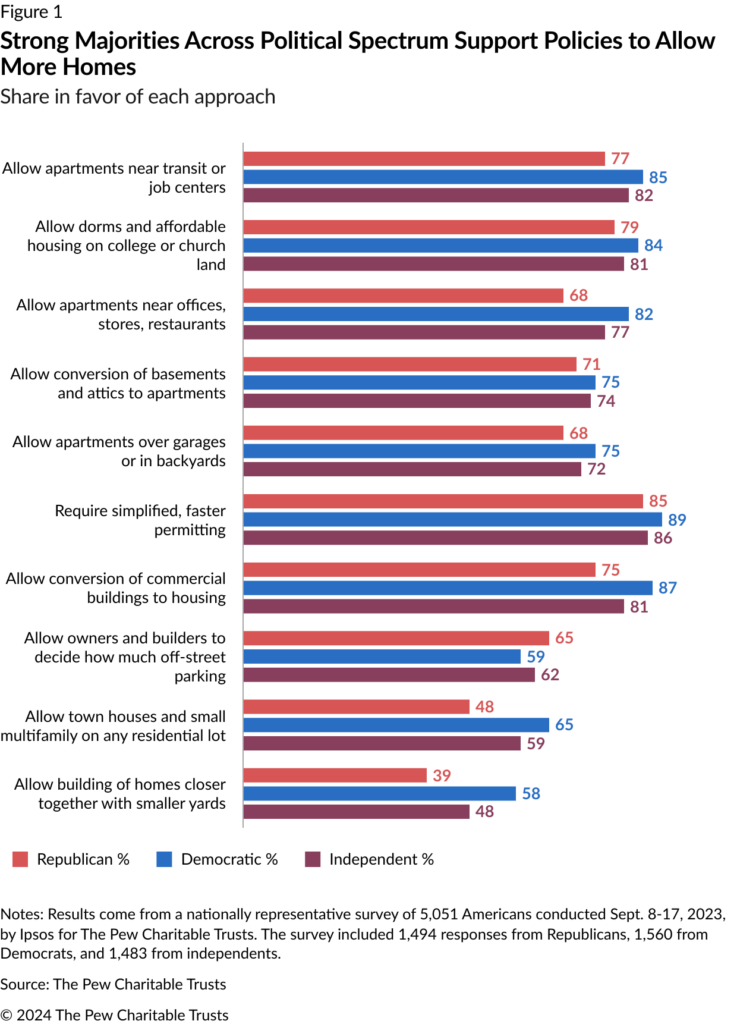
The Pew survey finds large majorities supporting many different deregulatory housing policies.
Pew Charitable Trusts.
Notice that every one of these policies has the support of a large majority, with the exception of allowing homes to be built closer together, with smaller yards, where respondents are evenly divided (49% for, 50% against). Most significantly, a clear majority (58%) supports allowing construction of multifamily homes on any residential lot. This would eliminate single-family-only zoning, the most widespread and pernicious type of exclusionary zoning. It is also notable that Democrats and independents tends to back YIMBY reforms more than Republicans do, despite the latter's reputation as being more sympathetic to property rights.
The Pew study also finds large majorities backing a wide range of rationales for housing policy change, including "To enable people to live closer to offices, stores, restaurants or public transportation" (77% say this is either an "excellent" or "good" rationale for policy change), and "To make housing more affordable" (82%), and "To help boost local economies by helping business owners have more potential employees and customers nearby" (76%). Most impressively, 65% say it would be excellent or good to adopt housing policies that "give people more freedom to do what they want with their property." Almost all building restrictions infringe on homeowners' property rights in that way!
By contrast, the ENO study is far more pessimistic about public support for YIMBYism. Here is the abstract summarizing their findings:
How much has rising political attention to problems of housing affordability translated into support for market-rate housing development? A tacit assumption of YIMBY (``Yes In My Backyard'') activists is that more public attention to housing affordability will engender more support for their policy agenda of removing regulatory barriers to dense market-rate housing. Yet recent research finds that the mass public has little conviction that more housing supply would improve affordability, which in turn raises questions about the depth of public support for supply-side policies relative to price controls, demand subsidies, or restrictions on ``Wall Street'' investors, to name a few. In a national survey of 5,000 urban and suburban voters, we elicited perceptions of the efficacy of a wide range of potential state policies for ``helping people get housing they can afford.'' We also asked respondents whether they support various housing and non-housing policies. Finally, as a way of estimating the revealed importance of housing-policy preferences relative to the more conventional grist of state politics, we elicited preferences over randomized, three-policy platforms. In a set of results that recall the politics of the inflation-ridden 1970s, we find that homeowners and renters alike support price controls, demand subsidies, restrictions on Wall Street buyers, and subsidized affordable housing. The revealed-preference results further suggest, contrary to our expectations, that price controls and anti ``Wall Street'' restrictions are very important to voters. Contrary to the recommendations of housing economists and other experts, allowing more market-rate housing is regarded as ineffective and draws only middling levels of public support. Opponents of market-rate housing development also care more about the issue than do supporters. Finally, we show that people who claim that housing is very important to them don't have distinctive housing-policy preferences.
The major differences between the Pew survey and the ENO study are that the latter asks more complicated and detailed questions, and that they intersperse questions about YIMBY policies with questions about pro-regulatory policies (e.g. - rent control and restrictions on developers), which most experts consider to be ineffective (rent control has a particularly bad reputation among those in the know), but which are clearly popular with many voters. ENO also leave more room for uncertainty and ambiguity (including allowing "don't know" answers), whereas the Pew questions have a "forced choice" format, with no "don't know" or "uncertain" option. The latter approach probably elicits more weakly held views than the former.
I also think the Pew question wording is relatively more favorable to YIMBY policies (sometimes implicitly suggesting they are likely to increase supply), while ENO's question wording often cuts the other way. ENO also include questions that reference corporate and developer interests, which may trigger "anti-market bias" and "supply skepticism." An earlier ENO study found that many people don't understand basic economics of housing and don't believe increasing supply is likely to reduce prices, suspecting instead that it will just benefit nefarious financiers and developers.
Interestingly, while the Pew study finds that Democrats are more supportive of deregulatory YIMBY policy than Republicans, ENO find the exact opposite. I think that, too, is an effect of question wording. The ENO questions more often often refer to developers and corporations, thereby triggering left-wing suspicion of capitalist interests.
Activists and politicians love to tout poll results that indicate their positions are popular, while denigrating those that suggest the opposite. I'm a big supporter of YIMBYism, and therefore wish I could say the Pew survey is right and ENO are wrong. But the truth is far more complicated than that. If anything, the ENO study is the more extensive and sophisticated of the two. As a longtime scholar of voter ignorance, I am well aware that many bad policies are popular, and that I myself have many unpopular views.
What the combination of the two studies shows is that public perceptions of housing policy are heavily influenced by frames and question-wording. If you ask about YIMBY policies in isolation, and imply they may increase the availability of housing and reduce costs, you will get strong majority support for them. If you have less favorable question wording, reference capitalist interests, and include questions about increased regulation, you get more negative results.
Similarly, if you frame deregulation as "giv[ing] people more freedom to do what they want with their property," it will get more support than if you frame it as letting developers and other business interests do what they want - even though these two are often the exact same thing! Business interests are owners, too, after all, and one of the things that an ordinary property owner might want the "freedom" to do with her land is sell it to a developer to build new housing that can accommodate more people.
Both the seller and the developer may be motivated by profit, rather than any high-minded desire to increase affordable housing. But, to paraphrase Adam Smith's famous statement about butchers, brewers and bakers: "It is not from the benevolence of the builder and the developer, that we expect our housing, but from their regard to their own interest."
While ENO use a more sophisticated methodology, it's not clear their approach better captures voters' responses to real-world political campaigns. In the real world, voters rarely carefully compare a wide range of policy options with nuanced wording. They often just see or hear about just one or two ideas at a time. Thus, I still think libertarians and YIMBYs would be well-advised to use referenda to promote their policies, in states where it is relatively easy to get questions on the ballot. A referendum question focuses on one policy at a time, and can be worded in a way that creates a favorable frame. Effective framing might also facilitate passage of traditional legislative proposals.
That said, ENO are right to warn that increased public focus on housing issues won't necessarily lead to better policy. Even if more YIMBY reforms get adopted, they may be vitiated by populist policies that actually make housing harder to build:
Our results imply that the more the public tunes in, the more likely it is that the hoped-for balance will be upset by populist candidates demanding stricter rent controls, tighter limits on corporate ownership of housing, and ever more demanding standards for deed-restricted affordability in new projects. Some relaxation of zoning restrictions may be achieved, but its effect is likely to be vitiated by a host of other requirements that make new housing economically infeasible to build.
This warning is well taken. But it doesn't mean YIMBYs should eschew political action entirely, or even that they should always avoid calling greater attention to housing issues. Far from it. still, the threat of ignorance-driven populism should engender some caution. It also reinforces the case for combining political action with strategic litigation, using the Takings Clause of the Fifth Amendment and various state constitutional provisions. Such a combination of strategies has served many previous reform movements well, and could work for this one, too.
In March, the Securities and Exchange Commission (SEC) finalized its long awaited climate disclosure rule, which requires public companies to disclose their greenhouse gas emissions and various climate-related risks to investors as various climate -related risks. According to a majority of the SEC, this information is important to investors, but companies have not disclosed this information adequately in a consistent and accessible fashion. Not all of the SEC Commissioners agreed. (For background on the issues underlying climate disclosure, I recommend this webinar we hosted at CWRU.]
Business groups and conservative states immediately filed suits against the rule--seven suits in total--even though it was less aggressive than some had feared, it remained controversial. Critics charge the rule extends beyond the scope of the SEC's delegated authority and, insofar as investors desire such information, companies have an incentive to provide it. Some have also raised First Amendment concerns about the scope of required disclosure.
Interestingly enough, environmental groups filed suit against the rule too, alleging that the SEC had not gone far enough. In particular, these groups were upset that the SEC dropped a proposal to require companies to disclose information about "Scope 3" GHG emissions (those emissions from suppliers and customers). According to the Sierra Club, for instance, investors would not be able to adequately assess climate-related risks without such information and it was arbitrary for the SEC to drop this aspect of the proposed rule. Two suits were filed. One in the U.S. Court of Appeals for the Second Circuit (NRDC v. SEC) and the other in the U.S. Court of Appeals for the D.C. Circuit (Sierra Club v.SEC).
Even more interesting than the environmental groups' decision to challenge the SEC rule was their subsequent decision to drop the litigation. Both suits were dropped last Friday. Why? According to the filings in each case, the groups had decided to focus their efforts on improving climate disclosure requirements "outside" of court.
The idea that the SEC was legally obligated to include Scope 3 emissions in its climate disclosure rule is quite the aggressive claim. Indeed, most observers believe the SEC dropped this aspect of the rule so as to reduce its legal vulnerability. Particularly in the wake of West Virginia v. EPA, it is hard to imagine that the Supreme Court would look favorably on such an expansive interpretation of the SEC's regulatory authority, particularly insofar as the climate disclosure rules require the disclosure of information that has not traditionally been understood as material to investors under the federal securities laws.
That said, there is a long history of flanking litigation in environmental law. That is, environmental and industry groups often file suits challenging new environmental regulations from opposite directions, and it often appears that some of this litigation is designed to make rules in question seem reasonable. Think of this as a "Goldilocks" strategy: If some say the rule is too weak and others say it's too strong, perhaps it is just right. It is also the case that environmental groups and industry trade associations sometimes file suit (or submit amicus briefs) to show their members that they are fighting the good fight--and justify continuing donations--even when the legal claims are somewhat weak.
It is possible that the environmental groups filed their challenges to the SEC rule to provide this sort of flanking or covering fire for the agency. It is also possible that the suits were filed in an effort to get the case into a sympathetic circuit. After all, some circuit courts of appeal could be considered more favorable terrain for attempts to defend an aggressive environmental regulation.
Consider that the seven "conservative" challenges to the SEC rule were all filed in fairly conservative circuits. Four were filed in the U.S. Court of Appeals for the Fifth Circuit, while the others were filed in the Sixth, Eighth, and Eleventh. The environmentalist suits, on the other hand, were filed in the Second and D.C. Circuits.
The filing of multiple challenges to the SEC rule in multiple circuits meant that the cases would be consolidated and there would be a lottery to determine where the various suits would ultimately be heard as a single case. (For details on how this works, see this post by Josh Blackman about the lottery in the OSHA vaccinate-or-test rule litigation.) By filing suit in the Second and D.C. Circuit, the environmental groups created the possibility that the challenges could be heard in courts that might be inclined to uphold the rule (perhaps by reading the major questions doctrine narrowly).
Whether or not the environmental groups were seeking to influence the lottery, they failed to do so. The Eighth Circuit "won" the lottery, and will hear the consolidated cases as Iowa v. SEC. The Eighth Circuit is a fairly conservative court; only one of the eleven judges in active service (and none of the active senior circuit judges) was appointed by a Democratic president. Perhaps in recognition of how the litigation might go, the SEC stayed the climate disclosure rule in April, so no company will be forced to comply with the new requirements before the litigation runs its course.
The lottery result might well explain the sudden decision by all of the environmental group challengers to drop their suits (particularly if one shares my assessment of the legal arguments that the SEC was legally obligated to adopt a more expansive rule). Filing suits in liberal circuits at least created the opportunity the challenge could be held in a circuit less inclined to stay the rule or hold it to be unlawful. This could, in turn, induce some public companies to increase their climate disclosures during the pendency of the litigation, such that climate disclosures would increase even if the rule were ultimately invalidated by the Supreme Court (as companies would be unlikely to reverse course once they had invested in such disclosures). But now that the case is in the Eighth Circuit--and the SEC has chosen to stay its own rule--there is less reason to devote resources challenging the rule as too lenient.
Whether or not environmental groups filed suit against the SEC rule in an effort to influence the lottery and secure a more favorable forum, other groups may well adopt such a strategy in high-stakes policy-related litigation. Given the number of groups (and states) eager to sue federal agencies, there is ample opportunity for mischief. Indeed, given the way the lottery works--a circuit is chosen even before courts consider jurisdictional questions--litigants who lack Article III standing could file suit in an effort to influence the process. Legal groups will go to great lengths these days to find a way to file suit in a favorable forum, so it only makes sense some might seek out lottery tickets hoping for a more favorable draw.
Earlier today, I published a guest essay on economist Bryan Caplan's popular Bet On It substack, explaining how federal constitutional litigation can play a key role in expanding affordable housing by curbing exclusionary zoning. Here's an excerpt:
In "The Constitutional Case Against Exclusionary Zoning," a forthcoming Texas Law Review article, University of Wisconsin law Professor Josh Braver and I explain how to get there. The Supreme Court can rule that all or most exclusionary zoning regulations that restrict housing construction violate the Takings Clause of the Fifth Amendment….
Braver is a progressive living constitutionalist. I am a libertarian generally sympathetic to originalism. We differ on many issues, but agree here. If we can agree on that, I hope others can too….
In his book, Bryan suggests that a Supreme Court decision striking down exclusionary zoning would have to overturn Village of Euclid v. Ambler Realty, the Court's 1926 ruling upholding it. I would be happy to see Euclid go. But, as described in our article, the Supreme Court could easily rule against exclusionary zoning under the Takings Clause even without overruling Euclid. That's because, technically, Euclid didn't consider the Takings Clause at all. It merely ruled that exclusionary zoning does not violate the Due Process Clause of the Fourteenth Amendment…. A future court ruling could make clear that Euclid only applies to the Due Process Clause (something the Supreme Court already suggested in a 2005 decision)….
If the Supreme Court rules that exclusionary zoning regulations are takings, governments would have to pay "just compensation" to affected property owners (usually defined as the "fair market value" of the property right in question). Few if any local governments could afford to compensate all of the many thousands of property owners currently barred from building high-rise or multifamily housing on their land by single-family zoning requirements and other exclusionary rules….
Federal constitutional litigation is far from the only way to deregulate housing, and should not be pursued to the exclusion of other strategies. In recent years, several state and local governments have enacted deregulatory legislation. Montana is a notable example. State constitutional litigation might be another useful tool….
These other options should be pursued. But federal-court judicial review has important unique advantages. State-by-state reform efforts cannot curb exclusionary zoning nationwide, at one fell swoop. A Supreme Court Takings Clause decision can take a major step in that direction. In addition, state-based reforms are often blocked or watered down by strong "NIMBY" ("not in my backyard") opposition, and by widespread public ignorance about the true effects of zoning restrictions…..
Federal judicial review can also help overcome various local government attempts to circumvent zoning reform, and forestall efforts to use state-constitutional "home rule" provisions to block it….
Historically, successful constitutional reform movements have relied on a combination of litigation and political action, rather than focusing on one approach to the exclusion of others. That was true of the civil rights movement, the women's rights movement, same-sex marriage advocates, gun rights, and such successes as property rights advocates have had in recent years. YIMBY housing advocates would do well to learn from this history….
Many thanks to Bryan for letting me do a guest post, and for his important work on housing issues.
Something like the idea animating The Collective-Action Constitution—or a narrower, more implicit, and more intuitive version of it—has been around for a long time and has been articulated in many places. At the Philadelphia Convention and state ratifying conventions, and in public essays and private correspondence, Madison, Hamilton, Wilson, Washington, and other prominent nationalists emphasized both the need for federal power in cases of general interests, separate state incompetence, or regulatory disuniformity and the need to stop states from creating interstate problems. The Constitution was drafted and ratified primarily to achieve these goals, not to limit federal power or to protect state authority or individual liberty.
John Marshall was at the Virginia ratifying convention, and collective-action reasoning supports—and may have informed—canonical federalism decisions of the Marshall Court. The most important example is McCulloch v. Maryland (1819), which embodies the book's argument. The Court upheld federal power to create a national bank as convenient to carrying into execution federal powers that solve collective-action problems for the states, and prohibited states from causing collective-action problems by taxing the bank. Another example is Gibbons v. Ogden (1824), which upheld federal power to regulate navigation under the Interstate Commerce Clause, thereby preventing states from causing collective-action problems by granting monopoly power over navigation routes.
Over the nineteenth century, federal courts helped entrench a political and economic union by policing state protectionism. Collective-action reasoning supported and likely influenced their invalidation of state laws under the dormant commerce doctrine, which today limits the extent to which states can cause collective-action problems by being protectionist or burdening interstate commerce.
In the early twentieth century, the federal government made—and the Supreme Court rejected—collective-action arguments in important federalism cases. One example is Hammer v. Dagenhart (1918), which invalidated a federal ban on the shipment in interstate commerce of goods produced by child labor. The Court there blessed a regulatory race to the bottom. A distinguishing feature of the Court's federalism jurisprudence from the late 1800s to the 1930s was its frequent rejection of the idea that multistate collective-action problems partially justify federal power.
Informal expressions of the collective-action concept ramped up during the New Deal and Great Society. Robert Stern, a lawyer for the federal government who overcame anti-Semitism to build a great life in the law, authored a stunning law review article that presaged modern theorizing about the relationship between the Interstate Commerce Clause and the regulation of multistate collective-action problems. Certain Supreme Court briefs filed by the federal government during the Great Depression reflected Stern's research and thinking. (See pages 7-8 of The Collective-Action Constitution for citations.) Perhaps relatedly, collective-action rationales seemed to inform transformative federalism decisions of the Court during the constitutional crisis of the New Deal, just after the "switch in time that saved nine" in 1937: NLRB v. Jones & Laughlin Steel Corporation, Steward Machine Company v. Davis, and Helvering v. Davis.
During the post-New Deal era that reoriented constitutional law, the Court invoked collective-action logics in justifying Congress's power to regulate interstate commerce. One example is United States v. Darby (1941), which overruled Hammer v. Dagenhart in upholding federal minimum-wage and maximum-hours regulations of manufacturers of goods shipped in interstate commerce. Another example is Wickard v. Filburn (1942), which validated Congress's attempt to raise the price of wheat on the interstate market by upholding a federal wheat-production quota as applied to a farmer who exceeded his quota but used the excess wheat for home consumption and livestock feeding. The Court also implicitly used collective-action thinking in continuing to invalidate state laws under the dormant commerce doctrine in such cases as H.P. Hood & Sons, Inc. v. Du Mond (1949).
Similarly, collective-action reasoning supports the Court's decisions upholding the Civil Rights Act of 1964 just after it was passed. This is (of course) not because collective-action problems impeded the ability of all states, Southern ones included, to champion racial equality and facilitate the interstate mobility of African Americans. Rather, the Court's decisions in Heart of Atlanta Motel, Inc. v. United States (1964) and Katzenbach v. McClung (1964) were lawful because Southern racism impeded the ability of most other states to protect interstate travel by African Americans, and the Interstate Commerce Clause lets Congress settle disagreements among states about whether collective action is warranted in the commercial sphere—and to pursue this goal when accomplishing it would benefit the rest of the states more than it would harm majorities of the electorate in Southern states. To act, Congress need not first prove empirically that all states have been trying and failing to pursue the regulatory regime in question; like in Darby and Wickard, it suffices for Congress to rationally conclude that the states face a cost-benefit collective-action problem.
The current era saw an increase in use of the collective-action idea on and off the Court. One example is United States v. Lopez (1995), where the Court likely sensed the absence of a multistate collective-action problem within a reasonable time horizon. For the first time since the 1930s, the Court declared a federal law—a ban on firearms possession in school zones—beyond the Interstate Commerce Clause. Another example is Gonzales v. Raich (2005), where the Court seemed to offer a collective-action rationale in holding that Congress can use its interstate-commerce power to prohibit the local cultivation and use of marijuana in compliance with state law permitting such use. As in Wickard, the Court deemed reasonable the federal government's concern about diversion of the regulated products across state lines—cost externalizations that Congress could reasonably deem to exceed internalized benefits.
Turning to contemporary legal scholarship, collective-action reasoning has explicitly appeared in the writings of an ideological diverse group of constitutional law scholars, judges, and attorneys, most of whom have focused on the Interstate Commerce Clause. Prominent examples include Michael McConnell, Jacques LeBoeuf, Donald Regan, Richard Levy, Robert Bork and Daniel Troy, Maxwell Stearns, Akhil Amar, Stephen Williams, Jack Balkin, Andrew Koppelman, and Stephen Calabresi. Robert Cooter and I expanded the scope of analysis from the Interstate Commerce Clause to Article I, Section 8. (For citations, see pages 10-11 of the book.)
So, even judging from this incomplete sketch of the role of collective-action reasoning in American constitutional thought over the past two-plus centuries, it seems fair to describe this idea as important, enduring, and, at times, influential.
It is revealing that collective-action thinking has a history; if it were entirely novel, it could not provide the basis for a persuasive structural theory of the Constitution. To date, however, the idea has not been examined rigorously and comprehensively. As noted, past discussions have been relatively casual, implicit, or intuitive. Or they have lumped collective-action problems together with other concepts such as interstate externalities, without distinguishing among different kinds of collective-action problems or specifying the analytical relationship between them and spillover effects. Or else they have focused on specific constitutional provisions, especially the Interstate Commerce Clause.
The Collective-Action Constitution leverages conventional legal and historical materials, as well as concepts and insights from political science and economics, to examine the extent to which collective-action logics illuminate the Constitution as a whole—the document, its Founding history, its underlying structural principles, and its evolving interpretation outside and inside the courts. The book's conclusion is that a collective-action account has significant explanatory power descriptively and normatively, but that it also has limits. Identifying the limits of the theory is as important as identifying its promise, because the limits help define the idea of collective action more sharply and give it greater explanatory power where it does apply. The book shows the great extent—previously underappreciated—to which the Constitution empowers the federal government to solve collective-action problems for the states and prohibits states from thwarting federal solutions to such problems or generating them.
The book also clarifies the contexts in which other rationales are required to justify federal power, especially legislative and judicial protection of most constitutional rights. Rights protection concerns how a state relates to its own inhabitants, which is a different question from how it relates to sister states or the federal government. Accordingly, the Collective-Action Constitution must be supplemented with what the book calls the Reconstruction Constitution to capture the functions of the Constitution more fully in modern America. Even regarding rights protection, however, the book argues that collective-action reasoning plays a role.
This year marks the 100th anniversary of one of the worst laws in American history: the 1924 Immigration Act. This was the law that ended the era when most immigration was presumptively legal, and shifted to the opposite presumption: that most would-be immigrants are presumptively barred from the United States. My Cato Institute colleague David Bier, a leading immigration policy expert, summarizes some of its awful consequences:
America is often said to have two "foundings": the first after the Revolution and the second after the Civil War with the abolition of slavery….. but there is a third "founding" that occurred in 1924—one that changed the future of America almost as much as these other foundings. Unlike the first two, America's third founding was fundamentally illiberal, inspirational to Hitler, and a rejection of America's first two foundings.
The third founding occurred on May 24, 1924, when President Calvin Coolidge signed the National Origins Quota Act, which imposed the first permanent cap on legal immigration. Prior to the 1924 Act, all would‐be immigrants were presumed eligible to immigrate unless the government had evidence showing that they were ineligible. The 1924 law replaced this system with the guilty‐until‐proven‐innocent, Soviet‐style quota system that we have today.
No law has so radically altered the demographics, economy, politics, and liberty of the United States and the world. It has massively reduced American population growth from immigrants and their descendants by hundreds of millions, diminishing economic growth and limiting the power and influence of this country. Post‐1924 Americans are not free to associate, contract, and trade with people born around the world as they were before.
The legal restrictions have erected a massive and nearly impenetrable bureaucracy between Americans and their relatives, spouses, children, employees, friends, business associates, customers, employers, faith leaders, artists, and other peaceful people who could contribute to our lives. It has made the world a much poorer and less free place for Americans and people globally, necessitating the construction of a massive law enforcement apparatus to enforce these restrictions….
The number of new legal immigrants as a share of the US population plummeted after 1924, and it has only slowly recovered. If the United States had granted legal permanent residence at the same per‐capita rate that it did from 1900–1914—before World War I disrupted travel—another 164 million immigrants would have been permitted to settle in the United States legally. Many of these immigrants would have ultimately returned to their home countries, as they did in great numbers even before airlines shrank the globe….
A century of freer immigration would have made the United States a vastly wealthier, freer, stronger, and more powerful country, while also raising hundreds of millions globally out of poverty and freeing hundreds of millions more from tyranny. The implications are too massive to summarize quickly, but Cato's Alex Nowrasteh has written an excellent alternative history, exploring some less obvious implications for US and world history had immigration not been cut off.
The most obvious harm caused by the 1924 Immigration Act was consigning many millions of would-be immigrants to a lifetime of poverty and oppression in their countries of origin. The most notorious example is that of Jews fleeing Nazi Germany, such as Anne Frank and her family. But there are many, many other examples, too.
As David Bier notes, the Act also did great harm to native-born Americans by depriving them of the economic growth, productivity, and innovation that immigration produces, and reducing America's power and influence in the world. Immigrants contribute disproportionately to scientific innovation and entrepreneurship. More generally, immigration restrictions severely constrain the economic freedom and civil liberties of natives, as well as that of would-be migrants themselves.
Ironically, the main groups targeted for exclusion under the 1924 Act were migrants from eastern, southern, and central Europe: Italians, Jews, Poles, Greeks, and others. Today, most Americans, including even most conservative immigration restrictionists, think of these groups as indisputable parts of the American mainstream. But, back then, nativists raised complaints against them similar to those now raised against Hispanic migrants. Jews, Italians, and others were said to be unassimilable, prone to crime, competitors for jobs, threats to national security, agents of nefarious foreign governments, and a menace to American values and culture.
Some of the worst elements of the 1924 Immigration Act were eventually repealed, especially in the 1965 Immigration Act. But, as Bier points out, the 1965 Act and subsequent legislation still retain key features of its predecessor, such as "a presumption against legal immigration, a low overall cap, country‐by‐country caps, and a preference for family unity." And we still have a system where the vast majority of would-be migrants have little or no chance of ever being allowed to enter legally.
The 1924 Act was not the first major federal immigration restriction. That dubious distinction belongs to the deeply racist Chinese Exclusion Act of 1882, which barred most Chinese immigration, and led to an awful Supreme Court decision giving the federal government a general power to restrain migration, despite the fact no such authority is enumerated in the Constitution. But the 1924 Act generalized the presumption of exclusion to a vast range of additional countries, making it applicable to migrants from most of the world.
Conservative Boston Globe columnist Jeff Jacoby has additional thoughts on the awfulness of the 1924 Act and its legacy here.
[We hold that] the Fearless Strivers Grant Contest, an entrepreneurship funding competition open only to businesses owned by black women, [likely] violates 42 U.S.C. § 1981, which prohibits private parties from discriminating on the basis of race when making or enforcing contracts …, [and] is … unlikely to enjoy First Amendment protection ….
[The] stated mission [of Fearless Fund] is to "bridge the gap in venture capital funding for women of color founders building scalable, growth aggressive companies." In pursuit of that mission, Fearless supplies grants to businesses under its "Foundation" arm. Fearless makes those grants on the basis of a competitive application process.
The "Fearless Strivers Grant Contest" offers four winners $20,000 apiece and digital tools to assist with business growth, as well as mentorship….
The panel majority began by concluding that the contest is likely covered by 42 U.S.C. § 1981, a federal law that has been read as generally banning race discrimination (but not discrimination based on sex, religion, sexual orientation, and so on) in all public or private contracts (not just employment, public accommodations, education, and the like):