

The Volokh Conspiracy

Mostly law professors | Sometimes contrarian | Often libertarian | Always independent | Est. 2002

The Volokh Conspiracy

Allowing "Black Lives Matter" Signs in Classrooms But Forbidding "All Lives Matter"/"Blue Lives Matter" Might Violate First Amendment

So holds the Eighth Circuit, concluding that the plaintiffs had sufficiently alleged that the "Black Lives Matter" signs were private speech, rather than government speech.

|

In Cajune v. Indep. School. Dist. 194, decided today by the Eighth Circuit, plaintiffs sued to challenge the School District's permission for some teachers to put up Black Lives Matter posters in classrooms (but not for members of the public to display other posters, such as All Lives Matter or Blue Lives Matter posters). The court, in an opinion by Judge Raymond Gruender, joined by Judges Bobby Shepherd and Steven Grasz, held that the plaintiffs stated a First Amendment claim: Plaintiffs had sufficiently alleged that the government was allowing private speech (which means the government generally can't discriminate based on viewpoint), rather than engage in government speech (where the government can select the viewpoints it conveys):

"The Free Speech Clause restricts government regulation of private speech; it does not regulate government speech." "When the government wishes to state an opinion, to speak for the community, to formulate policies, or to implement programs, it naturally chooses what to say and what not to say."

The Constitution "relies first and foremost on the ballot box, not on rules against viewpoint discrimination, to check the government when it speaks." In some situations, difficulties can arise in distinguishing between government speech and government regulation of private expression. To determine whether the government intends to speak for itself or to regulate private expression, we conduct a "holistic inquiry," looking to (1) "the history of the expression at issue," (2) "the public's likely perception as to who (the government or a private person) is speaking," and (3) "the extent to which the government has actively shaped or controlled the expression."

First, we look to the history of the expression at issue. We consider both the general history of posting messages on school walls as well as the specific history of the District in allowing similar messages to be posted on its walls. As to general history, the parties do not dispute that schools have traditionally controlled and communicated messages on posters placed on their walls. The District's specific history, however, tells another story. The District had not previously allowed private individuals to display a poster series like the Inclusive Poster Series on school walls. Indeed, Superintendent Baumann attempted on multiple occasions to exclude the BLM posters from the District, but the District acquiesced to the wishes of private persons after facing backlash from members of the community.
Read More

Free Speech

No Pseudonymity for Plaintiffs in Black-Lives-Matter-Poster-Related Lawsuit, Despite Fear of "Cancel Culture" Retaliation

|

In Cajune v. Indep. School. Dist. 194, decided today by the Eighth Circuit, plaintiffs sued to challenge the School District's permission for teachers to display Black Lives Matter posters in classrooms (but not for members of the public to display other posters, such as All Lives Matter or Blue Lives Matter posters). The court, in an opinion by Judge Raymond Gruender, joined by Judges Bobby Shepherd and Steven Grasz, upheld the district court's denial of some plaintiffs' motion to proceed pseudonymously:

This circuit has not directly addressed the standard by which a litigant may proceed under a pseudonym…. [W]e join our sister circuits and hold that a party may proceed under a fictitious name only in those limited circumstances where the party's need for anonymity outweighs countervailing interests in full disclosure….

The unnamed plaintiffs wish to remain anonymous in this litigation because they fear reprisal from political activists in southern Minneapolis. The unnamed plaintiffs contend that these political activists are part of the greater "cancel culture" movement, which seeks to punish any dissenting political viewpoints. In support of their contention, the unnamed plaintiffs reference three examples of cancel culture: (1) political activists' intentional interference with Bittersweet Bakery's business in Eagan, Minnesota; (2) HomeTown Bank's firing of Tara McNeally due to McNeally's criticism of the Shakopee School District's superintendent on Facebook; and (3) the plaintiffs in this case allegedly being assaulted and physically blocked from entering school board meetings by political activists.

Read More

A Blue June?

June 2022 was one victory after another for conservatives. June 2024 seems just the opposite.

|

Four years ago, we went through Blue June. It seemed that almost every big case at the end of the OT 2019 term seemed to go to the left. By contrast, the end of the OT 2021 term was just the opposite. During Red June, as I called it, all the big cases seemed to go to the right. The troika of Bruen, Dobbs, and Kennedy was unlike anything I had seen in my life.

OT 2023 seems to be trending to the left, with a fairly blue June so far.

FDA v. AHM, unanimous reversal of the Fifth Circuit. Moore v. United States, with only Justices Thomas and Gorsuch in dissent. United States v. Rahimi, with only Justice Thomas in dissent. Murthy v. Missouri, with Justices Thomas, Alito, and Gorsuch in dissent. (The NYT headline last night would have been useful supplemental authority: "Biden Officials Pushed to Remove Age Limits for Trans Surgery, Documents Show.") Based on the premature posting, Moyle split 6-3 with Justices Thomas, Alito, and Gorsuch in dissent. So far, the one outlier I can see is Garland v. Cargill, which prompted Justice Sotomayor to read her dissent from the bench.

Whatever happens in NetChoice will not be a victory for conservatives. Loper Bright will probably stop short of overruling Chevron. The Trump immunity case will not have much salience, other than making it impossible to hold a criminal trial before November. Grants Pass may actually make it harder for local governments to manage homeless encampments. Jarkesy may be a huge decision for the Seventh Amendment that people outside of D.C. will not care about. What's left?

I'm not ready to call it a Blue June yet, but we're trending in that direction.

The Flipped Dynamics on Federal Criminal Law

A generation ago, the liberals would have written the majority in Snyder and the conservatives would have dissented.

|

One of the more remarkable changes at the Supreme Court in recent years has been the flipped dynamics on federal criminal law. Synder v. United States turns on the line between a bribe and a gratuity. A generation ago, if Snyder v. United States came to the Supreme Court, it would have been a 7-2 ruling in favor of the federal government. The Court's conservatives and moderates would have gladly agreed with the Solicitor General's reading of the Section 666 (if ever there was an aptly numbered statute), with Justices Brennan and Marshall in dissent.

But today, the vote is just the other way. Justice Jackson wrote a dissent, joined by Justices Sotomayor and Kagan, upholding the SG's broad reading of federal criminal law. Jackson wrote:

We took this case to resolve "[w]hether section 666 criminalizes gratuities, i.e., payments in recognition of actions the official has already taken or committed to take, without any quid pro quo agreement to take those actions." Pet. for Cert. I. The majority today answers no, when the answer to that question should be an unequivocal yes.

And Justice Kavanaugh, for the Court's other conservatives, ruled in favor of the criminal defendant:

The Government asks this Court to adopt an interpretation of §666 that would radically upend gratuities rules and turn §666 into a vague and unfair trap for 19 million state and local officials. We decline to do so. Section 666 is a vital statute, but its focus is targeted: Section 666 proscribes bribes to state and local officials, while allowing state and local governments to regulate gratuities to state and local officials

Justice Jackson's dissent gestures to this flip, pointing out how only "today's" Court could reach this holding:

Snyder's absurd and atextual reading of the statute is one only today's Court could love.

Who is the conservative and who is the liberal here?

Jackson charges the majority with outright judicial activism--a common theme in her opinions:

Both the majority and Snyder suggest that interpreting §666 to cover gratuities is problematic because it gives "federal prosecutors unwarranted power to allege crimes that should be handled at the State level." App. 14–15 (emphasis added); see also ante, at 10–11. But woulds, coulds, and shoulds of this nature must be addressed across the street with Congress, not in the pages of the U. S. Reports. We have previously and wisely declined "to express [a] view as to [§666's] soundness as a policy matter." Sabri, 541 U. S., at 608, n. But, today, the Court can stay silent no longer. Its decision overrides the intent of Congress—and the policy preferences of the constituents that body represents—as unequivocally expressed by the plain text of the statute.Respectfully, I dissent.

I haven't done a deep dive, but my tentative observation is that the SG is filing fewer petitions on federal criminal issues. Perhaps better to maintain some favorable circuit precedents than risk setting adverse nationwide precedents.

A subtext of this opinion, though not stated, are gifts given to the Justices. The majority opinion lists a wide range of policies that limit gifts to government officials. But the dog that did not bark is the Supreme Court's own ethics code.

Justice Kavanaugh also gave Caitlin Clark a shout-out. See if you can find it.

Standing

Supreme Court Sends Message with Narrow Standing Holding in Murthy v. Missouri

Even if one thinks the federal government crossed the line in pushing more aggressive social-media-platform content moderation policies, plaintiffs must still satisfy the traditional requirements of Article III standing.

|

In a 6-3 decision authored by Justice Barrett, the Supreme Court concluded that none of the plaintiffs in Murthy v. Missouri had Article III standing to seek an injunction barring federal officials from seeking to influence content-moderation decisions on social media platforms. While the decision divided the Court, and Justice Alito wrote a lengthy dissent (joined by Justices Gorsuch and Thomas), Murthy appears to be a narrow decision, though one that sends a message to lower courts and litigants.

Here is Justice Barrett's summary of the opinion:

During the 2020 election season and the COVID–19 pandemic, social-media platforms frequently removed, demoted, or fact checked posts containing allegedly false or misleading information. At the same time, federal officials, concerned about the spread of "misinformation" on social media, communicated extensively with the platforms about their content-moderation efforts.

The plaintiffs, two States and five social-media users,sued dozens of Executive Branch officials and agencies, alleging that they pressured the platforms to suppress protected speech in violation of the First Amendment. The Fifth Circuit agreed, concluding that the officials' communications rendered them responsible for the private platforms' moderation decisions. It then affirmed a sweepingpreliminary injunction.

The Fifth Circuit was wrong to do so. To establish standing, the plaintiffs must demonstrate a substantial risk that,in the near future, they will suffer an injury that is traceable to a Government defendant and redressable by the injunction they seek. Because no plaintiff has carried that burden, none has standing to seek a preliminary injunction.

I believe this holding is rather narrow for a few reasons.

Read More

Supreme Court Prematurely Releases DIG in Moyle

Bloomberg downloaded the file before it was removed.

|

Bloomberg has a scoop!

The US Supreme Court is poised to allow abortions in medical emergencies in Idaho, according to a copy of the opinion that was briefly posted on the court's website.

The decision would reinstate a lower court order that had ensured hospitals in the state could perform emergency abortions to protect the health of the mother. The briefly posted version indicated the majority will dismiss the case as "improvidently granted."

Bloomberg Law obtained a copy of the opinion that appeared briefly on the court's website as the justices were issuing two other opinions Wednesday morning. The copy of the opinion isn't necessarily the final ruling, given that it hasn't been released.

The Supreme Court's press office didn't immediately respond to a request for comment on this inadvertent release.

This morning I was clicking reload as the opinions were coming down, but I missed this. The link must have been there momentarily.

This is a huge error on the Court's part. For all of the post-Dobbs security measures, this was a self-own. They usually hold all of the DIGs for the last day of the term, but this one came prematurely.

The Court's order from January stated:

The stay shall terminate upon the sending down of the judgment of this Court. VIDED.

Is a cert denial akin to "sending down" a judgment?

In any event, a DIG here is another victory for the Biden Administration.

Update: Bloomberg has more details:

The Supreme Court's press office said the opinion in the case had not been officially released. "The Court's Publications Unit inadvertently and briefly uploaded a document to the Court's website," Patricia McCabe, the court's public information officer. "The Court's opinion in Moyle v. United States and Idaho v. United States will be issued in due course."

The copy indicates the court is voting 6-3 to lift a stay it previously placed on a federal district court order, with conservative Justices Clarence Thomas, Samuel Alito and Neil Gorsuch dissenting. The district court order is designed to stay in place while the litigation goes forward.

The high court decision "will prevent Idaho from enforcing its abortion ban when the termination of a pregnancy is needed to prevent serious harms to a woman's health," Justice Elena Kagan said in a concurring opinion.

Justice Ketanji Brown Jackson wrote separately to say that she wouldn't have dismissed the case, according to the copy that was briefly online.

"Today's decision is not a victory for pregnant patients in Idaho. It is delay," she wrote. "While this court dawdles and the country waits, pregnant people experiencing emergency medical conditions remain in a precarious position, as their doctors are kept in the dark about what the law requires."

Update: Bloomberg posted a link to the opinion.

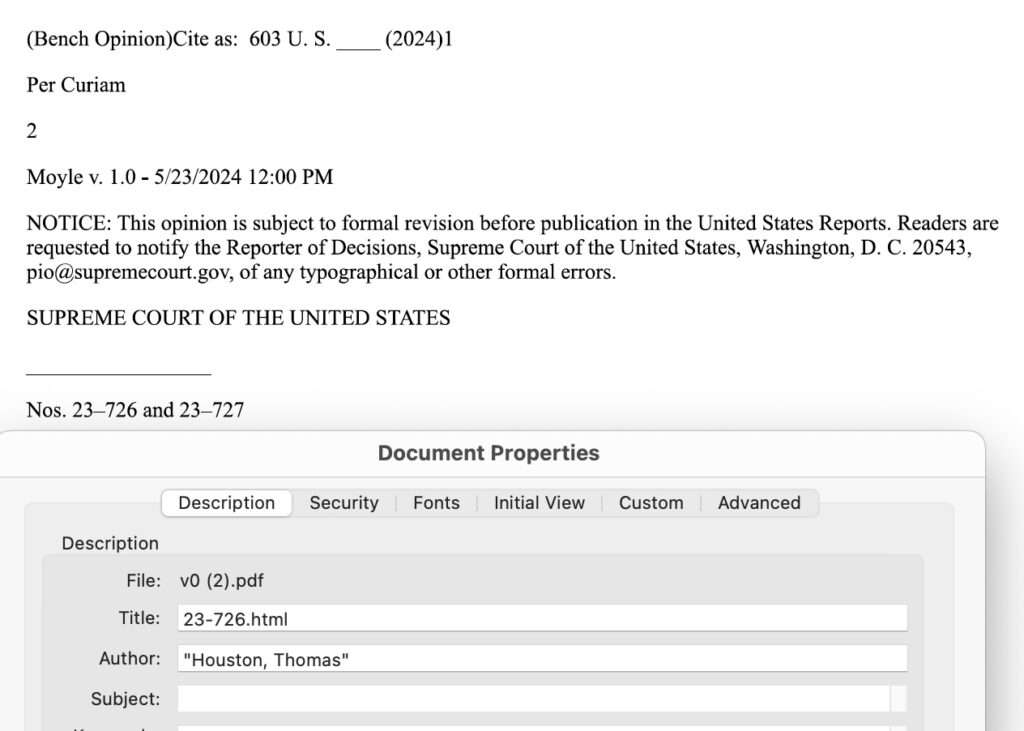
It is not formatted as a Supreme Court opinion would be formatted.

The Metadata says the author is "Thomas Houston." There is a notation at the top that says Moyle v. 1.0 5/23/2024 12:00 PM.

Free Speech

What Does Murthy v. Missouri, Today's Government/Social Media Case, Tell Us About First Amendment Law?

Very little.

|

Say you think the government is pressuring bookstores to take your book off their shelves. You want to get an injunction ordering the government to stop doing that. You acknowledge that the bookstores didn't violate the First Amendment, because the First Amendment doesn't bind the bookstores themselves. But you're arguing that the government violated the First Amendment by pressuring bookstores this way.

To get the injunction, you'd generally need to show four things (to oversimplify somewhat):

  1. Traceability of past injuries: The bookstores have in the past taken your books off the shelves because of government pressure and not just because they concluded on their own that they didn't want to carry the books after all.
  2. Substantial risk of future injury: The government is likely to act in a way that injures you in the future (since you're seeking an injunction against future action).
  3. Redressability: Issuing the injunction in this case is likely to prevent the harm, because the bookstores—freed from the government pressure—are likely to keep your books on the shelves.
  4. Merits: The governmental pressure indeed violates the First Amendment, for instance because it coerces the bookstores rather than just persuading them.

Read More

The Two Edges of Tradition: "Adverse Possession" and "Use It Or Lose It"

If the government exercises a power it lacks for a long time, it can keep exercising that power. But if a government does not exercise a power it has, it loses that power.

|

From an originalist perspective, NLRB v. Noel Canning was one of the worst separation of powers decisions in recent memory. The text of the Recess Appointments Clause clearly refers to "the recess of the Senate"--a single break between sessions. But Justice Breyer's majority opinion found that text "ambiguous," and then relied on historical practice--what we might now call "tradition"--to find that intrasession recess appointments were permissible. In short, many Presidents had made these types of appointments, and Congress had not meaningfully object to this practice, therefore the practice is constitutional.

Justice Scalia wrote a concurrence, which really read more like a dissent. He accused Justice Breyer of misreading the historical record, as intrasession recess appointments were the subject "of a long simmering interbranch conflict." But Scalia further criticized Breyer's methodology as akin to "adverse possession." That is, if the executive branch continuously exercises some power that it lacks, it can keep exercising that power.

As someone who teaches both Property and ConLaw, Scalia's argument about adverse possession has always resonated with me: if the government acts unlawfully for a long time, why should it be rewarded by being able to keep acting unlawfully? We tolerate squatter rights in the land use context, in part, to conclusively settle disputes and put property to the highest use. But the Constitution is not an abandoned lot or a fallow farm.

There is a flip-side to the "adverse possession" theory of the separation of powers. Justice Barrett articulated it in her Rahimi concurrence. She rejected a theory of originalism that "assumes that founding-era legislatures maximally exercised their power to regulate, thereby adopting a 'use it or lose it' view of legislative authority." Such a theory assumes that if some government did not exercise a power, that is evidence that the government lacks such a power, and future courts can prevent the government from exercising that power. It could also be that the government simply exercised discretion, and chose not to use that power. Barrett limited her point here to founding-era legislatures, but I think that dynamic would extend to post-enactment tradition.

Let's use an easy, and familiar example. In the 1860s, some states regulated abortions. (There were tiresome debates about how to count those states, which I'll table for now). Dobbs found that the fact that some states regulated abortion is proof that abortion was not considered a fundamental right when the 14th Amendment was ratified. I think that argument is correct as far as it goes. But imagine a counterfactual. Let's say states did not regulate abortion at the time. Perhaps they did not have much evidence that there was a problem with abortion, or perhaps the legislature chose to focus on other items. Would that lack of regulation suggest that states in fact did not have the power to prohibit abortions? Is this some sort of use-it-or-lose-it power? Would the lack of regulation in fact suggestion that abortion was a fundamental right? Wouldn't the better answer simply look to whether "abortion" was considered "liberty," or discussed as a right, when the Fourteenth Amendment was ratified? Why work backwards from laws that were, or were not passed?

I realize Glucksberg asks for a tradition of regulation to define rights. That is not an originalist framework. But I think it is also not originalist to look to a tradition to non-regulation to define government power. So much turns on gleaning unstated intentions from unenacted legislation by long-dead legislators. How is any of this originalism?

I see the "adverse possession" and "use it or lose it" theories as two edges of traditionalism. If the government exercises a power it lacks for a long time, it can keep exercising that power. But if a government does not exercise a power it has, it loses that power.

I still need to chew this through. Again, Justice Barrett's short concurrence raised a lot of food for thought.

Some Commentary From The Left On Rahimi

I find myself in agreement with Mike Dorf and Linda Greenhouse.

|

I received a message last night that I did not know how to answer. Has there ever been a Supreme Court decision with a lopsided majority who insisted that it was simply reaffirming precedent, when in fact it was rewriting precedent. Sure, this happens all the time in 5-4 or (now) 6-3 cases, where the Roberts Court pretends to follow some decision when in fact it narrows or broadens it. But has there been such an 8-1 decision? I could not think of a case. [Update: A colleague flagged Groff v. DeJoy, which pretended to uphold TWA v. Hardison, when it in fact rewrote five decades of precedent.[

I think everyone realizes that the Court reinterpreted Bruen. Look no further than Linda Greenhouse's new column:

This was a misunderstanding of Bruen, Chief Justice Roberts insisted. The court had not meant to suggest "a law trapped in amber" but simply whether "the challenged regulation is consistent with the principles that underpin our regulatory tradition."

This was news to Justice Thomas, who objected that "not a single historical regulation justifies the statute at issue."

Chief Justice Roberts, for his part, found two, both imported into the United States from English common law. One required those found likely to "break the peace" by abusing a spouse or misusing firearms to post a bond or face jail. The other could disarm those who used weapons to "terrify the good people of the land."

"Since the founding," the chief justice said, "our nation's firearm laws have included provisions preventing individuals who threaten physical harm to others from misusing firearms." The law at issue in the case, he concluded, "fits comfortably within this tradition" and was "what common sense suggests."

There is quite a difference between a principle that "fits comfortably" on the one hand and an analogous regulation that has to be a near-perfect match on the other. Which requirement describes the real Bruen, a decision that the chief justice and four members of his 2024 majority had signed only two years ago? It's tempting to conclude that these justices wanted to reinterpret Bruen while not expressly disavowing it.

I agree fully with Greenhouse--not a sentence I write often. I welcome others to prove me wrong, but I doubt anyone will bother. The Court reached the "right" result so they'll let things sit. I regret all the scholarship on Bruen that was published in the last two years that has since been rendered obsolete.

Greenhouse also suggests that Justice Gorsuch "seemed particularly uneasy" and that Justice Barrett vigorously disagree with Kavanaugh's exposition on tradition.

I also found myself in agreement with parts of a post from Mike Dorf on the Kavanaugh concurrence:

I confess that before writing my post Friday or proofreading Prof Segall's post for Monday, I hadn't read Justice Kavanaugh's concurrence in full. I skimmed it and concluded it was a little law review article defending originalism against straw man arguments.

Reading the whole concurrence, as I had to in order to edit Rahimi down for the annual supplement to my casebook, confirmed my initial impression. For example, Justice Kavanaugh writes: "Some say that courts should determine exceptions to broadly worded individual rights . . . by looking to policy. Uphold a law if it is a good idea; strike it down if it is not." That's ridiculous. Nobody says uphold a law if it is a good idea or strike it down if it's a bad idea. Thus, my impression was correct. Justice Kavanaugh takes aim at a straw man. . . .

The entirety of Justice Kavanaugh's concurrence is a self-indulgent exercise the point of which appears to be to get himself quoted in books and articles about constitutional interpretation.

Dorf also suggests that Kavanaugh misread some caselaw concerning scrutiny.

T-minus six minutes to go till new opinions. Stay tuned.

The Three Trump Appointees In Rahimi

Justices Gorsuch, Kavanaugh, and Barrett are fracturing over originalism.

|

I have spent some time thinking about how the three Trump appointees differ. In Rahimi, Justices Gorsuch, Kavanaugh, and Barrett each wrote concurring opinions. And they are not on the same page. I'm not even sure they're reading from the same book. Rahimi  provides another opportunity to consider how the troika approaches originalism.

Justice Gorsuch

I'm still uncertain what to make of Justice Gorsuch's dissent. I see some pangs of guilt for not joining Justice Thomas's dissent. He writes:

I appreciate that one of our colleagues sees things differently. Post, at 6–7 (THOMAS, J., dissenting). But if reasonable minds can disagree whether § 922(g)(8) is analogous to past practices originally understood to fall outside the Second Amendment''s scope, we at least agree that is the only proper question a court may ask.

Even if Gorsuch is not persuaded by Roberts's historical examples in all regards, Gorsuch seems convinced that this particular facial challenge cannot succeed.

And, at least in some cases, the statute before us works in the same way and does so for the same reasons [as the surety laws]: It permits a court to disarm a person only if, after notice and hearing, it finds that he "represents a credible threat to the physical safety" of others.

The facial challenge analysis is key to Gorsuch's vote. The opening paragraph of the Gorsuch's concurrence focuses on United States v. Salerno:

Mr. Rahimi pursues the "most difficult challenge to mount successfully": a facial challenge. United States v. Salerno, 481 U. S. 739, 745 (1987). He contends that 18 U.S.C. § 922(g)(8) violates the Second Amendment "in all its applications." Bucklew v. Precythe, 587 U. S. 119, 138 (2019). To prevail, he must show "no set of circumstances" exists in which that law can be applied without violating the Second Amendment. Salerno, 481 U. S., at 745. I agree with the Court that he has failed to make that showing. Ante, at 8.

Salerno is the case that judges cite when they do not want to declare a law unconstitutional. See Judge Sutton's opinion in the Obamacare litigation. Rahimi's merits brief didn't even cite Salerno. And the SG cited it once in her reply brief. During oral argument, Rahimi's lawyer said Salerno was not relevant. Instead, this case mirrored the facial challenge in United States v. Lopez. I think the Salerno dodge helped Roberts button up the eight-member majority. He is very good at what he does.

Justice Gorsuch tries to mediate some synergy between the three concurrences:

If changes are to be made to the Constitution's directions, they must be made by the American people. Nor is there anything remotely unusual about any of this. Routinely, litigants and courts alike must consult history when seeking to discern the meaning and scope of a constitutional provision. See post, at 6–16 (KAVANAUGH, J., concurring) (offering examples). And when doing so, litigants and courts "must exercise care." See post, at 3, n. (BARRETT, J., concurring)

But I think that Justices Gorsuch, Kavanaugh, and Barrett are quite far apart.

Gorsuch concludes:

Among all the opinions issued in this case, its central messages should not be lost. The Court reinforces the focus on text, history, and tradition, following exactly the path we described in Bruen.

Far from it. The Court rewrites Bruen, which apparently had a two-year expiration date.

Read More

Free Speech

New California Precedent on Anti-Harassment Orders and Public Speech About People

|

I was glad to see that the California Court of Appeal published its opinion in Luo v. Volokh, following a request by the First Amendment Coalition. (In California, any person or organization may ask a court to publish an opinion that was initially released as nonpublished.) The opinion thus becomes precedent in California, and might prove helpful in cases such as Adams v. Gulley, the case discussed in the "California Judge Orders Removal of Reddit Criticism of Scientist/Consultant Who Publicly Criticized English Lucy Letby Murder Trial" post.

Here again is the key reasoning in the newly published opinion:

Appellant Xingfei Luo, also known as Olivia Luo, twice sought a restraining order against respondent Professor Eugene Volokh pursuant to Code of Civil Procedure section 527.6. Luo sought to prevent Volokh from identifying her in his writings….

[Cal. Code Civ. Proc.] Section 527.6 provides an expedited procedure to prevent harassment. By definition, harassment must have "'no legitimate purpose.'" "Legitimacy of purpose negates harassment." Constitutionally protected activity also is excluded from the definition of harassment….

Section 527.6 defines harassment as "unlawful violence, a credible threat of violence, or a knowing and willful course of conduct directed at a specific person that seriously alarms, annoys, or harasses the person, and that serves no legitimate purpose. The course of conduct must be that which would cause a reasonable person to suffer substantial emotional distress, and must actually cause substantial emotional distress to the petitioner." A course of conduct is defined as "a pattern of conduct composed of a series of acts over a period of time, however short, evidencing a continuity of purpose, including following or stalking an individual, making harassing telephone calls to an individual, or sending harassing correspondence to an individual by any means, including, but not limited to, the use of public or private mails, interoffice mail, facsimile, or email."

{Luo described the parties' relationship as follows: "Volokh has learned my info through litigation." Luo stated, "Volokh has published my info online and invited ha[t]ers to stalk, harass, threaten and commit violence against me. I continue to receive threatening and harassing phone calls and voice mails calling me cunt, slut, lying on men and indicating they will rape and kill me. At the end of July, I was forced to move out of my prior residence for safety concern."

Luo requested the trial court order Volokh to "[1] Remove any remarks, comments, or references from any publicly available documents or articles authored by [Volokh] that connect [her] real name with rape or sexual assault; [2] Remove any remarks, comments, or references from any publicly available documents or articles authored by [Volokh] that connect [her] with the cases in which she has received a protective order to proceed under a pseudonym; [3] Cease publishing any remarks, comments, or references that connect [her] with rape or sexual assault; [4] Cease drawing public attention to [her] name [when] associated with rape or sexual[ ] assault."

Read More

Free Speech

If Pseudonyms, Then What Kind? How About "Doe WHBE 3"?

Should pseudonymous litigants, and any precedents set in their cases, be known by the initials of the law firms that represent them?

|

One problem with pseudonymous litigation is the proliferation of Doe v. cases against the same institutional defendant; the cases, and the precedents they set, can easily be confused with each other because they have the same name. In If Pseudonyms, Then What Kind?, published last year in Judicature (an academic law journal aimed at judges), I discussed various possible solutions, but I've just come across a new twist, from Doe WHBE 3 v. Uber Technologies, Inc.:

As plaintiffs' opening brief explains: "Because so many Jane Doe plaintiffs filed actions against Uber, they assumed additional pseudonyms utilizing the initials of the law firms representing them." Jane Doe WHBE 3 was "the third [case] in which the plaintiff was represented by Williams, Hart, Boundas and Easterby, LLP (now Williams, Hart & Boundas, LLP) (SF Super Ct. No. CGC-20-584649)."

I'm not wild about that: I tend to agree with courts that have concluded that the use of initials can be subtly "depersonalizing" or "dehumanizing," see the cases cited in nn.23 & 24, and this seems even more so with regard to these sorts of alphanumeric combinations.

Indeed, identifying a person through the initials of their lawyer seems especially awkward, though maybe that's just my own idiosyncratic reaction. (As the article notes, there have been other such alphanumeric pseudonyms before, though not quite with the same pattern.) My recommendation in the article is to follow the EEOC model of using an arbitrary first name followed by an arbitrary initial, e.g., "Angela M." Still, I thought I'd flag this alternative that is apparently being heavily used in this particular large batch of pseudonymous cases.

Is "Law Trapped In Amber"?

Lesson for Chief Justice Roberts from Jurassic Park.

|

I first watched Jurassic Park when I was a few months shy of my ninth birthday. It was a formative experience for my youth. Three decades later, the blockbuster still holds up. I recently watched it with a performance by the Houston Symphony. Still brings the house down.

The premise of the movie is that scientists extracted dinosaur DNA from mosquitos who were trapped in amber. But the DNA found in the mosquitos was incomplete. There would be "massive sequence gaps," as Dr. Ian Malcolm told us. Instead, the scientists had to complete the genetic code with DNA from frogs. While all the dinosaurs in Jurassic Park were bred to be female, frogs had the power to change their sex. As a result, the dinosaurs were able to breed. And the rest is history.

I thought of Jurassic Park when I read what will likely be the most quoted sentence in Chief Justice Roberts's Rahimi majority opinion:

Nevertheless, some courts have misunderstood the methodology of our recent Second Amendment cases. These precedents were not meant to suggest a law trapped in amber.

Roberts no doubt made this line up, but may have been thinking of Jurassic Park.

Justice Sotomayor quotes the line in her concurrence:

Thankfully, the Court rejects that rigid approach to the historical inquiry. As the Court puts it today, Bruen was "not meant to suggest a law trapped in amber."

As does Justice Jackson:

The Court today expounds on the history-and-tradition inquiry that Bruen requires. . . . Ante, at 7–8. We emphasize that the Second Amendment is "not … a law trapped in amber."

Justice Barrett also embraces the line:

To be consistent with historical limits, a challenged regulation need not be an updated model of a historical counterpart. Besides, imposing a test that demands overly specific analogues has serious problems. To name two: It forces 21st-century regulations to follow late-18th-century policy choices, giving us "a law trapped in amber."

Justice Gorsuch's concurrence seems content to be bound by amber, but doesn't think there is amber here:

We have no authority to question that judgment. As judges charged with respecting the people's directions in the Constitution—directions that are "trapped in amber," see ante, at 7—our only lawful role is to apply them in the cases that come before us. Developments in the world may change, facts on the ground may evolve, and new laws may invite new challenges, but the Constitution the people adopted remains our enduring guide.

"Trapped in amber" is sort of like "judges are umpires." A quotable platitude that masks difficult jurisprudential decisions. This line will be used to give countless judges cover to break free from history.

In a way, what Chief Justice Roberts did in Rahimi is akin to what the scientists did in Jurassic Park. He extracted an incomplete historical record from long ago, merged it with some modern-day know-how to fill the gaps, and created some new creation that people want to see. Mosquitos are not trapped in amber anymore than surety laws are stuck in amber. What the Court did here is not originalism. It is recreationism. We're left with the Second Amendment merged with some frog DNA. Welcome to Jurassic Park.

NFIB and Rahimi: Is a surety a mandate to prevent dangerous people from possessing a gun or a tax on dangerous gun owners?

Trying to reconcile Chief Justice Roberts on the ACA and 922(g)(8).

|

Chief Justice Roberts's greatest gift is to make a complicated case look simple--so simple, that the answer he reaches seems like the only plausible outcome. In less than 18 pages, Roberts purports to reaffirm Bruen while actually diluting the precedent. Now, the lower courts can uphold any gun control law that is "is consistent with the principles that underpin our regulatory tradition." If you read it quickly, you won't even realize what he's done. But this majority opinion in Rahimi is yet another masterclass in misdirection.

What is the leading "principle" that underpins the tradition for 922(g)(8)? Surety laws. As I was reading through the Chief's opinion, I could not stop thinking about the Obamacare cases. My NFIB PTSD was recently triggered by Moore, and Rahimi dragged me back in.

What is the connection, you may ask? Society has long determined that certain conduct is bad. There are several ways to deal with misconduct. First, after the person engages in misconduct, he can be punished. This is the criminal justice system. Second, if the person is likely to engage in misconduct, he can be subjected to some sort of prospective injunction to bar him from engaging in that misconduct. Think of the domestic violence restraining order at issue in Rahimi.  Third, a person can choose to prospectively pay some sort money that will allow them to engage in that misconduct.

Wait a minute, you might ask. Number three is not an option! Yes, it is. Look no further than the Affordable Care Act. Congress determined that going uninsured was a bad thing. To address that problem, Congress mandated that people purchase health insurance. But Congress allowed people to go uninsured by paying a penalty--or is it a tax? Doesn't really matter for present purposes. In some cases, the government may determine that the money generated by the fee can be used to address the underlying problem. Better that uninsured people pay a penalty than to throw them in jail, right? If you want another example, think of Jacobson v. Massachusetts. People who were unvaccinated could choose to pay a nominal fine. Once they paid that fine, they were free to mingle in society, without being vaccinated.

There is also a fourth way to deal with misconduct: the surety system. Long before there were law enforcement agencies, society developed a system to ensure bad conduct does not occur. In short, people who were at risk of engaging in misconduct could submit a payment to the court--known as a surety. If they behaved for a prescribed period of time, they would get their surety back. If they engaged in that misconduct, they would surrender the surrety. Thus, there was a financial incentive to behave.

Chief Justice Roberts explained that surety laws were invoked to prevent domestic violence. For example, a wife could demand a surety against an abusive husband. From this practice, Roberts finds support for Section 922(g)(8). But does it?

After posting a surety, a suspect domestic abuser can freely possess a firearm. But under 922(g)(8), a suspected domestic abuser cannot possess a firearm. Justice Thomas's dissent explains why this historical precedent provides no support at all for 922(g)(8). And this analogue brings us back to NFIB. Is the surety closer to a mandate, coupled with a penalty? Or is a surety closer to a tax on going uninsured? I think the answer is the latter.

A better analogue would be a system where a person who may pose a risk to others posts some sort of financial bond; the failure to post that bond would result in incarceration; and engaging in misconduct would also result in posting that bond. I think all would agree that Mr. Rahimi belongs behind bars, but if he is left on the street, there is no historical analogue that supports disarming him. Perhaps there is a "principle," but that exception will soon swallow the entire rule.

We will see what the Court does. The SG asked the Court to grant plenary review in Range and other pending Second Amendment cases. Or the Court may GVR everything to let the lower courts wallow in confusion for a few more years.

Supreme Court

Supreme Court to Consider State Ban on Gender Dysphoria Treatments for Minors (Updated)

The Court's grant of certiorari is limited to only one of the issues in this litigation.

|

Yesterday the Supreme Court granted certiorari in United States v. Skrmetti, a challenge to Tennessee's SB1, a law prohibiting puberty blockers, cross-sex hormones, and sex-transition surgeries for minors suffering from gender dysphoria. SB1 is one of several state laws recently adopted imposing such limitations on such care for minors, and Skrmetti is one of several cases involving challenges to such laws.

Tennessee's law was initially challenged on both Equal Protection and Due Process grounds. A divided panel of the U.S. Court of Appeals for the Sixth Circuit initially stayed and then reversed a preliminary injunction against the law. In opinions by Chief Judge Sutton, the court concluded that the challengers were unlikely to succeed on either their Equal Protection or Due Process claims.

Both the federal government and individual plaintiffs filed petitions for certiorari in Skrmetti. Yesterday the Court only granted the federal government's petition. One reason might be that the brief filed by the Solicitor General only submitted one issue -- Equal Protection -- to the justices. The SG did not ask the justices to consider the substantive dur process claim that Tennessee's SB1 infringed upon fundamental liberties, such as the right of parents to control the upbringing of and make medical decisions for their children.

The question presented in the SG's brief that was accepted for certiorari reads as follows:

Whether Tennessee Senate Bill 1 (SB1), which prohibits all medical treatments intended to allow "a minor to identify with, or live as, a purported identity inconsistent with the minor's sex" or to treat "purported discomfort or distress from a discordance between the minor's sex and asserted identity," Tenn. Code Ann. § 68-33-103(a)(1), violates the Equal Protection Clause of the Fourteenth Amendment.

The second question presented that was addressed by the Sixth Circuit and included in the petition for certiorari that was not accepted by the Supreme Court reads as follows:

Whether Tennessee's SB1 likely violates the fundamental right of parents to make decisions concerning the medical care of their children guaranteed by the Fourteenth Amendment's Due Process Clause.

While the Supreme Court is not ready to consider whether the Due Process Clause protects parental rights in this case, it will likely have additional opportunities to consider such questions in due course, and potentially in cases that have a different ideological valence.

While some states have imposed limits on various treatments for gender dysphoria for minors, other states have placed limits on conversion therapy. While such laws do not raise the same Equal Protection issues as Tennessee's SB1, they arguably place equivalent limits on parental rights. There are also brewing disputes over whether a parent's willingness to affirm a child's gender identity should be considered in custody disputes, as would have been required under a California bill vetoed by Gavin Newsom last year.

Whether or not the Court is willing to add a parental rights case to the docket anytime soon, Skrmetti is currently the highest profile case on tap for October Term 2024.

[Note, however, that should Donald Trump win the election, this is a case in which the federal government could change sides, so it will be worth paying attention to the briefing schedule and when this case is scheduled for argument. On this point, see Josh Blackman's post.]

UPDATE: While the Tennessee law in question prohibits both chemical and surgical treatments, it is important to note that the Solicitor General's brief limits its challenge to the prohibition on the use of hormones and puberty blockers. According to page 9 of the Solicitor General's brief: "The law also prohibits surgical procedures provided for the same purposes, but that prohibition is not at issue here."

The reason the SG claims the case is so proscribed is that the lower courts concluded that the private plaintiffs lacked standing to challenge the prohibition on gender-transition surgeries because none had plans to obtain or provide such surgeries in violation of the law.

Of course, if the SG is correct that the law imposes a sex-based classification that triggers heightened scrutiny, this conclusion would apply across the board. The question then would be whether, if the SG is correct that the prohibition on the use of hormones and puberty blockers fails heightened scrutiny, whether that would necessarily doom the prohibition on surgeries as well. Does the state have a stronger interest in limiting such surgeries for minors than it does for limiting puberty blockers? And is the prohibition on surgeries most closely related to the state's interests? And while this question may not be part of the case at it reaches the Court for review, I would not be at all surprised were the SG asked these questions at oral argument.

Free Speech

Plaintiff Accused of Being "Litigious" Sues for Slander

He loses.

|

From Dever v. Dugan, decided by a panel of the Vermont Supreme Court (Harold E. Eaton, Jr., Karen R. Carroll & Nancy J. Waples) on June 12:

Plaintiff was performing work at Amy's Bakery in Brattleboro…. Dugan owned the property where the business was located.

Plaintiff alleged in his complaint that Dugan stated "that, as owner of [the] property, he had the right to approve or refuse, anyone doing work in or on his building," and "he would not allow [plaintiff] to work in his building" because "[plaintiff] had sued people for whom he had worked in the past," and "there was a good chance" that plaintiff would sue them and "he didn't want to take that chance." According to plaintiff, Dugan told Comerchero [who owned Amy's Bakery] that if she did not terminate plaintiff immediately, he would evict her.

Plaintiff also alleged that Dugan gave Comerchero a list of cases that plaintiff had been involved in for use in a breach-of-contract case that plaintiff brought against her. While plaintiff referred to this list of cases as "malicious defamation," there was no allegation that plaintiff was not in fact involved in these suits.

The trial court rejected Dever's slander claim:

Read More

More



