The Volokh Conspiracy

Mostly law professors | Sometimes contrarian | Often libertarian | Always independent | Est. 2002

The Volokh Conspiracy

Politics

Kamala Harris Failed The California Bar On Her First Try

In July 1989, UC Hastings Had A 81.4% Pass Rate.

|

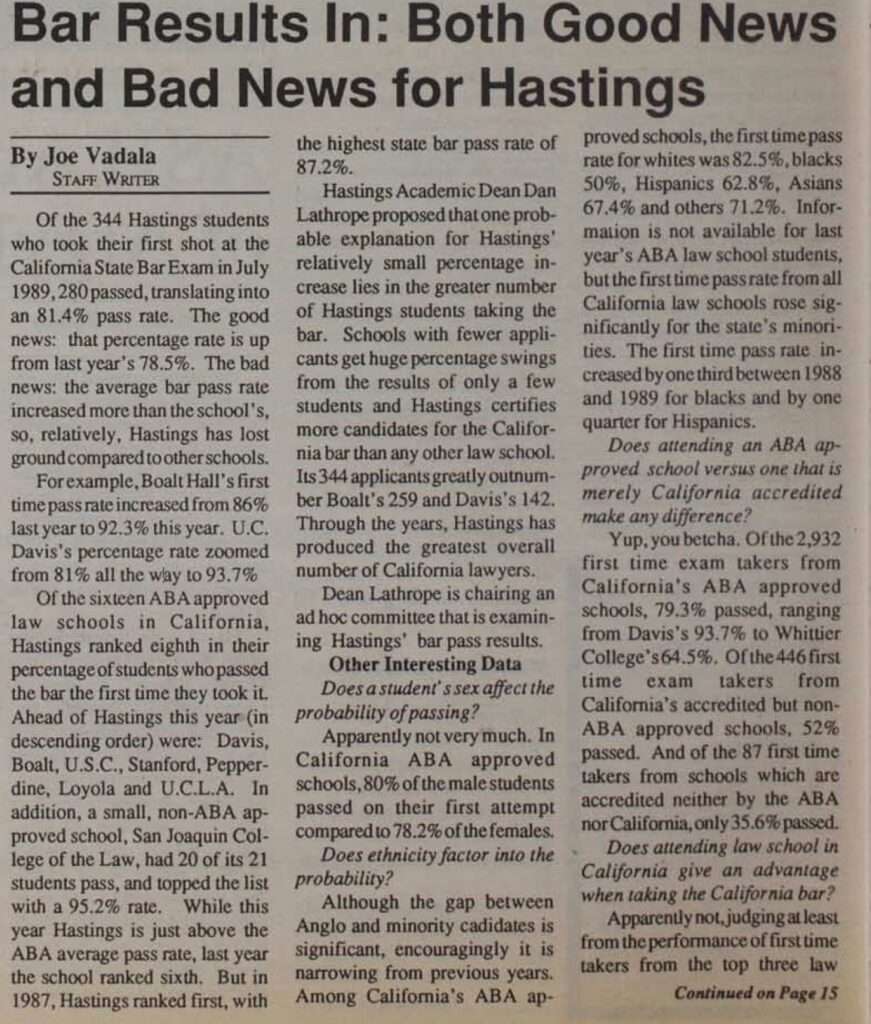
Vice President Kamala Harris graduated from UC Hastings Law School in 1989, and sat for the July 1989 California Bar. She did not pass on her first try. (Brett Stephens flagged this issue in his column.) According to Politico, Harris spent her 2L summer at the San Francisco District Attorney's Office, which offered her a job as a deputy DA after she passed the bar. Harris was admitted one year later in June 1990.

In July 1989, the pass rate for Hastings was 81.4%. The Hastings Law News had this report.

Harris is in good company with other famous people who failed the bar.

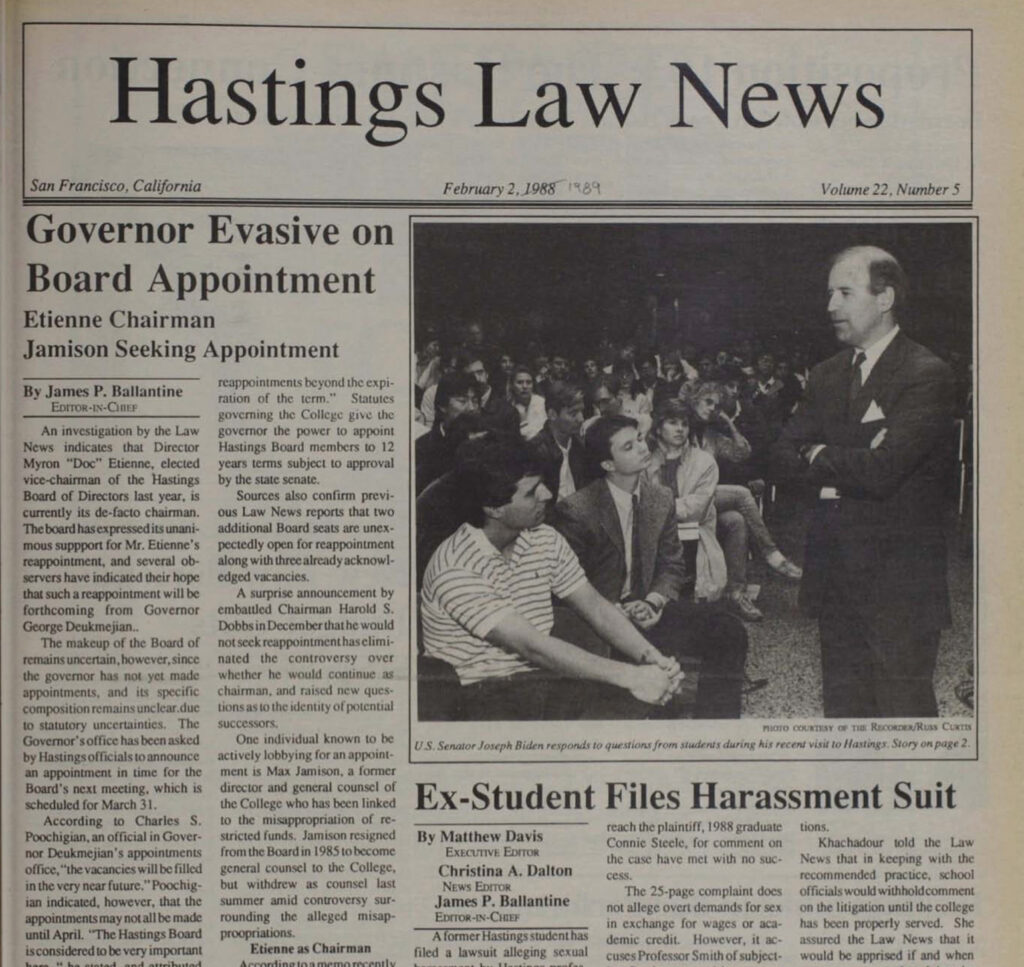
And in a coincidence, then-Senator Biden spoke at Hastings in February 1989 during Harris's 3L year.

Kamala Harris

Kamala Harris's Unduly Narrow View of Bodily Autonomy

She rightly backs "my body, my choice" on abortion, but goes against it on many other issues.

|

Vice President Kamala Harris at a campaign rally in Wisconsin
Vice President Kamala Harris. (Mark Hertzberg/Zuma Press/Newscom)


Vice President Kamala Harris, President Biden's likely replacement on the Democratic ticket, is known for her advocacy of abortion rights. I think she's largely right on that issue. But she - and many others - overlook the reality that bodily autonomy rationales for abortion rights also justify abolishing a wide range of other restrictions on people's rights to control their bodies. If you really believe in the principle of "My Body, My Choice," the implications go far beyond this one issue. Washington Post columnist Monica Hesse recently highlighted an episode from Harris's career that illustrates the problem:

Listen, nearly everything you need to know about the presidential candidacy of Kamala Harris can be summed up by 19 words she uttered at the 2018 confirmation hearings of Supreme Court Justice Brett M. Kavanaugh.

Harris, then a senator from California serving on the Judicial Committee, had used up several minutes trying to pin down Kavanaugh's opinion on Roe v. Wade. Like nearly every senator on the topic, she was mostly unsuccessful….

Finally, in a cool and deliciously patient voice, Harris changed tactics:

"Can you think of any laws," she asked the nominee, "that give the government the power to make decisions about the male body?"

"Um," Kavanaugh replied, furrowing his brow. "I am happy to answer a more specific question, but — "

"Male versus female," Harris offered, smiling, and when Kavanaugh still expressed confusion, she repeated her 19-word question: "Can you think of any laws that give the government the power to make decisions about the male body?"

Kavanaugh responded, "I am not thinking of any right now."

Kavanaugh got caught flat-footed here, thereby enabling Harris to score a rhetorical point. But it's not hard to think of a wide range of laws that "give the government the power to make decisions about the male body." Some of them impose constraints whose consequences are even more severe than those of abortion restrictions. I listed some of them here, noting the implications of "my body, my choice" for these policies:

1. Organ markets should be legalized. People should be free to sell kidneys, for example (subject, perhaps, to informed consent requirements).  If someone wants to sell a kidney, the response to prohibitionists should be: "you can't tell her what to do with her goddamn body, ever." Your kidney is part of your body, and the decision to sell should be your choice. As an extra bonus, legalizing such sales would save many thousands of lives.

2. Laws against prostitution should be abolished. They most definitely restrict people's freedom to control their own bodies (both prostitutes and their customers). The prostitute's body belongs to her, and using it for prostitution is her choice. Prostitution bans also restrict the bodily autonomy of customers. Thus, we should reject laws that punish them, while letting the prostitutes themselves go free. The "johns" own their own bodies no less than the prostitutes do. The kind of consensual sex you engage in with your body should be your choice.

3. The War on Drugs should be abolished. All of it. Not just the ban on marijuana. Its whole purpose is to restrict what sorts of substances you can put in your body. What you put in your body should be your choice. And, like the ban on organ sales, the War on Drugs harms large numbers of people, both in the US and abroad, in countries like the Phillippines and Mexico.

4. The government should not try to control people's diets through "sin taxes," or  restrictions on the size of sodas, and other such regulations. Here too, the goal is to restrict what we put in our bodies. If that leads to increased government spending on health care, the right solution is to restrict the subsidies, not bodily autonomy.

5. Draft registration, mandatory jury service, and all other forms of mandatory service should be abolished (if already in force) or taken off the political agenda (if merely proposed). All such policies literally expropriate people's bodies. What work you do with your body should be your choice.

6. We should legalize and use challenge trials for testing new vaccines against deadly diseases. The resulting earlier authorization of Covid-19 vaccines might have saved many thousands of lives. And it could save many more if we permit the use of challenge trials in the future….

8. People should be allowed to take experimental medical treatments not approved by government regulators. That's especially true if the treatments have a significant chance of saving people from death or serious illness.

With the notable exception of mandatory draft registration (which remains limited to males), these policies all constrain women, as well as men. But they are still severe restraints on bodily autonomy, including that of men. Some of them - especially the bans on organ markets and medical treatments approved by the FDA - literally kill large numbers of people.

Moreover, most of these other issues pose easier cases than abortion, where pro-lifers at least have a plausible argument that restrictions are needed to preserve the lives of innocents who did not consent to the procedure. I largely agree with the pro-choice side of the issue; but the moral status of the fetus makes abortion a comparatively difficult question. By contrast, most other restrictions on bodily autonomy - including the War on Drugs and bans on organ markets - are paternalistic in nature. They invade the bodily autonomy of consenting adults, supposedly for their own good.

Elsewhere, I have explained why efforts to distinguish these other cases are either wrong, would justify abortion bans, as well, or some combination of both. For example, the argument that bodily autonomy can be restricted when payment is involved, or when people enter into transactions in part because of poverty, can also be used to justify a wide range of abortion restrictions.

Yet, with rare exceptions, such as her commendable advocacy of marijuana legalization, Harris supports most of these other policies restricting bodily autonomy. It doesn't seem to bother her that they "give the government the power to make decisions about the…. body." In that respect, she is hardly unusual. Most other mainstream politicians take similar stances.

I am not politically naive. The obvious reason Harris and many other political leaders take contradictory stances on bodily autonomy is that abortion rights enjoy broad popularity, while most other bodily autonomy issues are either less salient, less popular, or some combination of both. Being pro-choice on abortion may well help Harris win over crucial swing-voters. Being pro-choice on organ markets or drugs other than marijuana probably won't. It could well hurt.

Right-wing politicians are also often inconsistent on bodily autonomy issues. They too prioritize political expediency.

I don't expect Harris and most other politicians to adopt a more consistent stance anytime soon. But I hope that calling attention to these contradictions might lead more people to give thought to the broader implications of arguments for bodily autonomy. The government should indeed get out of the business of exercising control over people's bodies. On that, Kamala Harris is more right than she herself is willing to admit.

Immigration

Over 1 Million People Flee Cuba in Just Two Years

That amounts to some 10% of the nation's total population. The surge highlights flaws in both right and left-wing positions on Cuba.

|

A group of Cuban migrants stand in the sun after arriving in the Florida Keys on January 2.
Cuban migrants in Florida (January 2023). (Pedro Portal/TNS/Newscom)


The Miami Herald reports that, in 2022-23, a staggering 1 million people fled Cuba's communist regime, some 10% of the total population:

A stunning 10% of Cuba's population — more than a million people — left the island between 2022 and 2023, the head of the country's national statistics office said during a National Assembly session Friday, the largest migration wave in Cuban history.

The data confirmed reporting by the Miami Herald and Cuban independent media that sounded the alarm over the mass migration of Cubans amid a severe economic downturn and a government crackdown on dissent in recent years.

According to the official figures made public for the first time, Cuba's population went from 11,181,595 on Dec. 31, 2021, to 10,055,968 on December 2023.

The emigration of 1,011,269 Cubans was the main factor contributing to a massive fall in Cuba's population by the end of 2023, when the population stood at a number similar to what it was in 1985, said Juan Carlos Alfonso Fraga, the head of the National Statistics and Information Office.

This is but the latest and largest of multiple surges of emigration from Cuba since the communist dictatorship was established in 1959. Cubans have long fled the horrific poverty and oppression created by the government's policies. The situation highlights flaws in both left and right-wing views on Cuba and migration.

There is a long history of Western leftists praising Cuba's communist government. But if the regime is as wonderful as they claim, why are so many people fleeing it? The regime's Western apologists have no good answer to that obvious question. The government's much-vaunted supposed achievements on improving health care are, in fact, largely a combination of repression and data manipulation.

US conservatives rightly condemn the communist government. But, in recent years, all too many of them have also advocated preventing Cubans fleeing it from coming to the US. For example, twenty red states filed a dubious lawsuit seeking to shut down a program allowing Americans to sponsor migrants fleeing Cuba and two other socialist dictatorships (Venezuela and Nicaragua); the case was eventually dismissed on procedural grounds by a conservative federal judge, and is now on appeal. If Cuban communism is as awful as conservatives (rightly) claim, it is unjust to use force to deny refuge to its victims, thereby consigning them to lives of poverty and oppression.

For its part, the Biden Administration was right to create the CNVH program, allowing Cubans (as well as citizens of three other Latin American nations wracked by violence and oppression) to come to the US if they can get American sponsors. But it should lift the arbitrary caps and other limitations that have limited the program's effectiveness.

In addition to saving people from oppression and poverty, letting more Cubans come to the US can also benefit our economy. Past waves of Cuban immigration have been crucial to the economic development of Florida. Today's Cuban refugees can do the same - if only we let them.

In sum, much of the left would do well to rethink its views of Cuba's communist government. And much of the right should reconsider its approach to Cuban immigration. Communism is a great evil, and for that very reason it is also evil to close the door on those fleeing it.

Immigration

Congressional Budget Office Estimates Recent Increase in Immigration will Reduce the Budget Deficit

A new CBO report concludes it will save the federal government almost $1 trillion over the next ten years.

|

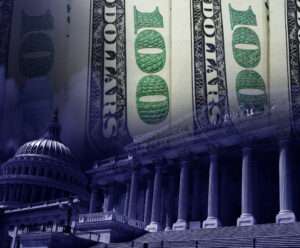
The U.S. Capitol is seen underneath $100 bills
Photo 181642336 © Zimmytws | Dreamstime.com

A standard defense of immigration restrictions advanced by many libertarians and conservatives is the idea that they are necessary to restrict welfare spending. If we let in too many immigrants, spending will increase and the government will either have to massively raise taxes or face a dangerous fiscal crisis. But a new report by the bipartisan Congressional Budget Office adds to the already extensive evidence that immigration actually improves the government's fiscal position. Specifically, the CBO finds that the surge in migration since 2021 will create a net savings of $970 billion for the the federal government between 2024 and 2034. CBO reaches this conclusion partly because most immigrants pay more in taxes than they take out in government benefits, and partly because immigration increases economic growth, which in turn increases tax revenue.

This is far from the first study reaching this sort of conclusion. I discuss some of the others in Chapter 6 of my book Free to Move. My Cato Institute colleague Alex Nowrasteh published a more recent and extensive overview last year. Unlike the CBO study, his analysis considers effects on state and local budgets, as well as the federal one.

Even if the fiscal effects of immigration really were negative, they could be addressed by the "keyhole solution" of further limiting immigrants' access to government benefits, rather than the far crueler and more harmful measure of excluding them entirely. I cover this approach in some detail in my book, and consider various ways it could work.

Improving the federal government's awful balance sheet is far from the only beneficial economic effect of immigration. It also promotes growth, entrepreneurship, and innovation, especially since immigrants make disproportionate contributions on the latter two fronts.

Obviously, fiscal arguments are far from the only possible rationale for constraining immigration. Restrictionists can still argue that we should keep people out because of possible negative effects on culture, crime, and the like. If these other types of harms are large enough, they could potentially outweigh beneficial economic effects. But fiscal issues do play a major role in debates over immigration policy, and they are probably the most common argument advanced by restrictionists who also consider themselves to be free market advocates.

Nondelegation

En Banc Fifth Circuit Concludes FCC's "Universal Service" Fee Is Unconstitutional

A majority of the judges concludes this fee constitutes a tax, the authority for which is improperly delegated.

|

Today, in Consumers' Research v. FCC, the en banc U.S. Court of Appeals for the Fifth Circuit concluded that the so-called "Universal Service" fee imposed by the Federal Communications Commission is unconstitutional. Specifically, by a vote of 9-7, the court concludes that this fee is a tax, the authority for which was delegated to the FCC which, in turn, subdelegated authority to set the tax to a private entity (the Universal Service Administrative Company). Whether or not either of these steps alone would create a constitutional problem under the nondelegation doctrine, the court concluded that the combination of the two delegations is unconstitutional.

Judge Oldham wrote for the court, joined by Judges Jones, Smith, Elrod, Willett, Ho Duncan, Englehardt and Wilson. His opinion begins:

In the Telecommunications Act of 1996, Congress delegated its taxing power to the Federal Communications Commission. FCC then subdelegated the taxing power to a private corporation. That private corporation, in turn, relied on for-profit telecommunications companies to determine how much American citizens would be forced to pay for the "universal service" tax that appears on cell phone bills across the Nation. We hold this misbegotten tax violates Article I, § 1 of the Constitution.

After dispensing with various preliminary matters, Judge Oldham outlines the substantive claim.

Petitioners contend the universal service contribution mechanism violates the Legislative Vesting Clause. See U.S. Const. art. I, § 1 ("All legislative Powers herein granted shall be vested in a Congress of the United States, which shall consist of a Senate and House of Representatives."). We agree. We (A) explain that the power to levy USF "contributions" is the power to tax—a quintessentially legislative power. Then we (B) explain that Congress through 47 U.S.C. § 254 may have delegated legislative power to FCC because it purported to confer upon FCC the power to tax without supplying an intelligible principle to guide FCC's discretion. Next, we (C) explain that FCC may have impermissibly delegated the taxing power to private entities. Finally, we (D) explain that we need not definitively answer either delegation question because even if § 254 contains an intelligible principle, and even if FCC was permitted to enlist private entities to determine how much universal service tax revenue it should raise, the combination of Congress's broad delegation to FCC and FCC's subdelegation to private entities certainly amounts to a constitutional
violation.

And from later in the opinion:

FCC has not delegated to private entities a trivial, fact-gathering role. It has delegated the power to dictate the amount of money that will be exacted from telecommunications carriers (and American consumers in turn) to promote "universal service." In other words, it has delegated the taxing power. And the delegation is not even "to an official or an official body, presumptively disinterested," but rather to private persons vested with no government power and with interests that "often are adverse" to those whom they are taxing. Carter Coal, 298 U.S. at 311; see also Ass'n of Am. Railroads v. U.S. Dep't of Transp. ("Amtrak III"), 821 F.3d 19, 29 (D.C. Cir. 2016) ("Delegating legislative authority to official bodies is inoffensive because we presume those bodies are disinterested, that their loyalties lie with the public good, not their private gain. But here, the majority producers may be and often are adverse to the interests of others in the same business." (citation and quotation omitted)). We accordingly have serious trouble squaring FCC's subdelegation with Article I, § 1 of the Constitution.

Note that this is not a full catalog of the problems here. Judge Oldham continues:

Even if the Constitution does not categorically forbid FCC's delegation to USAC and private telecommunications carriers, 47 U.S.C. § 254 does not authorize it. And there is no precedent establishing that federal agencies may subdelegate powers in the absence of statutory authorization. To the contrary, the only Supreme Court cases blessing private delegations involved explicit statutory authorizations.

And so he summarizes:

Even if the Constitution does not categorically forbid FCC's delegation to USAC and private telecommunications carriers, 47 U.S.C. § 254 does not authorize it. And there is no precedent establishing that federal agencies may subdelegate powers in the absence of statutory authorization. To the contrary, the only Supreme Court cases blessing private delegations involved explicit statutory authorizations. . . .

We are highly skeptical that the contribution factor before us comports with the bar on congressional delegations of legislative power. And we are similarly skeptical that it comports with the general rule that private entities may not wield governmental power, especially not without express and unambiguous congressional authorization. But we need not resolve either question in this case. That is because the combination of Congress's sweeping delegation to FCC and FCC's unauthorized subdelegation to USAC violates the Legislative Vesting Clause in Article I, § 1.

And he concludes:

American telecommunications consumers are subject to a multibillion-dollar tax nobody voted for. The size of that tax is de facto determined by a trade group staffed by industry insiders with no semblance of accountability to the public. And the trade group in turn relies on projections made by its private, for-profit constituent companies, all of which stand to profit from every single tax increase. This combination of delegations, subdelegations, and obfuscations of the USF Tax mechanism offends Article I, § 1 of the Constitution.

Judge Elrod wrote a concurring opinion, joined by Judges Ho and Engelhardt, and Judge Ho wrote a concurring opinion for himself.

Judge Stewart wrote the principal dissent, joined by Judges Richman, Southwick, Haynes, Graves, Higginson, and Douglas. It begins:

I dissent because the Universal Service Fund ("USF") is not unconstitutional. Section 254 of the Telecommunications Act of 1996 provides an intelligible principle and the Federal Communications Commission ("FCC") maintains control over the Universal Service Administrative Company ("USAC"), the private entity entrusted to aid its administration of the USF. The majority's exhaustive exegesis about policy, history, and assorted doctrines does not eclipse the consistent holding of three sister circuits that have addressed constitutional challenges to Section 254. All have held it constitutional under the intelligible principle test. The majority has created a split in a sweeping opinion that (1) crafts an amorphous new standard to analyze delegations, (2) overturns—without much fanfare— circuit precedent holding that this program collects administrative fees and not taxes, (3) blurs the distinction between taxes and fees, and (4) rejects established administrative law principles and all evidence to the contrary to create a private nondelegation doctrine violation.

Judge Higginson also wrote a separate dissent, joined by Judges Stewart, Southwick, Graves, and Douglas.

A petition for certiorari will almost certainly be filed by the federal government, and certiorari will very likely be granted.


Free Speech

No Pseudonymity for Plaintiff Professor Who Sued Colleague and University Alleging Rape

|

From Doe v. St Lawrence Univ., decided earlier this month by Magistrate Judge Daniel Stewart (N.D.N.Y.), and just appealed to the District Judge:

In 2022, both Plaintiff and Defendant Moralez were employed as professors at SLU. Plaintiff alleges that on April 12, 2022, she attended an off-campus meeting at Moralez's home to "talk about future courses to be taught by [Plaintiff] in sociology that would be used to also satisfy requisites for a major or minor in Public Health." That night, Plaintiff alleges that Moralez drugged and brutally raped her…. It is unclear whether SLU fired Moralez, but Moralez claims that "[s]ince leaving SLU [he has] been unable to secure a teaching position at any level."

Courts are split on whether plaintiffs alleging rape should be allowed to proceed pseudonymously (see Appendices 2a & 2b of The Law of Pseudonymous Litigation), and the Magistrate Judge acknowledged that "[a]llegations of sexual assault are 'paradigmatic example[s]' of highly sensitive and personal claims and thus favor a plaintiff's use of a pseudonym." But he noted that "allegations of sexual assault, by themselves, are not sufficient to entitle a plaintiff to proceed under a pseudonym," and concluded that pseudonymity shouldn't be allowed here:

Read More

Campus Free Speech

Will Be Talking about Impeachment and Campus Free Speech in DC

Check it out live or online

|

On Thursday, July 25, the American Enterprise Institute will be hosting a conference on the past and future of the impeachment power. Information can be found here. In addition to me, the line-up includes former Senator William Cohen, Judge Robert Sack, Philip Wallach, and Jack Goldsmith, among others.

On Thursday, August 1, Axios will be hosting a conference on campus free speech. Information can be found here. In addition to me, the line-up includes Representative Virginia Foxx and DOE Assistant Secretary Catherine Lhamon.

Both events will be live in DC and streamed on the web.

My new book on campus speech issues is You Can't Teach That! and is now available. Jonathan Rauch says, "Everyone who cares about higher education should read it."

My new book on the impeachment power is available for pre-order and will be published in the fall. Michael McConnell says, "Keith Whittington has done the country a favor."

No Clearly Established Right to Communicate with a Horse

That is, of course, unless the horse is the famous Mr. Ed.

|

In Meyler v. Mayor & City Council of Ocean City, decided last month by Judge James Bredar (D. Md.), police officers came over to Meyler and his friends near a bar at 2 am, because one of the friends was playing music loudly on his car radio.

One of the responding officers, Officer Foreman, was mounted on a police horse named Moose…. [At some point in ther action, as shown on the video], Meyler turns toward Moose and makes some clicking sounds. Moose does not immediately react, but about five seconds later he visibly moves his head and appears to take a step or two in response to the clicking, after having previously been still. Foreman's hands can then be seen briefly pulling on the reins to stop Moose's movement; after that point Moose appears calm and still again, and remains calm for the remainder of the video….

After more conversation among the officer, Meyler, and Meyler's friend, and more clicking by Meyler at the horse, Meyler "was arrested for failure to obey a lawful order and interference with a police animal," though the charges were later dropped. Meyler sued for false arrest, in part on the grounds "that he suffered hand abrasions, numbness, and back pain as a result of being handcuffed." But the court rejected Meyler's claims; here's an excerpt:

Read More

Judiciary

Will an Ohio Judge Lose His Law License?

The Office of Disciplinary Counsel comes for the "censorious" Judge Tim Grendell

|

Longtime VC readers may recall the "censorious thuggery" of Geauga County, Ohio Judge Timothy Grendell. His conduct from the bench has long been controversial, but he nonetheless ran for re-election unopposed in 2020.

When I last blogged about Judge Grendell, it was after reports he threatened to hold a mother in contempt of court for having her child tested for COVID-19 even though the test was ordered by a doctor prior to a hospital admission. In another case, Judge Grendell sent two teenage boys to juvenile detention for the weekend because they refused a court-ordered visit from their estranged father.

Judge Grendell's conduct has attracted notice in Ohio, and he is now subject to disciplinary proceedings. Attorneys with the Ohio Supreme Court's Office of Disciplinary Counsel are seeking to have Judge Grendell's law license suspended. According to the attorneys, Judge Grendell is a "quintessential bully" who has repeatedly "abused his power and abandoned his role as a neutral advocate." From their most recent filling:

Our court has disciplined rogue judges in the past. But this state has never seen a judge inflict pain and suffering on two innocent, young, and vulnerable children, while claiming to have acted in their best interests. Respondent acted in his and Glasier's interests and no one else's. Despite respondent's attempt to complicate this disciplinary matter by insinuating that only he could possibly understand the complexity and application of the juvenile rules, this is a simple case. Respondent is a bully who abused his power, abandoned his role as a neutral advocate, and worked to advance Glasier's and his own interests to the detriment of Hartman and her family.

The above concerns the case in which Judge Grendell had two boys detained for refusing to visit with their estranged father. The complaint also raises concerns about Judge Grendell's handling of other matters and political conduct inappropriate for a sitting judge. All filings are available here.

The initial complaint was filed in November 2022, and there was a hearing before the Ohio Board of Professional Conduct earlier this year. If the Board recommends sanction, it will be reviewed by the Ohio Supreme Court.

Politics

New in the American Spectator: The 11th Circuit Should Reject Jack Smith's Past Political Justifications to Expedite His Latest Appeal

"The Court of Appeals for the Eleventh Circuit has no reason to accommodate politically motivated efforts to convict Trump before the election or inauguration."

|

Seth Barrett Tillman and I published a new essay in the American Spectator concerning Special Counsel Jack Smith's pending appeal to the Eleventh Circuit. We write that Smith's only justification to expedite the appeal is to obtain a conviction before the election, or even before the inauguration. The courts are under no obligation to accommodate Smith's politically motivated efforts.

Here is the introduction:

Special Counsel Jack Smith is on a mission to convict Donald Trump before the election, and if needed, before the inauguration. At every level of the judiciary, Smith has urged federal judges to move at breakneck speed so he can get his man. Now that Judge Aileen Cannon has determined that Smith was unlawfully appointed, Smith is once again racing for another appeal. But there is no good reason for the courts to move more quickly than they usually would. Indeed, moving any faster or slower than normal would suggest that the judges are favoring one side or the other.

Despite all the faux outrage over Judge Cannon's decision, she disqualified only one person from pursuing this case: Jack Smith. Cannon did not grant Trump any immunity for his actions during or after he left office. The United States attorney for the southern district of Florida is fully capable of prosecuting Trump. To be sure, Attorney General Merrick Garland does not want his Justice Department to take the heat for prosecuting his boss's political rival, but that is a political problem for Garland and the administration and not a legal problem for the judiciary. The Court of Appeals for the Eleventh Circuit has no reason to accommodate politically motivated efforts to convict Trump before the election or inauguration. Trump should be treated like any other defendant.

And from the conclusion:

Smith seems to have determined that it is in the best interest of our democracy for voters to know whether Trump is convicted of a federal felony before voting. This is an extremely difficult political judgment that turns on disputed conceptions of what the public ought to know for the sake of democracy. Moreover, seeking to time a trial and conviction in this manner would mark a public and complete break with DOJ principles and policies of prosecutorial neutrality. It is imperative that the case against Trump be tried in the ordinary course of law, in the ordinary way, under an ordinary schedule. This case cannot be tried using newly invented legal rules, by a faux prosecutor, under an expedited schedule serving nakedly political (if not partisan) ends. Then-Attorney General Robert H. Jackson wisely observed that "the most dangerous power of the prosecutor" is "that he will pick people that he thinks he should get, rather than cases that need to be prosecuted." Only by adhering to this course of conduct does the judiciary uphold the rule of law.

I will report back when Smith files a motion to expedite the appeal to the Eleventh Circuit, or whether he seeks certiorari before judgment.

Guns

Is a Parking Structure a Building, When It Comes to Ban on Gun Possession "in Any Publicly Owned Building"?

|

From a South Carolina Attorney General July 9 opinion:

We received your letter requesting an Attorney General's opinion regarding whether section 16-23-420 of the South Carolina Code prohibits a person from carrying a firearm in a publicly owned parking lot or publicly owned parking garage….

Section 16-23-420 provides in relevant part:

… It is unlawful for a person to possess a firearm of any kind on any premises or property owned, operated, or controlled by a private or public school, college, university, technical college, other post-secondary institution, or in any publicly owned building, without the express permission of the authorities in charge of the premises or property. The provisions of this subsection related to any premises or property owned, operated, or controlled by a private or public school, college, university, technical college, or other post-secondary institution, do not apply to when the firearm remains inside an attended or locked motor vehicle and is secured in a closed glove compartment, closed console, closed trunk, or in a closed container secured by an integral fastener and transported in the luggage compartment of the vehicle…..

The opinion concluded (relying on a past opinion that) "any premises or property owned, operated, or controlled by" modifies only "school, college, …," and not "publicly owned building"; because of that, the statute doesn't limit firearm possession in non-school/college buildings' "surrounding premises." It then went on to conclude that parking garages shouldn't count as "building[s]" for purposes of the statute:

Black's Law Dictionary defines a building as "[a] structure with walls and a roof, esp. a permanent structure." We believe it is plain a parking lot would not be considered a building in accordance with its usual and customary meaning….

As to whether a parking garage qualifies as a building as used in section 16-23-420(A), we believe this is a closer question. Black's Law Dictionary does not define the term "parking garage"; however, Merriam-Webster English Dictionary defines a parking garage as "a building in which people usually pay to park their cars, trucks, etc." Despite this definition's use of the word building, we nevertheless believe a court would likely find a parking garage would not be considered a building under this statute because to hold otherwise would lead to a result clearly unintended by the General Assembly.

Read More

Free Speech

The Latest in the Prosecution of eBay Managers for Cyberstalking Online Critics

|

From the Justice Department's Thursday press release:

The former Senior Manager of Special Operations for eBay's Global Security Team was sentenced today in federal court in Boston for his role in a cyberstalking campaign targeting a Massachusetts couple. The defendant and his co-conspirators harassed and intimidated the victims in retaliation for their publication of an industry newsletter that eBay executives viewed as critical of the company.

Brian Gilbert, 56, of San Jose, Calif., was sentenced by U.S. Senior District Court Judge William G. Young to time served, one year of supervised release with the special condition that he have no contact with either of the victims in the case and a $20,000 fine. In October 2020, Gilbert pleaded guilty to conspiracy to commit cyberstalking and conspiracy to tamper with witnesses.

Gilbert is one of seven now-former eBay employees and contractors on the company's security team who were charged and ultimately convicted for their roles in the cyberstalking campaign:

  • Jim Baugh, eBay's former Senior Director of Safety and Security, was sentenced to 57 months in prison in September 2022;
  • David Harville, former Director of Global Resiliency, was sentenced to 24 months in prison in September 2022;
  • Stephanie Popp, former Senior Manager of Global Intelligence, was sentenced to 12 months in prison in October 2022;
  • Philip Cooke, a former Senior Manager of Security Operations, was sentenced to 18 months in prison and 12 months of home confinement in July 2021;
  • Stephanie Stockwell, a former Manager of Global Intelligence, was sentenced to one year in home confinement in October 2022; and
  • Veronica Zea, a contract intelligence analyst, was sentenced to one year in home confinement in November 2022.

Read More

Democracy

Biden's Withdrawal From the Presidential Race Is Not Anti-Democratic

Among other reasons, it's actually supported by a large majority of voters, including most Democrats.

|

NA

There's plenty of room for disagreement over whether President Biden's decision to withdraw from the presidential race is a good development, or not. But one common trope that deserves to be rejected is the idea that his withdrawal somehow undermines democracy. This argument was first deployed by die-hard Biden backers, but has more recently been taken up by Republicans. For example, GOP House Speaker Mike Johnson complains that "[h]aving invalidated the votes of more than 14 million Americans who selected Joe Biden to be the Democrat nominee for president, the self-proclaimed 'party of democracy' has proven exactly the opposite."

I am skeptical that Johnson and other GOP leaders actually care much about the will of Democratic voters. If they did, they would not have supported Trump's efforts to overturn the 2020 election (which, if it had succeeded, would have been a genuine massive affront to democracy). But even aside from the glaring hypocrisy, the argument has little merit.

Start with the obvious point that democracy does not require Biden or any other candidate to stay in the race if he or she concludes he wants to get out - even if the motive for dropping out is that the candidate believes there is no longer much chance of winning. Similarly, democracy doesn't preclude politicians, activists, and other elites from urging a candidate to leave the race, or even from threatening to withdraw their support if the candidate refuses to listen. All of this is itself a part of the democratic process. Subject to a few legal constraints, voters and elites can choose to give or withdraw their support, as they choose. And they can urge a candidate to drop out, if they want to.

If democracy is about following the will of the majority of voters, than Biden's withdrawal clearly qualifies. Survey data indicates a large majority of Americans, including some 65% of Democrats, wanted Biden to drop out, so the Democrats could select a different candidate. It's hard to argue that the democratic prerogatives of primary voters were somehow violated when most of those voters themselves wanted Biden out.

And it's also hard to argue that voter preference was a result of manipulation by elites. If anything,  most voters regarded Biden's age and infirmity as a serious weakness long before most Democratic elites decided it was. Biden's troubling performance in the June 28 was a kind straw that broke the camel's back. Even viewers who don't follow politics closely and pay little attention to the views of elites could see something was wrong. My nine-year-old daughter - who had never previously watched a presidential debate - commented that Biden looked old and "overwhelmed." Was her reaction somehow dictated by nefarious Democratic elites? Pretty obviously not.

Moreover, democracy doesn't require parties to use primaries to select candidates in the first place. Throughout most of American history presidential candidates were selected by party leaders at conventions and in the proverbial "smoke-filled rooms." Democracy came in because those leaders had incentives to select candidates likely to be popular with general election voters. Indeed, one disadvantage of primaries is that they often tend to advantage candidates who cater to the extremes of the party's base, but are less appealing to general election voters, thereby actually being less responsive to the majoritarian preferences of the voting public, as a whole. In that respect, primaries are actually a relatively less democratic way of choosing candidates than selection by party elites would be.

I am no great fan of Kamala Harris (Biden's likely replacement on the Democratic ticket), and she is not the candidate I would have chosen, if it were up to me. But her ascension clearly has the support of a large majority of Democratic voters. Democracy doesn't require the party to choose a candidate I like, and it certainly doesn't require it to choose one the Republicans would prefer to run against.

The fact that Biden's withdrawal wasn't undemocratic does not necessarily mean it was a good thing. I have long emphasized that democratic processes aren't always good, and should be constrained in many ways.  Such constraints are justified by the dangers of voter ignorance, tyranny of the majority, and other pathologies. In this particular case, I happen to agree with the majority of the public in thinking that Biden's withdrawal was, on balance, a good thing. But it would be wildly inconsistent for me to argue I'm right merely because majority public opinion - for once! -  happens to be on my side.

If you're a Democrat who thinks Biden is preferable to Kamala Harris or a Republican who would rather have Biden as an opponent because he would be easier to beat, you have reason to lament his downfall. But you should not condemn it as undemocratic.

In addition to the argument that Biden's withdrawal was undemocratic, there is the closely related -  but much more ridiculous - theory that it was a "coup." I'm not going to argue against this idea at any great length. Those who believe it are probably beyond rational persuasion. I will only say that a real coup involves violence, or at least the threat of it. The January 6, 2021 attack on the Capitol is plausibly described as a coup, though it is more accurate to call it an insurrection. Biden's withdrawal wasn't anything like that. Perhaps he got a raw deal; but a coup it was not.


Politics

Chief Justice Roberts, The Judicial Supremacist in Jarkesy

The Chief Justice wavers on many issues, but never in returning power to the federal judiciary.

|

Jarksey continues a trend by the Chief Justice: the transfer of power from the executive and legislative branches to the judiciary. From Stern v. Marshall to Loper Bright, Chief Justice Roberts rejects effort to deprive the federal courts of its powers to decide cases. Justice Sotomayor makes this point in her dissent:

Beyond the majority's legal errors, its ruling reveals a far more fundamental problem: This Court's repeated failure to appreciate that its decisions can threaten the separation of powers. Here, that threat comes from the Court's mistaken conclusion that Congress cannot assign a certain public-rights matter for initial adjudication to the Executive because it must come only to the Judiciary.

Indeed, Sotomayor pokes Roberts's much-vaunted "umpire" analogy:

The majority today upends longstanding precedent and the established practice of its coequal partners in our tripartite system of Government. Because the Court fails to act as a neutral umpire when it rewrites established rules in the manner it does today, I respectfully dissent.

On many issues, Chief Justice Roberts's jurisprudence is situational, and depends on a a confluence of many factors. But with regard to judicial independence, Roberts is dogmatic. In Jarkesy, Roberts extended this philosophy to the context of the Seventh Amendment. 

Politics

Graduate Students for Academic Freedom v. Graduate Students United at UChicago

|

A few years ago, the graduate students at the University of Chicago, where I teach, formed a legally recognized labor union. Last year, that union expanded to include the law school, at least to the extent that law students engage in paid work such as providing research assistance. Law students who want to work as research assistants must either join the union and pay dues, or else pay agency fees to the union even if they do not join. Either way, giving money to the union is a legally required condition of working as a research assistant.

Graduate Students United at the University of Chicago, the union, engages in political speech that some law students find quite objectionable. The union is part of the United Electrical, Radio and Mine Workers of America, which also engages in political speech. For some law students, having to give money to these causes is an unacceptable condition of employment.

Yesterday, a group of those students, Graduate Students for Academic Freedom, filed a federal lawsuit against the union arguing that the arrangement violates their First Amendment rights under cases like Janus v. AFSCME, which holds that compelled agency fees "violate[] the free speech rights of nonmembers by compelling them to subsidize private speech on matters of substantial public concern."

You can read the complaint here, and the motion for a preliminary injunction here.

From the start of the complaint:

INTRODUCTION

1.  Graduate students at the University of Chicago have been put to the choice of halting their academic pursuits, or funding antisemitism. That is unlawful.

2.  In the Winter of 2023, graduate students at Chicago voted to unionize, and are now exclusively represented by GSU-UE—a local of United Electrical (UE).

3.  That is a real problem. Among much else, UE has a long history of antisemitism. It is an outspoken proponent of the movement to "Boycott, Divest, and Sanction" Israel (BDS)—something so clearly antisemitic that both Joe Biden and Donald Trump have condemned it as such. Indeed, for years, the union has had a consuming fixation with the world's only Jewish state—a fixation peppered with all-too-common rhetoric. UE has charged Israel with "occupying" Palestine; has branded Israel an "apartheid regime"; and has accused Israel of committing "ethnic cleansing."

4.  GSU-UE is cut from the same cloth. On campus, it has not only echoed its parent union's rhetoric, but has added to it. It took pains to publicly "reaffirm" its commitment to BDS just one week after the October 7 terrorist attacks. And it has joined the "UChicago United for Palestine Coalition," which gained notoriety for its protest encampment and hostile takeover of the Institute of Politics. Through it, GSU-UE has joined calls to "honor the martyrs"; fight against campus "Zionists"; resist "pigs" (i.e., police); "liberate" Palestine from the "River to the Sea," and by "any means necessary"; and "bring the intifada home." Jimmy Hoffa's union this is not.

5.  Nonetheless, under a recent collective bargaining agreement extracted by the GSU-UE, graduate students at the University must now either become dues-paying members of the union, or pay it an equivalent "agency fee," as a condition of continuing their work as teaching assistants, research assistants, or similar positions.

6.  Constitutionally speaking, that is not kosher. The union's ability to obtain agency fees from nonconsenting students is the direct product of federal law—i.e., it involves governmental action, subject to the First Amendment. But if GSU-UE wishes to wield such federally backed power, it must accept the responsibility that comes with it; it cannot use a government-backed cudgel, outside constitutional constraint. And if the First Amendment means anything, it means students cannot be compelled to fund a group they find abhorrent as the price of continuing their work.

7.  The stories of Plaintiff's members lay bare the stakes that are at issue here. One member is an Israeli; another a proud Jew with family fighting in Israel; and some are graduate students simply horrified by the union's antisemitism—as
well as its other (to put it mildly) controversial political positions, which reach well beyond collective bargaining to virtually every hot-button subject (e.g., abortion, affirmative action, policing, gender ideology, even the judiciary). Although members come from different backgrounds, none can stomach sending a penny to this union.

8.  But that is the position they find themselves in—put to the choice of funding the union, or stopping their academic work. Some have chosen to opt-out entirely, and have quit pursuing RA work so long as it comes at the cost of their values. Others do not have the luxury. One student is here on a visa from Israel—something, of course, GSU-UE denounces under BDS—and cannot stop his work as a TA if he wants to stay in the country. Another depends on his RA work to help cover cost-of-living expenses, and cannot forgo that income if he wishes to stay at Chicago. Others are deeply torn—tortured as to how to weigh their consciences against their careers.

9.  The First Amendment was adopted to prevent these sorts of choices. Forcing a person to associate with—let alone fund—a particular ideological organization is always a fraught First Amendment endeavor. But the constitutional infirmity here is exceptionally stark. Unlike a garden variety agency fee in the private sector, the agency fees here work as an academic toll on graduate students' ability to pursue expressive activities at the very heart of the First Amendment: Students cannot perform certain teaching or research activities without first paying a kick-back to the union. And to make an intolerable situation worse, that compulsion is especially problematic here, given GSU-UE's decision to adopt a divisive political identity, based on issues well outside the ambit of traditional collective bargaining.

10. What is happening at Chicago is thus as clear an example as it gets of an agency-fee scheme that violates the First Amendment, by the Supreme Court's own lights. An agency fee scheme cannot "force[] men into ideological and political associations which violate their right to freedom of conscience, freedom of association, and freedom of thought." Harris v. Quinn, 573 U.S. 616, 631 (2014). But that is exactly this case. And for that reason, what is happening at Chicago is unlawful, and in violation of the First Amendment's most basic guarantees. It needs to be stopped.

There's much more detail in both documents -- especially concerning the "state action" doctrine, one of the legal issues on which the suit will turn. The plaintiffs are represented by Jon Linas, Brett Shumate, Harry Graver, and Riley Walters at Jones Day.

More