

2/5/1793: Chisholm v. Georgia argued.
The Volokh Conspiracy
Mostly law professors | Sometimes contrarian | Often libertarian | Always independent | Est. 2002
FBI Agents File Class Action Challenging "Retaliatory Firing"
While FBI agents may be at-will employees who can, generally speaking, be fired for "any reason or no reason," they can't be fired for an unconstitutional reason, or as punishment for the exercise of their constitutional rights (e.g. he can't fire all the African-American agents, or all the agents registered as Democrats).
The Complaint, filed in DC District Court, is posted here. Plaintiffs are "employees of the FBI who worked on Jan. 6 and/or Mar-a-Lago cases, and who have been informed that they are likely to be terminated in the very near future for such activity." They "intend to represent a class of at least 6,000 current and former FBI agents and employees who participated in some manner in the investigation and prosecution of crimes and abuses of power by Donald Trump, or by those acting at his behest."
Three Counts of unlawful activity are alleged: (1) Violation of the First Amendment to the Constitution: Retaliation Based on Perceived Political Affiliation; (2) Violation of Plaintiffs' Substantive and Procedural Due Process Rights under the 5th Amendment; and (3) Violation of the Plaintiffs' Fifth Amendment Right to Privacy.
I think they've got a decent case - don't you?
Trump's Tariff Power Grab May not be Over
Yesterday's deals with Canada and Mexico stopped the trade war for now. But Trump may yet return to asserting sweeping authority to impose whatever tariffs he wants.
Yesterday, Trump postponed his plan to impose massive 25% tariffs on imports from Canada and Mexico, as a result of deals in which the two countries largely promised to do things they were already doing, actions that are highly unlikely to curb the fentanyl crisis that Trump used as a pretext for his actions.
But this doesn't necessarily mean that the crisis is over. After all, Trump only postponed the tariffs by 30 days. He hasn't cancelled the plan to impose them entirely. What he does after the thirty day deadline expires remains to be seen. In addition, Trump's tariff ambitions may not be limited to Canada and Mexico. He also threatens to impose them on the European Union and others. Moreover, even just threatening tariffs only to pull back after extorting concessions on other issues, causes real harm, by disrupting the continuity and legal certainty on which trade relationships depend. A key purpose of free trade agreements - like the USMCA deal that Trump himself signed with Canada and Mexico in 2018, only to violate it now - is to establish certainty and forestall opportunistic imposition of trade restrictions.
Thus, we cannot rest easy about this issue. Importers and others should still plan to bring legal action against the imposition of these kinds of tariffs. And they would do well to use the major questions and nondelegation arguments I outlined here. As also noted in my earlier post, opponents should also do everything they can to oppose the tariffs politically, by highlighting the ways in which they will increase prices for Americans.
Court Upholds 15-Year Sentence for Multiple Politically Motivated Arsons of Walmarts
From U.S. v. Olson, decided yesterday by Eleventh Circuit Judge Ed Carnes, joined by Judges Andre Brasher and Charles Wilson:
During a two-week period …, Olson conspired with seven others to set fires in four different Walmart stores. They set the fires during business hours while customers, children, and employees were still inside the stores. The fires caused confusion, chaos, and fear….
In early 2021, Alexander Olson moved to Lillian, Alabama, with his brother, Quinton Olson, and his friend, Michael Bottorff, who became two of his co-conspirators, to live in a house already occupied by his other soon-to-be co-conspirators, Jeffrey Sikes, Erica Sikes, Sean Bottorff, Jenna Bottorff, and Mikayla Scheele. After moving in, Olson became involved in meetings (that sometimes lasted all day) in which the eight co-conspirators planned the Walmart fires.
Jeffrey Sikes was unquestionably the leader of the pack. On the night before the first fire, he instructed co-conspirators Olson, Sean Bottorff, and Mikayla Scheele to pack bags with tactical gear and clothes in preparation for the next day's operation. When that day arrived, Olson, Scheele, and Sikes entered the first Walmart during normal business hours, while Bottorff stayed in the getaway car. Sikes told Olson and Scheele that once the three of them were inside the store, they should disperse, douse store merchandise with lighter fluid, and then set the merchandise on fire. Each one of them, including Olson, lit a fire inside the store. As those three fires broke out and spread, there was "mass chaos" as customers, including young children, and employees scrambled to get out of the store.
The next day, Olson and Scheele set fire to another Walmart in Mobile, Alabama. They followed a similar pattern to the one they had used the day before: they entered the store separately, found each other once inside, and then split up as Scheele set fires. As the two of them left the store, there were "a lot of people outside" as everyone tried to escape the burning store. The alarms were loud, the smoke was thick, people were scared and screaming.
On the way back home from that second fire, the group stopped at a different Walmart so that Olson could buy a cell phone. They planned to use that phone to anonymously send a document entitled "Declaration of War and Demands for the People" to various media outlets.
The "Declaration of War" characterized Walmart's policies and business practices as "a crime against humanity" that "validate[d]" the conspirators' "action of war against them." The document included seven demands that Walmart would have to meet for the fires at its stores to stop:
- Pay its employees $18/hour, regardless of full-time status (Demand 1)
- Pay 100% of each employee's health insurance premium (Demand 2)
- Give new moms six months maternity leave and new dads two months paternity leave (Demand 3)
- Pay its CEO no more than five times as much as its lowest-earning employee (Demand 4)
- Implement a climate plan (Demand 5)
- Supply 900 ready-to-eat meals (900 from each store) to people in need each day (Demand 6)
- Produce half of its goods in the United States within five years (Demand 7)
Harvard Title VI Settlement Chilling Anti-Israel, Anti-Zionist, and Anti-Anti-Zionist Speech
FIRE (Robert Shibley) has a long and detailed analysis of the settlement (announced Jan. 21), which I highly recommend. A few thoughts of my own [UPDATE: I made some corrections below; see the UPDATE at the bottom for more details]:
[1.] The settlement adopts the International Holocaust Remembrance Alliance definition of anti-Semitism, which defines anti-Semitism to include, among other things,
Accusing Jewish citizens of being more loyal to Israel, or to the alleged priorities of Jews worldwide, than to the interests of their own nations.
Denying the Jewish people their right to self-determination, e.g., by claiming that the existence of a State of Israel is a racist endeavor.
Applying double standards by requiring of it a behavior not expected or demanded of any other democratic nation….
Drawing comparisons of contemporary Israeli policy to that of the Nazis.
Much as I disagree with such statements, they are constitutionally protected speech, whether anti-Semitic or not; no serious university should ban them.
[2.] Harvard also adds an express prohibition on anti-Zionist statements, which could be violated by statements such as "using or disseminating tropes, stereotypes, and conspiracies about Zionists (e.g., 'Zionists control the media')." Whether or not such statements are anti-Semitic, they too are constitutionally protected. People must be free to criticize ideologies (whether political, religious, or a mix), even in intemperate and hyperbolic (and unfair) ways.
Note also that Harvard policy now says, "Zionists, anti-Zionists, and non-Zionists are all protected against discriminatory disparate treatment and harassment under the policy." This follows that "using or disseminating tropes, stereotypes, and conspiracies about" anti-Zionists would be forbidden as well.
[3.] Harvard, as a private university, could restrict speech this way on its own without violating the Constitution. But I think federal government pressure aimed at getting such intermediaries to restrict speech does violate the Constitution (see NRA v. Vullo (2024), and also this post by Evelyn Douek & Genevieve Lakier). And the rules adopted in the settlement would indeed violate the First Amendment, as was recognized by this federal court decision that preliminarily enjoined a University of Texas rule that adopted the definition.
Alien Tort Statute Liability for American Publisher Would Turn on Whether It Knew Author It Paid Was Hamas Hostage-Holder
From Judge Tiffany Cartwright (W.D. Wash.) in Friday's Jan v. People Media Project:
Plaintiff Almog Meir Jan is an Israeli citizen who was kidnapped on October 7 and held hostage by Hamas operative Abdallah Aljamal before being rescued by the Israel Defense Forces. Defendants are People Media Project, its individual officers Ramzy Baroud and John Harvey, and unnamed Doe Defendants 1 through 10.
Jan alleges that Defendants employed and compensated Aljamal as a journalist and provided him a U.S.-based platform to publish articles supporting Hamas. Jan asserts that through these actions, Defendants aided and abetted his kidnapping and imprisonment as well as aided and abetted terrorism in violation of the Alien Tort Statute (ATS), 28 U.S.C. § 1350.
Defendants moved to dismiss …, arguing that Jan's allegations are insufficient to state a plausible claim that Defendants aided and abetted his kidnapping and Hamas's acts of terrorism. Defendants also assert that their decision to publish Aljamal's articles is protected by the First Amendment, and that Jan's claims do not overcome the ATS's presumption against extraterritoriality because the conduct relevant to the ATS's focus—kidnapping and imprisoning a civilian hostage—occurred outside the United States. In response, Jan argues that the ATS recognizes aiding and abetting as a cause of action, and that aiding and abetting illegal conduct is not protected speech. By compensating Aljamal and providing him a U.S.-based platform to publish articles justifying Hamas's actions, Jan argues that Defendants materially supported terrorism. Jan asserts that this domestic conduct is the gravamen of his ATS claims and is sufficient to overcome the presumption against extraterritoriality….
The court rejected the claims based on publishing pro-Hamas propaganda, for reasons discussed in a separate post. But here's what the court had to say about the claims based on providing funds to Hamas via Aljamal:
Publishing Pro-Hamas Propaganda Is Protected by First Amendment
From Judge Tiffany Cartwright (W.D. Wash.) in Friday's Jan v. People Media Project:
Plaintiff Almog Meir Jan is an Israeli citizen who was kidnapped on October 7 and held hostage by Hamas operative Abdallah Aljamal before being rescued by the Israel Defense Forces…. Jan alleges that Defendants employed and compensated Aljamal as a journalist and provided him a U.S.-based platform to publish articles supporting Hamas. Jan asserts that through these actions, Defendants aided and abetted his kidnapping and imprisonment as well as aided and abetted terrorism in violation of the Alien Tort Statute (ATS), 28 U.S.C. § 1350.
The court rejected the claims based on payment to Aljamal, for reasons I note in a separate post. But here is the court's explanation for rejecting the claims based on publishing pro-Hamas propaganda:
Jan alleges that by publishing Aljamal's articles, Defendants gave him a "platform to write and disseminate Hamas propaganda," aiding and abetting Hamas by garnering sympathy and attracting support for its cause….
"The Free Speech Clause of the First Amendment—'Congress shall make no law … abridging the freedom of speech'—can serve as a defense in … tort suits." Snyder v. Phelps (2011). Here, as in Snyder v. Phelps, whether the First Amendment prohibits holding Defendants liable for their articles turns largely on (1) whether their speech is of public concern, and (2) whether their speech is limited to theoretical political advocacy, rather than speech meant to incite or produce unlawful activity. See Snyder; Brandenburg v. Ohio (1969)….
Today in Supreme Court History: February 4, 1824
2/4/1824: Gibbons v. Ogden argued.
Monday Open Thread
What's on your mind?
Court Reaffirms First Amendment Right to Quote Epithets in University Class Discussions
From Friday's decision by Judge Michael Watson (S.D. Ohio) in Sullivan v. Ohio State Univ.:
American public universities have traditionally "prided themselves on being forums where controversial ideas are discussed and debated." Few universities have shown a stronger commitment to being such a forum than The Ohio State University ("OSU"). The crown jewel of OSU's commitment may well be a course titled "Crucial Conversations"—designed to train students how to communicate productively about difficult topics.
Yet a group of OSU officials (Defendants) terminated the lecturer who taught that course (Plaintiff Mark Sullivan) because of his controversial classroom speech, or so he alleges. For considered pedagogical reasons germane to the course, Sullivan quoted the n-word. After a student complaint launched an HR investigation, Defendants declined to renew Sullivan's employment contract.
Seeking reinstatement and damages, Sullivan brought a First Amendment retaliation claim, which Defendants now move to dismiss. The First Amendment forbids public universities from dismissing lecturers because of controversial academic speech. So, accepting Sullivan's allegations as true, for the reasons below, the Court DENIES Defendants' motion….
May Aliens Be Deported Based on Their Speech?
The answer, oddly, isn't settled.
Thursday's Fact Sheet related to Wednesday's Executive Order, Additional Measures to Combat Anti-Semitism, says (among other things):
- Immediate action will be taken by the Department of Justice to protect law and order, quell pro-Hamas vandalism and intimidation, and investigate and punish anti-Jewish racism in leftist, anti-American colleges and universities.
- The Order demands the removal of resident aliens who violate our laws.
Now, President Trump has promised that the Federal Government will: …
- Deport Hamas Sympathizers and Revoke Student Visas: "To all the resident aliens who joined in the pro-jihadist protests, we put you on notice: come 2025, we will find you, and we will deport you. I will also quickly cancel the student visas of all Hamas sympathizers on college campuses, which have been infested with radicalism like never before."
This suggests that aliens who commit crimes may be specially targeted for deportation because their behavior is "pro-Hamas" or "anti-Jewish." And it also suggests that aliens might be deported even if they don't commit crimes, but are merely "Hamas sympathizers" "who joined in the pro-jihadist protests."
Indeed, the order itself refers to 8 U.S.C. § 1182(a)(3), which provides (in subsections (B)(i)(VII) and B(iii)) that:
Any alien who … endorses or espouses terrorist activity or persuades others to endorse or espouse terrorist activity or support a terrorist organization … is inadmissible….
Today in Supreme Court History: February 3, 1812
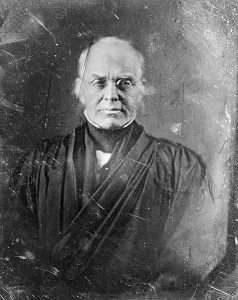
2/3/1812: Justice Joseph Story takes oath.
"Judge Orders LSU to Reinstate Law Professor Sidelined for Political Comments"
From Louisiana Illuminator (Piper Hutchinson), reporting on this short restraining order:
A state judge has [temporarily] ordered LSU to allow its law professor Ken Levy to return to teaching duties. The university had removed Levy from the classroom pending an investigation into alleged criticism of Gov. Jeff Landry….
A hearing on a longer-term preliminary injunction is scheduled for Feb. 10 (WAFB, Chris Nakamoto):
LSU removed Levy from his tenured teaching position last week, following comments Levy made to his students about Louisiana Governor Jeff Landry and President Donald Trump.
Back to the Illuminator:
In an affidavit to the court, Levy says that he brought up Landry's reaction to comments of fellow law professor Nick Bryner during class. Levy asked his students not to record his lectures because he didn't want to be targeted by Landry.
In November, Landry publicly asked LSU to discipline Bryner last year for his comments about President Trump the day after the presidential election. A video of Bryner's comments were sent to the governor, who then circulated the video on social media.
"If Governor Landry were to retaliate against me, then f*** the governor and f*** that. — all of which was a joke and clearly said in a joking manner to highlight my no recording policy in class and the First Amendment," Levy wrote in the affidavit…..
LSU has several policy statements and permanent memoranda that address disciplining a tenured faculty member. These policies call for several layers of review, all of which require peer faculty input. None of this happened before Levy was removed from his classes ….
The university is quoted as responding,
Challenge Trump's Tariffs Under the Nondelegation and Major Questions Doctrines
Recent Supreme Court precedent suggests such challenges might prevail, though success is not guaranteed.
Yesterday, Donald Trump imposed 25% tariffs on Canadian and Mexican imports, and 10% on those from China. These actions will inflict immense costs on the US economy, raise prices for many goods, and poison relations with two of our closest allies and trading partners, thereby weakening the US and strengthening our enemies. They are also unlikely to do much to stem the flow of fentanyl across US borders or address illegal migration - the ostensible excuses for these actions. Fortunately, there may be a way to successfully challenge these immensely harmful actions in court. Plaintiffs should file cases based on the nondelegation and major questions doctrines. The latter, especially, has been bolstered by recent Supreme Court decisions.
The Constitution gives Congress, not the executive, the power to regulate "commerce" with foreign nations. Trump claims the authority to impose these massive tariffs under the International Emergency Economic Powers Act of 1977 (IEEPA), a vague statute that gives the president the power to set trade restrictions in situations where there is "any unusual and extraordinary threat, which has its source in whole or substantial part outside the United States, to the national security, foreign policy, or economy of the United States, if the President declares a national emergency with respect to such threat."
Trump has indeed declared a national emergency at the border. But there is nothing "extraordinary" or "unusual" about either illegal migration or cross-border fentanyl smuggling. To the contrary, these phenomena are natural and longstanding consequences of severe immigration restrictions and the War on Drugs, which predictably create large black markets, and have done so for decades. Most fentanyl smuggling is actually done by US citizens crossing through legal ports of entry, which Canada and Mexico can't do much about. Moreover, illegal border crossings were actually at a low level when Trump came into office.
The unbounded nature of the administration's claim to power here is underscored by Trump's statements that there are no concessions Canada or Mexico could make to get him to lift the tariffs. That implies they aren't really linked to anything having to do with any emergency; rather, the invocation of the IEEPA is just a pretext to impose a policy Trump likes.
Under Trump's logic, "extraordinary" or "unusual" circumstances justifying starting a massive trade war can be declared to exist at virtually any time. This interpretation of the IEEPA runs roughshod over constitutional limitations on delegation of legislative power to the executive. For decades, to be sure, the Supreme Court has taken a very permissive approach to nondelegation, upholding broad delegations so long as they are based on an "intelligible principle." But, in recent years, beginning with the 2019 Gundy case, several conservative Supreme Court justices have expressed interest in tightening up nondelegation. The administration's claim to virtually limitless executive discretion to impose tariffs might be a good opportunity to do just that. Such flagrant abuse by a right-wing president might even lead one or more liberal justices to loosen their traditional skepticism of nondelegation doctrine, and be willing to give it some teeth.
A claim to such sweeping authority might fail even under the "intelligible principle" framework. If an "emergency" and an "extraordinary" or "unusual" threat exists anytime the executive says so, there is no real constraint here, intelligible or otherwise.
More promising than the nondelegation argument is the possibility of attacking Trump's tariffs under the "major questions" doctrine, which requires Congress to "speak clearly" when authorizing the executive to make "decisions of vast 'economic and political significance.'" If the statute is ambiguous, courts must presume that Congress didn't give the agency the power the executive claims. In recent years, the Supreme Court has relied on MQD to strike down a number of sweeping assertions of authority by the Biden administration, such as its attempt to forgive over $400 billion in student loans, and the establishment of a nationwide eviction moratorium (first begun under Trump). The imposition of massive tariffs on our two largest trading partners is pretty obviously a decision with "vast economic and political significance," one likely to cost the public even more than Biden's loan forgiveness plan would have. And, as in the student loan and eviction moratorium cases, the statutes under which the administration claims authority are far from clear in indicating it has such sweeping power. Furthermore, some of the conservative justices might welcome an opportunity to show that MQD isn't just a tool for the political right.
I don't argue that either a nondelegation or an MQD claim is sure to succeed. But the arguments are strong, particularly on MQD. Importers and others seeking to challenge Trump's awful actions would do well to try both. Making both simultaneously would also have the advantage of making the MQD argument (which is not constitutional in nature, thereby allowing Congress to potentially give the executive sweeping power by enacting a more clear statute) seem relatively moderate by comparison.
As is often the case, litigation and political action aren't mutually exclusive. At the margin, courts may be more willing to strike down Trump's tariffs if they are unpopular. Survey data indicates large majorities oppose tariffs if reminded they increase prices. Opponents would do well to emphasize that point at every turn - even as they also battle the tariffs in court.
UPDATE: In a recent Lawfare article, Peter Harrell makes a strong case that the IEEPA doesn't authorize tariffs at all. At the very least, any serious doubt about this issue strengthens the case for invalidating the administration's actions under the major questions doctrine.
Today in Supreme Court History: February 2, 1790
Friday Open Thread
What's on your mind?
D.C. Circuit Declines to Reconsider Decision Concluding CEQ Lacks Authority to Issue NEPA Regulations
A majority of the en banc court instead seeks to explain away the panel's conclusion as dicta. Will the Supreme Court agree?
Last November, in Marin Audubon Society v. Federal Aviation Administration, a divided panel of the U.S. Court of Appeals for the D.C. Circuit concluded that the Council on Environmental Quality lacked the statutory authority to issue binding regulations implementing the National Environmental Policy Act (NEPA). As CEQ first issued such regulations in the 1970s, and that such regulations are often the basis of NEPA suits against federal agencies, the decision was a big deal.
The opinion, by Senior Judge Randolph (joined by Chief Judge Henderson) explained why the text of NEPA should not be read to confer any such authority. Accordingly, the panel majority concluded, federal agencies are only obligated to comply with NEPA itself, and any regulations they may have adopted on their own to implement NEPA's requirements.
Judge Srinivasan dissented, largely on the grounds that the question of CEQ's statutory authority was not properly before the court (as it had not been briefed) and was not necessary to resolve the question presented to the court.
Every party to the case petitioned the D.C. Circuit to rehear the case en banc. In the interim, President Trump issued an executive order directing CEQ to propose rescinding its NEPA regulations and revoking the Carter Administration's EO that had directed the CEQ to issue such regulations and directing agencies to comply.
Today, the D.C. Circuit denied the petition, but Judge Srinivasan wrote an opinion respecting the denial of en banc that was joined by a majority of judges on the court. This opinion (reproduced below) seems designed to contain Marin Audubon without creating a vehicle for Supreme Court review. I doubt it will have that effect, however.
The Supreme Court has made very clear that courts are to scrutinize agency assertions of regulatory authority. While few litigants have challenged CEQ's authority to issue regulations (perhaps because the Carter EO directed federal agencies to comply with those regulations and Justice Department attorneys were never instructed to challenge whether violating such regulations was proper grounds for a citizen suit), the arguments that Congress never delegated such authority to CEQ are strong, and claims an agency failed to comply with such regulations should not be justiciable. (Whereas claims an agency did not follow its own NEPA regulations, would present a different question.)
It is worth remembering that the Supreme Court is itself considering a NEPA case at the moment, and while this question is not before the Court, it will surely have reached their attention. I would not be at all surprised were some of the justices to concur separately endorsing Judge Randolph's panel opinion, in effect inviting additional litigants to raise this claim in subsequent cases. The NEPA landscape has been permanently altered.
UPDATE: The concurring statement makes clear that the next time a NEPA case implicating CEQ's regulations gets to the D.C. Circuit, the court is likely to disregard the Marin Audubon Society decision as dicta (assuming, of course, that the regulations have not been rescinded by then). The outcome of any such decision, however, is almost certain Supreme Court review, and it would be quite surprising were a majority of justices to disagree with Judge Randolph's analysis.
* * *
The Srinivasan opinion respecting the denial of en banc reconsideration is below.
If Biden Knocked Tiktok, Can Trump Deep-Six DeepSeek?
The government would have a much stronger interest to ban a Chinese AI app that collects proprietary information than to ban a social media app that displays dance videos.
Long-time readers know I am ambivalent about AI. I refuse to use it, even as I know others think it gives them a competitive advantage. I am confident in my ability to write, research, and ideate better without AI. Maybe I'm wrong, but so be it.
I also reacted with some ambivalence to the launch of DeepSeek, a new Chinese AI App. I have no clue whether it is better or worse than OpenAI. But I do worry about the fact that millions of Americans are installing a Chinese AI app on their phones, and will submit troves of proprietary information about anything on their minds. Remember, every query can be tracked by DeepSeek, and by extension, the PRC. We learned as much from the TikTok litigation. We aren't simply talking about people watching dance videos. People ask their AI apps about everything. And I suspect submitting privileged information to a foreign adversary waives any sort of Attorney-Client privilege. The risk of potential blackmail and other compromise is unlimited.
Moreover, as could be expected, the app is generating Pro-PRC answers. You can call it data manipulation. The New York Times reports: "If you're among the millions of people who have downloaded DeepSeek, the free new chatbot from China powered by artificial intelligence, know this: The answers it gives you will largely reflect the worldview of the Chinese Communist Party."
Whatever interest may have supported the TikTok ban seems even greater for DeepSeek. And while the TikTok creators arguably had a First Amendment right to use the app to make videos, there is not a similar expressive interest here. To be sure, I've long argued that some algorithmic outputs may warrant First Amendment scrutiny. But as we move towards general AI, which has very little intercession of the human mind, the First Amendment rights are harder to justify. (I anticipated this shift in a 2013 article.)
Biden knocked TikTok. Will Trump deep-six DeepSeek?




