


The Volokh Conspiracy

Mostly law professors | Sometimes contrarian | Often libertarian | Always independent | Est. 2002

The Volokh Conspiracy

Immigration

DC Circuit Upholds District Court Order Blocking Deportations Under The Alien Enemies Act

The 2-1 ruling is procedural, but strongly suggests the majority judges also reject the Trump administration's position on the merits.

|

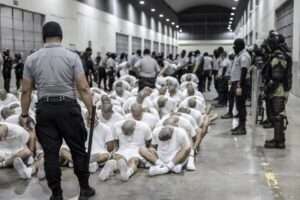
A prison guard transfers deportees from the U.S., alleged to be Venezuelan gang members, to the Terrorism Confinement Center in Tecoluca, El Salvador. Mar. 16, 2025 (El Salvador Presidential Press Office)


Earlier today, the US Court of Appeals for the DC Circuit upheld a district court temporary restraining order blocking the Trump Administration from using the Alien Enemies Act of 1798 to deport Venezuelan migrants it claims are members of the Tren de Aragua drug gang. The Alien Enemies Act is the only one of the notorious Alien and Sedition Acts of 1798 still in force. But the Act can only be used in the event of a declared war, or an "invasion" or "predatory incursion" perpetrated by a "foreign nation or government."

The ruling was a 2-1 decision. Judge Karen LeCraft Henderson (appointed by George H.W. Bush) and Judge Patricia Millett (appointed by Obama) each issued separate opinions upholding the trial court TRO for somewhat different reasons.

Judge Henderson's opinion primarily emphasizes the point that there is no war, invasion, or predatory incursion going on, and therefore the legal preconditions for invoking the AEA have not been met. She includes an excellent analysis of the meaning of "invasion":

First, the invasion must be "against the territory of the United States by any foreign nation or government." 50 U.S.C. § 21 (emphasis added). The requirement that the "invasion" be conducted by a nation-state and against the United States' "territory" supports that the Congress was using "invasion" in the  military sense of the term  See Ex parte Bollman, 8 U.S. (4 Cranch) 75, 131 (1807) (describing levying war against the United States as "a military enterprize . . . against any of the territories of the United States"); Wiborg v. United States, 163U.S. 632, 633 (1896) (explaining that a group of seamen were charged with preparing for a "military expedition . . . against the territory and dominions of a foreign prince"). Undesired people do not arrive against the territory. But foreign armies can—and as the 1798 Congress feared might—invade the territory of the United States. Second, the invasion may be actual, "attempted, or threatened." 5 U.S.C. § 21. Again, when used in reference to hostilities among nations, an attempted or threatened invasion of the United States would mark a logical trigger for enhanced presidential authority. Third, and relatedly, the conditional list of triggering events—a declared war, invasion or predatory incursion—must be read against the means the Congress employed to combat the same. The AEA authorizes the President to restrain and remove the nationals of a belligerent foreign power. Such power tracks when invasion is considered in its military sense.

Finally, consider history. The Alien Enemies Act was enacted by the Fifth Congress amid an actual conflict—the Quasi-War—with France, a foreign power. War was front and center in the minds of the enacting legislature. A little over one month before enacting the AEA, the same Congress authorized the President to raise a standing army of 10,000 men to combat any French invasion. But he could do so only "in the event of a declaration of war against the United States, or of actual invasion of their territory, by a foreign power, or of imminent danger of such invasion." Act of May 28, 1798, ch. 47, § 1, 1 Stat. 558. This language bears more than a passing resemblance to the language of the AEA, which the Congress enacted a mere thirty-nine days later. In his most famous exposition against the Alien and Sedition Act, Madison  explained that an "[i]nvasion is an operation of war." James Madison, Report of 1800 (Jan. 7, 1800), in Founders Online [https://perma.cc/2D3N-N64Z]. In such times, the "law of nations" allowed for the expulsion of alien enemies as "an exercise of the power of war." Id…..

The term "invasion" was well known to the Fifth Congress and the American public circa 1798. The phrase echoes throughout the Constitution ratified by the people just nine years before. And in every instance, it is used in a military sense. For example, the Guarantee Clause provides that "[t]he United States shall . . .protect each [State] against Invasion; and on Application of the Legislature, or of the Executive (when the Legislature cannot be convened) against domestic Violence." U.S. Const. art. IV,§ 4. The clause is a federal guarantee to the states against attack from without (invasion) or within (insurrection). In describing the clause, the Federalist Papers refer to invasion and domestic violence as "bloody" affairs involving "military talents and experience" and "an appeal to the sword." The Federalist No. 44 (J. Madison). To effectuate the guarantee the Congress has power "[t]o provide for calling forth the Militia to . . . suppress Insurrections and repel Invasions." U.S. Const. art. I, § 8, cl. 15. Again, to use military force against invasion. During these exigent times of hostilities—"in Cases of Rebellion or Invasion"—the Congress may suspend "The Privilege of the Writ of Habeas Corpus . . . when . . . the public Safety may require it." Id. art. I, § 9, cl. 2. Finally, if the federal guarantee fails, a state may exercise its Article I power to "engage in War" but only if "actually invaded, or in such imminent Danger as will not admit of delay." Id. art. I, § 10, cl. 3. When the Constitution repeats a phrase across multiple clauses—and the early Congresses echo that phrase in statute— it is a strong signal that the text should be read in pari materia…. The theme that rings true is that an invasion is a military affair, not one of migration.

I agree on all points, and have made similar arguments in my earlier writings about this issue. In particular, I have emphasized that the meaning of "invasion" in the AEA tracks the meaning of the same term in the Constitution. If courts accept the Trump argument that illegal migration and drug smuggling qualify as "invasion," that would have dire constitutional implications, such as enabling states to "engage in war" in response and the federal government to suspend the writ habeas corpus (including for US citizens) virtually anytime it wants.

Judge Henderson also presents what I think is the first judicial interpretation of the meaning of "predatory incursion":

The government finds no safer refuge in the alternative "predatory incursion." The government defines the term as "(1) an entry into the United States, (2) for purposes contrary to the interests or laws of the United States." Gov't Br. 18. And it explains that illegal immigration and drug trafficking readily qualify under that standard. As before, the government misreads the text, context and history. An incursion is a lesser form of invasion; an "[a]ttack" or "[i]nvasion without conquest." Samuel Johnson, Incursion, senses 1 & 2, A DICTIONARY OF THE ENGLISH LANGUAGE (4th ed. 1773). Its predatory nature includes a "[p]lundering," such as the "predatory war made by Scotland." Id., Predatory, sense 1. Secretary of State Thomas Pickering used the term to describe a lesser form of attack that France could conduct against the U.S. and which, in his view, could be repelled by the militia. See Letter from Thomas Pickering to Alexander Hamilton (June 9, 1798), in Founders Online [https://perma.cc/VD5M-QSNA]. This was raised in contradistinction to a full invasion, which would require an army. Id. Rep. Otis likewise described a predatory incursion as a lesser form of invasion or war. 8 Annals of Cong. 1791 (1798). Early American caselaw sounds a  similar theme: incursions referred to violent conflict. Alexander Dallas, appearing before the Marshall Court, described "predatory incursions of the Indians" onto Pennsylvania's frontier, which had led to "an Indian war." Huidekoper's Lessee v. Douglass, 7 U.S. (3 Cranch) 1, 11 (1805). Chief Justice Marshall referred to "incursions of hostile Indians," which involved "constant scenes of killings and scalping," and led to a retaliatory "war of extermination. Cherokee Nation v. Georgia, 30 U.S. (5 Pet.) 1, 10 (1831); accord Worcester v. Georgia, 31 U.S. (6 Pet.) 515, 545 (1832) (explaining that Pennsylvania's royal charter included "the power of war" to repel "incursions" by "barbarous nations"). Like its statutory counterparts, predatory incursion referred to a form of hostilities against the United States by another nation-state, a form of attack short of war. Migration alone did not suffice.

I think Judge Henderson is also right on this point, though the historical evidence here is not as extensive as in the case of "invasion."

Judge Henderson notes she does not definitively resolve whether Tren de Aragua's actions qualify as an "invasion" or a "predatory incursion," merely concluding that the government isn't likely to prevail on these points (which is enough to uphold the trial court TRO). But I think it's clear the government cannot prevail under her (correct definitions) of these terms.

In this opinion, Judge Henderson does not consider the issue of whether Tren de Aragua is a "foreign nation or government." But I think it's pretty obvious that it isn't, and this is an additional reason to rule against the Trump Administration.

In assessing whether an injunction is justified to block the deportations, Judge Henderson properly highlights the extreme egregiousness of the government's actions, under which the Venezuelan migrants have not simply been deported, but sent to imprisonment in El Salvador, often with little or no evidence that they are actually members of any drug gang or have committed any other crime:

The Executive's burdens are comparatively modest compared to the plaintiffs'. Lifting the injunctions risks exiling plaintiffs to a land that is not their country of origin…. Indeed, at oral argument before this Court, the government in no uncertain terms conveyed that—were the injunction lifted—it would immediately begin deporting plaintiffs without notice. Plaintiffs allege that the government has renditioned innocent foreign nationals in its pursuit against TdA. For example, one plaintiff alleges that he suffered brutal torture with "electric shocks and suffocation" for demonstrating against the Venezuelan regime. Id. (D.D.C. Mar. 19, 2025), ECF No. 44-5 ¶ 2. While awaiting adjudication of his asylum claim, he was expelled to "El Salvador with no notice to counsel or family" based on a misinterpretation of a soccer tattoo. Id. ¶¶ 5–7. To date, his family and counsel have "lost all contact" and "have no information regarding his whereabouts or condition." Id.¶ 10. The government concedes it "lack[s] a complete profile" or even "specific information about each individual" it has targeted for summary removal….

Judge Millett's opinion emphasizes the lack of due process provided to the deportees. They were not given any opportunity to challenge the government's claims (often based on extremely flimsy evidence or none at all) that they are members of Tren de Aragua. Here reasoning is similar to that of the recent district court ruling in the case, which I analyzed here. However, she goes beyond the district court in emphasizing that the right to a hearing here is not simply statutory, but is rooted in the Due Process Clause of the Fourteenth Amendment.

I emphatically agree, and made a similar argument here. As Judge Millett also explains, the right to due process here is not just an abstract issue of legal theory. The government's denial of due process has apparently led to the deportation and cruel imprisonment of many people who are not actually members of any drug gang and haven't committed any crime.

In his dissent Judge Justin Walker (appointed by Trump) does not address any of the substantive issues in the case. Rather, he argues it should have been brought in Texas (where the five named plaintiffs are currently detained by ICE), rather than in Washington, DC.I find the majority judges' analysis on this more persuasive than Walker's. But I am not expert in these types of procedural issues, so will leave them to others.

Overall, this is a significant win for the detained migrants. And it's notable that - so far - not one judge has endorsed the administration's ultra-broad theory of executive power here. But, obviously, this litigation is going to continue.

The administration may try appeal the DC Circuit ruling to the Supreme Court. If not, or if the justices refuse to take the case at this time, we will see a final ruling on the merits in the district court (which will, I think, almost certainly go against the administration), followed by further appeals.


 

The Idea of My New Book, The Digital Fourth Amendment—and Why It Matters

A second post on "The Digital Fourth Amendment"

|

I posted yesterday about why I wrote my new book, The Digital Fourth Amendment. In this post, I want to give an overview of the book.  What's the subject, and what's the argument?

Welcome to 2025. If the government is trying to solve a criminal case these days, they'll often look for digital records. Sometimes those records are collected from a suspect's physical devices like their cell phones. Sometimes those records are collected from network providers such as Google or Meta. In both settings, the way computers work changes what evidence exists and how the government can find it.  It often means that there's a lot of evidence out there if the government knows where to look.

So for example, in a murder case, in which the government suspects that the defendant killed his best friend for money, the government might get a warrant to search his cell phone and find stored Google searches including "are you capable of killing your best friend?" and "how does it feel when you kill someone for the first time?"  (This happened in a DC case, Burns v. United States.)  In a burglary case, in which the suspect was thought to have entered a woman's apartment at night and illuminated his way with his cell phone flashlight, the government might get a warrant to show that the flashlight app's log showed that it was "on" at the time of the burglary. (A Pennsylvania case, Commonwealth v. Ani.)  And if the government has a hunch that you committed a crime, investigators might tell your Internet provider to run off a copy of your entire account to store it for the government so you can't practically delete your files.  (This happens all the time, so-called Internet preservation.)  These are just a few examples.

The big legal question is, what are the legal rules for collecting all of this digital evidence?

Enter the Fourth Amendment. The Fourth Amendment was enacted in 1791 to prohibit unreasonable searches and seizures.  It's the primary bulwark of privacy protection against government evidence collection.  But what is a "search" of digital evidence?  What is a"seizure" of digital evidence?  And when is such a search or seizure "reasonable"?  Courts are just now trying to answer these questions.  And the answers they come to are important, as they determine what powers the government has to collect your digital evidence. And if you think that matters today, think of how important the digital rules will be in 25 or 50 years.  The future of government power hinges in no small part on these answers.

And here's the thing: Figuring out the answers is hard!  It's hard for a fundamental reason.  Rules about government investigations often depend on the facts.  Like all rules, they reflect the facts that exist when the rule is created.  But technological change tends to destabilize investigative rules.  A rule created in one era that had one meaning with the technological facts that existed in that era will have a very different meaning with the technological facts that exist in a later era.

This poses a basic puzzle for courts in the later era: Do you preserve the rule or the role?  That is, do you stick with the old formal legal rule, and just accept that it now has all sorts of unintended consequences inconsistent with the broader purposes and goals of the law?  Or do you try to preserve the role of the law, maintaining it over time, to make sure that the law's protections don't get outdated?

Read More

Next Up: Jenner and Block

Are you getting the message yet? Kiss the ring! And throw in some cash while you're at it. Or Our Leader will destroy you. Do not cross him - he has the entirety of the executive power of the United States at his disposal.

|

Given that the VC is a blog that is heavily focused on the law and the legal profession in all of its various manifestations, I think it is incumbent upon us to at least pay a little bit of attention to the Trump Administration's continuing attacks on lawyers and judges, if only to ensure that our silence is not construed as capitulation.  So no, I'm not going to let it go - no one's forcing you to read anything I write. 


The punishment that was meted out to Paul Weiss last week for having "hired unethical attorney Mark Pomerantz [who] according to his coworkers, unethically led witnesses in ways designed to implicate President Trump" while at the Manhattan DA's office has been rescinded! The Executive Order has been withdrawn! All it took, apparently, was $40 million in pro bono legal assistance for Trump-endorsed causes - cheap!!

Of course, the money was never the point (though I am surprised Trump couldn't extort a few million more; I bet Paul Weiss would have paid another $50 million for, say, a statue of Trump somewhere, or a nice fat contribution to the DJT Family Foundation).  The point is obedience, about sending the message: "I can crush you, big powerful law firm, like a bug, so don't fuck with me." Mission accomplished. Read More

Academic Freedom

New Academic Freedom Podcast on the Columbia Situation

A conversation with David Cole

|

A new episode of the Academic Freedom Podcast has been released. The podcast is sponsored by the Academic Freedom Alliance and the Center for Academic Freedom and Free Speech at Yale Law School.

This episode features a conversation with David Cole about the current situation at Columbia University. David Cole is the Honorable George J. Mitchell Professor in Law and Public Policy at Georgetown University Law Center. He is also the former National Legal Director of the American Civil Liberties Union. He is also a principal author of the recently released "Statement from Constitutional Law Scholars on Columbia."

The Trump administration is currently withholding some $400 million dollars in federal grants from Columbia University until it complies with a list of demands that includes everything from reforming undergraduate and graduate admissions to putting an academic department into receivership.

On the podcast, we discuss the legalities of the administration's actions and its implications for higher education broadly and for academic freedom in the United States.

Sex Discrimination

Ninth Circuit Declines to Block Idaho's "Biological Sex" Restrictions for Multi-Occupancy School Restrooms, Locker Rooms, and Shower Rooms

The court leaves open, though, the possibility that a narrower challenge aimed just at restrooms with closed stalls, where students wouldn't generally be partly or fully undressed where others can see them.

|

An excerpt from the long Roe v. Critchfield, decided last week by Ninth Circuit Judge Morgan Christen, joined by Judges Kim McLane Wardlaw and Mark J. Bennett:

Before the summer of 2023, public school districts in Idaho were free to adopt their own policies regarding students' access to [multi-occupancy] restrooms, locker rooms, and shower rooms. Approximately one quarter of Idaho's public schools had policies specifically permitting students to use the facilities corresponding to their gender identity. The Idaho Legislature altered that status quo by enacting Senate Bill 1100 (S.B. 1100), which now requires all public-school students in Idaho to use only the restroom and changing facility corresponding to their "biological sex." …

S.B. 1100 also requires that public schools provide a single-occupancy facility as a reasonable accommodation to a student who, for "any reason, is unwilling or unable to use a multi-occupancy restroom or changing facility designated for the person's sex and located within a public school building, or multi-occupancy sleeping quarters while attending a public school-sponsored activity." In order to access such a single-occupancy facility, the student must provide "a written request for reasonable accommodation to the public school." This accommodation does not allow students to access covered facilities designated for use by students of the opposite sex while opposite-sex students could be present. Finally, S.B. 1100 creates a civil cause of action for any student who encounters a student of the opposite sex in a covered facility. The statute entitles students to recover $5,000 from the public school for each such encounter….

The policy was challenged as violating the rights of transgender students, but the appellate court upheld the trial court's decision not to issue a preliminary injunction. As to the Equal Protection Clause, the court reasoned:

Read More

crime victims

Boeing Has Confessed to Committing Its Deadly Crime … and Should Now Plead Guilty

Boeing has no defense to the charged crime of defrauding the FAA. Rather than go through a pointless trial with a preordained result, it should plead guilty straightaway.

|

Yesterday Judge Reed O'Connor of the U.S. District Court for the Northern District of Texas set a trial date (June 23rd) in United State v. Boeing. The case concerns a long-pending federal criminal charge filed against Boeing for conspiring to defraud the FAA.  Boeing has reportedly been dragging its heels about pleading guilty. Boeing has no defense. It should do the right thing and plead guilty as soon as possible.

As I've blogged about previously (see here, here, here, and here), the criminal charge pending against Boeing arises out of two deadly crashes of Boeing 737 MAX aircraft in 2018 and 2019. A Justice Department investigation uncovered the fact that Boeing had lied to the FAA about the safety of the aircraft—lies that led directly and proximately to the crashes killing 346 passengers and crew. On January 7, 2021, the Justice Department filed a criminal information with a one-count conspiracy charge against Boeing, alleging that

From at least in or around November 2016 through at least in or around December 2018, in the Northern District of Texas and elsewhere, the Defendant, THE BOEING COMPANY, knowingly and willfully, and with the intent to defraud, conspired and agreed together with others to defraud the United States by impairing, obstructing, defeating, and interfering with, by dishonest means, the lawful function of a United States government agency, to wit, the Federal Aviation Administration Aircraft Evaluation Group ("FAA AEG") within the United States Department of Transportation, in connection with the FAA AEG's evaluation of the Boeing 737 MAX airplane's Maneuvering Characteristics Augmentation System ….

A few minutes after filing the charges, the Justice Department then filed a deferred prosecution agreement (DPA), deferring prosecution on the condition that Boeing take certain anti-fraud and other safety measures over the next three years. Judge O'Connor approved the DPA.

But later that year, I filed a Crime Victims' Rights Act (CVRA) challenge to the "sweetheart" DPA, arguing that the Justice Department had failed to confer with the victims' families about the deal. Following several evidentiary hearings, Judge O'Connor agreed that the Department had violated the CVRA in failing to confer with the victims' families in what can properly be described as "the deadliest corporate crime in U.S. history." But after further litigation—and an intermediate ruling from the Fifth Circuit that further victims' rights challenges were "premature"—the DPA's three-year term expired on January 7, 2024. The Justice Department then reviewed whether Boeing had lived up to its DPA obligations. Noting the blowout of a doorplug on a Boeing 737 MAX on January 5, 2024 (two days before the DPA expired), the Department concluded that Boeing had failed. On May 14, 2024, the Department filed its notice that Boeing had breached its safety obligations under the DPA. In July 2024, the Justice Department and Boeing reached a plea deal, under which Boeing would plead guilty, pay a $455 million fine, but would not admit to causing the 346 deaths. On behalf of my victims' families, I objected. And following a hearing, on December 5, 2024, Judge O'Connor rejected the proposed plea agreement, citing a constitutionally dubious DEI provision and lack of judicial involvement in monitoring Boeing. He gave the parties (DOJ and Boeing) thirty-days to advise how they wanted to proceed.

Since then, the Justice Department and Boeing have asked for—and received—three extensions of time to report back to Judge O'Connor. The extensions were to February 16, 2025; to March 14, 2025; and, most recently, to April 11, 2025. With regard to the last extension, I filed a notice for my victims' families that, if further extensions beyond April 11 were sought, then the families would object. Under the Crime Victims' Rights Act (CVRA), they have a right to proceedings free from unreasonable delay.

But before the April 11 deadline arrived, Judge O'Connor acted to speed things along. Two days ago (late on March 24), the Wall Street Journal (and other media) reported that Boeing was pushing to withdraw from any plea agreement that would require it to plead guilty. And then, less than 24 hours later, Judge O'Connor sua sponte set a trial date in the case:

The Court hereby VACATES its April 11, 2025, deadline in its previous Order and instead sets this case for trial on Monday, June 23, 2025, at 9:00 am in the Second Floor Courtroom, 501 W. 10th Street, Fort Worth, Texas. A separate Scheduling Order shall issue.

Judge O'Connor's order is good news, not only for the victims' families but also for the fair administration of justice. The families have now waited for years for justice in this case. Judge O'Connor's order means that they will either have a resolution by June 23—or a chance to see Boeing stand trial for its crime. Boeing has clearly used its expansive legal team to delay the proceedings. At some point, enough is enough. That point appears to have arrived yesterday.

Since yesterday's order, I've also seen some speculation that Boeing might just decide to go to trial and take its chances with a jury. This speculation does not full appreciate where things stand. Boeing has no defense. Read More

Free Speech

Libel Claims by The Satanic Temple Against Newsweek Over Sexual Abuse Allegations …

thrown out for lack of evidence of "actual malice" (i.e., knowing or reckless falsehood on Newsweek's part).

|

A short excerpt from today's long decision by Judge Mary Kay Vyskocil (S.D.N.Y.) in The Satanic Temple, Inc. v. Newsweek Magazine LLC:

The Satanic Temple, Inc. … [sued] Newsweek Magazine LLC … [for alleged defamation] in the article titled "Orgies, Harassment, Fraud: Satanic Temple Rocked by Accusations, Lawsuit" published by Newsweek. After this Court's [earlier] Opinion and Order on Defendant's motion to dismiss, only one statement, "Accounts of sexual abuse being covered up in ways that were more than anecdotal" (the "Article Statement"), remains at issue….

The court grants Newsweek summary judgment as to that last statement. The court concludes that there's a material factual dispute as to what the statement would mean to a reasonable reader (and whether it's false):

The relevant portion of the Article, with the Article Statement emphasized here (but not in the Article), reads:

He hadn't been involved long when he came to feel that TST 'appeared to be an inept, rudderless organization that had accidentally risen to prominence through something of a disingenuous prank,' referring to the 2013 filming event in Florida.

He soon left the group, then was leaked material about 'leaders posing happily with major alt-right media figures,' he wrote. 'Accounts of sexual abuse being covered up in ways that were more than anecdotal. Dozens of people kicked out for asking for financial records from this alleged-non-profit organization.'

Read More

Occupational Licensing

On the Effects of Occupational Licensing on the Legal Profession

An interesting new study on how state bar requirements may affect the quality and quantity of legal services.

|

Are state bar licensing requirements just a barrier to entry that reduces the quantity and increases the cost of legal services? Do they also improve the quality of legal services and protect consumers?

Count me among those who is generally skeptical of state occupational licensing requirements. So I read with interest a new study by Adam Chilton, Jacob Goldin, Kyle Rozema, and Sarath Sanga, "Occupational Licensing and Labor Market Mobility: Evidence from the Legal Profession." Here is the abstract:

We study how state occupational licensing requirements shape labor mobility across U.S. legal markets. Drawing on newly collected data, we link variation in state bar exam waiver policies to lawyers' license acquisitions, professional disciplinary records, and educational histories. We find that bar exam waivers increase the number of experienced lawyers obtaining a new license by 38 percent, but that the additional lawyers are subject to more professional discipline and tend to have graduated from less selective law schools. Our results suggest that state-level occupational licensing regimes can create a trade-off between the supply and quality of professionals in an industry.

And from their conclusion:

In this paper, we investigated the impact of occupational licensing requirements on the labor market mobility of lawyers and on the quality of lawyers offering legal services in a state. We specifically studied the impact of bar exam waivers for experienced lawyers on their likelihood of obtaining a license to practice law in another state and on whether the lawyers induced to move by a bar exam waiver differ in quality. To do so, we assembled novel datasets on bar exam waiver policies, license acquisitions of a sample of 1.7 million lawyers, and the professional disciplinary actions imposed on lawyers in 37 states. By exploiting more than one thousand changes in bar exam waivers between pairs of origin and destination states, we found that bar exam waivers increase labor market mobility by 38 percent. However, we also found that lawyers who are induced to obtain an additional license by a bar exam waiver are of lower quality than lawyers who would have obtained an additional license without the waiver. Taken together, these results imply that, in the legal context, occupational licensing requirements create a trade-off between the supply of labor and the quality of professionals.

Given this trade-off, future research is needed to further understand the welfare implications of occupational licensing in the legal profession. Our research specifically points toward two related topics that would benefit from additional investigation. First, because occupational licensing rules appear to impact both the quantity and quality of lawyers, future research should directly investigate the welfare implications that come from expanded access to legal services relative to potential costs associated with having a higher share of lower quality lawyers. The welfare benefits of increasing the supply of lawyers may far outweigh the costs of additional lower-quality lawyers, but more research is needed to directly explore this possibility. Second, future research should explore whether bar exam waivers create lower-quality lawyers or simply redistribute them. For instance, exam waivers may produce lower-quality lawyers if they lead to experienced lawyers not learning information that could directly improve the quality of legal services they provide; alternatively, exam waivers may simply allow existing lower-quality lawyers to expand their practices to new markets without  producing any new lower quality lawyers. These two possibilities have different welfare implications and suggest different strategies for trying to protect the public.

Donald Trump

Federal Court Rules Migrants Have Right to Hearing to Challenge Alien Enemies Act Deportations

Judge Boasberg ruled the migrants are entitled to due process in determing whether they really are "alien enemies" covered by the Act.

|

A prison guard transfers deportees from the U.S., alleged to be Venezuelan gang members, to the Terrorism Confinement Center in Tecoluca, El Salvador. Mar. 16, 2025 (El Salvador Presidential Press Office)


Yesterday, US district Judge James Boasberg ruled that migrants have a right to a hearing to challenge their deportation under the Alien Enemies Act of 1798. The Alien Enemies Act is one of the notorious Alien and Sedition Acts of 1798, the only one still in force. Trump is trying to use it to deport alleged members of Tren de Aragua, a Venezuelan drug gang. But the Act can only be used in the event of a declared war, or an "invasion" or "predatory incursion" perpetrated by a "foreign nation or government." As explained in my earlier writings about this issue, illegal migration and cross-border drug smuggling do not qualify as an "invasion" or "predatory incursion." Even if they did, they aren't being perpetrated by a "foreign nation or government." Tren de Aragua is a criminal organization, but it is pretty obviously not a "nation or government."

Much of the debate over Trump's invocation of the AEA focuses on whether he can use it all, given the absence of the requisite war, invasion, or predatory incursion. But Judge Boasberg chose not to address that issue (at least not yet), and instead focused on a different point.

The Court need not resolve the thorny question of whether the judiciary has the authority to assess this claim in the first place. That is because Plaintiffs are likely to succeed on another equally fundamental theory: before they may be deported, they are entitled to individualized hearings to determine whether the Act applies to them at all. As the Government itself concedes, the awesome power granted by the Act may be brought to bear only on those who are, in fact, "alien enemies." And the Supreme Court and this Circuit have long maintained that federal courts are equipped to adjudicate that question when individuals threatened with detention and removal challenge their designation as such. Because the named Plaintiffs dispute that they are members of Tren de Aragua, they may not be deported until a court has been able to decide the merits of their challenge. Nor may any members of the provisionally certified class be removed until they have been given the opportunity to challenge their designations as well.

Judge Boasberg cites extensive precedent showing that noncitizens targeted for detention or deportation under the AEA are entitled to a hearing to determine if they really are "enemy aliens" as defined by the statute and the presidential proclamation invoking it. That was true in every previous use of the AEA (always during actual declared wars: the War of 1812, World War I, and World War II). For example, in United States ex rel. Schwarzkopf v. Uhl, 137 F.2d 898 (2d Cir. 1943), a detainee was able to show he was not actually a German citizen, and thus could not be detained under the AEA as an alien enemy.

Georgetown law Prof. Steve Vladeck covers a variety of similar precedents going all the way back to the War of 1812 in a 2007 article.

I would add that this isn't just a statutory right, but also one required by the Due Process Clause of the Fifth Amendment. At the very least, such due process is surely required in a case where the migrants aren't simply being deported, but are instead incarcerated in a horrific El Salvadoran prison.

The need for due process here is more than just a matter of abstract legal theory. Evidence increasingly indicates that many of the people deported under the AEA by Trump are not members of Tren de Aragua at all, and haven't committed any crimes. The government actually admits that "many" of the deportees do not have any criminal record at all.

While Judge Boasberg chose not to resolve the issue of whether the AEA can be invoked at this time at all, he notes that "this Court is confident that it can — and therefore must, at the appropriate time — construe the terms 'nation,' 'government,' 'invasion,' and 'predatory incursion….' While doing so may be no light undertaking, it is a judicial one."

This suggests he is - rightly - skeptical of the notion that all such issues are "political questions" that courts are not allowed to address. Courts are likely to have deal with these questions as the AEA litigation continues.

I have previously why these issues should not be considered unreviewable political questions here, and here. Here's an excerpt:

There is no good reason to hold that the definition of "invasion" is a political question, especially if doing so would give the president a blank check to usurp power over… Congress and suspend the writ of habeas corpus anytime he wants. Such a vast concentration of power would surely go against the original meaning [of the Constitution], as it would enable the president to engage in arbitrary detention at will – exactly the kind of abuse early Americans had experienced at the hands of the British and sought to prevent in the future. "Invasion" has a clear definition readily susceptible to judicial interpretation…

Meanwhile, also yesterday, the US Court of Appeals for the DC Circuit held oral arguments on the government's appeal seeking a reversal of Judge Boasberg's earlier temporary restraining order blocking AEA deportations. The judges seemed to share at least some of Boasberg's concerns about the lack of due process:

"There were plane loads of people. There were no procedures in place to notify people," Judge Patricia Millett said. "Nazis got better treatment under the Alien Enemies Act."

Judge Millett noted that alleged Nazis were given hearing boards and were subject to established regulations, while the alleged members of Tren De Aragua were given no such rights.

"There's no regulations, and nothing was adopted by the agency officials that were administering this. They people weren't given notice. They weren't told where they were going. They were given those people on those planes on that Saturday and had no opportunity to file habeas or any type of action to challenge the removal under the AEA," Judge Millett said.

Judge Millett is absolutely right on these points. And they should trouble anyone who cares about civil liberties, or just simply opposes imprisoning people with no due process at all.

Doxing, Not Doxxing

|

Both "doxing" and "doxxing" are in use, but I want to argue in favor of the one-x spelling, for a simple reason: It's more consistent with the norms of standard English.

To my knowledge, no other standard English words (not counting brand names such as Exxon, or English renderings of Roman numerals) have an "xx" in them. And while the last letter of a verb is sometimes doubled before "-ing" (e.g., "popping," "hitting," and "tanning"), that isn't done for verbs that end with an "x": We write "boxing," "mixing," and "taxing," not "boxxing," "mixxing," and "taxxing."

I appreciate that this is an aesthetic preference, not some rigid law. If enough fellow English speakers come to prefer "doxxing," that will become the standard spelling. But at this early stage, I want to urge people to go with normal English practice.

AI in Court

11 Court Opinions in the Last 30 Days Mention AI-Hallucinated Material, and …

that's likely just the tip of the iceberg.

|

I did a Westlaw search, and found that 11 court opinions in the last 30 days mention that a party had likely included AI-hallucinated case citations or (in one instance) AI-hallucinated quotes from real cases; ten involved court filings, and one involved a party's communication with opponents. That's a rate of over 100 per year.

And that's likely just the tip of the iceberg, since the overwhelming majority of all court cases in the U.S. are state trial court cases, and opinions in those cases only rarely make it onto Westlaw. Eight of the cases I found were federal trial court cases, two were state appellate cases, and one was a state trial court case. This makes me think there are many more state trial court cases in which such hallucinations were noticed and mentioned but which aren't on Westlaw, and still more in which such hallucinations weren't mentioned or weren't even noticed.

Six of the cases involved pro se litigants, but five involved lawyers.

What Should Trump's Circuit Nominees Look Like?

|

When President Trump's first term began, he inherited a slew of circuit court vacancies. However, for his second term, there are likely to be far fewer circuit court seats to fill. By my count, Trump can make appointments to fill one seat on the First Circuit (Maine), two seats on the Third Circuit (Delaware and New Jersey), one seat on the Sixth Circuit (Tennessee), one seat on the Seventh Circuit (Wisconsin), and one seat on the Ninth Circuit (California). (If I've forgotten any others, please email me).

What should Trump look for in filling these seats? In a series of writings, Mike Fragoso sketches out how Trump 2.0 judges may differ from Trump 1.0 judges.

At the Federalist, Fragoso explains:

The approach adopted to pick judges in 2017 worked extremely well. But, in the end, it's 2025, not 2017. The times and the law have changed, in no small part thanks to Trump's judicial appointments. While Trump will surely keep looking for talented and well-credentialed lawyers to put on the bench, he will hopefully adapt his methods to reflect the needs of today and anticipate those of tomorrow.

And what are those needs of today and tomorrow? Fragoso suggests that the type of nominee may depend on the balance of the circuit. At Public Discourse, Fragoso writes that Trump should appoint judges to liberal circuits that will appeal to Justice Barrett, the Court's median voter:

On circuits dominated by liberals (such as the First or Fourth or the District of Columbia), the only chance conservatives have is intervention by the Supreme Court. It therefore makes sense to find conservative judges for liberal courts who can effectively speak the language of [Barrett's] process-formalist originalism in order to optimize the chances of Supreme Court review.

In other words, lower-court judges who think like Barrett are more likely to catch Justice Barrett's attention in a cert petition.

By contrast, in conservative circuits, there is no need to appoint a Barrett-centric judge:

On circuit courts dominated by conservatives (such as the Third, the Fifth, the Sixth, or the Eighth), the opposite is probably the case. They don't need the Supreme Court to save them; they're typically the court of last resort. In that case the more William Rehnquists the better, because Barrett's jurisprudential inclination is not to police their day-to-day rulings.

I'm not sure this is accurate. Justice Barrett has a tendency to reverse the Fifth Circuit on a fairly regular basis.

At National Review, Fragoso applies this approach to the vacancy for Chief Judge Sykes's seat. (Fragoso clerked for Sykes). The Seventh Circuit is, more-or-less, a court in equipoise. Here is how Fragoso breaks down the votes:

What does this mean practically? It means that for conservatives to win at the Seventh Circuit, they must run the ball up the middle. There is simply not a cohesive conservative bloc on the court. Brennan is a movement conservative; Kirsch is a hard-nosed prosecutor conservative; Easterbrook is Easterbrook; St. Eve is an establishment conservative; Scudder is a moderate conservative; Kolar seems to be a conservative moderate; and Pryor seems to be a liberal moderate. Maldonado and Jackson-Akiwumi always hold down the left flank, usually joined by Lee.

You see the nomenclature: movement conservative, prosecutor conservative, establishment conservative, and moderate conservative. If you think all Republican-appointed judges are the same, you are quite wrong. By the way, I think Judge Brennan will soon be the Chief Judge of the Seventh Circuit. I hope Chief Justice Roberts is ready for a movement conservative on the Judicial Conference.

Fragoso explains that any nominee to succeed Sykes should not be a "movement conservative" or an "arch-conservative," but should instead be someone willing to persuade the more-moderate members of the en banc court.

To succeed en banc, then, conservatives will need to persuade three of Easterbrook, St. Eve, Scudder, and Kolar. The best way to do that is to replace Sykes with a judge who is smart, personable, and credible enough to help persuade those very smart, very experienced, and relatively non-doctrinaire members of the court to agree with him or her. The left flank is utterly unpersuasive on the Seventh, so there is an opportunity to turn the middle toward the right — but not if the right is perceived by the center as doctrinaire or otherwise non-credible. Replacing Sykes with an arch-conservative will yield some great dissents.

And in turn, that more moderate appointee can issue favorable rulings, without requiring the parties to seek cert:

This matters for a number of reasons. The Supreme Court simply doesn't grant cert anymore. Well, it does, but exceedingly rarely and never when you want it. So one must assume that politically salient cases will die in the circuit. This is important because Indiana is a conservative innovator state and Wisconsin is a political battleground. With those cases terminating in Chicago 99 percent of the time, it's more important to secure judgments than to own the libs with a stirring dissent.

This is a shot-across-the-bow at the sort of appointees from Trump's first term that have generated the most headlines. Indeed, the Trump judges have blown away the Obama judges in terms of citations. Many of those Trump noms are better at writing dissents than persuading moderate colleagues. But then again, what does it mean to persuade colleagues: dilute and water down a position to avoid saying anything important. If the goal is to simply get courts to generally vote in a conservative direction without actually advancing conservative jurisprudence, then Fragoso's advice makes a lot of sense. But, if one believes that judges take an oath to faithfully interpret the Constitution, and those votes should not be cast with an eye towards cobbling together an en banc majority, then Fragoso's advice is problematic.

In 2009, Laurence Tribe wrote that President Obama should select Elena Kagan for the Souter seat because she would be effective at bringing Justice Kennedy to the liberal wing of the Court. Fragoso is basically offering the same advice, but in reverse: Trump should select judges who will bring moderates to the right. On the Supreme Court at least, I don't think I've seen a moderate-conservative bring a moderate to the right. The ratchet seems to only go to the left. Can anyone really persuade Frank Easterbrook to do anything other than what Frank Easterbrook wants to do? If so, he would have probably taken senior status many years ago. Perhaps the one outlier is Chief Justice Roberts persuading Justices Breyer and Kagan to join his Medicaid Expansion ruling, but NFIB is sui generis in every way.

In my view, Fragoso's advice seems short-sighted, as balances of courts shift over time. Will Trump's legacy on the courts really be defined by appointing a bunch of personable and persuasive individuals who put originalism and textualism on the back-burner when the votes aren't there? I'm skeptical. As I've written, all Presidents should focus on nominees who have exhibited judicial courage, and stay away from nominees whose primary focus is on getting along. Indeed, lower court judges have a duty to flag issues for the Supreme Court review: there is a trickle-up relationship between lower courts, stare decisis, and originalism. I freely admit my approach may yield fewer favorable en banc votes. But from my position, at least, ideas matter more than fleeting majorities.

Impeachment

On Judicial Impeachments

|

Over at The Dispatch, I have a new piece on the impeachment of federal judges. In a Truth social post, President Donald Trump did what no sitting president has done before, publicly called for the impeachment of a federal judge. In doing so, he stoked the flames of MAGA world which, since the start of President Trump's second term, has become very unhappy with the third branch of government. People of influence and power are now regularly floating extreme solutions to Trump's judicial problem, and impeachment is just one of the options apparently on the table.

As a practical matter impeachment is not easy, as Trump's own first term of office amply demonstrated. As a matter of constitutional principle, the abuse of power by a federal judge might well justify impeachment and removal, but identifying such abuses of powers is likely to be difficult and controversial. There are circumstances when impeaching a federal officer in the House might be a reasonable move even when conviction in the Senate is unlikely, but the House should think carefully about what they are trying to accomplish and how they can best accomplish it before embarking on any impeachment effort.

From the piece:

Indeed, impeachments in general should be a last resort to addressing abuses of power. While there are certainly occasions when nothing short of impeachment and removal will be adequate to remedy the problem posed by a misbehaving officer, we have more routine tools for addressing constitutional abuses. In the case of lower court judges, the first and most routine tool for addressing rulings that seem to be incorrect is to appeal that ruling to a higher court. If a judge has truly acted in a manner that is beyond the pale, then correction by an appellate court can be easily achieved. Only if a judge seems to make it a practice of engaging in such behavior should the blunt tool of impeachment become necessary. The administration seems to have little patience this time around for normal governing procedures, but litigation requires some patience as cases are argued, decided, and appealed.

Read the whole thing here.

For a broader examination of the impeachment power and the law and politics of using it, check out my most recent book.

More


