
Friday Open Thread
What's on your mind?

Mostly law professors | Sometimes contrarian | Often libertarian | Always independent | Est. 2002

What's on your mind?
From Judge Arun Subramanian's order today in Khalil v. Trustees of Columbia Univ. (S.D.N.Y.):
Plaintiffs are students who say the federal government has unlawfully coerced Columbia University to suppress their protected speech. They claim that the government investigated Columbia and threatened to cut off $400 million in funding to enlist the university in stifling political advocacy the government disfavors.
Shortly after filing their complaint, plaintiffs filed a motion for a temporary restraining order. Among other things, the motion seeks to prohibit the government from terminating Columbia's funding and to block Columbia from turning over any student records to Congress or taking the steps it announced two weeks ago to combat antisemitism on campus.
Judge Subramanian noted that plaintiffs may have a sound claim on the substance:
If plaintiffs can overcome the hurdles defendants raise, this case raises serious questions as to whether two branches of government violated the First Amendment by leveraging the "'threat of invoking legal sanctions and other means of coercion … to achieve the suppression' of disfavored speech." NRA v. Vullo (2024) (quoting Bantam Books, Inc. v. Sullivan (1963)).
But he declined to issue a TRO in favor of plaintiffs:
Moreover, challenges to spending belong in the Court of Federal Claims, not in Federal District Court.
Department of Education v. California sends a clear signal to the lower courts: review TROs that function as preliminary injunctions. If there is any reason that Justice Barrett decided to change her position, this might be it.
The majority opinion offers this new standard:
Although the Courts of Appeals generally lack appellate jurisdiction over appeals from TROs, several factors counsel in favor of construing the District Court's order as an appealable preliminary injunction. Among other considerations, the District Court's order carries many of the hallmarks of a preliminary injunction. See Sampson v. Murray, 415 U. S. 61, 87 (1974); Abbott v. Perez, 585 U. S. 579, 594 (2018).
The Court doesn't really explain what those "hallmarks" are. Nor does the Court explain how many of those "hallmarks" are created to cross the threshold from TRO to PI. This sentence will be scrutinized by lawyers, and minimized by inferior court judges.
Justice Kagan seems annoyed that the Court is making this ruling on the emergency docket.
But in my view, nothing about this case demanded our immediate intervention. Rather than make new law on our emergency docket, we should have allowed the dispute to proceed in the ordinary way. I respectfully dissent.
But where else can this ruling be made? If the case is appealed through the normal course, there will be no basis to decide if a TRO should be appealable. The only time to decide this question is now. And so the Court decided.
The Court also signaled, loud and clear, that challenges to spending belong in the Court of Federal Claims. There simply is no jurisdiction in federal district court to hear these cases.
Moreover, the District Court's "basis for issuing the order [is] strongly challenged," as the Government is likely to succeed in showing the District Court lacked jurisdiction to order the payment of money under the APA. Sampson, 415 U. S., at 87. The APA's waiver of sovereign immunity does not apply "if any other statute that grants consent to suit expressly or impliedly forbids the relief which is sought." 5 U. S. C. §702. Nor does the waiver apply to claims seeking "money damages." Ibid. True, a district court's jurisdiction "is not barred by the possibility" that an order setting aside an agency's action may result in the disbursement of funds. Bowen v. Massachusetts, 487 U. S. 879, 910 (1988). But, as we have recognized, the APA's limited waiver of immunity does not extend to orders "to enforce a contractual obligation to pay money" along the lines of what the District Court ordered here. Great-West Life & Annuity Ins. Co. v. Knudson, 534 U. S. 204, 212 (2002). Instead, the Tucker Act grants the Court of Federal Claims jurisdiction over suits based on "any express or implied contract with the United States." 28 U. S. C. §1491(a)(1).
This ruling should quickly knock out many other "spending" cases, and redirect them to the Court of Federal Claims. This is a court most people have never heard of, but will soon become very important. Critically, however, this court will not start issuing injunctions against the government to pay out the money. Rather, the proceedings will be far more deliberate.
Finally, the majority opinion notes that this district court did not issue a bond when it granted an injunction:
As for the remaining stay factors, respondents have not refuted the Government's representation that it is unlikely to recover the grant funds once they are disbursed. No grantee "promised to return withdrawn funds should its grant termination be reinstated," and the District Court declined to impose bond. App. to Application To Vacate Order 15a, 17a. By contrast, the Government compellingly argues that respondents would not suffer irreparable harm while the TRO is stayed.
A recent Op-Ed in the WSJ argues that district courts are required to impose a bond.
The argument is rock solid: Under Rule 65(c) of the Federal Rules of Civil Procedure, a party seeking an injunction needs to put up a bond to cover its costs. These bonds aren't optional. They're mandatory, unless the government is seeking an injunction. That means Judge Boasberg's order, and dozens like it, may not be valid at all. . . .
The Fourth Circuit has made clear that the bond rule isn't discretionary. Only the government may obtain an injunction without posting a bond: "There are no other exceptions." The Third Circuit has characterized the bond as a "condition precedent" to issuing injunctive relief. According to the Fourth Circuit, "failure to require a bond before granting preliminary injunctive relief is reversible error."
These precedents faithfully reflect the plain text of Rule 65(c), which permits courts to issue injunctions or temporary restraining orders "only if" the plaintiffs post bond. They also uphold Congress's unambiguous intent in 1914, when it repealed the discretionary language of the 1911 Judiciary Code and replaced it with a mandatory bond requirement.
Yet activist judges continue to sidestep the rule by setting nominal or de minimis bonds. Courts have some discretion in setting the amount, but it must be "proper to pay the costs and damages sustained by any party found to have been wrongfully enjoined." In practice, that cost is rarely zero—and appellate courts have repeatedly struck down attempts to treat it as such. . . .
The Justice Department should demand that judges require plaintiffs to post bond in every future injunction case. It should move to invalidate existing injunctions where no adequate bond was required. And it should make clear—to judges and the public—that it won't be bound by orders that are themselves invalid because the courts didn't follow the procedure required to issue them. Otherwise, millions more in taxpayer dollars will be drained, and activist judges will continue rewriting policy from the bench—leaving taxpayers to foot the bill.
This might be an issue that lower-court judges should focus on.
What will Justice Barrett do next?
Last month, the Supreme Court by a 5-4 vote refused to block a lower-court order requiring nearly $2 billion in funding through USAID. Today, in Department of Education v. California, the Supreme Court by a 5-4 vote blocked a lower court order requiring about $65 million in funding through the Department of Education. Can these cases be distinguished? Maybe, but the cases seem pretty similar. The rationales the per curiam opinion cites would seem to apply with equal force to the USAID case. If anything, the executive branch should have a freer hand to spend money on foreign policy rather than on domestic matters.
The only member of the Court in the majority for both cases is Justice Amy Coney Barrett. Given this apparent flip-flop, one would expect that Justice Jackson's dissent would call out the inconsistency. But the dissenter holds her fire. This is probably a prudent move, so as not to alienate Justice Barrett. If I had to guess, this Friday-afternoon opinion will be a prelude to Justice Barrett handing President Trump some serious losses. This is not a sea change around Coney Island. The minimal amount of funding for the teachers will quickly be forgotten.
The lawsuit raises nondelegation and major questions doctrine arguments.

Yesterday, the New Civil Liberties Alliance, a prominent conservative public interest group, filed a lawsuit challenging Trump's IEEPA tariffs against China. To avoid confusion, I should not these are not the much more sweeping "Liberation Day" tariffs enacted against some 180 nations (also using the IEEPA), which the Liberty Justice Center and I plan to challenge in court. The NCLA lawsuit focuses on the 10% tariff against Chinese imports adopted in February under the theory that it is somehow necessary to combat fentanyl smuggling. Still, their arguments (especially on nondelegation and the major questions doctrine) overlap in some ways with those I have been promoting since February, when Trump first announced IEEPA tariffs against China, Mexico, and Canada in February.
Here is NCLA's description of their case:
Representing Simplified, a Pensacola-based company owned by entrepreneur Emily Ley, NCLA challenges President Donald Trump's unlawful attempt to require Americans to pay a heavy tariff on all products they import from China. President Trump imposed the tariff by invoking the International Emergency Economic Powers Act (IEEPA). However, this statute authorizes specific emergency actions like imposing sanctions or freezing assets to protect the United States from foreign threats. It does not authorize the President to impose tariffs. In its nearly 50-year history, no other president—including President Trump in his first term—has ever tried to use the IEEPA to impose tariffs. This lawsuit does not quibble with President Trump's declaration of an opioid-related emergency, but it does take issue with his decision to impose tariffs in response, without legal authority to do so.
This China tariff is harmful to Simplified, a company that improves women's lives by selling premium planners and other home management products. Simplified's business depends on importing materials from China, and it already has paid substantial tariffs to purchase goods from China that are not available here. The "emergency" tariff will force it to make higher tariff payments, driving up its costs and thus prices for its customers, and reducing its profits.
Under art. 1, § 8 of the Constitution, Congress has sole authority to control tariffs, which it has done by passing detailed tariff statutes. The President cannot bypass those statutes by invoking "emergency" authority in another statute that does not mention tariffs. His attempt to use the IEEPA this way not only violates the law as written, but it also invites application of the Supreme Court's Major Questions Doctrine, which tells courts not to discern policies of "vast economic and political significance" in a law without explicit congressional authorization. If the IEEPA were held to permit this executive order, then the statute would run afoul of the nondelegation doctrine because it lacks an "intelligible principle" to limit or guide the president's discretion in imposing tariffs.
Reason's Jack Nicastro has a more detailed summary of NCLA's arguments here. For the complaint filed in the case, see here.
I have some differences with NCLA over other issues. But I think they are absolutely right about this case, and I commend them for bringing it.
I believe the Liberation Day tariffs are even more vulnerable on major questions and nondelegation grounds than the February China tariff, because of their vastly greater scope. They are a much bigger (or more "major") question, and also a more egregious example of "delegation run riot," as University of Texas law Prof. Sanford Levinson calls it. We also plan to make some arguments that NCLA did not, such as points related to the wording of the IEEPA (which requires an "unusual and extraordinary threat," as well as the declaration of a national emergency), and arguments that there is no true national emergency here to begin with.
That said, I wish the NCLA and their client every possible success in pursuing this case.
VHS rentals, true-crime documentaries, and IT techs in the jury room.
New on the Short Circuit podcast: Can an AI be an "author" under copyright law? Read More
The article covers state sanctuary policies, their constitutional basis, how they can constrain Trump's mass deportation efforts, and how Trump can try to get around them.

Earlier today, the Brennan Center (NYU) published my article on "Sanctuary Policies in a Federal System." It describes what state immigration sanctuary policies are, their constitutional basis, how they might hamper Trump's mass deportation policies, and how he can try to get around them. I also draw parallels with conservative "gun sanctuaries." Here is an excerpt from the introduction:
President Donald Trump's new administration has made a high priority of pursuing mass deportation of undocumented immigrants. It has also stripped hundreds of thousands of legal migrants of status, thus making them eligible for deportation.
If fully implemented, the administration's deportation agenda may consign hundreds of thousands of migrants to poverty, oppression, and sometimes even death in their countries of origin, such as Cubans and Venezuelans fleeing brutal authoritarian socialist regimes. It could also gravely damage the U.S. economy by deporting a large part of its labor force.
Over the last decade, "sanctuary" jurisdictions have become a focus of political and legal controversy. Sanctuary policies are adopted by state and local governments that refuse to aid federal officials in enforcing particular types of federal laws, including immigration restrictions and gun control regulations.
Sanctuary policies have their flaws and limitations, and the Trump administration may be able to use various means to at least partly get around them. But sanctuaries also have strong constitutional grounding and can help mitigate the harmful effects of his immigration policies.
Tariffs #1: Administration assumes that Trade Deficits are "the sum of all cheating."

Peter Navarro: "the sum of all cheating"
TARIFFS:
The data that President Trump put out on foreign countries' existing tariffs and non-tariff barriers turns out to be something else entirely, a fact already pointed out by me and others.
Trump's table purports to show "Tariffs Charged to the U.S.A. Including Currency Manipulations and Trade Barriers." But for most countries with which we have a deficit, it actually presents that country's trade deficit with the US, shown as a percentage of that country's exports to the US.
The Administration is claiming that the trade deficit is the correct measure of the total of all tariffs, currency manipulations, and non-tariff barriers—or as Peter Navarro put it on CNBC—"the sum of all cheating."
In essence, the Administration is adopting disparate impact theory and applying it to tariffs. They are assuming that without tariffs and non-tariff barriers, every country would have balanced trade with every other country—and thus essentially no trade deficits. Further, if you have a trade deficit with another country, not only is that difference is due to discrimination and cheating, but the trade deficit is the measure of the amount of that cheating. The country that sells more goods than it buys from another country is the cheater. This is a simple application of disparate impact theory to trade and tariffs.
DEI
In the fields of DEI and affirmative action, disparate impact theory treats any deviation from equal results as strong evidence of discrimination. The "'central assumption' of discrimination testing is that in the absence of discrimination, groups would be randomly distributed." (Lindgren, Measuring Diversity)
The Trump Administration seems to have rejected the theory of disparate impact, at least as a justification for compensatory discrimination in favor of under-represented groups. But it now adopts it for tariffs: treating differences in results as essentially conclusive evidence of cheating and discrimination.
NEXT: Tariffs #2: If running a trade deficit is cheating, then is the US cheating countries like the Netherlands, Australia, and the UK with whom the US runs a trade surplus?
Salerno is "unique among these Chevron substitutes, in that the 'no set of circumstances' framework is far more favorable to the government than even Chevron ever was."
I will grouse a bit more about VanDerStock. If our case was such a loser, it should have been easy enough for the Court to reject all of our arguments, and find the government had the best reading of the statute. That was the upshot of Loper Bright. Instead, for reasons that continue to confound me, Justice Gorsuch of all people decided to extend the Salerno standard to administrative challenges, thus greenlighting for the government a doctrine far more deferential than Chevron. I vigorously disagree with Bostock and McGirt, but understand why Gorsuch did what he did. But for the life of me, I cannot fathom why VanDerStock came out the way it did. Whatever good was done by jettisoning Chevron has now been unraveled.
And you don't have to take my word for it. Will Yeatman and Charles Yates of the Pacific Legal Foundation query if VanDerStock is an "accidental landmark." I didn't realize that DOJ lawyers were already pushing Salerno as a Chevron alternative:
The Salerno standard is another Chevron replacement that has been shopped by the government in the wake of Loper Bright. For example, last year in a challenge brought by Pacific Legal Foundation (where we work) to a 2023 Environmental Protection Agency and Department of the Army Clean Water Act regulation, the Justice Department invoked the "no set of circumstances"standard as a reason for that challenge to fail. Of course, the Salerno approach is unique among these Chevron substitutes, in that the "no set of circumstances" framework is far more favorable to the government than even Chevron ever was.
For practitioners and scholars of administrative law, the crucial concrete result from VanDerStok is that the Court linked APA § 706(C) with facial review. Already, the Justice Department is on the hunt for alternatives to Chevron in a post-Loper world. After VanDerStok, we can expect government lawyers to more freely argue for facial review of an agency's statutory interpretations under the "no set of circumstances" test.
Now, the lower courts have a green light to uphold all manner of regulations, without uttering the shibboleth of Chevron. This test cannot be beat! It is like Lee Optical deference for the APA:
Let's assume, arguendo, a future scenario where the Supreme Court conclusively interprets APA § 706(2)(A) or (C) to require facial review, Salerno-style, for all pre-enforcement challenges. Because this "no set of circumstances" test is nearly impossible to pass, judicial review would be unavailable as an effective matter. To put it another way, such a reading of § 706 would obviate Abbott Laboratories v. Gardner, the seminal 1967 decision on ripeness that unlocked the door to pre-enforcement review under the APA. This is not so far-fetched a scenario: it is, after all, what happened in VanDerStok, and at least a couple of circuit courts already seem open to the idea.
Is this really what Justice Gorsuch intended? Sure, the Court offered some limits on its majority opinion, but those won't hold for long. Yeatman and Yates doubt that the majority really thought things through:
Given the case's potential fallout, we doubt the VanDerStok majority thought through its holding, despite the sobering dissents. It makes little sense, as Professor Josh Blackman put it at the Volokh Conspiracy, for the Court to "create[] a far more powerful deference doctrine" after just ditching the Chevron doctrine.
I will end where I began. Over the past decade, the legal arguments in favor of Defense Distributed have been scoffed at. Yet, in case after case, the courts have refused to engage with our actual positions. Instead, judges on all sides of the spectrum mischaracterize the record, toy with rules about venue and jurisdiction, disregard our inconvenient arguments, and make up new doctrine. There is just such an irrational fear of people making their own firearms, that even the most ardent opponents of the administrative state will shrug. Again, though we suffered a defeat, I do not feel defeated.
Evan Bernick's fourth in a series of guest-blogging posts on birthright citizenship.
I'm a very competitive person by nature, and I like a good challenge. That's a big reason why I play video games, and why I particularly enjoy games by FromSoftware, the powerhouse developer behind Dark Souls, Bloodborne, and Elden Ring. (Especially Bloodborne.) These games are hard—brutally hard, intentionally hard, hard to the point of creating a semiannual debate about whether This Boss Is Too Hard.
I'm not good at FromSoftware games. (This is good.) I can and do beat them, but it's incredibly messy. Who cares, though? For me, it's fun and it's rewarding to finally FINALLY kill the Orphan of Kos or Malenia. It doesn't matter how it gets done, because it doesn't affect anyone else. All that matters is that I overcame the challenge.
Law isn't like this. If it's possible to say what the law is without taking a normative stance concerning whether it is good or bad, law itself is not normatively neutral. It tells people what to do. It confers power upon people to do things that they would not otherwise be able to do—and those things affect other people. It cannot be reduced to force or threats of sanctions, but as the late, great Fred Schauer emphasized, force is rarely entirely out of the picture. If you do law messily, you can harm people.
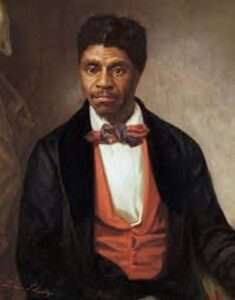
I bring this up because the harshest critique of anti-birthright arguments that is ever likely to appear in print contends that its targets—Peter Schuck and Rogers Smith (both opponents of the EO, for the record)—adhere to a theory of the Citizenship Clause that would take us back to Dred Scott. Gerald Neuman charges that Schuck and Smith's consent-based account of the parental allegiance necessary for a child's citizenship following birth faces two insurmountable obstacles. First, it cannot nullify the effects of Dred Scott's denial of citizenship to Black Americans. Second, its premises about citizenship closely track those of Chief Justice Taney's infamous opinion.
I'll conclude this series by taking inspiration from Neuman's arguments. I'll show that his charges—grave though they are—stick to consent theories of citizenship. And I'll contend that even if, somehow, someway, you can conjure up a consent theory that can avoid them, you shouldn't do it. The Dred Scott challenge isn't a difficult but rewarding game that ingenious scholars should have an interest in overcoming. It's an invitation to rewrite constitutional text and history in harmful ways. Read More
Today I spoke at Chicago-Kent Law School. I was invited to participate in a discussion about executive power, jointly hosted by the FedSoc and ACS. As is custom, the students posted flyers throughout the school. But not everyone was happy with my presence. Someone took the time to put a sticker on the poster in front of my face, saying "Nazis are unwelcome here." The student leaders promptly replaced the flyers and notified the administration.
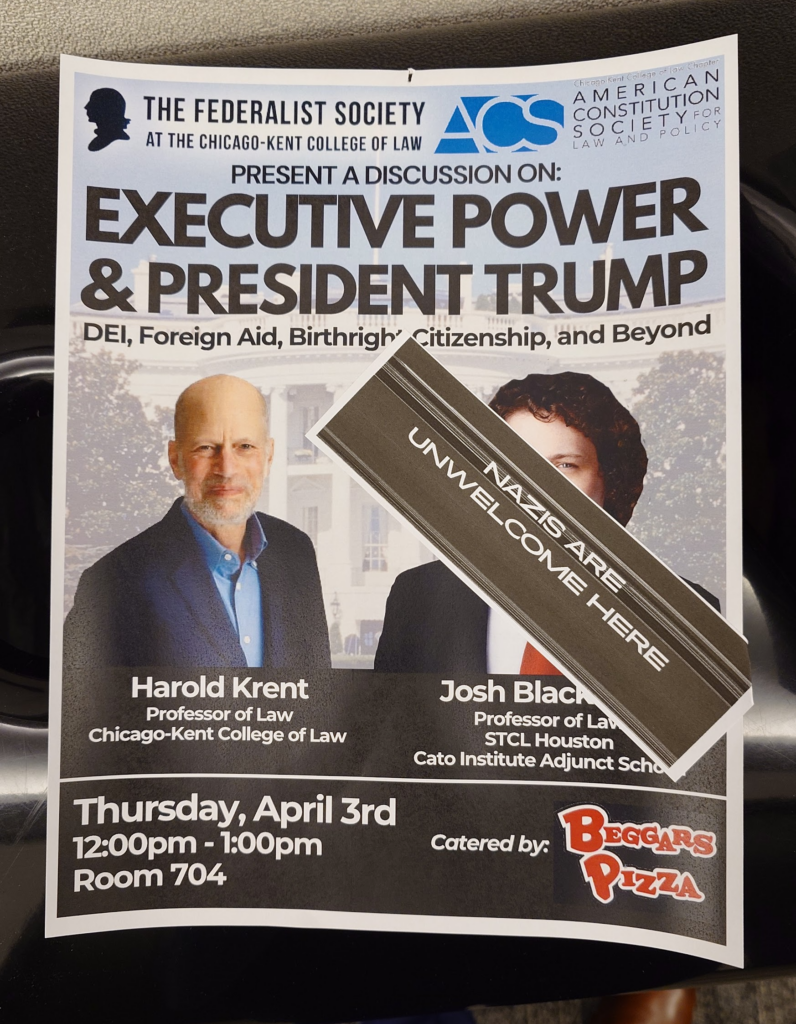
Thankfully, no one disrupted the event. Everything went smoothly. Still, I am struck, and disturbed, at how easily students label those they disagree with as Nazis.
Indeed, this isn't the first time I've been called a Nazi. When I was protested at CUNY back in 2018, the students called me a Nazi, a Fascist, and worse.
I am happy to pass along this announcement from my friends at the Heritage Foundation:
Title: Research Associate, Meese Center for Legal and Judicial Studies
Reports to: Director, Meese Center for Legal and Judicial StudiesJob Summary: The Research Associate is responsible for managing various Meese Center programs and projects, particularly its amicus and moot court programs, with opportunities to conduct research and author commentary on new cases and current legal issues. This role requires strong administrative skills, a working knowledge of emerging legal issues in state and federal courts, and exceptional legal writing, research, editing, and communication skills.
Job Duties:
- Schedule and host teleconferences and moot courts for the appellate advocacy program.
- Manage email alerts regarding amicus opportunities and process amicus requests from external organizations.
- Track petitions for certiorari at the U.S. Supreme Court and prepare alerts regarding Supreme Court orders and opinions.
- Provide administrative support for the public interest law program.
- Support and participate in various Meese Center events and conferences.
- Assist Meese Center scholars and staff as needed on Meese Center projects including the Election Fraud Database, Election Integrity Scorecard, Defensive Gun Use Database, and Judicial Appointments Tracker.
- Conduct research on behalf of scholars, identify emerging legal issues, track developments in key litigation, and author commentary on issues related to Heritage and Meese Center priorities.
Qualifications:
Education: B.A. in related field (required); part-time law student or paralegal training (preferred)
Experience: 2+ years of administrative, research, and writing experience, with legal experience preferred
Communication: Excellent, fast, and convincing writing for both research and commentary
Technology: Microsoft Suite (high proficiency)Other Requirements:
- Understand and support the Heritage mission and vision for America, and the department's goals and objectives.
- Promote content consistent with Heritage's priorities; speak with one voice.
- Proficiency in the Bluebook citation guide.
- Outstanding research, writing, editing skills, especially an ability to use legal research tools, to think outside the box, and to produce accurate and insightful content.
- Highly organized with the ability to maintain careful attention to detail, prioritize and manage multiple projects simultaneously, and complete projects in a timely and efficient manner.
- High level of professionalism (adaptability, maturity, integrity, accountability).
- Demonstrate strong desire and ability to assume increasing levels of responsibility.
- Exercise initiative, within mission and established policies, to achieve assigned objectives.
Benefits and Salary:
The Heritage Foundation offers a highly competitive benefits package that includes, but is not limited to, best-in-class health care, vision, and dental insurance, employer-sponsored retirement funding, "take what you need" PTO and sick leave, 14 weeks of paid leave for new moms and 6 weeks of paid leave for new dads, among other programs.
The salary range for this role is $57,000 - $67,000 annually. This range is a good-faith estimate, and the final salary offered to a selected candidate depends on a variety of factors including, but not limited to, the candidate's experience, education, and other qualifications; internal and external market pay for comparable jobs; and level of hire based on aforementioned qualifications.
4/4/1861: Justice John McLean dies.
The third time isn’t the charm.
A lot of water has poured over the dam since Judge Roger Benitez of the Southern District of California issued a preliminary injunction in 2017 against enforcement of California's ban on possession of a magazine holding over ten rounds. Since then, Duncan v. Becerra has been up and down the ladder from the district court to the Ninth Circuit for multiple panel and en banc decisions and then to the Supreme Court, which sent it back for reconsideration in light of Bruen. After Judge Benitez found that the ban is invalid under Bruen, the Ninth Circuit went directly en banc and for the third time upheld the ban.
"Third time's the charm" means you finally got something right, but here "third time isn't the charm," as the Ninth Circuit has now tripled-down in its resistance to the Second Amendment and to the Supreme Court's holdings. On March 20, the en banc court issued two opinions, one upholding the ban on the merits, and the other justifying its circumvention of en banc rehearing rules to allow five senior judges from the previous en banc court to participate again. I won't discuss that second decision here, but suffice it to say that it leaves the strong odor of the appearance of impropriety.
Authoring the majority's opinion on the merits, Senior Judge Susan Graber wrote: "Large-capacity magazines are optional accessories to firearms, and firearms operate as intended without a large-capacity magazine. A large-capacity magazine is thus an accessory or accoutrement, not an 'Arm' in itself. Possession of a large-capacity magazine therefore falls outside the text of the Second Amendment." But even if the text "encompasses the possession of [such] an optional accessory," its "especially dangerous uses" negate its protection.
The court conceded that "experts estimate that approximately half of privately owned magazines hold more than ten rounds," but claim – against the judgment of those citizens – that such magazines have "almost no utility in the lawful defense of the home." And such magazines are not even "arms": "At the time of ratification, a clear distinction was recognized between weapons themselves, referred to as 'arms,' and accessories of weaponry, referred to as 'accoutrements.' Common accoutrements included flint, scabbards, holsters, and ammunition containers such as cartridge cases and cartridge boxes."
The majority doesn't seem to know that a flintlock musket would not fire without a flint, meaning that it is an essential part of an arm protected by the Second Amendment. And speaking of flintlocks, given the majority's imperative that the more inferior the arm, the better, modern repeating arms that fire smokeless cartridges aren't protected because single-shot flintlock firearms are available. But Heller explicitly rejected that argument.
While claiming that a magazine that holds over ten rounds is not an arm, the majority asserts that a magazine that holds ten or less is an arm because it "is necessary to the ordinary operation" of the firearm "as intended." Ordinary operation as intended by whom? This made up distinction could be used to justify a ban on magazines that hold more than two rounds, as that would still allow the semiautomatic function.
Instead of historical analogues per Bruen, the court calls upon "a more nuanced approach" because the case "implicates both unprecedented societal concerns and dramatic technological changes." That refers to the fact that firearms have developed technologically (Heller said they are still protected) and they have been used in murders (Heller said that was no reason to ban handgun possession by law-abiding persons). The court cites the usual historical restrictions on lancegays, gunpowder storage, trap guns, Bowie knives, slungshot, and pistols but none of these were bans on mere possession.
Of course, Bruen's language about unprecedented social change is inapplicable to Second Amendment challenges to arm ban laws. As explained in Professor Mark Smith's Harvard JLPP article "What Part of 'In Common Use' Don't You Understand?":
They weren't authorized by Congress and go against the major questions and nondelegation doctrines.
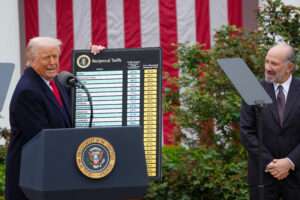
Yesterday, President Donald Trump announced his gargantuan "Liberation Day" tariffs. They impose 10% tariffs on imports from almost every nation in the world (with the notable exception of Russia), plus additional "reciprocity" tariffs on some 60 additional countries, based on an utterly nonsensical formula that isn't actually about reciprocity at all. If allowed to stand, this will be the biggest trade war since at least the Great Depression (the tariff rates here may actually be even higher than those of the notorious 1930 Smoot-Hawley Tariff, which greatly exacerbated the Depression), and the biggest tax increase on Americans in decades.
Economists across the political spectrum expect the tariffs to cause great harm. As my George Mason University colleague Tyler Cowen puts it, "[w]e will be moving into a future with higher prices, less product choice, and much weaker foreign alliances….. This is perhaps the worst economic own goal I have seen in my lifetime."
The enormous scale of the new Trump tariffs is at the heart of their illegality. In an earlier post, I explained why Trump's earlier use of the International Emergency Economic Powers Act of 1977 (IEEPA) to impose 25% tariffs on Canada and Mexico is illegal and unconstitutional under the major questions and nondelegation doctrines. This much larger abuse of the IEEPA is even more clearly illegal.
As GOP Senator Rand Paul put it, in a speech denouncing the new tariffs: "One person in our country wishes to raise taxes. This is contrary to everything our country was founded upon. One person is not allowed to raise taxes. The Constitution forbids it." Exactly so. The Constitution gives Congress the power to impose tariffs, and the President cannot exercise it without, at the very least, having much clearer congressional authorization than exists here.
The IEEPA gives the president authority to impose various types of sanctions in situations where there is "any unusual and extraordinary threat, which has its source in whole or substantial part outside the United States, to the national security, foreign policy, or economy of the United States, if the President declares a national emergency with respect to such threat."
In a recent Lawfare article, international economic policy expert Peter Harrell makes a strong case that the IEEPA doesn't authorize tariffs at all. Even if it does, they can only be used if 1) the president legally declares a "national emergency" and 2) the emergency is over an issue that poses "unusual and extraordinary threat, which has its source in whole or substantial part outside the United States, to the national security, foreign policy, or economy of the United States." Neither of these requirements has been met.
The supposed "emergency" here is the existence of bilateral trade deficits with many countries. By its nature, an "emergency" is a sudden, unexpected crisis. There is nothing new about bilateral trade deficits. They have existed for decades. Moreover, as economists across the political spectrum recognize, they are not actually a problem at all. America's bilateral trade deficit with Canada, Mexico, or the European Union is no more problematic than my trade deficit with my local supermarket: I buy thousands of dollars worth of food there every year; they virtually never buy anything from me!.
Even if courts defer to the president's claim that trade deficits qualify as an "emergency," they still don't count as an "unusual and extraordinary threat." There is nothing unusual and extraordinary about them (again, they have existed for decades), nor do they pose any real threat. Vice President J.D. Vance says the administration is trying to reverse a pattern that has gone on for "40 years." If so, there is no emergency here, and no "unusual and extraordinary threat."
In recent years, the Supreme Court has invalidated a number of executive initiatives under the "major questions" doctrine, which requires Congress to "speak clearly" when authorizing the executive to make "decisions of vast 'economic and political significance.'" If things are unclear, courts must reject the executive's assertion of power.
If Trump's sweeping use of the IEEPA to start the biggest trade war in a century does not qualify as a "major question," I don't know what does. Trump's "Liberation Day" makes even Joe Biden's $400 billion student loan forgiveness plan (which I opposed, and which the Supreme Court rightly invalidated under MQD) seem modest by comparison.
And, it is at the very least, far from clear that the IEEPA authorizes the use of tariffs, that we have an emergency here, or that there is any "unusual and extraordinary threat." If any of these three preconditions are not clearly and unequivocally met, then the major questions doctrine requires the courts to invalidate the tariffs unless and until Congress enacts new legislation clearly authorizing them.
In addition to running afoul of the major questions doctrine, Trump's new IEEPA tariffs also violate constitutional limits on delegation of congressional power to the executive. Even if Congress did clearly authorize these measures, it cannot give away its authority to the president on such an enormous scale. Admittedly, the Supreme Court has long taken a very permissive approach to nondelegation, upholding broad delegations so long as they are based on an "intelligible principle." But, in recent years, beginning with the 2019 Gundy case, several conservative Supreme Court justices have expressed interest in tightening up nondelegation rules.
Moreover, Trump's claims to virtually limitless tariff authority under the IEEPA undermine virtually any constitutional constraints on delegation. If longstanding, perfectly normal, bilateral trade deficits qualify as an "emergency" and as an "unusual and extraordinary threat," the same can be said of virtually any international economic transaction that the president disapproves of for virtually any reason. The president would have the power to impose any level of tariffs on goods or services from any country, pretty much anytime he wants. To borrow a turn of phrase from University of Texas law Prof. Sanford Levinson, this is "delegation run riot." If the courts are going to impose any limits on executive delegation at all, they have to draw the line here.
Finally, it's worth noting the relevance of the longstanding rule of statutory interpretation requiring courts to interpret federal statutes in ways that avoid constitutional problems. As the Supreme Court put it in Crowell v. Benson (1932), "[w]hen the validity of an act of the Congress is drawn in question, and even if a serious doubt of constitutionality is raised, it is a cardinal principle that this Court will first ascertain whether a construction of the statute is fairly possible by which the question may be avoided." Here it is obvious that it's "fairly possible" for courts to conclude that the IEEPA doesn't authorize tariffs, that there is no genuine national emergency, or that there is no "unusual and extraordinary threat," or that the Trump administration's interpretation of the law violates the major questions doctrine. Any one of these moves can avoid the need to address the constitutional nondelegation issue.
In sum, Trump's new tariff policy is not only horrifically awful, but also illegal on multiple different grounds.
As I have previously noted, the Liberty Justice Center and I are looking for appropriate plaintiffs to challenge this grave abuse of executive power in court (which LJC will represent on a pro bono basis, with me providing assistance, as needed). We have gotten a number of potentially promising contacts, and are guardedly optimistic we will be able to pursue this issue soon.
Jane Bambauer and I discuss President Trump's Executive Orders that target major law firms (such as WilmerHale and Jenner & Block). The Orders target the firms for retaliation based largely on their past support of various left-wing legal causes. Do those Orders violate the firms' (and their clients') Free Speech Clause or Petition Clause rights? Might they also violate the Fifth Amendment's Due Process Clause (in civil cases) and the Sixth Amendment right to counsel (in criminal cases)?
See also our past episodes:
The DOJ's rather heavy-handed attempt to coerce an elected municipal official to do its bidding on immigration matters is firmly and properly rejected
The district court in SDNY has dismissed the criminal case against NYC Mayor Eric Adams. The dismissal is with prejudice, i.e., the charges cannot be re-filed at a later date; the court rejected the DOJ's attempt to have the case dismissed without prejudice, which would have left the DOJ free to re-instate the charges at any time and for any reason. [The lengthy and quite comprehensive opinion by Judge Ho is available here].
"Everything here smacks of a bargain: dismissal of the Indictment in exchange for immigration policy concessions."
I have put lengthy excerpts from Judge Ho's opinion below. A brief summary:
First, the court was highly skeptical of DOJ's asserted rationale for dismissing the charges against Adams, calling them "pretextual." But it felt that it was in no position to deny the motion to dismiss in its entirety, because it would then "have no way to compel the government to prosecute [the] case":
"A court cannot force the Department of Justice to prosecute a defendant. That is by design. In our constitutional system of separation of powers, a court's role in a criminal case is to preside over the matter—not to decide whether the defendant should be prosecuted…. Any decision by this Court to deny the Government's Motion to Dismiss would be futile at best, because DOJ could—and, by all indications, unequivocally would—simply refuse to prosecute the case, inevitably resulting in a dismissal after seventy days for violating the Mayor's right to a speedy trial"
However, as to whether the dismissal should be with or without prejudice, the court - correctly[**] - found that dismissing the charges without prejudice, as the DOJ had requested, would "leave Mayor Adams under the specter of reindictment at essentially any time, and for essentially any reason … a sword of Damocles … that would create the unavoidable perception that the Mayor's freedom depends on his ability to carry out the immigration enforcement priorities of the administration, and that he might be more beholden to the demands of the federal government than to the wishes of his own constituents."
It therefore had no real option other than a dismissal with prejudice. Read More
Evan Bernick's third in a series of guest-blogging posts on birthright citizenship.

Trump's anti-birthright executive order is often described as being targeted at people who enter the country unlawfully. But its scope is broader, closely tracking the anti-birthright "theory" of disgraced, disbarred, and discredited former Chapman University law professor John Eastman. Consistently with Eastman's proposals on the subject, the EO also excludes the children of immigrants who entered the country legally but are not lawful permanent residents—i.e., not green-card holders.
I've spent the last two posts critiquing Kurt Lash's shockingly weak argument that the original meaning of the Citizenship Clause excludes the children of unlawful entrants from citizenship. But not even Lash commits to defending the component of Trump's EO which excludes lawful temporary visitors. The obvious problem with this component from the standpoint of Lash's parental-loyalty-based account of birthright citizenship is that lawful temporary visitors have voluntarily submitted themselves to the sovereign power of the United States, which has authorized their presence within its borders. There's nothing "disloyal" about this that would rebut Lash's crucial presumption in favor of parental loyalty—and thus birthright citizenship.
But the Trump administration's lawyers are making arguments for exclusion, and they are citing articles which they claim to be supportive of their position. They assert the existence of a constitutional requirement that a person be "domiciled" within the United States before their children can be entitled to birthright citizenship. And they contend that neither the children of unlawful entrants nor the children of lawful temporary visitors are domiciled in the United States.
I mean to establish two propositions in this post. First, there is no domicile rule—not as a matter of original public meaning. Second, if there were a domicile rule, it would not categorically exclude the children of unlawful entrants from citizenship. To be faithful to the relevant history, any such rule would entail case-by-case subjective inquiries into the intentions of millions of parents. The EO's exclusion of the children of all unlawful entrants from citizenship could not be sustained. Read More
Celebrate your independence with a subscription to Reason magazine, your most trusted source of honest, insightful news and analysis.




