

4/26/1995: U.S. v. Lopez decided.
The Volokh Conspiracy
Mostly law professors | Sometimes contrarian | Often libertarian | Always independent | Est. 2002

Friday Open Thread
What's on your mind?
Short Circuit: An inexhaustive weekly compendium of rulings from the federal courts of appeal
Electronic monitoring, secret GPS trackers, and a speck in the recesses of interstellar space.
Please enjoy the latest edition of Short Circuit, a weekly feature written by a bunch of people at the Institute for Justice.
New on the Bound By Oath podcast: In 1974, Congress added the law-enforcement proviso to the Federal Tort Claims Act to ensure that the victims of wrong-door raids by federal officers would have a legal remedy. On this episode, we talk with some folks who had a hand in getting the proviso passed into law, and we talk about the case of Martin v. United States, the wrong-door raid case that the Supreme Court will hear next week.
Apparent AI Hallucinations in Defense Filing in Coomer v. Lindell / My Pillow Election-Related Libel Suit
UPDATE: Lawyer's response added; post bumped to highlight the update.
[Post was originally posted April 24, 2025, at 8:14 pm.]
From yesterday's decision by Judge Nina Wang in Coomer v. Lindell (D. Colo.):
As discussed extensively on the record, after confirming with Mr. Kachouroff that he signed the Opposition consistent with his obligations under Rule 11 of the Federal Rules of Civil Procedure, the Court identified nearly thirty defective citations in the Opposition. These defects include but are not limited to misquotes of cited cases; misrepresentations of principles of law associated with cited cases, including discussions of legal principles that simply do not appear within such decisions; misstatements regarding whether case law originated from a binding authority such as the United States Court of Appeals for the Tenth Circuit; misattributions of case law to this District; and most egregiously, citation of cases that do not exist.
Despite having every opportunity to do so, Mr. Kachouroff declined to explain to the Court how the Opposition became replete with such fundamental errors. For example, when confronted with the first misquotation in a parenthetical appearing on page 3 of the Opposition—purportedly drawn from Mata v. City of Farmington, 798 F. Supp. 2d 1215, 1227 (D.N.M. 2011)—Mr. Kachouroff stated to the Court:
Your Honor I may have made a mistake and I may have paraphrased and put quotes by mistake. I wasn't intending to mislead the Court. I don't think the quote is far off from what you read to me.
When asked how a case from the United States District Court for the Eastern District of Kentucky became attributable to the United States District Court for the District of Colorado, Mr. Kachouroff indicated that he "had given the cite checking to another person," later identified as Ms. DeMaster. When asked whether he would be surprised to find out that the citation Perkins v. Fed. Fruit & Produce Co., 945 F.3d 1242, 1251 (10th Cir. 2019) appearing on page 6 of Defendants' Opposition did not exist as an actual case, Mr. Kachouroff indicated that he would be surprised.
DEI Discrimination at the Harvard Law Review
An exposé at the Washington Free Beacon reveals thorough DEI corruption at the Harvard Law Review. As summarized by author Aaron Sibarium, "the Harvard Law Review has made DEI the 'first priority' of its admissions process. It routinely kills or advances pieces based on the author's race. It even vets articles for racially diverse citations."
I had to chuckle at this one: "In a section titled 'Why should they write the foreword?', one 2024 spreadsheet stated that Shirin Sinnar, a professor at Stanford Law School, would be 'the first hijabi, Muslim woman to write the Foreword.'" I mean… lots of tiny American religious demographics, including ones that have faced significant discrimination, have never had a member of their group write the Foreword, and I don't see why that matters. I doubt HLR has had an Elder of the Mormon Church, a Hasidic Jew, a Jehovah's Witness, a Turban-wearing and sword-wielding Sikh, an Assyrian Christian, a member of an Amish community, a Pentecostal snake-handler, and so on, write the prestigious annual Foreword. The lack of self-awareness about confusing the current obsessions of the woke left with something akin to "diversity" is both shocking and not surprising.
KQED Interview on Legal Challenges to Trump's Immigration and Tariff Policies
We also covered the issue of the administration's failure to properly obey court orders and the looming threat of a "constitutional crisis."
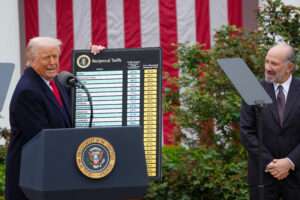
I recently did an interview with KQED NPR radio covering some of the legal challenges to Trump's egregious immigration and tariff policies, and considering the broader issues they raise (including the risk of a "constitutional crisis"). The interview was conducted on April 22, and therefore predates the two most recent challenges to Trump's IEEPA tariffs (those filed by twelve states led by Oregon, and the Pacific Legal Foundation). But we nonetheless covered a lot of important ground, and I think this is one of my better recent interviews.
The interview is about 26 minutes long and is available here and here.
Pacific Legal Foundation Files Case Challenging Trump's IEEPA Tariffs
PLF is a leading libertarian-leaning public interest organization. Their case is similar to that filed by Liberty Justice Center and myself.

The Pacific Legal Foundation (major libertarian public interest law firm) has filed a case challenging Trump's awful IEEPA tariffs, with the awesome name of Princess Awesome v. CBP. Their case is similar to the one filed earlier by Liberty Justice Center and myself.
I welcome PLF to the fight. They are a long-established public interest law firm that has won numerous cases, including before the Supreme Court [full disclosure: they are also my wife's employer, though she is not one of the attorneys on this case].
Like us, PLF is filing in the US Court of International Trade, representing US businesses that import goods from the countries hit by Trump's massive tariffs. Like us, they argue that the International Emergency Economic Powers Act of 1977 (IEEPA) doesn't authorize tariffs at all, that the trade deficits that supposedly justify the "Liberation Day" tariffs are not an "unusual and extraordinary threat" (which IEEPA says must be present to allow use of the law), and that Trump administration's position runs afoul of constitutional nondelegation rules. Their complaint, unlike ours, does not make use of the "major questions doctrine." But I suspect they might raise it eventually.
I cover these and other reasons why the Trump IEEPA tariffs are illegal in more detail in my Lawfare article, "The Constitutional Case Against Trump's Trade War."
PLF's clients are an interesting group, including Stonemaier, LLC, which produces the popular boardgame Wingspan. Also, Princess Awesome v. CBP is probably the greatest - and most awesome - case name ever!
As detailed in PLF's complaint, Princess Awesome is "a Maryland limited liability company that makes children['s] and adult clothing with the intention that all individual human beings deserve to be seen as their true selves and honored for their own unique set of interests." The clothes they make are produced abroad, in countries subject to the tariffs.
While our lawsuit is limited to the massive "Liberation Day" tariffs, PLF is also challenging earlier IEEPA tariffs imposed on China, supposedly justified by the threat of fentanyl smuggling.
There are also other lawsuits challenging some or all of the IEEPA tariffs, filed by twelve states led by Oregon (challenging all IEEPA tariffs, filed in the CIT), the state of California (ditto, but filed in federal district court), the New Civil Liberties Alliance (challenging tariffs against China on behalf of an importer, filed in district court), and one brought by members of the Blackfeet Nation Native American tribe (challenging tariffs against Canada, filed in district court). See links embedded in the previous sentence for my thoughts on these cases and how they relate to ours.
No Problem with Expert's Using ChatGPT to Confirm His Work
"Lehnert used ChatGPT after he had written his report to confirm his findings, which were based on his decades of experience joining dissimilar materials."
From yesterday's decision by Judge Gary Brown (E.D.N.Y.) in Ferlito v. Harbor Freight Tools USA, Inc.:
Plaintiff purchased a splitting maul (an axe specially designed for splitting wood) from defendant in 2017. Several months later, while plaintiff was hanging the maul to store it, the head of the tool detached and struck plaintiff, causing injuries to his nose and left eye. Plaintiff initiated this lawsuit in 2020, alleging that the head detached due to a design defect; defendant asserts the product failed due to plaintiff's misuse, which it contends is evidenced by a large crack in the handle….
To support his defective design claim, plaintiff seeks to offer expert testimony by Mark Lehnert, who identifies himself as a "consultant with products and liability history, extensive knowledge and experience in manufacturing and assembly, [and] mechanical and electrical engineering management." Lehnert holds no engineering degrees, yet reports extensive experience designing and manufacturing power tools, holds over a dozen patents, and has worked in management positions in engineering departments at several corporations over a period of decades.
Lehnert contends the maul used by plaintiff was defectively designed because the handle and head were weakly bound with adhesive, leading to the accident. He opines that good design requires securely attaching the head and handle by "drilling a small diameter hole through the side of the maul, into and through the handle" and placing an aluminum pin "through the head" to reduce the possibility of separation. Lehnert's report references several other mauls currently available for purchase that incorporate such a pin….
Defendant moves to preclude Lehnert's testimony, arguing that he is unqualified as an expert because he lacks engineering degrees, and his experience is limited to designing power tools rather than manual tools. Defendant further argues that Lehnert's opinion is unreliable because (i) he did not rely on any scientific, technical, or trade articles in preparing his report, and (ii) after completing the report, he entered a query into ChatGPT about the best way to secure a hammer head to a handle, which produced a response consistent with his expert opinion….
No problem, says the court:
Today in Supreme Court History: April 25, 1938
4/25/1938: United States v. Carolene Products decided.
Federal Court Blocks Trump Executive Order Denying Federal Funds to Sanctuary Cities
The decision is based on precedents in similar cases during Trump's first term.

During Donald Trump's first term, federal courts repeatedly struck down his efforts to pressure immigration "sanctuary" jurisdictions by pulling federal grants, and other coercive measures. Last November, I predicted we would see a repeat of this pattern under Trump 2.0.
That prediction (which was not a hard one to make) began to be vindicated today, as federal district Judge William Orrick issued a ruling blocking the federal government from withholding federal funds from San Francisco and fifteen other sanctuary jurisdictions which had filed suit challenging a Trump executive order to that effect.
As Judge Orrick notes in his ruling, the new anti-sanctuary executive order is similar to an earlier 2017 Trump EO, and is unconstitutional for the same reasons:
In 2017, President Donald Trump issued Executive Order 13,768 ("EO 13,768"), titled
"Enhancing Public Safety in the Interior of the United States," which was directed at so-called "sanctuary jurisdictions." The City and County of San Francisco and County of Santa Clara sued, arguing that Section 9 of EO 13,768 was unconstitutional. I found that they had pre-enforcement standing, that they were likely to succeed on the merits because Section 9(a) of EO 13,768 was unconstitutional, and that they faced irreparable harm absent an injunction. I enjoined Section 9(a) of EO 13,768. The Ninth Circuit affirmed. Cnty. of Santa Clara v. Trump, et al., 250 F. Supp. 3d 497 (N.D. Cal. Apr. 25, 2017) (Preliminary Injunction Order), aff'd, 897 F.3d 1225 (9th Cir. 2018).Here we are again. Shortly after taking office in 2025, President Trump issued Executive Orders 14,159 ("Protecting the American People Against Invasion") ("EO 14,159") and 14,218 ("Ending Taxpayer Subsidization of Open Borders") ("EO 14,218") (together, the "2025 Executive Orders"), the language and purpose of which mirror EO 13,768. Like EO 13,768, EO 14,159 directs the United States Attorney General and the United States Department of Homeland Security ("DHS") Secretary to withhold federal funds from "sanctuary jurisdictions," cities and counties that limit the use of local resources to enforce federal immigration law. EO 14,218 directs every federal agency to ensure that "federal payments" to localities do not "by design or effect" "abet so-called 'sanctuary' policies that seek to shield illegal aliens from deportation….
Precedent in the Ninth Circuit and the orders of this court show why the Cities and
Counties have established that they are likely to prevail on the merits of at least their separation of powers, Spending Clause, and Fifth and Tenth Amendment claims. The challenged sections in the 2025 Executive Orders and the Bondi Directive that order executive agencies to withhold, freeze, or condition federal funding apportioned to localities by Congress, violate the Constitution's separation of powers principles and the Spending Clause, as explained by the Ninth Circuit in the earlier iteration of this case in 2018; they also violate the Fifth Amendment to the extent they are unconstitutionally vague and violate due process. See City & Cnty. of S.F. v. Trump, 897 F.3d 1225, 1234– 35 (9th Cir. 2018); Cnty. of Santa Clara v. Trump, et al., 250 F. Supp. 3d 497, 530–32, 534–36 (N.D. Cal. Apr. 25, 2017). The 2025 Executive Orders' directives to withhold or freeze federal funding to sanctuary jurisdictions also violate the Tenth Amendment because they impose coercive condition intended to commandeer local officials into enforcing federal immigration practices and law. See Cnty. of Santa Clara, 250 F. Supp. 3d at 533. And as the order that will follow this one makes plain, the Cities and Counties have also shown a likelihood of success on the merits of their Administrative Procedure Act ("APA") claim: the Bondi Directive's order to freeze all DOJ funds is likely arbitrary and capricious, contrary to the Constitution and an ultra vires final agency action under the APA. 5 U.S.C. § 706(2).
As explained in detail in my Texas Law Review article on litigation arising from Trump's first-term actions targeting sanctuary jurisdictions, executive orders like this one violating constitutional rules on both federalism and separation of powers, because they seek to "commandeer" state and local governments and impose conditions on federal grants that were not authorized by Congress. That article includes discussion of the rulings cited in Judge Orrick's opinion today (including his own earlier decisions).
This is just a ruling on a preliminary injunction. We don't yet have a final ruling on the merits, by Judge Orrick. And any such ruling is likely to be appealed. But the combination of today's decision and precedents from Trump's first term - issued by both liberal and conservative judges - make it highly likely that Trump's new anti-sanctuary executive orders will ultimately meet the same fate as the old ones.
For more on the constitutional issues involved, see my Texas Law Review article and this shorter 2018 article I wrote for The Hill. In a recent article for the NYU Brennan Center, I explained how sanctuary jurisdictions can help constrain Trump's efforts at mass deportation, but also noted possible ways Trump could try to circumvent them.
"When the Supreme Court Spoke With One Voice" But Was Ignored By Everyone
Cooper v. Aaron is not a model the Roberts Court should try to emulate.
Last week, in Garcia v. Noem, Judge Wilkinson invoked President Eisenhower's decision to send federal troops to integrate Central High School in Little Rock. And yesterday, Jeff Toobin called on the Roberts Court to reaffirm Cooper v. Aaron to stop Trump. His piece was titled, "When the Supreme Court Spoke With One Voice." Toobin wrote:
The choice for the court is clear: Either the justices will reaffirm the holding of Cooper that the federal judiciary is "supreme in the exposition of the law of the Constitution" or they will cede that authority to Mr. Trump and his aides. Abdicating its role to the executive branch would not only demean the judicial function but also invite chaos, as the nation wonders, case by case, which branch of government has the last word.
To preserve their authority, as well as the rule of law, the justices must reclaim what their predecessors in 1958 knew to be the only honorable and lawful course. And when they do, it would be even better if all nine of them in 2025 also signed their names.
In Cooper, the Supreme Court may have spoken with one voice, but it was largely ignored.
The crisis in Little Rock, and the Supreme Court's resulting decision in Cooper v. Aaron, are poorly understood. In my post, I included an excerpt from our 100 Cases book which summarizes the case. I would also recommend my article in the Georgetown Law Journal, The Irrepressible Myth of Cooper v. Aaron.
Should Cooper provide a basis for the Supreme Court to reaffirm the principle of judicial supremacy against President Trump? No, it should not.
Pro-Life Amicus Brief in Georgia Adult-Entertainment Case
Two pro-life groups and five law professors urge the Supreme Court to take up Georgia Ass'n of Club Executives v. Georgia.
Yesterday, I blogged about the First Amendment Scholars' brief (filed by Chris Paolella of Reich & Paolella LLP) supporting the cert petition I filed in Georgia Ass'n of Club Executives v. Georgia. (For my blogging about the cert petition itself, see Parts 1 and 2 here, and see also the amicus brief supporting the cert petition filed by the Foundation for Individual Rights and Expression (FIRE) and the First Amendment Lawyers Ass'n. The state's brief is due in a month. See also this news article about the amicus briefs in Bloomberg Law.)
Today, I'll talk about the amicus brief filed by Secular Pro-Life, Progressive Anti-Abortion Uprising, and five law professors (Helen Alvaré of George Mason, Teresa Stanton Collett of University of St. Thomas (MN), George Dent of Case Western, Stephen Gilles of Quinnipiac, and Robert Pushaw of Pepperdine).
Thanks to Kelsey Hazzard of Secular Pro-Life and my Emory Law colleague Tom Arthur for writing and filing this brief. More generally, thanks to the organizations and people involved for recognizing that we're all in this together: pro-life people who oppose Hill v. Colorado should support this cert petition even if they have no interest in (or are even opposed to) adult entertainment, because high-level First Amendment doctrines (like the distinction between content discrimination vs. content neutrality) are rarely hermetically sealed to particular business models! Supporting Reed v. Town of Gilbert and making it extremely hard for the government to discriminate in regulation and taxation pays dividends across the board, whether you support nude dancing or anti-abortion counseling.
Here's the text of the (interesting parts of the) brief:
Interest of Amici Curiae
Secular Pro-Life is a not-for-profit organization whose mission is to advance secular arguments against abortion; create space for atheists, agnostics, and other secularists interested in anti-abortion work; and build interfaith coalitions of people interested in advancing secular arguments. Secular Pro-Life envisions a world in which people of all faith traditions, political philosophies, socioeconomic statuses, sexualities, races, and age groups oppose abortion.
Financial precarity motivates nearly three-quarters of abortions. The pro-life movement offers practical resources to help families overcome financial barriers and choose life for their children—but these resources are only useful to the extent that pregnant mothers know about them before it is too late. Therefore, Secular Pro-Life strongly supports the practice of peaceful sidewalk outreach to prevent abortions. Sidewalk outreach is especially critical for religiously unaffiliated mothers, who are disproportionately at risk for abortion compared to the general population, and who may not otherwise learn about free pregnancy supports that are commonly advertised through faith-based channels.
Secular Pro-Life takes an interest in this case because Hill v. Colorado, 530 U.S. 703 (2000), inhibits life-saving sidewalk outreach and unconstitutionally censors the speech of Secular Pro-Life's members.
Progressive Anti-Abortion Uprising (PAAU) is a single-issue non-profit organization committed to ending elective abortion, focusing on issues that land at the intersection of pregnancy and parenting. Non-violent direct action, including sidewalk advocacy, is at the core of PAAU's mission. Buffer zone laws of the type this Court upheld in Hill v. Colorado are designed to impede peaceful challenges to the oppressive status quo.
The following professors teach and/or research in the area of law and religion and are interested in the development of sound doctrine in this area, as well as the protection of free speech rights in Hill v. Colorado-type contexts. [List of professors and affiliations omitted because I gave their names above.]
Summary of Argument
Hill v. Colorado, 530 U.S. 703 (2000), was egregiously wrong on the day it was decided and remains so today. Relying on a line of cases that began with City of Renton v. Playtime Theatres, Inc., 475 U.S. 41 (1986), this Court in Hill treated buffer zone laws as content-neutral time, place, and manner regulations subject to only intermediate First Amendment scrutiny. This Court should instead apply strict scrutiny because buffer zone laws are, in both theory and practice, content-based restrictions on disfavored anti-abortion speech.
"To be sure, this Court has not uttered the phrase 'we overrule Hill.'" Coalition Life v. City of Carbondale, 145 S. Ct. 537, 540 (2025) (Thomas, J., dissenting from denial of certiorari). But "Hill has been seriously undermined, if not completely eroded." Id. at 542.
Although this case does not involve a buffer zone, Petitioner's direct challenge to the mistaken reasoning of City of Renton and its progeny offers this Court an ideal vehicle to, at long last, utter the phrase "we overrule Hill" and restore freedom of speech to pro-life Americans.
Today in Supreme Court History: April 24, 1963
4/24/1963: Sherbert v. Verner argued.
Wednesday Open Thread
What's on your mind?
Twelve States File Lawsuit Challenging Trump's IEEPA Tariffs
The suit resembles previous ones on the same subject filed by the state of California, and by the Liberty Justice Center and myself.

Today, twelve blue and purple states, led by the state of Oregon, filed a lawsuit in the US Court of International Trade challenging Donald Trump's massive IEEPA tariffs. Their complaint is available here. The arguments advanced by the multistate plaintiffs are similar to those presented in the lawsuit the Liberty Justice Center and I presented in a similar lawsuit filed on behalf of five US businesses severely harmed by the tariffs (also filed in the CIT). They also resembled those made by the state of California in a case filed in federal district court.
Like California and us, the twelve states argue that the International Emergency Economic Powers Act of 1977 (IEEPA) doesn't authorize tariffs at all, and that Trump administration's position runs afoul of constitutional nondelegation rules (though they shy away from the term "nondelegation." I think it might help if they were more explicit in indicating the tariffs also go against the"major questions" doctrine, and that the trade deficits that supposedly justify the "Liberation Day" tariffs are not an "unusual and extraordinary threat" (which IEEPA says must be present to allow use of the law). But perhaps they may go into these issues more fully as the case progresses.
I cover these and other reasons why the Trump IEEPA tariffs are illegal in more detail in my recent Lawfare article, "The Constitutional Case Against Trump's Trade War."
While our lawsuit is limited to the massive "Liberation Day" tariffs, the multistate plaintiffs - like California - also challenge earlier IEEPA tariffs imposed on Canada, Mexico, and China, supposedly justified by the threat of fentanyl smuggling. I argued that these tariffs are also illegal in a February post where I first outlined the idea of challenging IEEPA tariffs under the nondelegation and major questions doctrines.
There are also two narrower lawsuits challenging the Trump IEEPA tariffs: one brought by the New Civil Liberties Alliance (challenging tariffs against China on behalf of an importer), and one brought by members of the Blackfeet Nation Native American tribe (challenging tariffs against Canada). I expect there will be more lawsuits filed by other groups.
We welcome the twelve states to this fight!
It's impressive this issue has united such a diverse array of people and institutions, including the conservatives at the NCLA, libertarians like myself and many of the LJC lawyers I am working with, blue and purple state governments, Native Americans, and a bipartisan group of prominent legal scholars and former government officials.
Trump's tariff power grab has brought us all together. Perhaps he alone could do it!
Federal District Court Rules Against Trump in Alien Enemies Act Case
The court ruled that Trump invoked the AEA illegally, blocks deportation of Venezuelan migrants who filed the case, and sets out standards for notifying them of their rights to challenge their deportation.
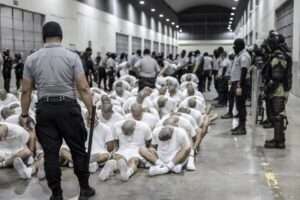
Yesterday, Judge Charlotte Sweeney of the federal District Court for the District of Colorado issued an important ruling against the Trump Administration, involving attempted deportations under the Alien Enemies Act of 1798. The Act can only be used to detain and deport immigrants in the event of a declared war, or an "invasion" or "predatory incursion" perpetrated by a "foreign nation or government." Judge Sweeney ruled (correctly) that none of these preconditions have been met. She also blocked deportation and transfer of the Venezuelan migrant plaintiffs detained in her district, and applied the Supreme Court's earlier ruling requiring that "AEA detainees must receive notice… they are subject to removal under the Act" and that "[t]he notice must be afforded within a reasonable time and in such a manner as will allow them to actually seek habeas relief in the proper venue before such removal occurs."
Here is an excerpt from her discussion of the requirements of the AEA:
Petitioners' first argument…., proceeds from a straightforward premise. The President's authority under the Proclamation is "vested" under the Act. TheAct demands, as a "statutory requirement," an "invasion or predatory incursion…." And because the Act's "text and history" use these terms "to refer to military actions indicative of an actual or impending war"—not "mass illegal migration" or "criminal activities"—the Act cannot sustain the Proclamation… The Court agrees with Petitioners….
The term 'invasion' was a legal term of art with a well-defined meaning at the Founding." J.G.G. v. Trump, No. 25-5067, 2025 WL 914682, at *8 (D.C. Cir. Mar. 26, 2025) (Henderson, J., concurring); see also id. (defining "invasion as a "'[h]ostile entrance upon the right or possessions of another; hostile encroachment,' such as when 'William the Conqueror invaded England'") (quoting Samuel Johnson, Invasion, sense 1, A DICTIONARY OF THE ENGLISH LANGUAGE (4th ed. 1773)); (reciting second dictionary defining "invasion as a "'hostile entrance into the possession of another; particularly the entrance of a hostile army into a country for the purpose of conquest or plunder, or the attack of a military force'") (quoting Noah Webster, Invasion, sense 1, AMERICAN DICTIONARY OF THE ENGLISH LANGUAGE (1828)).
The Court finds these at-the-Founding definitions persuasive in demonstrating what "invasion" does—and does not—mean as a matter of plain language. "Invasions" contemplate military action. J.G.G., 2025 WL 914682, at *9 ("The term 'invasion' was well known to the Fifth Congress and the American public circa 1798. The phrase echoes throughout the Constitution ratified by the people just nine years before. And in every instance, it is used in a military sense.") (Henderson, J., concurring). And at a bare minimum, "invasion" means more than the Proclamation's description of [the drug gang Tren de Aragua's] "infiltrat[ion]," "irregular warfare," and "hostile actions" against the United States….
Definitions of "predatory incursion" likewise reveal a mismatch between what the phrase means and what the Proclamation says. As with the analysis of earlier definitions of "invasion," the Court again finds Judge Henderson's research and analysis of Founding era definitions for "predatory" and "incursion"—which Petitioners cite, and to which they direct the Court—persuasive in its own analysis of Petitioners' TRO motion. See…. J.G.G., 2025 WL 914682, at *10 (Henderson, J., concurring). Explained in Judge Henderson's concurring statement to the D.C. Circuit's per curiam order denying emergency stays prior to the Supreme Court's ultimate intervention in Trump v. J. G. G., 2025 WL 1024097, at *1, the "predatory" nature of an "incursion" "includes a '[p]lundering,' such as the 'predatory war made by Scotland.'" 2025 WL 914682, at *10 (Henderson, J.,concurring) (original alteration and emphasis) (citing Samuel Johnson, Predatory, sense 1, A DICTIONARY OF THE ENGLISH LANGUAGE (4th ed. 1773))….
Petitioners contend, as with its failures to identify an "invasion" or "predatory incursion," the Proclamation likewise fails to assert a "foreign nation or government" is "invading the United States…." The Court agrees with Petitioners. The Court discerns little reason to linger on this point, especially where, as Petitioners observe, the Proclamation finds TdA is "closely aligned with [and] infiltrated[] the Maduro regime." Invocation of the Alien Enemies Act Regarding the Invasion of the United States by Tren de Aragua, 90 FR 13033. The Proclamation does not find TdA itself is a foreign nation, country, or government. At bottom, the Proclamation fails to adequately find or assert TdA is a "foreign nation or government," § 21, sufficient to justify the Act's invocation.
Judge Sweeney's analysis of the meaning of "invasion"and "predatory incursion" largely tracks that of Judge Karen LeCraft Henderson of the DC Circuit, in her opinion for the DC Circuit, in a ruling reversed by the Supreme Court on appeal, for procedural reasons. I have made similar points in my own previous writings on the AEA and the meaning of "invasion." Judge Sweeney also follows the DC Circuit and the Supreme Court in rightly rejecting the argument that interpretation of the AEA is a "political question" not subject to judicial review.
But this ruling is the first to address the issue of whether TdA's actions qualify as those of a "foreign nation or government." Judge Sweeney rightly concludes they obviously don't. Her conclusion is further bolstered by US intelligence assessments indicating that TdA is not acting at the behest of the Venezuelan government.
Judge Sweeney also interpreted the Supreme Court's ruling on notice to detainees to require the following:
The Court orders the following regarding the notice Respondents and the government must provide Petitioners and the provisionally certified class of individuals they seek to represent: Respondents shall provide a twenty-one (21) day notice to individuals detained pursuant to the Act and Proclamation. Such notice must state the government intends to remove individuals pursuant to the Act and Proclamation. It must also provide notice of a right to seek judicial review, and inform individuals they may consult an attorney regarding their detainment and the government's intent to remove them. Such notice must be written in a language the individual understands.
That all seems right to me.
Litigation over AEA deportations is continuing in multiple courts, and this ruling is sure to be appealed. But Judge Sweeney has issued a well-reasoned ruling that I hope other judges will follow.
Bipartisan Group of Prominent Legal Scholars and Former Government Officials Files Amicus Brief Supporting Our Case Challenging Trump's "Liberation Day" Tariffs
Signers include Steve Calabresi, Harold Koh, Richard Epstein, Michael McConnell, Alan Sykes, former Attorney General Michael Mukasey, and others.

A bipartisan group of prominent legal scholars and former government officials have filed an amicus brief supporting the lawsuit against Donald Trump's "Liberation Day" tariffs, recently filed by the Liberty Justice Center and myself, on behalf of five US businesses severely harmed by the policy.
The brief unites big-name constitutional law scholars across the political spectrum in a way I have rarely seen. Legal scholars on the brief include Steve Calabresi (Northwestern), Harold Koh (Yale), Richard Epstein (NYU), Michael McConnell (Stanford, also former federal judge), Alan Sykes (Stanford), and Gerard Magliocca (Univ. of Indiana).
Steve Calabresi is a famed conservative constitutional law scholar and co-founder of the Federalist Society. Michael McConnell is also one of nation's leading conservative/originalist constitutional law scholars, and Richard Epstein is probably the world's leading libertarian legal scholar. Calabresi literally (with Christopher Yoo) wrote the book on unitary executive theory. If he says an assertion of executive power exceeds constitutional bounds, it almost certainly does! McConnell is also a leading expert on executive power.
Koh, Sykes, and Magliocca are leading progressive scholars. Koh is one of the nation's leading experts on the constitutional law of foreign affairs, and Sykes on international economic and trade law. Magliocca is a prominent writer on constitutional history.
Former government officials joining the brief include former Attorney General Michael Mukasey, former Virginia Governor and Senator George Allen, former Senator and Secretary of Defense Charles Hagel, and more.
I never would have expected to see Richard Epstein, Steve Calabresi, and Harold Koh all on the same brief on a major issue. But here they are, together opposing "taxation by proclamation." Donald Trump brought them together. He alone could do it!
Many thanks to Josh Claybourn and Gerard Magliocca for their work bringing this group together.
Here is an excerpt from the brief's summary of argument:
What unites these amici is a shared conviction that process matters—that how we govern is as vital as what we decide. The powers to tax, to regulate commerce, and to shape the nation's economic course must remain with Congress. They cannot drift silently into the hands of the President through inertia, inattention, or creative readings of statutes never meant to grant such authority. That conviction is not partisan. It is constitutional. And it strikes at the heart of this case.
This dispute is not about the wisdom of tariffs or the politics of trade. It is about who holds the power to tax the American people. May a President, absent a clear delegation from Congress and without guidance that amounts to an intelligible principle, unilaterally impose sweeping tariffs under laws never designed for that purpose? This is not a debate over outcomes but a test of structure. It asks not what should happen, but who decides.
The Constitution gives a clear answer. Article I vests Congress—not the President—with the power to "lay and collect Taxes, Duties, Imposts and Excises," and to "regulate Commerce with foreign Nations." Unless Congress has delegated that authority through a valid and clearly bounded framework, the President may not impose tariffs….
In April 2025, President Trump proclaimed a sweeping tariff regime that touches nearly every imported good sold in the United States…. These levies did not arise from legislation. They were not the product of congressional debate or any statutory process. Nor were they supported by specific findings under existing trade laws. Instead, they were imposed unilaterally, by presidential proclamation….
But no statute authorizes what the President has done. The laws cited permit limited and targeted actions under narrow conditions. They do not authorize sweeping economic realignment. They do not permit unilateral taxation of vast sectors of the U.S. economy. These duties came not from Congress, but from a claim of executive power detached from constitutional limits….
IEEPA, the central statute invoked, cannot bear this weight. Enacted in 1977 to rein in presidential overreach, IEEPA allows the President to impose sanctions in response to genuine emergencies—not to reorder the economy in response to long-term trends. Its legislative history is clear: Congress never intended it as a backdoor for permanent tax policy, nor as a means of sidestepping Article I.
The core principle urged by amici is this: IEEPA and related statutes do not grant the President the power to impose tariffs of this kind or scope. That power remains squarely within the legislative domain. The Constitution places decisions about taxation and commerce in Congress's hands—not as a formality, but as a structural safeguard of democratic accountability….
This case requests this Court apply the principles which have been reaffirmed time and again: that Congress makes the law, and the Executive enforces it; that major policies require explicit legislation; and that the Constitution does not permit taxation by proclamation. These principles are neither new nor partisan. They are the foundation of the American republic.
The stakes here are immediate and profound—not because of any particular trade policy, but because of the process by which that policy was imposed. For decades, the United States has anchored a global trading system built on transparency, deliberation, and the rule of law. That stability is jeopardized when core powers—like the power to tax—are exercised unilaterally, without congressional input, statutory grounding, or public explanation. The President's tariff proclamations bypass the constitutional framework that lends legitimacy and predictability to American lawmaking. Already, foreign governments are reexamining their trade commitments in response. If courts permit this path to stand unreviewed, it will invite escalating disruption—not just to international commerce, but to the very norms that sustain constitutional governance. The Court's intervention is not merely appropriate; it is essential to reaffirm that in a republic, process cannot be subordinated to expediency.
First Amendment Scholars' Amicus Brief in Georgia Adult-Entertainment Case
22 law professors urge the Supreme Court to take up Georgia Ass'n of Club Executives v. Georgia.
Regular readers will remember my blogging (Parts 1 and 2) about the cert petition I filed in Georgia Ass'n of Club Executives v. Georgia, where we raised a First Amendment challenge to a state tax on adult entertainment establishments, and about the amicus brief supporting the cert petition filed by the Foundation for Individual Rights and Expression (FIRE) and the First Amendment Lawyers Ass'n.
Now, more amicus briefs have come in. (The state's brief is due in a month and our reply brief soon after that, so we should find out whether cert is granted by sometime this summer.) The first brief I'll mention is the First Amendment Scholars' brief, filed by Chris Paolella of Reich & Paolella LLP.
Here's the text of the (interesting parts of the) brief:
Interests of Amici Curiae
Amici are 22 legal scholars who research, teach, and publish scholarship on the First Amendment's free speech clause. Their names, their institutional affiliations, and examples of their relevant scholarship are set forth in the Appendix to this brief. Amici have no personal interest in this case; they submit this brief to urge the Court to grant certiorari to resolve a long-standing inconsistency in its First Amendment jurisprudence.
Summary of Argument
The threshold question in deciding whether a government regulation offends the First Amendment's guarantee of freedom of speech is whether the regulation discriminates based on the content of the speech. Laws "that target speech based on its communicative content . . . are presumptively unconstitutional." Reed v. Town of Gilbert, 576 U.S. 155, 163 (2015). They are subject to strict scrutiny, which requires the government to show that the restriction "is 'narrowly drawn' to further a 'compelling interest' and that the restriction amounts to the 'least restrictive means' available to further that interest." Ashcroft v. ACLU, 542 U.S. 656, 677 (2004) (citations omitted).
"On the other hand, so-called 'content-neutral' time, place, and manner regulations" aimed at combating "the undesirable secondary effects" of expression are subject to the less exacting standard of intermediate scrutiny. City of Renton v. Playtime Theatres, Inc., 475 U.S. 41, 47, 49 (1986). To survive intermediate scrutiny, a restriction on speech or expression need only be "narrowly tailored to serve the government's legitimate, content-neutral interests"; it need not "be the least restrictive or least intrusive means of doing so." Ward v. Rock Against Racism, 491 U.S. 781, 798 (1989).
In most cases, the decision whether to apply strict or intermediate scrutiny will determine whether the regulation survives. But the line dividing content-based laws and content-neutral regulations has never been entirely clear. In recent years, that line has become even blurrier.
In Reed, this Court declared that content-based regulations are subject to strict scrutiny "regardless of the government's benign motive, content-neutral justification, or lack of 'animus toward the ideas contained' in the regulated speech." 576 U.S. at 165. This holding is in obvious tension with City of Renton's view that, in at least some cases, a content-neutral "secondary effects" justification is enough to escape strict scrutiny—even where a law singles out a particular type of expressive content for regulation. Some lower courts have read Reed as undermining City of Renton and have revisited their prior jurisprudence in this area.
But other courts continue to apply City of Renton's "secondary effects" rationale to uphold laws that, on their face, discriminate between types of speech. And they apply them in contexts beyond the "time, place, and manner" restrictions at issue in City of Renton. Here, the Georgia Supreme Court upheld a tax levied on certain businesses featuring nude dancing—a type of expressive content—because the ordinance was "'aimed not at the content' of adult entertainment, but 'rather at the secondary effects'" of the expression. Pet. App. 15a (quoting City of Renton, 475 U.S. at 47–48) (emphasis in original). Other courts have applied this rationale to uphold laws regulating not just adult entertainment but also other types of speech, including public protest.
In short, there is incoherence at the center of this Court's First Amendment jurisprudence. Government regulators, speakers, and lower courts have no clear guidance as to whether a particular regulation will be viewed as content-based and subject to exacting strict scrutiny, or as a content-neutral regulation of secondary effects that need only satisfy intermediate scrutiny. This confusion has the potential both to confound good faith attempts at regulation and to chill speech that should be protected by the First Amendment.
Amici have differing perspectives on the continuing viability of City of Renton, as well as on the extent to which the government may constitutionally regulate specific types of speech based on that speech's secondary effects. They therefore take no position on whether City of Renton should be overruled, limited to a particular context, or read to cover facts like those here. Nor do they take any position on how the Court should rule on the challenged Georgia law.
But they agree that the Court must provide clear guidance as to the level of scrutiny that applies to a law which singles out a particular type of expressive content but provides a content-neutral justification. Until it resolves the tension between Reed and City of Renton, lower courts will continue to be afloat.
The Court should grant certiorari to resolve this fundamental inconsistency in its free speech jurisprudence.




