
The Volokh Conspiracy

Mostly law professors | Sometimes contrarian | Often libertarian | Always independent | Est. 2002

The Volokh Conspiracy

Free Speech

School's "Interest in Teaching Racial Sensitivity Is Not Sufficient" to Justify Punishing Student's "Free Expression Off-Campus"

So holds the Second Circuit: "Tying a student speaker's constitutional right to free expression solely to the reaction that speech garners from upset or angry listeners cannot be squared with [First Amendment] principles."

|

From Leroy v. Livingston Manor Central School District, decided today by Judge Barrington Parker joined by Judge Beth Robinson (disclosure: I argued in the case on behalf of amici Center for Individual Rights and myself):

Leroy was disciplined by his school after he took a picture with his friends and posted it on social media while outside of his school campus and after school hours. He thought his post, which showed a picture of his friend kneeling on his neck with the caption "Cops got another," was a joke, but he quickly realized others viewed it as an insensitive comment on the murder of George Floyd. He removed his post after a few minutes, but not before another student took a screenshot, which she reposted on other social media platforms…. After public outcry, in-school discussions, student demonstrations and a school investigation, the school superintendent suspended Leroy and barred him from participating in various school activities for the remainder of the school year.

The court concluded that Leroy's speech was protected against discipline by the First Amendment; here's a short excerpt from the long majority opinion:

[T]he school's decision to punish Leroy was motivated, at least in part, by the fact that "the perception of those images, what it depicts, is racist in nature," and the hope that "from this experience … [Leroy] has learned some valuable lessons that will serve him better down the road." …

But as in Mahanoy Area School Dist. v. B.L. (2021), the strength of the school's interest in preventing certain kinds of speech—there, vulgarity, and here, racially insensitive speech—"is weakened considerably by the fact that [Leroy] spoke outside the school on [his] own time." Also, as in Mahanoy, Leroy "spoke under circumstances where the school did not stand in loco parentis," and "the school has presented no evidence of any general effort to [prevent such speech] outside the classroom." These facts convince us that Livingston Manor's interest in teaching racial sensitivity is not sufficient to overcome Leroy's interest in free expression off-campus.
Read More

Free Speech

Gender Queer, Libel by Implication, and "Truth Is Not a Complete Defense of Defamation"

|

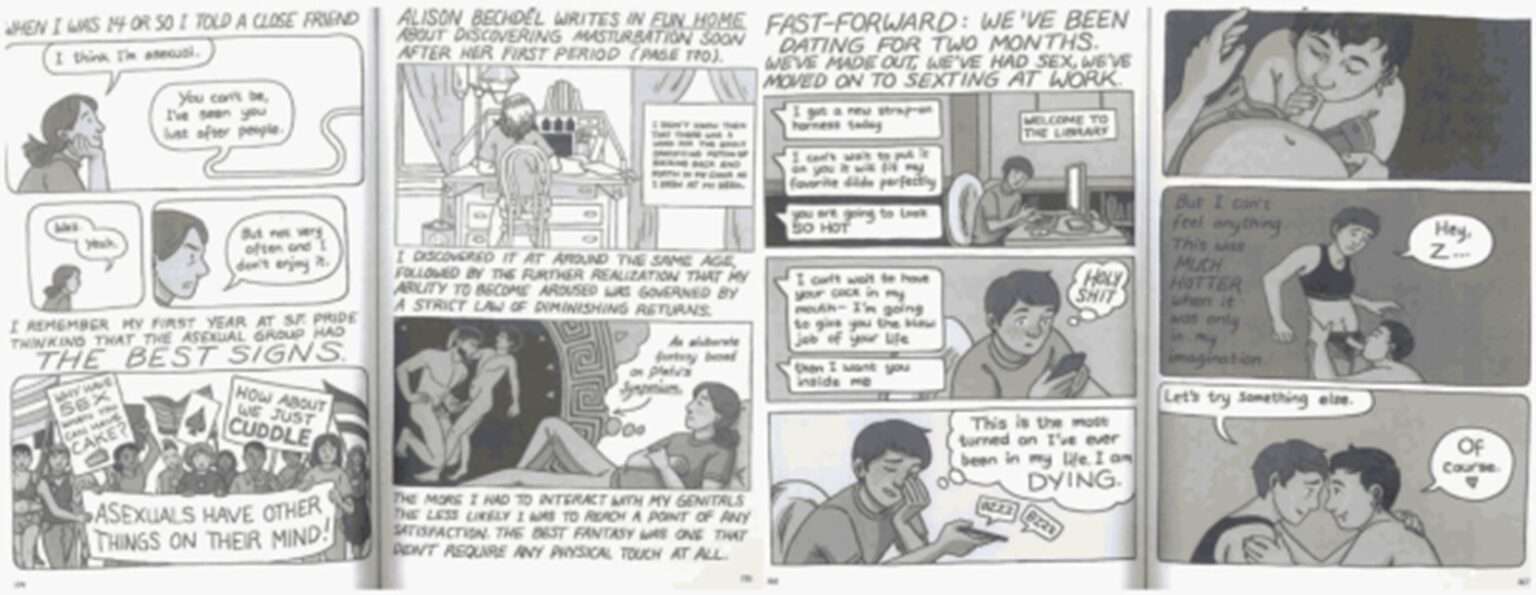
Galdos-Shapiro, a school teacher in Great Barrington (Mass.), was questioned and briefly detained in her classroom by the police over her having at her desk a copy of Gender Queer, which she had available to share with students. She sued police officials, and Judge Mark Mastroianni allowed her First and Fourth Amendment claims to go forward (Galdos-Shapiro v. Town of Great Barrington); the analysis there (see yesterday's post) is quite plausible, since the book isn't obscene, and in any event the relevant state obscenity laws excludes educational uses. The opinion doesn't include the objected-to illustrations from the book, but you can see copies of what appear to be the most controversial illustrations from a different opinion, here and here.

But the court also allowed her defamation claim to go forward as well, based on a press release that read:

On December 8, 2023 [t]he Great Barrington Police Department received a complaint from a person who witnessed what they perceived to be concerning illustrations in a book that was provided to students by a teacher at W.E.B. Dubois Middle School. The illustration provided by the witness depicted animated characters performing sexual acts on each other. Because this complaint was made directly to the police department, we are obligated and have a duty to examine the complaint further. Thanks to our established relationship with the school, we were able to carefully work together to investigate this situation. This involved immediate notification of the Superintendent and Principal of the middle school.

Because we were only provided a single image of the illustration, it was important to identify and examine the material that was reported to us. Working together, it was decided that the department would send an officer toward the end of the day in plain cloth[e]s to be escorted to the classroom and to see if the book containing the illustration could be located. After a brief conversation with the teacher, the officer was advised that the book in question was not there and could not be accounted for at that time. The officer advised the principal and teacher, that we were not there to investigate the subject matter of any books. As a procedure in sensitive or complex investigations, the police notified the District Attorney's Office.

Once the necessary information was gathered, it was determined that it is a matter to be managed within the Berkshire Hills Regional School District. The Great Barrington Police Department is dedicated to the safety of all people, especially children, and we take all complaints seriously….

Here's the court's reasoning on the defamation question:

Read More

Free Speech

Calling Teacher "Bully," "Lunatic," "Woke," "God Complex," and "White Savior" Is Opinion and Thus Not Defamation

|

Yesterday's Wisconsin Court of Appeals decision in MacCudden v. Johnson (Justice Joseph Donald, joined by Justice Maxine White), involved a former high school English teacher (MacCudden); at the time of the statements, she had resigned from the school district, but hadn't updated her LinkedIn profile.

Johnson received a screenshot from a friend of a portion of MacCudden's LinkedIn profile, which Johnson subsequently posted on social media. Johnson's post included the portion of MacCudden's LinkedIn profile which stated that she worked as a "Social Justice Coordinator" circled in red and Johnson wrote, "[w]hy the hell am I paying for a 'Social Justice Coordinator' in my school district?" Johnson further stated, "[t]his is just what @mtschools needs; more woke, white women w/ a god complex. Thank you, white savior."

Later, Johnson added, "[i]f [MacCudden] really wants to promote equity, perhaps she should forfeit her job to a person of color?" Johnson also replied to a social media user that:

Teachers who educate are paid a fraction of what these DEI "specialists" earn. Parents know these woke lunatics are bullies. They are bullying you into silence and compliance.

Good teachers should earn more, get support & feel safe. Partner with us and let's put kids first.

The court concluded that these statements weren't actionable defamation:

Read More

Free Speech

Emory University Senate Open Expression Committee Opinion on "Termination of Professor Due to Charlie Kirk-Related Speech"

|

From the opinion released Oct. 21, 2025:

In the wake of the assassination of Charlie Kirk, an Emory professor posted certain comments about the assassination on social media—first writing "Good riddance," and then writing that they "[didn't] feel bad" about the assassination and that Kirk "seem[ed] like a disgusting individual." The Emory administration, characterizing these comments as celebrating and inciting violence, terminated the professor.

The Committee for Open Expression finds that most of the reasons given by Emory for the termination are inconsistent with Emory's Open Expression Policy (Policy 8.14).

  • Inconsistency with Emory's values cannot itself be a reason for termination.
  • People's mere distress that an Emory professor can make such statements cannot itself be a reason for termination.
  • The Open Expression Policy cannot justify bowing to outsiders' efforts to put pressure on Emory to fire the professor by making threats to other members of the Emory Community.
  • Patients' and parents'/students' distrust cannot justify termination when it is not based on actual patient care or the content of teaching.
  • Violation of Emory's Social Media Guidelines cannot be the basis for termination, because these guidelines do not present themselves as being mandatory; and if they did, a termination cannot be based on the failure to provide a disclaimer in a context like this one, where a disclaimer would serve no useful purpose.

Read More

Gender Identity

DOJ Subpoena to Gender Medicine Telehealth Provider Quashed, but Record Not Sealed

|

From Judge Jamal Whitehead (W.D. Wash.) in Queerdoc, PLLC v. U.S. Dep't of Justice:

On January 20, 2025, President Trump issued Executive Order 14168, "Defending Women from Gender Ideology Extremism and Restoring Biological Truth to the Federal Government." The order declared it "the policy of the United States to recognize two sexes, male and female," stated these sexes are "not changeable," and characterized "gender ideology" and "gender identity" as a "false claim."

The following week, President Trump issued Executive Order 14187, "Protecting Children from Chemical and Surgical Mutilation." 90 Fed. Reg. 8771. This order characterized gender-affirming medical care as "the maiming and sterilizing of a growing number of impressionable young children" and declared it "a stain on our Nation's history" that "must end." The order directed DOJ to "prioritize investigations and take appropriate action to end deception of consumers, fraud, and violations of the Food, Drug, and Cosmetic Act."

On April 22, 2025, Attorney General Pamela Bondi issued a memorandum titled "Preventing the Mutilation of American Children." The memorandum promised that DOJ would "act decisively to protect our children and hold accountable those who mutilate them under the guise of care" and directed the Consumer Protection Branch of DOJ's Civil Division to "undertake appropriate investigations of any violations of the Food, Drug, and Cosmetic Act by manufacturers and distributors engaged in misbranding by making false claims about the on- or off-label use of puberty blockers, sex hormones, or any other drug used to facilitate a child's so-called 'gender transition.'"

On June 11, 2025, DOJ's Civil Division issued a memorandum stating it would "use all available resources to prioritize investigations of doctors, hospitals, pharmaceutical companies, and other appropriate entities" consistent with the Executive Orders and Attorney General's directives. The Civil Division memo identified two investigative priorities: (1) "possible violations of the Food, Drug, and Cosmetic Act and other laws" related to medications used in gender-affirming care, and (2) False Claims Act violations by providers who "evade state bans on gender dysphoria treatments by knowingly submitting claims to Medicaid with false diagnosis codes."

That same day, DOJ served QueerDoc with an administrative subpoena under Section 248 of the Health Insurance Portability & Accountability Act of 1996 (HIPAA), which authorizes subpoenas to aid "[i]n any investigation of … a Federal health care offense."

Read More

Bork Lecture at FedSoc National Convention Will Include Panel of Judges To Address Antisemitism

A fitting update to the rising tide of antisemitism on the left and the right.

|

Following up from my post last night, I am pleased to report that the Bork Lecture at the FedSoc National Convention will focus on antisemitism:

In 1987, Howard G. Crane — then-Managing Partner of Kirkland & Ellis and a self-described "liberal Democrat" — testified in support of Judge Robert Bork's nomination to the U.S. Supreme Court, describing Judge Bork as "a person without prejudice against any group." Crane, who was Jewish, explained that Judge Bork, as a young law firm associate, persuaded his firm to eliminate its ban on Jewish attorneys, resulting in Bork's firm hiring Crane.

In memory of Judge Bork's commitment to religious respect and his rejection of anti-Semitism, Hon. Judge Roy Altman (U.S. District Court for the Southern District of Florida) will moderate a discussion with judges from different faith traditions about the crucial importance of the American tradition of religious respect and tolerance in the U.S. constitutional order, including their personal experiences with interfaith dialogue.

The judges will discuss how First Amendment values — such as respect for free speech and for free exercise of religion — can provide a roadmap for preserving Western values under assault by anti-Semitism and other forms of religious intolerance.

Featuring:

Hon. Lisa Branch, United States Court of Appeals, Eleventh Circuit
Hon. Ray Gruender, United States Court of Appeals, Eighth Circuit
Hon. Andrew Oldham, United States Court of Appeals, Fifth Circuit
Hon. Martha Pacold, United States District Court, Northern District of Illinois
Hon. Lee Rudofsky, United States District Court, Eastern District of Arkansas
Hon. David R. Stras, United States Court of Appeals, Eighth Circuit
Hon. Amul R. Thapar, United States Court of Appeals, Sixth Circuit
Hon. Evan Young, Texas Supreme Court
Moderator: Hon. Roy Kalman Altman, United States District Court, Southern District of Florida

Congratulations to Judge Altman and all of the other members of the panel. This event could not be more timely.

Tariffs

"How Unprecedented Are Trump's 'Emergency Tariffs'"?

|

My Hoover colleague Philip Zelikow, who is involved in the tariff litigation, passed this blog post along to me, and it struck me as very interesting. The author, Alan Wm. Wolff,

was the U.S. Department of Treasury's international trade lawyer from 1969 to March 1971, in which capacity he drafted President Nixon's Import Surcharge Proclamation 4074 of August 17, 1971 and defended this import surcharge at the GATT in September 1971 as counsel with the U.S. delegation. He later served as Deputy General Counsel and General Counsel at the Office of the Special Representative for Trade Negotiations from 1973 to 1977 and as Deputy Special Trade Representative from 1977 to 1979 with the rank of Ambassador. In the Nixon and Ford Administrations, he was the chief drafter for the administration of the Trade Act of 1974, the country's basic trade statute.

An excerpt:

When President Donald Trump imposed his so-called reciprocal tariffs on pretty much all products from all countries this year, he said he was responding to a national emergency due to the nation's trade deficit. He claimed as authority for his actions the International Emergency Economic Powers Act (IEEPA). The lower courts have ruled against the tariffs, finding that Congress had not delegated to the president sufficient authority to impose them. Their decisions are being appealed to the Supreme Court, with oral argument scheduled for November 5.

Only once before has a president imposed a blanket tariff as an emergency measure. President Richard Nixon declared a balance of payments emergency and imposed a 10 percent import surcharge in 1971. It was upheld by an appellate court in 1975 in the case of Yoshida International, Inc. v. United States. It is universally assumed, including by the lower courts in the current case, that Nixon used the Trading with the Enemy Act (TWEA)—the nearly identical predecessor authority to IEEPA—for the 1971 import surcharge.

However, this reading of history is wrong: Nixon did not claim emergency authority for the measure under TWEA. Nixon claimed authority to impose sanctions under trade agreement laws for the tariffs he put into place.

Read More

"Before This Court, Artificial Intelligence Is Optional. Actual Intelligence Is Mandatory"

|

Words from Magistrate Judge Jason Robertson (E.D. Okla.) in last week's Mattox v. Product Innovations Research, LLC. A bit of background:

Plaintiffs' counsel submitted [eleven] pleadings containing fabricated case citations, erroneous citations, quotations of nonexistent law, and misstatements of law. The filings ranged from summary-judgment briefing, to motions in limine, and even a sanctions motion. The pattern was not inadvertent, and it was not harmless. The Court values trust among advocates, but trust must be earned through verification. In this case, filings were trusted, but never verified, and the results speak for themselves.

The court imposed $6K in punitive sanctions on the lawyers, and also required them to compensate the other side for >$23K in attorney fees.

Politics

I Think I Know Why SCOTUS Does Not Grant Fourth Amendment Cases Anymore

Search and seizure cases are very fact bound. The Court wants to set general standards.

|

On October 15, the Supreme Court heard nearly 2.5 hours of oral argument in the Voting Rights Act Case. Without even taking a break, the Court heard the second case, fittingly titled Case v. Montana. It was obvious the Justices were spent. They said so. At one point, Justice Gorsuch referred to a case called Brigham City as Brigham Young. He apologized, and said "Sorry. I am tired." At another point, Justice Barrett apologized for mispronouncing Caniglia, and said "it's been a long day."

Still, for those who managed to slog through the arguments, there was an important takeaway. The Justices did not want to write an opinion based on the unusual facts of this case. They wanted to write a broader rule that would be easy to apply.

Fred Rowley, who represented Case, spent a lot of time discussing the particular facts that the police officers knew about the defendant. He mentioned several officers by name, and referenced what they said on body camera footage. This approach may have been appropriate for this case, but it was unusual. In most Supreme Court cases, the facts on the ground really don't matter. The Justices are trying to set some sort of national rule. In this case, Justice Jackson in particular seemed frustrated with the fixation on the record. At one point, Jackson interrupted Rowley, who was talking about the facts, and said "We're trying to think about a standard here." Later, Rowley was talking about knowledge that one of the officers had about Case. Jackson again said, "Well, setting aside this particular case, let me just try to understand the standard that you want us to apply."

Fourth Amendment caselaw can be very fact-bound. The Justices did not want to get into the weeds. They seemed content to just announce a test, and let the lower courts figure it out. In this case, the test is "objective reasonableness" from Brigham City. Justice Barrett, in particular, did not want to say what that test entailed.

JUSTICE BARRETT: But are you really saying that we should do something different than in Brigham City or --or muddy the waters by saying, oh, you know, objectively reasonable basis but could be reasonable suspicion?

MR. CORRIGAN: You're --you're correct on --on the first part, on your --on the former. We are not saying that they should --that the Court --that Brigham City means reasonable suspicion. What --what we're saying is, in some instances, it could, as you said Justice Barrett, yield a result like reasonable suspicion, just like it could yield a result like probable cause.

JUSTICE BARRETT: Well, we don't need to say that. I think that would be confusing. I think we could just say Brigham City, objectively reasonable basis to believe, and put a period on that.

MR. CORRIGAN: I --I agree, Justice Barrett.

JUSTICE BARRETT: Okay. Thanks.

Put a period on it and wrap it with a bow.

Justice Jackson tried to put forward some sort of "matrix" that would apply different factors. The SG favored a "sliding scale." But those tests didn't get much traction. Justice Gorsuch said, "Yeah, I don't understand the sliding scale thing at all, I'll be honest, so help me out."

The Court is content to speak in bright line rules. Fourth Amendment caselaw is seldom about bright line rules. The Court just didn't seem comfortable here. This case may illustrate why the Court grants so few Fourth Amendment cases.

I still think a DIG is possible. It is not at all clear to me why the Justices took this case. And if they aren't prepared to write a clean opinion applying the facts, I don't know how much can be gained.

Free Speech

First and Fourth Amendment Claims Based on Police Investigation of Gender Queer in Classroom Can Go Forward

|

From Galdos-Shapiro v. Town of Great Barrington, decided Oct. 17 by Judge Mark Mastroianni (D. Mass.):

Beginning in 2018, Plaintiff worked as an English Language Arts teacher at Du Bois Regional Middle School in Great Barrington, Massachusetts…. [Superintendent] Dillon appointed her advisor to the school's local chapter of the Gender and Sexuality Alliance ("GSA"). Although paid, this position was primarily administrative, as she oversaw the local branch of "a national network of student-run organizations which unite LGBTQ+ and allied youth in an effort to build their community and to enable them to organize around issues impacting them in their schools and communities." It was Plaintiff's job to "facilitate a space and opportunity for the students themselves to undertake activities." She therefore opened her classroom during the seventh and eighth grade lunch and recess periods each Friday for the GSA's student run meetings. Plaintiff additionally acted as faculty liaison to the school's student run "Black, Indigenous, and People of Color Club," a group that met during the weekly Friday "crew period." …

Gender Queer is a graphic memoir addressing "issues of self-identity, the confusion of adolescence, and coming out as nonbinary." … Gender Queer is not part of the curriculum at Du Bois. It is not required to be kept in any classroom, nor must it be read by any student who does not wish to do so. Rather, Plaintiff kept a personally owned copy of the book in her classroom.

At one point in time, Plaintiff loaned the book to Du Bois's library for exhibition during a "Banned Book Week," but normally the book resided on a special bookshelf within her room dedicated to the GSA. To access the book, an interested student was required to obtain permission from Plaintiff. During her tenure at Du Bois, only one student sought access to the book. This student and the student's parents were well known to Plaintiff, and it was Plaintiff's understanding that the student's parents approved of their child's access to the book.

Read More

AI in Court

Apparent AI Hallucinations in Filing from Two >500-Lawyer Firms

Don't assume your firm is safe.

|

From Monday's decision by Judge Michael Simon (D. Ore.) in Green Building Initiative, Inc. v. Peacock:

GBI cites Stell v. Cardenas, No. 3:21-cv-413-HZ, 2022 WL 1696093, at *6 (D. Or. May 26, 2022), and Page v. Parsons, 249 F. Supp. 3d 998, 1017 (D. Or. 2017). Stell, however, is totally fake; it is an "hallucinated" case. There is no case at 2022 WL 1696093. Nor does there exist a case with the parties "Stell" and "Cardenas" (in either orientation—in the District of Oregon or elsewhere). Moreover, Case No. 3:21-cv-413 is a real case, styled JS Halberstam Irrevocable Grantor Trust v. Davis, and it was presided over by the undersigned ("SI"), not U.S. District Judge Hernández ("HZ"). Further, that case was closed by judgment on May 9, 2022, and no decision was issued on May 26, 2022.

Read More

Judicial Experience and Judicial Selection

A thought in response to Josh.

|

In his post on why a President or Governor might select a judicial nominee who has no prior judicial experience, Josh suggests that it may be because you can get better insights into the non-judge's views of the law based on the cases they have litigated as a lawyer:

One possible reason is that lawyers get to pick their cases. By contrast, lower court judges can only decide the cases that come before them, and in most cases, are constrained by stare decisis. Their opinions are not a reflection of their personal views, but--or at least should--follow the law. Advocates, especially those who engage in strategic litigation, are differently situated. They can advocate for their bona fide conception of the law, and are not subject to the same constraints. In many regards, non-judicial experience may be the most useful metric for how a judge will decide cases. This dynamic may not always be the case, especially for lawyers in government service. There was a time when John Roberts signed a brief calling for Roe to be overturned, and we al know how Dobbs turned out. But on balance, the cases a lawyer takes, and the arguments he advances, is a useful predictor of judicial behavior.

I am skeptical that this is the typical reason. Even people with prior judicial experience were non-judges once.  And if the cases a lawyer litigates are revealing, presumably the Presidents and Governors would want to pick among older candidates with more litigation experience who have really had the chance to pick their cases.  I gather that is not happening, though.

It seems to me that the more common reason Presidents and Governors pick someone with or without experience relates to the politics of confirmation.  It's mostly a question of math.  How many votes do you need to confirm your candidate, and how many do you have? If you need the votes of wary legislators or even legislators from the other party to get your nominees confirmed, picking nominees with prior judicial experience can give those legislators comfort and maximize your odds of getting the nominees through. You can point to how well respected the judges already are, and you can show the record they established.  On the other hand, if you walk in with all the votes you need already, you don't need to go with someone who is already a judge.  You can pick the person you want.

Senator Cruz Warns About Rising Antisemitism on the Right

"But the danger that I want to highlight to you tonight is not antisemitism on the left. It is antisemitism on the right."

|

On October 19, Senator Ted Cruz spoke at the 45th Annual Night to Honor Israel.

The Wall Street Journal published an excerpt of his remarks:

There is a danger that is very real, and we've talked about antisemitism. Listen, about a decade ago, antisemitism began rising on the left, and the Democrat Party did nothing. And in the decade that followed, it has consumed the Democrat Party. I do not believe this is exaggeration to say there is a real and meaningful pro-Hamas contingent of the Democrat Party in Washington, and the remainder of the Democrats are terrified of the pro-Hamas contingent. We know that.

But the danger that I want to highlight to you tonight is not antisemitism on the left. It is antisemitism on the right. And I'm here to tell you in the last six months, I have seen antisemitism rising on the right in a way I have never seen it in my entire life. Listen, CUFI [Christians United for Israel] is extraordinary. The work that CUFI does is desperately, desperately needed. But I'm here to tell you the church is asleep right now.

If I pick up my phone and send out a tweet, if I say good morning, within minutes, I will have hundreds of blatantly antisemitic responses. When Prime Minister Netanyahu was here a few months ago, I sat down with him for a couple of hours. I raised this issue with him, and his first reaction was he said: Well, that's Qatar. That's Iran. They're paying for it. It's astroturf. And I said, Mr. Prime Minister, yes, but no. Yes, Qatar and Iran are clearly paying for it, and there are bots and they are putting real money behind it. But I am telling you, this is real. It is organic. These are real human beings and it is spreading. In the last year, we had three prominent voices on the right, publicly muse: Gosh, maybe Hitler wasn't that bad a guy after all. Yes he was—he was the embodiment of evil.

And I asked Prime Minister Netanyahu, I said, imagine how different American political history would've been if Rush Limbaugh had been an antisemite instead of a philosemite. We would have a fundamentally different country if Rush Limbaugh had spent years spreading poison. I want to tell especially folks that are no longer teenagers or in your 20s, this poison of antisemitism on the right, it is spreading with young people. It is gaining traction. Part of it is philosophical. There's an isolationism. So they will argue, what business do we have supporting Israel? Why should America support Israel? It's their problem. Let them deal with it.

And let me give you an answer as someone elected to represent 31 million Texans and fight every day for your jobs, your freedom, and your safety and security, the United States supports Israel not because we are helping out a down-on-his-luck neighbor. We're not engaged in a charity act. The United States supports Israel because it is unequivocally in the national security interest of the United States to support Israel.

Cruz is correct. Antisemitism is the world's oldest virus, and plagues all sides of the political spectrum.

Read More

A Preference For Non-Judges on the Supreme Court of Texas?

Governor Abbott's recent appointments to SCOTX did not come from the bench.

|

In the past, prior judicial service may have been seen as a stepping stone for a federal judgeship. For example, during President George W. Bush's administration, many district court judges were later elevated to the circuit court. Not so now. During President Trump's second term, all six circuit court nominees have lacked any prior judicial experience.

And we may be seeing a similar trend in Texas. Governor Abbott's past three appointments to the Supreme Court of Texas have not had any prior judicial service. The most recent nominee, Justice Kyle Hawkins, served as Texas Solicitor General and most recently was a partner at Lehotsky Keller Cohn. Justice James P. Sullivan, appointed in 2025, served as Governor Abbott's General Counsel. Justice Evan Young, appointed in 2021, was a partner at Baker Botts. And Chief Justice Jimmy Blacklock, appointed in 2018 was appointed while serving as Governor Abbott's general counsel.

Then again, Governor Abbott's other three nominees from 2019 and 2020 all came from an appellate court in my hometown of Houston: Justices J. Brett Busby, Jane Bland, and Rebecca Huddle.

Why might a President, or Governor, prefer lawyers who are not judges? One possible reason is that lawyers get to pick their cases. By contrast, lower court judges can only decide the cases that come before them, and in most cases, are constrained by stare decisis. Their opinions are not a reflection of their personal views, but--or at least should--follow the law. Advocates, especially those who engage in strategic litigation, are differently situated. They can advocate for their bona fide conception of the law, and are not subject to the same constraints. In many regards, non-judicial experience may be the most useful metric for how a judge will decide cases. This dynamic may not always be the case, especially for lawyers in government service. There was a time when John Roberts signed a brief calling for Roe to be overturned, and we all know how Dobbs turned out. But on balance, the cases a lawyer takes, and the arguments he advances, are a useful predictor of judicial behavior.

More