
10/27/1787: First Federalist Paper is published.

Mostly law professors | Sometimes contrarian | Often libertarian | Always independent | Est. 2002

10/27/1787: First Federalist Paper is published.
Thus, Trump's attacks on boats in the Carribean have no moral or legal justification.

Donald Trump continues to order strikes on boats carrying supposed drug traffickers in the Carribean and the Pacific, killing an estimated 43 people so far. I have previously written about why these attacks are both illegal and unjust. See also insightful analyses by Brian Finucane at Just Security (here and here). Drug smuggling is, at most, a criminal law issue, not an act of war. And, in many cases, the people targeted either were not actually smuggling drugs or were not on their way to the US (US law cannot and does not forbid mere possession of drugs in international waters).
The most common answer to such critiques is that the strikes are justified because the supposed smugglers are transporting fentanyl, and fentanyl overdoses kill thousands of Americans each year. Thus, it is claimed, fentanyl smuggling represents a threat akin to terrorism (labeled "narco-terrorism" by the administration), and Trump is justified in using military force to forestall it.
This equation of drug overdoses with terrorist attacks overlooks the fundamental moral and legal difference between deaths that occur as a result of violent attack and those that occur because consumers voluntarily imbibed a dangerous drug. Many people die every year, at least in part because they chose to adopt dangerous consumer habits. For example, many thousands of deaths per year are obesity-related. Obesity is greatly exacerbated by bad diets. It doesn't follow that manufacturers and sellers of junk food are the moral equivalent of terrorists, and that the US government would be justified in killing them without any due process. The same goes for producers of many other products whose consumption contributes to poor health outcomes, such as alcohol, cigarettes, and more.
In the case of illegal drugs, the negative health effects are actually exacerbated by prohibition. The fentanyl crisis is itself largely a result of the War on Drugs, a predictable consequence of the "Iron Law" of prohibition, under which banning legal markets incentivizes dealers and users to turn to harder, more potent drugs.
In my view, the real evil here is the War on Drugs, which causes immense harm, and violates the fundamental principle of bodily autonomy. People should be able to decide for themselves whether the benefits of taking a given drug are worth the costs, including negative effects on health. The same goes for eating junk food, drinking alcohol, and so on. Ending the War on Drugs would simultaneously protect liberty and greatly reduce the role of organized crime and drug cartels in the drug trade - just as the end of alcohol Prohibition greatly curtailed the role of criminal organizations in that industry.
But at the very least, there is no moral or legal justification for turning the War on Drugs into a real war by executive fiat. Only Congress can authorize war, and it has not done so here (and for good reason).
But don't take my word for the importance of the distinction between terrorism and fentanyl smuggling. Take that of John Yoo! Prof. Yoo, a prominent conservative legal scholar, is the leading champion of sweeping executive power over national security issues. But he nonetheless concludes, in a recent Washington Post op ed, that Trump has gone too far, here:
These attacks risk crossing the line between crime-fighting and war. The Trump administration is right that illicit drugs are inflicting more harm on the U.S. than most armed conflicts have. More than 800,000 Americans have died of opioid overdoses since 1999….
But the U.S. cannot wage war against any source of harm to Americans. Americans have died in car wrecks at an annual rate of about 40,000 in recent years; the nation does not wage war on auto companies. American law instead relies upon the criminal justice or civil tort systems to respond to broad, persistent social harms. In war, nations use extraordinary powers against other nations to prevent future attacks on their citizens and territory. Our military and intelligence agents seek to prevent foreign attacks that might happen in the future, not to punish past conduct….
As an official in the Justice Department's Office of Legal Counsel, I was at my desk on Sept. 11, 2001. I advised that the U.S. could wage war against al-Qaeda without blurring the distinction between crime and war. After 9/11, the U.S. declared that it would wage war for the first time against an organization, rather than a nation. But the drug cartels alone do not present a similar challenge that rises to the level of war.
Crime is generally committed for personal gain or profit rather than a political goal. Drug cartels employ murder, kidnapping, robbery and destruction to create a distribution network, grab turf from other gangs, intimidate rivals or customers, and even retaliate against law enforcement. National security threats, such as terrorist groups, might resemble organized crime in some respects, but the Mafia and drug cartels are unconcerned with ideology and are primarily out to satisfy their greed.
Like a nation, a terrorist group conducts attacks that are highly organized, military in nature, and aimed at achieving ideological and political objectives. A terrorist group might resort to crime for funding, such as stealing money or defrauding charities, but terrorist groups use the money for military and intelligence efforts rather than the mere accumulation of wealth. An enemy's conscious political objective distinguishes war from general crime, which exists at a persistent level, and which society will never completely extinguish.
I think Yoo's analysis here understates the harm caused by the War on Drugs, even in its conventional criminal-justice form. But he's absolutely right about the distinction between crime and war.
There is no war here. Thus, Trump's boat strikes do not even qualify as war crimes. They are just plain ordinary crimes, a form of extrajudicial murder.
10/26/1774: First Continental Congress ends its first session in Philadelphia.
What's on your mind?
To take our collective mind off of more disturbing news, a recommendation for some new music
My son Sam, as some of you know, is an accomplished pianist and composer here in DC. [his website's here] He and Ralitza Patcheva, a close friend and colleague (and masterful Bach interpreter), have just released an album on Acis Records that is generating (deservedly so, in my opinion) some buzz: The Well-"Tampered" Clavier, in which each of the 24 Preludes and Fugues in Book 1 of JS Bach's magisterial "Well-Tempered Clavier" are rhythmically re-worked and re-imagined.
It's pretty wild: think Bach meets Scott Joplin, Dmitri Shostakovich, and Thelonious Monk.
The CD, and streaming links and other info, are all available here. Have a listen. I realize that a father's recommendation is by its very nature of questionable reliability, and that, ties of blood being what they are, I might urge you to listen even if I didn't think the music was very good. But that doesn't mean that I think this music is not very good - quite the contrary. I am very much a worshipper at the Bach altar, and I think Sam and Ralitza have come up with something that deepens one's engagement with the original while being new and interesting and fun to listen to. See if you agree!
An alarming compendium of DOJ misrepresentations and falsehoods
[Update 10-26: Apologies to the good folks at NYU Law School for mistakenly attributing JustSecurity.com to the Law School at Michigan (where they run a different compendium of legal actions against the Administration at the Civil Rights Clearinghouse.]
[There was a rather fascinating panel discussion at the Society for the Rule of Law summit this past week. [see a summary here ] Three retired federal judges -- Paul Grimm (ex-D MD), Nancy Gertner (ex- D MA), and Michael Luttig (ex- CA4), moderated by Benjamin Wittes of Lawfare -- spoke for an hour about what Judge Luttig called "the most important moment in all of American history . . . when the nation needs the federal judiciary more than it has ever needed it, and will ever need it again."
Judge Luttig[1] described the crisis this way:
Every day of the week, for the past 10 months, [district court] judges are facing the President of the United States and Attorney General of the United States… lying to their face. Lying to the judges. The prosecutors are lying to the federal courts. Meanwhile, outside the courtroom, the President of the United States, and the Attorney General of the United States, are trashing the federal courts. Trashing the individual judges. Calling them every name in the book. Never in American history has this ever happened.
The arguments that are being made… by the Department of Justice attorneys under Pam Bondi are contemptuous. Not just of the Constitution and the rule of law, but contemptuous of the federal courts, and even, if not especially, contemptuous of the individual judges that are hearing the cases. Not only has this never happened in all of American history, not one argument, but the arguments that these people are making to the federal courts has ever been made in American history, dripping with the contempt that these arguments are.
Judge Gertner put it this way:
It's not just an issue of the arguments they're making. They're lying. They are misrepresenting things. One of the things I thought after Trump was elected, and when the political debate made it into the courts, one of the things we know about courts is that there's a level of civility. That the lawyers, true to their oaths, will not lie, will not misrepresent, will not say they do x and do y. What is the most shocking of all — at a time when you're always shocked — is that that's not true. That's not true with respect to the Department of Justice lawyers. They will say x, they will do y, and recent whistleblower accounts suggest that they are openly and brazenly misrepresenting to the court. The system fractures what it happens.
If you think they're exaggerating - "Trump Derangement Syndrome!!" - here is the study Judge Gertner cited, from the Michigan NYU Law School's "Just Security" project, detailing 43 cases where federal court judges have called out the DOJ for having made serious misrepresentations - including a substantial number of outright, bald-faced lies - to the courts.
I know . . . what else is new? "Dog bites man." No point getting worked up about it, since it's only #6, or #17, on the ranked list of threats to constitutional norms and the constitutional order. But even if it's only for the future historian compiling a history of the Trump Era, it is worth noting.
And on a considerably more optimistic note, the panelists expressed a number of interesting thoughts on what they all agreed has been a "spectacular" performance by federal district court judges of all political stripes in the face of this onslaught. A ray of hope in this dismal prospect. They also discussed at length the question of whether or not the Supreme Court has given the lower courts adequate support for their efforts - a subject I'll leave for a future post.
[i] Judge Luttig was appointed to the 4th Circuit by George HW Bush in 1991, and I think it is fair to say that he is as rock-ribbed a Republican – in the old, honorable sense – as they come, and also that he is boiling with rage at the Administration's many-fronted attack on the rule of law.
10/25/1795: Justice John Blair resigns from the Supreme Court.
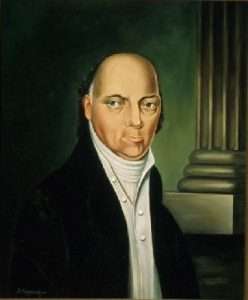
10/25/1795: Justice John Blair resigns from the Supreme Court.
Solar panels, campus protests, and not much due process.
Please enjoy the latest edition of Short Circuit, a weekly feature written by a bunch of people at the Institute for Justice.
I am pleased to report that Kyle Hawkins is the newest member of the Texas Supreme Court. I got to know Justice Hawkins during his tenure as Texas Solicitor General. With principle and courage, he represented Texas before the United States Supreme Court and the Supreme Court of Texas. I, for one, was partial to his argument in California v. Texas, even if the Supreme Court was not.
Justice Hawkins will be a brilliant jurist and a committed originalist.
Texas is very lucky to have him. Dare I say, Texas might have the deepest state supreme court bench in the country?
Here is the announcement:
Governor Greg Abbott appointed Kyle Hawkins as Justice, Place 7, on the Supreme Court of Texas for a term set to expire on December 31, 2026.
"Kyle Hawkins is a proven defender of both the U.S. and Texas Constitutions," said Governor Abbott. "Most recently, as a lawyer for President Trump's Department of Justice, he fought for the freedom of states like Texas to administer Medicaid programs consistent with pro-life values. As Texas Solicitor General, he litigated critical cases at the highest levels of the state and federal judiciary, from challenging the federal overreach of Obamacare to defending Texas' election integrity measures. In private practice, he has handled complex civil disputes at the heart of our thriving economy. Hawkins' tremendous experience will be an asset to the highest court in Texas as he remains steadfast in his dedication to the rule of law and the preservation of the liberties granted by God and enshrined by our founders."
Kyle Hawkins of Austin is a partner at the firm Lehotsky Keller Cohn LLP. Hawkins has over 16 years of experience in public and private practice. Previously, he served as Counselor to the U.S. Solicitor General, the Texas Solicitor General, and as a commercial litigation partner in the Dallas and Houston offices of Gibson Dunn & Crutcher. He previously served as a law clerk to Justice Samuel A. Alito Jr. of the U.S. Supreme Court and to Judge Edith H. Jones of the U.S. Court of Appeals for the Fifth Circuit. Additionally, he served as an Adjunct Professor of Law at the University of Texas Law School, where he taught seminars on constitutional law and oral advocacy. Hawkins received a Bachelor of Arts from Harvard College and a Juris Doctor from the University of Minnesota Law School.
What's on your mind?
An intern and a law clerk used generative AI, and the judges didn't catch the hallucinations.
In July, I wrote about Judge Julien Xavier Neals of the U.S. District Court for the District of New Jersey, who withdrew an opinion that used generative AI. Judge Henry T. Wingate of the Southern District of Mississippi likewise withdrew an opinion that used generative AI. Both opinions included made-up citations, which were obvious hallucinations.
Senator Chuck Grassley, the Chairman of the Senate Judiciary Committee, wrote to both Neals and Wingate.
Both judges wrote to Judge Robert Conrad, the Director of the Administrative Office of the U.S. Courts.
Judge Neals explained that a law school intern used generative AI, in violation of chambers policy, as well as the student's law school's policy:
As referenced in the Senator's letter, a "temporary assistant," specifically, a law school intern, used CHATGPT to perform legal research in connection with the CorMedix decision. In doing so, the intern acted without authorization, without disclosure, and contrary to not only chambers policy but also the relevant law school policy. My chambers policy prohibits the use of GenAI1 in the legal research for, or drafting of, opinions or orders. . . .
I would be remiss if I did not point out as well that the law school where the intern is a student contacted me after the incident to, among other things, inform me that the student had violated the school's strict policy against the use of GenAI in their internships.
Judge Neals has his chambers in Newark. We can guess which law school the student attends.
Judge Wingate explains that his law clerk used generative AI. However, the draft was published prematurely before it was checked:
In the case of the Court's Order issued July 20, 2025, a law clerk utilized a generative artificial intelligence ("GenAI") tool known as Perplexity strictly as a foundational drafting assistant to synthesize publicly available information on the docket. . . .
The standard practice in my chambers is for every draft opinion to undergo several levels of review before becoming final and being docketed, including the use of cite checking tools.1 In this case, however, the opinion that was docketed on July 20, 2025, was an early draft that had not gone through the standard review process. It was a draft that should have never been docketed. This was a mistake. I have taken steps in my chambers to ensure this mistake will not happen again, as described below
Judge Conrad also sent a letter to Senator Grassley. The AO does not keep statistics on judges who have withdrawn opinions with hallucinations:
We are aware anecdotally of incidents in which judges have taken official action (such as those described above) relating to the integrity of court filings in which the use of AI tools was in question, although we currently do not systematically track such activity at the national level.
We learn that the AO convened a task force on generative AI.
The interim guidance cautions against delegating core judicial functions to AI, including decision-making or case adjudication, and it recommends that users exercise extreme caution especially if using AI to aid in addressing novel legal questions. It recommends that users review and independently verify all AI-generated content or output, and it reminds judges and Judiciary users and those who approve the use of AI that they are accountable for all work performed with the assistance of AI.
I suspect some district court judges will impose the requisite layers of review to detect hallucinations. Other district court judges, who delegate much of their work to law clerks, will not perform these checks.
Litigants should check any adverse decision for hallucinations. This simple step will be cheaper than filing an appeal.
A series of essays at Law & Liberty
This month's Law & Liberty Forum features a series of essays explaining the need for a "New Environmentalism" and what such an environmentalism might look like. Steven Hayward has the lead essay. I authored a response, as did Richard Morrison and Allan Carlson. Hayward will have a reply next week.
Hayward's essay begins outlining the need for change:
Is it possible that we have reached a turning point for environmentalism? Perhaps we have already reached it, but don't fully recognize it yet?
Let's start with a basic axiom: the environment is too important to be left to environmentalists. Ever since the first Earth Day in 1970, which can be said to mark the birth of the modern environmental movement, environmentalism has been wedded to a narrow and often fanatical policy architecture that can accurately be described as demanding billion-dollar solutions to million-dollar problems, almost always choosing strategies that maximize political and legal conflict. The result is a kludgy regulatory regime and ongoing political gridlock. Sometimes, policy delivers perverse results in the form of worsening some environmental conditions.
He offers a brief explanation of how environmental protection reached this point, and identifies several policy reform ideas.
My contribution, "Liberal Principles for a New Environmentalism," offers my own account of how modern environmental policy went wrong and what environmental protection grounded in classical liberal principles would look like. It begins:
Congress constructed the edifice of federal environmental regulation atop a pile of misconceptions and mistaken assumptions. Once erected, it has withstood meaningful efforts at reform, and atrophied. However much some existing laws helped address twentieth-century environmental problems, they are increasingly obsolete and ill-suited to today's environmental challenges.
Steven Hayward is absolutely correct that "it is long past time for something new," and properly identifies many of the key attributes upon which a "new environmentalism" could be built. The case for greater utilization of property rights and supplementing market incentives for environmental purposes, such as through prizes, is quite strong. Substantial challenges remain, however. The environmental policy establishment shows little sign of altering course, and, at present, right-of-center political leaders show little interest in a serious or substantive approach to environmental policy.
The birth of the modern environmental movement coincided with an explosion of federal environmental legislation. In less than a decade, Congress enacted a raft of statutes seeking to counteract the environmental consequences of industrialization and centralize control of environmental policy in Washington, DC. Yet, as Hayward suggests, the specific contours of the new regulatory regime were premised upon mistaken, and in some contexts quite harmful, assumptions. For many in the nascent political movement, an environmental crisis required a reconsideration of basic liberal ideals, such as the importance of individual liberty and a belief in progress. In reality, it would have been more productive to commit more fully to applying classical liberal principles to ecological concerns—but that was not the road taken.
Like Hayward, I believe this requires recognizing the importance of property rights, particularly for conservation purposes, harnessing markets, and paying due regard to economic incentives. Unlike Hayward, I am not particularly sanguine about what sorts of policy progress is currently possible.
Particularly with the benefit of hindsight, the outlines of an alternative environmental agenda should be visible, one that recognizes property rights as the foundation of effective conservation, embraces the importance of local community input, and encourages technological innovation and market-driven efficiency improvements. Such an alternative is in line with classical liberal principles and would align with constitutional values far more than the sprawling regulatory edifice we currently have in place.
The problem is that few political leaders have been willing to embrace such an alternative vision of environmental progress. As Hayward recounts, the initial wave of environmental lawmaking was a bipartisan enterprise. Over time, Republican lawmakers grew disenchanted with the growth of centralized environmental regulation and the environmentalist movement's near-unending appetite for further government constraints on productive economic activity. Yet few were willing to consider, let alone embrace, an alternative policy vision.
My essay concludes:
Despite the tremendous environmental progress of the past century, serious environmental challenges remain. Meeting such challenges in an effective and efficient way, without sacrificing other societal needs, will require turning away from the environmental paradigms of the past and embracing the sort of new environmental vision Hayward recommends. The real question is whether there are any political leaders willing to embrace such an environmental agenda and push for reform. Looking at Washington, DC these days, the forecast is cloudy.

10/24/1894: U.S. v. E.C. Knight argued.

How campus antidiscrimination law might apply to campus protests.
I've recently posted on SSRN a new essay, "Zionism and Title VI," forthcoming in the Harvard Law Review Forum. HLR had asked me to respond to an essay by Professors Ben Eidelson and Deborah Hellman, applying Title VI's antidiscrimination rules to recent campus protests. Here's the SSRN abstract of my draft paper:
Universities across America have been accused of failing to protect their Jewish and Israeli students by failing to enforce their own rules on campus protests. Under Title VI of the Civil Rights Act, no one may be excluded from participation in a federally funded activity on the ground of race or national origin. Yet while some protests have allegedly targeted Jews or Israelis for exclusion from campus spaces, more are alleged to have targeted Zionists, those who support a national home for the Jewish people.
A recent essay by Professors Benjamin Eidelson and Deborah Hellman raises doubts about the statutory basis for many such claims. This Response argues that Title VI may apply more extensively to university anti-Zionism than the authors maintain. If made a condition of full participation in university life, anti-Zionism is a form of national-origin discrimination, creating a hostile environment for Israelis forced to abjure their national origin or Jews forced to abjure their nationhood. Israel is the Jewish state in the same ordinary sense in which Greece is the Greek state or Czechia the Czech state; "anti-Hellasist" or "anti-Czechist" restrictions would create hostile environments in just the same way, and the doctrinal arguments for these "untargeted" hostile-environment claims seem stronger than the authors suggest. When a university abandons its ordinary rules, moreover—ceding to a protest movement the authority to deny access to campus spaces or resources—it bears greater responsibility for that movement's actions and renders more menacing that movement's demands.
The Response concludes by noting that even when Title VI is silent, or even when free-speech doctrines might insulate violent slogans or student-group expulsions, the legal questions don't exhaust the moral ones. The campus anti-Zionist movement needn't be classified as antisemitism in law for it to be antisemitic in fact.
And from the introduction:
"Allah does not forget, however. This is how people earn their final place in the [h]ereafter."
Colorado Court of Appeals decisions were for a long time not available on Westlaw, and even access to them on the court's own site was limited. They have recently been put online, in batches, and some have come up in my searches; here's In re Weinraub & Carpenter, decided in 2019 by Colorado Supreme Court Justice Monica Márquez (sitting by designation on the Court of Appeals), joined by Judges Stephanie Dunn and James Casebolt:
In 2007, the parties married. During their marriage, father worked as an imam and administrator at a mosque in Denver. For her part, mother worked as a homemaker managing the household affairs and caring for the parties' five children.
In April 2016, following an incident of alleged domestic violence, which resulted in a criminal protection order, mother petitioned for dissolution of marriage…. Both parties are devout Muslims ….
The court upheld certain restrictions on the father's parenting time:
[Colorado law] authorized the district court to restrict father's parenting time so long as there was an allegation that the children were in imminent physical or emotional danger…. [In her petition for such a restriction, m]other included … [an] email exchange in which father wrote the following to mother:
From Tippecanoe County Assessor v. Goergen, one of several such opinions released that day by the Tax Court of Indiana (written by Judge Justin McAdam):
The Tippecanoe County Assessor, Eric Grossman, filed an original tax appeal in this Court without counsel. In his appeal petition, Grossman challenges the denial of a continuance by the Indiana Board of Tax Review as biased and raises constitutional claims related to Petitioner's "constitutional rights to due process and fair assessments."
The Tax Court concluded that Grossman couldn't represent the county because he wasn't a licensed lawyer, and only licensed lawyers may represent people or entities other than themselves in court. But it added the following:
The risks of allowing a non-attorney to represent others in court is made plainly apparent in Grossman's brief when he cites Hamilton Cnty. Assessor v. Allisonville Rd. P'ship, 170 N.E.3d 1117 (Ind. Tax Ct. 2021)—a case that does not exist. {While the Court cannot be certain of the origin of the fictitious case cited in Grossman's brief, it appears likely to be the result of a hallucination by generative artificial intelligence. The Court admonishes Grossman for citing a fictitious case in his brief and "caution[s] attorneys and pro se litigants alike against using AI to conduct legal research without independently verifying the citations generated. Judges must be able to rely on the authenticity of the authorities cited by the parties to make just decisions." Litigants have a duty to verify the authenticity of authoritative sources cited to the Court and ensure they are used accurately.} …
I reached out to Mr. Grossman, and he responded, graciously and in detail. Here is a written statement that he passed along:
A guest post by Prof. John Dehn.

President Donald Trump's attempts to federalize the National Guard and use it for domestic law enforcement are the subject of ongoing litigation in California, Oregon, and Illinois. What follows is a guest post on this important issue by Professor John Dehn, a leading experts on legal issues surrounding domestic use of the military. Prof. Dehn is also a former US Army officer, who spent fifteen years serving as a military judge advocate.
Building on a previous guest post, coauthored with Josh Braver, Dehn explains why judicial deference to presidential invocations of emergency powers to federalize the National Guard is not required by the Supreme Court's 1827 decision in Martin v. Mott., which has become a central focus of contention in these cases.
I myself have written about the Illinois litigation here, California litigation here and here, and about the more general issue of judicial review of emergency powers here. What follows below was written by John Dehn, not by me (Ilya Somin), though I generally agree with it, and certainly agree on the bottom line conclusion:
The Trump administration has misinterpreted, and to this point some appellate judges have misunderstood and misapplied, the Supreme Court's narrow decision in Martin v. Mott. The administration claims Martin establishes that presidents possess judicially unreviewable authority to determine whether exigent circumstances justifying a domestic use of the armed forces exist. This would mean that President Trump may federalize and deploy National Guard troops whenever and wherever he deems appropriate. In support, it primarily relies on one sentence of the Martin opinion, which Justice Story described as a "sound rule of [statutory] construction" rather than a doctrine of constitutional law.
"We are all of opinion, that the authority to decide whether the exigency has arisen, belongs exclusively to the President, and that his decision is conclusive upon all other persons."
Although district court Judge April Perry and a Seventh Circuit panel correctly concluded that Martin is not controlling in the context of National Guard deployments to support domestic law enforcement activities, the Ninth Circuit has twice concluded that this single, unqualified sentence represents binding Supreme Court precedent. It seems some judges and even some esteemed commentators do not appreciate the very limited context to which this sentence applied, and therefore the much narrower principle or doctrine that it should be understood to establish. Here, I want to briefly add something to what I have already written about this case (with Professor Joshua Braver) and then explain why the Supreme Court should stay its hand rather than Judge Perry's temporary restraining order.
Martin v. Mott was a replevin action that collaterally attacked the court-martial conviction of a militiaman, Jacob Mott, who disobeyed an order to muster and whose mare had been seized by Martin, a deputy U.S. marshal, to satisfy the fine imposed. Justice Story's opinion addressed various challenges to that order and the prior proceedings. Regarding the sentence for which he is being cited, Story's primary concerns were the negative consequences that allowing Mott's claims would have on: discipline in the ranks, the authority of the military chain of command, and the security of the country. His opinion did not address, and in the context of the case could not have addressed, the general ability or authority of courts to review a president's purported justification for the mobilization and use of the armed forces under a statute, or the legality of any measures he may direct them to employ. No issues beyond the legal authority for the mobilization order, the court-martial, and the resulting seizure were raised.
Any doubts about this understanding of Story's opinion are clarified by his citation to an 1814 opinion from the Supreme Court of New York in Vanderheyden v. Young, about which Story wrote, "the reasons in support of [the rule Story posited] were most ably expounded by Mr. Justice Spencer." As it turns out, reviewing Spencer's exposition of that rule is incredibly helpful to understanding Story's opinion. In a suit for damages against an officer who presided over the court-martial of another delinquent New York militiaman, Justice Spencer more completely articulated the rule of construction on which Story relied but only partially articulated:
It is a general and sound principle, that whenever the law vests any person with a power to do an act, and constitutes him a judge of the evidence on which the act may be done, and, at the same time, contemplates that the act is to be carried into effect, through the instrumentality of agents, the person thus clothed with power is invested with discretion, and is, quoad hoc, a judge. His mandates to his legal agents, on his declaring the event to have happened, will be a protection to those agents; and it is not their duty or business to investigate the facts thus referred to their superior, and to rejudge his determination. [emphasis added]
Justice Spencer also explained that any contrary doctrine "would be monstrous" for military discipline (using terms later echoed by Justice Story). If soldiers could challenge such orders in this way, he said, "[n]o man would dare to obey the orders, either of the president, or of his superior officer, lest, peradventure, the president had either abused his authority, or misjudged, in relation to the occurrence of the fact, which authorized him to call forth the militia."
Thus, Story's citation to Vanderheyden establishes that the cited sentence in the Martin opinion pertains only to the military chain of command and to damages or other redress available to disobedient militiamen punished by their superiors. It is not a general statement about the authority of courts to review such presidential determinations in suits for relief from actual or impending injuries stemming from a president's alleged misuse of statutory powers involving the armed forces.
But there are even more reasons why Martin v. Mott should not be understood as controlling in the present litigation. For example, the Act at issue in Martin has been amended and was later deconstructed and codified not only in 10 U.S.C. § 12406 but also 10 U.S.C. § 251, § 252, § 253, and § 254. The lower federal courts have yet to fully address and account for the effect of these changes, as Judge Nelson's confused concurring opinion in the most recent Ninth Circuit decision demonstrates.
Additionally, the use of federal armed forces or federalized National Guard troops for domestic law enforcement is now generally prohibited by the Posse Comitatus Act, "except in cases and under circumstances expressly authorized by the Constitution or Act of Congress." (emphasis added) It is also a sound rule of statutory construction that exceptions to general criminal prohibitions are to be construed narrowly, which arguably empowers courts to ensure that a president has done so. Thus, one might fairly conclude that even if the President invokes the Insurrection Act, an exception to the Posse Comitatus Act, and notwithstanding any statutory text that appears to grant broad presidential discretion to do so, courts may engage in judicial review to determine whether his invocation was proper. Dalton v. Spector is not controlling when a president exercises statutory discretion in a way that raises constitutional issues, as has been alleged in Illinois v. Trump.
Moreover, as Professor Steve Vladeck has explained, an overbroad reading of this sentence from Martin would be monstrous for the Constitution, the country, and the rule of law. Generally applying Story's incompletely articulated rule of statutory construction to statutes authorizing domestic use of the armed forces in emergencies is not only irreconcilable with recent Supreme Court decisions addressing similar issues (e.g. Loper Bright), it also would allow a president to unilaterally militarize or supplant the Constitution's framework for civil governance on a whim. Congress possesses no constitutional authority to grant a president such discretionary power, and courts should generally interpret statutes in a manner that avoids raising such serious constitutional issues. (E.g., Edward J. DeBartolo Corp. v. Fla. Gulf Coast Bldg. & Constr. Trades Council) For the same reasons, the Court should not interpret Mott or the present circumstances as falling within the category of a non-justiciable political question.
All of these observations provide ample reasons for the Supreme Court to stay its hand in these cases rather than the temporary order of a lower federal court. Its consideration of the complicated and, as yet, underexamined legal and factual issues in these cases would clearly benefit from further proceedings and, dare I say, additional legal scholarship that is undoubtedly in the works.
There is yet another important reason the Supreme Court should stay it hand in this case: the Trump administration's "unclean hands." Although an administrative stay is not technically a form of equitable relief to which the clean hands doctrine may be applied, federal courts consider similar factors when deciding whether to grant one. The heavy-handed, unconstitutional tactics of Immigration and Customs Enforcement (ICE) agents have undoubtedly increased the number and intensity of the protests against ICE operations in Chicago. In a separate case, Judge Sarah Ellis determined that federal agents in Chicago have used excessive force against protestors, members of the media, and others presenting no imminent threat of harm to the officers or others, which entail violations of (at a minimum) the First and Fourth Amendments. Upon finding that the administration may be ignoring her first order Judge Ellis amended it, granting additional relief. News reports also indicate that ICE has engaged in war zone-like operations that involve what appear to be additional violations of the Fourth Amendment and perhaps of an applicable consent decree as well. This abusive and dehumanizing behavior is not only unconstitutional but seems calculated to instigate the very outrage that the administration now claims it needs federalized National Guard troops to protect itself from. The Supreme Court should not effectively condone such reprehensible and cynical behavior by granting the administration's request for a stay.
John Dehn is associate professor and faculty director, National Security and Civil Rights Program at Loyola Law School.
Celebrate your independence with a subscription to Reason magazine, your most trusted source of honest, insightful news and analysis.




