
The Second Amendment 'Has Become Optional'
A decade after recognizing a constitutional right to armed self-defense, the Supreme Court remains reluctant to defend it.


A decade after recognizing a constitutional right to armed self-defense, the Supreme Court remains reluctant to defend it.

A poorly written proposal to expand copyright claims could potentially decimate online sharing of information.
Today's Supreme Court decision adds to the law -- and the uncertainty -- about when the First Amendment bans the government from requiring speech.

President David Cole says guidelines "are explicitly designed to help affiliates and national staff think through various factors in case selection decisions."

Will widespread private arms rebalance power between individuals and the state? It looks like we're going to find out.
David Cole and Nadine Strossen had responded to Kaminer's op-ed on this; Kaminer responds in turn.

Washington State told to revisit ruling against Arlene's Flowers.

It is well-established that everyone within the United States, even those who may have entered illegally or over-stayed a visa, are entitled to Due Process.
Is the ACLU becoming less committed to protecting free speech, especially speech that some view as "imped[ing] progress toward equality"?
In a case involving cellphone location data, Gorsuch says entrusting information to someone does not mean surrendering your Fourth Amendment rights.
SCOTUS rejects warrantless cellphone location tracking in Carpenter v. United States.

"If I do go to court and get wrongfully convicted, my whole life is ruined."

"Our defense of speech may have a greater or lesser harmful impact on the equality and justice work to which we are also committed."
The dangers of government surveillance.
Matt Kibbe explains why "beer is freedom," and talks about his new documentary series with Rep. Thomas Massie, Off the Grid.
It all began with a jurisdictional dispute over an Egyptian divorce proceeding and a New York divorce proceeding.

Frivolous defamation lawsuits undermine the First Amendment.
Very narrow decisions -- or decisions not to decide -- in some more of the Supreme Court's most watched cases.
No, says the Illinois Appellate Court.
Clinch seeks "an apology," "an undertaking from you not to post anti-trans or vilifying posts in future, and to remove those that are currently on your public Facebook profile," "a further undertaking from you to remove any anti trans and vilifying posts made by other people from your public profile," and "for you to participate in training about vilification, and trans' issues."

Law enforcement is upset, but data security is vital to prevent crimes.
New York's governor favors "extreme risk protection orders" that could be obtained by a wide range of people based on little evidence.
A big win for First Amendment advocates in Minnesota Voters Alliance v. Mansky.
But a more precise ban on clothing in polling places (which the Court treats as "nonpublic fora") that mentions candidates, parties, or ballot measures may be constitutional.

Federal Judge Raymond Moore applies strict scrutiny to a system with the power to restrict political speech and finds it unreasonable to outsource that power to anyone and everyone.
My first foray into podcasting here at Reason, a discussion with Reason editor Katherine Mangu-Ward.

Once again, lawmakers propose to use the regulatory state to punish people they don't like.

A conversation with Eugene Volokh about what's legal to publish and why-plus doxxing, lock picking, source protection, and more.

A day after DOJ joined free speech lawsuit, UM agreed to change policy that said "the most important indication of bias is your own feelings."

"The United States has a significant interest in the vigilant protection of constitutional freedoms in institutions of higher learning."
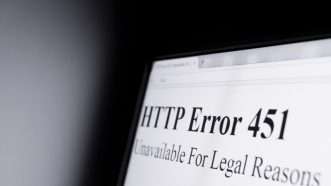
It's not just email spam; GDPR has led companies to shut down access to sites and games.

From DIY guns to designer drugs, classic-car parts, and human livers, 3D printing promises a dynamic and uncontrollable world.
The N.Y. Senate just unanimously passed a bill that would do that.
So holds the Maryland Court of Special Appeals, affirming a juvenile court finding of responsibility.

Former Senate Intel Committee staffer charged with lying about relationships with reporters covering Carter Page investigation.

The company's hands-off, user-centered approach is a model other content platforms would do well to emulate.
Each one of us has the right to access court records, so we can just sue pro se (though it helps to know the legal rules).
A tiny free speech victory.
The First Amendment constrains speech regulation by the government, not by private parties.
How much do you trust judges to make such decisions without public scrutiny?
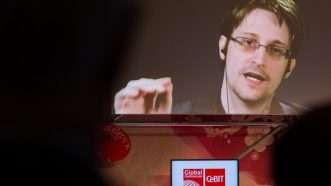
The government still snoops on its own citizens, but we're more aware of it-and we can push back.
There's a New Hampshire prosecution for criminal libel of a police chief -- and it may well be legally viable, at least if the defendant's statement is seen as a knowingly false factual claim. [UPDATE, June 8, 2018: Charges have now been dropped.]
Despite its ruling in favor of a Colorado baker, the Court remains hostile to religious exemptions from anti-discrimination laws.
The court decision was just a declaratory judgment, and thus not strictly legally binding.



New from Reason: a look into what Javier Milei has accomplished and what it will take to make the most of Argentina’s window for real change. Out now for subscribers.

