From Phillips v. D.C., decided Monday by Judge James Boasberg (D.D.C.):
This suit alleges that the District of Columbia's Metropolitan Police Department plays favorites in how it responds to requests for information under the local Freedom of Information Act. Plaintiff Amy Phillips, a public defender, contends that the District unlawfully flags FOIA requests from people critical of MPD, which leads to response delays and denials and constitutes a violation of her First Amendment rights….
Taking the facts as laid out by Plaintiff to be true, which the Court must do at this stage, the genesis of the controversy lies in an Adverse Action Hearing held by MPD's Disciplinary Review Division in March 2019 to adjudicate alleged misconduct by a former officer. Phillips, who is a criminal-defense attorney in the District and an "outspoken critic of MPD," attended the March 2019 hearings and soon after submitted a FOIA request to MPD for tapes and transcripts of the proceedings [as she had done before on other occasions]…. The request was denied in full less than ninety minutes after it was submitted…. After an appeal to the Mayor's Office of Legal Counsel and a suit in D.C. Superior Court that was covered in the local news, MPD began producing documents responsive to Phillips's requests in September 2019, albeit with redactions Plaintiff believes are unwarranted.
In early 2020, Plaintiff began communicating with Vendette Parker, a recently retired MPD FOIA officer, who had worked on Phillips's request when she was still employed by the District. Parker alerted Plaintiff to the Department's unofficial "watchlist policy," which singled out for special treatment FOIA requests that "may lead to criticism" of MPD, in particular those "originating from news reporters or people known to be critical of the department" or for information that could "embarrass the department." Requests within these parameters were flagged for higher-up officials and were often "delayed, denied, or improperly altered." This included Phillips's March 2019 FOIA request, which was flagged both because the records themselves might embarrass MPD and because Phillips had been placed on the Department's "watchlist" based on the content of previous record requests….
In honor of this major holiday, I post a round-up of my writings, interviews, and talks about one of the world's most popular science fiction franchises.
Today is Star Wars Day! In honor of this exciting event from a galaxy far, far away, here are some links to various writings and speeches I have done on the politics of this immensely popular science fiction franchise.
Much of this is copied from my 2018 Star Wars Day post, because I - unfortunately - have not had much chance to write about the most recent Star Wars series. But I hope to remedy that when time allows. Until then - may the Force be with you - even if you don't have a high Midichlorian count!
Rogue One and the Politics of Star Wars (my take on political themes in the best Star Wars movie since the original trilogy). This is probably my personal favorite among my Star Wars-related pieces. Among other things, it discusses why it's important to think about what the Rebels are fighting for, as well as what they are against, and why, they, like many of the American Founding Fathers, are "simultaneously freedom fighters and slave owners."
The World According to Star Wars (video of Cato Institute panel on Cass Sunstein's book of the same name, featuring the author and commentary by Michael Cannon (Cato Institute) and myself.
The Politics of Star Wars (audio of my December 2015 Libertarianism.org podcast on the politics of the Star Wars franchise - produced just before the release of The Force Awakens, so it only covers the development of the franchise up to just before that point).
More recently, I have written informal Facebook commentary on "The Book of Boba Fett," and "The Mandalorian." If the opportunity arises, I hope to turn these into more developed writings.
From today's opinion by Judge Nancy Freudenthal (D. Wyo.) in McCollum v. Baldwin:
This case arises from opinions expressed by Defendant [Alec] Baldwin through social media posts and private messages concerning Plaintiff Roice McCollum's attendance at the Washington, D.C. events on January 6, 2021. Plaintiffs ("the McCollums") allege Mr. Baldwin's opinions resulted in hateful messages and threats by third parties toward them, and they bring this action alleging various causes of action…. The Court finds and concludes that the McCollums have failed to meet their burden of proof in showing that this Court may properly exercise personal jurisdiction over Mr. Baldwin….
Focusing just on the allegations from the complaint which go toward the personal jurisdiction analysis, on January 3, 2022, Roice McCollum (who resides in Wyoming) posted on her Instagram feed a photograph of people surrounding the Washington Monument at the "Make America Great Again" protest in Washington. Roice McCollum had attended the Washington D.C. protest. Mr. Baldwin (from New York) commented on Roice's post by saying, "Are you the same woman that I sent the $ to for your sister's husband who was killed during the Afghanistan exit." {Jiennah McCollum's husband Rylee died in Afghanistan while on active duty as a marine. A GoFundMe account was started on behalf of Jiennah and her soon-to-be-born daughter.} The private Instagram messages between Mr. Baldwin and Roice McCollum on January 3, 2022 are as follows:
Yesterday, while we were all losing our minds about Dobbs, the rest of the judiciary continued to function. The Fifth Circuit decided Wearry v. Foster. The panel found that the doctrine of absolute prosecutorial immunity did not foreclose a 1983 suit against a state prosecutor.
When a prosecutor joins police in the initial gathering of evidence in the field, he acts outside his quasi-judicial role as an advocate; instead he acts only in an investigatory role for which absolute immunity is not warranted. Therefore, District Attorney Perrilloux is not entitled to absolute immunity for his actions.
Judge Ho wrote a dubitante opinion:
So I write separately, first, to explain how governing precedent requires us to grant prosecutorial immunity in this case, and second, to note that I reach this conclusion reluctantly, because the doctrine of prosecutorial immunity appears to be mistaken as an original matter.
First, Judge Ho resists the temptation to draw "razor-thin" distinctions to evade precedent.
As a panel, we're bound to follow both Supreme Court and circuit precedent—whether we like it or not. Moreover, if fidelity to precedent means anything, it means construing precedent faithfully.
Of course, "judges can always draw razor-thin distinctions and contend that a particular issue is not governed by a non-originalist precedent." Josh Blackman, Originalism and Stare Decisis in the LowerCourts, 13 NYU J.L. & Liberty 44, 51 (2019). But "judges should resist this temptation." Id. See also Williams v. Homeland Ins. Co., 18 F.4th 806, 821 (5th Cir. 2021) (Ho, J., concurring) (same).
I see no principled basis that the panel majority could possibly invoke to distinguish Cousin. To the contrary, the theories put forth by the majority are directly contradicted by Cousin itself.
The majority disagrees on this front:
Our brother's dubitante opinion contends these "razor-thin" distinctions are without a difference. Infra at 24. We disagree.
(Is it still common for judges to use the term "brother"? I know the Supreme Court abandoned that practice prior to Justice O'Connor's confirmation. This practice seems so antiquated.)
Second, Judge Ho cites an amicus brief from the Constitutional Accountability Center--a group known for progressive originalist advocacy.
The bad news is that, although Congress can fix what ails us in cases like this, it shouldn't have to. Because Congress never enacted the immunities that would presume to stop us from deciding Wearry's claims. As the Constitutional Accountability Center observes in its amicus brief, courts should construe provisions "in accordance with . . . text and history." So if we are going to recognize any immunities—notwithstanding the complete absence of any statutory text to support such immunities—at the very most we should recognize only those immunities that are "so well established in the common law . . . that the members of the 42nd Congress must have been aware of them and could not have meant to abrogate them by implication." See also, e.g., Burns v. Reed, 500 U.S. 478, 498 (1991) (Scalia, J., concurring in the judgment in part and dissenting in part) ("the presumed legislative intent not to eliminate traditional immunities is our only justification for limiting the categorical language of the statute"); Ziglar v. Abbasi, 137 S. Ct. 1843, 1870 (2017) (Thomas, J., concurring in part and concurring in the judgment) (same).
Third, Judge Ho cites scholarship from Scot Keller demonstrating that the notion of absolute immunity is not supported by history.
Take the doctrine of qualified immunity. It requires civil rights plaintiffs to prove not only a violation of their constitutional rights, but a "clearly established" one. But the "clearly established" requirement lacks any basis in either the text or original understanding of § 1983. See, e.g., Horvath v. City of Leander, 946 F.3d 787, 800–03 (5th Cir. 2020) (Ho, J., concurring in the judgment in part and dissenting in part); Scott A. Keller, Qualified and Absolute Immunity at Common Law, 73 Stan. L. Rev. 1337, 1388 (2021) ("The Supreme Court's largest departure from the common law of officer immunities occurred when Harlow v. Fitzgerald replaced the subjective good-faith defense for qualified immunity with a clearly-established-law test.").
Fourth, despite this history, Judge Ho maintains that a "faithful reading of precedent" requires the Court to grant immunity here.
The majority says it is "strange" to apply prosecutorial immunity here. Ante, at 16. I agree. As explained, I'm skeptical about the doctrine of absolute prosecutorial immunity as an original matter. But a faithful reading of precedent requires us to grant it here, no matter how troubling I might personally find it.
As a panel, we're duty-bound to follow precedent. And that means we're duty-bound to follow precedent, full stop—not just when it leads to results we like. "[A] principle is not a principle until it costs you." Lefebure v. D'Aquilla, 15 F.4th 650, 663 (5th Cir. 2021) (citing Psalm 15:4 (honoringthose who "keep[ ] an oath even when it hurts")). "[F]ollowing precedent only when you like it—and ignoring it when you don't—is . . . not principled judging. It is the very definition of 'WILL instead of JUDGMENT'—stare decisis 'only when I say so.'" Planned Parenthood of Greater Texas, Inc. v. Kauffman, 981 F.3d 347, 386 (5th Cir. 2020) (Ho, J., concurring). It would "replace judicial hierarchy with judicial anarchy." M.D. v. Abbott, 977 F.3d 479, 483 (5th Cir. 2020).
Our precedents apply absolute prosecutorial immunity in cases just like this. The panel majority has nevertheless decided to allow this suit to proceed to the merits. As an originalist, I may cheer this result. But I doubt that our prosecutorial immunity precedent permits it.
Well said. As an originalist, I cheer the dubitante opinion an exemplary of lower-court originalism: faithfully follow precedent, even if it is not supported by original meaning, but shine a light on why those precedents are flawed. In time, hopefully, this originalism in the lower trickles up to the Supreme Court. The trickle-up effect is a hell of a lot better than the Supreme Court's current leak-out effect.
The past day has been my most hectic press day since Trump left office. I recorded four television interviews, four radio interviews, two podcasts, and gave more than a dozen interviews to reporters, which yielded quotes from Reuters, Politico, the Washington Times, and others. (Not everyone who interviews me, or uses my material, ends up quoting me.) Plus I wrote eight blog posts here at the Volokh Conspiracy. My day was booked in fifteen-minute interviews, as I jumped from one call to another.
First, there are no laws that would explicitly cover the unauthorized release of a draft opinion; they're not classified or national security materials. Maybe Congress could pass a law allowing them to be designated as such, but nothing like that currently exists.
As [Orin] Kerr points out, obviously, if someone obtained the copy through a hack—a remote but not impossible proposition since Politico's national security correspondent placed his name on the story's byline—or stole a physical copy of the draft opinion, those are clearly crimes.
But what if someone who worked for the Supreme Court and had access to it (like a law clerk) released it without permission?
There are a few possibilities for prosecution but nothing that guarantees success.
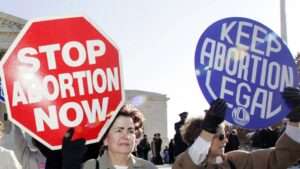
In this Nov. 30, 2005 file photo, an anti-abortion supporter stands next to a pro-choice demonstrator outside the U.S. Supreme Court in Washington. (AP Photo/Manuel Balce Ceneta)
As you probably know by now, a leaked draft Supreme Court opinion indicates there may well be five justices prepared to overrule Roe v. Wade. For a long time, many assumed that if Roe were to be overruled, abortion policy would be "left to the states." That will indeed happen in the short run. But such a state of affairs might not last. Many Republicans have been advocating nationwide bans on abortion, including very sweeping ones that would forbid all abortions more than six weeks into a pregnancy. For their part, many Democrats, including Senate Majority Leader Chuck Schumer, back nationwide legislation protecting abortion rights.
Would such laws be constitutional? I have written about this issue twice before (see here and here). The bottom line is that current Supreme Court precedent likely would enable Congress to ban most, if not all, abortions if it wanted to. That's because the Court has endorsed a ridiculously broad interpretation of Congress' powers to regulate interstate commerce. But that precedent might be pared back, thanks in part to that unlikely champion of abortion rights, Clarence Thomas.
Here's why current precedent likely supports broad congressional power to restrict abortion:
Under cases such as Gonzales v. Raich (2005), the Supreme Court has held that Congress' power to regulate interstate commerce includes the authority to restrict almost any "economic activity," so long as it has a "substantial effect" on interstate trade. And [in Raich] "economic activity" is defined very broadly to include anything that involves the "production, distribution, and consumption of commodities." That definition allowed the Court to use the Commerce Clause to uphold a federal ban on the possession of marijuana that had never crossed state lines or been sold in any market (even an intrastate one). Nearly all abortions involve the "consumption" and "distribution" of commodities, such as medical supplies. In addition, most abortions qualify as "economic" transactions because doctors, nurses, and others are paid to perform them.
One could argue that a federal law banning or severely restricting abortions isn't "really" aimed at regulating interstate commerce. The true motive would be to restrict abortion regardless of whether it involved interstate transactions or not. But much the same can be said for the marijuana ban upheld in Raich, and other federal laws enforcing the War on Drugs. They go far beyond targeting actual interstate trade in drugs, and instead forbid even in-state distribution and possession of illegal narcotics.
If, as is likely, the interstate abortion market expands in the wake of a Supreme Court decision overruling Roe, Congress could claim that suppression of intrastate abortions is necessary in order to enforce restrictions on those that involve crossing state lines. If abortion is banned in State A, but legal in neighboring State B, that creates an incentive for residents of A to cross into B in order to get abortions - even if the feds enact a ban on such crossing. That ban might be more effectively enforced if abortion were illegal in B as well as A…..
The Commerce Clause rationale for abortion restrictions might not apply to abortions that are performed on a noncommercial basis by staff who provide their services for free. But such cases are only a small percentage of the total. Moreover, in Raich, the Court upheld the ban on Angel Raich's possession of marijuana even though the producers had in fact provided it to her for free. The theory was that even such completely noncommercial production and distribution of an illegal drug could impact the interstate market.
These kinds of Commerce Clause arguments may strike some readers as the kind of sophistry that gives lawyers a bad name. I sympathize with that reaction! I hate these arguments myself, and have long argued that Raich is a terrible decision that should be overruled. But this is exactly the sort of reasoning that prevailed in Raich, and provides a constitutional rationale for much of the federal War on Drugs.
However, Raich has been much criticized by conservative and libertarian legal commentators, and is especially abhorred by Justice Clarence Thomas. He has also suggested, in a 2007 concurring opinion, that federal abortion restrictions may be beyond the scope of congressional power under the Commerce Clause. It is possible that one or more other conservative justices agree with him on this. A federal abortion ban could, therefore, be struck down by a coalition of conservative justices who oppose it on federalism grounds, and liberal ones who believe it violates constitutional individual rights. I outlined this scenario here:
In Gonzales v. Carhart (2007), the Supreme Court upheld a federal restriction on late-term "partial birth" against individual rights challenges. Justice Clarence Thomas wrote a concurring opinion emphasizing the possibility that the law in question exceeds the scope of congressional power under the Commerce Clause. Thomas previously wrote a forceful dissent in Gonzales v. Raich…. [In 2021], he reiterated key elements of his critique of that decision, and urged the Supreme Court to reconsider… it….
It's possible that one or more other conservative justices could join Thomas's reasoning.
One can then envision federal abortion restrictions getting invalidated by a coalition of conservative justices who believe they are beyond the power of the federal government, and liberal justices who object on individual-rights grounds. It is also possible (though less likely) that some liberal jurists could endorse the federalism argument against these restrictions. Liberal thinking on constitutional federalism shifted a good deal in recent years, and some of that shift may go beyond "fair weather federalism" brought on by opposition to Trump's policies. It's also possible that either liberal or conservative judges will think of clever ways to limit the scope of Raich, even if it doesn't get overruled completely.
Cynics may say that Thomas isn't really sincere in his opposition to Raich or his doubts about the constitutionality of federal abortion restrictions. I cannot know his true feelings for sure. But, as a general rule, Thomas is known for being a man who says what he means and means what he says. He even often gets criticized for his apparent reluctance to compromise with other justices or respect their sensibilities. I also see little motive for him to express the above views if he doesn't really mean them. It's unlikely Thomas was trying to curry favor with liberals. If he truly valued such favor, he would say and do a lot of things differently.
Attacking Raich and other ultra-broad Commerce Clause precedents may go against the grain for some left-of-center abortions rights advocates. But immigration advocates have made a similar shift in sanctuary cities cases (with great success), and the pro-choice legal community could follow their example. For some pro-choicers - myself very much included! - the possibility that reducing Commerce Clause authority would weaken the War on Drugs would be a feature, not a bug.
In addition to using the Commerce Clause, federal abortion restrictions could also be enacted using Congress' spending power. I go through some of the details here:
In addition to trying to directly regulate abortion by using its Commerce Clause powers, Congress could also try to do so indirectly by using its Spending Clause power to condition grants to state governments. For example, it could enact legislation restricting various types of health care grants to state governments unless the latter ban or severely restrict abortion. These kinds of conditional spending restrictions are subject to a number of constraints under current Supreme Court precedent. The amount of money involved cannot be so large as to be "coercive"; the conditions must be sufficiently related to the purpose of the grant; and they have to be clearly stated on the face of the law - not just inferred by the executive branch. The Trump administration ran afoul of all three of these restrictions during its campaign to cut federal funds to "sanctuary cities…."
Much depends on the exact scope and wording of the legislation at issue. Nonetheless, I think a carefully drafted conditional-spending restriction on abortion rights could potentially jump through these hoops. Then, blue states would face a choice of either losing some of their federal health care grants or imposing abortion restrictions.
The Spending Clause approach is less threatening to abortion rights because states could…. avoid the conditions by refusing the federal funds tied to them. In practice, such refusals of federal funds are very rare. But a hot-button ideological issue like abortion might prove an exception to that rule.
I would add that the requirements of relatedness and noncoercion set a ceiling to the amount of pressure Congress could bring to bear in this way. It couldn't deny affected states all or most federal health care funding (that is precluded by NFIB v. Sebelius, which struck down as coercive a provision of the Affordable Care Act that would deny all Medicaid funds to states that refuse to expand Medicaid), and it cannot deny funds with little or no connection to abortion.
Some conservatives have argued that a federal law banning abortion might be authorized by Section 5 of the 14th Amendment, rather than the Commerce or Spending Clauses. But that would be a radical departure not only from current Supreme Court precedent, but also from traditional conservative originalist approaches to the Fourteenth Amendment. Co-blogger Jonathan Adler explained why here.
Obviously, the above constraints on federal laws banning abortion would also apply to federal laws seeking to protect it against the states. In the wake of a decision overruling Roe, conservatives and liberals alike may need to decide whether they care more about preserving the autonomy of "their" states, or about retaining the power to control the other side's states when their preferred party is in power in Washington. In both cases, however, even if some would prefer to preserve maximal federal power, there may well be others willing to file federalism-based lawsuits, regardless of what their ideological comrades think.
Finally, I should note the scenarios discussed above may not come to pass, because political obstacles may prevent Congress from enacting any significant new abortion legislation, whether pro-life or pro-choice. Doing so would likely require either a massive 60-vote Senate supermajority or the abolition or limitation of the filibuster. On the Republican side, federal abortion restrictions could be opposed by key moderate senators, such as Susan Collins and Lisa Murkowski (both of whom are pro-choice).
But while the obstacles to such legislation are significant, they may not be insuperable. If you believe that abortion is murder, you might well be willing to set aside the filibuster to ban it. Ditto if you think it's a fundamental human right, and only federal legislation can ensure its protection. If Roe does indeed get overruled, time will tell if major new federal abortion legislation is politically feasible or not. If it turns out that it is, there is a good chance it might be successfully challenged on federalism grounds.
UPDATE: Back in 2015, co-blogger Jonathan Adler also wrote a post explaining why federal abortion restrictions exceed the scope of Congress' powers under the Commerce Clause. I think he's overly optimistic when it comes to current precedent. But the kinds of arguments he marshals are the sort that might well be accepted by Justice Thomas and others if the issue were to come before the Supreme Court.
Perhaps because it's largely in English, the song has drawn attention in the American music media (Rolling Stone, Billboard); it seems to me to lack the subtlety or lyricism that I've found in some of the other Ukraine war music I've blogged, but I thought I'd pass it along:
Here are the lyrics, with the Ukrainian portions translated by me:
I got ice in my veins
Loaded guns, I'm insane
Fight for peace in my land
Enemies laying dead
We kick shit with my troop
Iron tanks, bulletproof
We attack, we don't play
Don't fuck with Ukraine [x 4]
There's a lot to discuss about the leaked Dobbs draft, but I wanted to respond to my co-blogger Josh Blackman's suggestion that Dobbs could be the end of abortion-related law at the Supreme Court. I'm not sure how that could be, for two reasons.
First, in the short term, if Dobbs overturns Roe/Casey, you'll presumably have a lot of abortion-related legal issues at the Supreme Court and elsewhere about the scope of legislative and executive powers. For example, how much power does Congress have to impose national rules relating to abortion? What are the powers of federal executive agencies to influence abortion-related practices? What are the powers of states to prohibit out-of-state abortions? Dobbs could settle some questions, but I would guess it would shift the debate rather than end it.
Second, in the long term, changes in Supreme Court personnel work both ways. As far as I can tell, those who think Roe/Casey should be maintained also believe that, if Dobbs overturns Roe/Casey, then the Supreme Court should overturn Dobbs at its first opportunity. That doesn't seem likely in the next few years, as the votes aren't there now. But it's hard to predict the future. And presumably, someday there will be a Court with a majority of Justices appointed by Democrat-party Presidents. When that happens, another cycle might begin.
I understand that whether Dobbs would end the debate or merely shift the debate to the next stage isn't the most important question raised in the case and the leak. But for those interested in that particular issue, I thought I would say why I think the latter is more likely.
The Plaintiff, Alan Grayson, contends in his Second Amended Complaint that the Defendants, acting through Progress Tomorrow, published false and defamatory statements which damaged him "personally, professionally, and ultimately politically." The allegedly defamatory statements fall into three categories: (1) citation to a Congressional Ethics Investigation finding candidate Grayson had "Abused His Office for Financial Gain," including by using "taxpayer resources to conduct his high-risk investor scheme;" (2) images of Grayson's passport photograph with dollar signs replacing his eyes, an attaché case containing $150,000, and images implying he flew to the Cayman Islands to launder the money; (3) statements relating to accusations made by Grayson's ex-wife in connection with their divorce proceedings during which she accuses him of spousal abuse….
The Plaintiff retained Mr. Nicholas Carroll to provide expert testimony on the following topics:
Editorial opinion on potential liability, and whether to refer ads to legal counsel.
Harm to the reputation of Alan Grayson by negative political advertising.
The costs of repairing that reputation.
The Defendants seek to exclude Mr. Carroll's expert testimony for the following reasons:
(1) he is not qualified to testify with respect to the standards for publishing political ads;
(2) his testimony is unreliable insofar as it is based on nothing except his subjective, unscientific opinion that is not backed by review of any underlying facts or any studies;
(3) his testimony does not assist the trier of fact, because he is testifying on matters of common sense that can readily be determined by the jury without expert testimony; and
(4) he impermissibly replies (sic) on another expert's opinion….
On November 2, 2021--the day after S.B. 8 oral arguments--I wrote a post titled "End the Epicycles of Roe." I highlighted the many ways in which Roe has distorted other areas of law, including stare decisis, freedom of speech, facial challenges, tiers of scrutiny, and third-party standing. Justice Alito made many of these same points in Part III.D of his draft majority opinion:
Members of this Court have repeatedly lamented that "no legal rule or doctrine is safe from ad hoc nullification by the Court when an occasion for its application arises in a case involving state regulation of abortion." Thornburgh (O'Connor, J., dissenting); see Madsen v. Women's Health Center, Inc. (1994) (Scalia, J., concurring in the judgment in part and dissenting in part); Whole Woman's Health (THOMAS, J., dissenting); id. (ALITO, J., dissenting); June Medical (GORSUCH, J., dissenting). The Court's abortion cases have diluted the strict standard for facial constitutional challenges. They have ignored the Court's third-party standing doctrine. They have disregarded standard res judicata principles. They have flouted the ordinary rules on the severability of unconstitutional provisions, as well as the rule that statutes should be read where possible to avoid unconstitutionality. And they have distorted First Amendment doctrines.
The leak is a manifestation of yet another abortion-based epicycle: the breach of Courtroom confidentiality. Someone (we do not know who) thought the issue of abortion was significant enough to justify leaking a draft majority opinion to the press. I had long presumed such a leak would have been unthinkable, but abortion drives people to such extremes. This ultimate breach in Court confidentiality provides yet one more reason why the Supreme Court must exit the arena of abortion. Hopefully, this leak will be Roe's final epicycle.
Last night, I flagged a possible path forward for the Court in Dobbs:
For all we know, the Court issues a one sentence per curiam opinion overruling Roe, and remanding the case to the Fifth Circuit for further proceedings.
I think there is some precedent for this path.
Ex Parte Quirin considered the validity of a military prosecutions against eight Nazi saboteurs (one of whom was a U.S. Citizen). The Supreme Court heard oral argument on July 29 and 30, 1942. But by that point, the outcome was already preordained. The Germans would be executed. And the Justices knew this outcome.
On July 31, 1942, the Court issued a short per curiam opinion upholding the military tribunal. Nearly three months later, on October 29, 1942, Chief Justice Stone issued a fully-developed majority opinion. But by that point, the saboteurs were already executed.
Whether this is a valid precedent, or not, I will let others judge. Justice Scalia criticized the ruling in his Hamdi dissent:
The Government argues that our more recent jurisprudence ratifies its indefinite imprisonment of a citizen within the territorial jurisdiction of federal courts. It places primary reliance upon Ex parte Quirin,317 U.S. 1 (1942), a World War II case upholding the trial by military commission of eight German saboteurs, one of whom, Hans Haupt, was a U.S. citizen. The case was not this Court's finest hour. The Court upheld the commission and denied relief in a brief per curiam issued the day after oral argument concluded, see id., at 18—19, unnumbered note; a week later the Government carried out the commission's death sentence upon six saboteurs, including Haupt. The Court eventually explained its reasoning in a written opinion issued several months later.
But Quirin does provide a roadmap.
The Court could issue a brief per curiam opinion stating that Roe and Casey are overruled, and that abortion restrictions should be reviewed with rational basis scrutiny. And at the end of June, the Court could issue a formal opinion. This move will allow the Court, as the Chief Justice maintained, to complete its work.
BREAKING: Roberts confirms authenticity of draft Dobbs opinion, says it doesn't represent anyone's final position. He has directed Supreme Court marshal to investigate. "The work of the Court will not be affected in any way." pic.twitter.com/XuTEjZbU2M
"I refer to an article that appeared on September 30, 1991, in The Legal Times, which purported to report in some detail on the contents of preliminary drafts of the majority and dissenting opinions."
On February 19, 1992, a panel of the D.C. Circuit decided Lamprecht v. FCC. The panel included Chief Judge Mikva, and Circuit Judges Thomas and Buckley. (Yes, that would be Justice Thomas and the James Buckley from Buckley v. Valeo.) The opinion held that the FCC violated the Equal Protection Clause by granting an applicant extra credit for being a woman.
Several months earlier, on September 30, 1991, The Legal Times published a report that contained details of draft opinions in the case. (Senate Mulls Thomas' Controversial Case; Draft Opinion Would Overturn FCC Ruling On Gender Preferences,LEGAL TIMES, Sept. 30, 1991, at 20.) Judge Buckley wrote a concurring opinion that addressed this leak:
This litigation deals with a sensitive subject, and it is not surprising that it should have aroused some passions. Unfortunately, this case has also proven the occasion for a most serious breach of trust. I refer to an article that appeared on September 30, 1991, in The Legal Times, which purported to report in some detail on the contents of preliminary drafts of the majority and dissenting opinions. The issuance today of those opinions in their final form will demonstrate the general accuracy of the information divulged to The Legal Times.
The seriousness of this violation cannot be overstated. Each member of this panel has been aggrieved by it, as have the parties who brought this case to us for adjudication. Moreover, because one or more of their number has been guilty of a willful breach of trust, this incident must cast a shadow over the dozen or more able young law clerks who had become privy to the preliminary drafts. I say "willful" because the information in the published reports was too detailed to have been the product of inadvertent disclosures.
We cannot, of course, repair the damage that may already have been done to one or more of the parties as a result of this premature disclosure. But we can and must take steps not only to ensure against a repetition in the future, but to demonstrate the seriousness with which we take this violation. I believe the appropriate measure is for this court to initiate a formal investigation in an effort to identify the source or sources of this disclosure, and I urge my colleagues to do so.
The hemorrhaging of confidential information has become endemic in the legislative and executive branches of our government, with untold cost to their ability to function. It is essential that we prevent this disease from invading the judiciary, as this would inevitably undermine the public confidence that is one of the major strengths of our legal system.
The timing makes this leak even more egregious. Lamprecht was argued in January 1991. Judge Thomas was nominated to the Supreme Court in July 1991. The first hearing began on September 10, 1991. On October 4, 1991, Senator Ted Kennedy cited the Legal Times story as a reason to vote against Thomas.
Judge Thomas' record reveals that he may not be able to shed his past as easily as he asks us to believe. According to recent press reports, just 3 months ago Judge Thomas prepared a draft opinion in his first case on the D.C. Court of Appeals to raise a significant question of deference to Congress. Judge Thomas circulated his draft opinion to other members of the court, but no further action was apparently taken after his nomination to the Supreme Court, and the opinion has not been made public. This case, Lamprecht versus FCC, involved a challenge to Congress' decision to increase the number of women and minorities with scarce Federal broadcast licenses by requiring the FCC to grant qualified women and minorities some preference in awarding such licenses. Congress decided that such an increase would benefit all Americans by promoting diversity in broadcasting. In the case, the FCC had awarded a license to a woman, and the award was challenged by a competing applicant for the license on the ground that the statute directing the FCC to continue its preference policy was invalid. According to press reports, Judge Thomas' draft opinion accepted that argument, on the ground that Congress had offered inadequate evidence when passing the statute that awarding licenses to women would increase broadcasting diversity. Last year, the Supreme Court upheld the congressional preference for minorities in Metro Broadcasting versus FCC. During the hearings, Judge Thomas specifically testified that he had no reason to disagree with the Court's decision in Metro Broadcasting. He also stated that he accepted Supreme Court rulings directing courts to give greater preference to congressional enactments than the State or local laws. But Judge Thomas never mentioned Lamprecht versus FCC in either of these exchanges, even though he obviously has been deeply involved in both aspects of the questions he was asked-his views on the statutory preference for women and minorities, and his views on the degree of deference courts must give to Congress. It is not clear whether Judge Thomas' D.C. Circuit opinion will ever see the light of day. What is clear is that he was not entirely candid with the committee in discussing this issue, and that the open mind he professed to have on the Metro Broadcasting case may well have been much more closed than he led us to believe.
Thomas was confirmed by the full Senate on October 15, 1991. And the Lamprecth opinion did see the light of day. There is nothing new under the sun. Everything that is old is new again. The Supreme Court should issue Dobbs, with haste. To quote Judge Buckley, "The issuance today of those opinions in their final form will demonstrate the general accuracy of the information divulged to The Legal Times." So be it, if Politico was correct.
As far as I know, there was no investigation performed by the D.C. Circuit. I hope the Supreme Court will take this egregious leak seriously.
On a personal note, I recently saw Judge Buckley at a reception. He is 99 years old. I geeked out, and the only thing I could muster was, "I teach your Buckley v. Valeo case." He laughed and thanked me.
Update: I located the Legal Times article on Lexis, and have pasted it after the jump.
"Yet I have little doubt as to the inherent power of the Court to protect the confidentiality of its internal operations by whatever judicial measures may be required."
I recently had occasion to re-read New York Times v. United States, the Pentagon Papers Case. Footnote 3 of Chief Justice Burger's dissenting opinion speaks to our present moment:
With respect to the question of inherent power of the Executive to classify papers, records, and documents as secret, or otherwise unavailable for public exposure, and to secure aid of the courts for enforcement, there may be an analogy with respect to this Court. No statute gives this Court express power to establish and enforce the utmost security measures for the secrecy of our deliberations and records. Yet I have little doubt as to the inherent power of the Court to protect the confidentiality of its internal operations by whatever judicial measures may be required.
I agree entirely. The ball is in Chief Justice Roberts's Court.
From Mercer v. Stewart, decided by Judge Matthew F. Leitman (E.D. Mich.) last week:
In 2011, Petitioner Barbara Jean Mercer, who was then in the throes of a crippling addiction to crack cocaine, made two grave mistakes that sent her and those around her down a dangerous path. Her first mistake was stealing a small amount of crack from two violent drug dealers, Anthony Hannah and Shemel Thomas. Thomas quickly discovered the theft, and he then threatened to "shoot [Mercer's] shit up" and "hurt" her. Mercer was frightened by Thomas' threats. She told her live-in boyfriend, Richard Janish, about them, and he was "terrified."
Mercer then made her second mistake. She developed a risky plan with Janish to end the threats from Thomas and Hannah. In Mercer's words, she agreed with Janish that they would (1) "call [Hannah and Thomas] over [to Mercer's house]" with a promise of payment for the stolen crack and then, (2) when Hannah and Thomas arrived, Janish would "scare them a little bit" in an effort to persuade them to stay away from Mercer. This ill-conceived scheme ended with Thomas and Hannah shot to death at Mercer's house.
During the police investigation into the shootings, Janish and Mercer explained to investigators how their plan to scare off Thomas and Hannah went awry. Janish told officers that shortly after Thomas and Hannah arrived at Mercer's residence, he (Janish) had a confrontation with Hannah in front of the house and ended up having to shoot Hannah in an effort to defend himself. Janish and Mercer both told investigators that Janish then entered the house and found Thomas attempting to sexually assault Mercer. They explained that Janish shot Thomas in order to defend Mercer against the assault.
The local prosecuting attorney did not believe Mercer's and Janish's account of the killings. He concluded that Mercer and Janish had conspired to kill Hannah and Thomas long before they arrived at Mercer's house to collect the drug debt. The prosecutor charged Mercer and Janish with, among other crimes, one count of conspiracy to commit first-degree murder, and two counts of pre-meditated first-degree murder. At trial, the jury was also permitted to consider charges of second-degree murder and manslaughter because those offenses were lesser-included offenses of the first-degree murder charges. During the trial, the parties primarily clashed over whether Mercer and Janish planned the killings and whether they were guilty of conspiracy and first-degree murder. Mercer and Janish prevailed in that battle. The jury acquitted them of the conspiracy and first-degree murder charges.
Mercer and Janish also had a complete defense to the second-degree murder and manslaughter charges with respect to Thomas' death, but the state trial court prevented the jury from considering that defense. Under Michigan law, neither Mercer nor Janish could have been convicted of any homicide offense with respect to the killing of Thomas if the jury found, as they both told police, that Janish killed Thomas to prevent him from raping Mercer (the "Defense of Mercer Defense"). However, the state trial court refused to instruct the jury on the Defense of Mercer Defense.
There's a pretty famous story about Daniel Patrick Moynihan, which George F. Will relates in some detail:
[I]n 1976 was when Pat Moynihan, late of the Harvard faculty, won the Democratic nomination to run against the incumbent U.S. senator from New York, James Buckley. Over at Buckley headquarters Jim said he looked forward to running against Professor Moynihan, and he was sure Professor Moynihan would run the kind of high-level campaign one could expect from a Harvard professor. A few minutecs later, back at Moynihan headquarters Pat met the press. A reporter informed him that Jim Buckley was referring to him as "Professor Moynihan." Pat drew himself up to his full, considerable height and said with mock austerity, "Ah, the mudslinging has begun."
Well, I just came across a case that seriously considers the issue of whether (here, falsely) accusing someone of being an academic is defamatory. From Justice Christopher Barry-Smith in Tuvell v. Marshall (Mass. Super. Ct. 2017), a libel lawsuit that stemmed from a commenter banning controversy at the Ethics Alarms blog:
5/3/1802: Washington D.C. incorporated as the capital of the United States. Article I, Section 8 empowers Congress to "To exercise exclusive Legislation in all Cases whatsoever, over such District (not exceeding ten Miles square) as may, by Cession of particular States, and the Acceptance of Congress, become the Seat of the Government of the United States."