
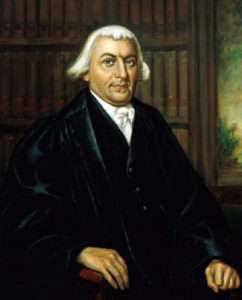
5/12/1790: Justice James Iredell takes the judicial oath.

Mostly law professors | Sometimes contrarian | Often libertarian | Always independent | Est. 2002

There's no opinion yet, and I don't know when one would be forthcoming, so it's hard to figure out what exactly will happen; but I thought I'd pass along the news. The law itself is here.
Netchoice: CA5 has stayed the district court's preliminary injunction in the NetChoice case (i.e., reviving for now Texas's strange anti-bias law, HB20.
The panel is not unanimous we are told, but not who dissents (I think I can guess, but who knows). pic.twitter.com/Fwm0ozYS0J
— Raffi Melkonian (@RMFifthCircuit) May 11, 2022
From the New Hampshire Supreme Court's decision today in Banaian v. Bascom, in an opinion by Justice Anna Barbara Hantz Marconi:
[According to the Complaint,] the plaintiff was a teacher at Merrimack Valley Middle School in May 2016, when a student at Merrimack Valley High School "hacked" the Merrimack Valley Middle School website and changed the plaintiff's webpage, creating a post that "suggest[ed] that [the plaintiff] was sexually pe[r]verted and desirous of seeking sexual liaisons with Merrimack Valley students and their parents." Another student took a picture of the altered website and tweeted that image over Twitter. The retweeter defendants retweeted the original tweet. As a result, the plaintiff was subject to "school-wide ridicule," was unable to work for approximately six months, and suffered financial, emotional, physical, and reputational harm….
Plaintiff sued the retweeters, among others, for libel, but the court concluded that 47 U.S.C. § 230, part of the CDA (Communications Decency Act), precluded the lawsuit:
The CDA provides in pertinent part that "[n]o provider or user of an interactive computer service shall be treated as the publisher or speaker of any information provided by another information content provider." An "interactive computer service" is "any information service, system, or access software provider that provides or enables computer access by multiple users to a computer server, including specifically a service or system that provides access to the Internet." An "information content provider" is "any person or entity that is responsible, in whole or in part, for the creation or development of information provided through the Internet or any other interactive computer service." "No cause of action may be brought and no liability may be imposed under any State or local law that is inconsistent with" section 230….
The meaning of "user" in the first element of section 230(c)(1) is the sole issue in this appeal. The plaintiff argues that "[a] person who knowingly retweets defamatory information is not a 'user' of an interactive computer service the CDA was designed to protect from defamation liability." She asserts that "[n]othing in the text of Section 230, or in the legislative history suggests that Congress intended to provide immunity to individual users of a website," and that "[t]he term 'user' of an interactive computer service should be interpreted to mean libraries, colleges, computer coffee shops, and companies that at the beginning of the internet were primary access points for many people." The plaintiff further asserts that "because the CDA changes the common law of defamation, the statute must speak directly to immunizing individual users."
I blogged last month about this motion to unseal and oppose pseudonymity that I filed in this case (Doe v. Town of Lisbon); since then, the officer filed a response, and I just filed a reply:
[I.] Lawsuits related to allegations of criminal misconduct are routinely
litigated in public, without pseudonymsWhen a police officer arrests a citizen who is then prosecuted, the court filings include the citizen's name—even though the citizen is presumed innocent, and may eventually be acquitted. If the citizen sues a police officer for false arrest, the citizen must generally sue in his own name, even though that would further publicize the citizen's alleged transgression. This is equally true if the citizen sues over an allegedly unconstitutional Terry stop or search unconnected to an arrest, which would otherwise never have been publicly noted. See, e.g., D.E. v. Doe, 834 F.3d 723, 728 (6th Cir. 2016) ("As for potential negative scrutiny from future employers, D.E. … 'forfeited his ability to keep secret his actions at the international border … when he sued United States Customs and Border Patrol agents.'").
If one citizen sues another over allegedly slanderous allegations of misconduct, criminal or otherwise, the plaintiff generally sues in his own name, even though that would further publicize the allegations. If a plaintiff sues a defendant alleging sexual assault, the defendant will generally be named, even though that too would publicize the allegations of conduct that is criminal as well as tortious. If an employee sues an employer for discriminatory firing, and the employer's defense (which the employee says is unfounded) is that the employee was fired for professional misconduct, the employee must generally sue in his own name. Doe v. Frank, 951 F.2d 320, 322-24 (11th Cir. 1992) (denying pseudonymity where employee sued for discrimination, and the employer claimed the employee was fired "because of an inability to perform his assigned duties, a repeated failure to maintain regular attendance and improper conduct in reporting to work under the influence of alcoholism"). If a professional sues a licensing agency that had found him guilty of professional misconduct, he must generally sue in his own name. Coe v. U.S. Dist. Court for Dist. of Colorado, 676 F.2d 411, 415, 418 (10th Cir. 1982) (concluding, after "balancing the need advanced by Dr. Coe to maintain individual and professional privacy rights against the right of the public to know all of the facts surrounding the formal proceedings posited with the Board," that "the privacy interest does not outweigh the public's interest").
In all these situations, the citizen's desire not to have his name associated with allegations of misconduct must yield to "the public's ability to oversee and monitor the workings of the Judicial Branch," which "promotes the institutional integrity of the Judicial Branch." Doe v. Public Citizen, 749 F.3d 246, 263 (4th Cir. 2014). The public has a "legitimate interest in knowing all of the facts involved, including the identities of the parties." Doe v. Frank, 951 F.2d at 322.
And the presence of allegations of criminal behavior is not a basis for pseudonymity, as D.E. v. Doe, supra, illustrates. When Doe v. Stegall, 653 F.2d 180 (5th Cir. Unit A 1981), allowed pseudonymity for a mother and two children who were challenging unconstitutional prayer in Mississippi public schools, the court did note that the family's views were "shown to have invited an opprobrium analogous to the infamy associated with criminal behavior"—but only in indicating the risk of "extensive harassment and perhaps even violent reprisals if their identities are disclosed." Id. at 186. "The threat of hostile public reaction to a lawsuit, standing alone," the court stressed, "will only with great rarity warrant public anonymity." Id. It was "the threats of violence generated by this case, in conjunction with the other factors weighing in favor of maintaining the Does' anonymity," that "tip[ped] the balance against the customary practice of judicial openness." Id.
Yet despite the general requirement that even professional damaging allegations must be discussed in open court, without pseudonyms, plaintiff Doe is arguing that New Hampshire police officers are entitled to pseudonymity when they sue in federal court over similar allegations. That is inconsistent with the federal courts' general—and sound—insistence on openness in litigation.
There's a lot of loose talk going around about the potential consequences of the Court's pending decision to overrule Roe v. Wade. Among other things, some serious people, such as several law professors in this Vox symposium, are suggesting that the Court may overrule Loving v. Virginia, which held that laws prohibiting interracial marriages are unconstitutional. After all, if abortion is not a firmly established historical right protected by the Due Process Clause, then perhaps neither is interracial marriage.
There are three reasons why Loving is safe.
First, over ninety percent of Americans approve of interracial marriage (compared to four percent in 1958!). Even more presumably think it should not be illegal, even if they disapprove of it. As a result, no state is going to ban interracial marriage, so no case will come to SCOTUS.
Second, overruling Loving would be politically unthinkable. The Supreme Court does not just follow the election returns, but it also does not go out of its way to overturn firm precedent that has the support of over ninety percent of the public and the demise of which would cause mass bipartisan public outrage.
Third, and most important, the Loving decision invalidated bans on miscegenation first and foremost on equal protection grounds, as an illegal racial classification, with the due process right to marriage only a secondary rationale. In the very unlikely event the Court were inclined to revisit the due process right to marry, Loving would be safe because of its equal protection holding.
Here's the Court:
While the state court is no doubt correct in asserting that marriage is a social relation subject to the State's police power, Maynard v. Hill, 125 U. S. 190 (1888), the State does not contend in its argument before this Court that its powers to regulate marriage are unlimited notwithstanding the commands of the Fourteenth Amendment. Nor could it do so in light of Meyer v. Nebraska, 262 U. S. 390 (1923), and Skinner v. Oklahoma, 316 U. S. 535 (1942). Instead, the State argues that the meaning of the Equal Protection Clause, as illuminated by the statements of the Framers, is only that state penal laws containing an interracial element as part of the definition of the offense must apply equally to whites and Negroes in the sense that members of each race are punished to the same degree. Thus, the State contends that, because its miscegenation statutes punish equally both the white and the Negro participants in an interracial marriage, these statutes, despite their reliance on racial classifications, do not constitute an invidious discrimination based upon race. The second argument advanced by the State assumes the validity of its equal application theory. The argument is that, if the Equal Protection Clause does not outlaw miscegenation statutes because of their reliance on racial classifications, the question of constitutionality would thus become whether there was any rational basis for a State to treat interracial marriages differently from other marriages. On this question, the State argues, the scientific evidence is substantially in doubt and, consequently, this Court should defer to the wisdom of the state legislature in adopting its policy of discouraging interracial marriages.
Because we reject the notion that the mere "equal application" of a statute containing racial classifications is enough to remove the classifications from the Fourteenth Amendment's proscription of all invidious racial discriminations, we do not accept the State's contention that these statutes should be upheld if there is any possible basis for concluding that they serve a rational purpose. The mere fact of equal application does not mean that our analysis of these statutes should follow the approach we have taken in cases involving no racial discrimination where the Equal Protection Clause has been arrayed against a statute discriminating between the kinds of advertising which may be displayed on trucks in New York City, Railway Express Agency, Inc. v. New York, 336 U. S. 106 (1949), or an exemption in Ohio's ad valorem tax for merchandise owned by a nonresident in a storage warehouse, Allied Stores of Ohio, Inc. v. Bowers, 358 U. S. 522 (1959). In these cases, involving distinctions not drawn according to race, the Court has merely asked whether there is any rational foundation for the discriminations, and has deferred to the wisdom of the state legislatures. In the case at bar, however, we deal with statutes containing racial classifications, and the fact of equal application does not immunize the statute from the very heavy burden of justification which the Fourteenth Amendment has traditionally required of state statutes drawn according to race.
The State argues that statements in the Thirty-ninth Congress about the time of the passage of the Fourteenth Amendment indicate that the Framers did not intend the Amendment to make unconstitutional state miscegenation laws. Many of the statements alluded to by the State concern the debates over the Freedmen's Bureau Bill, which President Johnson vetoed, and the Civil Rights Act of 1866, 14 Stat. 27, enacted over his veto. While these statements have some relevance to the intention of Congress in submitting the Fourteenth Amendment, it must be understood that they pertained to the passage of specific statutes, and not to the broader, organic purpose of a constitutional amendment. As for the various statements directly concerning the Fourteenth Amendment, we have said in connection with a related problem that, although these historical sources "cast some light" they are not sufficient to resolve the problem; "[a]t best, they are inconclusive. The most avid proponents of the post-War Amendments undoubtedly intended them to remove all legal distinctions among 'all persons born or naturalized in the United States.' Their opponents, just as certainly, were antagonistic to both the letter and the spirit of the Amendments, and wished them to have the most limited effect."
Brown v. Board of Education, 347 U. S. 483, 347 U. S. 489 (1954). See also Strauder v. West Virginia, 100 U. S. 303, 100 U. S. 310 (1880). We have rejected the proposition that the debates in the Thirty-ninth Congress or in the state legislatures which ratified the Fourteenth Amendment supported the theory advanced by the State, that the requirement of equal protection of the laws is satisfied by penal laws defining offenses based on racial classifications so long as white and Negro participants in the offense were similarly punished. McLaughlin v. Florida, 379 U. S. 184 (1964).
The State finds support for its "equal application" theory in the decision of the Court in Pace v. Alabama, 106 U. S. 583 (1883). In that case, the Court upheld a conviction under an Alabama statute forbidding adultery or fornication between a white person and a Negro which imposed a greater penalty than that of a statute proscribing similar conduct by members of the same race. The Court reasoned that the statute could not be said to discriminate against Negroes because the punishment for each participant in the offense was the same. However, as recently as the 1964 Term, in rejecting the reasoning of that case, we stated "Pace represents a limited view of the Equal Protection Clause which has not withstood analysis in the subsequent decisions of this Court." McLaughlin v. Florida, supra, at 379 U. S. 188. As we there demonstrated, the Equal Protection Clause requires the consideration of whether the classifications drawn by any statute constitute an arbitrary and invidious discrimination. The clear and central purpose of the Fourteenth Amendment was to eliminate all official state sources of invidious racial discrimination in the States. Slaughter-House Cases, 16 Wall. 36, 83 U. S. 71 (1873); Strauder v. West Virginia, 100 U. S. 303, 100 U. S. 307-308 (1880); Ex parte Virginia, 100 U. S. 339, 100 U. S. 334-335 (1880); Shelley v. Kraemer, 334 U. S. 1 (1948); Burton v. Wilmington Parking Authority, 365 U. S. 715 (1961).
There can be no question but that Virginia's miscegenation statutes rest solely upon distinctions drawn according to race. The statutes proscribe generally accepted conduct if engaged in by members of different races. Over the years, this Court has consistently repudiated "[d]istinctions between citizens solely because of their ancestry" as being "odious to a free people whose institutions are founded upon the doctrine of equality." Hirabayashi v. United States, 320 U. S. 81, 320 U. S. 100 (1943). At the very least, the Equal Protection Clause demands that racial classifications, especially suspect in criminal statutes, be subjected to the "most rigid scrutiny," Korematsu v. United States, 323 U. S. 214, 323 U. S. 216 (1944), and, if they are ever to be upheld, they must be shown to be necessary to the accomplishment of some permissible state objective, independent of the racial discrimination which it was the object of the Fourteenth Amendment to eliminate. Indeed, two members of this Court have already stated that they "cannot conceive of a valid legislative purpose . . . which makes the color of a person's skin the test of whether his conduct is a criminal offense."
McLaughlin v. Florida, supra, at 379 U. S. 198 (STEWART, J., joined by DOUGLAS, J., concurring).
There is patently no legitimate overriding purpose independent of invidious racial discrimination which justifies this classification. The fact that Virginia prohibits only interracial marriages involving white persons demonstrates that the racial classifications must stand on their own justification, as measures designed to maintain White Supremacy. [Footnote 11] We have consistently denied the constitutionality of measures which restrict the rights of citizens on account of race. There can be no doubt that restricting the freedom to marry solely because of racial classifications violates the central meaning of the Equal Protection Clause.
II
These statutes also deprive the Lovings of liberty without due process of law in violation of the Due Process Clause of the Fourteenth Amendment. The freedom to marry has long been recognized as one of the vital personal rights essential to the orderly pursuit of happiness by free men.
Marriage is one of the "basic civil rights of man," fundamental to our very existence and survival. Skinner v. Oklahoma, 316 U. S. 535, 316 U. S. 541 (1942). See also Maynard v. Hill, 125 U. S. 190 (1888). To deny this fundamental freedom on so unsupportable a basis as the racial classifications embodied in these statutes, classifications so directly subversive of the principle of equality at the heart of the Fourteenth Amendment, is surely to deprive all the State's citizens of liberty without due process of law. The Fourteenth Amendment requires that the freedom of choice to marry not be restricted by invidious racial discriminations. Under our Constitution, the freedom to marry, or not marry, a person of another race resides with the individual, and cannot be infringed by the State.
These convictions must be reversed.
of South Africa and the European Court of Human Rights."
The Journal of Free Speech Law has just published this new article, by Jacob Mchangama & Natalie Alkiviadou; here's the Abstract:
We compare the handling of hate speech by the European Court of Human Rights and the highest courts of South Africa: The latter, it turns out, adopts a more robust and well-articulated approach to the issues of hate speech than the former, falling more in line with the thresholds set out by documents such as the UN's Rabat Plan of Action. We argue that South Africa can be a good template for other countries, organizations, and social media platforms seeking a human-rights-based approach to handling hate speech.
This is our fourth non-symposium article (we've also published eleven in a symposium last year), and it was selected through our usual blind peer review process. It's also our first article from foreign authors, and our first dealing with foreign and comparative free speech law.
We encourage everyone to submit manuscripts to the Journal, and we promise a decision within 14 days (a promise which we have consistently adhered to), though you need to submit to us exclusively for those 14 days. Of course, as you can tell from our first issue, we are open to articles from all perspectives, whether arguing for broader free speech protection, narrower free speech protection, or anything else.
From Judge Ryan Nelson's opinion this morning in Jones v. Bonta, joined by Judge Kenneth Lee and in part (only as to the upholding of the hunting license requirement) by District Judge Sidney Stein (S.D.N.Y.):
California has restricted the sale of most firearms to anyone under 21. Plaintiffs challenged the bans on long guns and semiautomatic centerfire rifles under the Second Amendment. The district court declined to issue a preliminary injunction.
We hold that the district court did not abuse its discretion in declining to enjoin the requirement that young adults obtain a hunting license to purchase a long gun. But the district court erred in not enjoining an almost total ban on semiautomatic centerfire rifles. First, the Second Amendment protects the right of young adults to keep and bear arms, which includes the right to purchase them. The district court reasoned otherwise and held that the laws did not burden Second Amendment rights at all: that was legal error.
Second, the district court properly applied intermediate scrutiny to the long gun hunting license regulation and did not abuse its discretion in finding it likely to survive. But third, the district court erred by applying intermediate scrutiny, rather than strict scrutiny, to the semiautomatic centerfire rifle ban. And even under intermediate scrutiny, this ban likely violates the Second Amendment because it fails the "reasonable fit" test. Finally, the district court also abused its discretion in finding that Plaintiffs would not likely be irreparably harmed. We thus affirm the district court's denial of an injunction as to the long gun regulation, reverse its denial of an injunction as to the semiautomatic centerfire rifle ban, and remand for further proceedings consistent with this opinion.
Judge Lee also wrote a separate concurrence, "to highlight how California's legal position has no logical stopping point and would ultimately erode fundamental rights enumerated in our Constitution":
An interesting article by two former prosecutors (T. Markus Funk and Andrew S. Boutros) and District Judge Virginia M. Kendall (N.D. Ill.)
From a Bloomberg Law column today, reprinted with permission; I can't opine on the matter myself, but it struck me as worth passing along, and I'd of course also be glad to link to other views on the subject:
The possibility that a U.S. Supreme Court law clerk may have leaked a draft opinion to a Politico reporter has shined a rare spotlight on the consequences facing law clerks who betray judicial trust. Chief Justice John Roberts, who characterized the leak as "appalling," ordered the court's marshal to launch an investigation.
No doubt leaking internal court documents and other sensitive information—whether at the Supreme Court or in a lower court—threatens to end a promising legal career before it has launched, and for good reasons. But does such a bold breach also implicate the criminal law?
Most observers, including some prominent law professors and other members of the legal commentariat sharing their perspectives in outlets such as the New York Times, Washington Post, Reuters, Wired, USA Today, and Politifact, have opined that it likely does not.
As three former federal prosecutors who have been working on criminal cases for some 75 years combined, we offer a different perspective.
Violating the Hallowed Trust
UCSF's "working definition" of underrepresented minorities includes Filipino, Hmong, and Vietnamese
As regular VC readers know, I've written a book about how America's racial classifications developed and how the classifications are defined and enforced. One of the many arbitrary aspects of the classifications is that they lump together "Asian American" groups that have nothing in common--such as Bangladeshi and Cambodian Americans--into the same classification.
In higher education, because "Asian Americans" on average are "overrerpresented," at best members of that classification do not benefit from URM status, and at worst are subject to discrimination in admissions.
It turns out, however, that if one digs deep into the data, one finds that the "overrepresentation" of Asian Americans is primarily a product of the academic success of Indian, Chinese, Japanese, and (to a lesser extent) Korean Americans. Other Asian groups are anywhere from mildly "overrepresented" compared to their share of the population, or underrepresented.
Recognizing this dynamic, UCSF decided to include Filipinos, Hmong, and Vietnamese as URMs in its "working definition" of that category. But this raises its own questions. Why those three groups, and not Pakistanis, Bangladeshis, Cambodians, Laotions, and other Asian subgroups who also are likely "underrepresented" in higher education, certainly relative to Filipinos, who have among the highest average incomes of American ethnic groups?
For that matter, why only break down the Asian category? Some Hispanic subgroups are "underrepresented" relative to population, but I'm not sure that Cubans Americans are; I'm pretty confident that Spanish and Argentine Americans are not, though it's hard to get such data.
Among African Americans, Nigerian immigrants and their children are almost certainly "overrepresented," so why not break down the African American/black classification more finely?
For Native Americans, why not distinguish between, say, those who grew up on reservations and within a Native American community and, say, tribal members who are only a fraction of Indian descent and have few if any ties to their ancestral tribe? (One can, for example, be less than 1/5000 Cherokee and still be a member.)
And of course, "white" is not a homogenous category. Appalachians, for example, are the least-well-off of any American group that anyone bother to study, other than Indians living on reservations. Why do they not count as "underrepresented?"
In short, UCSF's instinct, that it's unfair to lump all "Asian Americans" together, is sound. But the same instinct, followed to its logical conclusion, tells us that all the classifications used by USCF and other universities arbitrary lump people with vastly different backgrounds, experiences, and average group success together.
These leaks from a "conservative" look designed to quell controversy.
Another day, another leak. Despite the ongoing investigation, information continues to spill out of the Supreme Court. The latest story comes from Politico. Now, Josh Gerstein and Alexander Ward share a byline with Ryan Lizza, who is the Chief Washington correspondent. And this story comes out the day before the scheduled May 12 conference, the first conference since the initial leak. (Though I think it likely that the Justices have met in some unscheduled fashion over the past week.)
The story makes six new claims.
First, we learn that no other draft dissents or concurrences have been circulated:
Justice Samuel Alito's sweeping and blunt draft majority opinion from February overturning Roe remains the court's only circulated draft in the pending Mississippi abortion case, POLITICO has learned, and none of the conservative justices who initially sided with Alito have to date switched their votes. No dissenting draft opinions have circulated from any justice, including the three liberals.
The fact that no other opinions are even in the mix explains why the Court could not quickly put out the decision to quell the current maelstrom. Whoever provided this leak has up-to-date information about the status of draft opinions. Of course, it is possible that Roberts privately circulated his concurrence to Kavanaugh and Barrett. Recall that in Casey, Kennedy, O'Connor, and Souter largely worked independently of others. Scalia was stunned when he learned that the votes flipped. I will return later in this post to (wildly) speculate why no other opinions have been circulated.
Second, Politico offers some speculation about its own exclusive--why someone would leak a February draft in May?
That could explain why no second draft of Alito's majority opinion has been distributed, as typically the two sides react to one another's written arguments and recast their own.
Many observers (present company included) presumed that the leaked draft was likely obsolete, as there were almost certainly other circulated opinions. But, according to Politico, there are no other drafts. Therefore, there would be nothing else to leak. Alito's opinion is still current.
Third, Politico quotes someone "close to the court's conservatives."
"This is the most serious assault on the court, perhaps from within, that the Supreme Court's ever experienced," said one person close to the court's conservatives, who spoke anonymously because of the sensitive nature of the court deliberations. "It's an understatement to say they are heavily, heavily burdened by this."
This person has connections to not just one conservative member, but several conservatives, plural. And this person is speaking on direct knowledge of how several of the Court's conservative members are reacting to this leak. And he is relaying that this leak is the "most serious assault on the Court" ever--more than the Civil War, more than Court Packing, more than the massive resistance to Brown, more than Bush v. Gore, more than Biden's ill-fated SCOTUS commission, and so on. Why? This enemy is not at the gates, but is "within." And we learn that the Justices are "heavily, heavily burdened." No kidding. You might call it an "undue burden." The justices are having their homes picketed, and things will likely get worse as we get closer to July.
Also, this sourcing is very similar to a source the Washington Post quoted:
A person close to the court's most conservative members said Roberts told his fellow jurists in a private conference in early December that he planned to uphold the state law and write an opinion that left Roe and Casey in place for now. But the other conservatives were more interested in an opinion that overturned the precedents, the person said.
I wonder if the same person was authorized by the Justices--or even the Chief--to talk to the Post and Politico.
Fourth, Politico quotes someone else to discuss the sentiments of the liberal Justices:
A second person close to the court said that the liberal justices "are as shocked as anyone" by the revelation. "There are concerns for the integrity of the institution," this person said. "The views are uniform."
Now this person is simply "close to the court," but not close to conservatives or liberals. But this person is conveying personal sentiments from Justices Breyer, Sotomayor, and Kagan. They have "uniform" views with the conservatives. This leak should disabuse anyone that a Justice authorized this leak. And, presumably, none of these Justices know that their law clerks did it. It would be difficult for a Justice to share this concern for the Court's integrity, while knowingly harboring a clerk who caused that breach. Again, I do not think this leak came from a clerk, but someone else "within."
Fifth, Politico speculates that Roberts's vote is still in play:
In the Mississippi abortion case currently before the court, Dobbs v. Jackson Women's Health Organization, it's not clear if Roberts will join the liberal justices in dissent, craft his own solo opinion in the case or perhaps join a watered-down version of Alito's draft.
Roberts could still try to lobby one of the five Republican-appointed justices to withdraw their support from Alito and sign onto a more centrist opinion that doesn't formally overturn Roe, but instead upholds Mississippi's 15-week cut off for performing most abortions. Such a move would deprive Alito of a majority and could maintain some federal guarantee of abortion rights, although precisely what regulations states could impose on abortion under such a scenario remains murky.
I take it that Alito's opinion still has five votes because there is no other opinion to join. Justices Kavanaugh and Barrett could still be waiting to see what the Chief cooks up. Or they may have already seen a private draft, like in Casey.
Roberts has not broadly circulated his draft concurrence, which would find a way to uphold the Mississippi law without overruling Roe and Casey. The delay in releasing that concurrence could explain the absence of any dissents. Why circulate a dissent if the majority may not hold. Kagan can keep her powder dry for now. But what is Roberts waiting for? Dobbs was argued in December. We are now in the second week in May. How long could it take to whip up a Chief blue plate special? Sophistry is not hard.
My cynical take is that circulating the draft opinion at the latest possible juncture creates chaos, and makes it more likely that things can move around without sufficient deliberation. This strategy resembles that of the death penalty abolitionists, who deliberately file last-minute appeals, hoping the rush causes a temporary stay. Of course, the response to this strategem is the Purcell principle. We are far too close to the end of the term to justify such a sudden shift in the process. I am mostly being facetious, but the analogy holds.
Sixth, Politico traces much of the current dysfunction to Roberts's decision in NFIB.
While Roberts is a conservative and has sided with his Republican-appointed colleagues again and again in cases involving voting rights, campaign finance and affirmative action, he seemed at times more like a swing justice on other issues, particularly over the past decade.
However, in a series of politically-charged cases, Roberts sided with the court's liberals to uphold the Affordable Care Act's individual mandate, reject then-President Donald Trump's repeal of protections for so-called Dreamers, and foil Trump administration plans to add a question about citizenship to the 2020 census.
Of those rulings, the Obamacare one ruffled the most feathers because Roberts reportedly reversed his position days before the decision was announced, ultimately voting to find the law constitutional.
"There is a price to be paid for what he did. Everybody remembers it," said an attorney close to several conservative justices, who was granted anonymity due to the sensitive nature of the court's arguments.
…
To some extent, Roberts is also now a victim of the expectations he set for himself by publicly and repeatedly embracing the goal of building consensus on the court. Speaking at a legal conference in Atlanta last week following POLITICO's disclosure of the draft abortion opinion, he hinted at the perils of that approach and suggested he'd lowered his own horizons a bit.
"I learned on the court unanimous means 7-to-2," Roberts joked, according to the Washington Post.
I agree--and I swear, I am not the "attorney." I am not close to any Justice. They are wise to keep as far away from me as possible.
When Roberts came on the Court, he explicitly said that public perception would affect his approach to judging. A desire to have more unanimous decisions was an express appeal to build public confidence in the Court. But this decision had predictable consequences, as Roberts would eventually place a jurisprudence of public relations over a jurisprudence of law. Since NFIB, Roberts has been falling into the bottomless pit from which he cannot extract himself. And, alas, he is trying to take some of his new colleagues down with them. If they take the leap, this pressure does not vanish. It will simply increase in the next case. Home picketing will seem quaint.
The employee argued that "her faith in God 'will protect her from COVID-19 so there is no reason to take a test.'"
From In re Whitehead (N.J. Office of Admin. L.), decided Sept. 1 by Administrative Law Judge Julio Morejon, and adopted Oct. 6 by the Civil Service Commission, but just posted on Westlaw:
Appellant, Carolyn Whitehead … was employed by respondent, City of East Orange, … as a Keyboarding Clerk I & Assistant Zoning Officer. On July 23, 2020, Whitehead was terminated from her employment for failure to take a COVID-19 test as a condition to return to work. Whitehead appeals East Orange's decision….
Whitehead claims that her rights under Title VII of the Civil Rights Act were violated by East Orange when it refused to provide her "reasonable accommodations" for her sincerely held religious belief that her faith in God "will protect her from COVID-19 so there is no reason to take a test," as she stated in oral argument….
Congress gave the Court power to pick cases, but it never gave the power to pick questions.
This is the third post walking through some of the arguments in my larger essay on the Origins of Supreme Court Question Selection. So far, I've suggested that the Court's practice of preselecting only some questions for review is in tension with the statutory text that requires the Court to decide cases through certiorari. I've also argued that—at least as an original matter—neither the general appellate power nor the common law writ of certiorari empowers the Court to cherry pick questions from cases. A careful reader or Court nerd will observe that there is a clear disconnect between these two points: statutory certiorari is different from common law certiorari. So, let's dig into statutory certiorari.
The Evarts Act and the Judges' Bill
Let's start the story during Reconstruction. Republican reforms after the Civil War led to a massive increase in the workload of the federal courts. Key drivers included the Habeas Corpus Act of 1867 and the Jurisdiction and Removal Act of 1875, which finally provided for federal question jurisdiction. Admiralty cases, railroad litigation, and bankruptcy proceedings crowded the dockets as congressional Republicans looked to the federal courts to help facilitate the party's emphasis on national economic development. The effects on the Court were dramatic. In 1860, the Court had 310 cases on its docket. In 1890, it had 1,816 after including the 623 filed in that year, and it was three years behind on its work.
5/11/1942: Gordon Hirabayashi "failed to report to the Civil Control Station within the designated area." The Supreme Court upheld the constitutionality of his conviction in Hirabayashi v. U.S. (1943).

A statement from the ACLU:
You'd be hard-pressed to find a more steadfast opponent of Trump and his policies than the ACLU, but Elon Musk's decision to re-platform President Trump is the right call. When a handful of individuals possess so much power over the most important forums for political speech, they should exercise that power with restraint. If Trump violates the platform rules again, Twitter should first employ lesser penalties like removing the offending post—rather than banning a political figure.
Like it or not, President Trump is one of the most important political figures in this country, and the public has a strong interest in hearing his speech. Indeed, some of Trump's most offensive tweets ended up being critical evidence in lawsuits filed against him and his administration. And we should know—we filed over 400 legal actions against him.
held to be vague and therefore unenforceable.
From Powell v. Knoepfler-Powell, decided last week by Judge David Bernhard of the Virginia Circuit Court (Fairfax County):
The Court … holds [that a divorce settlement agreement] term that the parties are to exercise "great care prior to introducing" their "boyfriends or girlfriends with whom they may have a romantic relationship" to their child, is void as against public policy and unenforceable. The clause is unduly vague and calls upon the Court to unreasonably limit the freedom of association and speech of the parties interacting with their child ….
The Court is part of government and as such, is restricted from unduly interfering with fundamental rights. The Virginia Code calls upon judges presiding in disputed custody and visitation cases to consider the best interests of subject children in application of a number of listed factors "for purposes of determining custody or visitation arrangements," which may empower the Court to a limited extent to regulate associations and speech when harmful to the child…. [But t]he Court must tread lightly, if at all, in imposing prior restraint on the associations and speech of a parent who has given no cause to the Court to conclude that she will act in any way harmful to the parties' child. In the context of this Court imposing an order restricting parental freedom of association and speech, it would thus be an abuse of discretion by allusion to the authorities herein cited at a minimum not to have a reasonable and equitable basis for so doing….
This provision, if again incorporated into this Court's order resolving the instant dispute, is equivalent to an injunction punishable upon transgression by the judicial contempt power. Previous agreement by the parties to a contractual term alone is not dispositive as to whether such provision is nevertheless void as against public policy.
If you don't like what Bracton said about abortion, wait till you read what he wrote about hunting foxes.
Justice Alito's draft opinion cited Henry de Bracton, a thirteenth century English jurist.
Henry de Bracton's 13th-century treatise explained that if a person has "struck a pregnant woman, or has given her poison, whereby he has caused an abortion, if the foetus be already formed and animated, and particularly if it be animated, he commits homicide." H. Bracton, De Legibus et Consuetudinibus Angliae 279 (T. Twiss ed. 1879); see also 1 Fleta ch. 20, reprinted in 53 Selden Soc'y 60-61 (H.G. Richardson & G.O Sayles eds. 1953)
You may have thought to yourself, who is Bracton? Think back to 1L. Remember Pierson v. Post (1805), the famous fox case? Both the majority and dissent in that classic case cite Bracton. Judge Tompkins's majority opinion explains that Bracton was in agreement with the Institutes of Justinian. (If you don't know who Justinian is, say Richard Epstein three times and he will appear like Beetlejuice.)
The cause was argued with much ability by the counsel on both sides, and presents for our decision a novel and nice question. It is admitted that a fox is an animal feræ naturæ, and that property in such animals is acquired by occupancy only. These admissions narrow the discussion to the simple question of what acts amount to occupancy, applied to acquiring right to wild animals?
If we have recourse to the ancient writers upon general principles of law, the judgment below is obviously erroneous. Justinian's Institutes, lib. 2. tit. 1. s. 13. and Fleta, lib. 3. c. 2. p. 175. adopt the principle, that pursuit alone vests no property or right in the huntsman; and that even pursuit, accompanied with wounding, is equally ineffectual for that purpose, unless the animal be actually taken. The same principle is recognised by Bracton, lib. 2. c. 1. p. 8.
Judge Livingston's dissent, by contrast, would have decided the case without relying Bracton and other jurists:
Whether a person who, with his own hounds, starts and hunts a fox on waste and uninhabited ground, and is on the point of seizing his prey, acquires such an interest in the animal, as to have a right of action against another, who in view of the huntsman and his dogs in full pursuit, and with knowledge of the chase, shall kill and carry him away?
This is a knotty point, and should have been submitted to the arbitration of sportsmen, without poring over Justinian, Fleta, Bracton, Puffendorf, Locke, Barbeyrac, or Blackstone, all of whom have been cited; they would have had no difficulty in coming to a prompt and correct conclusion.
(For those curious I published an article about Pierson v. Post and the natural law.)
When I read Alito's citation to Bracton, I thought, huh, I wonder if anyone else will think of Pierson v. Post. Dana Milbank had other thoughts. His column yesterday was titled, That 13th-century law treatise Alito uses? Here's what else it says. Milbank goes on to pluck out some choice quotes from Bracton's "De Legibus et Consuetudinibus Angliae."
But Bracton does have a lot to say about monsters, duels, bastardy, concubines, sturgeon "and other royal fish," the "pillory and the ducking-stool," and "a judgment with infamy."
"Where he ought to be executed by the sword he shall not be put to death in any other way, neither by the axe nor the spear, by cudgels nor by the rope," Bracton informs us. "Similarly, those condemned to be burned alive ought not to be injured by floggings, whippings, or tortures, since many perish while under torture."
So true! Let's take a closer look at the 13th-century work from which Alito draws in his cruel and unusual draft — and perhaps glimpse more of the world to which Alito and his fellow conservatives on the court would return us. . . .
But his view of personhood might raise questions in 21st-century America. Bracton categorizes slaves as property: "this slave, this estate, this horse, this garment." And he explains that "those born of unlawful intercourse, as out of adultery and the like, are not reckoned among children." Those children "born of prohibited intercourse … are fit for nothing."
I regret to admit that Henry de Bracton was not woke. He held regressive 13th century views. Society should collectively cancel him. Any citation to Bracton should at least include a Bluebook parenthetical to denote his views about slavery. For that matter, we should also cancel Magna Carta, which was published around that time. Remember Section 10:
If anyone who has borrowed a sum of money from Jews dies before the debt has been repaid, his heir shall pay no interest on the debt for so long as he remains under age, irrespective of whom he holds his lands. If such a debt falls into the hands of the Crown, it will take nothing except the principal sum specified in the bond.
No one would talk about Jews this way today, right?
Ultimately, I think Bracton looks good here. His works are nearly 800 years old, but we are still citing him! I wonder if anything written in this century will be worth citing in 800 years. No, tweets don't count.
The answer is probably "no." But the federal government could more easily ban such transactions.
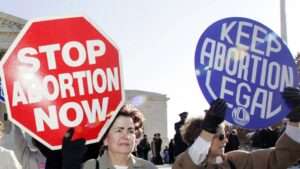
If, as seems likely, the Supreme Court overrules Roe v. Wade, some conservative states may not only restrict abortions within their borders, but also try to bar residents from traveling out of state to get them. If that happens, there is a good chance courts will declare such laws to be unconstitutional. There are at least three strong constitutional arguments against them. A federal law banning interstate travel for the purpose of getting an abortion would likely fare better in Court, however.
The most obvious rationale for challenging a state-law abortion travel ban is the Dormant Commerce Clause, which forbids state regulations that specifically restrict interstate commerce or discriminate against it. I am not an expert on the ins and outs of the Supreme Court's complicated jurisprudence in this field. But it seems to me that a ban on traveling out of state to engage in a specific type of economic transaction is a pretty obvious violation of the DCC. Traveling to get an abortion is pretty obviously interstate commerce, even under a relatively narrow definition of the term "commerce" - at least if the provider gets paid for its services (as is likely true in the vast majority of cases).
To be sure, states can ban people from bringing in out-of-state products that are banned within the state. For example, a state where marijuana is illegal can ban its importation from elsewhere. But no such importation of contraband occurs when the state government bars residents from getting abortions that are entirely administered outside their territory. Merely being a woman who is not pregnant is, presumably, not going to be made illegal (and such an absurd law would be unconstitutional, as well).
Barring interstate travel to get an abortion is more like a state criminalizing residents who travel to use marijuana in another state, rather than those who buy it in the latter location and then bring it back home. If the Dormant Commerce Clause forbids state laws barring residents from traveling to use marijuana in another state (or alcohol or any other product that might be forbidden in their home state), then the same goes for travel for the purpose of getting an abortion.
Some conservative jurists, such as Supreme Court Justices Clarence Thomas and the late Antonin Scalia, have argued that the Dormant Commerce Clause doctrine lacks originalist support and should be abolished. If they get their way, the Clause would not constrain state abortion travel bans - or anything else. But I don't think there is anything close to a majority on the Supreme Court in favor of that position.
A second potential line of attack on state abortion travel bans is that states lack the authority to regulate activity that takes place beyond their borders. This is often treated as a violation of the Due Process Clause of the Fourteenth Amendment, but can also be seen as an inherent limitation on state sovereignty. That sovereignty is territorial. State A only has jurisdiction over activity that takes place on its own territory, not that of States B and C. To be sure, things become more complicated if activities undertaken in B have a direct impact on the territory of A. But, in this case, an abortion conducted in B does not in fact threaten any legal rights of anyone located in A at the time, or inflict any kind of tangible harm on them at all.
If state sovereignty is broad enough to criminalize almost any activity residents engage in beyond its borders, then the state could potentially criminalize travel for a vast range of purposes. It could obviously, for example, criminalize travel for the purpose of consuming a product banned within its own territory. Thus, a state that bans marijuana could forbid residents from traveling to use it in another state. If a state bans a type of gun, it could forbid residents from using that type of weapon elsewhere. Even if the activity in question were not illegal in the would-be travelers' home, perhaps the state could ban it nonetheless. For example, perhaps Massachusetts could ban residents from going to New Hampshire to buy products that the latter (which has no sales tax) taxes at a lower rate than Massachusetts does.
Finally, state abortion travel bans are open to challenge because they violate the constitutional right to travel. The Supreme Court has recognized a constitutional right to travel between states since before the enactment of the Fourteenth Amendment (the Court ruled that it was a background structural element of the Constitution), and more recent precedent has also held that there is a right to travel under either the Due Process Clause or the Privileges or Immunities Clause of the latter amendment.
The Supreme Court's right to travel precedents focus on categorical bans or restrictions on entry and exist, such as exit taxes, constraints on the entry of indigent people, and - most controversially - limitations on new residents' eligibility for welfare benefits. These cases don't directly consider limitations on the reasons why people travel, such as - in this case - getting an out-of-state abortion. But if the right to travel doesn't bar states from penalizing people who travel for the purposes of getting an abortion, states could potentially severely undermine the right by punishing people for all sorts of other travel. The same logic would apply to travel for the purposes of consuming goods and services the state government disapproves of (marijuana, alcohol, medical treatment of various kinds), working for entities the state government objects to (e.g. - red states might disapprove of travel to provide services to blue state governments and vice versa), and so on.
Thus, I think a right to travel worthy of the name should bar states from banning travel for the purposes of getting an abortion out of state - or consuming any other good or service there, so long as the product in question isn't brought back to the resident's home state.
As in the case of the Dormant Commerce Clause, there is a distinction here between traveling for purposes of consuming marijuana in another state, and bringing the marijuana back home. Abortion, by definition, is a service that is entirely "consumed" on site, and therefore cannot be brought back home in the way drugs or alcohol can.
Admittedly, there are few, if any, precedents on the books considering the constitutionality of anything closely similar to a state abortion travel ban. But the case against it seems strong on the basic logic of all three of the above theories. Allowing states to impose abortion travel bans would be hard to do without also giving states broad power to restrict travel by residents for a wide range of other purposes. That reality should incline courts towards striking down these laws.
I recognize, however, that there is considerable uncertainty about what courts will actually do here. In an important new Columbia Law Review article, legal scholars David S. Cohen, Greer Donley, and Rachel Rebouche argue that the uncertainty is even greater than I suggest above. I highly recommend their article to anyone interested in these issues.
If I differ with them, it is primarily because of the point that upholding abortion travel bans would severely undermine all three of the above constraints on state extraterritorial jurisdiction, even in cases far removed from abortion. But it is possible that clever lawyers will come up with new ways to distinguish abortion travel bans from other extraterritorial state regulations.
Potentially, the federal government could also restrict interstate travel for purposes of getting an abortion. For example, it could pass a law barring medical facilities from performing abortions for residents of states where the abortion in question would be illegal.
If that happened, the resulting regulations would be far less open to challenge than state laws would. The Dormant Commerce Clause obviously doesn't constrain Congress. It could easily regulate all or most interstate abortion transactions using its power to regulate interstate commerce. Similarly, there are no territorial limits on the federal government's jurisdiction within the United States.
Congressional regulations could perhaps still be constrained by the right to travel. But even that is, I think, less likely to be applied against Congress by courts than against the states.
However, there are serious political obstacles to enacting federal abortion restrictions, even if the Republicans regain control of Congress. They include - among other things - the opposition of moderate and pro-choice GOP members of Congress, such as Senators Susan Collins and Lisa Murkowski, and the need to abolish or restrict the filibuster (which GOP Senate leader Mitch McConnell has vowed never to do, including for purposes of legislating on abortion). Of course, McConnell could potentially break his pledge, or a future Republican leader might take a different view. But McConnell did retain the filibuster for policy throughout his time as Senate Majority leader under Trump, even when getting rid of it might have helped the GOP achieve major legislative goals, such as repealing Obamacare.
Legal issues aside, abortion travel bans might be very difficult to enforce, whether enacted by state governments or by Congress. Enforcing authorities are likely to face many of the same obstacles as they do in trying to eliminate other black markets. Consider, for example, the history of the War on Drugs, which has noticeably failed to suppress the illegal drug trade, or even come close to doing so.
In addition, blue states have begun to adopt laws denying cooperation to other states seeking to enforce abortion travel bans, and more such laws are likely to be enacted in the future. They would likely react similarly to a federal ban, which they would have a right to do under the Supreme Court's anti-commandeering precedents, which bar the federal government from requiring state and local officials to help enforce federal law.
The anti-commandeering doctrine has protected conservative states that refuse to help enforce federal gun regulations, and liberal immigration "sanctuaries." It should work the same way for potential abortion "sanctuaries."
Without cooperation from destination states, abortion travel bans will be even more difficult to enforce. That would limit their effectiveness even if courts ultimately uphold them.
That said, such bans would likely inhibit at least some interstate abortion travel. And, even if their effectiveness turns out to be severely limited, their enactment would raise important constitutional issues. If upheld by courts, they would open the door to a wide range of other state controls over interstate travel. Hopefully, that troubling scenario will be avoided.
UPDATE: I have made a few minor additions to this post.
UPDATE #2: For what it is worth, I support co-blogger Eugene Volokh's proposal for a federal statute protecting the right to interstate travel against state-government interference. I think Congress has the authority to enact such a law (at least as to the vast majority of possible applications) under a combination of its powers under the Commerce Clause and Section 5 of the Fourteenth Amendment. But, at least for now, I am skeptical that such a proposal is politically feasible. Unless and until something like it gets enacted, the issues discussed in this post will be relevant in a post-Roe world.
This perennial question came up again in an e-mail from a reader about the abortion debate, so I thought I'd blog again about it. I think the answer is not just "no," but "hell, no"—I think it would be an outrageous discrimination against religious believers to have such a constitutional rule, and fortunately nothing in the history or the precedents of the Establishment Clause supports this position.
The argument is this: Isn't it illegitimate for the government to ban abortion, or to ban cloning, or fail to recognize same-sex marriages, when most of the arguments for that position are essentially religious? Isn't that an unconstitutional violation of the separation of church and state, or at least a violation of some democratic norm that people ought not force their religious views on others?
But most of the coercive laws that we hotly debate involve the forcing of a majority's views on the minority. That's true of laws protecting endangered species, antislavery laws, antidiscrimination laws, animal cruelty laws, environmental laws, intellectual property laws—or for that matter bans on infanticide, child sexual abuse, or more generally murder, rape, or theft. Some of these laws may be sound on the merits, and others unsound. But the fact that they force one group's views on another doesn't make them violations of the Establishment Clause, regardless of the source of the first group's views.
Celebrate your independence with a subscription to Reason magazine, your most trusted source of honest, insightful news and analysis.




