


The Volokh Conspiracy

Mostly law professors | Sometimes contrarian | Often libertarian | Always independent | Est. 2002

The Volokh Conspiracy

Bruen Broke The Deal

A guest post from Prof. Robert Leider (GMU)

|

Shortly after Bruen was decided, I wrote a post about the limits imposed by the decision. Even sooner, New York convened a special legislative session to revamp its gun laws. The new law, predictably, pushes the limits of Bruen. The New York Times offers this summary:

The state's new gun law bars the carrying of handguns in many public settings such as subways and buses, parks, hospitals, stadiums and day cares. Guns will be off-limits on private property unless the property owner indicates that he or she expressly allows them. At the last minute, lawmakers added Times Square to the list of restricted sites.

The law also requires permit applicants to undergo 16 hours of training on the handling of guns and two hours of firing range training, as well as an in-person interview and a written exam. Applicants will also be subject to the scrutiny of local officials, who will retain some discretion in the permitting process.

But more troubling, Bruen in many regards worsens the rights of gun owners in New York. Professor Robert Leider (GMU) makes this point in a guest post:

Many gun owners in California and New York will not be celebrating the Supreme Court's decision in New York State Rifle & Pistol Association v. Bruen.  In that case, the Supreme Court held that the Second Amendment protects a right to bear arms for self-defense outside the home. Before Bruen, six states required individuals to show "good cause" (usually some special danger) to get a license to carry a gun in public.  Three of these states permitted local officials to determine what constituted good cause.  In these states, many gun owners could easily obtain licenses because they lived in conservative areas where local officials recognized "self-defense" as good cause.  But because licenses were difficult to obtain in many other areas of the state, these states did not heavily restrict where licensed gun owners could carry their weapons.  Bruen shattered that political compromise.  After Bruen, all state licensing authorities will have to issue licenses to carry firearms to anyone regardless of whether they are in danger.  Predictably, liberal states are responding by heavily restricting the places where licensed firearm owners may carry their weapons.  Ironically, gun owners in these states will now find that although they may obtain licenses more easily, their licenses are virtually worthless to carry firearms for self-defense, and Bruen's effects will be felt hardest by those who already held unrestricted licenses.

With respect to gun licensing, judges and commentators frequently distinguish between "shall issue" and "may issue" states.  Although various definitions exist, the real difference between "shall" and "may issue" jurisdictions involves whether an applicant for a license to carry a gun has to demonstrate that he faces special danger.  In "shall issue" jurisdictions, there is no requirement to show a specialized need for a license.  This distinguishes them from their "may issue" counterparts, which require applicants to show "proper cause," "good cause," "good reason to fear injury to person or property," or some related formulation.  (For simplicity, I'll just use New York's formulation of "proper cause.")  The precise quantity of danger an applicant must face varies considerably among jurisdictions; "may issue" licensing is a broad spectrum of licensing policies.  Some jurisdictions, including Boston and Maryland, issue many licenses to business owners at risk of robbery.  Others, such as Hawaii, New Jersey, and San Francisco, hardly issue any licenses at all, essentially requiring police-documented death threats—and making it difficult to obtain licenses even then.

By the time Bruen was decided, there were effectively six "may issue" states:  California, Hawaii, Maryland, Massachusetts, New Jersey, and New York.  Three of these jurisdictions—California, Massachusetts, and New York— delegated the issuance of licenses to local officials using local policies.

Before Bruen, the definition of "good cause" in these three states was at the discretion of local licensing authorities.  In conservative jurisdictions, licensing officials routinely accepted that self-defense constituted "proper cause" to issue a license.  In liberal jurisdictions, however, licensing officials required substantially more reason, requiring anything from running a cash business to death threats to justify the license.

The result was an uneasy compromise.  Residents in conservative jurisdictions could obtain licenses to carry guns effectively on a shall-issue basis, while licenses in liberal areas were extremely difficult to obtain.  Liberal state legislatures fought to preserve their good-cause licensing requirement.  But they also looked the other way when conservative jurisdictions widely issued licenses, even though those licenses were unrestricted and usually valid statewide.  In online gun owner forums, one can find color-coded maps divided into green, yellow, and red jurisdictions ("green" for shall issue jurisdictions, "yellow" for moderately difficult may issue jurisdictions, and "red" for jurisdictions in which it was virtually impossible to get a license).  Where feasible, gun owners used these maps to move to jurisdictions with friendlier licensing officials.  And for gun owners, there were some advantages to being in a "may issue" state.  Compared with traditional "shall issue" states (especially in the South) "may issue" states had very few places in which a licensed person could not legally carry a firearm.

Bruen has destroyed that compromise.  After Bruen, all jurisdictions that require licenses to carry firearms must do so on a "shall issue" basis.  And the result is predictable:  legislatures in "may issue" states are scrambling to ban guns from as many locations as possible, including government buildings, stadiums, theaters, parks, financial institutions, public transportation, and restaurants.  Most devastatingly for gun owners, New York is trying to ban firearms on all private property at which the property owner does not post a sign welcoming firearms.  New York Governor Kathy Hochul, when asked where permit holders would be allowed to carry weapons, candidly replied, "Probably some streets."

Gun owners have always had the most rights in places where the gun issue has flown under the radar.  While legislatures in California, Massachusetts, and New York have passed strict gun laws, these legislatures have also placed few restrictions upon licensed gun owners.  With licenses difficult to obtain, these states did not give much consideration to where licensees could carry weapons.  Similarly, many private property owners are loathe to post signs banning gun carry; but they are going to be equally unwilling to post signs affirmatively welcoming gun owners.

If gun owners think the courts will bail them out, they are mistaken.  Courts probably will not force states to have a particular default rule for private property owners (allowing guns without a sign versus prohibiting guns without a sign).  Moreover, there is some precedent for what these states are proposing to do.  For many years, Alabama had a law prohibiting carrying pistols on premises not one's own, which the Supreme Court of Alabama upheld against a challenge that it violated the right to bear arms.

So the irony is that Bruen will be a pyrrhic victory for the gun owners Bruen was supposed to help the most.  In may issue states, those who already have unrestricted licenses will find themselves subject to far more restrictive carry laws than before Bruen was decided.  These gun owners might no longer have to fear that a licensing official will arbitrarily decide one day that they no longer have sufficient reason to carry a firearm in public.  But, as Gov. Hochul said, their new right to bear arms may be little more than the right to carry weapons on just "some streets."

I agree with Rob. Do not expect the Second Circuit to suddenly become enamored with the Second Amendment because Justice Thomas said so. The courts will resist (yes, I said it) Bruen the same way they resisted Heller. I hope the Supreme Court will resolve circuit splits in less than a decade.

Supreme Court

Which Circuit Has Justice Ketanji Brown Jackson Been Assigned to?

|

Each of the 13 federal circuit courts of appeals gets a Justice assigned to it, mainly to handle one-Justice applications (for stays, extensions of time, and the like) coming from that Circuit.

They are often given to Justices based on their connections to the circuit. Several Justices have the circuits on which they hard served: Roberts (D.C.), Sotomayor (2d), Alito (3d), Barrett (7th), Gorsuch (10th). Justice Thomas has the 11th, presumably because he's from Georgia. Naturally, some Justices have to double up (and Chief Justice Roberts is quadrupling up, though three of his circuits are the ones with the smallest caseloads).

Which was Justice Jackson assigned to, under yesterday's order? The answer seems to be the same for all recent freshly appointed Justices, except for Justice Alito.

Catching up on Cases

|

My general policy is to read each Supreme Court decision the day it comes out. Alas, publication deadlines have prevented me from reading all of the cases decided since June 21. Randy and I are finalizing the second edition of An Introduction to Constitutional Law. We have added several cases--recent and old. But the most difficult additions are Bruen and Dobbs. Our publisher had set a deadline of July 5 for both chapters. Thankfully, the Court released both cases earlier than expected, so we had a few extra days. On the flip side, they totaled more than 300 pages! Much of our time has been spent on distilling both cases down to chapters for the book. Both chapters are now submitted, and are going through the editing process. The book should go to press in August, and will be published in November. We are also preparing an illustrated version of the book--stay tuned for more details.

Now that those deadlines are out of the way, I can return to reviewing the other cases. On my agenda are Carson v. Makin, Vega v. Tekoh, Berger v. NAACP, Kennedy v. Bremerton School District, Torres v. Texas DPS, West Virginia v. EPA, and Biden v. Texas. I will blog observations about each case as I make my way through.

Administrative Law

Super Deference and Heightened Scrutiny

What should courts do when an agency action is based upon scientific evidence within the agency's expertise, but also implicates heightened scrutiny?

|

Federal courts are generally quite deferential to administrative agency conclusions about scientific matters within the agency's expertise. This is particularly true where the  subject matter concerns questions on the frontiers of science, or in areas that are contested. Courts are not experts on the underlying scientific questions, but agencies often are. Moreover, Congress often delegates to agencies the authority to make such judgments.

While courts are quite deferential to agency scientific determinations, current doctrine provides that courts are not supposed to defer to agencies when they take actions that implicate constitutionally protected rights or implicate suspect classifications. Rather, courts are supposed to apply various forms of heightened scrutiny to ensure that government officials are not transgressing constitutional protections.

What should courts do when these two imperatives conflict? In my latest article, "Super Deference and Heightened Scrutiny," just published in the Florida Law Review, I argue that the answer should be clear: heightened scrutiny trumps deference, even the "super deference" agencies receive for some scientific determinations.

What this means is that if federal agencies wish to argue that, say, scientific evidence concerning the spread of a disease justifies considering race when making treatments available or that such evidence supports suppressing speech (even commercial speech), courts should not review the scientific basis for such claims deferentially. Rather, they should fulfill their constitutional obligation to apply the non-deferential review that heightened scrutiny requires.

Here's the abstract:

Judicial review of federal agency action is systematically deferential. Such deference is arguably at its peak where agencies address scientific and highly technical matters within their area of expertise. This is what some call "super deference." While there may be strong arguments for deferential review of agency scientific determinations as a general matter, there are reasons to question such deference when agency action implicates constitutional concerns. In particular, where agency actions trigger heightened scrutiny, such as occurs when agency actions intrude upon expressly enumerated or otherwise recognized fundamental rights or adopt constitutionally suspect classifications, courts should not apply traditional levels of deference. This Article explains why the application of so-called "super deference" is inappropriate where federal agency action triggers heightened scrutiny and considers some of the potential implications of such a rule.

A PDF of the full article is here.

Supreme Court

Justice Kagan Throws Down the Gauntlet: We Are Not "All Textualists Now"

In her forceful West Virginia v. EPA dissent, Justice Kagan challenges the majority's commitment to textualism.

|

Yesterday,  in West Virginia v. Environmental Protection Agency, the Supreme Court concluded that the Environmental Protection Agency lacks the power under Section 111 of the Clean Air Act to base greenhouse gas emission limits for power plants based on generation switching. I summarized the ruling here. (Prior posts on the case are linked here.)

Justice Elena Kagan wrote a powerful dissent, challenging the majority's interpretation of the Clean Air Act and its express reliance on the "major questions doctrine" to narrow the scope of EPA's authority.

Justice Kagan's dissent concludes with a forceful challenge to the Court's avowed textualists. From Kagan's opinion:

Some years ago, I remarked that "[w]e're all textualists now." . . . It seems I was wrong. The current Court is textualist only when being so suits it. When that method would frustrate broader goals, special canons like the "major questions doctrine" magically appear as get out-of-text-free cards.  Today, one of those broader goals makes itself clear: Prevent agencies from doing important work, even though that is what Congress directed. That anti-administrative-state stance shows up in the majority opinion, and it suffuses the concurrence.

While her analysis is powerful, Justice Kagan does not fully grapple with the portions of the Clean Air Act that undermine her conclusions. Rather, she focuses on the word "system" in "Best system of emission reduction," without really engaging with those portions of the Act that indicate such systems must be adopted on a source-specific basis. To be fair, however, the majority opinion does not really call her on it, resting more heavily on the major questions doctrine than on close and careful statutory analysis. (In this regard, the majority opinion has some parallels with the opinion in NFIB v. OSHA.) Justice Gorsuch's concurrence defends the provenance of the major questions doctrine, but it too fails to square off with Kagan on the statutory text.

Justice Kagan also concludes with a paean to delegation, extolling the reasons Congress delegates and warning against limits on such authority. Her opinion closes:

when it comes to delegations, there are good reasons for Congress (within extremely broad limits) to get to call the shots. Congress knows about how government works in ways courts don't. More specifically, Congress knows what mix of legislative and administrative action conduces to good policy. Courts should be modest.

Today, the Court is not. Section 111, most naturally read, authorizes EPA to develop the Clean Power Plan—in other words, to decide that generation shifting is the "best system of emission reduction" for power plants churning out carbon dioxide. Evaluating systems of emission reduction is what EPA does. And nothing in the rest of the Clean Air Act, or any other statute, suggests that Congress did not mean for the delegation it wrote to go as far as the text says. In rewriting that text, the Court substitutes its own ideas about delegations for Congress's. And that means the Court substitutes its own ideas about policymaking for Congress's. The Court will not allow the Clean Air Act to work as Congress instructed. The Court, rather than Congress, will decide how much regulation is too much.

The subject matter of the regulation here makes the Court's intervention all the more troubling. Whatever else this Court may know about, it does not have a clue about how to address climate change. And let's say the obvious: The stakes here are high. Yet the Court today prevents congressionally authorized agency action to curb power plants' carbon dioxide emissions. The Court appoints itself—instead of Congress or the expert agency—the decisionmaker on climate policy. I cannot think of many things more frightening. Respectfully, I dissent.

Politics

Short Circuit: A Roundup of Recent Federal Court Decisions

Rare gems, neutral judges, and a blindsided referee.

|

Please enjoy the latest edition of Short Circuit, a weekly feature from the Institute for Justice.

Do you like warrantless, suspicionless, unannounced, nonconsensual business inspections? If so, we deeply regret to inform that the Ohio Dept. of Natural Resources is no longer doing those. Read all about it.

  • Family owes $1.2k in property taxes on their home but can't afford to pay. Ontario County, N.Y. officials puts a lien on the home and, after several months, seeks to foreclose. The property owners file for Chapter 13 bankruptcy protection. Meanwhile, the county sells the home for $22k, satisfies the $1.2k lien, and pockets the difference. The homeowners challenge the sale as a fraudulent conveyance. Second Circuit: As is their right. The sale would give the county a windfall at the expense of other creditors.
  • During the pandemic, the Port Authority of Allegheny County (just renamed Pittsburgh Regional Transit) required employees to wear masks but forbade political messages such as "Black Lives Matter" or "Trump 2020" on them. A violation of public employees' free speech? Third Circuit:  If the messages were disruptive, maybe not. But to prove that you need this thing called "evidence." No need to disturb the preliminary injunction.
  • Under federal civil rights law, plaintiffs can recover attorney's fees as a prevailing party. But winning a preliminary injunction doesn't make you a prevailing party—even if the government then hastily repeals the law you're challenging after you win the injunction—because, says the Fourth Circuit . . . well, because we said so 20 years ago and we're stuck with it. Concurrence: I'm just going to go ahead and ghostwrite your en banc petition for you.
  • Texas University System: Another challenge to our use of race in college admissions?! Surely we can just rely on our 2016 victory before the U.S. Supreme Court in Fisher v. University of Texas to resolve this. Fifth Circuit: Nope. This case—brought by Students for Fair Admissions—brings different claims and seeks different, prospective relief. So the courts will just have to hear it.
  • Practice tip from the Fifth Circuit: "When a lawyer has an outstanding motion but hasn't heard from the court for a long time, prudence would advise double-checking to make sure the motion is still pending. No news may mean that the court already ruled on the motion, and the time to appeal is ticking away." Relatedly, this municipal official from Pharr, Tex. can no longer appeal being denied qualified immunity and must proceed to trial. The bench ruling against him started a 180-day clock that had long since run out when he filed his appeal 412 days later.
  • Upset with the officiating at a San Antonio, Tex. high school football game, assistant coach orders his players to blindside the ref. The ref sues the coach and the school. Fifth Circuit: Can't sue the school because the coach went rogue. But you can definitely sue the coach even though it was students who did the actual tackling.
  • Circuit Split Watch! Does the First Amendment prohibit government officials from blocking citizens on their Facebook pages? The Second, Fourth, Eighth, and Eleventh Circuits have said yes, "focusing on a social-media page's purpose and appearance." But the Sixth Circuit parts ways, choosing instead to "focus on the actor's official duties and use of government resources or state employees." All of which counsel against a finding of state action in this case.
  • After the Biden administration chose to abandon the Trump-era "Public Charge Rule," under which would-be immigrants were required to prove that they would not need public assistance, several states wishing to defend the ruled tried to intervene in ongoing federal litigation against it. Seventh Circuit: But they were untimely; there's no reason the states can't file their own lawsuit challenging the policy's recission.
  • The FBI raids homes and offices of Milwaukee investment fund managers and seizes, among other things, rare gems and minerals. But the investigation concludes (and the gems are returned) without criminal charges being filed. Seventh Circuit: If you exclude the allegedly false statements an FBI agent made on the search warrant application, there's still enough there for probable cause. So qualified immunity for the agent from the fund managers' Fourth Amendment claims. But we'll note that, in this circuit at least, you can definitely still sue federal agents for damages for garden-variety Fourth Amendment violations (like excessive force and fabricating evidence).
  • Allegation: Harrison County, Mo. sheriff forced woman into sexual relationship and into selling drugs for him—and then had her prosecuted once she ended the relationship. (The sheriff died by suicide after (sealed) criminal charges were filed against him.) Does Missouri state law immunize the woman's probation officer, who allegedly invited the sheriff to attend their probation meetings, where the sheriff threatened her not to disclose the relationship. Eighth Circuit: It does not; it merely says the state must indemnify the probation officer if there's a damages award.
  • Allegation: St. Louis police are instructed that when an individual is cuffed, they shouldn't be held prone. Nor should officers apply pressure to their back even if they are thrashing (because that could be attempting to breathe, not resist). Nonetheless, these officers pinned a cuffed, shackled arrestee facedown for 10 to 15 minutes, putting pressure on his back. He dies. Eighth Circuit (2020): Qualified immunity. SCOTUS: You know what, take another look. Eighth Circuit (this week): Qualified immunity. There's no clearly established law on prone restraint (and we're not making any).
  • One of the world's largest undeveloped deposits of copper sits below a national forest an hour east of Phoenix, Ariz., and in 2014 Congress approved a land swap that will allow it to be extracted. Which will destroy Oak Flat, an area that is sacred to Apache American Indians. (It is going to sink 1,000 feet.) Will that "substantially burden" their religious exercise and fall afoul of the Religious Freedom Restoration Act? Ninth Circuit (over a dissent): A substantial burden is when the gov't imposes some kind of penalty on someone or denies them a gov't benefit because of their religion, which isn't happening here.
  • Allegation: Bicyclist rides away from Mesa, Ariz. officer who'd tried to stop him for lacking a front light. The officer then pulls his SUV in front of the cyclist and stops abruptly, sending the cyclist tumbling to the pavement, dislocating a wrist, among other injuries. Excessive force? Ninth Circuit: Maybe, but not clearly established excessive force. So qualified immunity. Concurrence: It was deadly force! But not clearly established deadly force.
  • Ninth Circuit: It's clearly established that officials shouldn't deceive a court in child custody cases, nor should they conspire to remove a child from a parent's custody without a court order in the absence of imminent danger. So no qualified immunity for this Kauai County, Haw. police employee who allegedly did both of those things, resulting in an 11-year-old being taken from her mother for 21 days and given to her father (who allegedly raped the mother when she was underage, conceiving the girl).
  • At fourth trial, man is convicted of beating his wife to death, in large part based on bitemark evidence and blue fibers underneath the wife's fingernail that supposedly came from the husband's shirt. But wait! The expert who gave the bitemark testimony later recants, and evidence arises suggesting a San Bernardino County, Calif. investigator planted the fibers (i.e., they were missing from crime-scene photos, not discovered during the autopsy, and only arose during the investigator's later examination). The man's conviction is tossed, and he walks after nearly two decades behind bars. Ninth Circuit: His claims against the investigator ought to go to trial; his claims against the county are undismissed as well.
  • Fort Myers Beach, Fla. bans all portable signs. All of them. And, noting various instances of sign-holding—including the 2000 election recount, Black Lives Matter, and the Tea Party—the Eleventh Circuit rules that the ban likely fails intermediate scrutiny under the First Amendment even though it is content neutral.
  • Doraville, Ga. "relies heavily on revenues from fines and fees." In other words, if people aren't convicted, the city can't pay its employees. Like, for instance, the municipal court judge, who can be let go for not generating enough revenue. Does that violate the due process rights of those brought before him? Eleventh Circuit: We'll credit the city's in-court representations that it can't fire the judge at will, even if the city's code and Rule 36 admissions say otherwise. All is fine in Doraville. Concurrence: It's actually a really close case, and the city is now judicially estopped from firing judges without good cause. (This is an IJ case; in 2016, one of our clients was fined and put on criminal probation (a condition of which required her to avoid alcohol!) after code enforcers spotted cracks in her driveway.)
  • Wreal, LLC launches FyreTV, distributed through the FyreBoXXX. It streams, well, exactly what you think it does. Amazon later launches fireTV and seems to perhaps confuse a fan who tweets at Wreal "Did you guys just merge with Amazon?" Is this an example of the doctrine of reverse-confusion trademark infringement? Eleventh Circuit: Let's apply this not-at-all-confusing seven-part test and send it to a jury.
  • And in en banc news, the Fifth Circuit will reconsider its decision to dismiss a challenge to an executive order requiring federal workers to be vaccinated against COVID-19.

Victory! In 2020, SWAT officers in McKinney, Tex. stormed a home that a fugitive had forced himself into (after evading police in a high-speed chase), shooting tear-gas grenades through windows, blowing a hole in the garage door, and driving through the front door. The destruction left the innocent homeowner, Vicki Baker, in financial ruin; the city and her insurance both refused to pay for the damage. (The raid also left her daughter's dog permanently deaf and blind.) But this spring, in a first-of-its-kind ruling, a federal district court said that police action can amount to a Fifth Amendment "taking" that requires just compensation (and also that other courts that have ruled against property owners in similar straits are disastrously wrong). And last week a jury ruled that the city must pay nearly $60k to make Vicki whole. Click here to learn more.

Free Speech

No-Contact Order Against Law Students (and Professor) Based on Conversation About Homosexuality and Bible …

likely unconstitutional, holds a federal district court.

|

From Perlot v. Green, decided yesterday by Chief Judge David Nye (D. Idaho), the facts:

On April 1, 2022, the law school at the University of Idaho held a "moment of community" in response to an anti-LGBTQ+ slur that had been left anonymously on a whiteboard in one of its classrooms …. Plaintiffs Perlot, Miller, and Alexander are law students and members of the University's chapter of the Christian Legal Society ("CLS"). Plaintiff Seamon is a professor at the law school and the CLS faculty advisor.

At the event, Plaintiffs gathered in prayer—with members of their society and others—in a showing of support for the LGBTQ+ community. After the prayer concluded, Jane Doe {a queer female and a law student at the University of Idaho School of Law} approached the group and asked those present why the CLS constitution affirms that marriage is between one man and one woman. Plaintiff Miller explained that CLS adhered to the traditional biblical view of marriage and sexuality—including the concept that marriage is defined as being between one man and one woman. Jane Doe expressed her opinion that the Bible did not support such a conclusion. Miller explained further that the Bible defines marriage as between one man and one woman in several places and that it condemns homosexuality—along with all other sins. Plaintiff Seamon purportedly affirmed Miller's explanation of CLS's position on marriage.

According to both sides, the parties then parted ways without further comment. Shortly after the event, Plaintiff Perlot left a handwritten note on Jane Doe's carrel. The note read—in its entirety: "I'm the president of CLS this semester. Feel free to come talk to me if you have anything you need to say or questions you want to ask. I'm usually  in my carrel: 6-034. over by the windows. Peter [smiley face]." {Defendants relay that Jane Doe interpreted this action as "violating" her private carrel with "messaging she interpreted as one of the Plaintiffs' efforts to proselytize about extreme hateful religious dogma that [she] emphatically rejects."}

A few days later, on April 4, 2022, Plaintiffs Perlot and Alexander attended an event with other students regarding the American Bar Association's accreditation of the law school. According to Plaintiffs, Jane Doe and others raised concerns about CLS and its members—namely that they held religious beliefs that were bigoted and anti-LGBTQ+. Plaintiff Alexander then spoke up, defended CLS, and stated that the biggest instance of discrimination he had seen on campus was actually against CLS and the administration's failure to timely recognize and register it as a group.

Read More

Slippery Slope Arguments

Types of Political Power Slippery Slopes

|

[Last month, I've been serializing my 2003 Harvard Law Review article, The Mechanisms of the Slippery Slope, and I'm finishing it up at the start of this month.]

Decision A may change the political balance in several different ways.

[1.] Decisions to change the voting rules (such as rules related to voter eligibility, ease of registration, apportionment, or supermajority requirements) may lead to more changes in the future. For instance, if noncitizen immigrants tend to support broader immigration, and oppose laws excluding noncitizens from benefits, then letting such noncitizens vote (A) may lead to more benefits for noncitizens, and more immigration (B).

[2.] Decisions that change the immigration or emigration rate could also lead to political power slippery slopes. {The same may be true of decisions that change childbearing rates by changing economic or social conditions in a way that makes having children more or less attractive.} This is true for both international migration and interstate and inter-city migration, and for both actual migration rules and any decision that makes migration more or less appealing. Allowing more residential development in a rural area (A), for instance, may lead to more policy changes (B), as migration from urban areas changes the political makeup of the rural area.

[3.] Political power slippery slopes can also be created by decisions that change the levels of participation in political campaigns, for instance the enactment of limits on what certain groups can say about candidates or proposals, or on how much money they can spend or contribute.

Read More

Free Speech

S.C. Bill Would Apparently Outlaw News Sites' Writing About Legal Abortion Clinics in Neighboring States

|

The South Carolina state Senate is considering a bill that would basically ban abortions, with no exception other than for abortions "designed or intended to prevent the death of a pregnant woman" (though even that's uncertain, given the sentence that "The provisions of this section must not be construed to authorize the intentional killing of an unborn child"). The bill wouldn't prohibit adult women from traveling to another state to get an abortion, though it would prohibit "transport[ing] a pregnant minor who resides in this State to another state to procure an abortion.".

The arguments for and against the prohibition on abortion are obvious, so I won't focus on them. (I oppose such prohibitions, but I have little useful to add about them.) Instead, I thought I'd flag something that's more within my area of expertise, and that others might miss: The law's ban on "knowingly or intentionally aid[ing or] abet[ting]" an abortion "includes, but is not limited to knowingly and intentionally,"

(1) providing information to a pregnant woman, or someone seeking information on behalf of a pregnant woman, by telephone, internet, or any other mode of communication regarding self-administered abortions or the means to obtain an abortion, knowing that the information will be used, or is reasonably likely to be used, for an abortion; [or]

(2) hosting or maintaining an internet website, providing access to an internet website, or providing an internet service purposefully directed to a pregnant woman who is a resident of this State that provides information on how to obtain an abortion, knowing that the information will be used, or is reasonably likely to be used for an abortion.

Say a news site writes a story, "North Carolina Abortion Clinic Near S.C. Border Targeted for Protests," and identifies the clinic. (Assume the clinic is legal in North Carolina.) It seems to me the elements of the crime would be met:

Read More

Abortion

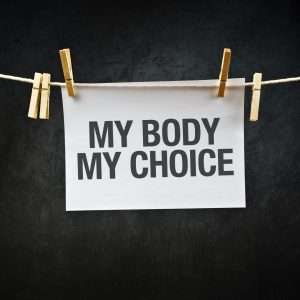
A Broader Perspective on "My Body, My Choice"

The principle has implications that go far beyond abortion. Some of them deserve far more attention than they have gotten to this point.

|

Public Domain

The Supreme Court's reversal of Roe v. Wade has re-focused attention on the moral principle of "My Body, My Choice," advanced by the pro-choice movement. I agree with both the general principle, and with almost of all of its applications to the specific case of abortion. But the idea has implications that go far beyond abortion, including many that are easier to defend and some that could potentially save large numbers of lives.

It frustrates me that many who propound the principle when it comes to abortion ignore or even oppose it in other contexts. Many on the political right are also inconsistent when it comes to issues of bodily autonomy.

In this post, I explain why abortion is a relatively hard case for the "My Body, My Choice" principle. If you believe (as I do) that it nonetheless applies here, you should be even more willing to apply it in many other cases. And some of those other applications are enormously significant.

Abortion is actually a difficult issue - even for libertarians and others who generally take a broad view of bodily autonomy. Political philosopher Michael Huemer and Clark Neily and Jay Schweikert of the Cato Institute have helpful discussions of the reasons why. I won't try to go over all of their analysis. But much of it comes down to the reality that there is a plausible case that abortion involves the taking of innocent life. And if it does, that effect happens almost every time. It's not just a marginal probablistic risk.

To be sure, libertarians and many others argue that we don't necessarily have a moral duty to save lives whenever we can, especially not one that should be enforced by the government. Similarly, Anglo-American law holds there is no liability if you walk by a baby drowning in a lake and choose not to save her (though some philosophers and legal scholars believe there should be). But, if a fetus has a right to life comparable to that of a baby, then abortion is a stronger case for regulation than the "drowning baby" scenario. In most, though not all, cases (rape is an obvious exception) the pregnant woman had a major role in putting the fetus in a position of jeopardy in the first place, by voluntarily choosing to have unprotected sex.

This makes the situation very different from one where the drowning baby was in peril for reasons having nothing to do with the person who might be able to save it. If you threw the baby in the water, or he ended up there through your negligence, you do indeed have a legal or moral duty to save him.

I think that "my body my choice" nonetheless justifies foregoing abortion restrictions in the vast majority of situations. Primarily, that's because I think fetuses (except perhaps in the very late stages of pregnancy) do not have a right to life comparable to that of infants. In addition, the severity of the burden imposed on pregnant women's bodily autonomy by abortion restrictions imposes a high burden of proof on defenders of such laws. I don't think pro-lifers have met that burden. But the issue is a genuinely hard one, despite the tendency of many on both sides to think that it's easy.

By contrast, a large number of other restrictions on bodily autonomy are much simpler cases, at least if you believe in a strong presumption in favor of "my body, my choice."

I listed several examples in a 2019 post on this subject. The list below includes some additions, whose importance has been highlighted by recent events:

1. Organ markets should be legalized. People should be free to sell kidneys, for example (subject, perhaps, to informed consent requirements).  If someone wants to sell a kidney, the response to prohibitionists should be: "you can't tell her what to do with her goddamn body, ever." Your kidney is part of your body, and the decision to sell should be your choice. As an extra bonus, legalizing such sales would save many thousands of lives.

2. Laws against prostitution should be abolished. They most definitely restrict people's freedom to control their own bodies (both prostitutes and their customers). The prostitute's body belongs to her, and using it for prostitution is her choice. Prostitution bans also restrict the bodily autonomy of customers. Thus, we should reject laws that punish them, while letting the prostitutes themselves go free. The "johns" own their own bodies no less than the prostitutes do. The kind of consensual sex you engage in with your body should be your choice.

3. The War on Drugs should be abolished. All of it. Not just the ban on marijuana. Its whole purpose is to restrict what sorts of substances you can put in your body. What you put in your body should be your choice. And, like the ban on organ sales, the War on Drugs harms large numbers of people, both in the US and abroad, in countries like the Phillippines and Mexico.

4. The government should not try to control people's diets through "sin taxes," or  restrictions on the size of sodas, and other such regulations. Here too, the goal is to restrict what we put in our bodies. If that leads to increased government spending on health care, the right solution is to restrict the subsidies, not bodily autonomy.

5. Draft registration, mandatory jury service, and all other forms of mandatory service should be abolished (if already in force) or taken off the political agenda (if merely proposed). All such policies literally expropriate people's bodies. What work you do with your body should be your choice.

6. We should legalize and use challenge trials for testing new vaccines against deadly diseases. The resulting earlier authorization of Covid-19 vaccines might have saved many thousands of lives. And it could save many more if we permit the use of challenge trials in the future.

7. Government-imposed mask mandates and lockdowns should be forbidden, or at least there must be very strong presumptions against them. Accumulating  evidence suggests that lockdowns did little good, and that the benefits of mask mandates are also modest, at best, as indicated by the serious flaws in the study most often cited to support them. At the very least, true advocates of "my body, choice" should have a strong presumption against such measures, inasmuch as they are truly massive intrusions on bodily autonomy, at least if continued for more than very brief periods. If they can be justified at all, it can only be by overwhelming evidence of large, life-saving effects. Or at least that's true if you have a strong commitment to "my body, my choice."

8. People should be allowed to take experimental medical treatments not approved by government regulators. That's especially true if the treatments have a significant chance of saving people from death or serious illness.

9. The Biden administration should drop its proposed ban on "vaping" and Juul e-cigarettes. Respect for "my body, my choice" requires us to let people decide for themselves whether they want to consume such products or not.

Like my earlier 2019 list, the above is far from exhaustive. But it's at least a rough indication of what truly consistent application of "my body, my choice" entails.

The organ market and challenge trial cases are especially worth highlighting. In both cases, eliminating limitations on bodily autonomy would not only expand freedom of choice, but also save enormous numbers of lives! This makes these situations far easier cases than abortion, where - as discussed above - there is a serious argument that freedom of choice entails the taking of innocent life. And yet organ markets and challenge trials get no more than a fraction of the attention and support that are focused on abortion rights.

Several of the items on the above list highlight inconsistencies by pro-choice liberals. But there is no shortage of similar inconsistency on the right. Consider, for example, conservatives who oppose mask and vaccine mandates on grounds of bodily autonomy, but strongly support the War on Drugs and laws banning prostitution.

Some will object that many of the cases described above must be ruled out because they involve restrictions on activities that are dangerous to health or safety (e.g. - prostitution, taking risky illegal drugs, and so on). If an activity is too dangerous, then government should be able to ban it in order to protect people from their own worst impulses.

But if that's your view, you're not really a supporter of "my body, my choice." Rather, you believe people should only be allowed to make choices that the government (or perhaps some group of experts) deems sufficiently safe. Among other flaws, such paternalism overlooks the possibility that people may legitimately differ over the amount of risk they are willing to accept.

Another standard objection to some of the items on my list is the fear that allowing them would lead to "exploitation" of the poor. For example, the poor may face more pressure to sell organs, become prostitutes, or participate in challenge trials (if participants in the latter are allowed to be paid). I have responded to this objection in some detail in previous writings on organ markets and challenge trials.

Here, I will add that the very same issue arises with abortion. After all, many abortions occur at least in part because the women who get them are poor and want to avoid further economic hardship. If we are going to bar poor people from taking risks with their bodies in order to alleviate difficult economic circumstances, that, too, entails massive deviation from "my body, my choice."

Regular readers may wonder whether the above is consistent with my willingness to support some types of vaccination mandates. The answer is that this stance is consistent with the framework outlined in my 2019 post  on this subject (written before the Covid pandemic made this a high-profile issue):

I do not believe any right should be absolute. A great enough harm… might justify restricting virtually any liberty, if that were the only way to prevent it. But those who take the principle of bodily autonomy seriously should at least adopt a strong presumption against restrictions, and only support them in cases where there is very strong evidence both that the harm exists and that restricting liberty will solve the problem without creating comparably serious harms of its own.

I should clarify that the "great harm" in question is harm to third parties, not to the person whose autonomy is being restricted. In the case of vaccination against deadly contagious diseases, the harm prevented is potentially very great (loss of thousands of lives) and the restriction on liberty is small. In most cases, once you get the shot you can go back to your normal life very quickly, and you no longer even notice the presence of the vaccine. That's a sharp contrast with such cases as lockdowns, mask mandates, the War on Drugs, and - yes - abortion restrictions, which impose severe constraints on liberty over long periods of time, sometimes even indefinitely.

Obviously, the case for vaccination mandates also rests on the assumptions that 1) vaccination significantly reduces disease spread (as opposed to merely protecting the vaccinated themselves), and 2) voluntary vaccination won't be widespread enough to make compulsion unnecessary. Thus, defensible vaccination mandates are a fairly unusual case where the combination of large potential benefits and the very modest nature of the restriction on liberty, combine to overcome even a strong presumption in favor of bodily autonomy.

This post, like its predecessor, obviously cannot do justice to all the implications of "my body, my choice," or deal with all possible case-specific arguments for restriction. Elsewhere, I have addressed some of the latter with respect to organ sales, mandatory jury service, and mandatory national service generally, among other cases. In each such case, "my body, my choice" at least requires a strong presumption against restrictions, one that can only be overcome by strong evidence of large third-party benefits.

Despite unavoidable limitations, I hope this post at least shows that many supporters of the "my body, my choice" principle should consider broadening their horizons by applying it more consistently, to a wider range of issues. Some of those issues even involve massive, glaring injustices that so far have failed to attract more than a fraction of the attention they deserve.

UPDATE: I have made a few minor additions to this post.

How Well Do You Know America's Racial Classification System? (Second of a Series)

|

As discussed in my forthcoming book Classified (out in less than 3 weeks!), contrary to popular belief, racial and ethnic classification in the US is not solely a matter of personal choice. The federal Office of Management and Budget created a classification scheme in 1978 to be used by all federal agencies, and barely amended since. The classifications you see on employment forms, applications for mortgages, applications for university admission, and so on, are taken from the official federal classifications. Importantly, while these forms rarely include instructions, the OMB classifications have official, legally binding definitions.

With that background, let's go to our second quiz, involving the Asian American classificaiton.

(1) Here are some countries in Asia: Pakistan, Tajikistan, Azerbaijan, Iran, Afghanistan, and Armenia. Americans with ancestors in which of these countries are classified as Asian American?

(2) Johnnie grew up in California, but his mom and dad grew up on one of the smaller islands of the Phillipines. Is Johnnie an Asian American or a Pacific Islander, or both?

(3) The Lopez family from Argentina moved to Japan in 1920. In 1980, the whole family, still composed solely of individuals with origins in Argentina, moved to the US. Is the family classified as Hispanic/Latino, Asian American, or both?


Answers:

Asian American is defined as person having origins in any of the original peoples of the Far East, Southeast Asia, or the Indian subcontinent.

(1) There is some ambiguity here, but in practice it seems that only Pakistan qualifies. Iran and Afghanistan are classified as being in the Middle East, which makes their residents white, not Asian. Armenia is not in the Far East or the Indian subcontinent. For Tajikistan, Azerbaijan, and Armenia, these classifications traditionally were interpreted by country of origin, and given that the latter were Soviet Republics, and the USSR was considered a white/European country, their residents were classified as white.

Note that I will occasionally get a question about whether an Ashkenazi Jew from somewhere like Tajikistan is "Asian American." The answer to that seems to definitely be no. Even if one posited that Tajiks generally should be classified as Asian American, note that the official definition requires descent from one of the "original peoples" of the area, which Ashkenazi Jews do not have.

(2) Asians and Pacific Islanders were classified together in one category until 1997, until Native Hawaiians successfully lobbied for a new classification of Native Hawaiian and Pacific Islander. They did so because they found that as part of the same category as Asians, they not only weren't eligible for affirmative action at "mainland" schools, they actively faced discrimination. But while the Philipines is literally a group of Pacific Islands, Filipino Americans remained classified as Asian Americans, not Pacific Islanders. The latter is limited to Americans origins in places like Samoa and Tonga.

(3) If members of the Lopez family consider themselves to be Hispanic, then they meet the official definition of being of Spanish origin or culture. No matter how many generations a Latin American family lives in Asia, however, they never become "Asian" under federal standards, because they are not descended from the original peoples of Asia. By contrast, if a Filipino family moves to Argentina as soon as they adopt Hispanic culture they become both Asian and Hispanic (assuming they at some point move to the US).


Supreme Court

Supreme Court Gives Biden Administration a (Temporary?) Win on Immigration with Final Decision of Term

Chief Justice Roberts final opinion of the term rejects the statutory challenge to the Biden Administration's rescission of the "Remain in Mexico" policy.

|

This morning Chief Justice Roberts delivered a gift to the BIden Administration with the final opinion in an argued case this Supreme Court term in Biden v. Texas. In a 5-4 decision, the Court concluded it had jurisdiction to hear the case and rejected a statutory challenge to the Biden Administration's rescission of the Trump Administration's Migrant Protection Protocol, aka the "Remain in Mexico" policy. The case is now remanded back to the lower courts for additional proceedings, including other challenges to the policy change.

Chief Justice Roberts wrote for a 5-4 Court, joined by the Court's liberals and Justice Kavanaugh, who also wrote a concurrence. Justice Alito wrote a dissent joined by Justices Thomas and Gorsuch. Justice Barrett also wrote a dissent joined by the Justices Thomas, Alito, and Gorsuch, save for the first sentence of her opinion ("I agree with the Court's analysis of the merits—but not with its decision to reach them.").

Here is how Roberts explains his decision:

In January 2019, the Department of Homeland Security—under the administration of President Trump—established the Migrant Protection Protocols. That program provided for the return to Mexico of non-Mexican aliens who had been detained attempting to enter the United States illegally from Mexico. On Inauguration Day 2021, the new administration of President Biden announced that the program would be suspended the next day, and later that year sought to terminate it. The District Court and the Court of Appeals, however, held that doing so would violate the Immigration and Nationality Act, concluding that the return policy was mandatory so long as illegal entrants were being released into the United States. The District Court also held that the attempted rescission of the program was inadequately explained in violation of the Administrative Procedure Act. While its appeal was pending, the Government took new action to terminate the policy with a more detailed explanation. But the Court of Appeals held that this new action was not separately reviewable final agency action under the Administrative Procedure Act.

The questions presented are whether the Government's rescission of the Migrant Protection Protocols violated the Immigration and Nationality Act and whether the Government's second termination of the policy was a valid final agency action.

On the jurisdictional question, the Chief Justice concluded the Court could here the challenge.

we see no basis for the conclusion that section 1252(f )(1) concerns subject matter jurisdiction. It is true that section 1252(f )(1) uses the phrase "jurisdiction or authority," rather than simply the word "authority." But "[j]urisdiction . . . is a word of many, too many meanings." Steel Co., 523 U. S., at 90. And the question whether a court has jurisdiction to grant a particular remedy is different from the question whether it has subject matter jurisdiction over a particular class of claims. See Reed Elsevier, Inc. v. Muchnick, 559 U. S. 154, 163–164 (2010) (concluding that "[t]he word 'jurisdiction' . . . says nothing about whether a federal court has subject-matter jurisdiction to adjudicate claims"). Section 1252(f )(1) no doubt deprives the lower courts of "jurisdiction" to grant classwide injunctive relief. See Aleman Gonzalez, 596 U. S., at ___ (slip op., at 11). But that limitation poses no obstacle to jurisdiction in this
Court.

And here's the majority's summary on the merits:

Section 1225(b)(2)(C) provides: "In the case of an alien . . . who is arriving on land . . . from a foreign territory contiguous to the United States, the [Secretary] may return the alien to that territory pending a proceeding under section 1229a." Section 1225(b)(2)(C) plainly confers a discretionary authority to return aliens to Mexico during the pendency of their immigration proceedings. This Court has "repeatedly observed" that "the word 'may' clearly connotes discretion." Opati v. Republic of Sudan, 590 U. S. ___, ___ (2020) (slip op., at 10) (emphasis in original); see also, e.g., Weyerhaeuser Co. v. United States Fish and Wildlife Serv., 586 U. S. ___, ___ (2018) (slip op., at 14); Jama v. Immigration and Customs Enforcement, 543 U. S. 335, 346 (2005). The use of the word "may" in section 1225(b)(2)(C) thus makes clear that contiguous-territory return is a tool that the Secretary "has the authority, but not the duty," to use. Lopez v. Davis, 531 U. S. 230, 241 (2001).

And as for whether the Biden Administration made the same mistake the Trump Administration had in rescinding DACA, Roberts concluded that the Adminsitration's second memorandum (the October 29 memo) was a separate, final agency action and the lower court erred in concluding otherwise.

Here is how the opinion concludes:

For the reasons explained, the Government's rescission of MPP did not violate section 1225 of the INA, and the October 29 Memoranda did constitute final agency action. We therefore reverse the judgment of the Court of Appeals and remand the case for further proceedings consistent with this opinion. On remand, the District Court should consider in the first instance whether the October 29 Memoranda comply with section 706 of the APA. See State Farm, 463 U. S., at 46–57.

Note this indicates the Biden Administration's victory may be short-lived, as Texas and others may still pursue their APA challenges to the policy, including arguments that the Administration failed to provide an adequate explanation for the policy decision. Justice Kavanaugh stresses the point in his concurrence. So the Biden Administration is not out of the woods yet. Expect Texas, et al., to really hone their State Farm arguments on remand.


Supreme Court

Supreme Court Rejects Broad EPA Authority to Regulate Greenhouse Gases from Power Plants (Updated)

Chief Justice Roberts writes for a six-justice majority in West Virginia v. EPA.

|

Today the Supreme Court decided West Virginia v. Environmental Protection Agency. Chief Justice Roberts wrote the opinion for the Court, rejecting claims that the case was non-justiciable and concluding that the EPA lacks broad authority to regulate greenhouse gas emissions from power plants under the Clean Air Act. Relying upon the "major questions" doctrine, the Chief Justice explained that Section 111 of the Clean Air Act does not allow the EPA to require generation shifting (i.e. the replacement of coal with renewable energy) to reduce greenhouse gas emissions. For quick background, my prior posts on the WVA case are indexed here.

The Chief Justice's opinion for the Court was joined by the Court's conservatives. Justice Gorsuch has a concurring opinion, joined by Justice Alito. Justice Kagan writes the dissent on behalf of herself and the other liberal justices.

As a threshold matter, the Chief Justice explains that the case is justiciable, even though the EPA is not currently enforcing greenhouse gas limits under Section 111. This is because the question on appeal is whether the petitioners experience an injury that is fairly traceable to the judgment below, and they easily meet that standard (as I noted here). Further, the government's stated intention to adopt new rules does not moot the case. Of note, Justice Kagan concedes the Court had jurisdiction to decide the case, and that it is not moot for purposes of Article III, but she makes clear she wishes the Court had declined to hear the case on prudential grounds.

On the merits, here is how the Chief Justice frames the issue in the case:

The Clean Air Act authorizes the Environmental Protection Agency to regulate power plants by setting a "standard of performance" for their emission of certain pollutants into the air. 84 Stat. 1683, 42 U. S. C. §7411(a)(1). That standard may be different for new and existing plants, but in each case it must reflect the "best system of emission reduction" that the Agency has determined to be "adequately demonstrated" for the particular category. §§7411(a)(1), (b)(1), (d). For existing plants, the States then implement that requirement by issuing rules restricting emissions from sources within their borders.

Since passage of the Act 50 years ago, EPA has exercised this authority by setting performance standards based on measures that would reduce pollution by causing plants to operate more cleanly. In 2015, however, EPA issued a new rule concluding that the "best system of emission reduction" for existing coal-fired power plants included a requirement that such facilities reduce their own production of electricity, or subsidize increased generation by natural gas, wind, or solar sources.

The question before us is whether this broader conception of EPA's authority is within the power granted to it by the Clean Air Act.

As already noted, the Chief Justice explains that the EPA does not have such authority. Whatever authority the EPA has to mandate that utilities adopt the "best system of emission reduction" that "has been adequately demonstrated," it does not extend to what the Obama Administration had proposed in the Clean Power Plan (and the D.C. Circuit had embraced): Basing emission limits on generation shifting.

Of particular importance, Chief Justice Roberts stresses that this conclusion is driven by recognition that in "extraordinary cases"—"cases in which the 'history and the breadth of the authority that [the agency] has asserted,' and the 'economic and political significance' of that assertion"—"call for a different approach" and "provide a 'reason to hesitate before concluding that Congress meant to confer such authority.'" In other words, even if one might conclude that the EPA's preferred interpretation of Section 111 is reasonable, the "major questions" doctrine counsels a narrower construction of the EPA's authority. As he writes:

in certain extraordinary cases, both separation of powers principles and a practical understanding of legislative intent make us "reluctant to read into ambiguous statutory text" the delegation claimed to be lurking there. Utility Air, 573 U. S., at 324. To convince us otherwise, something more than a merely plausible textual basis for the agency action is necessary. The agency instead must point to "clear congressional authorization" for the power it claims.

After pointing out there is nothing particularly new about this approach, the Chief Justice applies this principle to Section 111:

our precedent counsels skepticism toward EPA's claim that Section 111 empowers it to devise carbon emissions caps based on a generation shifting approach. To overcome that skepticism, the Government must—under the major questions doctrine—point to "clear congressional authorization" to regulate in that manner.

All the Government can offer, however, is the Agency's authority to establish emissions caps at a level reflecting "the application of the best system of emission reduction . . . adequately demonstrated." 42 U. S. C. §7411(a)(1). As a matter of "definitional possibilities," FCC v. AT&T Inc., 562 U. S. 397, 407 (2011), generation shifting can be described as a "system"—"an aggregation or assemblage of objects united by some form of regular interaction," Brief for Federal Respondents 31—capable of reducing emissions. But of course almost anything could constitute such a "system"; shorn of all context, the word is an empty vessel. Such a vague statutory grant is not close to the sort of clear authorization required by our precedents.

Importantly, the Chief Justice also goes out of his way to make clear that the Court is not endorsing the constrained interpretation of Section 111 embraced by the Trump Administration and urged by some petitioners:

We have no occasion to decide whether the statutory phrase "system of emission reduction" refers exclusively to measures that improve the pollution performance of individual sources, such that all other actions are ineligible to qualify as the BSER. To be sure, it is pertinent to our analysis that EPA has acted consistent with such a limitation for the first four decades of the statute's existence. But the only interpretive question before us, and the only one we answer, is more narrow: whether the "best system of emission reduction" identified by EPA in the Clean Power Plan was within the authority granted to the Agency in Section 111(d) of the Clean Air Act. For
the reasons given, the answer is no.

The Chief concludes:

Capping carbon dioxide emissions at a level that will force a nationwide transition away from the use of coal to generate electricity may be a sensible "solution to the crisis of the day." New York v. United States, 505 U. S. 144, 187 (1992). But it is not plausible that Congress gave EPA the authority to adopt on its own such a regulatory scheme in Section 111(d). A decision of such magnitude and consequence rests with Congress itself, or an agency acting pursuant to a clear delegation from that representative body. The judgment of the Court of Appeals for the District of Columbia Circuit is reversed, and the cases are remanded for further proceedings consistent with this opinion.

This decision is an important one. It expressly embraces and solidifies the "major questions" doctrine (largely consistent with the approach I suggested here) and reaffirms the notion that federal courts should be reluctant to allow administrative agencies to pour new wine from old bottles.

The decision also makes clear that the EPA does not have broad, free-ranging authority to address climate change under the Clean Air Act. (This is also a warning for other federal agencies, including FERC and the SEC.) It makes clear that if the federal government is going to take meaningful action to mitigate the threat of climate change (as it should) that action will have to come from Congress. It also underscores a point I have been making for some time about the risks of trying to address climate change through administrative regulation.

I will have more to say about the majority opinion, the Gorsuch concurrence, the Kagan dissent, and the broader implications for the administrative state in subsequent posts.

Politics

Shoot a Cat, Lose Your Dog (and the Right to Own Other Dogs, Forever): Not Cruel and Unusual Punishment

Special bonus: It used to matter, under Washington law, that cats and dogs were both carnivorous mammals.

|

From State v. Doll, decided Tuesday by the Washington Court of Appeals (Chief Judge Rebecca Glasgow, joinedby Judge Bradley Maxa and Bernard Veljacic),

John Fredrick Doll fired a rifle across a street, gravely injuring a neighbor's pet cat. Neighbors found the injured cat the next morning and it had to be euthanized. After a bench trial, Doll was convicted of first degree animal cruelty and discharge of a firearm in a public place. ["A person is guilty of animal cruelty in the first degree when, except as authorized in law, he or she intentionally (a) inflicts substantial pain on, (b) causes physical injury to, or (c) kills an animal by a means causing undue suffering or while manifesting an extreme indifference to life …."] …

Doll was sentenced to 30 days of confinement. In addition, former RCW 16.52.200(4)(b) (2016) permanently barred anyone convicted of first degree animal cruelty "from owning, caring for, or residing with any similar animals" to the one harmed in the offense. "Similar animal" was defined as "[f]or a mammal, another animal that is in the same taxonomic order." This prohibition was included in Doll's judgment and sentence. {The legislature has since amended the statute to provide that a conviction for first degree animal cruelty results in a lifetime ban on "owning, caring for, possessing, or residing with any animals," not just similar animals.}

At the time of his sentencing, Doll owned a dog. Cats and dogs are the same taxonomic order, Carnivora….

The court concluded, among other things, that this wasn't cruel and unusual punishment, which sounds right to me:

Read More

Slippery Slope Arguments

Political Power Slippery Slopes: Some Examples

|

[This month, I'm serializing my 2003 Harvard Law Review article, The Mechanisms of the Slippery Slope.]

Assume that the Supreme Court holds that Congress may legalize marijuana but ban marijuana ads, notwithstanding the commercial speech doctrine. Now Congress can enact a law that allows marijuana sales but not advertising (decision A) without fear that the Court will hold that marijuana advertising must also be legal (result B).

But can Congress prevent itself from legalizing marijuana advertising? Once marijuana sales are decriminalized, a multi-billion dollar marijuana industry will come out into the open, and probably grow. If industry members find that advertising is in their interest, they will probably lobby Congress to repeal the advertising ban. They may spend money on public advocacy campaigns, on contributions aimed at electing pro-advertising candidates, and on organizing marijuana users into a powerful voice. They will have employees who will tend to support the companies' positions. And the companies will likely have the ear of legislators from marijuana-growing states.

Decision A may thus change the balance of political power by empowering an interest group that might use this power to promote B; getting to A first and then to B would thus be politically easier than getting to B directly (though of course still not certain). And this would happen without multi-peaked preferences, small change tolerance, or attitudes altered by public deference to legal institutions.

Another classic political power slippery slope arises when a legislature creates a new benefits program or a new bureaucracy (decision A). The legislature might not want the program or bureaucracy to get bigger (result B), but decision A creates interest groups—the funding beneficiaries and the agency employees—that have a strong economic interest in the program's growth. Getting to B directly from the initial position 0 might have been politically impossible, because of the legislature's initial reservations about creating the program. But getting to A and then going to B would be easier.

Read More

More


