The Volokh Conspiracy

Mostly law professors | Sometimes contrarian | Often libertarian | Always independent | Est. 2002

The Volokh Conspiracy

Vaping

The Food & Drug Administration Has a Vaping Problem

Something is wrong at the Food & Drug Administration's Center for Tobacco Products, and federal courts are beginning to notice.

|

In 2016, the Food & Drug Administration (FDA) deemed electronic cigarettes and other vaping products to be "tobacco" products for the purposes of federal law. This move gave the FDA's Center for Tobacco Products legal authority to regulate vaping products like combustible cigarettes. How the FDA has proceeded to regulate such products since, however, has been something of a mess, suggesting either some degree of administrative incompetence, malice against portions of the industry, if not both.

Last October, the U.S. Court of Appeals for the Fifth Circuit eviscerated the FDA for flouting the basic administrative law requirements of "reasoned decisionmaking" when it denied Triton Distribution's premarket tobacco applications (PMTAs) for a range of vaping products. This is a big deal because vaping companies cannot sell their products if their PMTAs are denied.

In November, the U.S. Court of Appeals for the Sixth Circuit also found fault with the FDA's attention to basic administrative law requirements, this time in the agency's review of PMTAs from Breeze Smoke, another vaping product company. While the Sixth Circuit did not grant Breeze Smoke the relief it wanted, it was critical of the FDA's "formulaic" review of the PMTA materials.

Turning Point Brands is another vaping company that challenged the FDA's denial of its PMTAs, but rather than try its hand in court, the FDA  rescinded the PMTA denial because it "found relevant information that was not adequately assessed." Oops.

With this background, it should be understandable why many industry observers raised an eyebrow when the FDA denied PMTAs from Juul Labs, one of the larger and better resourced vaping companies. If any company was capable of submitting a vape product PMTA that meets the FDA's standards, one would think it would have been Juul.

Facing the prospect of a regulatory death-sentence, Juul challenged the FDA's decision, filing a petition for review with the U.S. Court of Appeals for the D.C. Circuit and an application for an emergency stay. Among other things, Juul pointed out that some of the FDA's reasons for denying the PMTAs, such as a lack of certain sorts of information, were simply wrong. In other words, the FDA gave Juul's applications the same sort of sloppy and arbitrary treatment it had given to those of Triton, Breeze Smoke, and Turning Point. In Juul's case, some also suspected the FDA was bowing to political pressure to target Juul.

The D.C. Circuit granted Juul's request, putting the effect of the PMTA denial on hold so the court could review Juul's claims. Perhaps recognizing that the D.C. Circuit would find  its conduct wanting, the FDA retreated, issuing an administrative stay of the PMTA denial so that it could conduct additional review of Juul's application materials. As the FDA tweeted that "The agency has determined that there are scientific issues unique to the JUUL application that warrant additional review."

Faced with the prospect of having to defend its conduct in court, the FDA decided it should take the time to conduct the review it was legally required to undertake in the first place.

As the above should make clear, the FDA's shoddy treatment of Juul is not an aberration. The Agency has time and again flouted basic administrative law requirements in denying PMTAs from vaping companies.

Some may claim that the FDA is merely trying to be careful, due to concerns that vaping products pose risks of nicotine addiction and may encourage some to take up smoking. The reality, however, is that vaping products are far-less dangerous than combustible cigarettes, providing consumers with a safer way to consume nicotine and giving smokers a more effective means of quitting (although FDA regulations bar vaping companies from informing consumers of these facts). Moreover, there is growing evidence that restrictions on vaping products can actually increase smoking, particularly among youth. In other words, the FDA's treatment of vaping products is bad for public health.

The FDA's decision to backtrack on Juul under fire is merely the latest example that something is wrong with the way the Center for Tobacco Products is seeking to regulate vaping products. Unless the FDA changes its ways, its legal losses will mount. And in the meantime, public health will suffer.

Slippery Slope Arguments

Slippery Slope Arguments and the Role of Ideological Advocacy Groups

|

[For the last month, I've been serializing my 2003 Harvard Law Review article, The Mechanisms of the Slippery Slope, and I'm finishing it up this week.]

Being aware of the slippery slope mechanisms can help counter them: such awareness may help prevent the initial decision A that might set the slippage in motion, and may possibly stop B even if A is indeed enacted.

This awareness, of course, is part of why ideological advocacy groups, such as the ACLU and the NRA, try to persuade people to pay attention to slippery slope risks. These groups' efforts may have helped prevent us from slipping down various slopes; I've heard people who don't much agree with the ACLU express gratitude that it exists, precisely because its vigilance often helps prevent sensible regulations from leading to broader prohibitions.

Slippery slope risks thus help explain and, to some extent, justify these groups' behavior. Such groups are often faulted as being extremist or unwilling to endorse reasonable compromises; these criticisms may often be largely correct and politically potent, and may lead voters to distrust these groups. What's more, the perceived extremism of some advocacy groups can increase the public's concerns about slippery slopes that go in the opposite direction. For instance, if a gun rights group becomes known as extremist for opposing even modest gun regulations, voters might become more skeptical of modest deregulations that the group proposes, because they may reasonably fear that the group will use such compromise deregulations to push for broader deregulations in the future. But the phenomena discussed in this article might suggest that these groups' tactics could, on balance, be sound:

Read More

Law & Government

Legal Questions about Abortion after Dobbs

|

Assume for now that Dobbs takes off the table the question of whether the 14th Amendment protects a right to abortion. What are the major legal questions about abortion likely to arise in the federal courts going forward? I've been trying to come up with a list of the major categories.

1.  Other federal constitutional claims to abortion. Perhaps somebody will press the 13th Amendment argument (see Koppelman; but see Lash) though it is hard to imagine it going any where. There are also free exercise arguments, which I suspect will also fail, though not quite for the same reasons that Josh Blackman has given.

2. The life/health of the mother. Does the 14th Amendment provide any limit on abortion laws that imperil the life or health of the pregnant woman? Dobbs adopts a rational basis standard, and even Justice Rehnquist's dissent in Roe, for instance, conceded that the 14th Amendment "does place a limit, albeit a broad one" on abortion laws, specifically opining that "If the Texas statute were to prohibit an abortion even where the mother's life is in jeopardy, I have little doubt that such a statute would lack a rational relation to a valid state objective."Additionally, some commentators such as Shirif Girgis have argued that history and tradition might require some kind of life-of-the mother exception. But I don't think we can regard either argument as certain, nor is it certain how they would extend to severe health risks or other scenarios.

3. State constitutional claims. Kansas is the most salient example here, but there are a lot of state constitutional lawsuits already filed, and I think it's hard to predict how they will all go. These could also give rise to proposals for constitutional amendment, and related disputes about the validity of those amendments, etc.

4. Federal preemption/mail for non-surgical abortions. One set of questions is about the FDA approval of mifepristone and the extent to which it preempts state law, another is about the ability of states to search the mail and other interstate delivery services that might be shipping mifepristone or other medications. (We could include as a footnote the interpretation of the federal statute that forbids the mailing of "Every paper, writing, advertisement, or representation that any article, instrument, substance, drug, medicine, or thing may, or can, be used or applied for producing abortion, or for any indecent or immoral purpose; and")

5. Federal power to enact further abortion legislation. Could Congress use its commerce power, or less plausibly (under current doctrine) its 14.5 power to enact nationwide restrictions or nationwide liberties with respect to abortion? Justice Thomas of course questioned this power in Gonzales v. Carhart, but it has never been settled. As a matter of political legitimacy, it would be nice if we could settle the answer to this question ex ante and symmetrically, adopting the same test without knowing whether it will be a nationwide liberty signed into law by President Biden in 2022, or a nationwide ban signed into law by President Pence in 2025. Unfortunately, we likely won't.

Additionally, it occurs to me that if the commerce power is held to be more limited, Congress might still be able to use its tax power to enact quite punitive taxes on abortion procedures. It is harder to use the tax power to create a liberty, though Congress might get creative. So federal power might not be symmetric in this respect in any event.

6. Travel/territoriality. Can a state prevent its residents from going to another state to obtain an abortion? If it does or must allow them to go, can it still punish them upon their return? Can states punish anyone, or their citizens more specifically, for acts they take outside of state boundaries? If no, how do we decide where certain inchoate or virtual acts take place? (For instance, placing a call or going on a website in order to take steps to obtain an abortion . . . .)  Justice Kavanaugh opined on the first of these questions in his concurring opinion in Dobbs, but even if we assume that his views are both dispositive and set in stone, it is not totally clear how they would play out across the full range of questions in this area.

7. Due Process / retroactivity. Can a state punish abortions obtained in violation of state statute, before the effective date of Dobbs? What is the effective date of Dobbs (the date of the decision? the date the mandate issues? the date of some dispositive action taken on remand?)? Can a state punish abortions going forward under a "trigger law" or a non-trigger law that was enacted before Roe and then unenforced for the past 50 years? Even if these laws are permissible as a matter of federal law, do state common law or state constitutional law doctrines limit them? What about abortions undertaken while a state trial court's preliminary injunction is pending, if that injunction is then reversed as improper? (Compare Mitchell with Morley on this.) Could some of these actions trigger state law "mistake of law" defenses in criminal prosecutions? Again, Justice Kavanaugh opined on the first of these questions, but that leaves many other questions in this string unaddressed.

8. The right to fund. If there is no right to obtain an abortion, does it follow a fortiori that there is no right to spend money to help others obtain an abortion? What about spending money in an illegal-abortion state to facilitate obtaining an abortion in another state? What about spending money to facilitate the exercise of the right to travel to obtain an abortion in another state (see #6)? It seems to me that the most relevant precedents here are from campaign finance law (see Eugene on the right to spend money on rights) which will surely make all concerned uncomfortable.

Are there more?

The 3-3-3 Court on the Merits Docket and the Shadow Docket

|

On June 18, 2021, I wrote, "We don't have a 6-3 Conservative Court. We have a 3-3-3 Court." I'm not sure if I was the first person to coin the phrase 3-3-3 Court, but I was one of the first. And I elaborated on this theme in a Newsweek column, titled "Conservative Justices Warn Kavanaugh and Barrett Lack 'Fortitude.'" Like with most things I write, this post proved controversial. Conservatives were unhappy that I lumped in Justices Kavanaugh and Barrett in with the Chief Justice. And progressives were miffed that I would try to minimize how radical the Court was by identifying a phantom moderate middle. One year later, we can revisit this paradigm.

As a threshold matter, we can look at how often the Justices agreed with each other. According to the New York Times, Chief Justice Roberts and Justice Kavanaugh agreed in 98% of argued cases. SCOTUSBlog pegged the number at 100%. I think this metric is somewhat inflated, because the Chief Justice's vote in Dobbs really should not be lumped in with those of the majority. But Dobbs aside--and that is a huge aside--Roberts and Kavanaugh are two peas in a pod. And don't forget Kavanaugh's already-influential concurrence in Bruen, which the Chief joined. Early predictions of a "budding bromance" have proved apt. By contrast, there was a much bigger gap with the newest member of the Court. Justice Barrett lined up with the Chief around 85% of the time. And Justice Alito was not far behind.

Another way to identify the Court's center is to measure how often the conservatives vote with the progressives. Roberts and Kavanaugh joined the Court's three progressives in four 5-4 cases: Biden v. Missouri (CMS vaccine mandate), Nance v. Ward (method of execution), Torres v. Texas DPS (state sovereign immunity), and Biden v. Texas (Remain in Mexico). Each of these cases was fairly significant. Justices Thomas, Gorsuch, and Barrett each voted with the Court's progressives twice in 5-4 splits, all in fairly minor cases. Justice Alito had zero such cases.

On the merits docket, Barrett is much closer to Thomas, Alito, and Gorsuch than she is to Roberts and Kavanaugh. This past term, the 3-3-3 paradigm did not hold. But on the shadow docket, the 3-3-3 Court is alive and well. This term, Kavanaugh and Barrett placed their stamp on the shadow docket. In my view, the demarcation point was John Doe 1-3 v. Mills. On October 30, I observed that Justices Barrett and Kavanaugh had cut the fuse on the shadow docket. Since that point, Justices Barrett and Kavanaugh have (likely) voted opposite of Justices Thomas, Alito, and Gorsuch in many cases. I say "likely," because we cannot be certain how a Justice voted on the shadow docket, unless there are four dissents. On the shadow docket, with three dissents, it is impossible to know for sure. Let's walk through five such disputes.

  1. Dr. A v. Hochul/We The Patriots v. Hochul (12/13/21): This case involved a New York policy that required health care workers to receive a vaccine. The regime lacked a religious exemption. The lower courts declined to block the requirement. The Supreme Court denied an injunction. Justice Thomas would have granted the application. Justices Gorsuch and Alito dissented from the denial of the application for injunctive relief. Six months later, the Supreme Court would deny cert in Dr. A. (I will revisit that denial later in the post.)
  2. Moore v. Harper (3/7/22): This North Carolina case involved the independent state legislature doctrine. The Court denied the application to stay pending the disposition of the cert petition. Justice Alito dissented from the denial of the application for a stay, joined by Justices Thomas and Gorsuch. Justice Kavanaugh concurred with the denial of the stay, and suggested that the Court should grant cert in an "appropriate case." Three months later, on June 30, the Court granted review in Moore, but the lower-court ruling will remain in effect for the next year or so.
  3. Coalition for TJ v. Fairfax County School Board (4/25/22): This case involved an affirmative action policy at a Virginia high school. The District Court enjoined the policy. The Fourth Circuit stayed the injunction. The Supreme Court denied a motion to vacate the stay. There was no opinion. Justices Thomas, Alito, and Gorsuch would have granted the application to vacate the stay.
  4. Dunn v. Austin (4/18/22): This case involved Air Force Reserve members seeking an exemption from the vaccine mandate. The lower courts denied relief. And the Supreme Court denied an injunction pending appeal. Justices Thomas, Alito, and Gorsuch would have granted the application for an injunction pending appeal.
  5. Ritter v. Miglioril (6/9/22): This case involved counting of undated mail-in ballots in one state-court judicial election. The Third Circuit allowed counting of undated ballots. The Supreme Court denied application for a stay. Justices Alito, Thomas, and Gorsuch dissented from the denial of the application for a stay. Alito wrote, "For these reasons, it appears to me that the Third Circuit's interpretation is very likely incorrect, and I would grant a stay to preserve the opportunity to review that decision prior to the elections in November." 

In each of these cases, Justices Alito, Thomas, and Gorsuch were willing to grant emergency relief. And I think it is safe that assume that Justices Barrett and Kavanaugh voted against emergency relief.

By my count, there were at least two cases in which Barrett and Kavanaugh voted for emergency relief, where Justices Thomas, Alito, and Thomas would have denied relief.

  1. Austin v. U.S. Navy Seals 1-26 (3/25/22): This case involved a vaccine mandate for service members. The District Court enjoined the vaccine mandate with respect to the service members. The Fifth Circuit declined to stay the injunction. The Supreme Court granted a partial stay, allowing the mandate to be enforced in part. Justice Thomas would have denied the application for a partial stay. He was joined by Justices Alito and Gorsuch. They would have exempted the Seals from the mandate.
  2. NetChoice v. Paxton (5/31/22): This case involved a Texas law that restricts social media firms. The Western District of Texas granted an injunction. The Fifth Circuit stayed the injunction. The Supreme Court vacated the Fifth Circuit's stay. Justice Alito, joined by Justices Thomas and Gorsuch dissented from the grant of the application to vacate the injunction. Alito wrote, "I would not disturb the Court of Appeals' informed judgment about applicants' entitlement to a stay." Justice Kagan also dissented. By process of elimination, we know for certain that there were five votes to vacate the stay: Chief Justice Roberts, and Justices Breyer, Sotomayor, Kavanaugh, and Barrett.

Why was emergency relief granted in these two cases? Who knows? Alas, we cannot simply read the opinions, because there were no opinions to read. Moreover, in both cases, the Court overrode a ruling from the Fifth Circuit. The NetChoice panel included Judges Jones, Southwick, and Oldham. And the Navy Seals panel included Judges Jones, Duncan, and Engelhardt. These panels include several of the most conservative judges in the Fifth Circuit, and probably in the federal judiciary. Yet, these were the cases where Barrett and Kavanaugh were (likely) moved to grant emergency relief on the shadow docket. I suspect they were (likely) trying to maintain the status quo, or something like that. But the other factors in Doe v. Mills (short-fuse, absence of circuit split, etc.) were not satisfied. I am not persuaded the Doe v. Mills standard is a standard at all, but rather was a stopgap response to incessant shadow docket criticism. The Supreme Court uses the shadow docket when it wants to.

One of the biggest exceptions to the 3-3-3 Court on the shadow docket was Merill v. Milligan. On January 24, 2022, a three-judge panel of the Eleventh Circuit issued an injunction to block Alabama's new electoral maps. The court found that Alabama should have created a second majority-minority district. Alabama appealed that ruling to the Supreme Court, and sought a stay of the injunction. On February 7, the Supreme Court issued an order in Merrill v. Milligan and Merrill v. Caster. The application for a stay was treated as a petition for a writ of certiorari before judgment. The Court granted that petition. The Court also stayed the injunction while it resolves the appeal. Alabama scored the shadow docket trifecta.

The Court split 5-4. Justice Thomas, joined by Justices Alito, Gorsuch, Kavanaugh, and Barrett supported the Court's order. Chief Justice Roberts dissented from the grant of the application for stays. But he agreed to grant certiorari before judgment, and would set the case for arguments next Term. Justice Kagan, joined by Justices Breyer and Sotomayor, dissented. They would not have granted the stay. Justice Kavanaugh wrote a concurrence, joined by Justice Alito, that responded to Justice Kagan's dissent. The other members of the majority did not explain their reasoning.

At the time, I dubbed Merrill the most important shadow docket entry since John Does 1-3 v. Mills. Justices Barrett and Kavanaugh (likely) granted emergency relief. Justice Kagan's dissent called out Justice Barrett:

The question whether to accept Alabama's position demands serious and sustained consideration—the kind of consideration impossible to give "on a short fuse without benefit of full briefing and oral argument." Does v. Mills, 595 U. S. ___, ___ (2021) (slip op., at 1) (BARRETT, J., concurring in denial of application for injunctive relief ).

I think Merrill is the exception to the rule for emergency relief this past term. I'm not sure that Merrill is consistent with Doe v. Mills. For what's its worth, the case was set for argument on October 4.

Another facet of the shadow docket concerns dissents from the denial of certiorari. By my count, there were three cases in which Justices Thomas, Alito, and Gorsuch would have granted certiorari in a case. It is impossible to know for certain, but it is safe to presume that Justices Kavanaugh and Barrett both did not vote to grant cert. Either could have provided the necessary fourth vote.

  1. Roman Catholic Diocese of Albany v. Emami (11/1/21): This case involved a New York mandate that insurance policies must cover abortions. After four conferences, the Court GVR'd the case in light of Fulton. Justices Thomas, Alito, and Gorsuch would have granted the petition for a writ of certiorari. I wrote about the denial here. Last month, the New York Court held that Fulton changed nothing. Shocker.  The Supreme Court will soon enough be facing another cert petition.
  2. Dignity Health v. Minton (11/1/21): This case presented the question whether a California Catholic hospital can be required to perform a hysterectomy on a transgender patient. After four conferences, the Court denied cert. The Court did not GVR in light of Fulton, like in Roman Catholic Diocese of Albany. Justices Thomas, Alito, and Gorsuch would have granted the petition for a writ of certiorari.
  3. Dr. A. v. Hochul (6/30/22): This case involved New York's vaccine mandate for healthcare workers. The Court had denied an emergency application in this case in December. After the last day of the term, the Court denied certiorari. Justices Thomas, Alito, and Gorsuch dissented from the denial of certiorari. Justice Thomas would not "miss the chance to answer this recurring question in the normal course on our merits docket." Indeed, Thomas alluded to the Court's hesitancy about deciding shadow docket disputes: "Here, the Court could grant a petition that squarely presents the disputed question and consider it after full briefing, argument, and deliberation. Unfortunately, the Court declines to take this prudent course." The Court turned this case away on the shadow docket, and on the merits docket.

***

This term, I do not think the merits docket reflected a 3-3-3 Court. But on the shadow docket, the 3-3-3 Court appeared in many of the most high-profile cases. Justices Thomas, Alito, and Gorsuch were far more likely to grant emergency relief. Following Mills, Justices Kavanaugh and Barrett were far more likely to deny emergency relief.


Texas Sets Up Test Case For Arizona v. U.S.

Can the states detain an alien based on "reasonable suspicion of illegal entry or other immigration crime"?

|

June 2012 was a rough month for conservatives. Of course, on June 28, 2012, the Court decided NFIB v. Sebelius. I could write a book about that day. But three days earlier, the right suffered another momentous defeat--one that I think was somewhat pushed out of the headlines by NFIB. I was actually in the Court when Arizona v. United States was handed down. I had never seen Justice Scalia so irate.

Listen to his dissent from the bench. He was livid. Scalia even went on a rant about DACA, which had been announced a few days earlier.

After this case was argued and while it was under consideration, the Secretary of Home Land Security announced a program exempting from immigration enforcement some 1.4 million illegal immigrants. A husbanding of scarce enforcement resources can hardly be the justification for this since those resources will be eaten up by the considerable administrative cost of conducting the non-enforcement program which will require as many as 1.4 million background checks and by any rulings on request for dispensation. The President has said that the new program is "the right thing to do" in light of Congress' failure to pass the administration's proposed revision of the immigration laws. Perhaps it is, though Arizona may not think so. But to say as the Court does, that Arizona contradicts federal law by enforcing applications of federal immigration law that the President declines to enforce boggles the mind. The Court's opinion paints what it considers a looming specter of unutterable horror, "If Section 3 of the Arizona statute were valid, every State could give itself independent authority to prosecute federal registration violations." That seems to me not so horrible and even less looming, but there has come to pass and is with us today, the specter that Arizona and the states that supported, predicted, a federal government that does not want to enforce the immigration laws as written and leaves the states' borders unprotected against immigrants whom those laws would exclude. So the issue was a stark one.

I used Scalia's words to write an imagined concurrence in Texas v. United States, the DAPA case. DACA recently celebrated its tenth anniversary; The DACA Decade would make a good title for a book I plan to write.

And Scalia compared illegal immigration to an "invasion" and a "siege."

As is often the case, discussions of the dry legalities, that are the proper object of our attention, suppresses the very human realities that gave rise to this suit. Arizona bears the brunt of the country's illegal immigration problem. Its citizens feel themselves under siege by large numbers of illegal immigrants who invade their property, strain their social services, and even place their lives in jeopardy. Federal officials have been unable to remedy the problem and indeed have recently shown that they are simply unwilling to do so. Arizona has moved to protect its sovereignty, not in contradiction of federal law, but in complete compliance with it. The laws under challenge do not extend or revise federal immigration restrictions but merely enforce those restrictions more effectively. If securing its territory in this fashion is not within the power of Arizona, we should cease referring to it as a sovereign state. For these reasons, I dissent.

Now, the Court may get another go at that precedent. Texas Governor Greg Abbot ordered the Texas national guard and state police to detain aliens who illegally entered the country, and to return them to the border. But wouldn't that action violate Arizona? Not quite. The executive order quotes this passage of Justice Kennedy's majority opinion:

However the law is interpreted, if §2(B) only requires state officers to conduct a status check during the course of an authorized, lawful detention or after a detainee has been released, the provision likely would survive pre- emption—at least absent some showing that it has other consequences that are adverse to federal law and its objectives. There is no need in this case to address whether reasonable suspicion of illegal entry or another immigration crime would be a legitimate basis for prolonging a detention, or whether this too would be preempted by federal law. See, e.g., United States v. Di Re, 332 U.S. 581, 589 (1948) (authority of state officers to make arrests for federal crimes is, absent federal statutory instruction, a matter of state law); Gonzales v. Peoria, 722 F.2d 468, 475–476 (CA9 1983) (concluding that Arizona officers have authority to enforce the criminal provisions of federal immigration law), overruled on other grounds in Hodgers-Durgin v. de la Vina, 199 F.3d 1037 (CA9 1999).

Arizona left open the question of whether Texas can detain aliens who violated federal immigration law. The Court could uphold Abbott's order without overruling Arizona. But this holding would undermine the weight of Arizona.

Justice Kennedy liked to leave lots of issues open, to be decided another day, if ever. For example, Justice Kennedy declined to overrule Washington v. Glucksberg in Obergefell. Instead, he scribbled a feeble distinction on that little slip of paper inside a fortune cookie. And, wouldn't you know it, Glucksberg was used to overrule Roe. I think litigators can spend the next decade picking up all of the issues that Justice Kennedy declined to resolve--just search Westlaw for "no need to decide" or "we do not need to address" or "we decline to resolve."

Free Speech

Roy Moore Loses Libel Suit Against Sacha Baron Cohen in Second Circuit

|

From today's opinion in Moore v. Baron Cohen, by Judges Rosemary S. Pooler, Gerard E. Lynch, Raymond J. Lohier, Jr.:

Baron Cohen created, co-produced, and co-wrote Who Is America?, a television program that aired on Showtime. As part of the show, Baron Cohen and his team convinced Roy Moore ("Judge Moore"), a former Chief Justice of the Supreme Court of Alabama and a former Senate candidate from Alabama, to fly to Washington, D.C. to receive a prize in honor of his support for the state of Israel and to be interviewed by an Israeli television program.

It was a ruse: He was instead interviewed by Baron Cohen, who presented himself as an Israeli anti-terrorism expert and former intelligence agent. The episode of the program in which the interview aired led into the interview with news clips reporting allegations from the time of Judge Moore's Senate campaign that he had engaged in sexual misconduct as an adult, including with one woman who was fourteen at the time.

During the interview itself, Baron Cohen, in character, described a fictional device that the Israeli military had purportedly developed to detect underground tunnels, which would also "identify other abnormalities," including "sex offenders and particularly pedophiles," by picking up on a certain "enzyme" that they secrete at "three times the level of non-perverts."

Baron Cohen then produced a wand-like object that was supposed to be that device and waved it over Judge Moore, at which point it beeped. After a tense exchange between the two, Judge Moore exited the set, amid protestations by Baron Cohen that he was not saying that Judge Moore was a pedophile.

Judge Moore sued, but the court said his defamation, intentional infliction of emotional distress, and fraud claims were barred by a waiver that Moore had signed:

Read More

Democracy

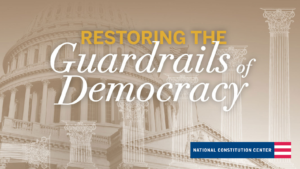
Team Libertarian Report from National Constitution Center "Restoring the Guardrails of Democracy" Project Now Available on SSRN

I coauthored the report with Clark Neily and Walter Olson, both of the Cato Institute.

|

The Team Libertarian Report from the National Constitution Center's "Restoring the Guardrails of Democracy" is now available for free download on SSRN.  I coauthored the report with Clark Neily and Walter Olson (both of the Cato Institute). Here is the abstract:

American democracy faces multiple serious challenges. In the immediate future, we must establish institutional safeguards to prevent the kind of negation of election results attempted by Donald Trump in the aftermath of the 2020 presidential election. In the medium-to-long run, more must be done to empower people to be able to make meaningful choices about the policies they live under. Ballot-box voting has great value. But it is not enough to ensure genuine political freedom. The latter requires enhancements to both "voice" and "exit" rights. We need to simultaneously increase citizens' ability to exercise voice within political institutions, and give them more and better exit options.

This report takes on all three challenges. We propose a variety of reforms that can address immediate short-term threats to democracy, while also increasing citizen empowerment in the long run.

Part I outlines reforms that can safeguard the electoral process against attempts at reversal, while also curbing presidential powers that could be abused in ways that undermine democracy. Among the most urgently needed reforms are new constraints on presidential powers under vaguely worded emergency statutes. These can too easily be manipulated by an unscrupulous administration in ways that could hobble democracy. It is also essential to reform the Electoral Count Act of 1887 in order to definitively preclude the sort of effort to overturn an election that then-President Trump engaged in after his defeat in 2020. In addition, we propose ways to incentivize electoral losers to concede defeat, rather than engage in bogus accusations of fraud and voter suppression, and to gradually restore public trust in the electoral system.

Part II describes how a number of serious flaws in the democratic process can be alleviated by expanding people's opportunities to "vote with their feet." Under conventional ballot-box voting, individual citizens usually have almost no chance of influencing the outcome. They also have strong perverse incentives to be "rationally ignorant" about the issues they vote on, and to process political information in a highly biased way.

Expanded foot voting rights can help alleviate these problems. People can vote with their feet, choosing what jurisdiction to live in within a federal system, and also through making decisions in the private sector. Relative to ballot box voters, foot voters have a much higher chance of making a decisive choice, and therefore much stronger incentives to become well-informed. Expanded foot voting can also help alleviate the dangerous polarization that has gradually poisoned our political system. Much can be done to expand foot voting opportunities in both the public and private sector by breaking down barriers to migration, such as exclusionary zoning. Foot voting can also be facilitated through greater decentralization of political power, which would reduce the incidence of one-size-fits-all federal policies from which there is no exit, short of leaving the country entirely.

Finally, Part III outlines ways in which ordinary citizens can be empowered to exercise greater "voice" in their dealings with the criminal justice system, particularly through reviving the institution of the citizen jury. Since the Founding and before, jury trials have been understood as an important tool of popular participation in government. Sadly, in the modern criminal justice system, the constitutionally prescribed role of juries in resolving criminal charges has been almost entirely displaced by so-called plea bargaining. As a result, citizen-jurors no longer exercise influence over those powers of government that directly impact the lives and liberty of the people more than most others. We propose multiple reforms that can help restore juries to their proper role in the criminal justice system.

Even if adopted in combination, our proposed reforms would not cure all the ills that afflict American democracy. But they can do much to shore it up against threats, and empower Americans to exercise greater control over the government policies they live under.

The NCC project also includes a Team Conservative report (coauthored by team leader Sarah Isgur, David French, and Jonah Goldberg, all affiliated with The Dispatch), and a Team Progressive report (coauthored by prominent election law scholars Edward Foley and Franita Tolson).  I offered some thoughts in the similarities and differences between the three reports here.

Equity Requires More Than a Dollar in Injury

|

Yesterday the Fifth Circuit held oral argument in an appeal of Judge Hanen's DACA decision. You can find a write-up of the oral argument by Mohar Chatterjee at Politico. One thing jumped out at me, and I will quote the relevant line from the Politico story (the transcript is not on PACER yet). Here's a paragraph of wind-up from the story, and then the quote from Texas Solicitor General Judd Stone II:

Wednesday's arguments before the 5th Circuit Court of Appeals took place just over a decade after President Barack Obama created the DACA program through executive action. Much of the roughly 45-minute argument session was devoted to whether Texas and other states suing to block the program could show enough impact on them to proceed with the court case.

"The relevant question here for summary judgment is whether… [Texas] has shown at least a dollar of expenditures that would be remedied by the removal of DACA, and whether some individual who has received that sort of spending under DACA will leave the United States," Texas Solicitor General Judd Stone II told the judges.

That's the logic of standing in a legal action for damages: if you can establish an injury, then you can proceed to the merits and the remedy. There's no principle at law by which a modest showing about standing constrains what you can get once you're through the door.

But the logic of equity is different. Here is the way Paul Miller and I put it on pages 1797-1798 of "Getting into Equity," published earlier this year by the Notre Dame Law Review as part of its federal courts symposium issue:

Fifth, this analysis helps illuminate why the Supreme Court's equity cases so often tend to merge together considerations of justiciability, merits, and remedy.  Other scholars have skillfully analyzed the interplay of these considerations, but in this less equity-conscious age some may miss that this interplay is different in law and in equity.  For legal claims, justiciability is a threshold, and once through the door the plaintiff is able to obtain remedies without much consideration of whether the plaintiff just barely made it over the threshold.  But in equity it all connects—the broader and deeper the remedy the plaintiff wants, the stronger the plaintiff's story needs to be.  This interplay is the result of equity's not having causes of action: the cause of action delimits the scope and relief in a legal suit, but without that limiting principle in equity, others are needed.  Put differently, this is an instance of the "paradox at the heart of equitable remedies": these remedies give courts the greatest capacity for managing the parties, and yet courts often decline to issue these remedies precisely "on the ground that they would require too much management of the parties."  The fact that equity lacks the rigid boundaries and limits of law, especially the cause of action, makes this paradox more intelligible.

And Ernie Young had a brilliant contribution to that symposium that explored the interaction of standing and equity. You can find it here.

In other words, a dollar of injury is not sufficient to establish the kind of standing needed, in equity, to ground a massive injunction. NB: This post isn't addressing the questions of whether national injunctions are permissible and what remedies are available under the APA; I've written on those questions at length. This post is just on the narrower question of whether "a dollar of expenditures" is a sufficient basis for a massive injunction (assuming that the quote in the story does capture the point that was made in oral argument). For that narrower question, the answer in traditional equity is no. For equitable remedies, the intensity of the injury to the plaintiff should be of great importance for the intensity of the remedy.

Free Speech

$370K Verdict in Bee Libel Lawsuit

|

Minneapolis Star Tribune (John Reinan) reports:

A Traverse County jury made the award to Nancy and Keith Budke of Wheaton, Minn. The Budkes, in the bee business for more than 40 years, sold 75 Texas hives to Nick Olsen of Maple Lake.

When Olsen got the hives home from Texas, he found that the bees had died in transit. Olsen blamed the Budkes, claiming the bees were infected with several diseases. He took to Facebook and vented about the deal, saying the Budkes were "screwing" him, calling them names and warning others not to buy bees from them.

Read More

crime victims

The Utah Supreme Court Holds that Crime Victims Can Intervene in Criminal Cases to Protect Their Rights

The Court agrees with my argument that crime victims can become "limited-purpose parties" in criminal proceedings to protect their interests, such as an interest in the confidentiality of mental health counseling records.

|

Today the Utah Supreme Court handed down an important victory for crime victims, holding that crime victims can become "limited-purpose parties" in criminal prosecutions when their rights are at issue. The Court ruled that a child sexual assault victim was entitled to be heard regarding any release of her confidential mental health counseling records to a criminal defendant. The decision is an important one for crime victims' rights here in Utah and even nationally, as it recognizes that crime victims can formally intervene in criminal cases to protect their interests.

The case involves defendant David M. Chadwick, who was charged with sexually abusing F.L. when she was a child. Chadwick requested that the trial court conduct an in camera review of F.L.'s therapy records and release certain information arguably relevant to his defense. The trial court granted Chadwick's request and conducted the review, after which it issued several orders quoting relevant excerpts from the records. The trial court then sealed the remaining records. Chadwick proceeded to trial and was convicted of sexual abusing F.L. while she was a child.

Chadwick then appealed to the court of appeals and challenged the adequacy of the trial court's in camera review. On its own motion, the court of appeals unsealed F.L.'s counseling records, allowing Chadwick's attorney to use those records in his opening appellate brief. In response, F.L. filed a motion asking the court of appeals to reseal her records and strike all references to the confidential materials in Chadwick's brief. The court granted F.L.'s request, instructing  Chadwick to file a revised brief without references to the records.

Chadwick filed the revised brief as instructed but also challenged the court of appeals' decision to reseal F.L.'s therapy records. Chadwick asked that the court to release those records to his attorney or, in the alternative, conduct a new in camera review of the records.

The Utah Crime Victim's Legal Clinic and I then filed a motion for F.L., asking that she be allowed to intervene in Chadwick's appeal as a limited-purpose party to protect her privacy interests. F.L. sought to assert her privacy right stemming from the Utah Constitution's Victims' Rights Amendment, which guarantees crime victims that they will be treated with "fairness, dignity, and respect." Utah Const., art. I, sec. 28. F.L. also sought to assert her privilege under Utah Rule of Evidence 506(b), which creates a privilege in mental health counseling records.

Rather than grant her motion to intervene, the court of appeals construed F.L.'s motion as seeking merely to file an amicus brief. We then filed a petition for an extraordinary writ in the Utah Supreme Court, asking it to direct the court of appeals to allow F.L. to intervene in the criminal proceedings concerning release of her records.

Following an oral argument in April, today the Supreme Court granted our petition for extraordinary relief. The Court agreed with our argument that the court of appeals erred by restricting F.L. "merely to kibitz from the sidelines about what is happening to her records." Instead. F.L. (like other privilege holders) was entitled to be heard immediately in court proceedings regarding her confidential records―and she was entitled to immediate protection of her rights by the Supreme Court. If F.L. were required to wait until after a final decision to appeal the denial of her motion to intervene, her confidential records might be released to Chadwick without her being able to assert her privacy interests. The Court explained that "in the extraordinary writ context, compelling a party to turn over what is alleged to constitute privileged information has the potential to result in irreparable injury, and appellate courts cannot always unring the bell once the information has been released."

More broadly, the Utah Supreme Court explained the circumstances in which crime victims can participate in criminal proceedings. The Court noted that, although a crime victim is not entitled to participate in all stages of criminal proceedings or for all purposes, that conclusion "does not eliminate the possibility that a victim may qualify as 'a limited-purpose party'" with standing to assert specific rights.  The Supreme Court held that, as a general matter, "if the law gives crime victims the ability to proactively assert a right or seek a remedy, then they may enforce those specific rights as limited-purpose parties in criminal proceedings." Accordingly, the Court reversed the court of  appeals decision declining to allow F.L. to intervene and remanded with instructions that the F.L. be allowed to participate in Chadwick's appeal on issues regarding the release of her records.

The Utah Supreme Court's decision is an important one for crime victims' rights here in Utah and has broader implications. By recognizing that crime victims have the right be heard in criminal proceedings affecting their rights, the Court has ensured that victims will have a voice in the the criminal justice process.  As crime victims rights continue to expand here in Utah and nationally, this recognition will help ensure that crime victims' enactments are not merely hortatory but instead are enforceable.

Crime victims may not be parties to criminal cases. But they can have important rights at stake in those cases―and should be heard in defense of those rights.

Free Speech

Court Rules for Student Free Speech as to Off-Campus "Me and the Boys Bout to Exterminate the Jews" Post

“Defendants cannot claim a reasonable forecast of substantial disruption to regulate C.G.’s off-campus speech by simply invoking the words ‘harass’ and ‘hate’ when C.G.’s speech does not constitute harassment and its hateful nature is not regulable in this context.”

|

From C1.G v. Siegfried, decided yesterday—correctly, I think—by the Tenth Circuit (Judge Paul Kelly, joined by Judges Scott Matheson & Carolyn McHugh):

On the evening of Friday, September 13, 2019, C.G. was off campus at a thrift store with three friends. He took a picture of his friends wearing wigs and hats, including "one hat that resembled a foreign military hat from the World War II period." on the social media platform Snapchat and captioned it, "Me and the boys bout [sic] to exterminate the Jews." C.G.'s post (the photo and caption) was part of his private "story," an online feed visible only to Snapchat users connected with C.G. on that platform. Posts on a user's Snapchat story are automatically deleted after 24 hours, but C.G. removed this post after a few hours. He then posted on his Snapchat story, "I'm sorry for that picture it was ment [sic] to be a joke."

One of C.G.'s Snapchat "friend[s]" took a photograph of the post before C.G. deleted it. {"Friends" on Snapchat are users who have connected on the platform and can therefore see one another's "private" stories.} She showed it to her father, and he called the police, who visited C.G.'s house and found no threat. Referencing prior anti-Semitic activity and indicating that the post caused concern for many in the Jewish community, a CCHS parent emailed the school and community leaders about the post.

C.G. was expelled for a year, for violating school district policies:

Read More

Trans

Pronouns and Cases Involving Transgender Parties

|

From In the Interest of C.G., decided today by the Wisconsin Supreme Court, in an opinion by Justice Rebecca Grassl Bradley, agreed with in relevant part by all the Justices except Justice Brian Hagedorn:

Because Ella [the pseudonym the parties used for the petitioner] entered the juvenile justice system as a male, many relevant records——including records prepared at the direction of Ella's appellate counsel——refer to her using male pronouns. When quoting those records, we use those pronouns. Elsewhere in our opinion, however, we use female pronouns out of respect for Ella's individual dignity. All parties and amici curiae used her preferred pronouns in their briefing, and the court of appeals used them in its published opinion.

{We recognize the use of preferred pronouns is a controversial issue. No law compels our use of Ella's preferred pronouns; we use them voluntarily. Our decision to do so bears no legal significance in this case, nor should it be construed to support their compulsory use.

Although cautioning courts to "remain scrupulously neutral" with respect to the use of pronouns, Justice Brian Hagedorn does not recognize in his concurrence that referring to Ella as C.G. will be seen as a partisan choice by many readers. The "ontological and moral question[]" over pronouns is neither legal in nature nor within the scope of the issues presented. We join the parties and the court of appeals in referring to Ella using her preferred pronouns.

Read More

Free Speech

No First Amendment Right to Legal Name Change

|

In the Interest of C.G., decided today by the Wisconsin Supreme Court, in an opinion by Justice Rebecca Grassl Bradley, joined by Chief Justice Annette Kingsland Ziegler, Justice Patience Roggensack, and Justice Brian Hagedorn, holds that there's no First Amendment right to change one's legal name. The case involves a sex offender, and sex offenders are barred by Wisconsin statute from such name changes; but the logic of the opinion would apply to name changes more broadly.

The court noted that Wisconsin law allows people to choose the names they use "in day-to-day affairs" (much as people often go by nicknames, which sometimes aren't abbreviations of their legal names, or much as a considerable number of women use their maiden names in some situations and their married names in others). The petitioner argued that this wasn't sufficient:

Nor does Ella's ability to informally go by a female-sounding name cure this problem. There is a meaningful distinction between the ability to informally identify as Ella [the pseudonym the parties used for the petitioner] and the ability to legally identify as Ella. As discussed, this creates an unconstitutional disconnect between Ella's ability to identify as a woman and the requirement to present legal documentation that does not match her true identity.

But the court concluded that was the most to which the petitioner was legally entitled (the opinions are long, so I offer only short excerpts, and omit the separate Eighth Amendment argument that the petitioner had made; read the full opinions for more):

Read More

Free Speech

Two Cases Reject Pseudonymity for Porn Copyright Infringement Defendants

The split in the cases grows.

|

From a June 23 decision by Judge Noel Hillman (D.N.J.) in Strike 3 Holdings, LLC v. Doe:

This is one of several cases filed by Plaintiff as the purported owner of copyrights in "adult motion pictures," whereby Plaintiff alleges copyright infringement…. Plaintiff … alleg[es] that Defendant downloaded 24 copyrighted works without authorization via BitTorrent protocol and distributed them to others. Plaintiff proceeded through discovery under a protective order pursuant to Federal Rule of Civil Procedure 26(f), which allowed Plaintiff to apply the John Doe pseudonym to the caption and to file certain documents with redactions. Now, at the close of this case, the Parties have filed a joint motion to seal certain materials ….

The Court notes that while litigants have an interest in privacy, the public also has a right to obtain information about judicial proceedings…. "The party seeking to seal any part of a judicial record bears a heavy burden of showing that disclosure of the record will 'work a clearly defined and serious injury to the party seeking closure.'" While this presumption of openness is rebuttable and not absolute, the injury must be serious enough to overcome considerations related to maintaining the public's confidence in the judicial system….

Parties describe the basis for sealing as: the potential of Defendant's present and prospective employers discovering Defendant's involvement in this case resulting in adverse employment consequences, his reputation becoming irreparably tarnished, and financial losses. While embarrassment is a consideration in favor of sealing, courts have denied motions to seal based solely on embarrassing information or general financial records….

"While preventing embarrassment may be a factor satisfying the 'good cause' standard, an applicant for a protective order whose chief concern is embarrassment must demonstrate that the embarrassment will be particularly serious." … "If mere embarrassment were enough, countless pleadings as well as other judicial records would be kept from public view." … In this case, the Parties have only alleged the possibility of harm if the identity of the Defendant is somehow retrieved from court records and disseminated by the press. The generality of this harm is not sufficient to overcome the presumption of access to court records….

Read More

Politics

Distinguishing Uses of Slurs in a Government Workplace

|

From In the Matter of Ruggiero, decided last month by the N.J. intermediate appellate court:

Ruggiero was accused of workplace misconduct and the County sought to terminate her. That sanction was first rejected by a hearing officer and then an Administrative Law Judge (ALJ). The ALJ found a six-month suspension, as had been recommended by the hearing officer, to be a more appropriate penalty. Both parties filed exceptions to the ALJ's findings leading to the decisions by the CSC{, which reduced [the] disciplinary sanction … to thirty working-days, ordered [Ruggiero's] reinstatement, and awarded her back pay}….

The following facts are derived from the record. In October 2018, on a date that no one can recall, Ruggiero, a self-identified woman of color and a fifteen-year employee of the Camden County Purchasing Department, was overheard by … two white colleagues, to have said the word "nigga." {The inclusion of this word, repeatedly, in this opinion while understandably jarring to read, is necessary to provide context for the reader and an accurate recitation of the record. The question of how legal discussions should deal with fact patterns that include epithets is a topical one. Randall L. Kennedy & Eugene Volokh, The New Taboo: Quoting Epithets in the Classroom and Beyond, 49 Cap. L. Rev. 1, 12 (2021) (How do lawyers and judges deal with this issue? The answer, it turns out, is that they routinely quote the epithets literally and precisely, without euphemisms or expurgation. A Westlaw query for "nigger & date (aft 1/1/2000)" finds over 9,500 Westlaw-accessible opinions (including cases, trial court orders, and administrative decisions). And that does not include the nearly 5,000 such opinions from before the year 2000, plus whatever is present in the vast set of trial court orders that do not appear on Westlaw. A search for "nigga niggaz & date (aft 1/1/2000)" finds over 2,300 opinions. A similar search for "fag" yields over 3,000 references, though a few of those are false positives).} The precise circumstances of the utterance could not be recalled by the witnesses, but they were clear that Ruggiero's use of the word was not directed at either of them or, in fact, to any person.

Immediately after hearing Ruggiero use the word, Jeanette [one of the colleagues] told her that she would appreciate it if Ruggiero would not use that word in her presence. Ruggiero does not dispute that this happened. Whether or not Ruggiero was defiant in response or more muted is disputed, but her defiance, if any, was apparently limited to saying something along the lines of "this is how I talk." This otherwise unmemorable interaction between the three co-workers ended shortly after it had begun.

Read More

Free Speech

Elected Official vs. [Chocolate] Dick At Your Door

Ventura County Supervisor Linda Parks sues a company that's in the business of delivering "chocolate Dick[s]," "offensive 5 inch chocolate phallus[es] with no redeeming social qualities, whatsoever."

|

I missed this when the case was first filed in March; from the Complaint in a lawsuit by Ventura County Supervisor Linda Parks against Rain Parade, LLC, doing business as Dick At Your Door:

[5.] On or about June 5, 2021, Defendants and each of them caused to be delivered to Plaintiff's home in Ventura County a "chocolate Dick," an offensive 5 inch chocolate phallus with no redeeming social qualities, whatsoever.

[6.] Defendants, and each of them, have continued their offensive and outrageous conduct by, despite their public statements of disclosure of persons contracting for sending their sick "novelties," failing and refusing to disclose the person(s) ultimately responsible for the offensive and outrageous conduct alleged herein.

[9.] The actions of defendants were outrageous, intentional, and malicious, and done with reckless disregard of the fact that they would certainly cause plaintiff to suffer severe emotional and physical distress.

[10.] As a proximate result of the acts of defendant, plaintiff suffered headaches, severe emotional distress in the form of fear, nervousness, anxiety, worry, and indignity.

I noticed this because of a just-posted California Fair Political Practices Commission decision (released in February), which allowed Parks to use campaign contributions to sue to uncover the name of the person who ordered the phallus (though that wouldn't extend to the substantive lawsuit against Dick At Your Door):

Read More

More