The lawsuit, which stems from statements about the fraternity’s use of a salute that looks similar to a Nazi salute and robes that some viewed as similar to Klan robes was rejected chiefly on the grounds that the statement was about the fraternity not the plaintiff, and was in any event opinion.
Two summers ago, Gallaudet University President Roberta Cordano suspended the school's chapter of the Kappa Gamma fraternity for violating a University policy banning the use of ceremonial hooded robes resembling those worn by some hate groups. Around the same time, a decades-old photograph resurfaced depicting a group of 34 chapter members performing something akin to a Nazi salute.
Announcing the suspension—which coincided with the nationwide protests over the death of George Floyd—President Cordano remarked that Kappa Gamma had "become the face of systemic racism in our community, with photographs of the salute and use of robes being shared on social media." Cordano did not display any photos or mention any fraternity member by name. The Washington Post later reported on the suspension, quoting Cordano's comments. It, too, did not publish any photograph or name any individual Kappa Gamma member….
Chartered in 1864, Gallaudet University has a storied history as the oldest college in the United States for students who are deaf and hard of hearing. The four plaintiffs in this case are Gallaudet alumni Steven Florio, Patrick Costello, William Millios, and Timothy Mallach. All graduated between 1989 and 1992 and were members of Kappa Gamma, the University's oldest fraternity.
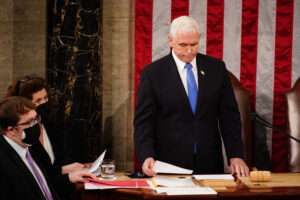
Then-Vice President Mike Pence oversees electoral vote count in Congress. (Jim LoScalzo - Pool via CNP/picture alliance / Consolidated News Photos/Newscom)
Andy Craig of the Cato Institute recently published "How to Pick a President: A Guide to Electoral Count Act Reform" an excellent overview of the problems with the Electoral Count Act revealed in the awful aftermath of the 2020 election, and how to fix them. Craig is a leading expert on ECA reform, and is his paper is a great introduction for anyone interested in these issues.
Here is the summary:
The peaceful transfer of power, regular elections, and limited terms of office are among our most precious legacies of the American Revolution. These bedrock constitutional principles are indispensable both to "insure domestic Tranquility" and to "secure the Blessings of Liberty to ourselves and our Posterity."
But as we saw in the 2020 election, operating under an antiquated rule book can pose serious risks. The Electoral Count Act of 1887 (ECA), with minor amendments since, is the statutory codification of important details left unaddressed by the Constitution's sparse provisions for electing a president. It is in dire need of reform.
America should not have to confront a potential constitutional crisis every four years. We should have confidence that the rule of law will prevail in determining the occupant of our highest office. The ECA as it stands is woefully inadequate to provide that assurance.
There is broad agreement on the need for ECA reform. Proposals range from a broad, expansive bill that could be criticized as overly complicated and assuming a role for Congress beyond the Constitution's limits, to a narrow, minimalist bill that could leave important problems unresolved by only making minor cosmetic changes.
There is a better middle course, built on a thorough consideration of the constitutional principles at stake. The ECA as it exists now is too flawed to save. Even if no substantive changes were to be made, a thorough rewrite is necessary to clarify the muddled and confusing language that Congress adopted in 1887. At the same time, ECA reform should respect the limits of Congress's role, in line with the principle that the ECA is simply codifying and clarifying constitutionally mandated processes. To that end, this analysis provides a top‐to‐bottom how‐to guide for an ECA reform that is both constitutionally and practically sound.
As Craig's paper lays out, ECA reform needs to address three interrelated problems:
1. Preventing state governments from, in effect, changing the rules after election day, in order to reverse election results they don't like.
2. Preventing Congress from throwing out electoral votes for bogus reasons (as some GOP members of Congress sought to do after the 2020 election).
3. Making it more clear that the Vice-President does not have the power to invalidate electoral votes (a step then-VP Mike Pence rightly refused to take in January 2021, despite the urging of Donald Trump).
While there is some dispute over details, there is broad agreement on these and related points among election and constitutional law experts across the political spectrum. The recent National Constitution Center project on "Restoring the Guardrails of Democracy" revealed that this is a point of agreement between the conservative, libertarian, and progressive teams that participated. The issue is covered in some detail in both the Team Libertarian report (which I coauthored with Clark Neily and Walter Olson), and the Progressive Report (written by election scholars Edward Foley and Franita Tolson). Team Conservative leader Sarah Isgur noted their agreement in a later NCC webinar.
It also appears that ECA reform has substantial bipartisan support in Congress. But whether it can pass before the fall 2022 elections remains to be seen. For obvious reasons, reform will become harder and harder to achieve as we get closer to 2024.
ECA reform won't cure all the ailments of American democracy. But it can eliminate some dangerous vulnerabilities for which - unlike many of our other problems - there are simple legislative fixes.
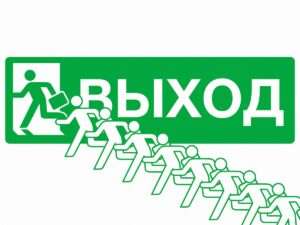
The Russian-language sign in this image says "exit."
Vladimir Putin's invasion of Ukraine and accompanying increase in repression within Russia itself kicked off a wave of Russian emigration, in addition to a massive flow of refugees from Ukraine. As a recent CNBC article explains, the initial wave has now been augmented by additional people, many of them skilled professionals in high tech and related fields:
Vladimir, whose surname has been removed due to the sensitive nature of the situation, is part of what he considers Russia's "second wave" of migration following the war. This includes those who took longer to prepare to leave the country — such as people with businesses or families who wanted to let their children finish the school year before leaving….
A "first wave" of artists, journalists and others openly opposed to Putin's regime felt they had to leave the country immediately or risk political persecution for violating the Kremlin's clampdown on public dissent.
"A lot of people got notices saying that they were traitors," said Jeanne Batalova, senior policy analyst at the Migration Policy Institute….
But as the war rages on, more Russians are deciding to pack up and leave.
"The way migration works is that once the flow begins and people start finding out how to do things — get a flat, apply for asylum, find a job or start a business — that prompts more people to leave. It becomes a self-fulfilling cycle," Batalova said….
There is no concrete data on the number of Russians who have left the country since the start of the war. However, one Russian economist put the total at 200,000 as of mid-March.
That figure is likely to be far higher now, according to Batalova, as tens of thousands of Russians have relocated to Turkey, Georgia, Armenia, Israel, the Baltic states and beyond….
In the tech sector alone, an estimated 50,000 to 70,000 professionals left in the first month of the war, with a further 70,000 to 100,000 expected to follow soon thereafter, according to a Russian IT industry trade group.…
The tech sector is one among several professional services industries that have seen an exodus of talent from Russia's larger cities, as people reject the war and worsening business conditions.
Scott Antel, an international hospitality and franchise lawyer who spent almost two decades working in Moscow, has so far this year helped five friends relocate from Russia to Dubai, in several cases purchasing properties for them, sight unseen, to expedite the move.
"You're seeing a massive brain drain," said Antel, whose departing friends span the legal and consulting professions, as well as hospitality and real estate. "The disruption for talented people is enormous and is going to be even more so."
This outflow represents a major opportunity for the West. For reasons I have outlined in detail before (see here, here, and here), opening our doors to Russians fleeing Putin is the right thing to do for a combination of moral, economic, and strategic grounds. Morally, it is wrong to keep out people fleeing an increasingly oppressive tyranny. Economically, we could use the extra production and innovation these immigrants can provide - especially since they are disproportionately professionals in science and high tech. Strategically, this can impose a "brain drain" on Putin's war machine, and strengthen our hand in the war of ideas against the authoritarian nationalism of Russia and China (a point American policymakers readily understood during the Cold War, when they welcomed refugees from communist states). The possible risk of espionage by Russian migrants is low and can be addressed by measures other than exclusion.
If the US and other Western nations were to open their doors, the scale of migration might become even larger than it is now, as places like the US and Canada are likely to be more attractive destinations for many Russians, than the limited options currently available. In addition, many emigrant Russians - particularly those in scientific and tech fields - could potentially be more productive in the West than in the much poorer and less advanced nations that are the only available options for most today (if they have any options at all).
In earlier posts (see here and here), I have also addressed the argument that opening the door to Russian and Ukrainian refugees is unfair so long as the US and other Western nations are less open to those fleeing violence and tyranny elsewhere. For those who care about consistency, I have a long record of also advocating refuge for victims of war and and oppression from elsewhere in the world (see also this recent post about Chinese fleeing that country's brutal Covid lockdowns).
Sadly, the track record so far suggests the US and other Western nations are likely to miss this opportunity. Since Putin's invasion began in February, many states have become more open to Ukrainian refugees (though more remains to be done on this front). But very little has changed when it comes to Russians fleeing Putin.
In May, President Biden asked Congress to take the very limited step of authorizing Russians with a master's or doctoral degree in science, technology, engineering or mathematics to obtain a US visa without first getting an employer to sponsor them. But little seems to have come of this. And, obviously, in Russia -as in the West - many highly productive people - including in the tech industry - do not have or need graduate degrees. Others could get them after coming to the West rather than before. Other Western governments have also been dragging their feet on this issue.
Hopefully, Western governments will take more advantage of this obvious opportunity than they have so far. But I am not as hopeful as I wish could be.
7/17/1862: Congress enacts the Confiscation Act, which empowers the government to seize the property of the rebels. The Supreme Court considered the constitutionality of that law in The Confiscation Cases (1873).
From Weisenbach v. Project Veritas, decided today by Erie County (Pa.) Court of Common Pleas Judge Marshall Piccinini:
Project Veritas is a non-profit media organization founded by James O'Keefe, III. On November 5, 2020, just two days after the November 3, 2020, presidential election, it published a story claiming to have uncovered a voter fraud scheme orchestrated out of the United States Postal Service General Mail Facility in Erie, Pennsylvania. Specifically, the article and accompanying video alleged that Erie Postmaster, Robert Weisenbach, directed the backdating of mail-in ballots in order to sway the outcome of the presidential election in favor of candidate Joseph Biden. The report relied upon an anonymous whistleblower, later revealed to be Richard Hopkins, a postal employee who claimed he overhead a conversation between Weisenbach and another supervisor. Hopkins stated that Weisenbach's motive for backdating mail-in ballots was that he was a "Trump hater," although, in reality, Weisenbach was a supporter of President Donald Trump and voted for him on election day.
In the days that followed, Project Veritas posted two more video interviews with Hopkins where he repeated his false claims, the latter after it was reported by news outlets that Hopkins had recanted his earlier allegations when confronted by postal inspectors, although Hopkins later claimed that recantation was coerced. The story soon gained traction among those amplifying claims of voter fraud, including President Trump himself. Weisenbach was forced to leave Erie for a time after personal details, including his address, were discovered and disseminated by readers of the Project Veritas stories. Project Veritas nonetheless maintains that the stories were investigated and published consistent with standards of "professional, ethical and responsible journalism."
Weisenbach disagrees. He brings this lawsuit against Hopkins, Project Veritas, and O'Keefe, alleging claims of defamation and concerted tortious activity. Defendants now seek to dismiss the claims before discovery has even begun by filing Preliminary Objections to Weisenbach's First Amended Complaint. That parties frame the action in broad terms as implicating competing ideals lying at the heart of our republic. Weisenbach argues that the stories were "not investigative journalism[,]" but rather "targeted character assignation aimed at undermining faith in the United States Postal Service and the results of the 2020 Presidential election" having "no place in our country." Defendants contend that this case raises fundamental concerns regarding freedom of the press, and that, pursuant to the First Amendment to the United States Constitution, we rely not on judges or juries to root out pernicious speech, but on competition in an uninhibited marketplace of ideas where the truth will ultimately prevail.
Whatever the merits of these lofty assertions, the Court's task today in reviewing Defendants' Preliminary Objections is much more modest. First, the Court must decide whether it lacks subject matter jurisdiction over the claims against Hopkins in light of the Federal Tort Claims Act, which vests federal courts with exclusive jurisdiction over actions brought against federal employees who cause injury while acting within the scope of their employment. Second, in assessing Defendants' Objections in the nature of demurrers, the Court must simply determine "whether, on the facts averred, the law says with certainty that no recovery is possible." For the reasons that follow, the Court answers both of those questions in the negative and consequently overrules Defendants' Preliminary Objections to the First Amended Complaint….
Please enjoy the latest edition of Short Circuit, a weekly feature from the Institute for Justice.
New cert petition: Does the Fourteenth Amendment require meaningful review of restrictions on the right to engage in a common occupation? IJ says yes, and that Kentucky's restrictions on home health agencies, which are preventing a pair of entrepreneurs from opening a new agency that caters to Louisville's large Nepali-speaking community, don't make a lick of sense. Click here to learn more.
FCC officials suspect some radio broadcasts are secretly paid for by the Chinese and Russian governments. So it issues an order requiring licensed broadcasters to independently verify that sponsors of broadcasts aren't having foreign governments foot the bill. The only problem, says the D.C. Circuit, is that that's "not the law that Congress wrote." The FCC has authority to require licensees to ask employees and sponsors about foreign governments, but not to force licensees to do independent research.
Congressional committee tries to subpoena then-President Trump's personal accounting firm. Now on remand from SCOTUS, the committee's chairwoman has explained in more detail why they want what they want: to craft new legislation on presidential self-dealing. D.C. Circuit: There's still separation-of-powers concerns, but the post hoc explanations are okay and the subpoena is basically okay. However, we'll narrow it a bit. Concurrence: Wow, these are big issues. How 'bout one of you try and go en banc? (Note: Justice Ketanji Brown Jackson arguably "rode circuit" in this case as she was a member of the panel at argument and was a justice by the time it was issued (although she did not participate in the writing of the opinion)).
Does it violate the Second Amendment for the NYPD to deny a Bronx man a license to have a shotgun or rifle in his home because of his 2011 arrest, which did not result in a conviction, for domestic violence? The district court said no, but we're sending it back down for another look, says the Second Circuit, in light of a recent Supreme Court ruling.
Anonymous internet users upload instructions for 3D printing gun parts and accessories with marks belonging to Everytown for Gun Safety, an anti-gun-violence group. Protected parody? Trademark infringement? Second Circuit: Back to the district court to determine if defendants can proceed anonymously.
Last year, Suffolk County, N.Y. police sent letters threatening to arrest and criminally prosecute owners of a particular firearm if they failed to turn them in within 15 days. Second Circuit: No one's actually been arrested or had their guns forcibly taken yet, so these plaintiffs don't have standing to sue.
Journalist makes Freedom of Information Act request of the Secret Service for records relating to President-elect Trump prior to his taking the oath of office on January 20, 2017. Second Circuit: Those aren't "agency records," as neither a presidential campaign nor a presidential transition is an "agency." And even if they were, they'd be covered by the "unwarranted invasion of personal privacy" exception to FOIA.
Like newborn babes swaddled in the cashmere blanket of ignorance, a panel of the Fourth Circuit finds it "perplexing" that the government would oppose the vacatur of a 2003 firearms conviction for a man whom the government concedes is actually innocent. But though we may never know why the government does the things it does, here, at least, it is the criminal defendant who prevails.
In the summer 2019, Corpus Christi, Tex. police sought to round up gang members with outstanding criminal warrants. One of those gang members was described only as a Hispanic male who, at some unidentified point, had been seen riding a bicycle in the "area of Leopard and Up River" with large handlebars. Police spot a man in the area matching the meager description, stop him, and frisk him. Uh oh! It's the wrong guy, but he is a felon in possession. The man moves to suppress the handgun, arguing there was no reasonable suspicion for the stop. Fifth Circuit (over a dissent): He's right. We've rejected even more extensive descriptions as too scanty to justify an investigatory stop.
Though court orders man who is incompetent to stand trial to be civilly committed or released, he remains in Clay County, Miss. jail for six years (until local news starts asking questions). Fifth Circuit: And not only that, but the current and former sheriffs lied to the court about it. No qualified immunity for the sheriffs.
In 2014, Texas prison officials banned Nation of Gods and Earths religious group from gathering. Officials: We have a new policy that lifts the ban. The case is moot. Fifth Circuit: On the contrary, the policy merely allows these inmates to apply to congregate. Judge Ho, concurring: "We cannot allow government officials to unilaterally avoid judicial review—and especially not when they openly admit that their change in behavior is strategic rather than sincere."
Officers flag down a motorist leaving a Lake Charles, La. rest area. A search reveals contraband. Was flagging him down a stop for Fourth Amendment purposes? District court: No, officers didn't physically step in front of his car. He was free to go. Fifth Circuit: It was a stop, not least because state law requires motorists to stop at an officer's command. Take another look at that motion to suppress.
Fifth Circuit: You can't vacate a five-year-old judgment just because the SEC bullied you into giving up your First Amendment rights as a condition of settlement. Concurrence: True enough, but bullying people into giving up their First Amendment rights sure seems like the sort of thing that's bound to have consequences one day.
District court: Coryell County, Tex. jail officials responded to a disruptive detainee with reasonable, measured force, removing the force once she was restrained. Qualified immunity. Fifth Circuit: Yeah, that's the defendants' version of events, which we can't review at the summary judgment stage. Plaintiff's facts show the detainee was tapping her hairbrush on her cell door, so officers repeatedly pepper sprayed her, punched her multiple times, and then, even after she was handcuffed and prone, pressed their 230- and 390-pound bodies into her back and neck until she was lifeless. On that version of events, no qualified immunity.
In 2017, Detroit officials—who have a habit of forcing people into foreclosure over inflated tax bills—mailed out 260k property tax assessments that tell homeowners they have at most four days to challenge those assessments or forever lose their chance at judicial review. The deadline does get extended, but officials do not individually notify homeowners, relying instead on an announcement at a city council meeting and local news coverage. Might that violate due process? Congress passed a law saying local tax issues like this have to go to state court, says the Sixth Circuit, unless there is no clear path to review in state court. Which (over a dissent) there isn't here. Case undismissed.
Does it violate the First Amendment for Westfield, Ind. officials to bar a large digital billboard from being put up on private property in town? The district court said yes, because the city's distinction between on-premises and off-premises signs allows officials to discriminate based on the content of speech. Seventh Circuit: But, since the Supreme Court just torpedoed that line of reasoning, this goes back down for another look (and another chance to develop the record).
St. Paul, Minn. police officer Heather Weyker, who was also a deputized federal task force agent, framed dozens of innocent people in the course of fabricating a non-existent interstate sex-trafficking ring. One of her victims, who spent years in federal custody before being acquitted, sues, arguing that Weyker's lies violated the Constitution. Eighth Circuit: You can't sue her in her capacity as a federal agent because federal agents have de facto absolute immunity. And you also can't sue her in her capacity as a local officer because her fake investigation was a federal one. (N.B.: This week, in a case involving a different victim, IJ asked the Supreme Court to tell the Eighth Circuit to take another look at Weyker's federal immunity.)
Is there a First Amendment right to record the police? Tenth Circuit (2021): Can't say. Won't say. Tenth Circuit (2022): There absolutely is, and it's a clearly established right. So no qualified immunity for this Lakewood, Colo. officer, who allegedly shined a flashlight into citizen-journalists' phones and cameras and, after being told to knock it off by a fellow officer, then drove his patrol car straight at the journalists, sped away, did a U-turn, gunned it back toward a journalist, swerved to avoid hitting him, and then blasted his air horn.
After a Utah Highway Patrol Trooper pulls over an out-of-state driver for a suspected window-tint violation, he lets the man go with a warning. But then the trooper contacts a buddy on the force and tells him to "go stop" the driver in order to walk a drug dog around the car. The second trooper does so. The dog alerts on the car, which leads to a search, but no drugs are discovered and the trooper again releases the man with a warning. The man sues, pro se, alleging the successive stops violate his Fourth Amendment rights. District court: Qualified immunity. Tenth Circuit: Take another look at that one.
Kansas contractors set up a scheme where they'd funnel money to noncitizens without work permits to hang drywall for other companies. Feds prosecute contractors under a statute making it illegal to "encourage" or "induce" illegal entry or presence in the U.S. Is the statute overly broad, making a "substantial amount" of protected speech illegal, regardless of what the defendants themselves ever said? Tenth Circuit: Yep. This law must take the overbreadth L. Dissent: That's pretty strong medicine when we can just read the statute another way.
Dunedin, Fla. septuagenarian leaves town for about two months to settle his mother's estate, and the man he paid to mow his lawn dies unexpectedly. Without notice, city officials fine him $500/day for overgrown grass, a total of $28.5k plus interest. He can't come up with the money on time, so officials seek to foreclose on his home. An excessive fine? A violation of due process? Eleventh Circuit: No, state law allows up to $500/day fines for municipal violations, and he should have raised his due process claims in state court. (This is an IJ case.)
And in amicus brief news, IJ is asking the Supreme Court to tell lower courts to start exercising the full extent of their jurisdiction over federal agencies instead of intuiting an unspoken congressional desire to let agencies proceed unchecked.
Friends, Iowa's Constitution begins with some stirring words: "All men and women are, by nature, free and equal, and have certain inalienable rights — among which are those of enjoying and defending life and liberty, acquiring, possessing and protecting property, and pursuing and obtaining safety and happiness." But do those words actually mean anything? Regrettably, last month the Iowa Supreme Court said no, applying rational basis review and pretty much rendering the clause judicially unenforceable. It's a real shame. Click here to learn about the rights-protecting history of the clause.
In a petition for reconsideration, I ask the Utah Supreme Court to modify a recent opinion to remove the qualifier "alleged" in front of term "victim" in light of the fact that the defendant has been convicted of sexually assaulting the victim.
Last week the Utah Supreme Court released an opinion agreeing with me (and the Utah Crime Victims' Legal Clinic) that a crime victim was entitled to be heard in appellate court proceedings concerning whether to release the victim's mental health counseling records. While the decision was (quite properly, in my view) protective of crime victims' rights, one oddity in the decision was its first sentence—which used the term "alleged" to describe the child sexual assault victim in the case, F.L. The opinion began: "F.L. is the alleged victim of sex crimes charged against David M. Chadwick." I have filed a petition for reconsideration, asking the Court to remove the term "alleged" from its opinion. At this point in the proceedings, the defendant has been convicted of the crime of child sexual assault against F.L. Accordingly, the term "alleged" is a legally inaccurate description of the victim's status—and inappropriately expresses incredulity about her testimony at trial.
Some quick background about the case: The defendant was charged with sexually assaulting F.L. when she was child. In the trial court, he sought F.L.'s mental health counseling records—a request that was mostly denied by the trial court judge. At trial, F.L. testified that the defendant sexually assaulted her. The jury then convicted the defendant of one count of child sexual assault.
The defendant appealed, asking the Utah Court of Appeals to release F.L.'s records to him for purposes of developing his appellate arguments. F.L. sought to intervene to protect the confidentiality of her records. The Court of Appeals refused to allow intervention and, on review of that refusal, the Utah Supreme Court released its opinion holding that F.L. was entitled to be heard in the Court of Appeals on the release-of-records issue.
In light of this background, to refer to F.L. as the "alleged victim" is inaccurate and inappropriate. Here's part of our argument from our petition for reconsideration:
That term ["alleged"] might be appropriate in a case in which a criminal defendant has yet to stand trial. Cf. State v. Archibeque, 2022 UT 18, ¶ 1 (discussing procedures at a preliminary hearing where a defendant "served his alleged victim" with a subpoena and the victim moved to quash). Here, in contrast, a jury has found beyond a reasonable doubt that Chadwick was guilty of one count of sexual abuse of a child—i.e., of sexually abusing F.L. See Op. at 2. While Chadwick is appealing his conviction, at this time it is plainly inaccurate to refer to F.L. as Chadwick's "alleged" victim—Chadwick's guilt for sexually abusing a child has been proven in a court of law. See BLACK'S LAW DICTIONARY 94 (11th ed. 2019) (defining "alleged" as "[a]ccused but not yet tried <alleged murderer>"(emphasis added)); BRYAN A. GARNER, GARNER'S DICTIONARY OF LEGAL USAGE 44 (3d ed. 2011) ("To allege is formally to state a matter of fact as being true or provable, without yet having proved it" (emphasis added)); Dictionary.Com ("Alleged is most commonly used in a legal context . . . in reports about crime … before it has been proven or before someone has been convicted."), available at https://www.dictionary.com/browse/alleged. In the eyes of the law, F.L. is the proven victim of Chadwick's abuse.
Our petition cites a comprehensive and helpful analysis of these issues by the National Crime Victim's Law Institute. In a review of cases involving whether to refer to a crime "victim," NCVLI explains that after a finding of "victim" status has been made, "[t]he use of 'alleged victim' incorrectly asserts that victim status has not been determined."
This debate about whether the term "alleged" is appropriate is no mere semantic quibble. For sexual assault victims—and particularly child sexual assault victims—one of their greatest fears is that they will not be believed when they come forward to report the abuse. While a defendant is, of course, initially entitled to a presumption of innocence in criminal proceedings, if a guilty verdict results at trial, that presumption no longer exists.
Appellate courts do not commonly refer to "alleged" victims on appeal. Our petition for reconsideration notes that in a number of recent decisions, the Utah Supreme Court does not refer to "alleged" victims in cases where the defendant has been convicted. For example, in State v. Bell, 2020 UT 38, 469 P.3d 929. the Utah Supreme Court's first sentence in its opinion was: "This case concerns a criminal defendant's request to view a sexual abuse victim's privileged mental health therapy records." Id. at ¶ 1 (emphasis added). Similarly, in Michigan v. Bryant, 562 U.S. 344 (2011), the U.S. Supreme Court's first sentence in its opinion was: "At respondent Richard Bryant's trial, the court admitted statements that the victim, Anthony Covington, made to police officers …." Id. at 348 (emphasis added).
I hope the Utah Supreme Court grants our petition for reconsideration and removes the term "alleged" from its recent opinion. Sexual assault victims face considerable headwinds in coming forward to report abuse. They shouldn't also face inaccurate skepticism in criminal appeals where a jury finding of "victim" status has been made by proof beyond a reasonable doubt.
In 2018, a closely divided 5-4 Supreme Court upheld Donald Trump's travel ban policy targeting residents of several Muslim-majority nations. In doing, so the Court relied in part on the notion that Trump's notorious campaign promise to institute a "Muslim ban" was not the real basis for the policy, or at least not the only one. Rather, the travel ban was also justified by a supposedly objective and thorough government study concluding that people from the nations covered by the ban may pose special security risks.
Unfortunately, the administration never released that study to the courts, essentially claiming that judges should trust the government's assurances, and defer to a study whose contents they were not allowed to see. The majority did just that, despite considerable evidence indicating that the study was little more than a flimsy smokescreen.
The Trump travel bans have since been revoked by Biden. But the study supposedly backing them still hasn't been released. Thus, we still don't definitively know whether and to what extent the Trump administration sought to deceive the courts about its contents and significance.
In a recently filed Freedom of Information Act (FOIA) lawsuit, the Cato Institute - a prominent libertarian think tank - seeks to force the Biden administration Department of Homeland security to release the Trump travel ban report, after DHS previously refused to release it voluntarily. Cato immigration policy specialist David Bier describes the lawsuit and its potential significance:
A new lawsuit by the Cato Institute could answer the question of whether the Supreme Court was wrong to accept assertions from former President Trump that his 2017 travel ban was based on security concerns, not animus against Muslims. Despite rescinding the ban, President Biden has still refused to disclose documents that Trump told the Court were the basis of his decision to ban immigrants from certain majority Muslim countries…
In a 5–4 decision, the Court's majority found that the ban was based not on Trump's open animus against Muslims, but instead on a Department of Homeland Security (DHS) report that supposedly detailed national security concerns. But the majority simply accepted this report as legitimate without ever seeing it. Indeed, DHS has allowed no one outside the Executive branch to see it.
After President Biden rescinded the ban—which he called "discriminatory"—I filed a Freedom of Information Act (FOIA) request on behalf of the Cato Institute for the DHS report. DHS ignored it, so now Cato is suing. It will be the first time Biden's DHS will have to either justify keeping the report a secret from the public or else release it. Even if DHS refuses to release the report, the court can order it to do so.
Given that DHS's new leadership labeled the ban "cruel" and "harmful," DHS should have been forthcoming with the report that purportedly supported it. But not so far. DHS initially claimed not to be able to find the report. Cato appealed that determination and won, which should have forced DHS officials to look again. They chose not to, so now they will face Cato in court….
Lest anyone forget, it was Trump who instigated the Muslim ban. It was Trump who, in his words, "morphed" it into a ban on select majority‐Muslim countries so he could blunt a constitutional challenge.
How did the Supreme Court ignore this back story and uphold the ban as constitutional? First, it adopted a laughably low bar, the so‐called "rational basis test" under which courts would have accepted nearly any justification except perhaps for the one Trump stated initially: "Islam hates us." And where did Trump find a suitable replacement for his initial justification? From the DHS report that the department still refuses to disclose….
The ban was purportedly "based on [the President's] findings—following a worldwide, multi‐agency review—that entry of the covered aliens would be detrimental to the national interest…."
But the Supreme Court never verified that the DHS report did any of this, and we have at least two very good reasons to doubt the claim's veracity. First, President Trump's proclamation identifying the banned countries lists the nine baseline criteria that DHS's report supposedly applied equally to every country. Under a neutral application of those criteria, however, dozens of other countries—including many non‐Muslim countries—should have failed.
Second, although the justices never saw the actual report, they did know that it was just 17 pages. Did DHS analyze the vetting systems of more than 200 countries in 17 pages across nine security metrics as the president claimed? It certainly did not. Yet the majority justices said that they it would not question DHS's "thoroughness" because "a simple page count offers little insight into the actual substance of the final report"—the very substance that DHS has sought to hide and Cato's lawsuit now seeks to uncover….
Even if the release of the report proves that the Trump Administration lied about its nature to the courts, that wouldn't necessarily mean that Trump v. Hawaii would have come out differently had the justices known the whole truth. The ultradeferential "rational basis" standard under which the majority evaluated the policy might well have led them to rule in favor of the administration anyway. The Court's reasoning was based less on trust in Trump than on an indefensible double standard under which immigration restrictions get far weaker judicial scrutiny than that applied to virtually any other type of government policy.
Still, a rationale based on blatant lies about the contents of a report that doesn't actually do what the government claims it does might potentially have been ruled insufficient even under rational basis. Revelation of mendacity on this scale might even lead at least some conservative justices to impose tougher standards of scrutiny in the future, at least in cases where there is evidence that the government is blatantly lying about its true motives, using national security concerns as a thinly veiled pretext for religious bigotry or some other unconstitutional purpose. In such situations, traditional rationales for deference based on executive branch expertise do not apply, because specialized expertise isn't the real reason for the policy.
And if the administration lawyers who litigated the case knew about the true nature of the report and deliberately misrepresented it in court, they might be subject to sanctions. Under the Federal Rules of Civil Procedure, "fraud" or "misrepresentation" by an "opposing party" can constitute grounds for granting the side that lost a case relief from the court's judgment (though I am not sure whether the losing parties to the travel ban litigation can get any relief at this point, given that the policy has been lifted).
Even if proof of the administration's mendacity would not lead to a different outcome in court, it is at least something the public should know about. I am no FOIA expert, and therefore cannot say whether Cato is likely to win the lawsuit. But DHS should release the travel ban report regardless. If the report includes classified national security information, they can redact that part. But, given its apparently short and perfunctory nature, it's highly unlikely that all or most of the report falls into that category, and neither the Trump nor Biden administration have ever claimed that it does.
NOTE: I am a Cato Institute adjunct scholar (an unpaid external affiliation).
UPDATE: Skeptics may wonder why the Biden DHS is resisting release of the report, if the contents are likely to prove embarrassing to Trump. There is no way to know for sure. But the most obvious possible reason is they do not want to set a precedent for releasing potentially awkward or embarrassing information from Biden's own administration. The Biden people may believe that risk outweighs any short-term political advantage that might be gained here. But if that's their concern, there is an obvious conflict here between the administration's interests and the public interest.
The authors include big-name conservative former federal judges Michael Luttig and Michael McConnell, former Bush Solicitor General Ted Olson, and others.
Several prominent conservatives recently released a report entitled "Lost, Not Stolen: The Conservative Case that Trump Lost and Biden Won the 2020 Presidential Election." The authors include former federal judges J. Michael Luttig, Thomas Griffith, and Michael McConnell (who is also a prominent legal scholar), former GOP senators John Danforth and Gordon Smith, former George W. Bush solicitor general and conservative "super-lawyer" Ted Olson, Republican election law expert Benjamin Ginsberg, and David Hoppe, longtime aide to a variety of GOP members of Congress. Luttig and McConnell were also often viewed as potential GOP nominees to the Supreme Court, and Danforth is the former Attorney General of Missouri, in which role he was a key mentor for future Supreme Court Justice Clarence Thomas (who started his legal career working for Danforth).
Here is an excerpt from the report's Introduction:
We are political conservatives who have spent most of our adult lives working to support the Constitution and the conservative principles upon which it is based: limited government, liberty, equality of opportunity, freedom of religion, a strong national defense, and the rule of law.
We have become deeply troubled by efforts to overturn or discredit the results of the 2020 Presidential Election. There is no principle of our Republic more fundamental than the right of the People to elect our leaders and for their votes to be counted accurately. Efforts to thwart the People's choice are deeply undemocratic and unpatriotic. Claims that an election was stolen, or that the outcome resulted from fraud, are deadly serious and should be made only on the basis of real and powerful evidence. If the American people lose trust that our elections are free and fair, we will lose our democracy….
We therefore have undertaken an examination of every claim of fraud and miscount put forward by former President Trump and his advocates, and now put the results of those investigations before the American people, and especially before fellow conservatives who may be uncertain about what and whom to believe. Our conclusion is unequivocal: Joe Biden was the choice of a majority of the Electors, who themselves were the choice of the majority of voters in their states. Biden's victory is easily explained by a political landscape that was much different in 2020 than it was when President Trump narrowly won the presidency in 2016. President Trump waged his campaign for re-election during a devastating worldwide pandemic that caused a severe downturn in the global economy. This, coupled with an electorate that included a small but statistically significant number willing to vote for other Republican candidates on the ballot but not for President Trump, are the reasons his campaign fell short, not a fraudulent election.
Donald Trump and his supporters have failed to present evidence of fraud or inaccurate results significant enough to invalidate the results of the 2020 Presidential Election. We do not claim that election administration is perfect. Election fraud is a real thing; there are prosecutions in almost every election year, and no doubt some election fraud goes undetected. Nor do we disparage attempts to reduce fraud. States should continue to do what they can do to eliminate opportunities for election fraud and to punish it when it occurs. But there is absolutely no evidence of fraud in the 2020 Presidential Election on the magnitude necessary to shift the result in any state, let alone the nation as a whole. In fact, there was no fraud that changed the outcome in even a single precinct. It is wrong, and bad for our country, for people to propagate baseless claims that President Biden's election was not legitimate.
Here is the authors' summary of the results of the extensive litigation challenging the election results in suits filed by Trump and his supporters, such as the "Kraken" lawyers:
As part of his post-election attempts to retain the presidency, Donald Trump and his supporters filed 64 cases containing 187 counts in the six key battleground states, in addition to utilizing some of the recount and contest procedures available to them under state law. The former president maintains to this day that the 2020 election was stolen and the results fraudulent.
This Report takes a hard look at the very serious charges made by Trump and his supporters. The consequences of a president and a major party candidate making such charges are monumental. If true, our electoral system is in desperate need of repair. If not true, that must be said because such false charges corrode our democracy and leave a significant share of the population doubting the legitimacy of our system, seriously weakening the country.
Every member of this informal group has worked in Republican politics, been appointed to office by Republicans, or is otherwise associated with the Party. None have shifted loyalties to the Democratic Party, and none bear any ill will toward Trump and especially not toward his sincere supporters. Many of us have worked over the years in polling places as part of Republican Election Day Operations looking for the same sort of fraud and irregularities Donald Trump claimed in 2020….
Fraud, irregularities, and procedural deficiencies formed the basis for challenging the results in five of the six highly contested Electoral College battleground states of Arizona (page 7), Georgia (page 27), Michigan (page 36), Nevada (page 47), and Wisconsin (page 64). In Pennsylvania (page 53), Trump verbally attacked the elections as fraudulent, but his lawyers never filed such charges in court.
For this Report, we examined every count of every case brought in these six battleground states….
We conclude that Donald Trump and his supporters had their day in court and failed to produce substantive evidence to make their case.
Of the 64 cases brought by Trump and his supporters, twenty were dismissed before a hearing on the merits, fourteen were voluntarily dismissed by Trump and his supporters before a hearing on the merits, and 30 cases included a hearing on the merits. Only in one Pennsylvania case involving far too few votes to overturn the results did Trump and his supporters prevail.
It's worth adding that many of these cases were heard by Republican-appointed judges, including some appointed by Trump himself. One of the most significant decisions rejecting Trump's claims was written Judge Stephanos Bibas of the Third Circuit, a well-known Trump appointee, and previously a prominent conservative legal scholar at the University of Pennsylvania. As he put it: "Free, fair elections are the lifeblood of our democracy. Charges of unfairness are serious. But calling an election unfair does not make it so. Charges require specific allegations and then proof. We have neither here."
The one case the pro-Trump side won (in Pennsylvania) not only involved far too few votes to change the outcome, but also didn't involve allegations of voter fraud.
"Lost, Not Stolen" provides an excellent overview of all the issues raised in the election litigation, how courts resolved them, and why nearly all of the allegations made by Trump and his supporters were false. It's great one-stop shopping for anyone interested in these issues.
Most of the information and arguments in the report are not new. As the authors point out, their conclusions are much the same as those reached in numerous court decisions, and multiple post-election audits of ballots in key "battleground" states, including several conducted by Republican state officials or groups aligned with the GOP. An Arizona audit conducted by the "Cyber Ninjas" - consultants hired by pro-Trump Republicans hoping to find evidence of fraud - even concluded that Biden won the state's biggest county by a slightly larger margin than the official vote tally indicates.
In addition to its thorough and user-friendly format, the report's significance lies in the fact that the authors are big-name members of the conservative legal community who cannot easily be dismissed as liberals, or even "Never-Trumpers." Indeed, the authors' sentiments towards Trump and other backers of the "Big Lie" are, to put it mildly, far more forgiving than my own.
Whether the report changes many minds remains to be seen. As I have previously pointed out, the evidence against Trump's Big Lie has been so strong and so readily available for so long, that most remaining belief in the lie is likely to be the result of some combination of "rational ignorance" and strong partisan bias. Still, there may be some who remain on the fence because they just haven't gotten around to looking the evidence, or have not seen it presented all in one place in an easily accessible form, by people on "their" side of the political spectrum.
Other things equal, people are willing to believe uncongenial facts presented by partisan allies, than if put forward by adversaries. Perhaps that dynamic will enable "Lost, Not Stolen" to have a bigger impact than I expect.
You may recall the claim to which I am referring from my earlier posts from back in December 2020: the "proof" that it was "statistically impossible" - "less than one in a quadrillion chance"** - that Biden could have won the election without engaging in massive fraud.
**A quadrillon is an actual number: 1 followed by 15 zeroes (10^15). An event with a probability of occurrence of one in a quadrillion can indeed be considered "statistically impossible" for all intents and purposes - roughly equal to the probability of flipping a fair coin 50 times and getting "heads" on each one. Not exactly impossible, but if it happens to you, you can pretty safely conclude that the coin is biased. [The original post had an incorrect assessment of this probability. H/t Jordan Brown and other commenters for correcting this error]
The claim appears to have had two independent sources. One was Texas A.G. Paxton's motion and supporting brief, submitted to the the Supreme Court as part of his unsuccessful attempt to get the Court to overturn the results of the 2020 election. Paxton, citing an expert report by economist Charles Cicchetti, actually asserted that the "probability of former Vice President Biden winning the popular vote in Georgia, Michigan, Pennsylvania, and Wisconsin independently" is "less than one in a quadrillion," and therefore that "the odds of Biden winning these four States collectively" was "less than one in a quadrillion to the fourthpower" (i.e. 1/1,000,000,000,000,000,000,000,000,000,000,000,000,000,000,000,000,000,000,000,000).
The second source for this preposterous claim** appears to have been the "Special Report" prepared by then-US Trade Representative Peter Navarro (at then-President Trump's urging), colorfully titled "The Immaculate Deception," purporting to document the "Statistical Irregularities in the Battleground States" that demonstrate the existence of "a coordinated strategy to effectively stack the election deck against the Trump-Pence ticket."
**For reasons I and others have set forth elsewhere, these claims are totally nonsensical and ridiculous. In brief: What the statistical analyses actually show is that (A) the odds of obtaining the reported results in any of the four states if the 2020 voting population had precisely the same Dem. v. Rep. party preferences as the 2016 votingpopulation are infinitesimally small, and (B) the odds of obtaining the reported results in any of the four states if mail-in and in-person voters had precisely the same Dem. v. Rep partypreferences are also infinitesimally small. There is, of course, no reason whatsoever to believe that either of those two conditions held true, so these analyses have no relevance whatsoever to any of the actual election results. Indeed, what the analyses actually "prove" is that the 2020 voting population did not have precisely the same Dem. v. Rep. party preferences as the 2016 voting population (duh), and mail-in and in-person voters did not have precisely the same Dem. v. Rep. party preferences (ditto).
But back to the Meeting of the Unhinged, at which, apparently, there was considerable discussion of these various "proofs" that Biden could not possibly have won the election. Our then-President bought them hook, line, and sinker - just what he was looking for! Proof! He reportedly turned to his White House advisors ("Team Normal") and said: "Sidney and Rudy are giving me something - what are you giving me?" I guess he didn't have time to look carefully at the underlying statistical models, what with all the screaming and f-bombing going on in the Oval Office late that night (though I wonder what Texas A.G. Paxton's excuse might have been).
Not long after Sidney Powell, General Flynn, and Rudy Giuliani left the White House in the early hours of the morning [of Dec. 19], Donald Trump issued a tweet that would galvanize his followers, unleash a political firestorm, and change the course of our history as a country. Trump's purpose was to mobilize a crowd. And how do you mobilize a crowd in 2020? With millions of followers on Twitter, President Trump knew exactly how to do it. At 1:42 AM on December 19, 2020, shortly after the last participants left the unhinged meeting, Trump sent out the tweet with his explosive invitation.
"Peter Navarro releases 36-page report alleging election fraud 'more than sufficient' to swing victory to Trump https://t.co/D8KrMHnFdK . A great report by Peter. Statistically impossible to have lost the 2020 Election. Big protest in D.C. on January 6th. Be there, will be wild!"
In the history of dangerous nonsense, this surely holds pride of place. This would all be hilarious - it is hilarious, soon to be a major motion picture I'm sure - except for the fact that it was actually part of a determined attempt - the first in our history - to unlawfully overthrow the democratically-elected government of the United States. We should probably be careful about focusing too much - tempting though it is - on the farcical and ridiculous aspects of these events for fear of appearing to diminish their seriousness. The Beer Hall Putsch of 1923 was similarly dismissed by many Germans as little more than a pathetic joke, and while Donald Trump is no Hitler (thank God), we should keep in mind that in 1923, Hitler wasn't yet "Hitler," either; I suspect that twenty years later, a fair number of Germans regretted not having taken the threat he posed in 1923 more seriously.
Special twist: The case "involve[s] allegations against a CEO who was one of the jurors in the Harvey Weinstein trial," and who had (according to news accounts) claimed he "singlehandedly delivered" the Weinstein guilty verdict.
Plaintiffs allege that they were sexually abused by the Chief Executive Officer of Branca USA. The complaint alleges that Jane Doe 1 was drugged and raped, and that Jane Doe 2 was sexually assaulted on numerous occasions. It further alleges that both women were groped and harassed, and that when they complained, they suffered retaliation….
Plaintiffs argue that they should be permitted to proceed pseudonymously. They note that the complaint contains detailed allegations of rape and sexual assault and argue that they will suffer significant psychological harm if they are forced to reveal their identities to the public. They also assert that the defendants will suffer no prejudice if Jane Doe 1 and Jane Doe 2 are permitted to pursue their claims anonymously, as counsel has identified their names to counsel for defendants. Finally, they assert that they have sought mental health treatment and would experience significant harm if forced to reveal their identities to the public.
Federal Rule of Civil Procedure 10(a) requires that the title of a complaint name all the parties to a litigation; this requirement "serves the vital purpose of facilitating public scrutiny of judicial proceedings and therefore cannot be set aside lightly." "[W]hen determining whether a plaintiff may be allowed to maintain an action under a pseudonym, the plaintiff's interest in anonymity must be balanced against both the public interest in disclosure and any prejudice to the defendant." "The people have a right to know who is using their courts." …
The courts in this District have considered in several cases whether to permit a plaintiff who alleges that she or he has been raped or been the subject of sexual assault to proceed pseudonymously…. [T]he results across the board come down to this: A claim by an adult plaintiff to have been the victim of sexual abuse and to have suffered physical or psychological damage as a result, accompanied by sufficient facts to support that claim, is not enough to entitle a plaintiff to proceed anonymously.
Critics of immigration restrictions often cite immigrants who make extraordinary contributions to the society. But what about the opposite case of immigrants who cause massive harm (like Hitler)? The argument deserves to be taken seriously. But it's ultimately much weaker than it seems.
Opponents of immigration restrictions - myself included - often cite the examples of immigrants who make extraordinary contributions to society. For example, immigrants contribute disproportionately to major entrepreneurial and scientific innovations, such as the development of the first two successful Covid vaccines approved by the FDA. The immigrants in question probably would not have been able to make these contributions if they were confined to their countries of origin. Even if only a tiny fraction of immigrants achieve such feats, migration restrictions cumulatively forestall a substantial number of such accomplishments, thereby causing great harm that goes beyond the losses incurred by keeping out immigrants who "only" make ordinary economic and social contributions.
But what of the opposite scenario: individual immigrants who cause extraordinary harm. By "extraordinary harm," I don't mean immigrants who do things like commit ordinary crime or become a burden on the welfare system. I mean people who have a large negative impact on society as a whole, comparable in scale to the positive impact of a major entrepreneur or scientific innovator. If such people exist and immigration restrictions are the only effective way to keep them from perpetrating their nefarious deeds, then that could potentially be a serious rationale for restrictionism. After all, one massively harmful migrant could potentially outweigh the benefits created by a large number who make "normal" contributions to society. Ideally, we would just keep out the enormously harmful individuals, while letting "normal" migrants through. But it may be impossible to identify the former with precision, so the only way to keep them out might be to exclude large numbers of other people, as well.
The problem of the massively harmful individual immigrant is distinct from concerns that large masses of migrants might collectively cause great harm, such as increasing crime, overburdening the welfare system, spreading bad cultural values, voting for terrible political leaders, weakening liberal democratic institutions, or exacerbating environmental degradation. These issues have already been covered in detail by both defenders and critics of migration restrictions. I myself go into them at some length in various writings, including Chapter 6 of my book Free to Move.
By contrast, I have yet to see any systematic analysis of the issue of the extraordinarily harmful individual immigrants. But the concern is an intuitively obvious one, and I see it come up fairly regularly when I give presentations on immigration-related issues. Both laypeople and experts occasionally raise it. At the very least, it deserves some serious consideration.
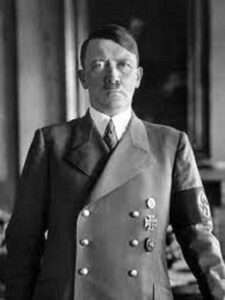
Are there actual examples of individual immigrants who cause great society-wide harm? There is at least one. And oh what an example it is: Adolf Hitler! In 1913, Hitler immigrated to Germany from Austria; he didn't become a German citizen until 1932. There is a plausible argument that Hitler's move to Germany was an essential prerequisite for the Nazis' rise to power, which in turn led to World War II and the Holocaust. Had the then-tiny Nazi Party that Hitler joined in 1919 remained under the uninspired leadership of its founder, Anton Drexler, it's unlikely it would ever have amounted to much of anything.
Had Hitler been forced to remain in Austria, he would never have become the leader of the Nazis, much less dictator over all of Germany. Even if he had gone on to become a fascist dictator of Austria, the resulting harm would have been far smaller, if only because Austria was a much less powerful nation.
More generally, I can see two major ways in which an individual immigrant could cause extraordinary harm. One is the Hitler Scenario: leading a political movement that perpetrates great evil when and if it comes to power. The second is developing an enormously harmful scientific or technological innovation. If immigrants disproportionately contribute to beneficial innovations, perhaps they might also be disproportionately responsible for harmful ones. For example, an immigrant could develop an especially heinous torture device, new surveillance tech that can be used to facilitate repression, or an innovation that greatly damages the environment. Call this the Mad Scientist Scenario (though scientists who make harmful innovations usually are not actually insane!).
Both scenarios have some intuitive plausibility as rationales for immigration restrictions. If barring Austrian migration to Germany was the only way to forestall the rise of Hitler and the Nazis, even I have to admit that's a price worth paying!
But before endorsing these theories, it's worth applying the three-part test I developed for assessing other consequentialist rationales for migration restrictions, in Free to Move:
Consider how big the problem is. If the answer is that it's nonexistent or greatly overblown, restrictions aren't justified.
If the problem is real, is there a "keyhole solution" that can address it without actually barring migrants?
If the problem is real, and there is no effective keyhole solution, can we address the issue by tapping some of the vast wealth created by migration?
Assessed in this way, both the Hitler and Mad Scientist scenarios start to look less impressive.
Under the first step, how you assess the Mad Scientist scenario largely depends on your views about technological innovation more generally. If - like me - you think it's generally beneficial, despite the occasional harmful invention, then you will be inclined to look favorably on the large increase in innovation caused by migration. Harmful innovations are the price we pay for beneficial ones. And there is, of course, no reason to believe that immigrant innovators are disproportionately likely to make harmful innovations relative to beneficial ones (though they make more of both, relative to natives).
If, on the other hand, you are a techno-pessimist, then you are likely to take a different view. But, in that event, you should also advocate for severe restrictions on innovation by native-born citizens, as well. You may even want to deport some of the more talented native-born scientists and inventors to places where they are less likely to succeed!
The Hitler Scenario strikes me as more significant. The only way to dismiss it outright is if you think political history is ultimately determined by structural factors, and individual leaders play little role. On this view, if Hitler had stayed in Austria, the Nazis (or some other similar right-wing nationalist party) would have come to power in Germany anyway, and pursued largely the same policies as Hitler did. While structural factors certainly matter, I think individual leaders also can make a big difference, at least sometimes.
Still, several factors suggest the risk here is small. Indeed, it's hard to think of any case where an immigrant has successfully led an illiberal authoritarian movement to power, other than Hitler (though of course that one case was hugely important). If the Hitler Scenario were a significant systematic risk, we should expect to see more cases of its coming to pass, or at least more near-misses.
One factor that makes the scenario unlikely is that immigrants generally participate in politics less than native-born citizens and have fewer of the kinds of connections needed to rise to power within the political system (see Chapter 6 of Free to Move for citations to relevant data). Another is that illiberal political movements often have ethno-nationalist ideologies that privilege the majority ethnic or cultural group as the "true" owners and rulers of the land. For obvious reasons, an immigrant is unlikely to be a plausible leader of such a movement.
Here, Hitler is actually the exception that reinforces the rule. As a German-speaking Austrian, Hitler could present himself as a member of essentially the same ethnic, linguistic, and racial group as native-born German nationalists. But that's a relatively rare situation.
If you worry that immigrants might lead a successful fascist movement, the most plausible candidates are those who share a common ethnicity race, language or culture with the natives. For the United States, that probably means a special focus on white immigrants from anglophone Canada, the UK, Australia, and New Zealand. Ironically, of course, immigration restrictionists usually most want to keep out immigrants from more divergent backgrounds and cultures.
Could an immigrant instead lead a left-wing socialist authoritarian movement? Such groups are often more cosmopolitan in orientation than nationalists, and thereby more open to following immigrant leaders. This possibility can't be ruled out. But I cannot find a single case where an immigrant actually played a decisive role in bringing such a movement to power. The closest example is Che Guevara's role in Castro's communist regime in Cuba (Che moved to Cuba from his native Argentina).
Che Guevara did indeed become a high-ranking regime functionary under Castro, and was responsible for many horrific atrocities. But it is highly likely that the Cuban communists would have seized power even without Che's assistance, and would have pursued essentially the same policies after coming to power, even if Che had never set foot in Cuba. The Batista government would have done well to keep Che out. But it's hard to argue that he had the same kind of massive impact on Cuba as Hitler had in Germany. And, as with Hitler in Germany, Che's rise to power in communist Cuba was likely assisted by the fact that he came from a nation that spoke the same language and had a relatively similar culture.
Finally, it's worth noting that the risk that an immigrant might lead a triumphant harmful political movement must be balanced against the potential benefit of one of them playing a decisive role in leading a movement that does great good. The latter is highly unlikely, for much the same reasons as the former is. But if we are going to consider one scenario, the other deserves consideration, and should be weighed against it. One of the immigrants we keep out in hopes of barring the next Hitler, could actually have been the next Martin Luther King.
In sum, the risk of a Hitler Scenario is very low, but not zero. But even that relatively low risk can be mitigated by keyhole solutions. Most obviously, societies can adopt a variety of constitutional and other safeguards that block illiberal authoritarian movements from coming to power in the first place. Given the risks posed by native-born authoritarians, such safeguards are necessary even if the society has little or no immigration.
And relying on these tools allows a nation to protect against authoritarianism without losing the immense economic and other benefits of free migration. We might not be able to preemptively keep out would-be Hitlers and Che Guevaras. But we can do much to ensure they never come to power.
Relevant safeguards include classic strategies like constitutional limits on government power, political decentralization, strong judicial review, and others. In extreme cases, governments might even bar illiberal, anti-democratic parties from contesting elections, as West Germany did with both the Nazis and communists for many years after World War II. This kind of approach carries risks of its own (incumbent political leaders can abuse it to suppress other opposition, as well). But the same is true of migration restrictions, which pose a grave threat to a variety of liberal values, including the liberty of natives.
If you worry about the Mad Scientist Scenario, it too might have possible keyhole solutions. Rather than trying to bar immigrants who might become scientists or entrepreneurs, the government could try to restrict especially dangerous lines of research. Obviously, this depends on the government's ability to predict which types of research pose a threat. But using immigration restrictions to suppress harmful innovation also requires the government to have substantial predictive abilities (figuring out which potential migrants - or groups of migrants - are likely to pose a threat), unless you want to go so far as just barring migration entirely.
In addition to keyhole solutions, the vast new wealth created by free migration can also help mitigate the danger posed by would-be immigrant authoritarians. Much social science research finds that high-income countries are more likely to become democratic - and stay that way. In that respect, the new wealth created by migration can strengthen democratic institutions even if it is not deliberately used for that purpose. And it can help protect against both native-born and immigrant authoritarians.
Situations where the Hitler and Mad Scientist scenarios can justify large-scale immigration restrictions are theoretically possible. But, in practice, it seems like they are extraordinarily rare, if they exist at all.
The Hitler and Mad Scientist scenarios are not the only possible ways an individual immigrant can cause great societal harm. They are just the most obvious. We can certainly imagine others. The best-known, perhaps, is the risk that an individual immigrant might organize a massive terrorist attack, like 9/11. This scenario, however, is subject to most of the same counterarguments as claims that groups of immigrants might increase terrorism (I discussed the issue here). In addition, even a large terrorist attack is far less likely to decisively damage societal institutions than the rise to power of authoritarians or a harmful innovation with large society-wide effects. In all of modern history so far, there has never been a terrorist attack by an immigrant that did large-scale systemic damage to liberal democratic institutions (though there certainly have been some that caused substantial loss of life, as is also true of those perpetrated by natives). Authoritarian terrorist movements led by natives have often had greater impact, perhaps for the same reasons that other effective political movements are almost always led by natives.
There is an inexhaustible list of other scenarios we can come up with where extraordinary individuals cause great harm. But each of them should be put through the same three-part analysis before it can be used to justify immigration restrictions. And if you can't think of even one real-world example where this kind of disaster actually happened - out of hundreds of millions of immigrants over the last two centuries - that's a pretty strong sign it's highly unlikely to be a real issue. By contrast, there are hundreds, probably even thousands, of examples where individual immigrants made decisive contributions to some massively beneficial innovation.
So the Tennessee Court of Appeals held yesterday, in Andreacchio v. Hamilton (in an opinion by Chief Judge D. Michael Swiney, joined by Judges Andy Bennett and Kenny Armstrong):
In February 2014, Plaintiffs' son, Christian Andreacchio, died in Meridian, Mississippi. The Meridian Police Department ruled his death a suicide. However, Plaintiffs contend that their son was murdered. Plaintiffs contend further that the Meridian Police Department conducted an incompetent investigation. Plaintiffs have, among other things, participated in an audio podcast called "Culpable" and appeared on the television show "Crime Watch Daily with Chris Hansen."
In contrast, Defendant has spoken out in support of the Meridian Police Department's conclusion that Christian Andreacchio's death was a suicide. Defendant created a Facebook page called "Unjustifiable" to counter Plaintiffs' assertions. In this context, Defendant allegedly shared Christian Andreacchio's autopsy photographs as well as some of Christian's text messages. Both the autopsy photographs and text messages were public records released by the Mississippi Attorney General's Office.
Plaintiffs sued for intentional infliction of emotional distress, but the court said no:
Two weeks after the Supreme Court term concluded, I finally finished reading all of the opinions. I am still digesting the final case, Biden v. Texas. I don't think I fully understand what the Chief Justice decided, and did not decide. When the Chief wants to be clear, he is very clear. When he wants to be obtuse, no one is better. And I'm not sure what the lower courts should do on remand. Plus, I'm still trying to square this case with the DACA and census litigation, but maybe that is a foolhardy errand. It is a John Roberts special!
I also need to chew on Justice Barrett's dissent a bit, which links the ability to enter relief with subject matter jurisdiction. As we know, all too well, from California v. Texas, if a court cannot enter a remedy, then the federal court lacks jurisdiction. But does the APA "Set Aside" remedy exist as a potential remedy, without an injunction? (I can already hear my friend Sam Bray whispering, "No.")
Finally, lurking in the background is yet another United States v. Texas case. This case, which presents a clear circuit split with the Sixth Circuit, concerns a nationwide injunction of a DHS "guidance" memorandum. The briefing is complete in that case, so we should see the first action from Justice Jackson shortly.
Oh, and by the way, the litigation here will likely spill over past 2024. If district court judges in Amarillo and Victoria lack jurisdiction to enter nationwide injunctions against Democratic administrations, then district court judges in San Francisco and Brooklyn cannot enter nationwide injunctions against Republican administrations. On balance, who benefited more from nationwide injunctions: blue states during the Trump Administration, or red states during the Biden Administration?