A federal jury yesterday convicted a former Media Partnerships Manager for the Middle East/North Africa (MENA) region at Twitter of acting as a foreign agent without notice to the Attorney General, conspiracy, wire fraud, international money laundering, and falsification of records in a federal investigation. The verdict follows a two-week trial before the Honorable Senior U.S. District Judge Edward M. Chen for the Northern District of California.
According to court documents and evidence presented at trial, Ahmad Abouammo, 44, formerly of Walnut Creek, California, and currently residing in Seattle, was employed at Twitter as Media Partnerships Manager for the MENA region. The evidence at trial demonstrated that Abouammo took bribes in exchange for accessing, monitoring, and conveying the private information of Twitter users to officials of the Kingdom of Saudi Arabia and the Saudi Royal family. In this position, Abouammo was responsible for protecting Twitter user information and owed Twitter his honest services. Twitter policies also required Abouammo to disclose violations of Twitter's security policies and report gifts from those with business dealings with the company. When questioned about the accesses of Twitter user information and his receipt of bribes, Abouammo then lied to FBI investigators and falsified a document.
"Abouammo acted in secret as an agent of a foreign government targeting dissenting voices," said Assistant Attorney General Matthew G. Olsen of the Justice Department's National Security Division. "This verdict shows that the Justice Department will not tolerate any act of transnational repression and will hold accountable those who aid hostile regimes in extending their reach to our shores."
Various media entities asked that it be unsealed—see, e.g., the New York Times' motion, filed yesterday—and the government has just filed a motion agreeing, at least as to the warrant and some of its attachments (I'm not sure whether there are others that aren't included within the government's position):
Although the government initially asked, and this Court agreed, to file the warrant and Attachments A and B under seal, releasing those documents at this time would not "impair court functions," including the government's ability to execute the warrant, given that the warrant has already been executed. Furthermore, on the day that the search was executed, former President Trump issued a public statement that provided the first public confirmation that the search had occurred. Subsequently, the former President's representatives have given additional statements to the press concerning the search, including public characterizations of the materials sought. As such, the occurrence of the search and indications of the subject matter involved are already public.
This matter plainly "concerns public officials or public concerns," as it involves a law enforcement action taken at the property of the 45th President of the United States. The public's clear and powerful interest in understanding what occurred under these circumstances weighs heavily in favor of unsealing. That said, the former President should have an opportunity to respond to this Motion and lodge objections, including with regards to any "legitimate privacy interests" or the potential for other "injury" if these materials are made public….
This Court should unseal Docket Entry 17, subject to the presentation of
countervailing interests by former President Trump.
UPDATE [8/11/22, 4:12 pm]: The Magistrate Judge responds: "The United States shall immediately serve a copy of its Motion on counsel for former President Trump. On or before 3:00 p.m. Eastern time on August 12, 2022, the United States shall file a certificate of conferral advising whether former President Trump opposes the Government's motion to unseal."
UPDATE [8/12/22, 3 pm]: Trump agreed with the unsealing, with the following statement:
Not only will I not oppose the release of documents related to the unAmerican, unwarranted, and unnecessary raid and break-in of my home in Palm Beach, Florida, Mar-a-Lago, I am going a step further by ENCOURAGING the immediate release of those documents, even though they have been drawn up by radical left Democrats and possible future political opponents, who have a strong and powerful vested interest in attacking me, much as they have done for the last 6 years. My poll numbers are the strongest they have ever been, fundraising by the Republican Party is breaking all records, and midterm elections are fast approaching. This unprecedented political weaponization of law enforcement is inappropriate and highly unethical. The world is watching as our Country is being brought to a new low, not only on our border, crime, economy, energy, national security, and so much more, but also with respect to our sacred elections!
That's Maria Volokh, a municipal government candidate in Moscow (not the one in Idaho), being prosecuted for speech critical of the war in Ukraine (see Mediazona, in Russian). Volokh's and her codefendant Sergey Smirnov's speech apparently consisted of walking through the center of Moscow with black tape over their mouths and carrying posters with "*** *****," which seems to be a symbol for the expurgated eight-letter phrase "нет войне" ("no to war").
I would have been proud to call Ms. Volokh a kinswoman, but she and I are not, to my knowledge, related.
From the Foundation for Individual Rights and Expression's press release, which links to relevant documents (including the Complaint):
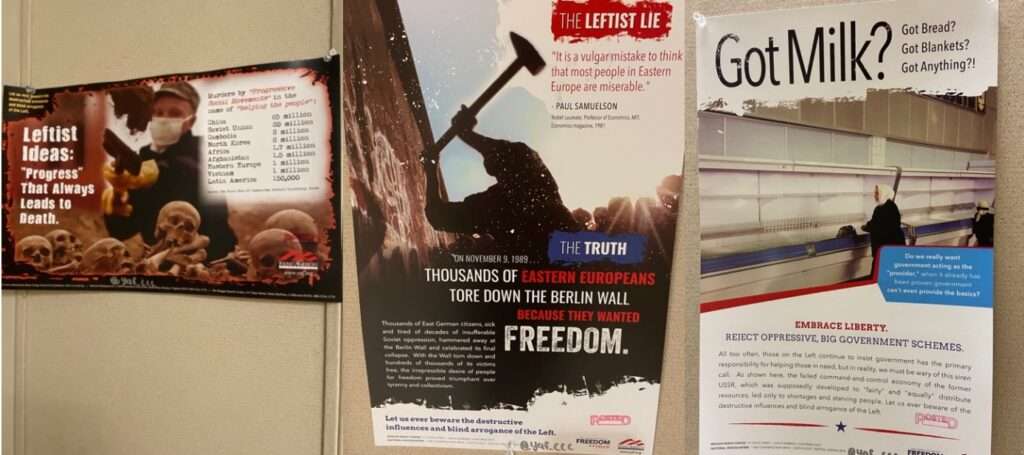
Three conservative college students wanted to criticize authoritarianism. But when administrators deemed their opinions inappropriate and offensive, the students found themselves facing an oppressive regime right on campus.
Today, students from a campus chapter of Young Americans for Freedom, represented by the Foundation for Individual Rights and Expression, sued California's Clovis Community College, delivering a simple message: Public colleges cannot ban students' flyers because administrators subjectively deem their political viewpoints inappropriate or offensive….
In November 2021, Alejandro and fellow club members Daniel Flores and Juliette Colunga received permission from administrators to hang three flyers on bulletin boards inside Clovis' academic buildings. The flyers advocated for freedom and listed the death tolls of communist regimes.
Emails obtained via a public records request reveal that soon after the flyers went up, a Clovis administrator wrote that he would "gladly" take the flyers down, following complaints about their content. The administrator also wrote that approving the flyers in the first place may have been a "mistake," and that Clovis instead should have censored them under a policy that states: "Posters with inappropriate or offense [sic] language or themes are not permitted and will not be approved."
On Nov. 12, Clovis President Lori Bennett personally ordered the flyers removed. After doing so, she searched for a reason to justify the viewpoint discrimination, inventing a brand new rule requiring flyers to double as club announcements.
Last Tuesday and Wednesday, I blogged the Introduction and the beginning of the argument in favor of such statutes, followed by an explanation of why such statutes usually don't violate employers' constitutional rights. This week, I've discussed some other arguments against such statutes (and you can see the whole article right now, if you'd like, by looking at the PDF). Say, though, that we do conclude that there should be some protection for private employee speech. Just what sort of protection should this be, and in particular what exceptions, if any, should there be for speech that unduly interferes with the employer's interests?
[* * *]
One possible answer is that there should be such exceptions, written in general and necessarily vague terms, and potentially applicable to a wide range of ways in which speech can interfere with the employer's business.
One such approach, for instance, might be to borrow the "undue hardship" doctrine from Title VII's religious accommodation law. Under Title VII, religious objectors can get exemptions from generally applicable work rules, but only so long as the exceptions don't create an "undue hardship" to the employer, which is to say so long as they impose only "de minimis costs."[1] An employee therefore could presumably wear religious headgear or insignia on the job, notwithstanding a policy that forbids headgear or jewelry. But if the headgear is likely to cause safety problems (for instance, because it might get caught in machinery) or the insignia are likely to cause undue controversy (presumably for reasons beyond just religious prejudice), the employer would be able to deny the accommodation.[2]
Another possibility might be to borrow the "bona fide occupational qualification" doctrine from Title VII's disparate treatment law.[3] Under Title VII, employers can discriminate based on religion, sex, and national origin when that's justified by such a "BFOQ." And some of the employee speech protection statutes likewise allow employee speech to be restricted if the restriction relates to a BFOQ,[4] if the restriction "is reasonably and rationally related to the employment activities and responsibilities of a particular employee or a particular group of employees, rather than to all employees of the employer,"[5] if the speech is "in direct conflict with the essential business-related interests of the employer,"[6] or if the speech creates "reasonable job-related grounds for an employee's dismissal."[7]
Finally, a third possibility might be to borrow the Pickering balance from government employee speech cases. Under that test, an employee's speech could be restricted if the "employee's speech interests are outweighed by the interest of the State, as an employer, in promoting the efficiency of the public services it performs through its employees."[8]
8/11/1942: General John DeWitt, Commander of Western Defense Command, issues exclusion order. The Supreme Court held this order was constitutional in Korematsu v. United States.
Today Joseph Greenlee and I filed an amicus brief in the Fourth Circuit case Maryland Shall Issue v. Hogan. Our brief is on behalf of the Firearms Policy Coalition Action Foundation (where he works) and Independence Institute (the Denver think tank where I work).
The case had previously appeared in the Fourth Circuit in 2020, when a panel ruled that a licensed firearms dealer had standing to challenge Maryland's 2013 handgun licensing law, and that the dealer also had third party standing on behalf of customers. 971 F.3d 199 (4th Cir. 2020). Now, the case has returned on the merits. The Maryland Attorney General denied consent for filing of the amicus brief, so we will wait to see whether the Fourth Circuit accepts it.
Under a 2013 Maryland statute, a state-issued Handgun Qualification License (HQL), which requires range training, is necessary to purchase, rent, or receive a handgun. This is on top of the pre-existing system requiring a "Maryland State Police Application and Affidavit to Purchase a Regulated Firearm" (MSP 77R). And of course on top of the background check required by federal law for all firearms purchases in gun stores. According to the complaint, applying for a HQL takes a month, and necessitates "hundreds of dollars in fees, costs and travel, not counting time off of work."
The amicus brief straightforwardly applies the Supreme Court's test for Second Amendment cases, as recently stated in New York State Rifle & Pistol Association v. Bruen
When the Second Amendment's plain text covers an individual's conduct, the Constitution presumptively protects that conduct. The government must then justify its regulation by demonstrating that it is consistent with the Nation's historical tradition of firearm regulation. Only then may a court conclude that the individual's conduct falls outside the Second Amendment's unqualified command.
Here, the case involves keeping a handgun in the home, which is certainly protected by the Second Amendment. The government bears the burden of proving that the HQL "is consistent with the Nation's historical tradition of firearm regulation."
In Bruen, the Court stated that history from the original periods (1791 for the Second Amendment, 1868 for the Fourteenth, which made the Second Amendment enforceable against the states) are most important. Colonial history is relevant, as is English history to the extent that it reflected an unbroken tradition that was adopted by the colonists and in force during the Founding Era. The nineteenth century is also relevant, with the first part of the century being most important, and the latter part of considerably less (but not zero) significance. Anything after 1900 is far too late to establish a tradition contrary to the constitutional text.
In the Maryland Shall Issue amicus brief, we describe in chronological order all pre-1900 licensing laws for gun possession. Such laws did exist, but only for people who were considered not to have civil rights: slaves (who were either blacks or Indians) or free people of color (again, blacks or Indians). Antebellum courts that upheld these laws expressly stated that they would be unconstitutional if applied to the white population. Aldridge v. Commonwealth, 4 Va. 447, 449 (1824); State v. Newsom, 27 N.C. 250, 252 (1844).
The Fourteenth Amendment and the Civil Rights Act got rid of all the gun possession licensing laws. No such law was enacted thereafter in the United States in the nineteenth century, except for an 1893 Florida statute. That statute made it unlawful to "own a Winchester or other repeating rifle" without a license from the County Commissioners; the license required an exorbitant bond.
As Florida Supreme Court Justice Rivers H. Buford later explained, the licensing law "was passed . . . for the purpose of disarming the negro laborers" in the state and "was never intended to be applied to the white population." Watson v. Stone, 148 Fla. 516, 524 (1941) (Buford, J., concurring). Justice Buford noted that "there had never been any effort to enforce the provisions of this statute as to white people, because it has been generally conceded to be in contravention of the Constitution and non-enforceable if contested." Id.
So the number of valid pre-1900 precedents for licensing home possession of a firearm is zero. While Bruen allows analogical reasoning (rather than simply copying valid gun control laws from pre-1900), here there is nothing on which to base an analogy.
The precedent for a training requirement for home possession is also non-existent. There is no question that a state government can train the militia. U.S. Constitution, Art. I, sect. 8, cl. 16 ("reserving to the States respectively, the Appointment of the Officers, and the Authority of training the Militia according to the discipline prescribed by Congress"); Md. Const. art. IX, § 1 ("The General Assembly shall make, from time to time, such provisions for organizing, equipping and disciplining the Militia, as the exigency may require, and pass such Laws to promote Volunteer Militia organizations as may afford them effectual encouragement.").
The HQL, however, applies to everyone in Maryland, not solely militia members. And the training requirements do not involve militia skills, such as perimeter defense by a group. Historically, training was not a precondition to possession of an arm for militia duty. Rather, the statutes required militiamen to possess certain arms (typically, a long gun and an edged weapon), and to bring those arms to training whenever the government scheduled militia training.
Notably, in many colonies and states, the government also required ownership of the same arms by people who were not in the militia. These included men with occupational exemptions (e.g., physicians), men who were too old for the militia, and females who were heads of households.
Additionally, many statutes required arms carrying by everyone engaging in certain activities, such as traveling, going to public meetings, going to church, going to court, or working in the fields. These requirements applied regardless of sex or household status.
Notably, there were no training requirements at all for non-militia who were legally required to possess the same arms as the militia. No state or colony before 1900 imposed any rule making training a prerequisite to keeping a firearm at home.
Therefore, the amicus brief suggests that the training requirement of Maryland's Handgun Qualification License is unconstitutional.
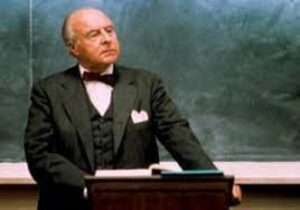
John Houseman plays Harvard law Prof. Kingsfield in the classic 1973 movie, "The Paper Chase."
A new study by MIT graduate student Eric Martinez and Georgetown law Prof. Kevin Tobia ("MT") gives us the most comprehensive view so far, of what law professors believe about a variety of legal and policy issues. They (unsurprisingly) find that the overwhelming majority of law professors are on the political left. A closely related, but more original finding, is that a large majority reject originalism as a method of constitutional interpretation. On the other hand, there are a number of important issues on which legal scholars have a surprising degree of cross-ideological consensus. That includes ideas about the goals of criminal justice and contract law, and the utility of textualism as a method of statutory interpretation (which is far more popular than originalism).
But before going into this, it's worth asking why we should even care what law professors think. Or at least why people who are not themselves lawyers, law students, or law professors should care. There are several reasons.
First, law professors are experts on a range of legal and policy issues. With some important caveats, expert opinion is a helpful heuristic for getting at the truth of disputed issues, especially when there is a broad consensus among experts in the relevant field. Of course experts are far from infallible. They can be and often are wrong about issues within their expertise. But, on average, they are more likely to be right about such issues than laypeople.
Second, law professors can influence the views of law students, who - of course - go on to be the next generation of lawyers. Lawyers, in turn, have disproportionate influence on a wide range of public policies. A high proportion of politicians and other policymakers are lawyers, as - of course - are nearly all judges. Maybe lawyers shouldn't have so much influence. But they do.
Finally, a good many lawprofs have a direct influence on the development of law and public policy. Courts often adopt ideas that were first developed by academics. A striking example from the political left is how feminist legal scholar Catharine MacKinnon's argument that sexual harassment is a form of sex discrimination was eventually adopted by the Supreme Court, with major consequences for the development of anti-discrimination law. An example on the right is the key role played by conservative and libertarian legal scholars in persuading the Supreme Court to restore judicial protection for gun rights under the Second Amendment. Maybe courts shouldn't be influenced by the ideas of law professors. But they often are.
Even outside the courts, lawprofs sometimes have significant influence on government policy. For example, Harvard law Prof. Cass Sunstein has helped influence governments around the world to adopt policies based on "nudging" and other forms of "libertarian paternalism."
For all these reasons, Martinez and Tobia's findings on the views of law professors are potentially significant. When it comes to their general political orientation, lawprofs are overwhelmingly on the left. MT's survey results shows that 81% of their sample of lawprofs at top 20 schools (as ranked by US News) identify as "liberal" compared to 12% who are "middle of the road" and 7% "conservative." Indeed, "conservatives" of all stripes are heavily outnumbered just by the 22% who identify as "very liberal." The sample of professors at top 50 schools not in the top 20, is only slightly less liberal (72% liberal, 14% middle of the road, 12% conservative).
This result is consistent with previous studies of law professor ideology. But MT's data is more recent and more comprehensive. In addition, because it was produced by scholars who are themselves on the left, it is hard to dismiss as just self-interested griping by conservatives.
An ideological imbalance this great is significant, and likely has at least some skewing effect on research and teaching. That's true even if the imbalance is not due to discrimination in hiring (though evidence suggests some probably is). To be clear, I do not claim that law faculties' ideological balance should "look like America" or that such a result would be achieved if only there were no discrimination in hiring. We don't need the former, and the latter almost certainly isn't true. But, for a variety of reasons, it would be better if the ideological skew were not as great as it currently is. For example, much social science research indicates that ideological homogeneity in groups accentuates various cognitive biases and inhibits the pursuit of truth.
I do have one reservation about the result generated by MT's ideology question. Respondents to their survey could choose from "conservative," "liberal," and "middle of the road" options, but there is no category for "libertarian" or "classical liberal." Such an approach is defensible in surveys of the general population, where people with libertarian views may be only a very small minority (depending on which measure you use), and many probably don't even know what the term "libertarian" means. By contrast, it is likely that a high percentage of non-liberal law professors are in fact libertarians rather than conservatives, and most lawprofs likely do know the word "libertarian."
How do I know? Because the pool of non-liberal lawprofs at top 50 and top 20 institutions is a small enough group that I am personally acquainted with the vast majority of the people in question. And in my experience, at least a third to a half of them are in fact libertarians (the ambiguity is because of differences over exactly where to draw the line). Thus, failing to include "libertarian" or other similar option on the survey is likely to skew the results. That's especially true in an era when growing conflict between libertarians and conservatives have made the two groups increasingly reluctant to identify with each other. Thus, many of the libertarians in MT's sample may have picked "middle of the road" or even "liberal" rather than identify as "conservative." Even so, correcting for this flaw would probably have still led to a finding that the overwhelming majority of lawprofs are on the left, though perhaps slightly less so.
Closely related to the finding on ideology is the result that only 17% of lawprofs in the study "accept" or "lean towards" originalism as a method of constitutional interpretation, while 76% "reject" or "lean against" it. By contrast, 70% support "living constitutionalism" and 61% support "common law constitutionalism" (in the sense of picking "accept" or "lean towards"). In my view, common law constitutionalism is actually a subset of living constitutionalism, but MT classify it separately.
Because the study's methodology allows respondents to "accept" or "lean towards" more than one methodology, this likely overstates the degree of support for all three theories (in the sense of the percentage of respondents for whom a given option is actually the theory they prefer above all others). But that makes it all the more striking that so few respondents support originalism even in this attenuated sense.
The authors report that support for originalism is highly correlated with ideology. Conservatives are far more likely to accept it than liberals. This, perhaps, is not surprising. We see the same correlations in surveys of the general public. But, as the authors point out, the result is at odds with perceptions that originalism is rapidly gaining ground in the intellectual world, and with Justice Elena Kagan's famous statement that "we are all originalists." When it comes to the legal academy, she's pretty clearly wrong. Indeed, MT find that support for originalism (17%) is only slightly greater than backing for prison abolitionism (13%) and substantially less popular than the radical idea of granting legal personhood to "non-human animals" (31%).
On the other hand, 61% of law professor "accept" or "lean towards" the use of textualism as a methodology for statutory interpretation. That backing cuts across ideological lines and is only modestly less than support for "purposivism" (77%), and "pragmatism" (73%), while outstripping "intentionalism" (54%).
While textualism is often seen as closely associated with originalism, with both being championed by conservative judges such as the late Antonin Scalia, many legal scholars clearly differentiate between the two, and have a favorable opinion of one, but not the other. For what it is worth, I find the same divergence in student attitudes when I teach constitutional law and legislation classes. Originalism tends to be a highly polarizing topic, with people on the right mostly supporting it, while those on the left mostly don't. By contrast, many liberal students seem to like textualism, and even those that don't rarely object to it as strongly as they do to originalism.
Textualism is just one of a number of issues on which there is considerable cross-ideological agreement in MT's study. Other examples include the purposes of criminal law (where large majorities agree that deterrence, rehabilitation, and incapacitation are all legitimate objectives), and the purposes of contract law. The agreement on criminal law is particularly striking, as I would have expected more left-wingers to reject the notion that we should imprison people for the purpose of preventing them from committing possible future crimes during the time they are are incarcerated (that's what "incapacitation" means). I think that notion is deeply problematic and illiberal. But the vast majority of lawprofs (most of whom are well to the left of me!) apparently disagree.
On the other hand, only 40% of lawprofs in the survey accept or lean towards "retributivism" as a rationale for criminal punishment. That theory, of course, is the most intuitive rationale for punishment, and likely has much broader backing from the general public.
There is much other interesting data in the MT article, which I cannot take the time and space to go over here. They have clearly advanced our understanding of legal academics' attitudes on a wide range of issues. There is also much room for others to build on their research. For example, more needs to be done to determine whether lawprofs specializing in a given area, such as contracts or property, have different views on issues within that field than those who do not.
NOTE: I have used rounding in reporting the survey data figures.
UPDATE: I have made minor additions to this post.
UPDATE 2: I have changed "TM" to "MT" as the abbreviation for the authors' names, because Martinez is actually listed first.
Last Tuesday and Wednesday, I blogged the Introduction and the beginning of the argument in favor of such statutes, followed by an explanation of why such statutes usually don't violate employers' constitutional rights. This week, I've discussed some other arguments against such statutes (and you can see the whole article right now, if you'd like, by looking at the PDF). Say, though, that we do conclude that there should be some protection for private employee speech. Just what sort of protection should this be?
[* * *]
[A.] Protecting at Least Political Speech Generally, Not Just Campaign-Related Speech
Some of the existing statutes are limited to particular campaign-related activity, such as advocating for a candidate or ballot measure, or signing a ballot measure petition, or contributing to a campaign. Some other statutes include political speech more broadly.[1]
I'll forgive you if you did not read Marietta Memorial Hospital Employee Health Benefit Plan v. DaVita Inc. It came out on June 21, the same day as Carson v.Makin, two days before Bruen, and three days before Dobbs. I didn't get to the case till July 12. I read everything so you don't have to. You're welcome.
The case considered whether a group health plan that does not cover outpatient dialysis for all plan participants violate the Medicare Secondary Payer statute. The Court split 7-2. Justice Breyer joined Justice Kavanaugh's majority opinion. Justice Kagan wrote a pithy, three-page dissent, joined by Justice Sotomayor.
In the final paragraph of Kagan's dissent, she calls on Congress to fix the statute:
As the majority recognizes, the MSPA's renal disease provisions were designed to prevent plans from foisting the cost of dialysis onto Medicare. See ante, at 2. Yet the Court now tells plans they can do just that, so long as they target dialysis, rather than the patients who rely on it, for disfavored coverage. Congress would not—and did not—craft a statute permitting such a maneuver. Now Congress will have to fix a statute this Court has broken. I respectfully dissent.
Ledbetter!
Surprise, surprise, Congress is working to fix the statute. And DaVita, the respondent in this case, helped draft the new bill. Indeed the draft bill mirrors DaVita's proposal! Politico has the scoop:
Roughly two months after dialysis giant DaVita lost a Supreme Court case involving insurance coverage for its services, Congress introduced bipartisan legislation that would be a boon for dialysis providers. Its language appears to be largely modeled from a proposal circulated by the company, according to documents obtained by POLITICO.
The recently introduced measure would obligate health plans to cover dialysis the same way they do treatments for other chronic illnesses — and, if enacted, would likely increase reimbursement amounts for companies like DaVita. It would also impact a multibillion-dollar line item in the Medicare budget, making it an attractive offset to an end-of-the-year government spending package.
The rent-seeking began even before the Supreme Court decision. Specifically, when the Biden Administration lined up opposite of DaVita, the wheels started to turn:
"Providers and patient groups in this area have been consistent in pushing for a fix in light of the ruling," a Republican Senate aide granted anonymity to speak about the advocacy told POLITICO. The lobbying began around December when the Biden administration filed a brief in support of the group health plan, the aide said, but "ramped up a ton" after the June 21 decision.
DaVita hit the gas after the Supreme Court decided the case.
Three weeks after DaVita's Supreme Court loss, Kathleen Waters, the company's chief legal officer, and Kelly Philson, one of its top lobbyists, drafted proposed legislative language that would make additions to the Medicare statute at issue in the case, according to the metadata within a Word document obtained by POLITICO. The proposal would create coverage parity for dialysis services "as compared to other covered medical services" provided by the plan. There is no outward indication the text is from DaVita.
And a bipartisan group introduced a bill that "largely mirrored" DaVita's proposal.
On July 29, a bipartisan group of 17 House members introduced a bill that largely mirrored the proposal, and Sens. Bob Menendez (D-N.J.) and Bill Cassidy (R-La.) followed with a Senate companion on Aug. 3. Instead of creating parity between dialysis treatments and other services generally, it would prohibit a group health plan from putting "limits, restrictions, or conditions" on dialysis benefits compared to services needed to treat other chronic conditions the plan covers.
"After the Supreme Court decision in June created a loophole, members of Congress who are concerned about the potential harmful impact to their constituents in this vulnerable patient population started working to restore the protections under the Medicare Secondary Payer Act," a DaVita spokesperson said in an emailed statement in response to an inquiry from POLITICO about the company's involvement in the proposal and its lobbying and campaign activity.
If only every losing party had the means to lobby Congress to turn an Article III defeat into an Article I victory.
In addition to spending roughly $4 million a year on its lobbying efforts, DaVita has a prolific political action committee.
Each of the 17 co-sponsors of the House bill has received campaign money from DaVita's PAC since January 2021, totaling $67,000, according to OpenSecrets, which tracks political spending. Five co-sponsors also received contributions to their leadership PACs, Federal Election Commission records show.
From Doyle v. Vault PK, an opinion by Judge Eddie Sturgeon (Cal. Super. Ct., San Diego County, July 13, 2022):
The purpose of this Minute Order is to address a statement made by Plaintiffs counsel, Timothy Scott, made on the record during trial on June 30, 2022. Specifically, while Mr. Scott was addressing the Court, and after this Court orally granted Defendant MTS's motion for nonsuit, Mr. Scott stated as follows:
"…I hope this doesn't sound unctuous, but just to end the weekend on a good note, I want to thank the court staff. I want to say to have a good weekend to Mr. DeMaria. I want to say have a good weekend to Ms. Frerich. And I want to say have a good weekend to both MTS counsel. I'll See you next Tuesday. See you next Tuesday."
Completely unaware of the intended meaning of "See you next Tuesday," (see infra), the Court responded, "How kind."
"The 2021 Request seeks information that may inform the United States House of Representatives Committee on Ways and Means as to the efficacy of the Presidential Audit Program, and therefore, was made in furtherance of a subject upon which legislation could be had."
The introduction and conclusion from today's long D.C. Circuit decision in Committee on Ways & Means v. U.S. Dep't of Treasury by Judge David Sentelle, joined by Judge Robert Wilkins and in large part by Judge Karen LeCraft Henderson:
The Chairman of the United States House of Representatives Committee on Ways and Means filed a statutory request for documents from the Department of the Treasury related to then-President Donald J. Trump and related entities. Treasury initially objected to the request, and the Committee filed this lawsuit. After a change of administrations, Treasury acquiesced, stating that it intended to comply with the request. In the meantime, the Trump Parties intervened in the action. The district court ruled in favor of the Committee. Intervenors appeal. For the reasons set forth below, we affirm….
The 2021 Request seeks information that may inform the United States House of Representatives Committee on Ways and Means as to the efficacy of the Presidential Audit Program, and therefore, was made in furtherance of a subject upon which legislation could be had. Further, the Request did not violate separation of powers principles under any of the potentially applicable tests primarily because the burden on the Executive Branch and the Trump Parties is relatively minor. Finally, § 6103(f)(1) is not facially unconstitutional because there are many circumstances under which it can be validly applied, and Treasury's decision to comply with the Request did not violate the Trump Parties' First Amendment rights. We affirm.
Grimmett v. Costa, decided today by Judge Catherine Eagles (M.D.N.C.), refused to issue a preliminary injunction against a N.C. statute that makes it a misdemeanor
[f]or any person to publish or cause to be circulated derogatory reports with reference to any candidate in any primary or election, knowing such report to be false or in reckless disregard of its truth or falsity, when such report is calculated or intended to affect the chances of such candidate for nomination or election.
From the opinion, which I think is likely correct as to such narrow statutes focused on libels of candidates (because [1] narrowly crafted criminal libel statutes are generally constitutional under Supreme Court precedents, even though [2] broader laws banning lies in election campaigns, including ones that aren't libelous of particular individuals, are likely unconstitutional):
The defendant, N. Lorrin Freeman, Wake County District Attorney, expects to present testimony to a grand jury for it to determine whether to initiate criminal proceedings for violation of this statute based on a political advertisement published and circulated during North Carolina's 2020 general election for Attorney General. The plaintiffs, persons and entities involved with the production and circulation of that advertisement, contend the statute on its face violates the First Amendment and seek a preliminary injunction barring enforcement.
The plaintiffs are not likely to succeed on the merits of their facial constitutional claim. The statute criminalizes false defamatory speech about public officials made with actual malice; such a statute is constitutionally permissible. Assuming a more exacting level of scrutiny applies because the statute is directed to political speech, the statute advances compelling state interests in protecting against fraud and libel in elections and is narrowly tailored to serve those interests….
In 2020, Josh Stein and Jim O'Neill ran for Attorney General of North Carolina. Mr. O'Neill was the Forsyth County District Attorney. The Stein Campaign paid Ralston Lapp to produce and coordinate the media placement of a political advertisement known as "Survivor" during the lead-up to the general election. Ms. Grimmett, one of the plaintiffs, appears in the advertisement, and states "[a]s a survivor of sexual assault that means a lot to me and when I learned that Jim O'Neill left 1,500 rape kits on a shelf leaving rapists on the streets, I had to speak out." "Survivor" was broadcast on television stations in North Carolina during September and October 2020.
In September 2020, an attorney for the "Friends of Jim O'Neill" campaign committee filed a complaint with the North Carolina State Board of Elections asserting that "Survivor" contained a false "derogatory report" about Mr. O'Neill and violated § 163-274(a)(9). The attorney asked the Board to investigate the allegations, find probable cause, and refer the complaint to the Wake County District Attorney.
My forthcoming Cato Supreme Court Review article on the Supreme Court's January 2022 vaccine mandate rulings is now available on SSRN. The decisions dealt with important policies, and also have significant broader implications for the scope of executive power and other issues. I am one of the relatively few people who think the Court got both cases right (though I have reservations about the Court's analysis of some issues, and omission of others). Here is the abstract:
In January 2022, the Supreme Court decided two major cases reviewing the legality of sweeping Covid-19 vaccine mandates imposed by the Biden Administration. In National Federation of Independent Business v. Occupational Safety and Health Administration, a 6-3 ruling invalidated a regulation requiring employers with 100 or more workers to compel nearly all of them to get vaccinated against Covid or wear masks on the job and take regular Covid tests. In Biden v. Missouri, decided the same day, a 5-4 Court upheld a Centers for Medicare and Medicaid Services (CMS) policy requiring health care workers employed by institutions receiving federal Medicare and Medicaid funds to get vaccinated.
Both cases addressed large-scale policies that were significant in their own right. The two cases also have important implications for the scope of executive power to set regulations (NFIB) and impose conditions on federal grants to state and local governments (Biden v. Missouri). The majority was justified in striking down the OSHA employer mandate because Congress had never clearly authorized it, and also justified in upholding the CMS mandate because it was backed by far more unequivocal statutory authorization.
NFIB v. OSHA reaffirmed important constraints on the executive's power to decide a "major question" of policy on its own, while also giving an indirect boost to constitutional nondelegation constraints on the transfer of legislative power to the White House and the administrative state. For its part, Biden v. Missouri makes clear that the executive can exercise reasonable discretion when Congress does clearly authorize it, particularly in the context of attaching conditions to federal grants to state and local governments.
Part I of this article provides a brief overview of the history of the two cases and the policies they address. It is particularly notable that both were sweeping emergency measures enacted in response to the Covid pandemic, and both reached the Supreme Court on a heavily expedited basis. I also summarize the Supreme Court's rulings. Part II defends the outcome in NFIB v. OSHA, but also criticizes key elements of the Court's reasoning.
Part III assesses Biden v. Missouri. In this case, the Court's statutory reasoning is compelling. But the justices erred in failing to address some crucial issues related to Congress's Spending Clause authority to set conditions on federal grants to state and local governments. Finally, part IV considers some broader implications of the two rulings. Americans across the political spectrum have much to gain from judicial enforcement of limits on executive power. The kind of sweeping unilateral authority the Biden administration claimed in NFIB could easily have been misused by future presidents of both parties. The Court's sensible statutory interpretation in Biden v. Missouri also bodes well for the future.
This is a defamation case against The New York Times, two of its reporters, and others. The plaintiff, allegedly a Swiss foundation, moves to recuse the undersigned on the ground that his spouse, whom he married in 2004, was a reporter for the The New York Times from 1969 to 1979 and in-house media counsel to the prominent publisher, Random House, "through the year 2000." {The plaintiff omits the fact that she was an Assistant United States Attorney in this district from 1979 until 1983.} It contends that recusal is warranted under 28 U.S.C. § 455(a) because the "impartiality [of the undersigned] might reasonably be questioned" on that basis. {While plaintiff has not mentioned the fact, though it long has been a matter of public record, the Court notes also that his spouse receives pension payments from the Newspaper Guild NY - NY Times pension plan and a pension plan for the benefit of retirees of Random House, Inc.}
As the Second Circuit repeatedly has made clear, recusal under Section 455(a), insofar as relevant here, is required only where "a reasonable person, knowing all the facts, would conclude that the trial judge's impartiality could reasonably be questioned." It has made clear also, moreover, that "to say that § 455(a) requires concern for appearances is not to say that it requires concern for mirages."
As Judge Mukasey wrote in the case quoted by the Second Circuit (and in the preceding sentence): "Section 455(a) was not meant to require disqualification every time one party can make some argument, no matter how unreasonable, that the appearance of prejudice would result. Indeed, a judge must be alert to avoid the possibility that those who would question his impartiality are in fact seeking to avoid the consequence of his expected adverse decision …. Nothing in [§ 455(a)] should be read to warrant the transformation of a litigant's fear that a judge may decide a question against him into a 'reasonable fear' that the judge will not be impartial."
In my view, a reasonable person could not reasonably question the Court's impartiality on the basis that my spouse worked for The New York Times over 43 years ago and for Random House over 20 years ago—in each case years before our marriage. That view is unchanged by the fact that my spouse receives benefits from pension plans on account of her employment by those two entities. Indeed, the fact that she long has been retired makes the plaintiff's contention even more unreasonable. Accordingly, the motion to recuse the undersigned is denied.
Sounds quite right to me. A spouse's ideological commitments (or professional activities related to those commitments) are generally not a grounds for recusal, see, e.g., Judge Stephen Reinhardt's opinion in Perry v. Schwarzenegger (9th Cir. 2011), the California same-sex marriage initiative case in which he participated while his wife, Ramona Ripston, was the head of the ACLU of Southern California: