Thursday Open Thread
What's on your mind?

Mostly law professors | Sometimes contrarian | Often libertarian | Always independent | Est. 2002

What's on your mind?
I posted Sunday about the post alleging that the FBI misled the judge (and the L.A. Times story following up on that); just today, though, Judge Gary Klausner (C.D. Cal.) seems to have rejected that allegation, in Snitko v. U.S.:
Plaintiffs' other Fourth Amendment argument is that the Government misled Judge Kim in its warrant affidavit, thus breaching its duty of candor. Specifically, Plaintiffs note that the affidavit states only that the Government intended to inventory the box contents, while omitting the fact that investigators were making preparations to forfeit much of that property.
Naturally, law enforcement agents may not submit warrant affidavits that contain "material falsities or omissions." The test for determining whether a false statement or omission was material is whether an affidavit containing the omitted material would have provided a basis for a finding of probable cause." If probable cause would have remained even if the omitted facts were included in the affidavit, an omission is "immaterial." Further, an omission relating to "how the search would be conducted," rather than relating to "whether a warrant should issue" in the first place, is also immaterial.
Here, Plaintiffs do not argue that the purported omission—that the Government had made certain preparations to forfeit boxholder contents—had any effect on the existence of probable cause to search and seize USPV's property, including the nests of boxes. Rather, they base their argument on two Ninth Circuit cases that address alternative types of improper affidavit omissions.
The Yale Law School DinnerPartyGate lawsuit (Stubbs v. Gerken) can go forward on an interference with prospective business relationships claim, based in large part on the law school's alleged interference with plaintiffs' clerkship opportunities, though the other claims are dismissed.
From Stubbs v. Gerken, decided today by Judge Sarah Merriam (D. Conn.):
Plaintiffs Sierra Stubbs and Gavin Jackson …, each of whom was a student at Yale Law School, bring this action alleging, in sum, that two deans of the Yale Law School, along with the Law School's Director of Diversity, Equity and Inclusion, "worked together in an attempt to blackball" plaintiffs from the prestigious job opportunities that are often available to Yale Law School students and graduates….
For purposes of deciding the Motion to Dismiss, the Court presumes the following factual allegations set forth in the Second Amended Complaint to be true….
Events Leading to the "Dossier"
Stubbs and Jackson each first met Professor Amy Chua … when each was enrolled in Chua's International Business Transactions course. Chua "has served as an important mentor for her students, many of whom successfully obtain prestigious [judicial] clerkships." In September 2018, well before Stubbs and Jackson met Chua, Gerken, the current Dean of YLS, began "publicly criticizing Chua[.]"In "an email to all members of the [YLS] community[,]" Gerken expressed "'enormous concern'" about "'allegations of faculty misconduct' supposedly against Chua[.]" {The allegations against Chua included claims that she had "given advice on dress or appearance to [judicial] clerkship candidates preparing for interviews[.]"} It was "reported" that in 2019 "Chua had entered a 'no-socializing' agreement with the University whereby she agreed not to socialize with students off-campus."
In February 2021, plaintiffs "separately attended Zoom 'office hours' with Chua to discuss their coursework." These conversations "would also cover career discussions and any concerns that [plaintiffs] voiced about the University." Such concerns included those of Jackson, who "struggled with what he felt was a lack of institutional support for students of color, which ended with his frustrated resignation from the board of the Yale Law Journal." Jackson's resignation "received media coverage[,]" which "caused" him "to face significant hostility at the school." Chua was "in a unique position to offer [Jackson] guidance on these issues[,]" having been subject to "race-based, online instigated hostility, as well as being one of the few faculty members of color at" YLS.
The University of Idaho's guidance to faculty on classroom discussion makes plain a First Amendment problem
The general counsel of the University of Idaho issued a guidance memo to university employees regarding the implications of the state's new abortion law for university operations. That memo told professors that they should maintain instructional neutrality in any classroom discussions relating to abortion if they wished to avoid the possibility of criminal prosecution. I wrote about the law and the memo in an earlier post. Eugene Volokh has likewise blogged about it.
The Foundation for Individual Rights and Expression and the Academic Freedom Alliance and the American Association of University Professors have now issued separate letters regarding the assault on academic freedom in Idaho. The FIRE letter can be found here. The AAUP statement can be found here. The AFA letter can be found here.
From the AFA letter:
It is imperative that the University of Idaho not merely inform the faculty of the potential risks of teaching with such a law on the books but also strongly voice its objections to any such interpretation or application of the state law. The general counsel's guidance sends a chilling message to every member of the faculty who must discuss difficult and controversial material relating to abortion as part of their teaching duties. The statute itself might not recognize "academic freedom [as] a defense to violation of law," but the First Amendment is an overriding limitation on the power of the state legislature to impose such a restriction on classroom teaching in state universities.
From Magistrate Judge Phillip Green's Report & Recommendation Tuesday in Trouten v. Ballotpedia (W.D. Mich.):
Plaintiff alleges that Ballotpedia "has withdrew the 'Bryan Trouten for United States House of Representatives Campaign' on their website." Plaintiff alleges that this action constitutes libel and/or defamation under state law. Plaintiff seeks $5,000,000.00 in damages….
It must first be noted that Plaintiff does not allege that Defendant made any false or defamatory statement concerning him. Instead, Plaintiff alleges that Defendant merely removed information from its website concerning him. Defendant argues that Plaintiff's claim fails the first element. But Plaintiff further alleges that, by removing the information in question from its website, Defendant was falsely "claiming that [Plaintiff] withdrew his campaign." Thus, Plaintiff asserts that Defendant's actions implied, falsely, that Plaintiff had withdrawn his campaign.
Michigan recognizes a cause of action for defamation by implication. To prevail on such a claim, Plaintiff must establish that the defamatory implication is "materially false." Plaintiff alleges that he did not withdraw his candidacy for the U.S. House of Representatives and, moreover, that he timely submitted with the State of Michigan the paperwork necessary to be considered a write-in candidate. Thus, contrary to Defendant's arguments, Plaintiff's allegations satisfy the initial element of the analysis.
The professor, Joseph Michael Phillips, had spoken about Confederate memorials, race relations, a shooting, and masks.
From Judge Amos Mazzant's decision Monday in Phillips v. Collin Community College Dist. (E.D. Tex.) (see also Keith Whittington's post on the underlying controversy, and my post from when the lawsuit was filed):
This case arises from a series of statements—a newspaper publication, an interview, class discussions, and social media posts—made by Phillips during the time he was a professor at Collin College. According to Phillips, Defendants "violat[ed] his constitutional rights by retaliating against him for speaking as a private citizen about public issues" in each of the enumerated instances. Specifically, Phillips complains that Defendants placed a prior restraint on his speech through a number of policies and directives, all of which Phillips claims were "attempt[s] to silence College faculty" from speaking "as private citizens on matters of public concern."
Phillips asserts that the conflict between Phillips and Defendants began in 2017 when Phillips co-authored an open letter published in the Dallas Morning News advocating for the removal of Confederate memorials. In the letter, Phillips identified himself as a professor at Collin College and listed his faculty email as a point of contact. According to Phillips, he co-authored the letter as a private citizen. Nonetheless, after the letter was published, two Collin College administrators met with Phillips and reminded him of Collin College's policy that requires faculty to "'exercise appropriate restraint, exhibit tolerance for differing opinions, and indicate clearly that they are not an official spokesperson for the College' when they speak or act as private citizens."
Later, in 2019, Phillips granted the Washington Post an interview wherein he discussed race relations and the then-recent shooting at an El Paso, Texas grocery store. The shooter was a former Collin College student but was not a former student of Phillips's. Prior to Phillips's interview, Collin College's President, H. Neil Matkin, sent out a directive via email to the Collin College campus:
From CNN (David Culver & Jason Kravarik) Tuesday:
Several times a week you can hear gunfire echoing from Brandi Joseph's scenic Southern California property. A licensed firearms instructor and dealer, Joseph decided to open Fortune Firearms in December to serve a growing and rapidly changing clientele.
"There is a huge uptick in female owners," Joseph said. "Women are getting trained; women are carrying … liberal and conservative."
Proof of that change pulled up Joseph's long, dusty driveway in the San Jacinto Valley just before 10 a.m. for a Saturday social, of sorts. A group of seven African American women stepped out of their cars seemingly eager to start their first firearms training session….
If you want more data about gun owner demographics, you can see the study noted here, though it doesn't discuss whether and to what extent those demographics have been changing. (The overall numbers still show more gun ownership by whites and American Indians than by blacks and Hispanics, though not by much, and considerably more than by Asians.) Still, this struck me as an interesting anecdotal discussion, especially noteworthy because it's not something I'd normally expect from CNN.
J.D. Tuccille here at Reason has a run-down (including links to where mainstream media sources have called the President on the errors, which he nonetheless repeats). An excerpt of one of Tuccille's observations:
"There's no justification for a weapon of war. None. The speed of that bullet is five times that that comes out of the muzzle of most weapons. It can penetrate your vests," President Biden huffed last week. "What in God's name do you need an assault weapon for?" he added.
This wasn't the first time the president insisted on the supposed superpowers of so-called "assault weapons" and especially of AR-15s, which are popular among gun owners.
"Do you realize the bullet out of an AR-15 travels five times as rapidly as a bullet shot out of any other gun, five times—is lighter—and can pierce Kevlar?" he insisted on August 30 while touting his administration's "Safer America Plan," which includes tighter firearms restrictions.
Really? Well, no.
I just came across a September 2021 Biden "Executive Order on White House Initiative on Advancing Educational Equity, Excellence, and Economic Opportunity for Hispanics." A few thoughts.
(1) "Only 40 percent of Latino children participate in preschool education programs as compared to 53 percent of their White peers…. Hispanic and Latino students are more likely than their White peers to experience remote learning arrangements…"
Comment: The executive order oddly contrasts "Latino" with "White." I say oddly because Statistical Directive No. 15, which governs racial classification by the US government, classifies "Hispanic/Latino" as an ethnicity, not a race, and Hispanics can be of any race. I haven't seen the 2020 census data yet, but in past censuses, and in private studies conducted by Pew and others, a bit over fifty percent of American Hispanics self-identify as white; among the ten biggest Hispanic groups, the figures range from around 20% of Dominicans (who have a large admixture of African ancestry) to around 80% of Cubans.
The Biden Administration has proposed changing Directive 15 to treat Hispanic/Latino as a race, but that, for now, is just a proposal---one that has been proposed and ultimately rejected many times since the 1970s. The Administration apparently wants to informally designate Hispanics as a race without going through the legwork to do so officially.
(2) "Due to systemic and historical inequities faced in the classroom, the high school graduation rate for Hispanic students is below the national average." There is also a promise to "monitor and support the development, implementation, and coordination of Federal Government educational, workforce, research, and business development policies, programs, and technical assistance designed to improve outcomes for historically underserved communities, including Hispanics and Latinos."
Comment: The use of "historical" in this context struck me because it's rather inapposite. In 1970, Hispanics composed approximately five percent of the US population. Now, they are approximately twenty percent. That increase has been fueled primarily by immigration. There are entire Latino subgroups, such as Salvadorans and Guatemalans, who were barely present in the US until the 1980s but now have a substantial representation in the country.
In short, whatever the reasons for lower socioeconomic attainment among Latinos, historical inequities are unlikely to be the main cause, given that most Latinos trace their ancestry to the US to no earlier than 1970, and many much later. Post-1970 Latino immigrants, unlike prior immigrant groups, benefited from a host of federal civil rights protections, affirmative action, and social welfare programs.
(3) Treating Hispanics/Latinos as a uniform group makes little sense in general, but even less so when trying to make social welfare policy. Consider the Latino population of Florida. There are Cuban Americans descended from those who came to the US around the time that Castro came to power; another large group, with different demographics, who came in the Mariel immigration in 1980; hundreds of thousands of Puerto Ricans, many of who arrived after the last big hurricane; a large group of Mexican farm laborers who work in the agricultural sector; relatively well-off Venezuelans and Argentines ex-pats fleeing socialist policies in their home countries; poorer South Americans, many of whom have overstayed visas or otherwise have dubious legal status, and don't always mix with their wealthier (and whiter) counterparts; and so on.
Some of these groups are, on average, doing quite well as judged by various socio-economic indicators; others are not. The reasons for these disparities have everything to do with the economic, social, and human capital they brought to the US, not with their "Hispanicness." Racism may also play some role, but that would be the case primarily for those who are dark-complexioned, but not, say, an Italian-Argentine immigrant. In any event, Mexican farm labors an hour outside of Tampa and Miami Cubans have sufficiently little in common that grouping them together in making policy is, at best, problematic.
(4) Surveys show that the vast majority of Hispanic/Latino Americans prefer to be considered either "just American" or by their national origin (Cuban American, Mexican American, etc). They accept Hispanic or Latino as a secondary identity, but not their primary one.
(5) For a long time, Mexican Americans dominated the demographics of the Latino population in the US. One could therefore read "Hispanic" or "Latino" as "Mexican American" and be pretty close to the truth, statistics-wise. Mexican Americans are themselves a diverse population, ranging from wealthy, white expats to Indians whose first language in Mexico was an Indigenous one, not Spanish, but at least they are a somewhat coherent national-origin group. The Latino population, however, has grown increasingly diverse; only around 60% of Hispanic Americans are now of Mexican origin. Moreover, native-born Mexican Americans have a high intermarriage rate, increasingly the internal diversity of those deemed by statistics-keepers to be Mexican (and also leading many people with Mexican ancestry to not identify as Hispanic to survey-takers). [UPDATE: I should have mentioned, re the lined in parentheses above, that assimilation into the "non-Hispanic white" category distorts statistics about Hispanic Americans. Better educated and wealthier Hispanics are more likely to marry non-Hispanic whites, and many children of such unions don't identify as Hispanics in surveys. So statistics about, e.g., economic mobility for Hispanics understate the groups' success.]
So perhaps it's time to go back to the 1960s, when the major Latino groups of the time--Mexican, Cuban, and Puerto Ricans were tabulated separately. (Fun fact: the affirmative action category in the Bakke case that reached the Supreme Court in 1978 was Mexican-American, not Hispanic). It certainly makes little sense for a "White House Intiative" to draw no distinctions between Anya Taylor-Joy and a Mexican Indian picking strawberries in central California.
(6) Needless to say, if this sort of thing interests you, you should read my book on American racial classication.
An appeal a day late (even if not a dollar short). [UPDATE: But there may be a lifesaving treatment!]
On Aug. 1, Chief Judge Lee Rosenthal (S.D. Tex.) handed down an opinion in Stella Immanuel v. CNN:
One of the side effects of COVID-19 is litigation. Some of that litigation has arisen from the national conversation, medical and lay, over what medication is effective to prevent and treat COVID-19. The plaintiff in this case, Dr. Stella Immanuel, sought to be a visible public part of that national conversation. On July 27, 2020, she stood with a group calling themselves "America's Frontline Doctors" in front of the United States Supreme Court to publicly advocate the use of hydroxychloroquine ("HCQ") to treat COVID-19. "America's Frontline Doctors" is a political group of physicians "committed to educating the American public and political leaders" about HCQ treatment, "as well as other issues related to the COVID-19 pandemic, from an unbiased medical perspective.". Dr. Immanuel, a member of this organization, was not only there; she gave a speech, presenting in this very public forum her views about treating COVID-19 with HCQ.
A video of Dr. Immanuel's speech quickly went viral on the Internet. Then-President Trump tweeted about it. In response to Dr. Immanuel's speech, Cable News Network, Inc. ("CNN") published tweets and news broadcasts about her speech. Dr. Immanuel alleges that CNN accused her of "'spreading conspiracy theories on COVID-19' and promot[ing] an 'unproven drug'" as an effective treatment option. According to Dr. Immanuel, CNN also disparaged her personal and religious beliefs by publicizing her words and writings that she had made in sermons she posted on her YouTube channel for her church. The statements included that Dr. Immanuel:
- "believes that women can be physically impregnated by witches in their dreams";
- "believes that lusting after movie stars can conjure demons that can make women physically pregnant with demon babies by impregnating them in their dreams";
- "has … claimed that sex with 'tormenting spirits' is responsible for gynecological problems, miscarriages, and impotence"; and
- "has claimed alien DNA was used in medical treatments."
From Khalil v. Fox Corp., decided Monday by Judge Louis Stanton (S.D.N.Y.):
The plaintiff in this action is Majed Khalil, a Venezuelan businessman. During the course of the events giving rise to this action, he was also referred to as "Khalil Majed Mazoud." Defendants in this case are Lou Dobbs, Fox Corporation and Fox News Network, LLC. Defendant Lou Dobbs is a Fox personality, who hosted the show Lou Dobbs Tonight. Defendant Fox News Network, LLC is wholly owned by Defendant Fox Corporation …. The Complaint alleges that Dobbs was under contract with Fox during the time period when the allegedly defamatory remarks were made. The Complaint also alleges that Fox controlled multiple social media accounts related to Lou Dobbs, including a Twitter account in Dobbs' name, which has millions of followers.
The allegations in the Complaint stem from statements made by Lou Dobbs and Sidney Powell on Lou Dobbs Tonight and related Twitter posts following the 2020 election. During the show, the Complaint alleges that Dobbs held himself as a reporter of facts, not opinion. Fox described his show as "the #1 program on any business network among total viewers."
On November 7, 2020, Fox projected that President Trump lost the 2020 Presidential Election. Almost immediately following the election, Fox news channels, which generally cater to a conservative audience, began to report on theories that the election was fraudulent. One such theory of election fraud centered around two voting machine companies, Dominion Voting Systems … and Smartmatic Corporation …, which were allegedly formed by various individuals from Venezuela with the purpose of rigging elections.
Many of the accusations against Dominion and Smartmatic stemmed from Sidney Powell, who appeared repeatedly as a guest on Fox television programs, including Lou Dobbs Tonight. Powell told Fox viewers that Dominion was using software to either flip votes from votes for then-President Trump to Joe Biden or to simply add votes for Joe Biden. However, many prominent politicians, organizations, and government agencies countered Powell's narrative of the 2020 election, referring to her theories as "insane," "a national embarrassment," "unhinged," and "crazy." Even then-President Trump's campaign team distanced itself from her, stating, "Sidney Powell is practicing law on her own. She is not a member of the Trump Legal Team. She is also not a lawyer for the President in his personal capacity."
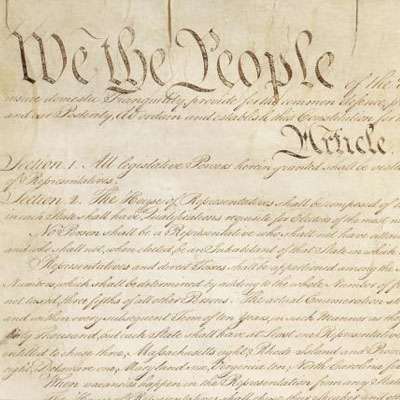
9/28/1787: Confederation Congress adopts Constitution and sends it to the states.
Justice Scalia, to the rescue.
As I noted in my post on the related contraceptives question, Keith Whittington blogged yesterday about the University of Idaho General Counsel's Office letter that said professors were limited in their classroom discussions of abortion. Here are some key passages:
During all times that university employees are performing their jobs, the law prohibits them from taking any action, and from using or providing institution funds or facilities, for any of the following:
- Promoting abortion; …
Some … activities are permitted, with certain limitations, such as: …
- Having classroom discussions on topics related to abortion when limited to discussions and topics relevant to the class subject and instructor neutrality in the discussion….
Classroom Discussions. Classroom discussion of the topic should be approached carefully. While academic freedom supports classroom discussions of topics related to abortion, these should be limited to discussions and topics relevant to the class subject. The laws discussed above, specifically including those addressing promoting abortion, counseling in favor of abortion and referring for abortion, will remain applicable. Academic freedom is not a defense to violation of law, and faculty or others in charge of classroom topics and discussion must themselves remain neutral on the topic and cannot conduct or engage in discussions in violation of these prohibitions without risking prosecution.
As authority for this, the letter cites the Idaho "No Public Funds for Abortion Act," which was just enacted last year; and that does say that publicly provided funds
shall [not] be used in any way to provide, perform, or induce an abortion; assist in the provision or performance of an abortion; promote abortion; counsel in favor of abortion; refer for abortion; or provide facilities for an abortion or for training to provide or perform an abortion.
The letter thus appears to be reading "promote" to mean "support" or "encourage," which is indeed what the word "promote" often means in ordinary English.
But in this sort of context, it seems to me, "promote" does not refer to abstract advocacy, such as the statement "I believe that abortion should be legal" or even "I encourage you to obtain an abortion." It refers to the recommendation to a particular person to get an abortion. Though, when taken in isolation, the verb "promote" is susceptible of multiple and wide-ranging meanings, in context these meanings are narrowed by the well-established legal canon of noscitur a sociis ("it is recognized by its associates"), which counsels that a word is given more precise content by the neighboring words with which it is associated. And those neighboring words are all reasonably read to have a transactional connotation, focused on recommendations that particular people undertake procedures (perhaps in particular clinics), not abstract advocacy.
Don't take it from me, though, take it from Justice Scalia, from whom I cribbed liberally in the preceding paragraph.
I think the letter's analysis as to contraceptives is inconsistent with the statutes, and with a binding Supreme Court precedent.
Keith Whittington blogged yesterday about the University of Idaho General Counsel's Office letter that said professors were limited in their classroom discussions of abortion, and others have written about it extensively as well. I think there's a lot wrong with the University's position, but I had a slightly different take on it.
[1.] Let's begin with a mostly non-free-speech issue, distribution of condoms (though it's coupled with advertising of condoms, which does raise free speech questions):
During all times that university employees are performing their jobs, the law prohibits them from taking any action, and from using or providing institution funds or facilities, for any of the following: …
- Advertising or promoting services for abortion or for the prevention of conception….
Specific activities that may continue
University employees may, with certain limitations: …
- Provide condoms for the purpose of helping prevent the spread of STDs and not for purposes of birth control.
The university can provide condoms for the purpose of helping prevent the spread of STDs but not for purposes of birth control.
Now, there is an early 1970s Idaho statute (Idaho Code § 18-603) that does forbid anyone, except a doctor or someone acting for a doctor, from distributing—or advertising—contraceptives for birth control purposes:
It was filed by Pacific Legal Foundation public interest lawyer Frank Garrison, and includes a novel strategy for getting around the problem of standing.
Earlier today, Pacific Legal Foundation (PLF) public interest lawyer Frank Garrison filed the first meaningful lawsuit challenging President Biden's loan forgiveness plan, which the Congressional Budget Office estimates would cost some $400 billion. PLF, a libertarian-leaning public interest firm that is also my wife's employer, is representing Garrison.
The Biden Administration Office of Legal Counsel argues that the loan forgiveness plan is authorized by a provision of the 2003 HEROES Act, which gives the Secretary of Education the power to "waive or modify" federally funded student debt obligations of borrowers whose ability to pay off the debt has been undermined by a war or national emergency (in this case, the Covid-19 pandemic). For reasons I outlined in a previous post, the Biden plan goes far beyond what the statute authorizes, and is also at odds with the "major questions" doctrine and nondelegation constraints on executive power. The situation is similar to Donald Trump's attempt to use emergency powers to usurp Congress' spending power to divert military funds to build his border wall (which, for the record, I opposed at the time; see here, here, and here). PLF's just-filed complaint on behalf of Garrison advances the statutory authorization, major questions, and nondelegation arguments.
Most interestingly, Garrison has a novel strategy for getting around the problem of standing, which many experts see as the biggest potential obstacle to a successful legal challenge to the loan forgiveness program. As I explained in an earlier post on this issue, current Supreme Court precedent requires plaintiffs in federal cases to prove "standing," which includes demonstrating that they have suffered or are likely to suffer an "injury" because of the law or policy they are challenging. Importantly, that injury cannot be based merely on the plaintiff's status as a taxpayer who will have to bear the fiscal costs of the new government program. The Washington Post has a helpful description of how Garrison can fulfill this requirement:
The argument [made by PLF] is in line with other objections to Biden's plan, but the foundation may have the one thing legal experts said was needed to make a legitimate case: a client with the standing to sue.
Garrison said he has been working toward having his federal student loans canceled through a program that erases the debt of public servants after 10 years of payments and service. Participants in that Public Service Loan Forgiveness program do not have to pay federal or state taxes. However, Biden's plan could result in borrowers in several states, including Indiana [where Garrison lives], being required to pay local tax bills.
The plan would cancel up to $10,000 in federal student loan debt for borrowers who earn less than $125,000 per year, or less than $250,000 for married couples. Those who received Pell Grants, federal aid for lower-income students, could see up to $20,000 in forgiveness.
Since Biden's plan would take effect before Garrison's debt is forgiven through the public service program, Garrison said he expects to pay more than $1,000 in state income taxes for the $20,000 of forgiven debt.
In sum, Garrison qualifies for standing because he (and at least some other participants in the Public Service Loan Forgiveness program) actually stand to lose money as a result of the administration's plan. And that loss is specific to their situation, and not just a result of their general status as federal taxpayers.
This strategy strikes me as sound. It may seem silly that a plaintiff can get standing based on a relatively small financial loss like this one, but taxpayers as a class are not allowed to get it based on the vastly greater fiscal liability Biden's plan saddles them with, collectively. But that kind of silliness is built into the Supreme Court's standing precedents, which allow standing based on even a very small individualized material harm (as little as $1 will suffice!), but deny it even for very large fiscal impacts imposed on taxpayers as a class. If you think this is ridiculous, I agree! In my view, the entire doctrine of standing is extremely dubious, and the Supreme Court should abolish it. But that isn't likely to happen anytime soon.
Under current standing doctrine, it also does not matter if forestalling the relatively small financial loss he stands to suffer is not Garrison and PLF's true motive for bringing the case. Public interest firms and other litigants routinely bring cases whose primary purpose is to set a more general precedent rather than to mitigate the damages suffered by a specific client. When it comes to standing doctrine, the plaintiffs' motives for filing a lawsuit are irrelevant, so long as they do in fact have an "injury" of the right type.
Should the PLF/Garrison lawsuit prevail on the merits, there is likely to be a legal battle over how broad the resulting injunction should be, whether it should be a nationwide injunction against the entire loan cancellation program (as the complaint requests), an injunction limited to a particular geographic area or category of loan recipients (such as people in the same situation as Garrison), or one narrowly focused on Garrison as an individual. In my view, nationwide injunctions are justified in cases like this, where the program being challenged is illegal for reasons that are uniform across the country. But many people - including some conservative judges and legal scholars - disagree.
I expect this will not be the only lawsuit filed against the loan forgiveness program. In an earlier post, I described three other categories of litigants who could get standing to challenge it. We might also see lawsuits by others in the same situation as Garrison.
In addition to citing the 2003 HEROES Act as authorization for the loan cancellation policy, the Biden Administration could also potentially rely on a provision of the 1965 Higher Education Act. I criticized that theory here.
Today's filing is probably just the beginning of what is likely to be a prolonged legal battle over the legality of Biden's massive loan forgiveness plan.
NOTE: As indicated above, the Pacific Legal Foundation - the public interest firm litigating this case - is my wife's employer, as well as Garrison's. She, however, is not involved in litigating this specific case. I myself have played a minor, unpaid role in urging PLF to take on this issue, and sharing my ideas about the case with them. Garrison's novel strategy for gaining standing was not my idea, however.
Those inclined to claim that I am only interested in this case because of narrow self-interest should note that I also was an active opponent of Donald Trump's similar abuse of power in the border wall funding diversion policy and that, as a university professor, I actually stand to benefit if Biden's policy goes forward. For fairly obvious reasons, universities - and their faculty - are likely beneficiaries of loan forgiveness policies that essentially subsidize the consumption of our services.
UPDATE: It may be worth noting that, as the complaint explains (see pg. 7), Garrison is part of a group of 8 million borrowers for whom loan forgiveness under the administration plan will be automatic. So he cannot avoid it merely by choosing not to apply for it.
UPDATE 2: It turns out there was an earlier lawsuit challenging the loan forgiveness program, filed by an Oregon resident. This lawsuit has little or no chance of getting to merits, because, among other things, the plaintiff has no chance of getting standing. Nonetheless, it did come earlier than the PLF case, and I have adjusted the title of this post accordingly.
UPDATE 3: Since I wrote the above post, the White House has said there will be an opt out from loan forgiveness for any otherwise eligible borrowers who want it. However, the administration has not actually put forward any opt-out plan for the 8 million , or explained how it will work. When and if the administration puts out an actual opt out plan, we will know more about whether it can defeat standing in this case, or not.
UPDATE 4 (September 30, 2022): I have addressed more recent developments in this case in a follow-up post here. Since I wrote the above, another important lawsuit challenging the loan forgiveness policy was filed by six state governments. Their lawsuit has a stronger basis for standing than that filed by PLF. I discuss the state lawsuit here.
UPDATE 5: Oliver Dunford of the Pacific Legal Foundation reminds me that PLF filed an amicus brief supporting one of the lawsuits challenging Trump's border wall diversion, and thus - to their credit - has taken a consistent position on these sorts of issues, regardless of the partisan valence of the particular program in question.
"[A] prisoner's right to be free from highly invasive intrusions on bodily privacy by prison employees of the opposite sex—whether on religious or privacy grounds—does not change based on a guard's transgender status."
From West v. Radtke, decided Sept. 16 by Chief Judge Diane Sykes joined by Judges Joel Flaum and Michael Brennan (reversing a decision I blogged about here):
Rufus West is confined at Wisconsin's Green Bay Correctional Institution where he must undergo strip searches by prison staff on regular occasions—namely, when he leaves and reenters the prison, during lockdowns, before and after visits from outsiders and certain other movements within the facility, and whenever directed by a prison supervisor. Under prison policy two guards participate in every strip search, one who directly performs it and another who observes to ensure that it is performed properly.
West is a Muslim. Strip searches by prison guards of the opposite sex violate the moral tenets of his faith, which prohibit him from exposing his body to a woman who is not his wife. { According to his Islamic beliefs, he is forbidden to expose his naked body to anyone but his wife. This precept compels him to shield the area between his naval and knees from others, especially from those of the opposite sex. Knowingly violating the nudity prohibition will condemn him in the afterlife, with greater condemnation resulting from cross-sex violations of the taboo.} In July 2016 he was required to submit to a strip search by a guard who is a transgender man—a woman who identifies as a man.
West objected on religious grounds but was refused an accommodation, and the transgender guard participated in the strip search as the observing officer. After this incident, West requested an exemption from future cross-sex strip searches. The warden denied the request and told West that he would be disciplined if he objects again….
West sued under RLUIPA (the Religious Land Use and Institutionalized Persons Act of 2000), through which Congress provided that prisons that receive federal funds "may not 'impose a substantial burden on the religious exercise' of an inmate unless it can prove that doing so 'is the least restrictive means of furthering [a] compelling governmental interest.'" (For more on RLUIPA and its relationship to RFRA and the history of the Free Exercise Clause precedents, see this post.) The court held that West had shown that the prison's actions imposed a substantial burden on his religious exercise:
From One for Israel v. Reuven, decided yesterday by Judge Raag Singhal (S.D. Fla.):
[Plaintiff] One for Israel is a ministry initiative whose mission is to evangelize Israelis and promote Messianic Judaism. [Plaintiffs] Eitan Bar … and Mordechai Vaknin … are missionaries working for the ministry who teach the New Testament and share Gospel of Jesus Christ with youth, soldiers, and students…. The defendant is Yaron Reuven …, an Orthodox Jewish Rabbi who maintains a website, a mobile application, and a YouTube channel to promote Orthodox Judaism….
On February 8, 2021, Reuven published a video titled, "What Happened when Missionaries ONE FOR ISRAEL Met Rabbi Daniel Asor" in which he made the statements at issue in this case. Reuven published the video on his YouTube channel, Facebook, and other social media platforms. About 2 minutes and 37 seconds into the video, Reuven tells viewers about a meeting that took place in 2014 at a coffeeshop in Israel. As related on the video, Rabbi Asor met with Eitan and Vaknin to debate religious issues before an individual who was considering converting to Messianic Judaism.
At the meeting, Rabbi Asor "destroy[ed]" both Eitan and Vaknin by proving them wrong. Reuven reports that Eitan and Vaknin got angry and tried to beat up Rabbi Asor. He says Eitan and Vaknin "tried to break his bones!"
Plaintiffs contend the story Reuven told is false and an invention to negatively portray them and the organization for which they work. The video has over 7,500 views on YouTube. Plaintiffs allege they have suffered significant reputational and psychological damage because of the release of the video and brought this action seeking compensation from Reuven.
The court concluded the missionaries weren't limited purpose public figures, because that would require them to have injected themselves into a "public controversy," and there was no such controversy here:
Celebrate your independence with a subscription to Reason magazine, your most trusted source of honest, insightful news and analysis.