Please enjoy the latest edition of Short Circuit, a weekly feature written by a bunch of people at the Institute for Justice.
Anita Adams wants to build a modest addition on her property in Seattle so that family members can move in, but the city says she must pay nearly $77k in "housing affordability" fees to get a permit. Which means she cannot afford the addition and there will be less housing. Click here to learn more about IJ's latest case.
In my last post, I highlighted Cato Institute scholar Alex Nowrasteh's excellent critique of claims that immigration causes harm by reducing social trust. Rarely do I devote two posts in a row to writings by the same person. But I could not pass up his compelling summary of the evils of nationalism, drawn from his opening statement in a recent debate with Rich Lowry of National Review.
Nationalism is a major force in both the US and around the world, and the major point of divergence between libertarians and the "New Right." I tried my own hand at summarizing the dangers of nationalism back in 2009, including some of the parallels between it and communism. But, frankly, Nowrasteh's piece is way better.
"Nationalism," like "conservatism," and "liberalism," is a fuzzy term that different people use in different ways. But Nowrasteh captures the main focus of most nationalist movements and thinkers, when he describes it as an ideology based on loyalty to a "nation" based on a "group of genetically similar individuals with a common language, culture, religion, and ethnicity." As he explains, "[n]ationalism is to the right wing what communism is to the left wing, poorly reasoned utopianism that often leads to some of the worst crimes against humanity."
Here are some excerpts from his summary of its dangers, with commentary by me:
The first downside of nationalism is that it increases centralized state power. In nationalism, the state representing a nation (known as a nation-state) is the only organization that counts because it represents the entire nation. Individualism is not important, individual rights don't matter, and a nation's government does and should determine everything regardless of the desires of dissenters….
Nationalist movements do indeed have a long history of suppressing dissent and undermining liberal democracy. The ethnic and cultural homogeneity nationalists seek is usually impossible to achieve without it.
The second effect of nationalism is that it tends to concentrate state power in a single person, the leader. Nationalists often conflate the nation with that of an individual political leader who is a nationalist, frequently a strong man, sometimes a dictator, and other times a king, probably because the nation is just an abstraction that requires a totem of some kind to be real in the minds of men….
Nationalism isn't the only political ideology that tends to promote strongmen. But it has a particularly powerful tendency towards leader-worship. Recall such figures as Hitler, Mussolini, and Franco. In our own day, we have examples like Putin, Erdogan, and Xi Jinping, among others. Even nationalist movements in liberal-democratic nations have a tendency to do this. Consider, for example, the worship of Donald Trump by his core supporters, which exceeds that of any other modern US president. The kinds of people who become nationalist strongmen tend to be unscrupulous, ruthless and cruel. Thus, not only does nationalism concentrate power. It often does so in worst possible hands.
The third common effect of nationalism is more state control over the economy. After all, the nation knows best and its government will do whatever it thinks is in the national interest (or, more accurately, whatever is in the best interests of nationalist politicians). It's no mistake that National Conservatives, as they call themselves today in the United States, favor industrial policy, protectionism, high taxes, closed borders, pro-union policies, a large welfare state, praise the New Deal, and desire more state control over the economy. Increasing state control over the economy is partly ideological and partly just a byproduct of the increasingly centralized state that nationalists demand.
Very true. I would add that the types of statist economic policies nationalists advocate tend to be among the most harmful, condemned by most economists across the political spectrum. In addition, this concentration of economic power becomes even more dangerous when combined with nationalists' disdain for individual rights and elevation of brutal strongmen leaders.
The fourth effect of nationalism is more government control over the private lives of citizens and central planning of culture. From the French Revolution originating the term "nation building" in France and their central planning of language to Vladimir Putin in Russia and dozens of nationalist leaders in between, they all use the state to force their preferred version of a centrally planned culture on society….
The fifth effect of nationalism is the glorification of militarism, war, and lesser hostility between nations through trade wars and tearing up arms control treaties for no good reason. Judged by the number of deaths caused by different types of governments in the 20th century, just focusing on governments murdering their own citizens, nationalism is second only to communism….
We see nationalist wars most vividly today in Russia's attempt to conquer Ukraine as part of a nationalist irredentism to reconstitute the Russian Empire by bringing the QUOTE "fake ethnicity of Ukrainians" back into the Russian fold. It's no mistake that so many nationalists around the world admired Putin prior to his invasion, such as Dutch nationalist Thierry Baudet, French nationalist Marine Le Pen, Italian nationalist and Prime Minister Georgia Meloni and former Italian Prime Minister Berlusconi (who still defends Putin after the invasion), and many American National Conservatives, as they call themselves. Some American National Conservatives, or NatCons, slobbered over Putin (in part) because his military recruitment advertisements showed Russians as manly….
The sixth common effect of nationalism is ethnic chauvinism and, to a disturbingly frequent extent, genocide. Slaughters in Nationalist Turkey, mass death in Nationalist China, and two world wars were caused by nationalists with revanchist dreams. Historian Aristide Zolberg went as far as to call the formation of new nation-states "as a refugee-generating process" to expel groups of people who are not members of the new nation. Not every nationalist government commits genocide or engages in ethnic chauvinism, but not every communist regime causes a great famine either. We shouldn't give nationalists a pass any more than we should give communists a pass…
All well-taken points.
But won't nationalism at least give us a warm sense of national unity, overcoming our divisions? Not so much:
Did you feel better and more connected to other American strangers when Donald Trump, who embraced nationalism, was president? Did Trump cause American solidarity to increase? Just the opposite. Nationalism is a schismatic ideology that pulls citizens apart from one another instead of binding them together. Meaning and belonging come from family, friendships, real communities of people who know each other, worship in groups of people who know each other, hobbies, career, and other personal human relationships, not from devotion to a national abstraction….
In an ideologically founded country like the U.S., nationalism is a disuniting force and not a uniting one. Nationalism here builds walls around different groups and defines political opponents or other groups as less American than others. Nationalism is an exclusionary ideology, not an inclusive one. Nationalism often defines a country in terms of what it's not – usually foreigners. But that frame is easily applied to defining fellow American citizens as not real Americans either. Claremont senior fellow Glenn Ellmers, an American nationalist and writer at a nationalist publication, wrote in 2021 that the 80 million Americans who voted for President Joe Biden in 2020 were "not Americans in any meaningful sense of the term…." These nationalists believe that half of American voters have betrayed the nation. They obviously don't care about building national solidarity. If they wanted to build national solidarity and harness good feelings for national greatness, they would be trying to bring the country together instead of trying to label half of their fellow countrymen as non-Americans or un-American. Where is this benign and uniting nationalism that Rich [Lowry] speaks of? Certainly not in the minds or on the lips of nationalists.
Particularly, in a society as diverse as the United States, nationalist ideology is a source of division and mutual hatred, not unity. The divisive nature of nationalism isn't unique to Trump or his particular political movement. It's an inherent feature of nationalist ideology, more generally. If you believe that the nation rests on a common ethnicity, culture, language, and so on, then there is a natural tendency to demonize those who don't fit that description. Even if it doesn't go as far as ethnic cleansing or genocide, that tendency is necessarily divisive.
In his commentary on the debate with Lowry, Nowrasteh does note a possible virtue of nationalism. Sometimes, its origin is "reactive" in nature - a response to racial or ethnically based oppression:
When certain ethnic or religious groups are persecuted, a common reaction of those persecuted is the strengthening or creation of nationalism for psychological and defensive reasons. Individuals are very easily persecuted, but individuals in a large group who defensively cooperate, have solidarity, and aid each other are harder to oppress. Zionism, for instance, grew rapidly in the late 19th and early 20th centuries as anti-Semitism, pogroms, and state oppression of Jews were widespread in Europe. Persecuted groups can even form a new ethnic identity in response to persistent persecution.
Zionism is just one of many "reactive" nationalist movements. Other cases include Polish and Irish nationalism, and various nationalist movements in developing countries, that arose in part as a reaction to European colonialism. Ukrainian nationalism, of course, is in large part a product of centuries of oppression by successive Russian and Soviet rulers. Here in the US, black nationalist movements arose as a reaction to centuries of oppression and discrimination at the hands of whites.
But even reactive nationalism often becomes a force for evil. Time and again, the nationalist movements of oppressed groups have themselves become oppressors when when they seize power. Obvious examples include various Eastern European nationalists, the nationalist governments of numerous post-colonial nations, and others. All too often reactive nationalists replicate the same type of evil they set out to oppose.
Moreover, reactive nationalism is far from the only way to fight ethnic and racial oppression. A better approach is to appeal to universal principles of liberty and justice. This strategy is no Utopian pie in the sky. It's how the abolition of slavery and Jim Crow segregation were achieved, and how much other oppression was curtailed around the world. Those who think people will never fight and die for universalist liberalism should remember the sacrifices made to win the American Revolution (fought for those very principles), the many lives lost to end slavery, and numerous other examples.
Abjuring reactive nationalism in favor of universal liberal principles is far from a new idea. The great African-American abolitionist Frederick Douglass advanced it back in the 19th century:
We hear, since emancipation, much said by our modern colored leaders in commendation of race pride, race love, race effort, race superiority, race men, and the like…. In all this talk of race, the motive may be good, but the method is bad. It is an effort to cast out Satan by Beelzebub…..
The evils which are now crushing the negro to earth have their root and sap, their force and mainspring, in this narrow spirit of race and color, and the negro has no more right to excuse and foster it than have men of any other race….
Hence, at the risk of being deficient in the quality of love and loyalty to race and color, I confess that in my advocacy of the colored man's cause, whether in the name of education or freedom, I have had more to say of manhood and of what is comprehended in manhood and in womanhood, than of the mere accident of race and color; and, if this is disloyalty to race and color, I am guilty….
In Douglass's time, the word "race" referred not just to skin color, but to what we today call "ethnicity." Thus, his condemnation was not limited solely to nationalistic movements based on skin color. If a man who personally experienced the horrors of racially based slavery could grasp the wrongness of reactive nationalism, we should be able to, as well.
Reactive nationalism also is likely to bring down a counter-reaction by stimulating nationalism among other groups. As Douglass warned, "[d]o we not know that every argument we make, and every pretension we set up in favor of race pride, is giving the enemy a stick to break our own heads?… We cannot afford to draw the color-line in politics, trade, education, manners, religion, fashion, or civilization. Especially we cannot afford to draw the color-line in politics." What is true of racial color lines also applies to ethnic divisions.
There may be times and places where some kind of reactive nationalism is the only politically feasible alternative to an even greater evil. Choosing between greater and lesser evils may be the only options we have. But we should at least remember that the lesser evil is still evil and should be dispensed with at the first available opportunity.
According to the Complaint, "Ashley Guillard promotes herself on Amazon and TikTok as an Internet sleuth that solves high-profile unsolved murders by consulting Tarot cards, and performing other readings, to obtain information about the murders."
In November 2022, four students at the University of Idaho were murdered at a home near the campus. The tragedy has garnered attention, and inflicted great sorrow, throughout the University, the State, and the country. Defendant Ashley Guillard—a purported internet sleuth—decided to use the community's pain for her online self-promotion. She has posted many videos on TikTok falsely stating that Plaintiff Rebecca Scofield (a professor at the University) participated in the murders because she was romantically involved with one of the victims. Guillard's statements are false. Professor Scofield did not participate in the murders, and she had never met any of the victims, let alone entered a romantic relationship with them. Guillard's videos have been viewed millions of times, amplifying Guillard's online persona at the expense of Professor Scofield's reputation. Professor Scofield now sues Guillard for defamation….
None of the four students who were murdered ever took a class from Professor Scofield. Although the University of Idaho is a relatively small university, she does not recall ever meeting any one of these students….
Ashley Guillard promotes herself on Amazon and TikTok as an Internet sleuth that solves high-profile unsolved murders by consulting Tarot cards, and performing other readings, to obtain information about the murders. She has purported to solve the murders of musician Kirshnik Khari Ball (a.k.a. Takeoff), Shanquella Robinson, Tiffany Valiante, Kevin Samuels, and the November murders at the University of Idaho.
In State v. Brimmer, decided today by the Iowa Supreme Court, the majority (Justices Dana Oxley, joined by Justices Christopher McDonald, Matthew McDermott, and David May) concluded that defendant's public trial rights were violated by the complete closure of his trial, including the exclusion of his family (here, just his mother):
[T]he pandemic is an overriding interest that supports the court's decision to limit the public's access to Brimmer's trial [in April 2021]. But identifying an overriding interest is only the first step to closing a trial to the public. The district court was also required to tailor any closure so that it was "no broader than necessary to protect" the identified interest and to consider—and adopt—any reasonable alternatives to a complete closure….
As trials resumed, courts around the country adopted measures to balance COVID precautions with defendants' rights, and many subsequently faced constitutional challenges to their modified trial proceedings. Some courts reconfigured their courtrooms to make space for at least a limited number of people to attend while maintaining physical distancing requirements, as Brimmer requested here. Others provided alternative means for the public to observe proceedings, such as livestreaming a video or audio feed to another location within the courthouse or over the internet, so that members of the public could view, or in some instances at least listen, to the trial as it was happening. Courts utilized YouTube, local television broadcasts, and Zoom teleconferencing platforms to provide virtual access to the public in real time.
While most courts have upheld these various modifications to a public trial challenge when scrutinized under the Waller v. Georgia (1984) test, virtually all of those cases involved only a partial closure. But here, all members of the public were excluded from in-person participation, and no live video, or even audio, feed of the trial was made available….
A recent article in the New York Times proclaimed the arrival of the "Imperial Supreme Court." These conservative jurists continue to rule against the executive branch, we learn. As with all empirical work, counting cases is very subjective. This rule is especially apt in separation of powers cases. Who won Trump v. Mazars (2020), for example? Was it the President, the Congress, or was it the Supreme Court? That decision did not stop the House committees from obtaining President Trump's tax returns. Nor did the Supreme Court allow the House committees to obtain President Trump's tax returns immediately. The decision, as with much of Chief Justice Roberts's handiwork, was muddled. The Court put forward a balancing test to determine whether the committees had a valid legislative purpose to obtain the tax returns. And that dispute would not be resolved quickly.
Fast-forward to 2022. Former-President Trump asked the Supreme Court to block the release of the returns. Trump argued that the request from the Ways & Means Committee was pretextual. The goal, Trump argued, was "exposing President Trump's tax information to the public for the sake of exposure." In response, the Ways & Means Committee told the Supreme Court that its request "is well-tailored to illuminating how the IRS conducted any audits of Mr. Trump while he was President and whether reforms are needed to enhance the IRS's ability to audit Presidents in the future." Indeed, the Committee rejected any argument that the release was pretextual. Rather, this request, like prior requests, was part of a plan to evaluate the IRS's audit of presidential tax returns. On November 22, the Supreme Court declined to block the release, with no recorded dissents.
With the tax returns in its possession, what would the Ways & Means Committee do? On December 2, Daniel Hemel explained that the Committee has the power to release the reports, but it should hesitate to do so on a rushed basis. He explained:
On the other hand, the Ways and Means Committee has maintained throughout the litigation over Trump's tax returns—which culminated with last week's Supreme Court decision—that it is seeking the documents as part of its plan to review the IRS's presidential audit program. (The presidential audit program is the procedure—mentioned in an IRS manual but not codified in any statute or regulation—by which the IRS examines individual tax returns filed by the president and vice president each year.) Any review of the presidential audit program that starts now and ends when the GOP takes control of the House in January would be slapdash and superficial. If Democrats on the House Ways and Means Committee rushed to release Trump's returns in the lame-duck session—without conducting the comprehensive review of the presidential audit program that they promised—it would look like their stated motive for seeking the documents was indeed, as Trump has alleged, pretextual.
Did the Ways & Means Committee follow Hemel's sage advice? No. On a party-line vote, the Committee voted to release six years of Trump's tax returns, including the 2020 return filed after his term concluded. The Committee discovered that Trump's returns were not audited during his first two years in office. That discovery is quite newsworthy. But why was it necessary to release six years of return to prove that point?
The Times' report suggests that the breakdown of the IRS's presidential audit program started—and ended—with Trump. But only the committee can explain its reason for publishing six years of Trump's returns. And Tuesday's report is strangely silent on that critical question.
…
A high-level summary would have sufficed to show that—notwithstanding Trump's campaign trail claim that his returns were "very beautiful"—his filings contained items that should have merited further IRS scrutiny, such as a very large net operating loss carry forward that wiped away years of taxable income. We don't need to know, for example, precisely how much interest income Trump received from his adult children on intra-family loans in order to conclude that the IRS's failure to audit Trump for his first two years in office was potentially consequential.
Moreover, it's not clear why the committee decided to include Trump's tax year 2020 returns in the data dump—except for the scintillating fact that Trump paid $0 of federal income tax for that year (which was probably not unusual for owners of hotel properties at the height of the Covid-19 pandemic).
…
In short, the IRS appears to have fallen down on the job. But Democrats on the Ways and Means Committee—who promised to carry out a thorough review of the IRS's presidential audit program, yet instead made a hair-trigger decision to release Trump's tax returns—fell down on the job as well. And as a consequence, a pox on both Trump and the IRS has become a pox on the House too.
I think Hemel is correct that this situation reflects poorly on both the Trump Administration and the House. But in the long run, there is another concern: the Supreme Court. Chief Justice Roberts, in particular, may feel played. The Ways & Means Committee insisted that the returns were necessary for a legislative purpose. Then the Committee releases all of the returns, without any explanation for why that disclosure served that legislative purpose. Trump's arguments about pretext look a lot stronger. Wouldn't it have been enough for the Committee to simply request information about how often the returns of Trump, and other Presidents were audited? Why were the specifics of the returns needed?
In the long run, the House will feel the burn. Going forward, the Court may be less likely to give deference to a House Committee seeking to perform oversight of the executive branch. The Ways & Means Committee may have won the battle, but the prognosis for the war looks bleak.
From U.S. v. Smith, decided Tuesday by Magistrate Judge John Love (E.D. Tex.):
On November 10, 2022, Defendant was indicted on one count of Deprivation of Rights Under Color of Law in violation of 18 U.S.C. § 242. The indictment charges that Defendant violated 18 U.S.C. § 242 when he directed his police dog, Mata, to bite a minor, R.E., while R.E. did not pose a threat that warranted the use of the police dog. The indictment charges the police dog caused bodily injury to R.E…. [T]he government filed … a request for this court to enter a gag order against Defendant Smith and his attorney….
The Supreme Court has called a gag order "one of the most extraordinary remedies known to our jurisprudence." If the district court determines that there is a "substantial likelihood" that extrajudicial commentary by trial participants will undermine a fair trial, then it may impose a gag order on the participants, as long as the order is also narrowly tailored and the least restrictive means available. Gag orders are appropriate for trial participants only when there is a substantial likelihood that comments from the lawyers and parties might taint the jury pool. The court must ensure they are narrowly drawn and the least restrictive corrective measure available to ensure a fair trial. Prior restraints on free speech are traditionally disfavored. For a prior restraint to stand, the government must demonstrate that (1) the activity restrained poses a clear and present danger or serious and imminent threat to compelling government interest; (2) less restrictive means to protect that interest are unavailable; and (3) the restraint is narrowly tailored to achieve its legitimate goal….
Although titled as a motion for protective order, the government's motion actually asks the court to enter a gag order in this case. The government contends there is a threat to a fair trial warranting a gag order in this case based upon: (1) a previous Facebook post made by Defendant Smith that contained content disclosing personal identifiable information of the minor victim contained in an arrest warrant; and (2) defense counsel's statements to the media where he attacked the victim's character, called him derogatory names, and referenced unadjudicated charges against him. Defendant contends the information regarding the minor in his arrest warrant was made public and that the government started a publicity fire when it released a press release first….
I read a lot of new Fourth Amendment cases, and in the last year or two I've noticed something interesting: Body-worn cameras seem to be changing Fourth Amendment law. To be clear, the cameras aren't having an explicit effect. Courts don't have camera-specific rules. But body-worn cameras are changing how courts review police-citizen interactions. The ability to "go to the tape" allows courts to reconstruct in detail exactly what happened. And that lets courts scrutinize much more closely what the police are doing—and to adopt doctrines that rely on that second-by-second scrutiny.
A number of the relevant cases involve the length of traffic stops. Traffic stops are the most common police-citizen interaction, and a stop for speeding or a broken taillight can often turn into something more. Given that, what happens during a traffic stop is super important. One of the important doctrinal tool to limit traffic stops (maybe the most important) is the time element. In Rodriguez v. United States, in 2015, the Court held that the permitted time of a traffic stop is determined by the time that an officer actually did or should have completed the mission of the stop — the mission being the safety-related rationales that permit traffic stops in the first place, like writing a ticket, making sure the car is registered, the driver has a valid license, etc.
Rodriguez came at an interesting moment. It introduced a time-based test at a time when police body-worn cameras were coming into widespread use. And by creating a test that distinguishes things within the mission of the stop from things outside the mission, the Court created a test that in theory could hinge on pretty specific, second-by-second inquiries into time. Before body-worn cameras, though, that would have been essentially impossible. Courts trying to reconstruct what happened during traffic stops would be stuck with the old tools of relying on memory from a long past event.
Body-worn cameras have changed that. In the context of traffic stops, they allow a second-by-second reconstruction of everything that happened. They allow a scrutiny of each and every question, and of each and every movement. Of course, cameras can't capture everything; you still might only get a partial picture. But often the cameras capture a lot, especially in the context of a traffic stop's duration. And that lets courts adopt doctrinal rules that rely on the new camera technology in their application.
Take, for example, State v. Riley, 514 P.3d 982 (Idaho 2022). It's a pretty ordinary traffic stop case in the books. A stop for expired tags leads to a suspicion there are drugs in the car, which leads to another officer coming to walk a drug-detection dog around the car. The dog alert leads to a search of the car, and they find drugs. Before body-worn cameras, this would have received no scrutiny at all.
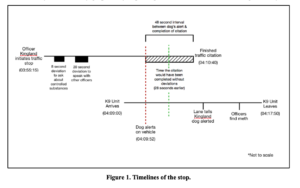
But body-worn cameras let the court do something different. The opinion by Justice Moeller features a second-by-second reconstruction of every relevant question and every relevant pause, which leads the court to scrutinize each question to decide if it was inside or outside the mission of the stop. The court can then subtract out the precise seconds added by the outside-the-mission questions and pauses to determine if the dog sniff occurred within the proper period of a stop. According to the court, the officer spent exactly 8 seconds asking the driver if there were drugs in the car, and later spends another 20 seconds discussing the situation with backup officers who arrived at the scene. The court's opinion includes this chart to explain the timeline:
Ultimately, the court rules that the government wins by 20 seconds. That is, although the outside-the-mission goings-on added 28 seconds, the dog alerted 48 seconds before the first officer finished writing his ticket for the stop. So the dog alerted within the time window that would have existed without the outside-the-mission conduct by 20 seconds.
In this particular case, I don't think the camera changes the ultimate outcome of the case. But it's the methodology, I think, that matters. The court's method for determining if the Fourth Amendment was violated rests on being able to scrutinize timestamps on a video and calculate hypothetical timeframes. I doubt a court would have thought to do that in a world without video. The available technology changes how the doctrine can be applied, and that, in a practical sense, helps to change what the doctrine is.
Anyway, I'm not sure how far these changes will go over time. I assume we're moving in the direction of having more and more body-worn cameras, and maybe more video evidence generally. So we'll see whether or how the new forms of evidence have a small or large effect on doctrine. But it seems like something to watch. It's a subtle difference, but I think it's a real one.
From Magistrate Judge Lauren Louis's decision in Griffin v. MyPillow, Inc. (S.D. Fla.), posted today:
This action arises from an out-of-district subpoena directed to the Supervisor of Elections for Monroe County, Florida, issued in connection with US Dominion, Inc. et al. v. My Pillow, Inc. et al., Case No. 1:21-cv-00445-CJN (D.D.C.) … (the "District of Columbia Case").
The District of Columbia Case is an action for defamation brought by plaintiffs US Dominion and its subsidiaries … against defendants My Pillow and its CEO, Michael Lindell, who are Respondents in the instant proceeding. Plaintiffs, who are manufacturers of vote tabulation systems used in elections throughout the country, set out in their complaint that My Pillow and Lindell promoted then-President Donald J. Trump's election-related claims (that the 2020 U.S. presidential election had been stolen from him) to boost their My Pillow product sales among audiences watching certain news outlets, knowing these claims to be false….
Plaintiffs assert that these claims have been resoundingly discredited and rejected in numerous courts, by various agencies of the Federal government, by election officials in numerous states, and by election specialists…. In their complaint, Plaintiffs assert that, on February 4, 2021, they again put the defendants on notice of the falsity of their statements, pointing the defendants to the alleged flaws in the report and data that the defendants had used to support their election-related claims. In response, the defendants asserted, in television interviews, that they were being targeted by Plaintiffs.
The next day, and after having been put on notice by Plaintiffs regarding the alleged falsities of his statements, Lindell broadcasted a purportedly sham documentary-style movie, which is described in greater detail in the complaint. Plaintiffs contend that, apart from promoting My Pillow's products in that movie, Lindell knowingly lied that the discredited report and allegedly manufactured data obtained from conspiracy theorists both were proof that the 2020 presidential election had been stolen, due to algorithms hacked into Plaintiffs' vote tabulation machines….
On September 7, 2022, Respondents served the Subpoena on the Supervisor, commanding production of 22 different categories of information related to the voting system used by Monroe County, Florida during the 2020 U.S. presidential election. The requested information includes forensic copies of all computer drives affiliated or attached to the Supervisor's vote tabulation system, forensic copies of certain files generated by the vote tabulation systems, diagrams of the Supervisor's computer networks running the election system, MAC addresses for election equipment, network logs, credentials for encryption services used by the election system, lists of personnel who had access to the election system before and shortly after the November 2020 presidential election, vote tabulation documents generated during the November 2020 election, documents produced in relation to the November 2020 election, documents related to intrusion attempts on the election system, contracts and agreements with the supplier of the election system, and contracts and agreements related to network security and cybersecurity….
Perhaps the most important defense of immigration restrictions is that idea that too much immigration will degrade the culture and institutions of the receiving country. The danger may be especially great if the immigrants have bad political or cultural values. In the extreme case, such deterioriation might even "kill the goose that laid the golden egg" that makes the destination country attractive to migrants in the first place.
One of the major arguments of this type advanced in recent years is the claim that immigrants from low-trust societies could diminish social trust in receiving countries, thereby damaging political, social, and economic institutions. This argument is most recently advanced in detail by economist Garett Jones, in his book The Culture Transplant: How Migrants Make the Economies They Move to A Lot Like the Ones They Left. Jones argues that trust is vital to economic growth and that immigrants from low-trust societies undermine it in their destination countries, thereby also reducing growth there.
In a recent substack essay, Cato Institute immigration policy expert Alex Nowrasteh effectively critiques Jones' book, and the "social trust" rationale for immigration restrictions more generally. To briefly summarize, Nowrasteh shows that 1) the link between trust and growth is questionable, 2) the evidence that immigration reduces trust is also weak, and 3) even if trust is useful and immigration reduces it, institutional incentives are often an effective substitute for it.
Many of the issues involved are complex and subtle. If you want to grasp the nuances, there is no substitute for reading the whole thing! Nowrasteh delves into the trust issue in greater detail in two social science papers (see here and here). Ironically, as he points out in one of them, immigrants and their descendants actually - on average - have greater trust in American institutions than native-born citizens do (whether that's a good thing or not may depend in part on how much trust you think these institutions deserve). Nowrasteh's excellent book Wretched Refuse: The Political Economy of Immigration and Institutions (coauthored with Ben Powell), also has lots of relevant material.
As Nowrasteh notes, a previous review of Jones' book by economist Bryan Caplan points out that it actually justifies vastly increasing immigration to the United States from a wide swathe of the world, including countries with some 50% of the world's population. If you agree with Jones' claims that immigrants make receiving countries' cultures more like their own, and with his assessment of what qualifies as desirable cultural values, it turns out many countries have "better" cultures than we do, and ours can be improved by taking in more immigrants from these places:
Using Jones' hand-picked measure of cultural quality, immigration from all of the following countries to the United States would be, by his argument, a clear-cut cultural improvement: Algeria, Argentina, Australia, Austria, Belarus, Belgium, Brazil, Canada, China, Costa Rica, Croatia, Denmark, Estonia, France, Germany, Greece, Hong Kong, Hungary, Ireland, Italy, Japan, Latvia, Lithuania, Netherlands, New Zealand, Norway, Poland, Portugal, South Korea, Moldova, Russia, Singapore, Slovakia, Spain, Sweden, Switzerland, Thailand, Tunisia, Ukraine, the United Kingdom, Uruguay, and Vietnam. Using a slightly different cultural measure adds the 1.7 billion inhabitants of India and Pakistan to the list. According to the research upon which Jones rests his book, we should expect migration from this long and populous list of countries to (a) substantially increase per-capita U.S. gross domestic product (GDP), (b) drastically increase gross world product, and (c) drastically increase global economic growth.
I am skeptical about both these measures of cultural quality and the idea that immigrants change destination-country culture anywhere near as much Jones claims. So I prefer to rest the case for free migration on other grounds, such as freedom, justice, and enhancing human welfare.
Here, I would add two points to Nowrasteh's critique. First, even if social trust is desirable (and it's hard to deny that societies need at least some minimal level of trust), it doesn't follow that more is always better. It could be that once you achieve a relatively modest level of trust (e.g. - we generally trust strangers not to assault or swindle us, and the like), further increases have few benefits. At some point, increased trust could even be harmful. For example, excessive trust in commercial transactions make us vulnerable to exploitation by conmen. Excessive trust in government officials might enable them to get away with corruption and harmful and unjust policies, and so on. If so, declining trust - whether driven by immigration or other factors - may not be a problem unless and until it gets a society below that bare minimum.
Second, the idea that people's behavior is driven largely by long-established and difficult-to-change cultures is undermined by the overwhelming evidence of how people of similar cultural backgrounds behave very differently in different institutional settings. The well-known examples of China and Taiwan, North Korea and South Korea, and East Germany and West Germany are dramatic cases in point. And there are many other such examples.
I have been a visiting professor in China, and also spent time in Taiwan. The contrast between the two was like night and day - despite the fact that the vast majority of the population of both countries consists of Han Chinese.
The theory of longterm cultural persistence is also at odds with casual everyday observation of immigrant behavior. Far from holding on tightly to the values of their previous countries, many immigrants have great difficulty getting their children to even speak their parents' native language. Even those parents who seek to impede children's assimilation usually have great difficulty in doing so. Anyone who is an immigrant or knows many immigrants (I fall into both categories, myself) is likely aware of many examples of these phenomena. These effects are, of course, heightened if immigrants or their children intermarry with natives.
The idea that immigration can cause great harm by reducing social trust deserves serious consideration. The same goes for some other claims to the effect that immigration might degrade social and political institutions. But, so far at least, there isn't much there. Indeed, there is much more evidence that liberal democratic institutions can be degraded by native-born nationalists (many of them hostile to immigration), than by immigration.
UPDATE: It's worth noting that some argue that immigration might degrade political and institutions not because the immigrants themselves have bad values, but because they generate harmful reactions by natives. I addressed such claims here, and in Chapter 6 of the revised edition of my book Free to Move.
That the Bureau of Criminal Apprehension "was able to assemble the shotgun components using a stock bolt and a stock bolt washer from another firearm" "was sufficient to prove that the unassembled shotgun parts in this case constituted a firearm."
From State v. Stone, decided Nov. 28 by the Minnesota Court of Appeals but just reported in the Westlaw Bulletin (opinion by Judge Michelle Larkin, joined by Judges Denise Reilly and James Florey):
Appellant challenges his conviction for unlawful possession of a firearm, arguing … [among other things that] an unassembled shotgun lacking a stock bolt and stock bolt washer is not a "firearm" ….
At trial, Investigator Michael Dieter testified that he and Investigator Bradley Gadbois were "driving past a known drug house" and observed a car and a minivan parked near the residence. Dieter saw a woman in the car injecting heroin. Dieter approached the woman, and Gadbois approached the minivan. There were three people in the minivan. Gadbois spoke to the driver, Z.R. Gadbois became suspicious based on Z.R.'s statements, searched Z.R., and found a baggie containing suspected drug residue. Gadbois next searched the minivan and discovered, between the second and third rows of seating, a blue Ozark Trail backpack….
Dieter was familiar with the "type" of backpack found in the minivan and noticed that the backpack's detachable "fanny pack" or "day pack" was not in the minivan. Dieter searched the backpack and found an unassembled shotgun with two barrels, along with a "prescription box" and a paystub, which were both made out to Stone…. Dieter testified that Z.R. told him the backpack belonged to "Coco." Dieter knew that Coco was Stone's nickname….
Stone was convicted under Minn. Stat. § 609.165, subd. 1b(a), which prohibits a person "who has been convicted of a crime of violence" from possessing a "firearm." He contends that his conviction must be reversed because "an incomplete collection of disassembled component firearm parts is not a 'firearm' within the meaning of Minn. Stat. § 609.165, subd. 1b(a)." He frames his argument as a challenge to the sufficiency of the evidence to sustain his conviction and argues that the meaning of section 609.165, subdivision 1b(a), is intertwined with the issue of whether the state proved his guilt beyond a reasonable doubt….
"Defendants are ORDERED to identify the lawyer responsible for this motion. The lawyer, by January 3, 2023, is ORDERED to submit an explanation of why the lawyer thought this was a justified motion. When I see the explanation, I will consider whether subsequent proceedings are appropriate."
The motion for leave to file under seal (D.I. 20) is DENIED.
This is about as frivolous a motion to seal as I have seen. Defendants submitted a declaration of Phil Harnish in support of their motion to transfer the case to the Northern District of California. The motion is based on the purported need to avoid disclosing "sensitive personal information about employees that, if revealed, would harm those employees," and "commercially sensitive information that, if revealed, would aid Defendants' competitors and harm Defendants." (Id. at 2).
The sensitive personal information seems to be that Mr. Harnish works at YouTube's headquarters in San Bruno, California. There is a second employee whose name (Ben Hulse) and office location (also San Bruno) are both redacted, as though he were a confidential source for the CIA. I put "Phil Harnish" into the Google search engine; the first thing that comes up is his "Linked In" page, which has a picture, the job title of Senior Staff UX Engineer, and a link to his personal website and his personal email address. I put "Ben Hulse" into the Google search. It's a more common name than I would have guessed, but when I added "YouTube," up came his Linked In page, with his job description—Senior Staff Software Engineer—but no picture. There are no social security numbers, bank accounts, home addresses, or anything similar in the Harnish declaration. If the sensitive personal information is by whom they are employed, where they work, and the nature of their work, the Linked In pages seem to refute that as being sensitive.
The commercially sensitive information is which teams Mr. Harnish and Mr. Hulse lead, the size of the teams, and which products the teams work on. I am certainly unpersuaded by an unsworn motion that revealing this information is likely to work a defined and concrete harm to Google or YouTube.
Defendants are ORDERED to identify the lawyer responsible for this motion. The lawyer, by January 3, 2023, is ORDERED to submit an explanation of why the lawyer thought this was a justified motion. When I see the explanation, I will consider whether subsequent proceedings are appropriate.
From Gannett Media Corp. v. U.S., decided yesterday by the Second Circuit (Judges Reena Raggi, Joseph Bianco & Sarah Merriam):
This appeal arises out of a criminal case in which several defendants were indicted on various federal charges related to an alleged insurance fraud scheme and scheme to defraud certain U.S. government entities. In October 2020, the district court granted the defendants' motions to dismiss the indictment on speedy trial grounds and, in doing so, highlighted the "government's repeated missed deadlines resulting in the conditional interest of justice exclusion, the government's failure to produce by the July 31, 2019 deadline any material from several of the devices seized over a year earlier, and the government's failure to approach its electronic discovery obligations with the necessary vigor required to manage ESI of this volume." The district court, however, determined that the dismissal should be without prejudice given the lack of bad faith.
After a new indictment was filed, the defendants moved for reconsideration of the dismissal of the prior indictment without prejudice, arguing that dismissal with prejudice was warranted based on newly-discovered evidence that the government had engaged in misconduct, including making intentionally misleading statements and omissions to the court. The district court directed the government to respond, in affidavit form, to the allegations and, during oral argument on the motion, concluded that an evidentiary hearing was necessary to address the district court's concerns regarding the government's conduct and its prior representations to the court. The defendants pled guilty before the hearing occurred and, under their plea agreements, withdrew their motions for reconsideration.
However, on April 22, 2022, the district court issued an order noting that, pursuant to its inherent authority to supervise conduct of the members of its bar, "additional fact-finding may be warranted where it is unclear if government lawyers intentionally made a misleading statement to the Court." Thus, the district court considered "whether the Court, on its own, should resolve those factual disputes, notwithstanding the withdrawn motions" by the defendants. Moreover, the district court ordered that, if the government took the position that no further misconduct inquiry by the district court was necessary, it should file a submission setting forth the basis for that position, including any potential "plans the government has to pursue the issues on its own internally."
In a decision and order dated July 20, 2022, the district court granted the government's motion to file its submission ex parte and under seal. The district court determined, based upon the government's submission and affidavit in support of its motion to seal (collectively, the "Sealed Submissions"), that it would "not take further steps sua sponte to investigate the allegations that were the subject of the planned evidentiary hearing …."
A progressive makes the case the two justices should step down within the next two years so that President Biden may appoint their successors with a Democratic Senate.
Over at Vox, Ian Millhiser argues that Justices Sonia Sotomayor and Elena Kagan should retire now so that they can be replaced while Democrats control both the White House and the U.S. Senate. Failing to do so, he warns, risks that they could be replaced by a Republican President, as happened when Justice Ruth Bader Ginsburg died, leading to Donald Trump appointing Justice Amy Coney Barrett to Ginsburg's seat.
Both justices are much younger than Ginsburg was in 2014. There are no reports that either is in ill health (although Sotomayor has diabetes, she's managed that condition nearly her entire life). Realistically, both justices could probably look forward to a decade or more of judicial service if they desire it. But even a mighty Supreme Court justice cannot overcome the merciless math facing Democrats in a malapportioned Senate that effectively gives extra representation to Republicans in small states.
Barring extraordinary events, Democrats will control the White House and the Senate for the next two years. They are unlikely to control it for longer than that. The 2024 Senate map is so brutal for Democrats that they would likely need to win a landslide in the national popular vote just to break even. Unless they stanch the damage then, some forecasts suggest that Democrats won't have a realistic shot at a Senate majority until 2030 or 2032. And even those forecasts may be too optimistic for Democrats.
If Sotomayor and Kagan do not retire within the next two years, in other words, they could doom the entire country to live under a 7–2 or even an 8–1 Court controlled by an increasingly radicalized Republican Party's appointees.
Millhiser acknowledges that there are benefits to experience and longevity on the bench. Longer serving justices may be more influential than their more junior colleagues for a variety of reasons, including the ability to control opinion assignments and the cultivation of relationships within the Court. But Millhiser is skeptical that such concerns should carry the day here as "at some point, the advantages of longevity and experience must yield not just to the Senate's unforgiving math, but to the mathematics of the Court itself. In the Supreme Court, the only number that truly matters is five."
FIRE has the details, though you can also read the full brief (written by FIRE's Adam Steinbaugh and me, with many thanks to our excellent local counsel Zachary Phillipps of Wofsey Rosen Kewskin & Kuriansky, LLP). I've been writing about this law since 2010, so I'm especially pleased to have been involved in this case, where I hope the law will finally be cut back. Here's a long excerpt from FIRE's summary, written by Adam Steinbaugh:
Any person who, by his advertisement, ridicules or holds up to contempt any person or class of persons, on account of the creed, religion, color, denomination, nationality or race of such person or class of persons, shall be guilty of a class D misdemeanor.
By its plain terms, the law only applies to an "advertisement" of some sort…. But that's not how police and prosecutors in Connecticut treat the law in practice. In 2019, for example, police at the University of Connecticut tracked and arrested several students for "playing a game" in which they uttered vulgar, transgressive words at a progressively louder volume—starting with "penis" and later replacing it with "nigger"—while walking through a parking lot. They weren't saying the words to anyone in particular, and the only way people learned what the students were saying was when someone turned up the volume on a cell phone recording.
What were the students advertising? Nothing. Still, they were being arrested under this law. This raised the question: Who else was?
This year, to learn how police were actually applying the law, FIRE undertook a broader search for records, expanding on similar requests first issued by Professor Volokh. The records we found—all of which are included in the brief—demonstrate that the UConn students do not represent a one-off example of police and prosecutors applying the law outside the context of advertisements. In fact, of the dozens of arrests, charges, and convictions we documented, none had anything to do with commercial advertisements.