
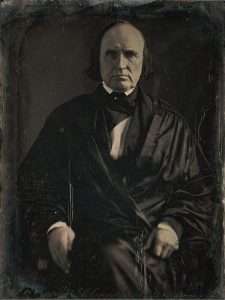
1/11/1830: Justice John McLean takes oath.

Mostly law professors | Sometimes contrarian | Often libertarian | Always independent | Est. 2002

1/11/1830: Justice John McLean takes oath.
Debs and the Federal Equity Jurisdiction, a new article with Professor Aditya Bamzai, has just been published in the Notre Dame Law Review. You can read it here, and this is the abstract:
The United States can sue for equitable relief without statutory authorization. The leading case on this question is In re Debs, and how to understand that case is of both historical and contemporary importance. Debs was a monumental opinion that prompted responses in the political platforms of major parties, presidential ad- dresses, and enormous academic commentary. In the early twentieth century, Congress enacted several pieces of labor legislation that reduced Debs's importance in the specific context of strikes. But in other contexts, the question whether the United States can bring suit in equity remains disputed to this day. The United States has expressly invoked, or implicitly relied on, Debs in some of the most high-profile cases in recent years, including United States v. Texas.
This Article explains the equitable principles at work in Debs and shows how these principles still have a normative basis today. Collecting materials from traditional equity practice and historic treatments of Debs that have escaped the attention of the recent academic literature, this Article especially considers the connection that the Debs Court draws between equitable relief and a proprietary interest. It shows how the equity-property connection works as an empowering and limiting principle for the abil- ity of the United States to bring a suit in equity. And it offers guidance to the federal courts by explaining and defending the traditional contours of their equity jurisdiction.
Responses to some of the most common queries I have gotten.

Since publishing a Washington Post article (paywall-free version here) about the Uniting for Ukraine private refugee sponsorship program, I have gotten a variety of questions about how the program works, particularly from people interested in possibly becoming sponsors. Interest was further heightened by the White House's recent expansion of private sponsorship to include four Latin American countries: Cuba, Nicaragua, Venezuela, and Haiti.
In this post, I go over a few of the most common questions and misconceptions I have seen. The post is not a comprehensive guide to becoming a sponsor. Still less does it try to address all the moral and policy issues at stake in these programs (though I have written about the latter in various previous writings, such as here and here). But I hope it can be useful nonetheless.
I. Is the Uniting for Ukraine program capped at 100,000 participants?
Months ago, President Biden said the US would seek to take in 100,000 Ukrainians fleeing the Russian invasion of their country. This has apparently led many people - both Ukrainians and potential American sponsors - to assume that the Uniting for Ukraine program is capped at 100,000 participants. But, in reality, there is no such cap. The figure of 100,000 was just political rhetoric, not a legally binding constraint.
This is actually one of those rare instances where a government policy has outperformed aspirational promises, as opposed to fallen short of them. As of December, 94,000 Ukrainians had already entered the country under the policy, and tens of thousands more had been authorized to come, though not yet arrived. By now, the 100,000 figure has almost certainly been exceeded.
While there is no numerical cap on Uniting for Ukraine participants, the newly announced program for Cubans, Nicaraguans, Venezuelans, and Haitians does have such a restriction: a cap of 30,000 per month from all four countries combined. However, applicants who miss the cutoff one month can potentially be admitted the next.
II. Do participating migrants have to live in their sponsor's house?
The answer to this unexpectedly common question is "no." There is no such rule, and admittedly anecdotal evidence suggests that most sponsorees do not in fact live in their sponsors' homes, and especially not for more than a brief period after arriving in the US. Participants in private sponsorship programs generally seek out rental housing, as have most other immigrants throughout American history. They can afford to do so, because they are legally authorized to work in the United States, and most seek to quickly enter the labor force (which is very feasible given severe labor shortages in many sectors of our economy).
Far from being required to live with their sponsors, migrants are not even required to take up residence in the same city or state. For example, our own sponsorees now live in Florida, despite the fact that my family and I live in Virginia. The family we sponsored chose Florida because they have friends there (previous Ukrainian immigrants) and because of housing and job opportunities.
III. What are the financial obligations of sponsors?
The answer to this question isn't completely clear. The US Citizenship and Immigration Service indicates that sponsors should be able to assist with housing, health care, and various other basic needs. If you interpret this broadly and literally as requiring sponsors to pay for all such expenses, the cost will be prohibitive for all but the very wealthy. However, USCIS regulations do not require the provision of any specific amount of assistance. And, in practice, neither the government nor program beneficiaries can sue sponsors for failure to provide a specific sum. Thus, the amount of financial support is largely left up to sponsors and beneficiaries to determine among themselves.
Would-be sponsors do have to file a form that, among other things, indicates the amount of financial resources they have. USCIS can reject people they deem as having insufficient funds. In practice, however, anecdotal evidence indicates such rejections are rare, and acceptance certainly is not limited to the very wealthy.
Potential sponsors should not take this situation as a license to withhold assistance they have promised to give. As I see it, if you promised to give people fleeing war and oppression a given sum of money or other assistance, you are morally obligated to keep that promise, even if they cannot go to court to enforce it.
Sponsors should be honest about what support they can and cannot give. But, ultimately, the biggest gift sponsors can offer migrants is not money but the chance to live in a society with vastly greater freedom and opportunity than the one they fled.
What is true of funds is also true of logistical and other assistance. Official guidelines on this are vague and general, generating little in the way of precise, legally enforceable obligations. But many newly arriving migrants can benefit from help with navigating bureaucratic and other difficulties, which sponsors can often provide even if they cannot give much money.
IV. How can I begin the process of potentially becoming a sponsor - or a sponsoree?
If you already have connections with eligible citizens of one of the five covered countries who want to be your sponsorees, you can file Form I-134A at the USCIS website (one for each sponsoree, even if they are members of the same family). Remarkably - especially by the sclerotic standards of US immigration bureaucracy - approval often comes very quickly, as fast as within a week or two of filing. Ours took only nine days.
If you are interested in being a sponsor, and want to be connected with potential sponsorees, the best way to start is to register and create a profile at the Welcome.US website, a private nonprofit that facilitates connections between sponsors and eligible migrants. They have a site for potential sponsors and participants in the Uniting for Ukraine program (which is how my wife and I found our own sponsorees), and are in the process of setting up a similar site for sponsors and migrants for the four Latin American countries.
Their Uniting for Ukraine site has instructions and communications options in Russian and Ukrainian, as well as English. I hope and expect the site for the four Latin American countries will also eventually be accessible in Spanish and French.
The Welcome.US Ukrainian site allows potential migrants to set up their own profiles and contact potential sponsors on the site directly. I am not sure if the site for the other four countries yet has this capability. But hopefully it will soon.
UPDATE (June 7, 2023): The Welcome.US site now does have capabilities to connect potential sponsors with potential sponsorees from the four Latin American nations.
reviewing Common Good Constitutionalism.
We have now published The "Common-Good" Manifesto, our review of Adrian Vermeule's Common Good Constitutionalism, in the Harvard Law Review. (For previous posts, see here and here.)
Here is the introduction:
Two prominent scholars once described a "genre" of literature — the "constitutional manifesto" — that "sits uneasily between the scholarly or theoretical analysis of constitutional law and the buzzwords of day-to-day constitutional politics." Such a work must "expound a philosophical vision of constitutional law and politics" that's intellectually serious but "nonetheless accessible to a broad audience." Not only that, it must be "politically savvy, so that it may guide a political and legal movement in particular directions over time." Yet the case for its constitutional method, "openly defended as a tactic for achieving a political agenda," can't succeed as a political matter if it also adheres to traditional academic values like "a commitment to public candor." If it tries to split the difference, the wires will show.
One of those scholars, Professor Adrian Vermeule, has now tried his own hand at the genre. Three years ago, he announced that originalism had "outlived its utility" for producing a "substantively conservative approach to constitutional law and interpretation." In Common Good Constitutionalism, he offers a new constitutional manifesto, expounding a philosophical vision that might "direct persons, associations, and society generally toward the common good." Alas, the wires still show.
Common Good Constitutionalism has been accompanied by an impressive intellectual and rhetorical campaign, and it has already been widely (if mostly skeptically) reviewed. We share the skeptical bottom line, but we worry that the book's critics have yet to cut down to the bone. What's wrong with the book is not that it advances a form of living constitutionalism, that the common good is unknowable, or that pursuing the common good will necessarily lead to untoward results. Indeed, the book highlights important strands of Founding-era and nineteenth-century legal thought, of which scholars of all stripes should take account. What's wrong with the book is that it fails to hold up at a theoretical level — either on its own terms or as compared to the originalist approach it purports to threaten. Vermeule is a very deep thinker, working with a many-centuries-old legal tradition, yet the results are surprisingly superficial.
The problem, we think, is that the demands of a political and legal campaign and those of a constitutional theory are not the same. Though Vermeule writes with extraordinary skill, the sort of red meat that inspires a movement can, on reflection, seem rather thin gruel. Vermeule once reminded his many Twitter followers "that twitter is a dark arena of rhetorical combat, not an academic seminar. Tweet accordingly." We fear that the spirit of the dark arena has now spread to the monograph — and that the tools and techniques that serve so well in one medium turn out to be handicaps in another.
Nonetheless, we take the book seriously as an intellectual challenge, which is why we feel compelled to respond. This poses a further issue. If Common Good Constitutionalism were more straightforwardly structured, it might be easier to lay out its argument, to explain where we disagree, and then to set out the evidence that might support one position against another. Instead, communicating a full sense of the book sometimes requires careful attention to its rhetorical strategies and direct criticism of what seems to us to be failures of scholarship. Noting such failures can sound ad hominem, particularly because you, the reader, have no way of assessing them, short of reading the book yourself and deciding whether we have been fair. If these constraints lead in places to an unusually sharp tone, we apologize for its necessity.
In any event, we proceed as follows. In Part I, we take Common Sense Good Constitutionalism on its own terms, arguing that the theory fails to support the book's hostility toward originalism, to motivate its surprising claims about outcomes, or even to offer an account of constitutionalism at all. In Part II, we argue that its chief objections to originalism are unpersuasive and already answered in the literature it cites. In Part III, we attempt a sympathetic reconstruction of the book's arguments as contributions to originalist debates, though we find them underbaked as a matter of both history and jurisprudence. In Part IV, we discuss Vermeule's political aims and their relation to the book's cult following.
And the conclusion:
Common Good Constitutionalism is both an achievement and a disappointment. While Vermeule performs a real service in refocusing attention on the American natural-law tradition, his account of that tradition may mislead as much as it enlightens. And while his forceful writing will win him wide readership and some applause, it also keeps him from engaging carefully with alternative views or recognizing potentially shared ground. Opposing views are composed of "myths," "shibboleths," "chatter," "horror," and "panicky, bewildered outrage" (pp. 18, 34, 62, 67), while his own views are pugnaciously, though inconsistently, expressed. A rhetorical pose in which common good constitutionalism must always be victorious, its enemies always cringing and pitiful, lends itself more to political than to intellectual advance.
Some readers might not mind. They might favor common good constitutionalism for the outcomes it promises to license, or even just for the combative posture it lets them take. We have little to say to these readers: one doesn't need to read a book to lobby for preferred outcomes or to start fights online.
What Common Good Constitutionalism purports to add to the project is an intellectually rigorous foundation. If it had, it could have moved the scholarly ball forward, persuading some to share its views and obliging the rest to refine their own views in its light. Unfortunately, it too often lets other goals get in the way. So while we can't root for the book's success as a manifesto, movement, or call to arms, we wish it were better as a book.
Click here for the rest!
The proposed fellow would have been Kenneth Roth, former head of Human Rights Watch, and apparently a highly prominent expert on the subject.
Here's FIRE's post criticizing this:
The dean of Harvard's Kennedy School has refused to approve the fellowship of the man — hailed as the "godfather" of human rights work — because he disagrees with his stance on Israel.
HKS, one of the top public policy institutions in the world, has violated Harvard's clear commitments to free expression by denying former Human Rights Watch executive Kenneth Roth a fellowship because of his purported "anti-Israel bias." As always, FIRE is neutral on Roth's views on Israel, as well as the underlying Israeli-Palestinian conflict, and has defended individuals on every side of the issue.
Harvard's human rights experts reportedly sought Roth for the job after he announced he was stepping down as executive director of Human Rights Watch. Sushma Raman, executive director of HKS's Carr Center for Human Rights Policy, invited Roth to join the center as a senior fellow. Roth and Raman agreed on terms, and the fellowship was set to be confirmed, but when it was elevated to HKS Dean Douglas Elmendorf, he refused to approve the deal.
Focusing on all-causes mortality, and not just on COVID mortality, helps account for various potential indirect effects of lockdowns.
COVID lockdowns could have saved lives, by decreasing COVID deaths (and also incidentally decreasing some other deaths, for instance from auto accidents, from other communicable diseases, and the like). They also could have cost lives—for instance, through drug abuse deaths or suicides or homicides stemming from people being cooped up for months, drug abuse deaths or suicides or homicides stemming from economic damage and unemployment caused by the lockdown, cancers not caught early as people delayed early screening (even if such early screening would have been officially excluded from the lockdown), and so on.
What was the likely aggregate of all these effects? In particular, to look at just one data point (recognizing that it's indeed just one data point), how did Sweden, which basically didn't lock down, fare compared to other prosperous countries?
Sweden did have a higher COVID mortality rate than many other European countries, including the neighboring Norway, Denmark, and Finland. But what about what is sometimes called "all-cause excess mortality," which is to say total mortality in the country compared, on a percentage basis, to the pre-COVID mortality? Moreover, some of the effects of lockdowns (positive and negative) could have lasted well after the lockdowns, indeed for years past them. What then about the all-causes excess mortality from 2020 to the present, rather than just based on the 2020 data or the 2020-21 data?
A recent UK Office of National Statistics report says that Sweden and Norway were essentially tied for the lowest "[p]roportional all-cause excess-mortality scores" (which "measure[] the percentage change in the number of deaths compared to the expected number of deaths (based on the five-year average [from 2015 to 2019])" among the listed European countries, looking at data from Jan. 2020 to June 2022: Their excess mortality was up 2.7%, compared to, say, 5.2% for Denmark, 7.1% for Finland, and 11.8% for the Netherlands.
and stop jailing people unlawfully.
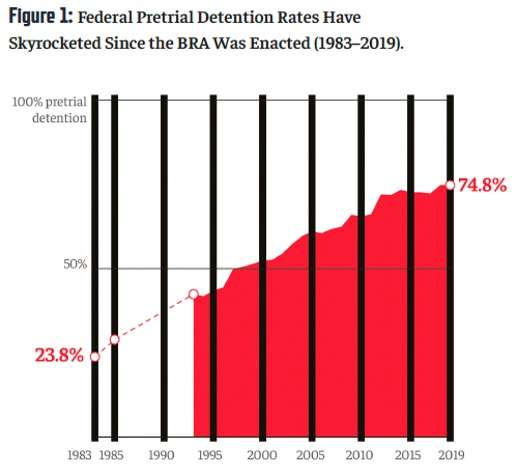
In our Federal Criminal Justice Clinic's new report, Freedom Denied, we sought to understand the current federal pretrial detention crisis that results in the pretrial jailing of three out of every four federal arrestees.
This post addresses the first of our four findings and recommendations: "Judges must follow the correct legal standard at the Initial Appearance hearing and stop jailing people unlawfully."
The Bail Reform Act of 1984 (BRA) allows the prosecution to move for detention at the Initial Appearance in only a limited set of cases.
There is a widespread misperception that prosecutors are entitled to a Detention Hearing every time they request one. However, under the BRA, the prosecutor may move for detention at the Initial Appearance only if authorized by one of the factors in § 3142(f) (the "(f) factors"). The BRA says that "the judicial officer shall hold a [detention] hearing" only "in a case that involves" one of the 7 (f) factors. "If none of the § 3142(f) factors are satisfied, however, the [judge] is prohibited from holding a detention hearing or detaining the defendant pending trial." If no (f) factor applies, the arrestee must, as a matter of law, be released at the Initial Appearance. In this sense, § 3142(f) "serve[s] as a gatekeeper to [pretrial] detention."
The BRA's legal standard at the Initial Appearance was a central reason that the Court in United States v. Salerno upheld the constitutionality of the Act: "The Act operates only on individuals who have been arrested for a specific category of extremely serious offenses. 18 U.S.C. § 3142(f)."
It is therefore especially troubling that
[o]ur data expose a severe misalignment between the BRA's prescribed Initial Appearance process and the practice that unfolds in federal courthouses around the country. We observed a problematic feedback loop play out during Initial Appearances: the prosecutor requests pretrial detention for reasons not authorized by the law, the defense attorney does not object, and the judge neither questions the prosecutor nor adheres to the statutory requirements, sometimes jailing people unlawfully. See Figure 5. When judges rubber stamp prosecutorial detention requests that deviate from the legal standard, prosecutors continue disregarding the law and judges continue jailing people improperly in a subset of cases—in an endless cycle. The illegal detentions that result from this mutually-reinforcing process ultimately lead to higher jailing rates at the Initial Appearance and beyond, and fall disproportionately on people of color.
We found that in some cases, judges illegally jail people who should be released back to the community:
Easterday v. Everhart, decided Thursday by the Indiana Court of Appeals, in an opinion by Judge Melissa May, joined by Judges Terry Crone and Leanna Weissmann, involved the custody of the parties' 12-year-old daughter. The parties' original agreement was for joint legal custody but for mother to have primary physical custody, with father having the child "Wednesday evenings and every other weekend." In 2022, mother asked for a change in custody:
During the hearing, the parties presented evidence and testimony about their different views regarding Child's religious upbringing. Mother testified she and her family, including child, changed churches and now attend "Seymour Christ Temple Apostolic" in Seymour, Indiana. Since changing churches, Child stopped painting her nails and now wears only long skirts. Child attends church three times a week, on Sunday morning and Sunday evening for services and on Thursday night for youth group. Mother admitted Child was baptized without Mother informing Father until after the baptism occurred. Mother testified she wanted the trial court to modify the parenting time "to eliminate [Father's] ability to question [Child's] religion or try to talk [Child] into believing that there is no God[.]"
Father testified he is an agnostic. He denied telling Child "there wasn't a God" and testified he had not tried to "convince her the church she goes to isn't something she should be attending[.]" He testified he wanted Child "to make her own choice" about religion.
The trial court gave the mother full legal custody, and added:
The Court finds that there has been a change in circumstances relating to legal custody. The Court finds that [Child's] parents hold very different views on religion. The Court having considered the evidence and in-camera interview, finds that [Child] has made an independent well reasoned decision about her faith, which should be respected and encouraged. The Court finds that to allow [Child] to pursue and express her faith, that [Mother] should have sole legal custody of [Child] as well as primary physical custody. [Father] shall not discuss religion with [Child]….
The Court of Appeals reversed those aspects of the order (the correct result, I think, see my Parent-Child Speech and Child Custody Speech Restrictions):
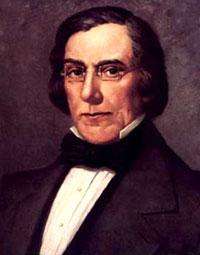
1/10/1842: Justice Peter Daniel's takes the judicial oath.
Episode 436 of the Cyberlaw Podcast
Our first episode for 2023 features Dmitri Alperovitch, Paul Rosenzweig, and Jim Dempsey trying to cover a months' worth of cyberlaw news. Dmitri and I open with an effort to summarize the state of play in the tech struggle between the U.S. and China. I say recent developments show the U.S. doing better than expected. U.S. companies like Facebook and Dell are engaged in voluntary decoupling as they imagine what their supply chains will look like if the conflict gets worse. China, after pouring billions into a so-far-fruitless effort to take the lead in high-end chip production, may be pulling back on the throttle. Dmitri is less sanguine, noting that Chinese companies like Huawei have shown that there is life after sanctions, and there may be room for a fast-follower model in which China dominates production of slightly less sophisticated chips, where much of the market volume is concentrated. Meanwhile, any Chinese retreat is likely tactical; where it has a dominant market position, as in rare earths, it remains eager to hobble U.S. companies.
Jim lays out the recent medical device security requirements adopted in the omnibus appropriations bill. It is a watershed for cybersecurity regulation of the private sector. It's also overdue for digitized devices that in some cases can only be updated with another open-heart surgery. How much of a watershed it is may become clear when the White House cyber strategy, which has been widely leaked, is finally released. Paul explains it's likely to show enthusiasm not just for more cybersecurity regulation but for liability as a check on bad cybersecurity. Dmitri points out that Biden administration enthusiasm for regulation may not lead to legislation now that Republicans control the House.
We all weigh in on LastPass's problems with hackers --and with candid, timely disclosures. For reasons fair and unfair, two-thirds of the LastPass users on the show have abandoned the service over the Christmas break. I blame LastPass's acquisition by private equity; Dmitri tells me that's painting with too broad a brush.
I offer an overview of the Twitter Files stories by Bari Weiss, Matt Taibbi, and others. When I say that the most disturbing revelations concern the massive government campaigns to enforce orthodoxy on COVID-19, all hell breaks loose. Paul in particular thinks I'm egregiously wrong to worry about any of this. No chairs are thrown, mainly because I'm in Virginia and Paul's in Costa Rica. But it's a heartfelt, entertaining, and maybe even illuminating debate.
In shorter and less contentious segments:
Download the 436th Episode (mp3)
You can subscribe to The Cyberlaw Podcast using iTunes, Google Play, Spotify, Pocket Casts, or our RSS feed. As always, The Cyberlaw Podcast is open to feedback. Be sure to engage with @stewartbaker on Twitter. Send your questions, comments, and suggestions for topics or interviewees to CyberlawPodcast@steptoe.com. Remember: If your suggested guest appears on the show, we will send you a highly coveted Cyberlaw Podcast mug! The views expressed in this podcast are those of the speakers and do not reflect the opinions of their institutions, clients, friends, families, or pets.
From the statement:
It is with great concern that the Muslim Public Affairs Council (MPAC) views the firing of an art professor, Erika López Prater, from Hamline University on the grounds of showing a fourteenth-century painting depicting the Prophet Muḥammad. We issue this statement of support for the professor and urge the university to reverse its decision and to take compensatory action to ameliorate the situation.
News sources report that the matter reached the university administration after a Muslim student complained to them about the professor showing the image in class. Subsequently, undergraduate students at the university received an email from the administration declaring the incident to be "undeniably inconsiderate, disrespectful and Islamophobic." Because the professor was hired as an adjunct, her contract was not renewed and she was effectively fired.
As a Muslim organization, we recognize the validity and ubiquity of an Islamic viewpoint that discourages or forbids any depictions of the Prophet, especially if done in a distasteful or disrespectful manner. However, we also recognize the historical reality that other viewpoints have existed and that there have been some Muslims, including and especially Shīʿī Muslims, who have felt no qualms in pictorially representing the Prophet (although often veiling his face out of respect). All this is a testament to the great internal diversity within the Islamic tradition, which should be celebrated.
Legislative restrictions on ideas and viewpoints that can be advocated in the classroom undermine free inquiry
The Academic Freedom Alliance has issued a new guidance statement. It calls for an end to policies designed to restrict the advocacy or discussion of "divisive concepts" in university classrooms.
President Donald Trump issued Executive Order 13950 on September 22, 2020, which prohibited federal workplace training programs that taught, advocated, or promoted any "divisive concepts." Since then, many proposals have been made in the states similarly to exclude divisive concepts, or what has sometimes been characterized as "critical race theory," in government workplace training and in public schools. More recently, such bans have also been contemplated for state colleges and universities. The most prominent of these was adopted by the Florida legislature in the "Stop W.O.K.E. Act" in 2022. The enforcement of that statute has now been enjoined as unconstitutional by a federal district court. I have discussed the problem with such legislation at some length.
We should be particularly wary of public officials imposing limitations on what ideas can be discussed inside the university. The temptation to abuse such a power in order to suppress ideas that incumbent politicians or transient majorities find threatening to their interests and sensibilities is far too great. Conservatives have rightly warned that campus speech codes are used to silence points of view that some members of the campus community did not like. Campus speech codes imposed by legislators or trustees should spark the same concern, even if the targeted speech is different. Repugnant ideas on a college campus should be challenged through criticism and debate, not through the tools of censorship.
. . .
We should also worry about the precedent that such divisive concepts bans set for the future. If a legislature may ban students from hearing someone espouse the view that individuals should receive adverse treatment on the basis of their race or sex in order to advance equity goals or that ideas of merit can be oppressive, they could equally ban any number of other controversial social, political, philosophical, or scientific concepts from the university campus. A future legislature could just as well ban anyone on a state university campus from espousing the view that human life begins at conception or that mandatory vaccination policies are an affront to individual liberty or that free enterprise has been an engine of human progress. We protect a realm of free inquiry by insisting that university campuses should enjoy some degree of insulation from the political passions of the moment. We should not have to hope that enlightened politicians will tolerate the good kinds of ideas and suppress only the bad ones. We should leave the winnowing of good from bad ideas to the process of scholarly investigation and disputation and free and open classroom debate.
Our conversation with one of dating apps' harshest critics continues
On today's episode (Apple Podcasts link here and Spotify link here) of Strangers on the Internet with co-host and psychologist Michelle Lange, we return for the second half of our exchange with bestselling author, award-winning journalist, filmmaker and producer Nancy Jo Sales. Part 1 of the conversation is available here.
Nancy Jo explains why she believes that dating apps are deeply embedded in frat boy culture and rape culture, as well as what role social media whisper networks play in protecting female app users. Why and how do dating app operators make it so difficult to conduct independent research about the apps? How do conversations between Nancy Jo and incels go down? And does she see any hope for Gen Z and dating, watching her daughter enter young adulthood in today's world? Fasten your seatbelts, this episode is a wild ride!

Our Federal Criminal Justice Clinic at the University of Chicago Law School recently released the first comprehensive national investigation of federal pretrial detention—Freedom Denied: How the Culture of Detention Created a Federal Jailing Crisis. We conducted this study to understand why the federal system jails 75% of those pending trial, even though they are presumed innocent and have not been tried or convicted. We discovered that federal judges routinely lock people in jail in violation of the law, which increases jailing rates and exacerbates racial disparities.
In 1987, the Supreme Court upheld the constitutionality of jailing federal defendants before trial in United States v. Salerno, declaring, "In our society, liberty is the norm, and detention prior to trial or without trial is the carefully limited exception." At that time, just 29% of people charged with federal crimes were jailed before trial; the rest were released back to their families. But today, pretrial jailing has become the norm, and we conclude that "the culture of detention" is to blame:
This Report reveals a fractured and freewheeling federal pretrial detention system that has strayed far from the norm of pretrial liberty. This Report is the first broad national investigation of federal pretrial detention, an often overlooked, yet highly consequential, stage of the federal criminal process. Our Clinic undertook an in-depth study of federal bond practices, in which courtwatchers gathered data from hundreds of pretrial hearings. Based on our empirical courtwatching data and interviews with nearly 50 stakeholders, we conclude that a "culture of detention" pervades the federal courts, with habit and courtroom custom overriding the written law. As one federal judge told us, "nobody's … looking at what's happening [in these pretrial hearings], where the Constitution is playing out day to day for people."
The culture of detention is so deeply engrained that it often overrides explicit protections and requirements codified in the Bail Reform Act:
I'm delighted to report that Alison Siegler (@SieglerAlison)—Clinical Professor of Law, the Founding Director of the University of Chicago Law School's Federal Criminal Justice Clinic (FCJC), and the lead author of Freedom Denied: How the Culture of Detention Created a Federal Jailing Crisis (2022)—and one of her coauthors, Jaden Lessnick, will be guest-blogging this week about their report. An excerpt from the report:
Over thirty years ago, the Supreme Court held that people charged with federal crimes should only rarely be locked in jail while awaiting trial: "In our society, liberty is the norm, and detention prior to trial or without trial is the carefully limited exception." Given that everyone charged with a crime is presumed innocent under the law, federal judges should endeavor to uphold the Court's commitment to pretrial liberty.
This Report reveals a fractured and freewheeling federal pretrial detention system that has strayed far from the norm of pretrial liberty. This Report is the first broad national investigation of federal pretrial detention, an often overlooked, yet highly consequential, stage of the federal criminal process. Our Clinic undertook an in-depth study of federal bond practices, in which courtwatchers gathered data from hundreds of pretrial hearings. Based on our empirical courtwatching data and interviews with nearly 50 stakeholders, we conclude that a "culture of detention" pervades the federal courts, with habit and courtroom custom overriding the written law.
As one federal judge told us, "nobody's … looking at what's happening [in these pretrial hearings], where the Constitution is playing out day to day for people." Our Report aims to identify why the federal system has abandoned the norm of liberty, to illuminate the resulting federal jailing crisis, and to address how the federal judiciary can rectify that crisis….
I much look forward to their posts.
"Dr. Kostihova compared showing the image [of Muhammed] to using a racial epithet for Black people ...."
The New York Times (Vimal Patel) wrote yesterday about the Hamline University lecturer who was fired for displaying a painting of Muhammed in class. The article identifies the lecturer by name, Erika López Prater, which to my knowledge hadn't been publicly done until a few days ago. And it adds some other noteworthy items:
The instructor's actions, [Jaylani Hussein, the executive director of the Minnesota chapter of the Council on American-Islamic Relations,] said, hurt Muslim students and students of color and had "absolutely no benefit."
"If this institution wants to value those students," he added, "it cannot have incidents like this happen. If somebody wants to teach some controversial stuff about Islam, go teach it at the local library." …
Four days after the class, Dr. López Prater was summoned to a video meeting with the dean of the college of liberal arts, Marcela Kostihova.
Dr. Kostihova compared showing the image to using a racial epithet for Black people, according to Dr. López Prater.
This vividly illustrates, I think, some of the points that Randy Kennedy and I wrote about in The New Taboo: Quoting Epithets in the Classroom and Beyond with regard to similar demands for expurgating items (there, quoted epithets) from class discussions of source materials, such as court opinions, court records, historical documents, musical works, and so on. And it reinforces our view (see especially pp. 56-57 of that article) that, if universities adopt a norm that professors should expurgate epithets from the sources they're discussing, it will be hard to credibly and consistently reject other demands for expurgation, including of supposedly blasphemous images.
1/9/1919: Schenck v. United States argued.
Economist Bryan Caplan explains how cutting back on zoning and other restrictions could create millions of new jobs for workers - on top of other beneficial effects.

Both leftists and "national conservative" right-wingers have lamented declining job opportunities for the working class - particularly males - and proposed to revive their fortunes through a variety of subsidies and protectionist measures. But my George Mason University colleague, economist Bryan Caplan points out a much better way to create millions of attractive new working class jobs:
My dear friend and colleague Don Boudreaux keeps arguing with national conservatives like Oren Cass who want to use industrial policy to revive American manufacturing…. The more I read these debates, the more convinced I am that both sides are overlooking common ground that reaches all the way to the horizon.
What common ground could that possibly be, you ask?
National conservatives yearn to help non-college domestic workers, especially men who feel out-of-place in the modern service economy. Like my dissertation advisor Anne Case and her Nobel laureate husband Angus Deaton, they plausibly attribute much of the opioid epidemic to the lack of meaningful work for non-college males.
Meanwhile, free-market economists have spent years talking about a big policy reform that would create millions of well-paid, meaningful jobs for non-college males: housing deregulation. While few give this reform the top priority that I do, almost every economist I know now recognizes that housing regulation has been strangling housing supply for decades, especially in the richest areas of the country….
What makes me so sure that housing deregulation would be great for non-college males? Because non-college males build almost all our housing! Over 80% of all construction jobs are non-college already - and almost 90% are male…
[N]otice that there are already over ten million construction workers in America. That's only modestly below the nation's total manufacturing employment!
Upshot: We can credibly do everything national conservatives hope to do for America's non-college males via deregulation. Even modest relaxation of existing regs could swiftly create one or two million more well-paid working-class jobs. The radical housing deregulation I champion could easily double the size of the construction industry for decades.
Just imagine all the honest toil required to demolish those silly two-story homes in San Francisco and replace them with skyscrapers.
Unrealistic? Well, adding millions of construction jobs is vastly more realistic than adding millions of factory jobs. Even if you give Trump's protectionism 100% credit for all the manufacturing employment increase during his administration, that's only about 400,000 jobs total. And that's a crazy assumption because the growth rate was virtually the same during the last seven Obama years. …
To create millions of new factory jobs would require truly draconian protectionism. Why? Because you're fighting against not just global competition, but technological progress itself. Technological progress in agriculture has given us so much food that we no longer need many farmers. Technological progress in manufacturing has given us so much stuff that we no longer need many factory workers.
The same is not true for construction, because this industry has been suffocated by regulation for the last half century. Instead of being near-satiated, we have massive pent-up demand. Americans hunger for cheap, spacious, homes in desirable locations. We have the technology to build these homes. We have millions of working-class males hoping for better jobs. All we lack is government permission to let them do the work.
While working-class men would be the most immediate beneficiaries of housing construction deregulation, women stand to reap benefits, as well. More and better employment opportunities for working-class men would obviously benefit their wives, daughters, and other female family members. In addition, they would reduce crime and other social pathologies in working class communities, which would help women, as well as men.
Working and lower-middle class men and women alike could also have much to gain from expanded ability to vote with their feet and "move to opportunity," which would be created by breaking down exclusionary zoning and other barriers to new construction. As I have long argued, this is an underappreciated common interest of mostly Democratic poor minorities and the increasingly Republican white working class. Many in both groups would be able to move to places with better job and educational opportunities.
The nation as a whole would also benefit greatly from the resulting increase in innovation and growth. Even current homeowners in attractive areas - often seen as natural advocates of "NIMBY" resistance to new construction - can benefit, as well.
Overcoming opposition to housing deregulation will not be easy. But important progress has been made in recent years, in places like such as Oregon and California. And there is potential for much more. Leaders as varied as liberal California Gov. Gavin Newsom and Virginia GOP Governor Glenn Youngkin have begun to see the light on this issue. Hopefully, the trend will continue.
Celebrate your independence with a subscription to Reason magazine, your most trusted source of honest, insightful news and analysis.




