The Volokh Conspiracy

Mostly law professors | Sometimes contrarian | Often libertarian | Always independent | Est. 2002

The Volokh Conspiracy

Religion and the Law

Recent Supreme Court Decisions and the Non-Establishment Principle

|

I participated last Fall on a Wisconsin Law Review symposium panel on "Is the Court out of Control?," and wrote up a short (12-page) article for that. I'm posting it in several pieces; I hope some of you find it interesting, and I also still have time to make any corrections, if need be. Here's the third part (you can also read the first part and second part):

Some have suggested that the problem with Dobbs is that it lets states implement one particular, religious understanding of when life begins, or more precisely of when the right to life vests. But of course, any legal system must adopt some rule on this subject. The line could be drawn at conception, at the end of the first trimester, at viability, at the end of the second trimester, at birth, or after birth—ancient Romans, for instance, allowed exposing unwanted children to leave them to die.[1] All these decisions are based on unproven and unprovable views, whether moral, spiritual, or otherwise.

Likewise for animal rights. In my own state of California, it's a crime to sell horse meat for human consumption.[2] That's based on a nonrational moral or spiritual judgment: One argument for a similar proposal in Illinois, for instance, described eating horse meat as "morally perverse," "a perversion of the human-animal bond."[3] And it's a judgment that controls what people can put into their own bodies. Yet it's precisely the sort of judgment that democracies generally leave to the political process. The same is true for many other decisions about which animals the law should protect, and against what forms of treatment.

And of course, many voters' and legislators' moral judgments turn on their religious beliefs. Consider the draft, or the decision whether to start a war (or to stop one). Some people oppose all war for religious reasons. Some oppose unjust war for religious reasons.[4] Some support some wars for religious reasons. ("As He died to make men holy, let us die to make men free."[5])

Read More

Campus Free Speech

Additional Thoughts on "The Etiquette of Equality"

|

I second Orin's suggestion that it is worth reading The Etiquette of Equality, by Ben Eidelson. I saw the paper presented at a workshop last year and have thought about it regularly since then. A couple of additional thoughts:

The fact that there is an etiquette norm (or contested etiquette norm) against using particular words or making particular analogies is for me not the end of the inquiry. Sometimes there are etiquette norms that we can be justified in violating -- indeed, we might even think it important to violate and try to undermine them if they are too nefarious. Maybe we refuse to bow to a foreign prince, or refuse to obey gendered clothing norms.

Or maybe we insist on exercising our right to free speech, even in cases where it is offensive, precisely because of the importance of that right to free speech. Or maybe not. The etiquette analysis helps us see why exercising that right is costly, and helps us process a negative reaction, but it doesn't tell us which etiquette norms we should have or when we are morally justified in violating them.

The analysis also reminds me of a related analysis from Scott Alexander, Give Up Seventy Percent Of The Way Through The Hyperstitious Slur Cascade (which, to be clear, I don't understand Eidelson, Orin, or even me to endorse). Alexander notes that norms that a particular word is a slur, or other such norms against using particular words and phrases, have a "hyperstitious" structure:

A hyperstition is a belief which becomes true if people believe it's true. For example, "Dogecoin is a great short-term investment and you need to buy it right now!" is true if everyone believes it is true; lots of people will buy Dogecoin and it will go way up. "The bank is collapsing and you need to get your money out right away" is likewise true; if everyone believes it, there will be a run on the bank. . . .

[various examples ensue]

As Alexander argues, after a certain point, most people will comply with social norms not to use particular words and phrases and symbols unless they are unusually insensitive to those norms, and then after a certain further point, will comply unless they are actively hostile to those norms. At that point the norm is strongly self-reinforcing. But on the way there, there can be a lot of conflict and confusion.

Alexander concludes:

So one thing I think about a lot is: when do I join the cascade?

I can't never join the cascade. I'm not going to refer to the Japanese as "Japs" out of some kind of never-joining-hyperstitious-slur-cascade principle. This would be the dumbest possible hill to die on. I would lose all my social credibility and maybe even actually sadden one or two real Japanese people.

And if I'm the last person to join a hyperstitious slur cascade, then I'll probably do pretty badly. I don't think we've reached 100% fixation on nobody-uses-Confederate-flags-innocently. A relative of mine who lives in the South and has no known political opinions still has a Confederate flag sticker in his room. But I wouldn't want to emulate him, even if I had some good reason to like Southernness.

On the other hand, the people who want to be the first person in a new cascade, like USC's social work department, are contemptible. And the people who join when it's only reached 1% or 5%, out of enthusiastic conformity or pre-emptive fear, are pathetic.

(none of this applies to things being done for good reasons - banning actually harmful things - I'm just skeptical that this process gets used for that very often)

I think I usually join about 70% of the way through. Realistically, success is already overdetermined by 50% - but I want to make them work for it and make it as annoying for them as possible. This is a compromise between principle and self-preservation, but I don't know a better way to do it. I will fight harder when it's something useful and important instead of just some words, and there might be some things - like the example of being openly gay, used above - where it's worth never giving in to pressure to taboo something, and trying to preserve your right to keep doing it until you can start a virtuous respectability cascade cycle.

I'm writing this post so that the next time someone comments with "did you know that term you used, which was the standard until six months ago and which nobody was ever offended by until then, is now considered offensive, why don't you use term XYZ instead?", I can give my honest answer: "Because it's less than 70% of the way through the hyperstitious slur cascade, and that's the boundary that I've set for myself."

Again, I am not particularly committed to a 70% or any other threshold, but I recommend reading both Eidelson, and Alexander, for those interested in these issues.

What makes AI safe?

Episode 452 of the Cyberlaw Podcast

|

In this episode, we dive into some of the AI safety reports that have been issued in recent weeks. Jeffery Atik first takes us through the basics of attention-based AI, and then into reports on AI safety from OpenAI and Stanford. Exactly what AI safety covers remains opaque (and toxic, in my view, after the ideological purges committed in the name of "trust and safety" by Silicon Valley's content suppression bureaucracies). But there's no doubt that a potential existential issue lurks below the surface of the most ambitious AI projects.

Whether or not ChatGPT's stochastic parroting will ever pose a threat to humanity, Nick Weaver reports, it clearly poses a threat to a lot of people's reputations.

I confess that there's surprisingly little cyberlaw in the biggest intel leak of the last decade. It turns out that leakers can do as much damage as cyberspies, just by folding, carrying, and photographing classified documents. While there's some evidence that the Russian government may have piggybacked on the leak to sow disinformation, Nick says, the real puzzle is the leaker's motivation. That leads us to the question whether being a griefer is grounds for losing your clearance.

Paul Rosenzweig educates us about the Restricting the Emergence of Security Threats that Risk Information and Communications Technology (RESTRICT) Act, which would empower the administration to limit or ban TikTok. He highlights the most prominent argument against the bill, which is, no surprise, the discretion the act would confer on the executive branch. The bill's authors, Sen. Mark Warner (D-VA) and Sen. John Thune (R-SD), have responded to this criticism, but it looks as though they'll be offering substantive limits on executive discretion only in the heat of Congressional action.

Nick is impressed by the law enforcement operation that shuttered Genesis Market, where credentials were widely sold to hackers. The data seized by the FBI in the operation will pay dividends for years.

I give a warning to anyone who has left a sensitive intelligence job to work in the private sector: If your new employer has ties to a foreign government, the Director of National Intelligence has issued a new directive that (sort of) puts you on notice that you could be violating federal law. The directive has detailed provisions for how the intelligence community will tell its current employees about the new post-employment restrictions, but it offers very little guidance to intelligence community alumni who have already moved to the private sector.

Nick is enthusiastic about the tough tone taken by the Treasury in its report on the illicit finance risk in decentralized finance.

Paul and I cover Utah's bill requiring teens to get parental approval to join social media sites. After twenty years of mocking red states and their Congressional delegations for trying to control the internet's impact on kids, it looks to me as though Knowledge Class parents are getting worried about their own children. When the idea of age-checking internet users gets endorsed by the UK, Utah, and The New Yorker, I suggest, those arguing against the proposal may have a tougher time than they did in the 90s.

And in quick hits:

Download 452nd Episode (mp3)

You can subscribe to The Cyberlaw Podcast using iTunes, Google Play, Spotify, Pocket Casts, or our RSS feed. As always, The Cyberlaw Podcast is open to feedback. Be sure to engage with @stewartbaker on Twitter. Send your questions, comments, and suggestions for topics or interviewees to CyberlawPodcast@steptoe.com. Remember: If your suggested guest appears on the show, we will send you a highly coveted Cyberlaw Podcast mug! The views expressed in this podcast are those of the speakers and do not reflect the opinions of their institutions, clients, friends, families, or pets.

Law School Free Speech, Wokeness, and "The Etiquette of Equality"

A different take.

|

As a general rule, essays on "wokeness" and law school free speech debates shed more heat than light.  But I found this essay from Harvard Law professor Ben Eidelson, "The Etiquette of Equality," to be a particularly interesting read.  Eidelson offers a middle ground that probably won't make advocates on either side happy, but I think he makes some illuminating points along the way.

The paper begins with this hypothetical:

Imagine a classroom discussion of Lawrence v. Texas, the U.S. Supreme Court's landmark decision holding sodomy laws unconstitutional. One student argues that the Court's ruling was correct because a state may not base its criminal laws on bare moral disapproval. Another student picks up on Justice Scalia's dissenting opinion and responds that, if that principle were sound, polygamy and bestiality would also be immune from punishment.A third student chimes in to observe that those comparisons are offensive, even harmful, and urges or intimates that the second should apologize. What should happen next?

One natural thought is that it depends on whether the offense that the third student took (or supposed others would take) is justified. That is evidently what Justice Scalia himself thought: faced with an openly gay student's similar request for an apology, Scalia rebuked the questioner for failing to grasp the reductio argument that he had actually made. Insofar as Scalia had "compared" same-sex intercourse and bestiality, after all, he claimed only that bans on these practices are alike by the lights of the principle that the Court invoked to invalidate sodomy laws. As Scalia correctly observed, that claim really has nothing to do with whether same-sex intercourse is morally tantamount to bestiality at all.

Yet I suspect many will share my instinct that this point of logic is not all that matters, from a moral point of view, in the kind of encounter that I have described. For if many people confronted with Scalia's analogical argument will foreseeably take its expression as implying a moral equivalence between same-sex intercourse and bestiality—or, more simply, as an anti-gay insult—that fact alone seems to bear on whether, or at least how, one should voice the argument. And insofar as Scalia or the second student in our imagined dialogue predictably caused gay audience members to think they were being insulted (even, in a sense, mistakenly), and did so without good reason, taking offense at that behavior—under that revised description—could well be warranted after all. In a sense, the listener's interpretation, which starts off foreseeable but mistaken, seems to bounce off of the speaker and return to the listener vindicated in the end.

This line of thought might suggest that the second student did act wrongly and should indeed apologize. But that is not a comfortable result either. Treating the student's mere invocation of the analogical argument as an insult will tend to ratify the misunderstanding of what they actually said, to discourage the expression of other ideas that could also be misunderstood, and to raise the overall "symbolic temperature" within the community. Indeed, a general practice of validating reactions such as the third student's here could well result in gay students facing more, rather than fewer, comments that they rightly take as offensive—at least in a belief- or evidence-relative sense of rightness—and thus leave them only worse off. So, again, what should the characters in this story do? I am tempted to say that, if you think the answer is obvious, one of us is missing something important.

Read the whole thing here.

Religion and the Law

Recent Supreme Court Decisions and Equality

|

I to participated last Fall on a Wisconsin Law Review symposium panel on "Is the Court out of Control?," and I wrote up a short (12-page) article for that. I'm posting it in several pieces; I hope some of you find it interesting, and I also still have time to make any corrections, if need be. Here's the second part (you can also read the first part), which responds to some criticisms of recent Supreme Court decisions:

Of course, there are other things that people might argue should control the Court. Perhaps, for instance, the Court should feel controlled by particular substantive principles, such as equality.

So, for example, some suggest that the Court's new Free Exercise Clause jurisprudence wrongly protects just conservative Christians.[1] But I don't think this is so on the facts (and I say this as a longstanding defender of Employment Division v. Smith[2] and therefore a critic of some of the Court's recent moves towards a broader reading of the Free Exercise Clause[3]). Consider, for instance, the outcomes of the Court's recent religious exemption cases, whether under statutory schemes (RFRA and its sibling RLUIPA) or under the Free Exercise Clause:

  • Gonzalez v. O Centro Espírita Beneficente União do Vegetal[4] protected a small Brazilian religion that is centered around the use of a hallucinogenic plant (União do Vegetal translates to "the Union of the Plants"),[5] which is very far removed culturally and theologically from American Christianity.
  • Burwell v. Hobby Lobby Stores, Inc.[6] indeed protected conservative Christians who objected to funding what they viewed as coverage of abortion.
  • Holt v. Hobbs[7] protected Muslim prisoners who objected to beard bans. Such beard mandates are usually characteristic of Muslims, Jews, and Sikhs.[8]
  • Roman Catholic Diocese of Brooklyn v. Cuomo[9] protected Catholics' religious gatherings, but its companion case was Agudath Israel of America v. Cuomo, brought by a Jewish congregation.[10]
  • Fulton v. City of Philadelphia[11] protected a Catholic group.
  • Dunn v. Ray[12] rejected a Muslim death row inmate's claim about a right to have a spiritual advisor of his faith present during the execution, while Murphy v. Collier[13] accepted such a claim (as to a stay application) by a Buddhist, and Ramirez v. Collier[14] accepted such a claim by a Baptist. But, again, one of the prevailing inmates was a non-Christian, and it appears that the non-Christian inmate who lost did so because the Court concluded his claim was untimely.[15]

Read More

Politics

Amateur Hour: A Little Bit of Python Can Let ChatGPT Discuss Your Documents

Guest Post on Chat GPT by Professor Seth Chandler (UH)

|

I am happy to share this guest post from Professor Seth Chandler (UH), who did some pretty cool work with ChatGPT and the Barnett/Blackman 100 Cases book. With this cool new technology, you can ask the authors anything with virtual office hours.

***

We are by now generally familiar with the amazing capabilities of ChatGPT and Large Language Models generally. We may also have confronted an inevitable limitation: during their training, they didn't necessarily see the data you care about most. That limitation, however, is not likely to persist. I want to show what is possible today with a little programming from a Python amateur and what is almost certain to transform legal study and legal practice in a very short time.

Even today, with just a little programming skill, you can take your own documents and use the ChatGPT engine to ask questions based on those documents just as you would on the content with which that engine was originally built. Here's an example. I fed in a 400-page book from Conspirators Randy Barnett and Josh Blackman: "An Introduction to Constitutional Law:  100+ Supreme Court Cases Everyone Should Know." I then asked ChatGPT, "When can a state enforce a generally applicable law that nonetheless adversely affects the religious practices of an individual?" Here's the answer it gave (I asked for 250 words).

"A state can enforce a generally applicable law that adversely affects religious practices of an individual if the law satisfies the test established in Employment Division v. Smith (1990), which holds that if a law is generally applicable and does not target particular religious practices, it need not be justified by a compelling state interest even if it has an incidental burden on religious exercise. Under Smith, a neutral law of general applicability can be enforced even if it impacts religious practices, as long as the government is not singling out a particular religion for discriminatory treatment. However, discrimination targeting specific religious practices is still prohibited under the First Amendment's free exercise clause, as established in the case of Church of the Lukumi Babalu Aye v. City of Hialeah (1993).

The Supreme Court has not provided a bright-line rule to determine when a law is neutral and generally applicable. Rather, the Court has analyzed the language, purpose, and enforcement of the challenged law to determine whether it is aimed at a particular religious practice or is generally applicable. If a law is found not to be neutral or generally applicable, it must satisfy strict scrutiny review and justify the burden on religious exercise by a compelling state interest. In summary, a state can enforce a generally applicable law that adversely affects religious practices of an individual as long as the law is neutral and generally applicable without targeting particular religious practices. If the law is not neutral or generally applicable, then it must satisfy strict scrutiny review and justify the burden on religious exercise by a compelling state interest."

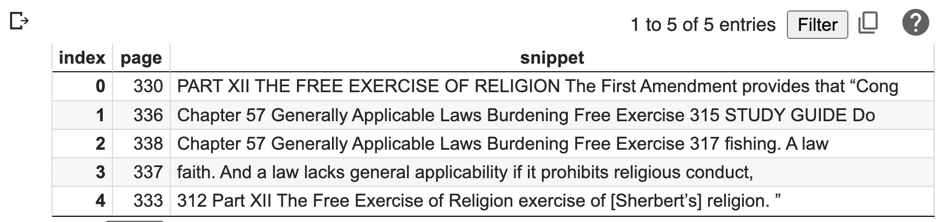
Perfectly respectable. But probably even without ingesting the wisdom of Professors Barnett and Blackman, ChatGPT could have done decently on that softball. Indeed, if all we are considering is text completion, vanilla ChatGPT should be able to compete well with my augmentation version so long as the questions are in areas that ChatGPT already knows about, such as the line of cases and statutes going through Employment Division v. Smith. But then I asked for something more. I asked it for pinpoint sources so that the student could go to the book and read more fully what it said. That's a variant of semantic search that ChatGPT does not presently do. Here's its response.

And now the student can see whether ChatGPT was hallucinating and learn more about the Sherbert to Smith to RFRA to Boerne to Fulton saga. That's a better outcome than ChatGPT alone.

Perhaps that question wasn't challenging enough. Let's give it some facts from a new court case that ChatGPT couldn't have been trained on back in 2021. They come from the website of the Alliance Defending Freedom; my use of them does NOT mean I agree with what is being claimed.

"`The Oregon Department of Human Services (ODHS) requires that people seeking to adopt must "respect, accept, and support" the sexual orientation  and/or gender identity of any child who ODHS could place in the applicant's home. This guidance obligates parents to agree to use a child's preferred pronouns,  take a child to Pride parades, or facilitate an adolescent's access to medical  interventions like puberty blockers and cross-sex hormones.  But such rules would force Jessica to violate her religious beliefs.  Jessica believes that God created humans as male and female and that a person's God-given  sex has spiritual significance for who we are and how we should act.  And she believes that a person cannot choose his or her gender because a person's identity is inextricably intertwined with their sex. As a Christian, Jessica always seeks to speak the truth, and as a mother, she desires to raise her children in the faith. Therefore, she cannot say anything to affirm that a person can identify as a gender that is not aligned with the person's biological sex. During her application process, Jessica alerted ODHS that she will gladly love and  accept any child, but she cannot say or do anything that goes against her Christian faith.  In response, ODHS gave her two choices: abandon your religious convictions or forego the possibility of ever adopting a child. When Jessica stood her ground, ODHS rejected her application for failing to "meet the adoption home standards.' If Jessica sues Oregon, will she win? Tell me the key constitutional doctrines and precedents."

Here's the response from ChatGPT mediated by the text I had it specially ingest. I asked it for less than 500 words.

"The case you describe raises potential issues related to the First Amendment's Free Exercise Clause and the Fourteenth Amendment's Due Process and Equal Protection Clauses. Under the Free Exercise Clause, individuals have a constitutional right to practice their religion and the government cannot prohibit or penalize individuals based on their religious beliefs. In this case, Jessica is arguing that the ODHS is penalizing her by rejecting her adoption application because of her religious beliefs about gender and sexuality. Jessica may argue that the ODHS policy violates her Free Exercise rights because it compels her to express beliefs that conflict with her religious beliefs. However, the Supreme Court has also emphasized that the government can sometimes impose neutral and generally applicable laws on religious individuals or institutions. In Employment Division v. Smith (1990), the Court ruled that the Free Exercise Clause does not provide a right to exemptions from neutral and generally applicable laws. However, some states, such as Oregon, have passed laws that provide greater protection for religious exercise than required by the federal Constitution. Under the Due Process and Equal Protection Clauses, Jessica may argue that the ODHS policy violates her right to parent and raise her children as she sees fit, as well as her right to equal treatment. In Troxel v. Granville (2000), the Supreme Court held that parents have a fundamental right to make decisions concerning the care, custody, and control of their children. In this case, Jessica may argue that the ODHS policy infringes on this fundamental right by requiring her to violate her religious beliefs. Jessica may also argue that the ODHS policy discriminates against her based on her religion. Under the Equal Protection Clause, the government cannot discriminate against individuals based on their religion. Here, Jessica may argue that the ODHS policy targets her because of her religious beliefs about gender and sexuality, which would violate her right to equal treatment.

Ultimately, the outcome of the case would depend on the specific facts and circumstances, as well as how the court applies these constitutional doctrines and precedents."

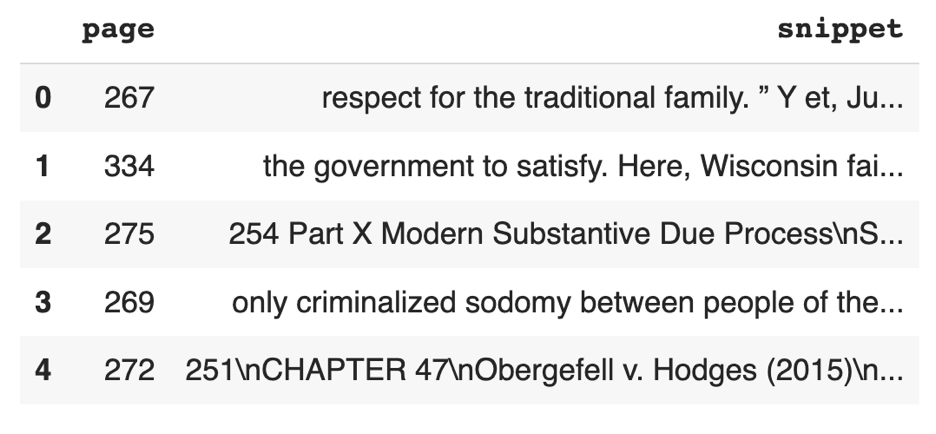
Good job, although that last sentence is the sort of pablum I would strike out on a student exam. But I like the Troxel citation, the reference to state RFRA's and the general framing of the dispute. And what I also like, again, is the fact that I can go back and see how ChatGPT based its response on the materials I had provided. Here are its top sources.

My point here isn't primarily about ChatGPT's answering capabilities, although even after a few months I continue to be astounded. And it's not really about Constitutional Law either, although I will share at the end of this article some of the other Q&A I had with Professor Barnett and Blackman's book. It's about how little you need to know right now to do exactly what I did.  And what I did is the rough equivalent – sorry Randy and Josh – to having office hours with the author of a constitutional treatise.

As long as you can get the materials in some reasonable digital format, law faculty law students, the average lawyer, indeed almost anyone with modest computer skills, can slurp text into a computer, split it up into reasonable chunks, send the chunks off to OpenAI or others' "embedders" that convert each of them into a vector of numbers, and then send these "embedding vectors," along with some metadata (like the page numbers or underlying text) into what is known as a "vector database" such as Pinecone that is optimized for exactly the process described here. The cost of "semantic search" has been reduced by many orders of magnitude. Once I had my Python program written (see discussion below), the whole process for the 400-page book took about a minute and cost me about 10 cents – OpenAI charges a small amount to embed text. And while, yes, today, the process I described did take some computer savvy, because I'm thoughtfully sharing the code, you can now do it too. Also, lest you be overly impressed, ChatGPT was a huge help along the way. One thing that neural network does really, really well is to write, adapt and debug Python code.

And what I did is amateur. Although I am a 33-year veteran of Wolfram Language (Ok, so I'm not a newbie to computer science), my knowledge of Python is genuinely limited. Others will not be challenged. Within a few months, there is surely going to be an app in which you just tell the computer what files to ingest, wait a few minutes, and receive a link to plugin to which you can point ChatGPT. Once you have that plugin, you can then commence an endless fireside chat with the corpus you uploaded. Indeed, it doesn't have to be a single chat. You could have multiple corpuses loaded and see how the two of them interact with each other. Imagine a synthetic dialog between GPT-Williston and GPT-Corbin on contract law or GPT-Scalia and GPT-Kagan battling over the nature of substantive due process. (At least the discussions would be well written!).

Yes, yes, there are issues. How are students going to learn anything when they have perpetual office hours and can just ask the machine? What about irksome intellectual property issues. I cleverly avoided the wrath of these authors by not returning full text from the sources. I just provide pointers that let owners – including new owners -- of the underlying material search it with pinpoint accuracy.  Surely, as is always the case, the pioneers in this area will be the porn industry. And who knows what profits the owners of digital rights will charge for permitting strong semantic search on materials otherwise difficult to get in digital form. It might make the cost of today's casebook supplement look like a pittance.

In the meantime, however, rejoice and think of positive use cases. I'm thinking of abolishing office hours and just uploading transcripts of my classes and exports from the PowerPoints right into ChatGPT. (Just kidding, dean). Or take every brief from some organization and see if AI can find inconsistencies. Or, if I were a practitioner, stop paying a fancy vendor and just create a DIY semantic search engine to pour over my opponent's document production.

Who knows where we are heading? I rather suspect this column will seem quaint in a very short time and that I may be expressing undue excitement about the fax machine of generative AI. But if the lack of serious impediments in my foray is representative, wherever we are headed, we are going to get there very fast.

  Read More

Unikowsky on Judge Kacsmaryk's Mifepristone Decision

Worth a read.

|

Adam Unikowsky is a biglaw partner, and a former law clerk to Justice Scalia, who has an active Supreme Court practice.  In his free time, he has started up an excellent Substack on legal issues (mentioned here before by Jonathan Adler).  I've enjoyed each post; they each combine serious legal analysis with really strong writing.  Unikowsky's latest is a takedown of Judge Kacsmaryk's Mifepristone decision.  Unikowsky's overview: "The decision is indefensible. In this post, I will walk through the decision and explain just how bad it is."

The post is thorough and quite a read, going through what Unikowsky presents as error after error after error after error.  Here's just a taste:

The court then claims that "Plaintiff medical associations have associational standing via their members' third-party standing to sue on behalf of their patients." (p. 9). This section reveals that the court does not understand what "third-party standing" means.

"Third-party standing" is something that plaintiffs sometimes have to show in addition to—not instead of—Article III standing. Plaintiffs always, 100% of the time, have to show what the Supreme Court has called the "irreducible constitutional minimum" of standing under Article III—(1) a concrete and particularized injury, that is (2) caused by the defendant's action, and (3) redressable by the requested relief. In some cases, a plaintiff that has standing asserts that some action harming them is illegal because it violates someone else's rights—in which case they bear the additional burden of showing they are entitled to assert the rights of that third party, i.e., third party standing.

Lawsuits by abortion providers challenging abortion restrictions are a classic illustration of the third-party standing doctrine in action. In most cases, especially pre-Dobbs, abortion restrictions target abortion providers rather than women seeking abortions: if a provider performs an abortion in violation of state law, the provider is punished. Abortion providers who sue states seeking to enjoin abortion restrictions have obvious Article III standing. They face a concrete and particularized injury (the state if going to shut them down and incarcerate their doctors if they perform illegal abortions); it's caused by the state, which enforces the law; and an order enjoining the state from enforcing the law would redress the injury.

In challenging those laws pre-Dobbs, the providers would claim that the laws are unconstitutional because they violate their patients' constitutional right to an abortion. Thus, although the providers were the direct targets of the law, the providers' legal theory was that the laws were unconstitutional because they violated the constitutional rights of third parties—i.e., their patients. In this context, courts would consider whether the providers were permitted to assert the legal interests of their patients under a doctrine known as "third-party standing," or whether instead the plaintiffs had to be women seeking abortions. So, for plaintiffs who already had Article III standing, courts would consider whether the plaintiffs also had third-party standing.

The district judge doesn't understand this. He says: "The injuries suffered by patients of the Plaintiff medical associations' members are sufficient to confer associational standing" (p. 10). In other words, he thinks that if hypothetical patients have Article III standing, this means that the doctor-members of the plaintiff organizations can also assert "third-party standing" without a showing that the doctor-members themselves were injured. Standing does not work this way, this is completely wrong.

Even if standing did work this way, the court's application of the doctrine would still be wrong…..

You can read and sign up for Unikowsky's Substack free here.

Politics

Apply for the 10th Annual James Wilson Fellowship

"The Institute will make a place for up to 15 Fellows who are law students, clerks, or lawyers and legal academics only a few years out of law school."

|

I am happy to pass along this announcement from my friends at the James Wilson Institute:

10th Annual James Wilson Fellowship

August 6-11, 2023

Washington, D.C. Area

Deadline to Apply: April 19, 2023

Professor Hadley Arkes, joined by other distinguished scholars, will offer an in-person seminar over six days in the Washington, D.C. area, on Natural Law and its bearing on our jurisprudence. The course will focus on discussing the central points of a jurisprudence of Natural Law, such as the classic connection between the "logic of morals" and the "logic of law," the properties of moral truths and the principles of judgment, and how we would see certain landmark cases differently if they were viewed through the lens of Natural Law. Our main objective is to restore a moral coherence to our jurisprudence.

Topics discussed in past seminars have included, "The Natural Law, the Positive Law, and the American Regime"; "The Natural Law and Ordinary Language: Recovering the Philosophic ground for the Restriction of Assaulting Speech Acts"; "Abortion, Privacy, and the Law: Who is the Bearer of Natural Rights?'"; and "Religion and the Law." To read the biographies of our 2022 faculty, please visit here.

The Institute will make a place for up to 15 Fellows who are law students, clerks, or lawyers and legal academics only a few years out of law school. Each Fellow will receive a $500 stipend and additional funds partially to defray travel expenses. Accommodations, most meals, and entertainment will be provided. 

Application 

Please submit the following package of materials to be considered for the James Wilson Fellowship. An electronic package of materials in PDF files isgreatly preferred, though not required:

  1. Personal Information: Full name, DOB, mailing address, preferred telephone number, and email.
  1. Resume/CV: Undergraduate and graduate education with degrees expected, professional experience, fellowships, internships, awards, and publications.
  1. Personal Statement: In 500 words or fewer, please explain what draws you to the Fellowship for the James Wilson Institute and this project on the recovery of Natural Law: why are you interested in spending a week with peers studying Natural Law and its connection to our jurisprudence? Have you done any reading on the subject, or are you interested in acquiring a firmer hold on it? Have you read any of Professor Arkes's writings, with his own perspective on Natural Law?
  1. Legal Writing: A journal article, legal brief, course paper, or other relevant piece excerpted up to 15 pages.
  1. Contact Information: Two References, Academic or Professional.
  2. Official Academic Transcripts: All undergraduate and graduate work may be submitted separately from the application package via undergraduate and graduate transcript services.

All electronic application materials may be emailed to: Fellowships at JamesWilsonInstitute.org 

All physical application materials may be sent to: 

James Wilson Fellowship, Attn: Garrett Snedeker, 124 S. West St., Suite 200, Alexandria, VA 22314 

A complete application package is due no later than 11:59 pm on April 19. Candidates will be notified no later than April 28. 

Please email any questions to staff at jwinst.org 

Politics

"Viability" in Lucas v. South Carolina Coastal Council and Planned Parenthood v. Casey

Justice Blackmun: "Viable is a good medical term, it isn't a legal term, but the lawyers have taken it over and the judges too."

|

Lucas v. South Carolina Coastal Council held that the government must provide compensation if a regulation deprives the owner of all "economically viable use" of his property. Lucas was argued on March 2, 1992 and Justice Scalia handed down the majority opinion on June 29, 1992. Here is a colloquy from that argument:

JUSTICE BLACKMUN: We're throwing around the term no economic viability of this property. . . . Viable is a good medical term, it isn't a legal term, but the lawyers have taken it over and the judges too. What do you mean by economic viability? . . .

MR LEWIS: So I think when you go down and you take a piece of property from uses down to no uses and from $1 million down to $0, you have a taking under our Constitution regardless of what--

JUSTICE BLACKMUN: That's hardly the medical definition of an old-time term of being viable.

Viability was apparently on Justice Blackmun's mind in Lucas. With good reason.

Planned Parenthood v. Casey was argued the following month on April 22, 1992, and was decided on June 29, 1992. And we know all-too-well that the Casey plurality adopted the viability line as part of the undue burden framework. (Well, everyone but Chief Justice Roberts, at least.)

I had never connected that two Supreme Court decisions, decided on the day, both turned on the concept of viability. In Lucas, the majority opinion per Justice Scalia, concluded that "viability" was a useful line for the Takings Clause; in dissent, Justice Blackmun thought "viability" was not a useful line. Meanwhile, in Casey, the plurality relied on the "viability" line, while the dissenters rejected this line. Of course, economic viability and fetal viability are very different concepts. Still, there is some disconnect.

Finally, Justice Blackmun's dissent in Lucas includes this sentence:

There is nothing magical in the reasoning of judges long dead.

Such a sentence is apiece with another claim Justice Blackmun wrote on June 29, 1992:

I am 83 years old. I cannot remain on this Court forever, and when I do step down, the confirmation process for my successor well may focus on the issue before us today.

Justice Blackmun likely missed the disconnect here as well.

The "Denominator" Problem At Stanford Law School

At what point does a permissible protest turn into unlawful heckling?

|

I am now teaching the Takings unit of Property Law. In this somewhat incoherent body of caselaw, the Supreme Court often grapples with a recurring theme: what is the relevant denominator. In other words, when the government regulates a person's property, should the court consider (i) only the part of the property that is being regulated or (ii) the "parcel as a whole," including the parts of the property that are not being regulated. If you follow the first path, then ~100% of the person's relevant property interest is being regulated, and there is almost certainly a taking. If you follow the second path, then a smaller percentage of the person's property interest is being regulated, and there is likely no taking.

In 2018, as many will recall, I was protested at the CUNY Law School in New York. Depending how you count, my speech was disrupted for the first eight minutes or so. During that chaotic period, I was not able to speak. At around the eight-minute mark, the protestors departed. After that point, I was no longer heckled. I decided not to give my prepared speech, but rather sought to do Q&A. Even after the incident, I remained conflicted on whether my speech was disrupted. Indeed, I turned to (of all things) takings law to help address that issue. What was the relevant denominator? Was it the eight-minute segment that was entirely disrupted? Or was it the planned hour-long speech, of which about eight minutes was disrupted? I discussed this issue at some length in the First Amendment Law Review, starting at Page 46. Specifically, I explain that the "parcel as a whole" framework may work for a concrete property interest, but is a poor fit for a dynamic protest in which the outcome is uncertain:

But the "parcel as a whole" test is a very poor fit for free speech jurisprudence. This property-centric approach presumes stability while campus protests are volatile. In Penn Coal, the parties understood exactly how much land could not be mined. And in Penn Central, the parties knew exactly how much of the train station could still be utilized. That model works for metes and bounds. It doesn't work for a real-time discourse. Hindsight is always 20/20. When the event began, I had no idea how long the disruption would last. For all I knew, the students could have made noise nonstop. Why did the students at CUNY not protest me for the full hour? I take some credit. Rather than trying to deliver my lecture as planned, or shout over the students, I tried to engage them. I asked them questions to try to forge a common ground. That strategy defused the situation. But it could have backfired. The students could have shouted at me for the entire hour—or worse, continuously clanked a cowbell! The event also could have turned violent. Even after the students exited, I had a concern they would return at some point.

I think a similar dynamic was at play at Stanford Law School. The students heckled Judge Duncan during the first portion of the event. Dean Steinbach came to the podium and proceeded to criticize Judge Duncan. After Steinbach gave her spiel, many of the protestors left. Judge Duncan tried to answer questions for some time, but was unable to deliver his original speech. How do we measure whether there is a disruption? The New York Times interviewed Nadine Strossen about this issue:

Holding vulgar signs or asking pointed questions or even making gagging noises — as many students did when Judge Duncan was introduced — does not necessarily violate the university's policy.

In her memo, Dean Martinez said she would not take action against individual students, citing the difficulty of distinguishing between protected speech and unprotected speech.

"Are 10 minutes of shouting out of an hour-and-a-half-long event too much?" said Ms. Strossen, the free-speech crusader. "That is a matter of judgment and degree."

If you get the balance wrong, Ms. Strossen said, then you risk chilling speech on the other side.

I don't know that it is fair to use the 10-minute mark with the benefit of hindsight. In an ideal world, shortly after Duncan started, an administrator not named Steinbach should have issued a firm warning. If anyone continued to heckle after that warning, the student should be deemed to have violated the policy. The "denominator" cannot be that the planned event that was never allowed to transpire.

The Times also offers some new information that puts Dean Steinbach in a somewhat more favorable light. In particular, Tim Rosenberger, the FedSoc chapter President offers some praise of Steinbach.

To begin with, Ms. Steinbach had a cordial, productive relationship with the leader of the student-run Federalist Society, Tim Rosenberger Jr. Ms. Steinbach, who started at Stanford in 2021, said she wanted to expand the role of D.E.I. to include groups like veterans, older students and conservatives. She viewed herself as a bridge builder. Mr. Rosenberger, for his part, said he wanted a Federalist Society chapter that was better integrated into the university and had found that she was willing to engage in ways that many students, professors and administrators, to Mr. Rosenberger's disappointment, would not.

Moreover, Steinbach helped to moderate a FedSoc event with that right-wing ideologue Nadine Strossen:

In January, when Mr. Rosenberger could not find a co-sponsor for an event with Nadine Strossen, a former head of the American Civil Liberties Union and a champion of free speech, he found a partner in Ms. Steinbach, who moderated the event. "That took some courage," he said. Ms. Strossen said she had spoken to many Federalist Society chapters in recent years and had noticed that, especially since the Jan. 6 attack on the Capitol, the group had become effectively "blacklisted" at many law schools. This backdrop, Ms. Strossen said, made Ms. Steinbach's enthusiastic participation in the event "extraordinary."

What the hell does it say about Stanford that no one would speak with the former head of the ACLU? Nadine is a national treasure. How sad. Props to Steinbach for behaving cordially with the "right" kind of FedSoc guest. Judge Duncan, however, would receive a very different treatment.

Next, the Times turns to Steinbach's role on the day of Judge Duncan's visit. First, we learn that Dean Martinez had approved the email Steinbach sent out:

On the morning of Judge Duncan's talk, Ms. Steinbach sent an email to the entire law school, approved by Dean Martinez. She summarized the concerns that students had with Judge Duncan but said that students who tried to stop speech "would only amplify it," and she linked to the free-speech policy. Ms. Steinbach's connection to students might have made her confident that she could be the broker between the two sides. But during a free-speech conflagration, who should play the role of enforcer? And how should that message be delivered?

I had long suspected that Steinbach at least thought she had the backing of the administration. This datapoint provides more support. Dean Martinez may have more blame than we know.

The university had made other preparations. Law school administrators had warned university officials that students could run afoul of the university's speaker policy that day, according to an email obtained by The Times. The university sent an official to join others representing the law school. But when the judge asked for an administrator, it was Ms. Steinbach who stepped up to the podium.

It was never clear to me why Steinbach, of all people, came to the podium when Judge Duncan asked for an administrator. Even worse, why did no one go to the podium earlier when there was relentless heckling? It was not Judge Duncan's job to signal for help.

Steinbach explains that she viewed her role as de-escalating the crisis. And, for the first time, Steinbach acknowledged that she erred--sort of. I think this statement is a cop-out. The university had a policy that she ignored. Instead, she took 6 minutes to attack an invited speaker on behalf of the administration.

"My role was to de-escalate," Ms. Steinbach said. She wanted to placate students who said they were upset with Judge Duncan — "and to, I hoped, give the judge space to speak his prepared remarks." In hindsight, she said, she did not get the balance right. She noted, however, that she had been speaking to students in the room, and did not realize that her words would be blasted out to the world.

Oh come on. The event was being recorded by the school, and countless phones. She spent time crafting her words carefully. She had to know her words would be broadcasted worldwide. I don't believe she is so naïve.

Rosenberger, the chapter President, faulted Steinbach to a degree:

Mr. Rosenberger said that he had been upset by Ms. Steinbach's remarks in the lecture hall but that she had been something of a "scapegoat" for the university's broader failure to protect speech.

He said that he wished an official had stepped to the podium and warned students that further disruption would be in violation of the university's free-speech policy — but that Ms. Steinbach, as D.E.I. dean, was not that messenger.

"If she was the administrator whose job was to enforce the no-disruption policy, then yeah, she totally failed, but that's not her job description," Mr. Rosenberger said. "People have called her stupid and incompetent. She's a smart and good person who was just put in a really bad spot."

Again, why did Steinbach go up there to deliver a prepared six-minute remark? She obviously had intended to speak to the room. This wasn't impromptu. Dean Martinez again throws Steinbach under the bus:

Dean Martinez, in an email to The Times, said that one of the problems that day was a "lack of clear communication" among administrators in the room. But she laid at least part of the blame with Ms. Steinbach.

"Regardless of what should have happened up to that point," she wrote, "when Judge Duncan asked for an administrator to help restore order, it was Ms. Steinbach who responded, introduced herself as an administrator, and then delivered remarks."

For whatever reason, Steinbach deemed it her role not to enforce university policy, but to engage in conflict resolution. Again, the DEI administrator misunderstood her role on campus.

I'll have much more to say about this topic in a future column.

Property Rights

Zoning Restrictions Spread to New Areas, Making Housing Crisis Worse

Harvard economist Edward Glaeser describes a dangerous trend. But a cross-ideological tide of reform might help reverse it.

|

NA

A broad consensus of experts agree that zoning restrictions on the construction of housing are extremely harmful, and need to be cut back.  In a recent City Journal article, Harvard economist Edward Glaeser - arguably the nation's leading scholar on this subject - describes how  the problem has gotten worse in recent years, with regulations tightening in many areas:

The overregulation of American housing markets began in the nation's coastal, educated, productive enclaves. Over time, however, barriers to building have spread. Tony suburbs of Phoenix and Austin, which once left their builders free to construct plentiful affordable housing, have now become almost as restrictive as the Boston area.

The expansion of land-use regulations will have an enduring impact on the cost of American housing. The web of restrictions pushes prices up by limiting the number of houses that can be built and deters development through the uncertainty that it creates. Since the permitting process often allows only tiny one-off projects, American builders can't exploit the economies of scale that have made almost every other manufactured good far more affordable.

The consequences of land-use regulations go beyond high housing costs. Since people can't afford to move into areas that don't build, America's most productive places have remained too small. The nation's gross domestic product is therefore lower than it could be with a more rational housing system, and poverty too often gets frozen. Housing-price bubbles are more extreme when the housing stock is fixed, too, so the country courts financial chaos by refusing to make building easier…

While the coasts were the initial epicenters of overregulation, 61 percent of the non-coastal West and 53 percent of the non-coastal East became substantially more regulated between 2006 and 2018. By contrast, 34 percent of the non-coastal East and 28 percent of the non-coastal West reduced regulation; 52 percent of the Sunbelt became more regulated, and 33 percent less regulated……

Across the country, the biggest regulatory changes were seen in minimum lot sizes and the number of entities required to approve any rezoning. In 2006, 28 percent of communities had a minimum lot size of one acre. By 2018, 39 percent of communities in the sample had a minimum lot size greater than one acre. The share of communities where a rezoning required approval by at least three entities went from 22 percent to 45 percent.

This creep of regulation means that restrictive zoning is no longer just a problem for New York and San Francisco. Regulatory curbs on new building are now part of life around much of the United States, and that has pernicious effects that go far beyond just pushing up prices….

This closing of the metropolitan frontier has macroeconomic implications. Again, restricting the supply of something that is in demand will make asset bubbles far more likely—and these, if large enough, can have a massive destructive impact when they burst, as they did in 2007…..

The second macroeconomic point is that restricting housing growth means limiting the movement of poor people to rich, productive places. Throughout our history, Americans have moved in search of economic opportunity….. That process of relocation has slowed greatly because poor people cannot buy or rent homes in the prosperous areas of technological progress, such as Silicon Valley…

Local land-use regulations also make America more unequal. My colleague Raj Chetty and his coauthors have produced an "opportunity atlas" that shows where poor Americans have the best chances of growing up to be successful. Their primary measure of opportunity is the adult income of children whose parents were poorer than three-fourths of their contemporaries at the time when the child was born…. [L]and-use regulations are strictest in areas that offer poor children the most economic opportunity.

The data cited by Glaeser is simultaneously compelling and depressing. It shows that the already severe problem of exclusionary zoning has been getting worse.

If there is some room for optimism here, it's that most of the studies  Glaeser cites were conducted too soon to take account of the growing wave of zoning reforms enacted in recent years, such as the abolition of single-family zoning in Oregon, a number of recent enactments in California and Connecticut, and much else. States as varied as New York, Massachusetts, Utah, Montana, and Virginia are in the process of implementing or considering major reforms this year. Progress will be difficult, as there are powerful "NIMBY" ("not in my backyard") interests arrayed against it. Public ignorance of the relevant economics is also a factor.

Nonetheless, it is noteworthy that there is a substantial cross-ideological movement for reform. Glaeser's take on the issue has much in common with that of people as varied as Virginia Republican Gov. Glenn Youngkin and Hawaii Democratic Senator Brian Schatz, who recently made the case for reform in the Slate:

As a Democrat, I come from a long tradition of progressivism based on helping people. But one of the areas where I think the Democrats have it wrong, traditionally, is that we're actually creating a shortage of the thing that we say we want. We are making it incredibly difficult to create housing, and then we sort of puzzle through what to do about it. And the solution is very simple, in fact. We need to make it legal to build housing of all kinds.

This should be attractive to people who are progressive, because we have a massive nationwide housing shortage. But also, people who are right of center should be attracted to the basic property rights argument, which is that, hey, it's your land—you own it.

I couldn't have put it better myself! This is indeed the biggest American property rights issue of our time, more so even than eminent domain abuse, even though I have devoted much of my work to the latter. It's also blocking opportunity for the poor, and thereby stunting economic growth and innovation. And the solution is indeed "to make it legal to build housing of all kinds."

FDA

Two (Wrong) Mifepristone Court Rulings in One Day

On Good Friday, two district courts issued decisions on the FDA's approval of the abortion drug mifepristone.

|

Late yesterday, a district court in Texas issued its much-anticipated ruling in Alliance for Hippocratic Medicine v. Food and Drug Administration, a challenge to the FDA's approval of the abortion medication mifepristone, which has been on the market for over two decades. As some hoped and others feared, the court ruled against the FDA, concluding that mifepristone should not be an approved medication.

By an amazing coincidence, a second district court, this one in Washington State, issued its own ruling in a competing mifepristone lawsuit soon after the Texas decision, issuing an order barring the FDA from altering the status of mifepristone, at least in the plaintiff states. (Interestingly enough, this is not the only time we've seen dueling opinions on a high-profile health-law question issued on the same day. The same thing happened with Halbig v. Burwell and King v. Burwell in 2014, creating a circuit split in a matter of hours. Go figure.)

I previewed some of the arguments in each case in prior posts. Here and here I explained why the district court in Texas lacked jurisdiction to hear AHM's claims against the FDA. Among other things, the plaintiffs lack standing, did not file within the relevant statute of limitations, and did not exhaust their administrative options. Nothing in the district court's opinion changes my view of these arguments. If anything, it reinforces them. Among other things, the court makes clear that the conclusion that AHM satisfies Article III standing requirements rests on outlier decisions like Havens Realty (which the Supreme Court may consider overturning, or simply abandoning, next term), which progressive groups like CREW tried to use in their emoluments litigation.

Additionally, the opinion's embrace of an expansive conception of equitable tolling and refusal to enforce the administrative exhaustion requirement rest on the most gossamer of threads -- the analysis reads more like what one would expect in a time-limited law-school exam than a thoughtfully considered judicial opinion. And the invocation of Section 705 of the Administrative Procedure Act to justify the unusual remedy of issuing a stay of the FDA's 2000 approval of mifepristone is too clever by five. No matter what one thinks of abortion or the availability of mifepristone, this opinion is hard to defend (and that's without getting into the merits of the issue).

As it happens, the second decision is no better. For reasons I explained here, the plaintiff states in that case face equivalent jurisdictional hurdles in demonstrating standing and exhaustion, particularly insofar as they were suing to maintain the status quo (as opposed to challenging the FDA's existing mifepristone rules as too restrictive). The Washington district court barely engages these arguments, waiving them away with conclusory statements unaccompanied by any meaningful analysis. It is enough to make a cynical observer think that the opinion was rushed for release, perhaps explaining the coincidental timing. Whatever the faults of the Texas ruling -- and there are many -- at least there is substantive analysis to critique. The Washington decision is more like a punt. Its one saving grace is that it does not attempt to justify nationwide relief and instead limits the effect of its injunction to the plaintiff states.

Where does this all leave us? The Texas decision stayed the effective date FDA's 2000 approval of mifepristone -- in effect suspending the approval (with a caveat that it would revoke the approval if the U.S. Court of Appeals for the Fifth Circuit disapproves of the court's use of APA Section 705 in another case), but has also stayed the effective date of the decision by seven days to afford the government time to appeal. Meanwhile, the Washington decision has enjoined the FDA from "altering the status quo" concerning its regulation of mifepristone as of the FDA's January 2023 rules governing prescription and distribution of the drug within the plaintiff states. Thus, at least within those states, we would appear to have dueling injunctions (as happened with the DACA litigation), virtually guaranteeing quick action from appellate courts, if not the Supreme Court itself.

I hope to have more to say about both of these decisions shortly, time permitting.

Politics

Short Circuit: A Roundup of Recent Federal Court Decisions

Scooter injuries, loyalty oaths, and Canadian barrels.

|

Please enjoy the latest edition of Short Circuit, a weekly feature written by a bunch of people at the Institute for Justice.

Debate! Tune in online on Monday, April 24 at 8pm Eastern to see IJ's own Anthony Sanders debate Prof. Kurt Lash on Baby Ninth Amendments?: State Constitutions & Unenumerated Rights. Hosted by the Federalist Society's student division and the Charleston School of Law's chapter. Click here to register.

Read More

More