The Supreme Court has accepted certiorari in Carnahan v. Maloney to consider whether members of Congress can sue to force disclosure of information from the General Services Administration.
Today the Supreme Court granted certiorari in Carnahan v. Maloney, which presents the question "whether individual Members of Congress have Article III standing to sue an executive agency to compel it to disclose information that the Members have requested under 5 U.S.C. 2954." This case will likely produce an important ruling on the scope of Article III standing by members of Congress and (if I may dare a prediction) the ultimate decision will likely constrain the tendency of some members of Congress to litigate when they should legislate.
The case arises from a long-running effort of members of the House Committee on Government Operations to obtain information from the General Services Administration about its management of the Old Post Office building which was leased to the Trump Old Post Office LLC for purposes of operating the Trump Hotel. Members of Congress feared, with some justification, that the terms of the least may have violated federal law given Donald Trump's financial interest in the hotel.
5 U.S.C. § 2954 provides that seven members of the House Government Operations Committee can demand information from a federal agency, even if not a majority of the Committee. Citing this provision, several members of the Committee sought information about the lease. After the GSA refused to comply, the member of Congress filed suit.
In December 2020, a divided panel of the U.S. Court of Appeals for the D.C. Circuit concluded that the members of Congress had standing to sue the GSA. Judge Millett wrote for the panel, joined by Judge Tatel concluding that the members had suffered an informational injury that satisfies the requirements of Article III. Senior Judge Ginsburg dissented.
The GSA sought rehearing en banc, but that petition was denied last August. Judge Rao dissented, joined by Senior Judge Ginsburg and Judges Henderson, and Walker. Senior Judge Ginsburg also authored a solo dissent. Judge Millett concurred in the denial, joined by Judge Tatel.
I suspect Judge Rao's dissent was influential in the Court's decision to grant certiorari. It begins:
Mere months after the Uvalde school district suspended its entire police force for failing to effectively respond to a deadly shooting at an elementary school, school officials banned a concerned parent from school property — because he questioned the qualifications of a new police hire.
Today, the Foundation for Individual Rights and Expression demanded the Uvalde Consolidated Independent School District lift its ban against Adam Martinez, a father of two students in the district. The district banned Martinez from all district property for two years, including from school board meetings. FIRE's letter to UCISD threatens litigation if the district does not lift the unconstitutional ban by May 22, 2023.
One case in which the Court denied certiorari was Teva Pharmaceuticals USA v. GlaxoSmithKline LLC, which presented the question: "If a generic drug's FDA-approved label carves out all of the language that the brand manufacturer has identified as covering its patented uses, can the generic manufacturer be held liable on a theory that its label still intentionally encourages infringement of those carved-out uses?" The Order List notes that Justice Kavanaugh would have granted certiorari in this case.
The Order List further indicates that Justice Kavanaugh would have granted certiorari in two other patent law cases, Tropp v. Travel Sentry and Interactive Wearables v. Polar Electro Oy. As neither of these cases attracted significant amicus support, it suggests that Justice Kavanaugh is looking at cert petitions quite closely. It is also interesting that all three of these cases involved the Federal Circuit Court of Appeals. The Federal Circuit has exclusive jurisdiction in patent cases, so justices cannot rely upon whether there is a circuit split when deciding whether to grant certiorari.
This is not the first time Justice Kavanaugh has publicly noted his desire to hear cases in which his colleagues had little interest. As I noted last month, there have been at least two other instances in which Justice Kavanaugh dissented from the denial of certiorari this term.
[Note: This point has been revised to note the two additional cases in which Justice Kavanaugh indicated his desire to grant certiorari.]
In yesterday's New York Times, Michael McConnell explains why "The idea that the 14th Amendment gives the president unilateral power to borrow is dangerous nonsense." He writes:
Section 4 of the 14th Amendment, enacted in the wake of the Civil War, says: "The validity of the public debt of the United States, authorized by law … shall not be questioned." The immediate purpose was to prevent future Congresses (if controlled by pro-Confederate Democrats) from repudiating pension obligations and other debts incurred to win the Civil War. No doubt it applies beyond those narrow circumstances. But by its terms it does not authorize the president to borrow more money in violation of Article I, Section 8, Clause 2. Nor does it authorize the president to impose taxes in violation of Article I, Section 8, Clause 1. By its terms, it does not augment the president's powers one iota.
Nor does Section 4 have anything to do with payment of the national debt. It does not make it unconstitutional for the United States to run out of money. Nice idea, but impossible. Section 4 prevents the only institution of government that could deny the validity of the debt — namely, Congress — from doing so. For the United States to fail to pay interest or principal on its debt would be financially catastrophic, but it would not affect the validity of the debt. When borrowers fail to make payments on lawfully incurred debt, this does not question the validity of those debts; their debts are just as valid as before. The borrowers are just in default.
Moreover, even if the president were to issue new bonds without congressional authorization, the text of Section 4 makes plain that these bonds would not be constitutionally binding. Only public debt "authorized by law" — meaning by statute — has that status. Were Mr. Biden to issue bonds on his unilateral authority, the bond market would know that those bonds were not backed by the full faith and credit of the United States. Sensible investors would not purchase such bonds or would demand such a high risk premium as to make them uneconomical.
Professor McConnell's op-ed reminded me that this is not the first time we have heard these arguments. Indeed, I blogged on Professor McConnell's views about the debt limit over a decade ago in this post. It was one of a series of posts I wrote between 2011 and 2013 over the debt ceiling, the 14th Amendment, and platinum coin fantasies. (For some reason -- likely my error -- that listing excludes this post, noting then-Treasury Department General Counsel George Madison's insistence that the Department "has always viewed the debt limit as a binding legal constraint that can only be raised by Congress," and this post noting the history of government shutdowns.)
For those interested in more historical perspective on the use of debt ceiling standoffs to pursue other political goals, I recommend this paper from 1993 explaining how "the use of the debt ceiling vote as a vehicle for other legislative matters," had become a "pattern" in the mid-1970s and 1980s, and this Washington Post fact check noting the history of attaching non-budget items to debt ceiling increases.
Yevgeniya Berkovich, a Russian poet and theater director, has been arrested for supposed "justification of terrorism" in a play about Russian women who married jihadist men and went to Syria. (The play had been running for years, and which had won the Golden Mask national theater award last year.) Many seem to suspect, though, that the arrest had little to do with the play and much to do with Berkovich's opposition to the war.
Here is one poem of hers, which was written at least a year ago but which seems to have been widely shared in the last several days, on occasion of her arrest and of the May 9 Victory Day anniversary of victory in World War II; my apologies for the clumsy translation (Russian speakers should read the text for themselves). A few observations, based on my limited knowledge of modern Russian life: Both sides in the war, and especially the Russians, routinely invoke the heroism of the "grandfathers," the generation of men who had fought against the Nazis in World War II. The "immortal regiment" refers to Victory Day parades in which people carry photographs of their relatives who fought on the front lines. "The Ninth Wave" is a famous painting in the Russian Museum. Prishvin is a famous Russian children's writer. Sergey, I think, is just a generic Russian Everyman name; to my knowledge, it doesn't refer here to anyone in particular. Seriozha is the standard nickname for Sergey, and Seriozhenka is a standard further diminutive, used affectionately. As you will see, the poem shifts in voice from the narrator to the grandfather to the grandson.
Either he overloaded on the news,
Or it was the wine with dinner,
But at night Sergey was visited by his grandfather, who had fought.
He sat down on the Ikea stool, blocking with his back the courtyard
Behind the window. I need to have, he says, some words with you, Seriozhenka.
White v. Discovery Communications, LLC, decided Wednesday by the Florida Court of Appeal, rejected a man's libel claim against Netflix, on jurisdictional grounds (stemming in part from a particular procedural feature of the case), and against Microsoft on § 230 grounds. The facts are interesting, though largely beside the point for this post:
[Nathaniel] White sued various nonresident defendants for damages in tort resulting from an episode of a reality/crime television show entitled "Evil Lives Here." Mr. White alleged that beginning with the first broadcast of the episode "I Invited Him In" in August 2018, he was injured by the broadcasting of the episode about a serial killer in New York also named Nathaniel White. According to the allegations in the amended complaint, the defamatory episode used Mr. White's photograph from a decades-old incarceration by the Florida Department of Corrections. Mr. White alleged that this misuse of his photo during the program gave viewers the impression that he and the New York serial killer with the same name were the same person thereby damaging Mr. White….
[Mr. White's] complaint … alleged that Microsoft used search engines "through the internet or any other internet service" to make the defamatory statements available to others. According to paragraph 50 of the amended complaint, Microsoft's use of search engines and other internet services made it, and certain other defendants, "information content publishers." Mr. White sought to hold Microsoft liable for publishing the allegedly defamatory episode….
And here's the reasoning of Judge Robert Long's concurrence:
I concur with the Court that under section 230(c)(1), Microsoft cannot be treated as a publisher of the defamatory statements in this case. But if section 230 did not exist, Microsoft may be liable under Florida law for republishing the defamatory material. See Doe v. Am. Online, Inc. (Fla. 2001) ("[E]very repetition of a defamatory statement is considered a publication.").
I question section 230(c)(1)'s constitutionality as applied to state defamation law. 47 U.S.C. § 230(e)(3) ("No cause of action may be brought and no liability may be imposed under any State or local law that is inconsistent with this section."); Doe (holding section 230(c)(1) preempts state defamation law)….
[This post is co-authored with Seth Barrett Tillman.]
Last week we shared the third-installment in our ten-part series on the offices and officers of the Constitution. Here, we will share the near-final draft of the fourth installment: Offices and Officers of the Constitution, Part IV: The "Office . . . under the United States" Drafting Convention. The phrase "Office . . . under the United States" is used in four provisions of the Constitution of 1788: the Elector Incompatibility Clause, the Impeachment Disqualification Clause, the Incompatibility Clause, and the Foreign Emoluments Clause. Tillman has written about this language since 2008, and we have written about the phrase "Office . . . under the United States" during the four years of the Foreign Emoluments Clause cases. This article provides a synthesis of some of that work.
Here is the abstract:
This Article is the fourth installment of a planned ten-part series that provides the first comprehensive examination of the offices and officers of the Constitution. The first installment introduced the series. The second installment identified four approaches to understand the Constitution's divergent "office"- and "officer"-language. The third installment analyzed the phrase "Officers of the United States," which is used in the Appointments Clause, the Impeachment Clause, the Commissions Clause, and the Oath or Affirmation Clause. This fourth installment will trace the history of the "Office . . . under the United States" drafting convention.
This Article proceeds in eight sections. Section I introduces the British drafting convention: "Office under the Crown." For the last three centuries, this phrase has referred to appointed positions. And, in our view, this English and British legal tradition crossed the Atlantic—ultimately becoming part of a wider Anglo-American legal tradition. Section II considers the use of the "Office . . . under" drafting convention in the Articles of Confederation, which was ratified in 1781. Section III turns to the four clauses in the Constitution that use the phrase "Office . . . under the United States," albeit with some variations: the Elector Incompatibility Clause, the Impeachment Disqualification Clause, the Incompatibility Clause, and the Foreign Emoluments Clause. In our view, the phrase "Office . . . under the United States" refers to appointed positions in the Executive and Judicial Branches, as well as non-apex appointed positions in the Legislative Branch.
Section IV analyzes several reports prepared during President Washington's administration by the Treasury Department under its first Secretary of the Treasury, Alexander Hamilton. These documents support our position: the British "Office . . . under" drafting convention, which was used to distinguish between appointed and elected positions, had been adopted by Hamilton, a framer, and some of his contemporaries. Section V reviews an anti-bribery statute enacted by the first Congress. This 1790 statute, and other similar early federal statutes, provide further support for our position that the First Congress and early congresses adhered to the British "Office under" drafting convention. Section VI considers how the phrase "Office under the United States" was used during the American Civil War. At this time, more than seven decades after the framing, Hamilton's understanding of the "Office . . . under" drafting convention, as well as the documents he and his department had drafted, were still remembered and remained influential. Section VII surveys other nineteenth-century commentators who recognized the "Office . . . under" drafting convention, including Joseph Story. Section VIII revisits an 1809 state legislative debate concerning the 1776 North Carolina Constitution. Some participants in that debate, including a future state supreme court justice, recognized that the state constitution's "office"-language distinguished between appointed and elected positions.
These eight parts support our position: in the Anglo-American legal tradition, the phrase "Office under the . . ." was, and remains, a commonly-used drafting convention that refers to appointed officers. This phrase does not refer to elected officials.
In the article, we discuss Alexander's Hamilton 1793 Complete Report. This document was the subject of some attention during the Foreign Emoluments Clauses litigation. Part IV.C of the article, starting on p. 497, walks through the Hamilton imbroglio in some depth.
Part II of our article also provides a parsing of several provisions from the Articles of Confederation, starting on p. 461.
The fifth installment, will focus in particular on the four provisions in the Constitution of 1788 using the "Office . . . under the United States" drafting convention: Elector Incompatibility Clause, the Impeachment Disqualification Clause, the Incompatibility Clause, and the Foreign Emoluments Clause.
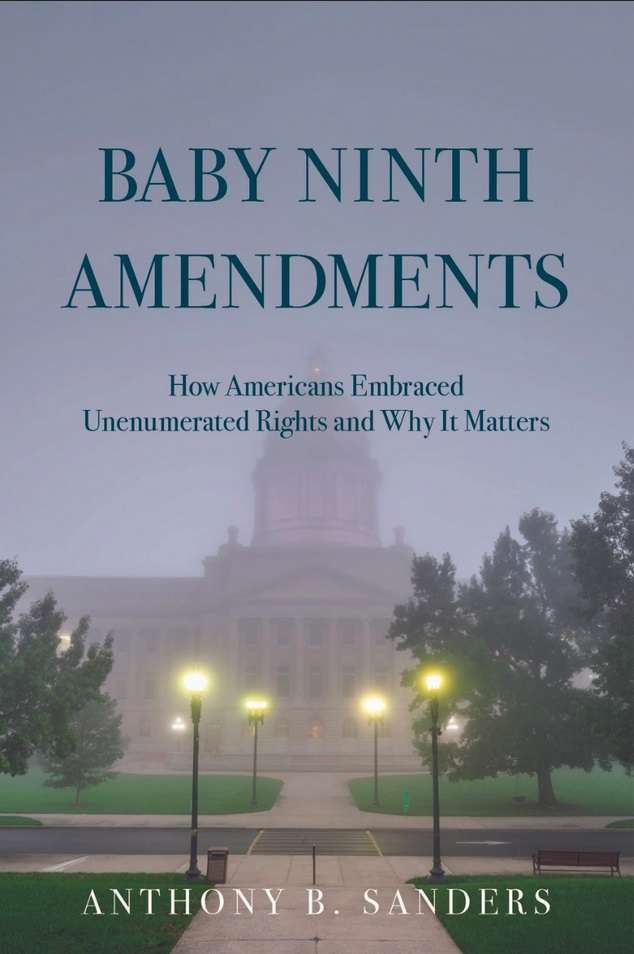
Thank you to Eugene and the rest of the Volokh Conspiracy for allowing me to post about my new book published by University of Michigan Press, Baby Ninth Amendments: How Americans Embraced Unenumerated Rights and Why It Matters. I've been a VC reader since my second year of law school (which was also the VC's second year!) and it's an honor to have this opportunity.
My book tells the largely unknown story of how Americans have solved a problem: How do we enumerate rights when we have an infinite number of them?
I start with a thought experiment involving an average American named Jane. Jane goes about her day making choices for herself and her family on her own terms. Some of these choices are pretty mundane: She chooses when to get up, what to eat, and what hobbies to pursue (gardening and stamp collecting in her case). Some are pretty important: She goes to work at a job that she chose over other options, sends her child to a school she chose, and repairs part of her house with her own labor.
I'm delighted to report that Anthony Sanders, a senior attorney and Director of the Center for Judicial Engagement at the Institute for Justice—one of the country's foremost libertarian public interest law firms—will be guest-blogging this coming week about his new book:
Here's the summary, from the book jacket:
Listing every right that a constitution should protect is hard. American constitution drafters often list a few famous rights such as freedom of speech, protection against unreasonable searches and seizures, and free exercise of religion, plus a handful of others. However, we do not need to enumerate every liberty because there is another way to protect them: an "etcetera clause." It states that there are other rights beyond those specifically listed: "The enumeration in the Constitution, of certain rights, shall not be construed to deny or disparage others retained by the people." Yet scholars are divided on whether the Ninth Amendment itself actually does protect unenumerated rights, and the Supreme Court has almost entirely ignored it. Regardless of what the Ninth Amendment means, two-thirds of state constitutions have equivalent provisions, or "Baby Ninth Amendments," worded similarly to the Ninth Amendment.
This book is the story of how the "Baby Ninths" came to be and what they mean. Unlike the controversy surrounding the Ninth Amendment, the meaning of the Baby Ninths is straightforward: they protect individual rights that are not otherwise enumerated. They are an "etcetera, etcetera" at the end of a bill of rights. This book argues that state judges should do their duty and live up to their own constitutions to protect the rights "retained by the people" that these "etcetera clauses" are designed to guarantee. The fact that Americans have adopted these provisions so many times in so many states demonstrates that unenumerated rights are not only protected by state constitutions, but that they are popular. Unenumerated rights are not a weird exception to American constitutional law. They are at the center of it. We should start treating constitutions accordingly.
When I first started writing about political ignorance in the late 1990s, many academics and political commentators were inclined to dismiss the problem. Even if voters knew little about government and public policy, it was often argued, they could still be relied upon to make good decisions through a combination of information shortcuts and "miracles of aggregation." Since the rise of Donald Trump and similar right-wing politicians in many European nations, such complacency has diminished. The same recent history has given new credence to libertarian critics, such as Bryan Caplan, Jason Brennan, and myself, who argue that voter ignorance is a fundamental structural flaw of democratic processes, one that can only be effectively ameliorated through various types of constraints on the power of democratic majorities.
In two recent articles - an academic paper in the American Political Science Review and a popular piece in Democracy, political scientists Henry Farrell, Hugo Mercier, and Melissa Schwartzberg (FMS) try to push back against those they label as the "new libertarian elitists" (primarily Brennan, Caplan, and - possibly - me). Unlike more traditional academic defenders of the wisdom of democratic decision-making, FMS properly recognize that voter ignorance is a serious problem and that - at least in many situations - it is not likely to be overcome through simple information shortcuts or "aggregation" mechanisms in which voters' errors conveniently offset each other. But they still attack what they call libertarian critics' "elitist" approach, and also argue that democratic decision-making can be reformed to greatly alleviate the challenges of ignorance.
Unfortunately, they misconceive key elements of the libertarians' position, and underestimate the scale of the problem of voter ignorance. Let's start with the charge of "elitism." Almost by definition, a true political elitist wants to concentrate power in the hands of a small group - the elite! This is pretty much the opposite of what Caplan and I propose. As we explain in our respective works on political ignorance, we advocate limiting the power of government such that more decisions can be made in the market and civil society. I also contend that some of the same benefits can be achieved by decentralizing many functions of government to the state and local level, thereby enabling people to make more decisions by "voting with their feet," rather than at the ballot box.
Empowering ordinary people to "vote with their feet" is the very opposite of elitism. It actually reduces the power of political elites rather than increases it. In the status quo, where national governments exercise power over a vast range of activities, and the electorate is highly ignorant, political elites (such as politicians and bureaucrats) get to control many aspects of our lives with little or no supervision by ordinary people. The latter are often either unaware of the existence of these policies or have little understanding of their effects.
Expanded foot voting can significantly reduce that power. In addition, foot voting can empower ordinary individual citizens to make decisions that actually have a decisive effect on their lives, while ballot-box voting - even in the best case scenario - only gives them a tiny chance (e.g. - about 1 in 60 million in a US presidential election) of affecting the outcome.
Caplan and I have proposed a variety of measures to expand foot-voting opportunities, such as ending exclusionary zoning and breaking down barriers to international migration. In addition to their other advantages, these reforms would also reduce the power of political elites over ordinary people, by enabling more of the latter to reject policies they oppose - including those enacted by elites.
Perhaps there is some elitism in the mere notion that political knowledge matters, and therefore people with greater knowledge can make better decisions than others. FMS take Brennan and Caplan to task for believing that experts are likely to make better decisions on public policy than laypeople. But, if so, FMS are themselves guilty of the same sin, in so far as they recognize that knowledge matters and that some people may be more biased in their evaluation of political information than others.
FMS are right to emphasize that experts (and other relatively more informed people) suffer from biases of their own (I have made similar points myself). But they overlook the fact that Caplan (including in a study coauthored with me and others) has tried to correct for this by controlling for various sources of bias, such as ideology, partisanship, income, race, gender, and more. Even after such controls, there are still large gaps between experts' views on many issues, and those of the general public, which suggests that the superior knowledge of the former does matter. Similar results arise in many studies that compare more knowledgeable members of the general public with less-knowledgeable ones (while also controlling for likely sources of bias), such as the work of political scientist Scott Althaus.
In any event, Caplan and I do not claim that political power should be transferred to experts or even to some subset of more knowledgeable voters. Rather, we contend that the big difference in views between more and less knowledgeable people is one of several indicators that political ignorance is a serious problem, one that should be addressed not by giving more power to a small elite, but by limiting government power (and, in my case, also decentralizing it).
Jason Brennan is a more complicated case, as he advocates "epistocracy" - the idea that decision-making authority should be in the hands of the "knowers." But, as he explains in some detail in his book Against Democracy, and other works, that does not necessarily require giving power to a small elite. Rather, he proposes a variety of strategies for empowering more knowledgeable voters while still maintaining a large, diverse electorate.
I am very skeptical that these ideas can actually work. But they are not inherently elitist, unless you conclude that any knowledge or competence-based limitations on access to political power qualify as such. If so, you must also condemn the many competence-based restrictions on the franchise that already exist, such as the exclusion of children and many of the mentally ill, and the requirement that immigrants must pass a civics test that most native-born Americans would fail (at least if they had to take it without studying).
In fairness, FMS are not entirely clear on the issue of whether I come within the scope of their condemnation of "libertarian elitists" or not. In the APSR article, they seem to count me in the same category as Brennan and Caplan. In the Democracy piece, by contrast, they differentiate me from them, as "more willing than Brennan or Caplan to acknowledge limits to [his] claims and to entertain possible doubts." Either way, I think the key point is that advocating limitation and decentralization of government power as a response to the problem of political ignorance is not elitist, but the very opposite. In addition, FMS fail to consider the reasons why Caplan and I conclude that foot voters and market participants are likely to make better-informed decisions than ballot box voters, and overlook most of the supporting evidence we cite.
Along with misunderstanding libertarian thinkers, FMS also understate the scope and severity of the problem of political ignorance itself. Decades of survey data show that most voters often don't know even such basic things as which party controls which house of Congress, which branches and levels of government are responsible for which policies, how the federal government spends its money, and much else. On top of that, they also routinely reward and punish incumbents for things they didn't cause (such as short terms economic trends, droughts, and even local sports team victories) while ignoring more subtle, long-term impacts of government policy. Voters also tend to be highly biased in seeking out and evaluating political information, often only using sources that align with their preexisting views (such as conservatives who only rely on Fox News, or liberals who watch MSNBC), and rejecting or downplaying information that contradicts them. Committed partisans are also prone to accepting delusions and conspiracy theories that fit their preexisting biases. The belief of many Republicans that the 2020 election was stolen from Donald Trump is just one particularly egregious example of that tendency. Such widespread ignorance and bias are not limited to Trump supporters, or to any one side of the political spectrum. I cover all this in much greater detail in my book Democracy and Political Ignorance, which is just one part of a vast literature documenting these phenomena, most of it by non-libertarian scholars.
The problem of ignorance is exacerbated by the enormous size and scope of modern government. In most developed advanced democracies, government spending consumes one third or more of GDP. In addition, the government extensively regulates almost every type of human activity. Effectively monitoring a government of this size and scope requires either extensive knowledge, truly amazing information shortcuts, or a combination of both.
Any solution to the problem of political ignorance must take account of both the vast depth of the ignorance itself and the enormous complexity of the government rationally ignorant voters are expected to monitor.
The evidence FMS cite falls well short of this challenge. They are right to point out that, in some situations, survey respondents in experimental settings are willing to adjust their views in the face of new evidence. That's good news! But, to significantly undermine the critiques offered by Brennan, Caplan, and others, it has to apply to a vast range of issues, and to deal with the reality that real-world voters rarely make much effort to seek out opposing views at all.
If you want to seriously address the problem of voter ignorance, while avoiding both "elitist" solutions (such as giving more power to experts) and imposing much tighter constraints on government, you have to find ways to increase voter competence across a vast range of issues. If such increases are impossible or unlikely to occur anytime soon, then elitist and libertarian solutions are likely to be your only realistic options. Expanding the domain of foot voting can transfer more decisions to a sphere where people have better incentives to be informed. Reducing the size and scope of government can help reduce the knowledge burden on voters. If the state had only a few relatively simple functions, a small amount of voter knowledge might be enough!
I don't completely rule out the possibility that we can achieve significant increases in voter knowledge, at least in some respects. While I think some combination of expanding foot voting and cutting back on government power is by far the most promising strategy for addressing the dangers of voter ignorance, I do not suggest it is the only thing that can be done or that it can fix the entire problem by itself. In my book and elsewhere, I have suggested (to little avail!) that the idea of simply paying voters to increase their knowledge levels deserves greater consideration. Perhaps others will have more success in developing this idea than I have. I also recognize - and have repeatedly stressed in various works - that the problem of political ignorance isn't the only factor that must be considered in assessing the appropriate size and scope of government, and in determining the relative value of foot voting and ballot box voting.
Neither FMS' articles nor this post are likely to resolve the longstanding debate over political ignorance. But the discussion will be better if participants take due account of the enormous scope of the problem, and properly distinguish between "elitist" proposed solutions and those that are not.
5/13/1912: Seventeenth Amendment is approved by the House of Representatives. The Senate approved it the prior month. The Seventeenth Amendment was ratified in 1913.
On Friday, New York City Mayor Eric Adams was the graduation speaker at the City University of New York Law School. One might think that the Democratic politician, who was elected in one of the most Democratic cities in the country, would receive a warm welcome from the second-most liberal law school in the country. But no. He was too conservative for the students. Adams was protested.
As the dean of the City University of New York School of Law, Sudha Setty, introduced the mayor at a Queens College auditorium on Friday, she noted his time spent on the police force. The crowd booed.
When Mr. Adams took to the stage and began to speak, things got much worse. Many of the newly minted doctors of law, in black gowns and mortar boards, turned their backs to him.
There were more boos and heckles, according to video of the event, which was closed to the press, and according to two people who were in attendance. Even a couple of raised middle fingers, one person said.
The linked YouTube video was made private, but I found this clip on Twitter. Adams is booed, heckled, and interrupted, as the graduates turned their back to the Mayor.
RIGHT NOW. At the CUNY Law school graduation. Graduates turn their backs on NYC Mayor Eric Adams. A protest against his terror against Black & brown communities, public education, libraries, migrants, health & safety. His support for state violence. Wow. pic.twitter.com/hC9npXJwnh
Mayor Adams called out the students for not participating in a "healthy dialogue."
Mr. Adams tends not to give such speeches with prepared remarks in hand, according to his spokesman, Fabien Levy, so there was no script from which to veer. But the mayor, who has something of a combative streak, did quickly tailor his riff to the situation at hand.
"We're watching a clear lack of desire to even participate in healthy dialogue," he told the students. He concluded his remarks with a broad smile, commending the graduates for exercising their right to protest, but suggesting that they do more.
"My message today to the graduates," he said, "my message to those who believe that their beliefs are the only beliefs in a diversified city like New York, my message to you, instead of being a detached spectator in the full contact sport called life, get on the field and participate about improving the lives of the people of this city."
Well said. Civil discourse is extremely important, but alas, has no place at CUNY. Welcome to the club of CUNY Law protestees, Mayor Adams.
Several years ago, the graduation speaker at my law school went on a rant about gun control. I took off my hat as a sign of protest. At one point, I sighed and rolled my eyes. I only realized later that my reaction was caught on camera, and broadcasted on the big screen. My Dean was not pleased with me, and asked how I could react that way, given the CUNY debacle. I replied that my silent protest was an effective way to make my point, without interrupting the speaker. I also told our graduation speaker that her remarks were completely inappropriate, and she was shocked and offended. Several of my conservative students thanked me afterwards for saying and doing what they could not. Tenure is a good thing.
National Pork Producers v. Ross is one of the more unusual Supreme Court splits I've seen in recent years. On its face, there are five votes to affirm. But the divide is quite fractured. There is no single controlling opinion. Justices in the majority and dissent have an unusually high level of agreement. And Justice Gorsuch seems to adopt two positions that are very much in tension.
Let's start with Justice Gorsuch's majority opinion. Part I provides a detailed history of food safety regulations, as well as the history behind Proposition 12. Part II provides an overview of the Court's "dormant" Commerce Clause doctrine. You can tell that Gorsuch is skeptical of these cases, but no one (here at least) urged the Court to reconsider those precedents. Part III rejects the so-called "extraterritoriality doctrine" and the "per se rule." (Chief Justice Roberts's dissent doesn't entirely disagree with Part III, but would adopt something short of a per se rule). In Parts I, II, and III, Gorsuch is writing for a majority. He is joined by Justices Thomas, Sotomayor, Kagan, and Barrett.
However, things go off the rails in Part IV. The five members of the majority do not agree on a single rationale. Part IV-A, which commands a majority, explains how the Court has followed Pike. So far, so good. The remainder of Part IV fractures into two camps. The first, conservative camp involves Justices Gorsuch, Thomas, and Barrett. The second, progressive camp involves Justice Gorsuch, Sotomayor, and Kagan. These two camps are very much at odds, and it isn't entirely clear how Gorsuch joins both camps.
Please enjoy the latest edition of Short Circuit, a weekly feature written by a bunch of people at the Institute for Justice.
Friends, if you live in the DC area and want to learn more about "Baby Ninth Amendments," meet the author of a new book with that title, and grab some free apps and drinks, then register here to meet us at The Admiral in Dupont Circle on Thursday, May 25 for a festive happy hour full of unenumerated rights.
On June 20, 2022, I published a post titled Some Tentative Thoughts On The Jewish Claim To A "Religious Abortion." I started thinking about that post several weeks earlier. I only published it when I did to get ahead of the imminent Dobbs decision, which eventually was released on June 24 (a few days earlier than I expected). I spent as much as I did on the post because I knew it would be controversial. I was writing on two of the most hotly-contested topics in our polity, abortion and religious liberty, against the backdrop of a long-simmering divide within the Jewish community. I knew that my post would stir up a debate in my own circles--there would be tweets from law professors, essays on Slate, and maybe a few footnotes in post-Dobbs law review articles. But the reaction was far greater. The post went viral, and global. Beyond the usual suspects, my piece was discussed in Jewish publications in the United States and in Israel. And it was referenced in mainstream media sources.
In the past, some of my writings had triggered national conversations, such as my work during the Trump impeachments, but those reactions were seldom about me. At most, I was called a "partisan hack" or some such charge. But here, the reactions to my writing were quite personal. Even the local Jewish newspaper in Houston (yes, we have one) carried an editorial about my piece. People from a local synagogue invited me to attend a program they were hosting on the topic. (I wasn't able to make it, but I asked them to send me a recording). The rabbi from my parents' temple in New York asked me about it. People attacked me, in particular, as a Jew being critical of other Jews. In the lingo, chilul hashem, which is often used to describe a Jew defaming his own people. Or, to use the title of a recent book, a Bad Jew.
My usual policy is to respond to critics on my own terms, and my own timetable. I learned this lesson well during the Hamilton documents imbroglio of 2017. Law professors and others accused Tillman and me of doing something wrong, and demanded a response immediately. We took our time, prepared our response methodically, and--in my view at least--our strategy was vindicated. This lesson is all-too-important in our Twitter-crazed culture, where people make wild accusations, but seldom follow-up if they were mistaken. I am fairly confident that the overwhelming majority of people who criticized my piece did not actually read it. At most, they read a piece in Slate, or perhaps read a piece somewhere else that paraphrased what was in Slate, or most likely, read a few negative tweets, and went from there. It's like making a photocopy of a photocopy of a photocopy--something is lost with each successive reproduction. I don't fault people for not taking the time to read my lengthy post, which was filled with legal jargon and professorial nuances. That sort of writing does not translate well for wide-spread consumption. And I knew that fact going in, which is why I wrote a 1,900 word blog post, rather than a snappy op-ed.
I also do not fault the people who wrote on Slate and other sites about my piece. They responded in short order, and tried to summarize my fairly nuanced idea into a package that was readily accessible.