The Volokh Conspiracy

Mostly law professors | Sometimes contrarian | Often libertarian | Always independent | Est. 2002

The Volokh Conspiracy

Progressives Should Be Grateful For President Trump's Not-So-Conservative SCOTUS Picks

|

Recently, Ron DeSantis, the Governor of Florida and GOP presidential candidate, offered a mild criticism of President Trump's three Supreme Court nominees. "I respect the three [Trump] appointees," DeSantis said, "but none of those three are at the same level of Justice Thomas and Justice Alito." DeSantis is not wrong. Consistently, Justices Brett Kavanaugh, Amy Coney Barrett, and to a lesser extent Neil Gorsuch, have voted to the left of Justices Clarence Thomas and Samuel Alito. Today, critics assail this Supreme Court as the most conservative bench in modern history. True enough. But it could have been far, far worse for progressives if President Trump had actually nominated Justices in the mold of Justices Scalia, Thomas, and Alito. 

Look past the string of headline-grabbing conservative victories concerning abortion, affirmative action, the religion clauses, the Second Amendment, and so on. Rather, count up the 5-4 cases on the merits docket that swing left, the rejection of applications on the emergency docket brought by conservative litigants, and the denials of certiorari petitions that could have moved the law to the right. These three-dozen cases are all progressive victories snatched from the jaws of conservative defeat. On balance, progressives should be grateful for President Trump's not-so-conservative SCOTUS picks.

The Merits Docket


Let's start with the Supreme Court's merits docket. Justice Gorsuch has cast the deciding vote in five 5-4 cases that swung to the ideological left. First, Sessions v. Dimaya held that a federal immigration law was unconstitutionally vague. Second, Washington Department of Licensing v. Cougar Den exempted members of an Indian tribe from a tax on fuel importers. In both of these two cases, Justice Kennedy voted with the Court's conservatives in dissent. The third case, Herrera v. Wyoming, protected the right of an Indian Tribe to hunt on "unoccupied"  property. Fourth, United States v. Davis held that a criminal penalty for using a firearm during a "crime of violence" was unconstitutionally vague. The fifth case was the most significant. Justice Gorsuch wrote the majority opinion in McGirt v. Oklahoma, which held that large portions of Oklahoma, including the city of Tulsa, remain "Indian country." As a result, the state of Oklahoma could not prosecute crimes committed by members of the Creek nation. In each of these five cases, President Trump's nominee to replace Justice Scalia voted opposite the Court's four conservatives.

After Justice Kavanaugh replaced Justice Kennedy, it should have become harder for the Court's four progressives to cobble together a majority for 5-4 cases--in theory at least. In May 2019, Justice Kavanaugh wrote the majority opinion in Apple v. Pepper, joined by Justices Ginsburg, Breyer, Sotomayor and Kagan. The case held that iPhone owners could sue Apple for alleged antitrust violations. 

In September 2020, Justice Ginsburg passed away. By the end of October, Justice Barrett was confirmed to fill the vacancy. Now, with only three progressives on the Court (Breyer, Sotomayor, and Kagan) two conservative Justices would have to swing left to form a five-member majority. Yet, the progressives would prevail in five more 5-4 decisions. In each case, Chief Justice Roberts and Justice Kavanugh joined the three progressives. First, Biden v. Texas approved the Biden administration's immigration policy. Second, Biden v. Missouri held that the federal government could mandate vaccines for health care workers. Third, Nance v. Ward ruled in favor of a death row inmate. Fourth, Torres v. Madrid allowed a plaintiff to sue police officers who shot her. Fifth, Torres v. Department of Public Safety ruled that Texas could be sued for damages.

In June 2022, Justice Breyer retired, and was replaced by Justice Ketaji Brown Jackson. This past term, Chief Justice Roberts and Justice Kavanaugh continued to join the Court's three progressives in two prominent 5-4 cases. Allen v. Milligan held that Alabama violated the Voting Rights Act by not creating a second "majority-minority" district. And Cruz v. Arizona permitted a prisoner to challenge his conviction in federal court.

Finally, even when Justice Kavanaugh votes with the Court's conservatives, he still pivots left. Justice Kavanaugh wrote influential concurring opinions in the landmark abortion and Second Amendment cases. These concurrences narrowed the majority opinion by resolving difficult questions that were not yet in front of the Court.

By my count, since Justice Gorsuch's appointment, a Trump appointee has cast the decisive fifth vote in a 5-4 case that swung to the left a dozen times. To date, Justice Barrett has not cast the deciding vote in a 5-4 liberal case. But this tally only considers the Supreme Court's merits docket. The Supreme Court's emergency docket provides an even larger set of data points.


Emergency Docket


On the so-called "shadow" docket, five votes are needed to grant relief. Generally, these applications for emergency relief are decided by unsigned per curiam opinions. On occasion, one or more Justices will dissent from the denial or grant of relief. Since November 2020, Justices Thomas, Alito, and Gorsuch have consistently ruled together on emergency applications. Had Justices Kavanaugh and Barrett joined the conservative troika in each case, (3+2=5) full relief would have been granted.  

In January 2021, the Harvest Rock Church and South Bay United Pentecostal Church challenged California's restrictions on in-person gatherings and singing during worship. The Court, by a 6-3 vote, ruled that the prohibition on indoor worship violated the Free Exercise Clause of the First Amendment. Justices Thomas, Alito, and Gorsuch went further, and declared unconstitutional the singing ban. Justices Barrett and Kavanaugh, however, left the singing ban in place. (This concurrence was Justice Barrett's first writing on the bench.) This 3-2 split on the emergency docket would repeat itself again and again.

In four cases, Justices Kavanaugh and Barrett declined to cast the deciding votes that would have blocked the enforcement of vaccine mandates: Dunn v. Austin, We The Patriots USA v. Hochul, Does 1-3 v. Mills, and Dr. A. v. Hochul. Eventually, Justices Kavanaugh and Barrett also likely declined to grant certiorari in Dr. A v. Hochul. (I say likely here, and elsewhere, because the Justices did not expressly state their positions, but we can reasonably infer how they voted.) Justices Thomas, Alito, and Gorsch would have heard the case. Meanwhile, in Austin v. U.S. Navy Seals 1-26, Justice Kavanaugh and likely Justice Barrett allowed the Navy to deny religious exemptions for the vaccine mandate. 

This 3-2 split would fracture other cases on the emergency docket. The plaintiffs in Coalition for TJ v. Fairfax County School Board asked the Supreme Court to block an affirmative action policy at an elite public high school. Justices Thomas, Alito, and Gorsuch would have granted the application. Justices Kavanaugh and Barrett were silent. In Moore v. Harper, the republican North Carolina legislature asked the Supreme Court to block the state supreme court's finding of a partisan gerrymander. Justices Thomas, Alito, and Gorsuch would have granted the stay. Justice Kavanaugh and likely Justice Barrett declined to grant relief. (In June 2023, Justices Kavanaugh and Barrett would cast the fifth and sixth vote against the North Carolina legislature on the merits docket). In Alabama Association of Realtors v. HHS, the Court declined to block the federal eviction moratorium. Justices Thomas, Alito, Gorsuch, and Barrett would have granted the application. Justice Kavanaugh concurred to explain why he would leave the policy in place, at least temporarily. (After the Biden administration called Kavanaugh's bluff, and continued the policy, the Court halted the moratorium by a 6-3 vote.) In NetChoice v. Paxton, Justices Kavanaugh and Barrett voted to block the enforcement of a Texas law that restricted social media sites. Justices Thomas, Alito, and Gorsuch would have allowed the regulations to go into effect.

Since Justice Barrett's confirmation, I count thirteen cases in which she and Justice Kavanaugh could have joined Justices Thomas, Alito, and Gorsuch on the emergency docket. But the duo chose not to. By contrast, Justices Barrett and Kavanaugh likely joined the Court's progressives in Lombardo v. St. Louis. That unsigned opinion gave another appeal to the family of a prisoner who died in police custody. Justices Thomas, Alito, and Gorsuch would have allowed the case to end. Ultimately, the lower court ruled against Lombardo's family again, and the Supreme Court denied certiorari over Justices Sotomayor and Jackson's dissent. 

Prior to Justice Barrett's confirmation in October 2020, Justice Kavanuagh was often the odd man out on the emergency docket. I count at least five cases from before the presidential election, which challenged COVID-related voting procedures: Berger v. North Carolina State Board of Elections, Wise v. Circosta, Moore v. Circosta, Andino v. Middleton, and Republican National Committee v. Common Cause Rhode Island. In each case, Justices Thomas, Alito, and Gorsuch would have granted full relief. Justice Kavanaugh did not.

Cert Denials


On the Supreme Court, four votes are required to grant certiorari. In rare cases, one or more Justices will dissent from the denial of certiorari. When there are three such dissents, we can reasonably infer that one more Justice was unwilling to give a "courtesy" fourth vote. Like with the emergency docket, there have been a string of high-profile cases where Justices Thomas, Alito, and Gorsuch dissented from the denial of certiorari. One more vote from a Trump appointee would have granted the petition. By my count, Justices Kavanaugh or Barrett could have been the fourth vote for certiorari in five important cases, but they chose not to.

In 2018, the Supreme Court denied appeals from Kansas and Louisiana, which excluded Planned Parenthood from Medicaid funding. Justice Kavanaugh, who could have provided the pivotal fourth vote, was silent in these cases. Arlene's Flowers v. Washington involved a florist who declined to make floral arrangements for a same-sex wedding. After nearly seven years of litigation, the Supreme Court denied review. Justices Thomas, Alito, and Gorsuch would have granted the petition. Justices Kavanaugh and Barrett were silent. Boardman v. Inslee involved a challenge to a Washington law that granted employee information to unions. The Court denied review, but Justices Thomas, Alito and Gorsuch would have granted certiorari. Justices Kavanaugh and Barrett allowed the case to conclude. Shoop v. Cunningham presented a challenge to a two-decade old murder conviction. Justices Thomas, Alito, and Gorsuch would have granted review, and summarily reversed the lower court judgment that ruled for the prisoner. Justices Kavanaugh and Barrett said nothing. 

In Dignity Health v. Minton, California required a Catholic hospital to perform a hysterectomy on a transgender patient. The Court denied review, over the dissents of Justices Thomas, Alito, and Gorsuch. Alas, without the votes of Justices Kavanaugh or Barret, the Catholic hospital would be forced to perform the procedure. In a related case, Roman Catholic Diocese of Albany v. Emami, New York mandated that religious employers must fund abortions through their employee health plans. Justices Thomas, Alito, and Gorsuch would have granted certiorari immediately. But Justices Kavanaugh and Barrett kicked the can down the road, and let the New York courts consider the case in light of a recent Free Exercise Clause decision, Fulton v. City of Philadelphia. 

The following year, the New York appellate division ruled that Fulton did not change the relevant standard, so the Diocese lost again. And why did Fulton not change the relevant standard? Because in Fulton, Justices Barrett and Kavanaugh declined to overrule Employment Division v. Smith, a decision that required courts to deferentially review laws that burden religion. Even when Justices Barrett and Kavanaugh joined a conservative majority opinion, they tempered its reach. 

Meanwhile, Justices Thomas, Alito, and Gorsuch would have overruled Smith in Fulton. The relationship between Fulton and Catholic Diocese of Albany illustrates with clarity the gap between Justices Kavanaugh and Barrett on the one hand, and Justices Thomas, Alito, and Gorsuch on the other.


***

Critics of the Court should be at least somewhat grateful. Had President Trump nominated three Justices in the mold of Justices Alito and Thomas, none of the nearly three-dozen cases I mentioned above would have gone to the left, none of the moderating concurrences would have been written, and many of the emergency applications would have been granted. I'm not saying that the progressive glass is half-full--but they're lucky it's not empty. On the other hand, conservatives should be thrilled, but their cup does not exactly runneth over. 
Murder

New Statistical Evidence Supports the "Minneapolis Effect" as an Explanation for Increases in Homicides

A recently published statistical analysis of homicide rates in New York City finds strong support for the hypothesis that de-policing resulting from the George Floyd protests caused the 2020 homicide spikes.

|

It is well known that there were significant spikes in homicides in 2020, particularly in major urban areas. In an article I published in 2021, I attributed these spikes to what I dubbed the "Minneapolis Effect"--specifically reductions in proactive policing as police pulled back in the wake of the George Floyd protests. I blogged about my article here.

A few days ago, an important new statistical study found corroboration for my hypothesis in New York City. Professor Dae-Young Kim's article "Did De-Policing Contribute to the 2020 Homicide Spikes?" answers the question posed in the title in the affirmative.

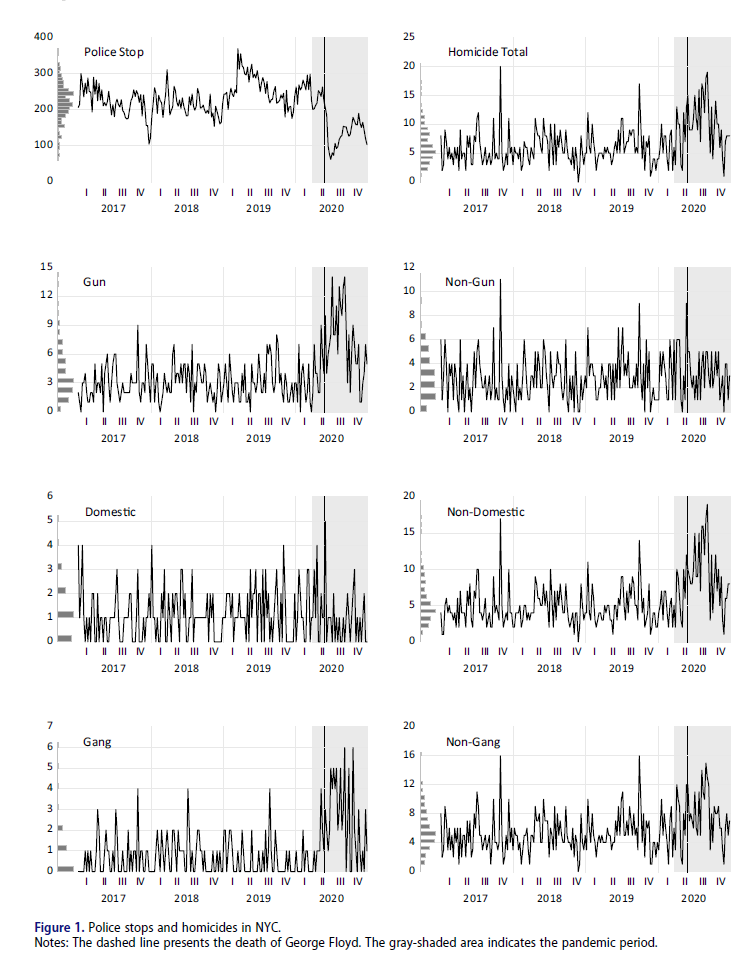
Professor Kim's article examines NYC homicide data from 2017 through 2020. It divides homicides into six different categories: gun, non-gun, domestic, non-domestic, gang, and non-gang. It assesses the connection between homicide rates in those categories and a significant reduction  in NYPD police stops of pedestrians. In NYC, stops fell from 13,453 in 2019 to 8,375 in 2020--a 30% decrease in proactive policing.

Professor Kim's article found that the reduction in stops led to an increase in three homicide categories:

… the interaction term of police stops and the pandemic presents the extent to which the 2020 homicide surges were attributable to reduced proactive law enforcement. Specifically, gun, non-domestic, and gang homicides significantly increased as police stops decreased in the pandemic and post-Floyd era. In addition, the supplementary correlation analyses present a significant correlation of police stops to gun (r=−.406, p =.008), non-domestic (r=-.321, p=.041), and gang (r=−.364, p=.019) homicides, respectively, in the pandemic and post-Floyd era. In contrast, the significant correlations disappear in the pre-intervention era.

While the full article is behind a paywell, one can gain a quick sense of the strength of Professor Kim's analysis by looking at graphs depicting NYC police stops, total homicides, and the six homicide categories described above:

In the first of the eight charts above, the reader can see the dramatic reduction in police stops by NYPD following the George Floyd protests. In the remaining charts, the simultaneous significant increase in homicides in the gun, non-domestic, and gang categories (but non in non-gun, domestic, and non-gang categories) is visually evident.

The explanation Professor Kim gives for this pattern tracks the one that I gave in my paper on the "Minneapolis Effect"--specifically, that police stops are targetted at gun crimes and related gang activity, and thus a reduction in stops will produce the greatest increase in homicides in these specific categories. As Professor Kim puts it:

Pedestrian stops are used to stop and frisk anyone, but mostly known gang members, on the street they suspect might engage in criminal activity or carry concealed weapons. Given the goal of pedestrian stops, the effects of de-policing should be more pronounced on gun, non-domestic, and gang homicides that usually occur in public settings. The current findings echo Piza and Connealy's (2022) study in that the lack of policing caused crime increases, ultimately compromising public safety and endangering communities.

In an earlier paper on the 2016 Chicago homicide spikes, Professor Fowles and I saw a similar pattern in the Chicago data.

Professor Kim's findings support the conclusions that I reached in my paper on the "Minneapolis Effect" about the compelling need to increase proactive policing. Here is the conclusion from my earlier article:

The quantitative data and qualitative evidence strongly suggest that a "Minneapolis Effect" has struck—that is, in the wake of antipolice protests following George Floyd's death in Minneapolis, police officers are being redeployed from antigun efforts and are retreating from proactive law enforcement tactics. This reduction in law enforcement efforts targeted at firearm crimes has led, perhaps predictably, to an increase in firearm crimes.

This article attempts to quantify the size of the Minneapolis Effect, estimating that about 710 more homicides and 2,800 more shootings occurred because of reduced policing in June and July alone. And the victims of these crimes are disproportionately Black and Brown, often living in disadvantaged and low-income neighborhoods.

While these estimates are stated in the cold precision of an economic calculation, it must be remembered that behind these grim numbers lies a tremendous toll in human suffering—lives lost, futures destroyed, and families left grieving. Understanding the nation's recent—and ongoing—homicide spikes requires urgent attention. And even more urgently, the nation needs to consider all possible responses to this tragedy, including responses that involve increased and proactive law enforcement efforts directed at combating gun violence.


Supreme Court

Notes on "The Restrained Roberts Court"

Contrary to popular perception, the current Supreme Court overturns precedent and declares laws to be unconstitutional less often than its predecessors did.

|

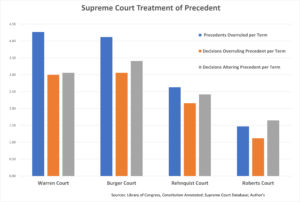
In the July 31 issue of National Review, in an article titled "The Restrained Roberts Court," I explain why some common criticisms of the current Supreme Court are simply untrue. In particular, I explain that the Roberts Court overturns precedent and holds legislative enactments unconstitutional significantly less often than did the Warren, Burger, or Rehnquist Courts. In other words, the Roberts Court is meaningfully less "activist" than its post-WWII predecessors, at least as measured by conventional metrics.

From the article:

Commentators and reporters generally accept that the current Court is more likely to overturn precedent and invalidate laws than we have come to expect. Yet this widely shared perception is wrong. Based on available metrics, the current Court is less likely than its predecessors to overturn precedents or invalidate legislative enactments. If such actions are the hallmark of judicial imperialism, the Roberts Court is not particularly imperialist. . . .

the Roberts Court is the least likely of any court since World War II to overturn precedent. The Warren, Burger, and Rehnquist Courts all overturned Supreme Court precedents at a higher rate than the Roberts Court, and it is not particularly close. Compared with its predecessors, the Court under Chief Justice Roberts has largely maintained the status quo.

This is not anything new. Folks have been charging that the Supreme Court under Chief Justice Roberts has been abandoning precedent for years. As I have shown in prior posts going back years, the data did not support such charges then, and it does not support such charges now.

Terms Cases Overruled Overruled/Term Overruling Cases Overruling/Term Alteration/Term (SCD)
Warren Court 15 64 4.27 45 3.00 3.06
Burger Court 17 70 4.12 52 3.06 3.41
Rehnquist Court 19 50 2.63 41 2.16 2.42
Roberts Court 17 25 1.47 19 1.12 1.65


While it may well be the case that the current Court, over time, may begin overturning precedents at a higher rate than its post-WWII predecessors, we have not seen that yet (and that is true whether one treats the Roberts Court as a single court, or if we divide it into a "First" and "Second" Roberts Court with the change occurring either when Justice Kavanaugh replaced Justice Kennedy or Justice Barrett replaced Justice Ginsburg.)

As in my prior analyses, I based my claims looking at three data sets, two compiled by the Library of Congress (precedents overturned per term and decisions overturning precedent per term) and one from the Supreme Court database (precedents altered per term). All three data sets produce similar results.

The number of precedents overturned per term may be lower in the Roberts Court, but are the precedents overturned more longstanding or significant? It does not appear they are any older or more longstanding. The average age of precedents overturned by the Roberts Court (38 years old) is older than that of the Warren Court (22 years old), but comparable to that of the Burger (35) and Rehnquist (39) Courts.

What about significance? From the article:

It is fair to note that not all cases — nor all precedents — are created equal, and some observers have considered the precedents that the Roberts Court has overturned to be especially important. But there is no neutral measure of a precedent's importance. Most people likely think the Dobbs decision to overturn Roe v. Wade was more important than the overturning of Nevada v. Hall's holding on state sovereign immunity in Franchise Tax Board of California v. Hyatt. But was Dobbs more significant than the Court's 2002 decision in Atkins v. Virginia to overrule Penry v. Lynaugh and declare the execution of an intellectually disabled person to be a violation of the Eighth Amendment? And if so, by how much? And what about decisions that overturned precedents concerning the rights of criminal defendants to confront their accusers, or the authority of states to tax out-of-state businesses, or the application of the 14th Amendment's liberty and equality guarantees to homosexual conduct and gay marriage?

The article shows how there is a similar story to be told when it comes to Court decisions declaring legislative enactments to be unconstitutional. The Roberts Court is doing that less than its post-WWII predecessors as well.

Note that these trends coincide with the Court hearing fewer cases, and this is largely due to the justices' collective decision to hear fewer cases. Hearing fewer cases means there are fewer opportunities to overturn precedent, declare statutes unconstitutional, or otherwise shift the law. The cases which produce such outcomes may be a larger share of the Court's overall decisions, and such cases may have a more consistent ideological valence than before, but as a quantitative matter, the Court is still doing less.

One claim about the Roberts Court that I think has greater merit is that it has is more skeptical of the executive branch than its predecessors have been. I think this is a fair claim, and is the result of a longer term trend. Across the board the Court has become less deferential to the executive branch over time. This is true in the context of administrative law (going from, say, SEC v. Chenery II to West Virginia v. EPA) but in areas like national security as well (going from Ex parte Quirin to Boumediene v. Bush).

What is most different about the Roberts Court is not that it is more likely to overturn precedent or declare statutes to be unconstitutional. What is different is that it is a more consistently conservative court than its predecessors. The Burger Court had a supermajority of justices appointed by Republican presidents, but was not particularly conservative. While the Rehnquist Court was thought by some to be fairly conservative, it issued plenty of decisions overturning precedents or declaring statutes to be unconstitutional that most would consider to be "liberal" decisions. Lawrence v. Texas and Roper v. Simmons are good examples.

During the first twelve years of the Roberts Court, the Court tended to be conservative, but not consistently, and certainly not consistently in cases in which precedents were reconsidered or statutes held unlawful. Justice Kennedy was the median justice during this period and the Court's decisions to overturn precedents and reject statutes largely tracked his particular jurisprudential vision, and this often meant decisions overturning precedents or rejecting statutes while moving the law in a "liberal" direction. Obergefell v. Hodges and Kennedy v. Louisiana are good examples.

When Justice Kennedy was on the Court, he was the median justice on a Court that was otherwise 4-4. This meant that his preferences often controlled. Chief Justice Roberts and Justice Kavanaugh may be the median justices on the current court, but both of them are more consistently conservative in their rulings than was Justice Kennedy. Further, for the Court to overturn precedent or reject a statute on "liberal" grounds, the concurrence of more than one conservative justice is required. So we may get an occasional decision in which, say, Justice Gorsuch and Justice Barrett join the three progressive justices to overturn a conservative precedent, but such cases are likely to be rare.

This change in the court affects what cases the Court agrees to hear as well. It takes four justice to grant certiorari, so the three progressive justices lack the ability to force the Court to hear a case that concerns them (and they may not want to force the consideration of such cases either, as they may not like the outcome). This only reinforces the likelihood that when the Court decides to reconsider a prior precedent, it is more likely to reconsider a precedent about which the conservative justices are skeptical, and any resulting decision will likely move the law in what most would consider to be a conservative direction.

My National Review article concludes:

The reality is that some precedents should be overturned and some federal or state laws should be declared unconstitutional. It is also the case that the nation is divided over when such steps are warranted. I approve some of the Roberts Court's decisions in each of those categories and disapprove of others — but, in each case, my evaluation is based on my sense of the merits of the case and the Court's arguments. Accusations that the Court is vaporizing precedent and trampling democratic enactments — suggesting that it is not merely making bad decisions but doing so in an illegitimate way — are part of a broader effort to delegitimize it.

For many decades and with some regularity, the Court has overturned precedents and struck down legislative enactments. But so long as most such decisions moved the law in a progressive direction, legal elites mostly bit their tongues. What is different about the Roberts Court is not that it is keener to change the law but that, when it does so, it is more likely to shift doctrine in a conservative direction. If that makes the Court "not normal," as President Biden recently charged, and if that is supposed to be a problem, then the Court's critics should make their case openly and honestly.

Politics

Today in Supreme Court History: July 17, 1862

|

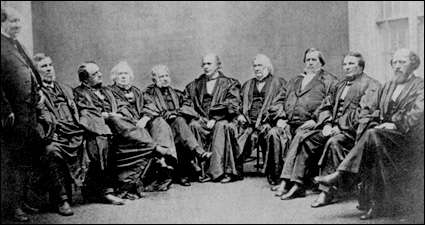
7/17/1862:  Congress enacts the Confiscation Act, which empowers the government to seize the property of the rebels. The Supreme Court considered the constitutionality of that law in The Confiscation Cases (1873).

The Chase Court (1873)

Academic Freedom

My New Article on Legislative Restrictions on Classroom Speech

|

I am pleased to see that my latest article on the efforts of state legislatures to restrict what ideas professors can endorse in the classroom has now been published. "Professorial Speech, the First Amendment, and Legislative Restrictions on Classroom Discussions" appears in the latest issue of the Wake Forest Law Review.

From the abstract:

Academic freedom enjoys an uncertain status in American constitutional law under the First Amendment. It is particularly unclear how the First Amendment applies when it comes to professorial speech in the classroom. This lack of clarity has grave implications in the current political environment. There is now an unprecedented wave of legislative proposals aimed at curtailing teaching and discussing controversial topics relating to race and gender in state university classrooms, and the constitutionality of such measures will soon need to be resolved.

This Article sets out a new argument for protecting from legislative interference how faculty at state universities teach their courses. Building on existing First Amendment jurisprudence regarding academic freedom and government employee speech, the article lays out the constitutional infirmities with anti-Critical Race Theory proposals and clarifies the scope of an individual constitutional liberty in the context of professorial speech.

From the conclusion:

The Supreme Court has invited confusion by noting but not fleshing out an academic-freedom exception to ordinary government-employee speech doctrine.  It is possible to flesh out that exception in a way that coheres with the Court's various doctrinal commitments, but it will require reaffirming that professorial speech is "a special concern of the First Amendment."  When state government officials attempt to restrict what ideas can be taught in the classrooms of public universities, they do real damage not only to the intellectual life of those universities but also to the public discourse of the country.  The First Amendment is grounded in the fundamental commitment to the view that ideas should be freely discussed and that they cannot be rejected or embraced as a result of government diktat.  In the mid-twentieth century, the government sought to prevent the spread on college campuses of what it regarded as dangerous ideas by dismissing any professor who might adhere to them, discuss them, or teach them.  The Court rejected the stifling hand of censorship then.  The tools of censorship being wielded by the government today are different, but the ultimate goal is the same.  Government officials do not want professors at state universities to discuss ideas with which those government officials, and perhaps even popular democratic majorities, disagree.  The First Amendment bars them from having their way.

The argument developed in the article has relevance for legislation like Florida's Stop WOKE Act, the constitutionality of which is now before the 11th Circuit.

You can find the article here.

Free Speech

Poems of Emigration: "Simply People Who Couldn't Think as Instructed"

|

Russian history has produced a subgenre of poems and songs about emigration (something American history has fortunately been largely spared). I blogged in March about Yevgeniy Kliachkin's "Farewell to the Motherland," and I also like the great Bulat Okudzhava's poem that begins,

How good it is that Zworykin left
And invented television there
If he had not left the country,
He, like all the rest, would have gone to Golgotha….

How good it is that Nabokov left
Not sharing with anyone the secrets of parting
How lucky that was! And on how many prophets
Their native land showed no mercy! …

Not a happy sentiment, but, hey, Russia's is not a happy history. In any event, a few weeks ago I came across Robert Rozhdestvenskiy's "The Talented Were Leaving My Country," written about the emigration of the 1970s. Here are the opening stanzas, which I found to be the most affecting; as usual, apologies for the flawed translation:

The talented were leaving my country,
Taking with them their dignity.
Some having sampled the Gulag gruel
And some a week before it.

Those who left weren't some sort of heroes—
How to tell who's a hero and who's not?
Simply people who couldn't think as instructed
Even if those were the very best of instructions ….

Free Speech

No Pseudonymity or Sealing in College Student's Race Discrimination Lawsuit

A federal court rejects plaintiff's arguments "that sealing ... is required because she is being 'slandered and libeled' and '[m]aking [her] information public would magnify the effects of [defendants'] wrongdoing' rather than right those wrongs."

|

From Judge Rachel Kovner (E.D.N.Y.) in Anonymous v. Doe, decided last week:

Between June 14 and June 20, 2023, plaintiff, proceeding pro se and under the name "Anonymous," filed four actions … alleging that defendants the City of New York, LaGuardia Community College, and various individual employees of the College violated her constitutional rights. Along with the complaints, plaintiff filed requests that each action be placed under seal and that she be allowed to proceed anonymously ….

Plaintiff's four complaints all contain allegations that she was discriminated against in violation of federal and state law during her time as a student at LaGuardia Community College…. Plaintiff's first complaint alleges that, in June 2022, a College employee identified only as Jane Doe, in an attempt to discriminate against plaintiff on the basis of her race, falsely accused plaintiff of making a threat against a professor, eventually leading to plaintiff being barred from campus…. Plaintiff's second complaint centers around an incident in June 2022 when, in the aftermath of Jane Doe's accusation against plaintiff, plaintiff was allegedly accosted by multiple College security officers, threatened with arrest, and falsely imprisoned…. Plaintiff's third complaint alleges that a College professor subjected her to differential treatment based on her race and created a hostile learning environment, then falsely accused plaintiff of threatening her, ultimately leading to plaintiff being denied a diploma…. Plaintiff's fourth complaint alleges that the College discriminated against her and defrauded her in various ways, including by misrepresenting its services, fraudulently decreasing her GPA, depriving her of an opportunity to attend or speak at her commencement ceremony, and improperly placing financial and disciplinary holds on her student record….

[A.] Plaintiff's Sealing Requests Are Denied

Read More

Politics

Short Circuit: A Roundup of Recent Federal Court Decisions

A rough ride, an injury in law, and sexy polygraphs.

|

Please enjoy the latest edition of Short Circuit, a weekly feature written by a bunch of people at the Institute for Justice.

In 2021, the Fort Bend, Tex. sheriff excluded independent journalist Justin Pulliam from a press conference, claiming Pulliam was not "media." A few months later, deputies arrested Pulliam while he was filming their activities, claiming he was "interfering"—part of a pattern of retaliation against Pulliam for his journalism. But good news! A federal district court recently ruled that claims against the sheriff, his deputies, and the county can proceed. Click here to learn more.

Read More

Call for Papers: Free Speech and Civil and Social Progress

|

Request for Paper Proposals
Snapshot:
Voices for Liberty, an initiative of the Liberty & Law Center at the Antonin Scalia Law School, seeks to examine the ways in which free speech propels civil and social progress. Authors are invited to submit proposals for original articles that will ultimately appear in academic journals and explore the role free speech plays in advancing civil rights movements, especially for marginalized or underrepresented groups.
PRIORITY DEADLINE of August 15th 2023, 5:00 ET for full consideration, with review on a rolling basis through September 8th.
All proposals should include a summary of issues to be addressed, the proposed methodology, and feasibility of having a completed draft by June 2024, with final submission by September 2024. Selection includes participation in a series of support and writing events. Full application details follow.
Full Details:
What role has freedom of speech played when it comes to the legal and social progress of groups that have been historically disadvantaged and/or socially marginalized? In the current public debate, some view freedom of speech as detrimental to minority groups, while others champion it as a necessary condition for protecting underrepresented voices. The former view is more often espoused in both the academy and the popular press. As a result, freedom of speech is frequently seen as a countervailing force in tension with civil rights. But is it?
Voices for Liberty aims to:
• Highlight and focus attention on important contributions to the welfare of minority and underrepresented groups made by the ability to speak throughout history;
• Analyze the effects of restricting speech;
• Assess the argument that limiting speech will help minority groups achieve greater equality; and
• Share evidence of the impact of robust speech protections on current and future civil rights movements.
Original scholarship of specific interest includes, but is not limited to:
• A historical examination of the relationship between social progress on minority rights and concerns and freedom of speech for groups and movements such as (but not limited to) abolition, women's suffrage, women's liberation, religious minorities, the Civil Rights Movement and LGBTQ rights.
• The role free speech plays in advancing the causes of contemporary social movements such as Black Lives Matter, transgender rights, the MeToo movement, etc.
• The role of free speech in making possible new and future civil rights movements.
• The impacts of speech regulation, including hate speech provisions, on civil rights movements and underrepresented groups.
• The impacts of social media and technology on the relationship between civil rights of minority and underrepresented groups and free speech. Read More

A Worthy Open Letter Defending Liberalism in the Academy from its Opponents on the Left

|

I tend to be a bit skeptical of the value of open letters, and I rarely sign them, partly for that reason, and partly because I rarely agree wholeheartedly with the entire letter.

That said, I signed the one below (as did co-Conspirator Randy Barnett, among other luminaries), and you can add your signature here if you are so inclined. (Note, this letter is a project of David Bernstein of the Jewish Institute for Liberal Values. This is not me, though we cause at least as much confusion as the two Ilyas. Making matters worse, we both published books last year, and our mutual editor at Post Hill press is … another David Bernstein.)

An Open Letter from Jewish Scholars about Today's Intellectual Environment
*THIS LETTER IS FOR JEWISH SCHOLARS AND FRIENDS IN THE ACADEMIC WORLD

Dear Friends,

We, the undersigned Jewish scholars and academics, are concerned about the current ideological environment in the US and elsewhere and the increasingly censorious culture in many institutions of higher learning. Although we are acutely aware of the illiberalism and threats to academic freedom emanating from the political right, and in no way downplay these dangers, in this letter we focus our attention on, and express our deep concern about, a dangerously intolerant ideology on the political left that has taken hold in academia.

We firmly believe that the purpose of education is to teach students how to think, not what to think. A liberal education, by definition, should present students with different approaches to important questions so they can appreciate the complexity of issues and at the same time attempt to formulate their own opinions. Too often, however, universities and campus communities have veered away from their core missions and have propagated—among both faculty and students—a set of moral and intellectual attitudes that restrict critical inquiry, viewpoint diversity, and intellectual openness. We regard such inquiry and openness as bedrocks of any liberal, democratic society. As taught in the Ethics of Our Fathers, "Who is wise? He who learns from every person, as it is said: 'From all who taught me have I gained understanding.'"

Moreover, the suppression of unpopular opinions impinges on society's ability to address problems. What happens in academia rarely stays in academia. Shutting down scholarly inquiry ultimately limits the range of popular discussion on social issues, including sensitive topics such as race and gender identity, and makes it difficult, if not impossible, for intellectual and political leaders to formulate sound policy, promote advances in science, and resolve social tensions. Good scholarship, which cannot thrive if it is blinkered by ideological demands, bureaucratic restrictions, and groupthink, can and must inform the public conversation.

The ascendency of an ideology that reduces people to "oppressed" and "oppressors" and categorizes individuals into monolithic group identities poses a particular threat to the Jewish people. In this stark, neo-Manichean worldview, Jews are frequently grouped with the privileged, and Israel is dogmatically singled out as an oppressor-state–a shallow dichotomy that foments new variants of antisemitism and reinforces old ones.

As scholars, we stand for the principles of free inquiry in our educational institutions. As Jewish scholars, we remind the Jewish community and others of the dangers of any ideology that diminishes the free exchange of ideas. Instead, we encourage leaders and educators to stand up for our deeply held liberal principles and our own tradition of "argument for the sake of heaven."

Conservatism

Two Cheers for the "Freedom Conservatism" Statement of Principles

It has many good points. But I have some reservations and questions.

|

The Freedom Conservative logo.


Earlier today, a group of 83 prominent conservative (and a few libertarian) academics, intellectuals, and public policy experts issued the "Freedom Conservatism" Statement of Principles. One of the signers, John Hood, has written an article where he summarizes the group's principles, as follows:

We believe in free enterprise, free trade, free speech, strong families, balanced budgets, and the rule of law. We champion equal protection and equal opportunity. We think Washington has too much power and our states, communities, private associations, and household have too little. We believe Americans are safest and freest in a peaceful world that is led by a United States committed to pursuing its just interests.

With the caveat that it's far from entirely clear what counts as a "just interest" of the United States, this sounds great to me! I also agree with much of Stephanie Slade's Reason article about the "Freecon" statement, particularly where she notes its superiority over the rival "National Conservatism" statement of principles, issued last year. Compared to most of what is produced by the so-called New Right, the Freecon statement is a much-needed breath of fresh air.

I largely agree with all but one or two of the Freecon principles, and partly endorse even the latter. I'm also a longtime admirer of the writings of many of the signers.

But I still have some questions and reservations. I completely understand that any group statement will involve some compromise, and that no such statement can include much detail, without becoming too long and unwieldy. Still there are issues the signatories may need to rethink or at least consider in more detail as they move forward.

In what follows, the Freecon principles are in block quotes, and my comments in regular text:

  1. Liberty. Among Americans' most fundamental rights is the right to be free from the restrictions of arbitrary force: a right that, in turn, derives from the inseparability of free will from what it means to be human. Liberty is indivisible, and political freedom cannot long exist without economic freedom.

I agree completely! But I wonder how far the signers are prepared to go with this idea. If "liberty is indivisible," does that mean they reject paternalistic restrictions on freedom supported by many social conservatives, such as the War on Drugs and laws banning pornography and prostitution? Are they on board with the "My body, my choice," principle, and all its implications? For some of the more libertarian signers, I think the answers to these questions are "yes." For others, I'm not so sure.

  1. The pursuit of happiness. Most individuals are happiest in loving families, and within stable and prosperous communities in which parents are free to engage in meaningful work, and to raise and educate their children according to their values.

I completely agree with this one, as well! Though the caveat of "most" is significant. I assume the signers rightly acknowledge that some people are happiest remaining single. But, here too, I wonder how far the signers are willing to go. Does their conception of "loving families" include those built on same-sex marriage? Should parents be free to "raise educate their children according to their values" if those values are left-wing or allow for things like gender reassignment? Once, again, I am confident the answers to these questions are "yes" for the more libertarian-leaning signers, but not sure about some others.

  1. The foundation of prosperity. The free enterprise system is the foundation of prosperity. Americans can only prosper in an economy in which they can afford the basics of everyday life: food, shelter, health care, and energy. A corrosive combination of government intervention and private cronyism is making these basics unaffordable to many Americans. We commit to reducing the cost of living through competitive markets, greater individual choice, and free trade with free people, while upholding the rule of law, freedom of contract, and freedom of association.

It's hard to find a bone to pick with this one! My only possible reservation is about the meaning of "free trade with free people." Taken literally, it may mean a rejection of free trade with the billions of people who live under oppressive dictatorships of one kind or another. I suspect the signers actually mean we might need some narrowly targeted trade restrictions to prevent, e.g., the sale of weapons technology to authoritarian adversaries like China and Russia. But the meaning of this point may require some clarification.

  1. Full faith and credit. The skyrocketing federal debt—which now exceeds the annual economic output of the United States—is an existential threat to the future prosperity, liberty, and happiness of Americans. We commit to building a constructive reform agenda that can restore America's fiscal sustainability, ensuring that future generations inherit a more prosperous and secure nation than the one we now inhabit.

I would not have used the term "full faith and credit" (which has a technical legal meaning that may confuse readers) to denote this idea. "Fiscal sanity" might be better. But otherwise, I completely agree. I wish, however, the authors would have made clear the need to cut entitlement spending, as part any "reform agenda" for getting federal spending under control. This is a problem both major political parties, "national conservatives," and most left-liberals seem determined to ignore.

5. A nation of laws, not men. Equality under the law is a foundational principle of American liberty. Unfortunately, today this principle is under attack from those who believe that the rule of law does not apply to them. One manifestation of this problem is the explosion of unaccountable and unelected regulators who routinely exceed their statutory authority and abridge Americans' constitutional rights. The President should only nominate policymakers and judges who are committed to upholding these rights.

I agree with much of this, but have a reservation. The rule of law has been undermined because we have too many laws. But I'm not convinced that "unaccountable and unelected regulators" are a bigger menace than the elected politicians and voters who empower them. Many of the biggest power grabs and rights violations of recent years have been originated by the occupants of the White House, rather than by regulators and bureaucrats acting on their own initiative. Indeed, there are few bureaucrats and regulators that the president and Congress could not hold accountable if they wanted to. The problem is not so much rogue regulators as an excessive concentration of power in the federal government.

In the many instances where the executive branch wields powers not given to the federal government, I am not sure that greater accountability to the elected president is necessarily a good thing. It could lead to an even more dangerous concentration of power in the hands of one person.

  1. Americans by choice. Immigration is a principal driver of American prosperity and achievement. America is exceptional because anyone—from any corner of the earth—can seek to live in America and become an American. Nearly all American citizens descend from someone who came here from somewhere else, and we must treat all citizens equally under the law. To this end, the United States, as a sovereign nation, has the right to secure its borders and design a rational immigration policy—built on the rule of law—that advances the interests and values of American citizens.

This is the one I have the most reservations about. The statement rightly praises immigration's crucial role in promoting American "prosperity and achievement" and in American exceptionalism, more generally. But it then seems to suggest (the text is not entirely clear on that point) that the US has a "sovereign" power to restrict immigration as it wishes, even equating this to "secur[ing] its borders." The latter, perhaps unintentionally, perpetuates the pernicious conflation of immigration restriction with security against attack. Noticeable by its absence is any recognition that immigration restrictions violate the "liberty" and "the right to be free from the restrictions of arbitrary force" that is at the heart of the statement's Principle 1. And, yet, immigration restrictions do in fact severely infringe the freedom of both would-be immigrants and current American citizens. Indeed, they likely do so more than any other US government policy - even if we consider only the liberty of native-born Americans.

Admittedly, Principle 6 is vague enough to be susceptible of more pro-immigration interpretations. For example, perhaps advancing "the interests and values of American citizens" requires abolition of all or most immigration restrictions (I certainly think it does!). But if that's what the authors mean, it would help to be more clear about it.

  1. Out of many, one. The best way to unify a large and diverse nation like the United States is to transfer as many public policy choices as possible to families and communities. Much of the discord in America today comes from the fact that too many decisions are made for us by centralized authorities. The Constitution of the United States is the best arrangement yet devised for granting government the just authority to fulfill its proper role, while restraining it from the concentration and abuse of power.

I agree almost completely. My one major caveat is that state and local governments should not be allowed to enact policies that severely restrict mobility, such as exclusionary zoning. Also, this - like Principle 1 - needs to be applied to immigration, including by divesting the federal government of its sweeping authority to impose immigration restrictions. At the very least, state governments should be empowered to admit additional immigrants on their own.

  1. America's promissory note. Martin Luther King, Jr. described the Constitution and the Declaration of Independence as containing "magnificent words…a promissory note to which every American was to fall heir." Prior to 1964, however, slavery and segregation were enforced by state governments and, in many cases, by the federal government. Many who descend from victims of this system now face economic and personal hurdles that are the direct result of this legacy. We commit to expanding opportunity for those who face challenges due to past government restrictions on individual and economic freedom. We adamantly oppose racial discrimination in all its forms, either against or for any person or group of people.

I agree. I hope the signers are prepared to support all the policy changes needed to make government color-blind, including some that may discomfit many on the political right.

  1. The shining city on a hill. American foreign policy must be judged by one criterion above all: its service to the just interests of the United States. Americans are safest and freest in a peaceful world, led by the United States, in which other nations uphold individual liberty and the sovereignty of their neighbors.

It's hard to disagree with any of this. But that's in large part because it's hard to tell what this principle actually means. Much depends on what exactly counts as "the just interests of the United States." Interpreted narrowly, it might mean indifference to all but direct security threats (narrowly defined), or narrow American material self-interest. But the second sentence suggests America has an interest in promoting a world where "other nations uphold individual liberty and the sovereignty of their neighbors." If so, that might justify things like humanitarian intervention, backing Ukraine in its resistance to Russian aggression, and much else.

Also, what if upholding "individual liberty" conflicts with upholding "sovereignty," as it often does in many situations where sovereigns perpetrate human rights violations? Is outside intervention to protect liberty justified in such cases, or must we respect to sovereignty of oppressive regimes?

I am somewhat more hawkish than many of my fellow libertarians, and believe we should back Ukraine and other relatively liberal states against authoritarian adversaries. But it's hard for me to tell what kind of foreign and security policy the Freecons are advocating here. Perhaps this vague language is an attempt to finesse internal disagreements. The issue is a crucial one that has led to major internal divisions among conservatives - and libertarians, as well.

  1. Freedom of conscience. Essential to a free society is the freedom to say and think what one believes to be true. Under the First and Fourteenth Amendments to the Constitution, federal and state governments have a legal obligation to uphold and protect these freedoms. Private institutions have a moral obligation to do the same.

Agreed. My one caveat is I'm not sure what is meant here by the "moral obligation" of private institutions to uphold and protect freedom of speech and conscience. If it means merely that they have an obligation to abjure lobbying for censorship by the state, I agree. But I differ if it means all private organizations have a duty to promote free speech internally, similar to the government's obligations under the Constitution. For example, a conservative organization can legitimately hire only conservatives, publish only conservative views in its publications, and the like. The same goes for, e.g., a church that only wishes to promote speech compatible with its theology.

Much more can be said about many of these issues! But this post is already long, so I will leave off. Despite my caveats and reservations, there is much to praise in the Freecon statement. I hope and expect they will elaborate their ideas more fully in the future.

NOTE: I am not a signer of the Freecon statement. Ilya Shapiro of the Manhattan Institute is. He and I sometimes get confused with each other, but we are not the same person.

Guns

Second Amendment Roundup: Delaware's Gun Ban Heats Up

Third Circuit briefing is ongoing in challenge to rifle ban signed into law just a week after Bruen.

|

On June 30, 2022, just a week after the Supreme Court decided the Bruen case, Delaware Governor John Carney signed into law a ban on "assault weapons" and standard-capacity magazines, effective immediately. Apparently he didn't get the memo that a ban on firearms in common use is off the table constitutionally.

Delaware plagiarized California's 1989 findings that it was imperative to ban any gun that is not a "sports or recreational firearm." The state ignored the Delaware Bill of Rights guarantee of the right to bear arms "for the defense of self, family, home and State," and disregarded Heller's admonition that self-defense is "the central component of the right itself."

Delaware copied a definition from Connecticut that criminalizes a rifle depending on where one's fingers are placed when firing, and Maryland's long list of banned rifles, such as the Colt AR-15. Curiously, that list excludes AR-15 HBAR (heavy barrel) rifles, unless made by Bushmaster – any semiauto rifle made by that firm is banned.

The U.S. district court for the district of Delaware's denied a motion by challengers for a preliminary injunction on the basis that they are not likely to prevail on the merits. The case is Delaware State Sportsmen's Ass'n v. Del. Dep't of Safety & Homeland Security. Appeal briefs are now being filed, which includes an amicus curie brief on behalf of the Delaware Association of Second Amendment Lawyers by yours truly and co-counsel Dan Peterson. Here are some of our arguments.

Heller held that arms that are in common use for lawful purposes – those chosen by the American people – are protected by the Second Amendment. That rule should resolve any gun ban without further ado. Bruen's methodology, which evaluates restrictions by reference to the text of the Second Amendment and historical analogues, applies to regulations such as about where guns may be carried, not to outright bans on possession, where the common-use test applies. Read More

Withdrawal of Consent to Search Computers Also Blocks Searches of Digital Copies, Court Holds

An important decision from the Maryland Supreme Court.

|

In Fourth Amendment law, the authority to grant consent to search allows you withdraw that consent, too, at least before the search occurs.  But consider this wrinkle.  When the government searches a computer, the forensic process  has two distinct steps.  First, the government makes a perfect copy of the data (known as an "image") and saves in on a government storage device.  Second, the government searches the image rather than the original.

So how does withdrawal of consent work now? There are two key questions.

First, if a computer owner grants consent to search, an image is made, and then consent is withdrawn, does the withdrawal of consent extend to the image?  That is, does the owner's control include control of the copy on the government's machine?  Or does the government necessarily control the image?

Second, if an owner retains rights in the image, is there a different result if the owner signed a consent form stating that, once the government made the copy, the owner relinquished rights in the copy?  That is, can rights retained in the image that might generally exist with a general consent be relinquished if there is specific and explicit disavowal of rights as to the image?

There have been a few district court rulings that touched very briefly on the first of these questions. Long-time readers may remember I blogged about two of those cases; you can read my 2009 post from our volokh.com days here and my 2015 post from the Washington Post era here.

All of this is a wind-up to say that, last week, the Maryland Supreme Court ruled on both questions in considerable detail in an important new case, State v. McDonnell.  McDonnell is the first case to address both of the issues, and it did so in detail.  Given the detail of McDonnell's reasoning, and how sparse the caselaw has been,  I think McDonnell is worth a close look.

The basic facts are simple. McDonnell signed and initialed a consent form that said the following:

I have been informed of my right to refuse to consent to such a search. I hereby authorize the undersigned Special Agent, another Special Agent or other person designated by USACIDC, to conduct at any time a complete search of: . . . all digital media including cell[ ]phones, thum[b ]drive[s], hard disk drives, laptops & any other media relevant to this investigation.

I understand that any contraband or evidence found on these devices may be used against me in a court of law.

I relinquish any constitutional right to privacy in these electronic devices and any information stored on them. I authorize USACIDC to make and keep a copy of any information stored on these devices.

I understand that any copy made by USACIDC will become the property of USACIDC and that I will have no privacy or possessory interest in the copy.

I give this written permission voluntarily. I have not been threatened, placed under duress, or promised anything in exchange for my consent. I have read this form or it has been read to me and I understand it. . . .

I understand that I may withdraw my consent at any time.

Based on McDonnell's consent, investigators seized McDonnell's devices and imaged his computer a few days later.   And a few days after that, McDonnell's lawyers sent a message to the government withdrawing consent.  Relying on the language in the consent form, agents then searched the image anyway.  McDonnell later moved to suppress the evidence found on the image, arguing that it was the fruit of an unlawful search and seizure because he had previously withdrawn his consent.

In the new case, the Maryland Supreme Court unanimously agreed with McDonnell.  First, McDonnell's withdrawal of consent blocked the government's ability to rely on consent to search the image as well as the original.  And second, the potentially contrary language in the consent form did not alter that holding.

Here's the court's reasoning as to the first holding, that a person generally retains rights to withdraw consent as to images, at least until the images are searched:

Read More

More