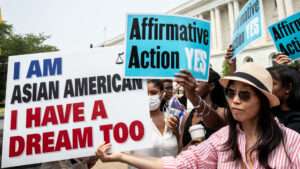
Concerns that elite universities have rigged their admissions policies to disfavor Asian Americans are nothing new. In 1987, Newsweek reported accusations along those lines. The article noted that the acceptance rate for Asian American applicants at elite colleges had dropped dramatically, that Harvard, Princeton, and Stanford had all studied why the Asian American acceptance rate was lower than for white students with similar academic credentials. (The answers ranged from potential unconscious biases to Asian Americans being less likely to benefit from legacy and athletic preferences.) UC Berkeley, already 22% Asian American in 1978, "revised its procedures in 1983 to give greater weight to essays and extracurricular activities, areas in which Asian-American students traditionally fare less well."
The article concludes with these thoughts:
Schools opened the way to previously excluded ethnic groups in the 1960s. Now Asian-Americans have turned affirmative action on its head by outperforming not only other minorities but the majority as well. As a result, educators are asking themselves whether it is legitimate to try to preserve the traditional, largely WASP culture of most prestigious schools. "Stanford could become 40 percent Jewish, 40 percent Asian-American and 10 percent requisite black," says emeritus Harvard sociologist David Riesman. "You'd have a pure meritocracy, and that would create problems for diversity and alumni."
I remember reading this at the time and being appalled that people would think there is something inherently wrong with a school being 40 percent Jewish and 40 percent Asian American. I was a bit surprised that I was actually able to find the article!
I recall reading another article around the same time, which I haven't been able to find, that helps explain why strong suspicions of discrimination against Asian Americans at Berkeley and UCLA didn't lead to lawsuits. The article explained that once in a while, a parent of an Asian American kid with a 1600, 4.0, and excellent extra-curriculars would threaten to sue. If the admissions office took the threat seriously, they would quietly admit the student.
unwillingness to charge and prosecute people who murder and commit life threatening serious crimes, and the proliferation of anti-police rhetoric have created a heyday for Oakland criminals."
"If there are no consequences for committing crime in Oakland, crime will continue to soar." "We are 500 police officers short of the number that experts say Oakland needs. Our 911 system does not work. Residents now know that help will not come when danger confronts them. Worse, criminals know that too."
"There is nothing compassionate or progressive about allowing criminal behavior to fester and rob Oakland residents of their basic rights to public safety. It is not racist or unkind to want to be safe from crime. No one should live in fear in our city."
That is from what appears to be an authentic copy of the letter (which is signed by Oakland NAACP President Cynthia Adams and Bishop Bob Jackson of the Acts Full Gospel Church) as reproduced in a Tweet by former Oakland City Councilman Loren Taylor (who had narrowly lost the Mayoral race last year):
On Thursday, the Supreme Court vacated stays entered by the U.S. Court of Appeals for the Fourth Circuit against the Mountain Valley Pipeline. The brief order was issued without any noted dissent. It reads:
The application to vacate stays presented to The Chief Justice and by him referred to the Court is granted. The July 10, 2023 stay orders of the United States Court of Appeals for the Fourth Circuit, case Nos. 23-1592 and 23-1594, and the July 11, 2023 stay order of the Fourth Circuit, case No. 23-1384, are hereby vacated. Although the Court does not reach applicant's suggestion that it treat the application as a petition for a writ of mandamus at this time, that determination is without prejudice to further consideration in light of subsequent developments.
The Supreme Court's willingness to intervene in this way at the request of a private party is unusual, but so were the Fourth Circuit's stays. As I noted here, the Fourth Circuit entered the stays even though Congress had clearly removed the court's jurisdiction to continuing hearing challenges to the controversial project. And even assuming the Fourth Circuit had jurisdiction to consider the stay requests, it is hard to understand how the court's judges ever concluded that those who sought stays against the pipeline ever had a chance of success on the merits (let alone the likelihood of success necessary for such relief). Dan Farber makes a similar point here.
This episode is a useful reminder that some of the increase in activity on the Supreme Court's "shadow docket" is not wholly of the Court's own making. Over the past several years, there has been an increase in the award of extraordinary or unjustified relief by lower courts to which the justices have been responding. This is not the only factor that has led to an increase in activity on the "shadow docket," but it is an important factor that should not be overlooked.
7/30/1956: Congress enacted a resolution, declaring that the motto of the United States is "In God we Trust." The Supreme Court declined to grant review in Newdow v.Congress, which considered the constitutionality of that motto.
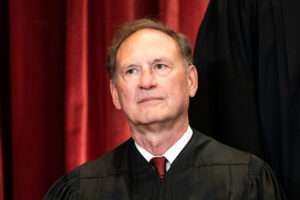
Supreme Court Justice Samuel Alito. (Erin Schaff/UPI/Newscom)
Supreme Court Justice Samuel Alito recently kicked off a controversy by saying that "No provision in the Constitution gives [Congress] the authority to regulate the Supreme Court — period." Taken literally, that statement is nonsense. Congress clearly does have power to regulate the Court in a variety of ways. Alito is also probably wrong if we interpret his statement more narrowly, as merely saying that Congress has no power to impose an ethics code on the justices, as various critics of the Court have recently advocated. But congressional power over the Court is not unlimited. And some ethics rules could potentially run afoul of constitutional constraints.
As many critics of Alito's remark have pointed out, the Constitution gives Congress extensive authority over various aspects of the Supreme Court's structure and operations. Congress can set the number of justices, their pay and benefits, the amount and type of staff they are entitled to, and the scope of the Court's appellate jurisdiction. Article III of the Constitution states that the Court's "Appellate jurisdiction" is constrained by "such Exceptions, and under such Regulations as the Congress shall make."
These powers are subject to some textual limitations. For example, Congress cannot abolish or even restrict the "original jurisdiction" of the Court (cases which begin in the Supreme Court, as opposed to the lower courts), which extends to "all Cases affecting Ambassadors, other public Ministers and Consuls, and those in which a State shall be Party." Similarly, Article III, Section 1 says that federal judges' pay "shall not be diminished during their Continuance in Office." Thus, Congress cannot lower the pay of current judges. But it can let inflation eat away at the real value of their salaries, and can mandate lower pay for judges appointed in the future.
Despite some textual constraints, it's pretty obvious Congress has extensive authority to regulate the Court in various ways. I suspect Alito is well aware of this, and didn't mean to make the radical claim that Congress literally has no power over the Court at all. Either that, or he may have spoken off the cuff, without carefully considering the implications. We all make mistakes like that sometimes. But people understandably pay more attention when the one who makes such a gaffe is a Supreme Court justice.
Alito may have meant something like that Congress lacks the power to regulate the Court's internal operations, because doing so would undermine the judiciary's ability to function as an independent branch of government. And imposing an ethics code would, in his view, breach that constraint.
Even this more moderate and reasonable version of Alito's position is questionable. Article III empowers Congress to make "regulations" for the Court's appellate jurisdiction. That power surely includes at least some authority to ensure that cases are heard in a fair and unbiased fashion. For example, few deny Congress can bar Supreme Court justices (and other federal judges) from taking bribes. And the federal anti-bribery statute does in fact cover the justices along with other federal judges. The same logic can also empower Congress to restrict at least some potential conflicts of interest less extreme than outright bribery.
On the other hand, Congress' regulatory authority over the Court is not unlimited. For example, it cannot dictate case outcomes or mandate the use of particular interpretive methodologies, such as originalism or living constitutionalism. Doing so would usurp the core of "The judicial Power of the United States," which Article III says is vested in the Supreme Court and lower federal courts, not in the legislative branch. If "judicial power" has any meaning at all, it includes the power to decide cases independently, without coercion by other branches of government.
Similarly, Congress cannot use an ethics code or other regulations to incentivize judges to rule in particular ways. For example, it cannot give higher pay to judges who make right-wing rulings as opposed to left-wing ones, or vice versa. And it cannot make ethics rules under which justices are more free to take gifts and awards from conservative groups than liberal ones (or the reverse). And so on.
Difficult questions may arise in situations where evidence indicates that a seemingly neutral ethics code or other regulation was in fact enacted for the purpose of skewing judicial incentives in favor of some litigants or causes relative to others. Such a situation would raise questions similar to other cases where a facially neutral law or regulation was actuated by constitutionally impermissible motives (e.g. - a facially neutral law intended to target people based on race, gender, or religion).
In sum, the literal version of Alito's statement makes little sense. Congress can pretty obviously regulate the Supreme Court in a variety of ways. It can also probably impose at least some types of ethical restrictions on justices, at least if we concede that it has the power to ban bribery, which few dispute. But congressional power over the Court is far from unlimited. And some ethics rules could potentially go beyond the scope of congressional authority.
While Congress can enact at least some ethics rules constraining the justices, that doesn't by itself tell us what constraints it should impose. My own view is that many of the ethical complaints against the justices are overblown (e.g. - there's nothing wrong with former Supreme Court clerks making small Venmo payments to defray the cost of a holiday party they and the justice they worked for decided to organize). There is also no evidence that any justice decided any case differently because of any gifts from a private party.
At the same time, I do think there should be constraints on justices taking large gifts from private individuals and organizations, other than perhaps close relatives. Some of the largesse Justice Thomas got from conservative billionaire Harlan Crow, goes beyond what can reasonably be justified. The same might also be said for some of the free travel and other perks received by other justices, including some of the liberals. Congress should, I think, impose some restrictions, though it may not be easy to find the exact right place to draw the line. I may have more to say about that in a future post.
For now, it's enough to say that Congress does have considerable authority over the Court. But that power is itself subject to important constraints.
An Arkansas statute (Act 372) makes it a crime (in its section 1) for librarians and booksellers to "[f]urnish a harmful item to a minor." The U.S. Supreme Court has held that the First Amendment does not protect the distribution of "obscenity," a narrow category that basically covers hard-core pornography. To be obscenity, a work must satisfy all three of the following elements, largely drawn from Miller v. California (1973), though with extra detail added by Smith v. U.S. (1977), Pope v. Illinois (1987), and Brockett v. Spokane Arcades, Inc. (1985):
"the [a] average person, [b] applying contemporary community standards, would find that the work, [c] taken as a whole, [d] appeals to the prurient interest" (which means a "shameful or morbid" interest in sex as opposed to a "normal, healthy" interest);
"the work depicts or describes, [a] in a patently offensive way [under [b] contemporary community standards], [c] sexual conduct specifically defined by the applicable state law"; and
"the work, [a] taken as a whole, [b] lacks serious [c] literary, artistic, political, or scientific value[, [d] applying national standards and not just community standards]."
And the Court has also held that the law may bar distribution to minors of sexually themed material, if it fits within what is basically the Miller test with "of minors" or "for minors" added to each prong (e.g., "the work taken as a whole, lacks serious literary, artistic, political, or scientific value for minors"). Ginsberg v. New York (1968), a pre-Miller case, upheld a law that implemented the then-current obscenity test with "to minors" added at the end of each prong; most lower courts and commentators have assumed that Ginsberg plus Miller justify laws that implement the Miller-based test with "to minors" added to each prong as well. This category is often labeled material that is "obscene for minors" or "harmful to minors." (This is a completely different First Amendment exception from the one for child pornography, which focuses not on the recipient of the material but on the person depicted in the material.)
Now of course this raises the question: Minors vary sharply in age; is a work "obscene as to minors" when it has value for a 17-year-old (or isn't patently offensive when displayed to a 17-year-old) but lacks value for a 5-year-old? Back in 2004, the Arkansas Supreme Court held (to quote a summary from a contemporaneous federal district court decision) that It is now clear that "material which is only harmful to the youngest of the minors" is treated as "harmful to minors" "even though such material would not be harmful to adults or older minors." And because of this, District Court Judge Timothy Brooks (W.D. Ark.) held today in Fayetteville Public Library v. Crawford County, Section 1 of Act 372 is likely unconstitutional:
For generations, progressives litigants saw the Supreme Court as their salvation. Any and all unfavorable lower court decisions would be promptly appealed to the Supreme Court for correction. Even as the Court began to lean more to the right, progressive litigants felt emboldened in particular areas--especially with regard to Justice Kennedy and gay rights. But after Justice Kennedy's retirements, progressives began to think long and hard before filing cert petitions. The thinking went that it was better to leave in place an unfavorable circuit precedent than to risk setting an unfavorable nationwide precedent. This orthodoxy was so entrenched that the University of Virginia SCOTUS clinic was criticized for successfully petitioning for certiorari in Jones v. Hendrix, a prisoner case. Ultimately, the Court resolved a circuit split against the prisoner, and in the process, wiped our local circuit precedents that favored prisoners.
I think the memo has gone out that when progressive cause litigation loses in the lower court, let it be. But what about when progressives are bottom side? That is, the lower court ruled for the progressive side, and the non-progressive/conservative side is filing the certiorari petition? Of course, the progressive side can vigorously argue, as they should, in opposition to certiorari. There is always a good reason to deny cert. But what if the Court grants cert anyway? In recent years, we have seen a new strategy of SCOTUS keep-away: after certiorari is granted, the respondent takes some action to get the case off the docket.
Perhaps the most egregious example of this strategy was New York State Rifle & Pistol Association v. New York City (2020). No, not New York State Rifle & Pistol Association v. Bruen (2022), the landmark case that declared unconstitutional New York State's may issue conceal carry regime. The 2020 case involved New York City's unusual law that governed carrying firearms from one's house to a firing range. After certiorari was granted, New York City repealed the law, New York State prevented the city from re-enacting the law, and Mayor de Blasio salted the earth around City Hall to make sure the statute could never grow again. OK, I made up the last part, but you get the gist. This was a brazen effort to moot the case out, and it worked. The City was all too happy to litigate the case in the Second Circuit, but was not willing to roll the dice, and set a nationwide precedent. In dissent, Justice Alito, Thomas, and Gorsuch wrote "By incorrectly dismissing this case as moot, the Court permits our docket to be manipulated in a way that should not be countenanced."
This type of keep-away works when the government is the respondent. (And a similar ploy may be in the works with another pending case from New York, Vitagliano v. County of Westchester). But what about when the respondent is a private party? There is a different version of keep-away: voluntarily dismiss the complaint with prejudice in the district court, and suggest to the Supreme Court that the entire case is moot. A case scheduled for oral argument in October fits this bill.
In March, the Supreme Court granted review in Acheson Hotels, LLC v. Laufer. The question presented is "Whether a self-appointed Americans with Disabilities Act 'tester' has Article III standing to challenge a place of public accommodation's failure to provide disability accessibility information on its website, even if she lacks any intention of visiting that place of public accommodation." Stated differently, can a disabled person click onto a website for a hotel, and sue the hotel for ADA violations, even though she never actually plans to visit the hotel? This case implicates an anomaly of Article III, Havens Realty v. Coleman (1982). Havens found that an organization can assert an Article III injury based on a "drain of the organization's resources." For example, an organization that sends a "tester" to determine if there was a violation of the law could claim the money needed to send the tester was an injury in fact. This injury seems to be self-inflicted, as that term is understood today: anyone can generate standing-on-demand by spending money to investigate the alleged illegal activity. When Acheson Hotels was granted, I suggested that Havens Realty may be yet another Burger Court precedent on the chopping block.
Now, the plaintiff in Acheson Hotels has taken actions to moot the case. The facts here are complex, and I will quote from Amy Howe's post on SCOTUSBlog:
In a 10-page filing earlier this week, lawyer Kelsi Brown Corkran of the Georgetown University Law Center asked the justices to dismiss Laufer's case as moot. Corkran cited recent disciplinary proceedings in a federal court in Maryland against Tristan Gillespie, who has filed over 600 lawsuits under the ADA on behalf of Laufer and other "testers."
A report issued on June 30 by three federal judges recommended that Gillespie be suspended from practicing before the Maryland court for six months. It noted that Gillespie had filed as many as 16 "tester" complaints in one day, each seeking $10,000 in attorneys' fees even though it was "highly improbable" that he had actually spent that much time on each lawsuit. The report found that Gillespie had violated the rules governing the conduct of lawyers "not once, or twice, but hundreds of times," and that he had "litigated his cases with his clients as an afterthought" – failing, for example, to keep his clients up to date on settlement agreements or to inform them of his decision to dismiss over 100 cases when facing the prospect of disciplinary action.
In considering factors that might weigh in favor of a lighter sanction for Gillespie, the report acknowledged that Gillespie had not acted on his own, but instead "at the direction of his boss, Thomas B. Bacon," who represented Laufer in the 1st Circuit and in opposing Supreme Court review. (Corkran's filing indicates that Bacon no longer represents Laufer in the Supreme Court.) The panel believed that Gillespie had "joined a pre-existing scheme that raises serious ethical concerns—including repeat clients, a compromised investigator, and a method for extracting unwarranted attorneys' fees from targeted hotels based on a well-worn settlement script."
Gillespie was not involved in the dispute that is currently before the Supreme Court, Corkran told the justices, while Corkran and her team only became involved in the case after the justices granted review. But Laufer nonetheless opted to voluntarily dismiss her case in the district court so that the allegations against Gillespie do not become a distraction "from the merits of her ADA clams and everything she has sought to achieve for persons with disabilities like herself." Because she has dismissed her district court case, Corkran contended, there is no longer a live controversy for the Supreme Court to decide. And because Laufer is responsible for the fact that there is no longer a case for the justices to decide, Corkran continued, the 1st Circuit's decision in her favor should not stand.
Let me put my cynic hat on for a moment. Laufer has filed hundreds of these lawsuits, as have other plaintiffs nationwide. If the Supreme Court rules that Laufer lacks standing, than favorable circuit precedents are wiped out, and this gravy train would be derailed. But if the case is dismissed, at most, the judgment in Laufer's case is vacated, but the underlying First Circuit precedent remains, as do other circuit precedents. The disability rights advocates would gladly sacrifice a single case against a small hotel in order to preserve this nationwide settlement program. Think my language is harsh? Read Acheson's response:
"[P]ostcertiorari maneuvers designed to insulate a decision from review by this Court must be viewed with a critical eye." Knox v. SEIU, 567 U.S. 298, 307 (2012). That is especially true here, where Laufer's litigation program was recently revealed to have been an unethical extortionate scheme, and the unapologetic purpose of Laufer's effort to moot this case is to ensure that she or similar plaintiffs can continue pursuing similar schemes.. . . .
Laufer is abandoning her case to pave the way for Laufer and similar plaintiffs to resume their campaign of extortionate ADA suits against unwitting small businesses without the hindrance of an adverse ruling from this Court. The Court should not reward Laufer's effort to insulate lower-court rulings upholding "tester" standing from Supreme Court review.
Acheson also explains that dismissing the case as moot would set a risky precedent that blesses post-certiorari maneuvering.
But even if the hotel wants to stand on principle and litigate the case, it would be pointless. Why? Because the hotel will know that if it takes the case up to the First Circuit or this Court and is on the verge of victory, the plaintiff will abandon her case to avoid an adverse ruling. And the hotel will have no recourse; this Court's decision in this case will set the precedent that it is perfectly fine for the plaintiff to abandon her case at the last minute to avoid an adverse ruling.
The Court should see through this practice, and keep the case. Of course, there will be howls (like with 303 Creative) that the Court decided a "fake" case that was already moot. But I think that argument cuts the other way. Laufer, and other testers like her, routinely bring "fake" cases to extract settlements: demand $10,000 from a small business to make the case go away. These cases are "fake" precisely because there is no Article III standing. And the only way for the Court to halt this practice is to say that there was no subject matter jurisdiction from the moment the case was filed--and that inquiry would come before any decision about mootness. If the Court approves this stratagem, it risks future litigants simply dismissing district court complaints whenever certiorari is granted.
From the Complaint in Robertson v. Upchurch (M.D. Tenn.), just filed today (paragraph numbers and some paragraph breaks deleted); recall, of course that these are all just the plaintiffs' allegations:
Ryan Upchurch is a media personality, musician, and prolific "YouTuber" who has approximately 3,110,000 subscribers on YouTube as of the date of this filing.
Upchurch began posting about the disappearance of Kiely Rodni, the granddaughter of Plaintiff David Robertson and the daughter of Plaintiff Daniel Rodni, after Kiely's disappearance in August 2022 became a viral international news story…. Upchurch had not previously participated in so-called "true crime" YouTube but began to do so as the Kiely Rodni case became "news."
Kiely Rodni disappeared after a party near Tahoe National Forest on August 6, 2022. In the weeks following her disappearance, numerous online posters began wildly speculating as to "what really happened" to Kiely Rodni. (As it would ultimately turn out, Kiely died of drowning when her vehicle crashed into the Prosser Reservoir and became submerged below fourteen feet of water. No foul play was suspected.)
Ryan Upchurch was a prominent figure in this wild speculation. After Kiely's Rodni body had been found, and after authorities had publicly stated that an autopsy had confirmed her identity, Upchurch uploaded several videos making outlandish claims, including that Kiely Rodni, Daniel Rodni, and David Robertson were "not real" and that the entire tragic episode was a "scam" by Kiely's family to raise money on a GoFundMe website. Upchurch also published images of David Robertson and further published Daniel Rodni's former home address to his 3 million subscribers.
The Board of Education for the School District has issued several policies regarding harassment, bullying, and the use of personal communication devices that are intended to "maintain an education and work environment that is free from all forms of unlawful harassment." To that end, Policy 5517 prohibits students from engaging in discriminatory harassment or bullying based on the personal characteristics of other students, such as their race, national origin, sex, disability, religion, or ancestry. Similarly, Policy 5136 prohibits students from using their personal devices to send messages that threaten, humiliate, harass, embarrass, or intimidate other students. And lastly, the Code of Conduct prohibits speech that involves "discriminatory language," including the intentional misgendering of transgender students—i.e., failing to address a student by their preferred pronouns….
[The Court denies plaintiff's motion for a preliminary injunction] because [plaintiff] has failed to establish a substantial likelihood of success on its First Amendment claim.
While schoolchildren do not wholly "shed their constitutional rights to freedom of speech or expression at the schoolhouse gate," Tinker v. Des Moines Indep. Cmty. Sch. Dist. (1969), kindergarten through 12th grade ("K-12") educators nevertheless retain "comprehensive authority … consistent with fundamental constitutional safeguards, to prescribe and control conduct in the schools." Thus, public schools are permitted to proscribe student speech that "materially disrupts classwork or involves substantial disorder or invasion of the rights of others."
Carlos Pena in his shop, which was destroyed by a SWAT team (Institute for Justice)
In a number of cases around the country, law enforcement agencies have destroyed or severely damaged the homes or businesses of innocent people. When property owners sue for compensation under the Takings Clause of the Fifth Amendment (which requires payment of "just compensation" when the government takes private property), law enforcement usually claims they aren't required to provide it because their actions fall within the "police power" exception to takings liability. The latest case of this kind involves an LA SWAT team that severely damaged an innocent man's store in the process of unsuccessfully trying to detain a suspect.
It took Carlos Pena decades to build his local business after immigrating to North Hollywood, California, from El Salvador. It only took a few hours to destroy it.
While Pena is the one who created NoHo Printing & Graphics, where he fashioned commercial signs and banners, T-shirts, headshots, and other products, he is not the one who did the damage, despite the fact that he has been left with the bill and without a livelihood.
In early August of last year, after a fugitive violently thrust Pena from his shop and barricaded himself inside, a SWAT team from the City of Los Angeles fired more than 30 rounds of tear gas canisters over the course of 13 hours. When the government entered the building, the officers found their target had escaped. Left inside was a shop that was a shell of itself, with Pena's inventory ruined and the bulk of his equipment unusable.
Pena didn't fault the city for attempting to subdue an allegedly dangerous person. But he objected to what came next: The government refused his requests for compensation, strapping him with expenses that exceed $60,000 and a situation that has cost him tens of thousands of dollars in revenue, as he has been resigned to working at a much-reduced capacity out of his garage, according to a lawsuit he filed this month in the U.S. District Court for the Central District of California.
"Apprehending a dangerous fugitive is in the public interest," the suit notes. "The cost of apprehending such fugitives should be borne by the public, and not by an unlucky and entirely innocent property owner."
As Pena acknowledges, the police were justified in seeking to arrest this suspect. Perhaps they were even justified in using tactics that ended up destroying much of an innocent man's store (though those tactics ultimately failed in their purpose and the fugitive got away). But the city is not justified in denying him compensation. As the Supreme Court famously stated inArmstrong v. United States (1960), "[t]he Fifth Amendment's guarantee that private property shall not be taken for a public use without just compensation was designed to bar Government from forcing some people alone to bear public burdens which, in all fairness and justice, should be borne by the public as a whole."
The "public burden" of law enforcement should not be arbitrarily imposed on innocent people who had the misfortune of having their property be in the wrong place at the wrong time when a fugitive decides to hole up there. Carlos Pena's property was taken by the government for a public use no less than if they had used eminent domain to build a road over his land.
Despite the strong case for compensation in such situations, previous court decisions have reached widely divergent decisions in these kinds of cases. The Tenth Circuit's 2019 decision in Lech v. Jackson is a notable recent example of a case where courts have ruled that the "police power" exception to takings liability immunizes nearly all law enforcement operation (I criticized Lechhere). In Lech, as in the present case, police inflicted massive damage on an innocent person's property in an attempt to smoke out a fugitive.
In Baker v. City of McKinney, decided last year, a federal district court disagreed with Lech(the judge was in a different circuit and therefore not bound by the Tenth Circuit's decision), and paved the way for a jury verdict awarding over $59,000 in damages to a homeowner whose house was severely damaged by a police SWAT team trying to apprehend a fugitive who had holed up inside. In my view, Baker is a better-reasoned decision than Lech, for reasons I summarized here:
The fact that the "police power" may have been involved does not normally immunize the government from takings liability. As the Lech decision notes, the police power extends to government actions "for the protection of public health, safety, and welfare." Modern jurisprudence defines these concepts very broadly. Yet, in many contexts, courts nonetheless routinely rule that takings have occurred even though the purpose of the law at issue was to protect health or safety. For example, in the classic 1922 case of Pennsylvania Coal v. Mahon, the Supreme Court ruled that a prohibition on mining can qualify as a taking, even though its purpose was to protect the safety of people and property on the surface. Similarly, environmental regulations can sometimes qualify as takings if they destroy enough of the value of a property, even though their purpose is often to promote health or safety…
Outside the context of law-enforcement operations, the fact that the government was trying to promote public safety does not create blanket immunity from having to compensate innocent owners whose property is taken or destroyed in the process. There is no good reason to exempt law-enforcement operations from takings liability of the same kind that applies to other government actions that might enhance public safety.
Indeed, as the Supreme Court recognized in the 2015 Horne case, the Takings Clause was inspired in the first place in part by revulsion at both British and American forces' seizure of property during the colonial era and the Revolutionary War. Many of these British actions were, of course, undertaken for the purpose of enforcing British law against recalcitrant colonists.
In December 2019, the US Court of Federal Claims ruled that the US Army Corps of Engineers was liable for a taking when it deliberately flooded numerous properties in Texas during Hurricane Harvey in order to prevent even worse flooding elsewhere. In 2012, the Supreme Court ruled that the government could be liable for a taking when it inflicted recurrent flooding on property, even though the purpose of the flooding was to protect farm interests in the region. If the "police power" theory doesn't immunize the government in these kinds of cases, despite potentially massive benefits to public safety, it is difficult to see why law-enforcement operations should be given blanket immunity from takings liability.
Here, as elsewhere, if there really are great public benefits from the government's seizure or destruction of property, it should be willing to pay for the damage it inflicts on innocent owners. If, on the other hand, law enforcement agencies find that they routinely end up paying compensation that far exceeds any plausible benefit arising from the use of such aggressive tactics, then…. [m]aybe they should be more careful about destroying property in the future.
So far, the Supreme Court has turned down opportunities to resolve this issue. Perhaps they will take it up in the future.
NOTE: The plaintiffs in this case are represented by the Institute for Justice, for which I served as a summer clerk when I was a law student, and have written pro bono amicus briefs in various cases more recently. I do not have any involvement in the present litigation, however.
Cato Institute immigration policy expert Alex Nowrasteh explains the close parallels between a policy most conservatives hate, and one most them reflexively support.
People are seen both protesting and celebrating the U.S. Supreme Court ruling on affirmative action. (Allison Bailey/ZUMAPRESS/Newscom)
Many of the people who strongly oppose the use of racial preferences for affirmative action are also strong supporters of tight immigration restrictions. Few see any contradiction between these two positions. But, as Cato Institute immigration policy scholar Alex Nowrasteh points out in a recent post, immigration restrictions are a form of affirmative action for natives. They undermine meritocracy in much the same way as racial preferences in higher education do, except much more so:
The recent Supreme Court case about affirmative action in university admissions (SFFA v. Harvard) paralleled a broader social debate overmeritocracy. Those opposed to affirmative action broadly say they are supportive of meritocracy. They believe individual achievement should be more prominent in university admissions, at least when the government is involved in university funding. The debate over affirmative action and meritocracy intersects with the immigration debate in two ways. First, immigration restrictions are the most destructive form of affirmative action. Second, immigrants and their descendants have been essential in reducing the scope of affirmative action in the United States over the last 30 years….
U.S. immigration restrictions are the most anti‐meritocratic policies today, and they are intended as affirmative action for native‐born Americans…. Just peruse nativistwebsites, and you'll see many arguments about immigrants taking jobs from more Americans who are more deserving because of where they were born. When people think of anti‐meritocratic policies, they rightly jump to quotas, race‐based affirmative action, or class‐based affirmative action….
It's true; those are all anti‐meritocratic and likely wouldn't exist in a free market outside of a handful of organizations in the non‐profit sector. But U.S. immigration restrictions are worse. The U.S. population is about 4.2 percent of the global population. Immigration laws prevent the other 95.8 percent of the world from trying their hand in the U.S. market meritocracy.
There is disagreement about exactly what qualifies as meritocracy. But, generally speaking, meritocrats believe that important educational and economic opportunities should be distributed primarily based on some combination of skill, talent, and hard work, not based on arbitrary circumstances of birth outside students' and job applicants' control. The paradigmatic opposite of meritocracy is a system of hereditary aristocracy, in which opportunities are distributed primarily based on who your parents are…..
Today, hereditary aristocracy is widely condemned in liberal democratic societies. Even relatively limited forms of it come in for widespread criticism. For example, many point out that "legacy admissions" at elite universities are unmeritocratic, and should be rejected for that reason…. Conservatives and other critics of affirmative action for racial minorities similarly argue that an applicant's race or ethnicity are outside her control and in and of themselves tell us nothing about her merit.
But that which is widely condemned in the domestic context is equally widely accepted when it comes to migration restrictions—even though the departure from meritocracy is far greater in the latter case. Our system of immigration restrictions—and that used by most other nations—is essentially a form of hereditary aristocracy by another name….
For most people, citizenship status determines where you are allowed to live and work, which in turn largely determines not only your economic fate, but often whether you will have protection for even very minimal human rights. And citizenship itself is largely determined by birth—much like membership in old-time aristocracies. If you were not born a US citizen or a close relative of one, there is very little chance you will ever be allowed to emigrate here…..
The deviation from meritocracy here is vastly greater than those many complain about in other contexts. If you were born in Cuba, Venezuela, or Zimbabwe, and migration restrictions force you to stay there, you are highly unlikely to ever escape poverty and oppression—no matter how talented, hard-working, or otherwise meritorious you might be….
By contrast, if legacy preferences or affirmative action prevent you from getting admitted to Harvard…., there is a good chance you can still attend a selective college, often one that is just one rung down from the one that rejected you. There is still a deviation from meritocracy. But it's far smaller than in the case of migration restrictions.
Conservative meritocrats are quick to condemn affirmative action programs premised on the assumption that we need to give blacks and Hispanics a leg up against whites and Asians. But these meritocratic principles are forgotten when it comes to immigration restrictions. That happens even though the departure from meritocracy is far greater in the case of the latter. Moreover, unlike African-Americans and some other minority groups, native-born citizens can't plausibly claim they deserve affirmative action preferences in order to compensate them for historic injustices, such as slavery and segregation.
In this respect, immigration restrictions are actually more akin to legacy preferences than affirmative action for historically discriminated-against minorities. Both represent a form of privilege for the already advantaged. Even for relatively poor Americans, being born in the US and growing up here is a major advantage relative to the conditions faced by migrants who were born and raised in poor and oppressive societies.
Racial discrimination and immigration restrictions are also akin in being driven by zero-sum logic. The implicit assumption is that there is a fixed set of opportunities and the only way to benefit Group A is at the expense of B, and vice versa. Thus, for example, old-time segregationists argued that we must protect white workers against black and Asian competition. Immigration restrictionists claim that gains to immigrant workers necessarily come at the expense of natives. "Woke" leftists argue that progress for minorities depends on racial preferences in education and employment.
In a certain sense, this is true. If a black worker beats out a white one for a job, the latter loses out. Ditto if an immigrant beats out a native. But focusing on this narrow frame overlooks the ways in which opening up opportunities to more people benefits all of society, including previously advantaged groups. My co-blogger David Bernstein explained why in a 2016 post:
Virulent racists and anti-racist activists would seem to have little in common, but in fact they tend to agree on one mistaken premise: Race relations are a zero-sum game. If whites are doing well, it's at the expense of members of other races. If members of other races are doing well, it's at the expense of whites….
In fact, whites, as a group, don't benefit from discrimination against, or oppression of, other groups, except perhaps psychologically if such discrimination and oppression make them feel superior…. But from a purely economic perspective, wealth comes from gains from trade, and the wealthier your trading partners, the more wealth you can accrue….
[C]onsider as a real-world example the huge opening of economic opportunities for women in the past 50 years. Men, as a group, may have lost some psychic benefit in feeling superior to women, and one can argue about the social effects on marriage and family, but men as a group are much better off economically now that women can pursue all sorts of careers that were closed to them in the past. In pursuing careers commensurate with their talent, women make American society much wealthier, which means that men have better doctors, better products to buy, better job opportunities and so on….
The same dynamic applies, though not as obviously, when a majority imposes economic restrictions on a minority, whether through law, custom or some combination thereof. Let's say a young African American man born in 1920 had the potential to be a great scientist, but because of discrimination and racism instead wound up enmeshed in the criminal justice system. How did that benefit the majority? The majority lost whatever scientific contributions that individual could have made, was at risk of being victimized by his criminal behavior and had to use its tax money to pay for any jail time he may have served. Even if a potential scientist becomes a laborer rather than a criminal because of racism, that's still a loss to society, including to the white majority. Multiply such scenarios by millions of people, and the huge economic loss to the majority should become clear.
David's logic applies to immigration restrictions as well as to domestic gender and racial discrimination. I outlined the reasons why here. Indeed, immigration restrictions have a massive negative impact on the freedom and prosperity of native-born Americans, perhaps more so than any other federal government policy.
A few whites were still net beneficiaries of discrimination against blacks. For example, if you were a marginal white Major League Baseball player who lost his job as a result of the integration of baseball in the 1940s, it is possible that the gains of integration for you weren't enough to offset the loss of what might be a vastly better career than anything you could find elsewhere. The same goes for a modern native-born athlete who is denied a job in the NBA or the National Hockey League because of competition from immigrant players. But, on the whole, whites have benefited greatly from reductions in racial discrimination enabling minorities to access a wider range of careers, and natives from the economic contributions of immigrants.
In the last part of his post, Nowrasteh also notes that increased immigration since the 1960s has helped undermine affirmative action politically. In particular, the growing presence of Asian students in higher education has weakened traditional rationales for racial preferences. I discussed this aspect of the issue myself, here.
As noted in my 2020 post on immigration and meritocracy, I am not a pure meritocrat myself. My views on these issues are primarily driven by considerations of liberty, justice, and increasing human welfare. If we can become wealthier, happier and freer, by being less meritocratic, I'm willing to take that tradeoff. But when it comes to immigration, domestic racial discrimination, and legacy preferences, meritocracy and these other considerations go hand in hand. A more meritocratic society on these fronts is also likely to be freer, wealthier, and more just.
At the very least, those who value meritocracy highly should take a far dimmer view of immigration restrictions than many of them currently do. If you truly oppose hereditary privilege, you cannot exempt from scrutiny what is by far the biggest example of it in our society.
From Wednesday's decision in Wright v. McCormack (Ct. App. Eng. & Wales) (Lord Justice Warby, joined by Lord Justice Singh and Lady Justice Andrews) (headings and paragraph numbers deleted):
The issue on this appeal is whether damages for defamation can properly be reduced to reflect the claimant's fraudulent exaggeration of the claim. That is what the trial judge did here. The appellant says that he was wrong in law to do so because it can never be legitimate to make a reduction on that ground.
The appellant is Dr Craig Wright. He is a businessman active in the field of cryptocurrency who maintains that he is Satoshi Nakamoto ("Satoshi"). Satoshi is the name used by the author or authors of a famous 2008 "White Paper" entitled Bitcoin: a Peer to Peer Electronic Cash System. It is widely believed that Satoshi invented the cryptocurrency of that name and currently holds a large quantity of Bitcoin. Dr Wright is involved in the promotion of something called "Bitcoin Satoshi Vision" or BSV. Dr Wright's claim that he is Satoshi has been widely published.
In April 2019 Peter McCormack, a blogger and podcaster about cryptocurrency, posted a series of tweets about the appellant's claims and conduct. He began with "Craig Wright is not Satoshi". He repeated that assertion, adding "Craig Wright is a fraud", "BSV is a fake Bitcoin run by frauds", "Craig Wright fraudulently claimed to be Satoshi", "let's go to court and prove once and for all that he is a liar and a fraud", and other similar statements. In October 2019 Mr McCormack also took part in a video discussion on YouTube in which he said, among other things, "Craig Wright is a fucking liar, and he's a fraud; and he's a moron; he is not Satoshi." Dr Wright sued him for libel.
7/28/1880: San Francisco prohibits operation of laundires in wood buildings, "without having first obtained the consent of the board of supervisors." The Supreme Court found this ordinance unconstitutional in Yick Wo v. Hopkins (1886).
In Biden v. Nebraska, Justice Barrett wrote a concurrence about the major question doctrine. Her analysis invoked an example that any parent could relate to:
Consider a parent who hires a babysitter to watch her young children over the weekend. As she walks out the door, the parent hands the babysitter her credit card and says: "Make sure the kids have fun." Emboldened, the babysitter takes the kids on a road trip to an amusement park, where they spend two days on rollercoasters and one night in a hotel. Was the babysitter's trip consistent with the parent's instruction? Maybe in a literal sense, because the instruction was open-ended. But was the trip consistent with a reasonable understanding of the parent's instruction? Highly doubtful. In the normal course, permission to spend money on fun authorizes a babysitter to take children to the local ice cream parlor or movie theater, not on a multiday excursion to an out-of-town amusement park. If a parent were willing to greenlight a trip that big, we would expect much more clarity than a general instruction to "make sure the kids have fun."
When I read this example, I thought, yeah, that makes sense. As a parent of two young children, if I gave a babysitter my credit card and said "make sure the kids have fun," and she took them to an amusement park, I would be incensed, and would almost certainly fire the babysitter. I distinctly remember when I was about eight years old my parents hired a babysitter to watch me and my younger sister. They gave the babysitter some cash to buy food. The babysitter drove to a nearby convenience store and bought some food, including a small, single-serve container of ice cream. (If my memory serves, it was vanilla Häagen-Dazs). When we got home, the baby sitter refused to share the ice cream with us. When our parents came back, we told them about the ice cream incident. They were not happy, and they did not hire that baby sitter again. I asked my dad what would happen if our babysitter had taken us on a road trip to Six Flags without express authorization. He said they probably would have called the police and accused her of kidnapping the kids. Indeed, since Six Flags was in New Jersey, there would have been an interstate crime!
I think parents generally leave their kids with babysitters with fairly specific instructions. Perhaps the example would be different with a full-time nanny, rather than an ad-hoc babysitter. A regular nanny may have more latitude, but I think a roadtrip, combined with a hotel, would require express authorization.
But maybe I'm an outlier? Kevin Tobia, Daniel Walters, Brian G. Slocum wrote a new paper, titled Major Questions, Common Sense? The authors respond to Justice Barrett on the major question doctrine. They conducted a survey of roughly 500 people to determine whether Justice Barrett's hypothetical about the babysitter was actually "common sense." They asked respondents a series of questions to determine whether a babysitter who took the kids to the amusement park acted "reasonably." (I am grossly oversimplifying their methodology, and I urge you to read the entire paper.) The results? Only 8% of respondents thought that the amusement park hypothetical violated the parents' instruction. That's it!
Although people evaluate Barrett's "major" action (taking the kids to an amusement park) as less reasonable than at least one alternative, they nevertheless understand it as consistent with the rule.
I couldn't tell from the paper how many of the 500 respondents have children, or have ever actually hired a babysitter. A cynic might argue that people who have children probably lack the free time to earn $1 for a five-minute task. Or maybe the sort of people who take surveys for $1 would love a trip to an amusement park! Then again, maybe the respondents have so much free time because their kids on roadtrips with the babysitter.
When Justice Barrett referred to the "normal course," she may be referring to people who are familiar with the process of hiring babysitters. Or maybe the authors would respond that language can't be restricted to a specific category of people, including parents. Maybe the argument is that parents wouldn't be ordinary people, to understand an example about parents hiring a babysitter.
Diversity of views is very important. One facet of diversity is having children. More than any other experience, my kids have fundamentally changed the way I view the world. Careful readers may have noticed a shift over the last five years.