The Volokh Conspiracy

Mostly law professors | Sometimes contrarian | Often libertarian | Always independent | Est. 2002

The Volokh Conspiracy

Free Speech

Social Media Political Insults of Public Employee in Election Campaign Aren't Protected by the First Amendment

So a Minnesota Court of Appeals panel concluded this Summer, over a sharp dissent.

|

From Fideldy v. Schumacher (Minn. Ct. App.), decided July 25, in an opinion by Judge Peter Reyes, joined by Louise Dovre Bjorkman; the Minnesota Supreme Court denied review Oct. 25:

Respondent Rebecca Lynn Fideldy has been employed as a legal secretary with the Itasca County Attorney's office for 16 years. Prior to this, she was employed with the John Dimich Law Office for ten years as a legal secretary. Appellant Rose Marie Schumacher and John Dimich have been friends for 40 years. While employed at the John Dimich Law Office, Fideldy would occasionally see Schumacher there.

In the beginning of 2022, two employees, not involved in this appeal, from the Itasca County Attorney's office were discharged from their positions with that office but remained employees of Itasca County. During this time, John Dimich was running for Itasca County Attorney against incumbent, Matti Adam, Fideldy's supervisor.

On July 10 and July 12, 2022, Schumacher posted comments on social media titled "Itasca Involved. Informed. Inspired" about Fideldy.

On July 10, 2022, Schumacher posted:

Matti is desperate and her intimidation tactics are ramping up … it[']s coming out Matti. Whether you want it to or not … Becky Fideldy isn't the only leaker in your tight circle.

On July 12, 2022, Schumacher posted:

Read More

Free Speech

Denmark Bans Desecrating Copies of Holy Books

|

Deutsche Welle reports on today's actions:

The Danish parliament on Thursday approved legislation that would effectively prohibit Quran burnings in the northern European country.

The law criminalizes the "inappropriate treatment of writings with significant importance for a recognized religious community."

The bill was passed with 94 votes in favor by the 179-member Danish parliament, also known as the Folketing. Seventy-seven votes were cast against the legislation.

Burning, tearing, or defiling religious texts in public could land people with a fine or up to two years behind bars. Destroying a holy text on video and disseminating the footage online could also put offenders in jail….

Read More

Free Speech

Self-Described "Transgender" "Pedo" Threatens Blacks, Christians, Children, Ugandan and Kenyan Governments

|

Some background for the motion to keep defendant in jail pending trial (U.S. v. Alexia N. Willie a/k/a Jason Lee Willie (S.D. Ill.)):

In a recorded interview … at the Sheriff's office, Kennedy, the man with whom WILLIE resides, said that he previously had called the FBI about threats made by WILLIE. Kennedy said that the FBI had come to his house a couple times over the last few years because of WILLIE's online conduct.

He said that WILLIE goes on the internet to find preachers, or republicans, or black people, and said that WILLIE talks to people about how WILLIE is going to "have sex with their kids in the bathroom, and stuff like that." Kennedy said that he's trying to get mental health assistance for WILLIE. Kennedy said that WILLIE goes on different websites while at the residence, including MeetMe. Kennedy said that WILLIE is always yelling at people online and using the n-word and talking about having sex with their kids and references to bathrooms. Kennedy said he has heard WILLIE make threats toward school kids but has not heard of threats to specific schools….

In December of 2018, the FBI received reports of a threat on Facebook in which WILLIE claimed to have killed a preacher that had molested WILLIE and hundreds of other children and that millions would die, and that WILLIE was the entity mentioned by the United Nations coming to change humanity and that God was with WILLIE. In November of 2019, Amazon reported an online threat on Twitch (an online video communication platform often used by gamers) to kill people using bombs and an assertion that WILLIE will feel better when "they [people who discriminate against trans rights]" are dead. The FBI spoke with WILLIE who claimed to not be sincere in the threats and claimed to have no firearms….

On March 28, 2023, one day after the Covenant School shooting in Nashville, Tennessee, the FBI received a report that WILLIE posted on Facebook that there would be many more and larger attacks on Christians by transgender people and that Christians would come to know fear like never before. {In the Covenant School shooting, a transgender individual, who was also a former student, shot and killed three adults and three children.}

Here is the text of each of the fourteen video threats, from the indictment:

Read More

War on Drugs

Future of Freedom Podcast on Proposals to Expand War on Drugs by Attacking Mexico

The podcast addresses recent GOP advocacy of military intervention to curb cross-border drug trafficking.

|

NA

The AT Network has posted a podcast (part of its Future of Freedom series) I participated in on "How Should the U.S. Respond to Mexican Cartels?" I made the case against proposals - currently in vogue with many GOP politicians - to expand the War on Drugs by sending US troops to attack cartels in Mexico. The first half of the podcast is an interview with Joshua Treviño of the Texas Public Policy Foundation, who is much more supportive of military intervention. I am having trouble embedding the podcast. But you can listen to it at this link.

I criticized proposals for anti-drug military intervention in Mexico in greater detail here. Both there and in the podcast, I recognize that some of the politicians advocating this may only be posturing or only supporting small-scale intervention with the approval of the Mexican government. But I worry that bloviation and small-scale intervention could expand when these limited efforts predictably fail.


Griswold v. Anderson: The Section 3 Case Before The Colorado Supreme Court

|

[This post is co-authored with Professor Seth Barrett Tillman].

On December 6, the Colorado Supreme Court heard oral argument in Griswold v. Anderson. In this case, a number of Colorado voters asked the Court to order the Colorado Secretary of State to remove Trump from the primary ballot. The trial court adopted our intellectual position: that the President is not an "Officer of the United States," and therefore is not subject to Section 3 of the Fourteenth Amendment. We did not file an amicus brief with the trial court. The trial court's decision was appealed directly to the Colorado Supreme Court, and we did file an amicus brief before that court. Our brief argued that Section 3 requires federal enforcement legislation, and that the President is not an "Officer of the United States" as that phrase is used in the Constitution of 1788 and Section 3. 

The arguments stretched more than two hours, perhaps as much as 1/3 of that time was devoted to the officer issue. The justices asked both sides probing questions, and seemed to understand the nuances of the textual arguments. We recognize that some well-known professors insist that this argument is frivolous and not even worth discussing. Indeed, at the Federalist Society National Lawyers Convention a few weeks ago, Judge Michael McConnell predicted that judges would not accept this argument. The Colorado Trial Court ruled exactly one week after McConnell's remarks. 

The Justices raised many questions and issues: e.g., state election law, the political question doctrine, the meaning of "insurrection," and the interplay between the First Amendment and Section 3. But in this post, we will highlight some of the questions posed to both sides about the officer issue. We think these questions demonstrate why the officer-issue is, and always will be, one that requires careful legal judgment and cannot be dismissed out of hand. 

Read More

Campus Free Speech

Universities Must Make a Choice

Only one option will preserve the central mission of the university

|

Yesterday's House hearings demonstrated the bind that university presidents are in as American college campuses are buffeted by protests relating to the events in Israel and Gaza. University leaders want to point to their free speech policies when students, donors, and politicians demand that they take action against antisemitic speech, but everyone knows that they have frequently cast aside any concern with free speech, academic freedom, and institutional neutrality when such principles seemed inconvenient. Even now, universities seem unable to bring themselves to enforce their existing policies on harassment and the time, place, and manner of expressive activities on campus.

In my new piece in the Chronicle of Higher Education, I sketch out the choice before us.

One path is suggested by Stanford University's provost, Jenny S. Martinez. After student protesters at Stanford Law School shouted down a federal judge last spring, Martinez, who was then dean of the law school, issued a striking public letter rebuking the protesters, reaffirming the school's commitment to free expression and open discourse, and firmly rejecting the view that a commitment to diversity necessitated suppressing some speech or speakers. As provost, Martinez has similarly emphasized that colleges must tolerate even extreme and hateful speech, while taking action against actual harassment or threats. Moreover, she and Stanford's president announced that they believe the university should "generally refrain from taking institutional positions on complex political or global matters that extend beyond our immediate purview." Institutional neutrality would best secure an environment in which diverse scholars could develop and express their own individual ideas.

A quite different path is suggested by the University of Pennsylvania's president, M. Elizabeth Magill. Magill has come under particularly intense pressure to address perceived antisemitism on her campus. In her testimony to the congressional committee, she emphasized that "Penn's approach to protest is guided by the U.S. Constitution" and gives "broad protection to free expression — even expression that is offensive." But when confronted with questions about whether calls for genocide violated university policy, Magill and her fellow presidents stumbled in their replies. As a result, Magill released a short video. There she repeated that "Penn's policies have been guided by the Constitution," but she added that "in today's world … these policies need to be clarified and evaluated." She promised a "serious and careful look at our policies" with an eye to ensuring a "safe, secure, and supportive environment." She will, she promised, "get this right."

Magill's implication is clear: The university's policies need to be revised so that they do not so closely follow the Constitution; they should instead prioritize students' sense of safety. Protections for free expression and perhaps even academic freedom might well be pared back in the process.

Read the whole thing here.

Free Speech

David Lat, "Against Free-Speech Hypocrisy"

"And in (partial) defense of Harvard President Claudine Gay's controversial congressional testimony."

|

From David Lat (Original Jurisdiction), a characteristically well-written and thoughtful analysis. Lat acknowledges that many universities have departed from what he (and I) think is the proper protection of speech:

[A]s my longtime readers know, and as the rest of this post will make clear—I abhor free-speech selectivity. So I do not defend, and in fact I condemn, the many, many times that university leaders, including law school deans, have run roughshod over free expression to advance certain (typically progressive) political perspectives. These are often the very same leaders who, in the words of Greg Lukianoff, "have suddenly rediscovered the value of free speech and academic freedom." Such inconsistency, even hypocrisy, is utterly unacceptable. And if you read through the Original Jurisdiction archives, you will see me repeatedly calling it out over the years….

But he argues (as do I) that the solution is equally protecting various views, not equally restricting them:

Read More

Democracy

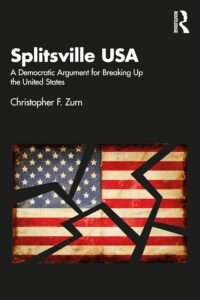
My Forthcoming Publius Review of Christopher Zurn, "Splitsville, USA: A Democratic Argument for Breaking Up the United States"

The book argues democracy can be preserved and improved by breaking up the United States into two or more new nations.

|

Routledge

My forthcoming review of Christopher Zurn's book, Splitsville, USA: A Democratic Argument for Breaking Up the United States is now available on SSRN. It will be published in Publius: The Journal of Federalism. Here is the abstract:

The US political system has been suffering from multiple serious problems, most notably severe polarization and weakening of crucial political norms underpinning democracy. In Splitsville USA, political philosopher Christopher Zurn advocates a radical solution: national divorce. He contends that Americans will be better off if the United States were divided up into two or more new nations. The book is a useful thought experiment and will surely help stimulate debate. But ultimately, Zurn's proposed remedy is unconvincing. The author overstates the feasibility and effectiveness of peaceful dissolution, while undervaluing those of some potential alternatives, most notably decentralization and limitation of government power. Splitsville also fails to convincingly address a number of potential negative effects of dissolution, particularly the threat to dissenting minorities within the new nations, and the impact on the international system.

As noted in the review, the fact this book was written by a serious scholar and is getting respectful attention is a notable sign of the times. A decade or two ago, calls for breaking up the United States were far more unthinkable than is the case today. It is also notable that, while arguments for breakup and secession are often associated with the political right, Zurn is a progressive.

In my own writings on these issues, I have argued that secession should be a more easily available option than is the case in most political systems today, but also that the flaws in American democracy are better addressed by other means, including by limiting and decentralizing government power, and otherwise empowering people to "vote with their feet."

Free Speech

"This Will Not End Well": FIRE on Penn President's Backtracking on Free Speech

"Conservatives like Rep. Elise Stefanik should ask themselves: Do you honestly believe this [proposed new rule against "calls for genocide"] won't be weaponized to ban an Israeli cabinet official from speaking at Penn? An Israeli Defense Force soldier?"

|

Another excellent statement by FIRE, yesterday:

[Wednesday], University of Pennsylvania President Liz Magill signaled that one of our nation's most prestigious institutions is willing to abandon its commitment to freedom of expression.

"For decades, under multiple Penn presidents and consistent with most universities, Penn's policies have been guided by the Constitution and the law," explained Magill in a video posted to X. But now, she continued, the university "must initiate a serious and careful look at our policies," a process to start "immediately."

This is a deeply troubling, profoundly counterproductive response to yesterday's congressional hearing on "Holding Campus Leaders Accountable and Confronting Antisemitism." Were Penn to retreat from the robust protection of expressive rights, university administrators would make inevitably political decisions about who may speak and what may be said on campus. Such a result would undoubtedly compromise the knowledge-generating process free expression enables and for which universities exist.

To be clear: Universities will not enforce a rule against "calls for genocide" in the way elected officials calling for President Magill's resignation think they will. Dissenting and unpopular speech — whether pro-Israeli or pro-Palestinian, conservative or liberal — will be silenced.

Read More

Free Speech

FIRE's Statement on the House Hearings on Anti-Semitism

"Double standards are frustrating, but we should address them by demanding free speech be protected consistently — not by expanding the calls for censorship."

|

From FIRE yesterday:

[Tuesday], the U.S. House Committee on Education & the Workforce held a hearing on "Holding Campus Leaders Accountable and Confronting Antisemitism." For hours, members of Congress grilled the presidents of Harvard, the University of Pennsylvania, and the Massachusetts Institute of Technology on their responses to anti-Semitism on campus following Hamas' October 7 attack on Israel — and many observers noted the hypocrisy of leaders of institutions with checkered records on free expression suddenly claiming their institutional commitments to free speech prevented them from cracking down on anti-Semitic speech.

Of course, one can understand the frustration of critics who rightly observe how quickly college administrators — including those at Harvard, Penn, and MIT — will reach for speech codes when certain disfavored views are expressed, yet don the cloak of free speech when they are more sympathetic to the speech at issue. Speech codes depend for their very existence on the exercise of double standards, as FIRE co-founder Alan Charles Kors has said.

But the solution to this moral cowardice is not to expand the use of vague and overbroad harassment codes so that they apply in more cases. Rather administrators should eliminate these codes and defend free speech in all cases. No hypocrisy. No double standards.

FIRE has battled vague, broad college harassment policies since our founding in 1999. We have defeated hundreds of unconstitutional, illiberal harassment policies at campuses nationwide — and we target these particular speech codes because harassment policies have long been the tool of choice for censorial college administrators. FIRE's case archives prove that harassment charges are regularly used to censor all kinds of speech, from punishing a student group at Long Island University critical of trans issues to investigating pro-choice students at American University.

Read More

Sex Crimes

You're 18 and Having Sex with 14-Year-Old? No Problem (in Arkansas). But Better Not Show Your Genitals!

|

From Kidd v. State, decided today by the Arkansas Court of Appeals, in an opinion by Chief Judge Brandon Harrison, joined by Judges Rita Gruber and Kenneth Hixson:

Kidd and M.C. met at a private high school with ten to fifteen students. She [Kidd] was a senior. He [M.C.] was in ninth grade. Kidd was about three years, nine months older. They exchanged DMs (direct messages) on Snapchat, Instagram, and Pinterest. The conversations went where one might guess.

During Spring Break in March 2021, the two had sexual intercourse at least seven times, mostly in Kidd's parked car. She was then eighteen; he was fourteen. M.C.'s parents found out. The prosecution that followed revealed that virtually everyone involved had made some mistaken assumptions about what sexual conduct between Kidd and M.C. was or was not prohibited by Arkansas law.

Kidd had assumed that, because of her and M.C.'s ages, sexual intercourse with M.C. was a crime. She told him in one message that if she became pregnant with his baby, she would have to give birth in jail. M.C.'s parents also believed sexual intercourse between Kidd and M.C. was illegal, and testified so at the bench trial.

In truth, it was not a crime for Kidd to "engage in sexual intercourse" with M.C.—at least it was not a sexual assault, the crime she probably had in mind (and which the State might rather have charged). It would have been second-degree sexual assault for Kidd, who was "eighteen years of age or older" to engage in "sexual contact with another person who is [l]ess than fourteen (14) years of age." But M.C. was fourteen. It would have been fourth-degree sexual assault if, at "twenty (20) years of age or older" she had "[e]ngage[d] in sexual intercourse or deviate sexual activity" or "sexual contact" with a person under sixteen. But Kidd was younger than twenty.

Read More

Free Speech

Should Universities Ban "Advocacy of Genocide"?

|

This question has been in the news recently, in light of the recent House Committee hearings on "Holding Campus Leaders Accountable and Confronting Antisemitism." A few thoughts on my part:

[1.] There's no "advocacy of genocide" exception to the First Amendment, or to the contractual promises of student free speech that many private universities rightly implement.

[2.] Indeed, as I've argued before, it is important that students be free to debate what is proper to do in war, and what wars are just. War involves mass killing, in some wars by the millions. I think some such killing is atrocity and some is just. But different people draw the lines differently, and that is a matter that is quite rightly up for debate.

For instance, some people label the Israeli invasion of Gaza as "genocide." I think they're wrong, both as a moral matter and as a matter of international legal norms (such as they are). I think Israel is entitled to kill as many Hamas fighters as it can, and if Hamas hides behind civilians, then Israel is entitled to kill the civilians to get to Hamas. Likewise, I think the U.S. was quite right to kill many German and Japanese civilians in the course of fighting the German and Japanese militaries.

Read More

Free Speech

Alabama Basketball Player's Libel Lawsuit Against New York Times Can Go Forward

|

From today's decision by Judge Scott Googler (N.D. Ala.) in Spears v. New York Times Co. (for more on the earlier correction in the case, see here):

On the night of January 14, 2023, Spears and his two high school friends, Dylan Serafini and Esai Morse, went to the popular student gathering area called "The Strip" located on University Boulevard in Tuscaloosa, Alabama, following the Alabama-LSU basketball game. At the time, Spears was a freshman at The University of Alabama and played guard on the Alabama basketball team. At 12:30 a.m., Spears and his friends met up outside of Houndstooth Bar with one of Spears's teammates, Brandon Miller, and were also joined at some point by the team's student manager, Cooper Lee. After meeting up, they drove to Moe's Original BBQ in downtown Tuscaloosa where they stayed until 1:40 a.m. While at Moe's BBQ, Spears FaceTimed another teammate, Jaden Bradley, who invited Spears and his friends to join Bradley and others.

After declining the invitation to go out, Spears and his friends drove back to his dorm room while Miller and Lee drove to The Strip in Miller's car. At 1:48 a.m., Spears FaceTimed Bradley again to see where they had gone, which is when Spears learned that there had just been a shooting on The Strip and bullets had struck Miller's windshield. Later that day, Tuscaloosa police investigated the incident and interviewed members of the basketball team who were out the night before, including Spears. Police ultimately charged two men in relation to the shooting. No one else, including Spears, was charged.

In its investigation of the incident, The Times learned that surveillance video showed two people "were struck by bullets in the crossfire," and that a "detective also made note of an unidentified passenger in Miller's car." In March, a confidential source "familiar with the case" purportedly told The Times that Spears was the unidentified passenger in Miller's car at the time of the shooting.

Read More

Animals

Does Divorcing Spouse's Euthanizing Family Pet Violate Court Orders Preventing Disposal of "Property"?

No, says a judge, applying New York law.

|

From C.M. v. E.M., decided last week by Justice Edmund Name of the Nassau County (N.Y.) trial court:

[T]he principal issue raised on these motions is whether or not the euthanasia of a family companion animal during the pendency of a matrimonial action is violative of the Automatic Orders. There can be no doubt that the loss of a family pet or companion animal can be devastating. But the principal question before the Court is a narrow one. The Court concludes, after examining the text of the Automatic Orders, reviewing the Legislative history and underlying purpose of the enactment of Automatic Orders, considering the evolution of case-law with respect to companion animals and the Legislative history behind DRL [Domestic Relations Law] § 236(B)(5)(d)(15), and reviewing the purpose of the Defendant's application, that the euthanasia of a companion animal without the consent of the other party is not violative of the Automatic Orders in a matrimonial action. While the Defendant may have other remedies at law—both civilly and criminally—the narrow and drastic remedy of contempt of court the Defendant seeks here is not one of them….

The Defendant [husband] argues that the Plaintiff [wife] vindictively violated the Automatic Order by putting their beloved family pet, B., to death without reason, necessity or justification. The Defendant argues that B. was an emotional support dog whose custody had not been determined. The Defendant argues that the Plaintiff did not discuss B.'s medical condition nor provide the opportunity for the Defendant to spend time with B. before the dog's death. The Defendant argues that he is suffering extreme emotional distress because of B.'s death. The Defendant seeks compensation for this loss in the amount of $1,500 as punitive damages….

The Plaintiff argues that the Defendant was not an emotional support animal, could no longer walk without a severe limp, had "too many" masses to count, and was on significant pain medication since July, 2023. The Plaintiff argues that she was given a prescription for a tranquilizer for the dog, transported the dog to the Vet, and at the Vet appointment, the dog lunged at the Vet. The Plaintiff argues that the Vet recommended euthanasia….

Read More

"Strangers on the Internet" Podcast Episode 49: Exclusive Interview with Author L.L. Kirchner

How far can a spiritual journey take you?

|

The forty-ninth episode (Apple Podcasts link here and Spotify link here) of Strangers on the Internet with co-host and psychologist Michelle Lange features an exclusive interview with award-winning screenwriter and author L.L. Kirchner.

L.L., who has written the memoirs Blissful Thinking: A Memoir of Overcoming the Wellness Revolution (available here) and American Lady Creature: (My) Change in the Middle East (available here), takes my co-host and me through the whirlwind of her life in this episode you will not want to miss. While living in Qatar, L.L. received a phone call from her husband announcing that he wanted a divorce. Afraid that she would spiral back into substance addiction, L.L. promptly decided to take a spiritual journey to India where she quit smoking cigarettes as soon as she landed and threw herself into yoga and meditation, even visiting a sex cult at one point.

L.L. tells it all, from the start of her eventually babysitting-funded alcoholism that started at age ten (later on adding other drugs) to the dating column and matchmaking experiment she ran for an alternative newspaper. After some online dating adventures of her own in NYC, did she really end up finding love with Florida Man?? Come find out!

L.L. Kirchner
More