The Volokh Conspiracy

Mostly law professors | Sometimes contrarian | Often libertarian | Always independent | Est. 2002

The Volokh Conspiracy

How Has Legal Academia Changed Since Posner on Meltzer?

Revisiting Posner's 2007 essay.

|

Back in 2007, Richard Posner published a very interesting reflection on the state of the legal academy in the form of a memorial essay to his colleague Bernard Meltzer.  It's a very brief essay, only 3 pages long.  But Posner's essay laments the loss of the former generation of lawyer-scholars that used to populate law schools. In the old days, Posner says, there were lots of law professors who were superb lawyers steeped in lawyering. These days, Posner says, that model is largely gone.  Today's professors see themselves as academics first and lawyers second.  Posner suggests that the best education and the best scholarship is a mix of the two.  Both the lawyer-model and the academic-model are useful in their own ways.  A student should get a healthy mix of the two, and scholarship of both kinds is very useful.

Over at X, in response to a tweet from me on the essay, Adam Unikowsky asked a good question:

Do you think the relationship between lawyering and legal academia has changed since Posner wrote that 16 years ago? If so, in what direction?

I don't have any special expertise on this question, but I have two tentative thoughts on it.

First, in some ways, the trend towards the academic model has only accelerated.  Sarah Lawsky keeps numbers on the entry-level classes, and her annual report includes a chart on the percentage of new hires with doctorate degrees:
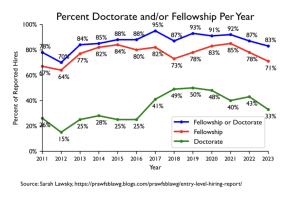
The green line is the key here.  Note the jump from around 25% from 2011 to 2016 to the 40-50% range starting around 2017.  And as Lynn LoPucki noted in his 2016 essay, Dawn of the Discipline-Based Faculty, the trend is even more pronounced at the "elite" schools.  At my own institution, UC Berkeley Law, having a Ph.D. is effectively now the norm for entry-level hires. It's certainly not required.  But a majority of entry-level hires have one.

Doctorates, or their absence, isn't a perfect proxy for the dynamic Posner describes.  But it's in the ballpark.  And the trend toward even more Ph.Ds suggests that, on the whole, the trend Posner noted has accelerated.

That's one part of the picture. But there's another set of developments that cuts the opposite way.

In the last fifteen years, many law schools have made significant improvements in expanding programs that are beyond the scholarship-line tenure-track professors, as well as breaking down barriers that used to divide the different parts of the faculty.  Many schools have expanded clinics, hiring new faculty to teach clinics who are outstanding practitioners as well as academics.  They have expanded legal writing programs, bringing in excellent lawyers as professors of legal writing.  Some schools have added "professors from practice",  leading senior practitioners who join the faculty to teach classes and participate in the life of the law school but are not on the tenure track.

This is a big generalization, and I hope I'm not too far off in this description.  Describing a diverse area like legal academia reminds me of the parable of the blind men and the elephant. You never know if what you experience is just one part of the elephant. (If you think I'm off, please let me know in the comment threads.)  But my sense is that these changes have had a significant impact on the kinds of faculty that a law student might encounter.  When I was in law school, three decades ago, it was common to go through three years pretty much only encountering the regular podium scholarship faculty.   But my sense is that's rare today, if not entirely unheard of.  Today's law students are going to be taught by legal writing professors, clinical professors, professors from practice, and of course adjunct professors.  All of them are likely to be excellent lawyers steeped in lawyering.

In short, I think there have been two changes since Posner's critique that cut in somewhat opposite directions.  On one hand, the trend Posner saw has accelerated, with more Ph.Ds. than before. On the other hand, schools have made very helpful and important strides towards recognizing the critical role of faculty beyond the podium tenure track.

Alleging Police Officer's "OK" Symbol Was "White Power" Hand Sign Is Constitutionally Protected Opinion

|

From today's Ohio Court of Appeals opinion in Olthaus v. Niesen, written by Judge Pierre Bergeron and joined by Judges Candace Crouse and Marilyn Zayas (for more on the general legal issue, which has arisen as to allegations of Communism as well as racism, see this post):

During the wave of racial justice demonstrations that swelled in the summer of 2020, the Cincinnati City Council convened a series of open meetings. At an open forum before the council's budget and finance committee meeting in June  2020, Officer Olthaus was assigned to provide crowd control and security.

During an interaction with defendant-appellee Terhas White, who was participating in a demonstration outside the council's chambers, Officer Olthaus flashed an "OK" symbol, pinching together his thumb and index finger. He maintains that he made this gesture in response to Ms. White asking him about the status of his fellow officer who had recently left the area after an interaction with demonstrators.

She and the other defendants-appellees (collectively, "Defendants"), however, saw things very differently. In various ways, they publicly criticized Officer Olthaus and his gesture, describing him, primarily in social media posts, as a "white supremacist" and calling the gesture a "white power" hand sign….

[Olthaus] alleges that Ms. White published social media posts referring to him as a "white supremacist kkkop" and "white supremacist piece of shit," and that Julie Niesen made posts in a similar vein. He also alleges that Ms. White knowingly submitted a false complaint with the city's Citizen Complaint Authority ("CCA"), accusing him of using a "white power" hand signal on the job. He accuses Ms. Gilley of filing a similar complaint with the CCA in which she asserts that he "[threw] up a white supremacy hand-signal towards citizens of color," which she perceived as "a threat to me, my children and so many others."

Finally, he claims that James Noe posted a profane insult about him on social media in the context of saying that he flashed "white power symbols to Black speakers," and that Mr. Noe posted a "deceptively edited photograph" of Officer Olthaus designed to portray him as a "white supremacist." [The supposed deceptive editing wasn't heavily litigated, and to my knowledge the editing didn't actually make any factual assertions about Plaintiff. -EV] He also claims Mr. Noe threatened to publicize his personal identifying information on social media.

Olthaus sued for defamation and related torts, but the court concluded that the defendants' speech was opinion rather than a false statement of fact:

Read More

Politics

Interesting Venue Clause Decision: Where Is a False Statement Crime "Committed"?

|

From yesterday's U.S. v. Fortenberry (9th Cir.), in a decision by Judge James Donato (N.D. Cal.) joined by Ninth Circuit Judges Gabriel P. Sanchez and Salvador Mendoza, Jr.:

Federal agents interviewed Jeffrey Fortenberry at his home in Lincoln, Nebraska, and his lawyer's office in Washington, D.C., in connection with an investigation into illegal campaign contributions made by a foreign national through conduit donors. At the time, Fortenberry was a member of the House of Representatives elected to multiple terms by voters in Nebraska's 1st congressional district. The federal agents were based in Los Angeles, California, where the illegal contribution activity was said to have occurred. At the end of the investigation, Fortenberry was charged with making false statements during the interviews in violation of 18 U.S.C. § 1001, but not with a violation of the federal election laws. He was tried and convicted by a federal jury in Los Angeles….

The Constitution plainly requires that a criminal defendant be tried in the place where the criminal conduct occurred. The district court determined, and the government urges on appeal, that a Section 1001 violation occurs not only where a false statement is made but also where it has an effect on a federal investigation. We conclude that an effects-based test for venue of a Section 1001 offense has no support in the Constitution, the text of the statute, or historical practice. Consequently, we reverse Fortenberry's conviction without prejudice to retrial in a proper venue….

Read More

Religion and the Law

Nebraska Court Upholds Order That Father Not Take Son to Sweat Lodge

The court is silent on whether it would be OK to take him to Houston in July.

|

From yesterday's decision by the Nebraska Court of Appeals in Ewing v. Evans, by Judge Francie Riedmann, joined by Judges Riko Bishop and Lawrence Welch:

Joseph Evans appeals the order of the Lancaster County District Court that overruled his complaint to modify a custody order and parenting plan. We conclude that Evans failed to show a material change in circumstances to warrant modification. Furthermore, we find the district court did not abuse its discretion in enjoining Evans from taking the child into sweat lodges ….

Evans and Ewing are the biological parents of a son born in May 2013. The parties were never married, and their relationship ended in February 2014. On January 23, 2015, Evans was in a severe automobile accident in which he collided with a wall at 75 miles per hour. Among his many injuries, he suffered a broken back, a traumatic brain injury, and bleeding in his brain.

In March 2015, the district court issued a custody order … regarding the parties' son. The order was based on a joint stipulation filed by the parties in which Ewing received sole physical and legal custody of their son and Evans received parenting time set out under a parenting plan….

In 2021, the trial court ordered Evans not to take his son to a sweat lodge, and the Court of Appeals upheld the injunction. There's a lot going on in the opinion, but I'll focus on the sweat lodge issue:

Read More

Guns

Mark McCloskey, Pardoned for Brandishing Guns at Protesters, Can't Get the Guns Back

|

From today's Missouri Court of Appeals decision in McCloskey v. State, written by Judge James M. Dowd and joined by Judges John P. Torbitzky and Michael S. Wright:

This appeal arises out of a petition for replevin in which appellant Mark McCloskey sought the return of two firearms that police had seized pursuant to search warrants in connection with a June 28, 2020, incident in which McCloskey and his spouse exhibited the firearms as a group of protesters passed by their home. They were charged with felony unlawful use of a weapon punishable by up to four years in prison. McCloskey and the State reached a plea agreement whereby McCloskey pleaded guilty to misdemeanor fourth-degree assault and forfeited ownership and possession in the two firearms in exchange for the State dismissing the felony charge….

Soon after, the governor pardoned McCloskey and he filed against the State, the Sheriff, and the Mayor (Respondents) his underlying petition for replevin of the weapons in which he claimed the governor's pardon gave him the right to their immediate return….

While we agree that the pardon restored all of his rights forfeited by the conviction and removed any legal disqualification, disadvantage, or impediment, Missouri law is unequivocal that a gubernatorial pardon obliterates the fact of the conviction, not the fact of guilt. Thus, McCloskey's guilty plea, for which he obtained the benefit of the State dismissing a felony charge punishable by jail time, survived the pardon and importantly, with respect to the issue at hand in this replevin action, triggered the guns' forfeiture. Therefore, since McCloskey's guilt remains, it follows that he is not entitled to the return of the weapons….

Read More

Judiciary

Fifth Circuit Rejects Younger Abstention Claim by Prosecutor Seeking to Prosecute Netflix for Airing "Cuties"

A rare federal court decision denying Younger abstention.

|

Netflix's decision to release of "Cuties" prompted a swirl of controversy. It also led to litigation. Specifically, some prosectors filed suit against Netflix alleging the film constituted child pornography. Last year, a federal court in Texas enjoined prosecution of Netflix, noting that the film was almost certainly protected by the First Amendment, but the efforts to score culture war points in court continued, leading ultimately to the U.S. Court of Appeals for the Fifth Circuit.

On December 18, the Fifth Circuit rejected the prosecutor's appeal of the district court's injunction in Netflix v. Babin. Among other things, he sought refuge under Younger abstention (a favorite of FedCourts students everywhere) to claim the federal courts should stay their hand, but to no avail.

Here's Judge WIllett's summary of the decision:

Younger abstention is one of a handful of federalism-flavored carveouts to a federal court's "virtually unflagging obligation" to exercise congressionally conferred jurisdiction. Out of respect for the legitimate interest of the state, and to avoid needless friction, federal courts may not interfere with an ongoing state criminal proceeding, so long as the defendant being prosecuted has an adequate opportunity to raise constitutional challenges in the underlying state forum.

A state has no legitimate interest, however, in a prosecution brought in bad faith or to harass. Nor, for that matter, does a defendant have an adequate opportunity to assert constitutional violations in the state proceeding when the prosecution itself is the constitutional violation. Thus, in exceptional cases in which a state prosecutor is credibly accused of bad faith and has no reasonable hope of obtaining a valid conviction against the defendant, comity-infused deference gives way, and a federal court may exercise its equitable power to enjoin the prosecution.

In this case, a Texas state prosecutor, Lucas Babin, criminally charged Netflix for advertising and promoting child pornography based on its streaming of Cuties, a controversial film starring preteen girls who participate in a dance competition. Soon after Netflix asserted its First Amendment right to stream and promote Cuties, Babin multiplied the first indictment into four, selectively presented evidence to the grand jury, and inexplicably charged Netflix for a scene that involved a verifiably adult actress. Based on these and other allegations of bad faith, Netflix sought and successfully obtained a preliminary injunction against Babin and his prosecution. Babin now appeals, arguing that the district court clearly erred in finding bad faith and abused its discretion by declining to abstain under Younger.

At this preliminary stage, and on the fact-intensive record before us, we cannot conclude that the district court erred. With the benefit of a seven hour evidentiary hearing, including Babin's own testimony, the district court was best positioned to make the largely credibility-based determination of bad faith. The findings underlying that determination, along with the inferences drawn from them, are not clearly erroneous, and they likely warranted injunctive relief under what we have historically understood to be—and continue to recognize as—a narrow exception to Younger abstention. We accordingly AFFIRM.

Climate Change

William Barr Responds on American Petroleum Institute v. Minnesota

The former Attorney General disagrees with me on whether state and local government climate change lawsuits belong in federal court.

|

Earlier this month, I explained why federal circuit courts have been correct to reject energy company attempts to remove various cliamte change cases to federal court, and suggested these suits are not cert worthy. A few days later, the U.S. Court of Appeals for the D.C. Circuit affirmed my view in a clear and concise opinion by Judge Neomi Rao.

In my earlier post, I criticized arguments made by former Attorney General William Barr and AEI's Adam White in support of certiorari in American Petroleum Institute v. Minnesota, a case currently under consideration at One First Street. AG Barr has now responded, and I reproduce his reply below, along with my brief rejoinder.

I am grateful to Professor Jonathan Adler for agreeing to publish my response to his blog post on API v. Minnesota, a case pending before the Supreme Court.

Read More

Free Speech

First Amendment Likely Protects Even Unlicensed Engineers' Right to Provide Expert Opinion in Government Proceedings

(Note that the court dealt with a professional licensing board's threat of punishment for such engineers; it doesn't deal with the separate question whether a government body may refuse to accept testimony from an unlicensed expert.)

|

From the Conclusion to last week's decision by Judge Richard Myers (E.D.N.C.) in Nutt v. Ritter:

At its core, this case concerns the extent to which a law-abiding citizen may use his technical expertise to offer a dissenting perspective against the government. Stating that dissent required the speaker to use his expertise in several ways. He had to do some math. He had to apply recognized methodologies. He even had to write a report memorializing his work.

Some of that work may plausibly be considered conduct. But it ends up providing him the basis to speak his mind. Thus, although the government may properly exercise its interests in policing the use of technical knowledge for nonexpressive purposes, those interests must give way to the nation's profound national commitment to free speech in this case. At the very least, the government had to show that it seriously considered less restrictive alternatives before targeting pure speech. The government failed to meet its obligations under the First Amendment.

And here's more from the opinion:

Read More

Free Speech

First Amendment Likely Protects "Death Doulas"

|

From Richwine v. Matuszak, decided last week by Chief Judge Holly Brady (N.D. Ind.):

Plaintiff … is a "death doula." Through her business and co-Plaintiff, Death Done Differently LLC …, Richwine speaks with people about a difficult topic, one many people avoid: death and dying. This includes providing individualized advice to clients and their families to plan for death, options for funeral goods and services, and how they would like to be remembered. Defendants—officials of the State of Indiana—ordered Richwine to cease speaking unless she obtains a funeral-director license for herself and a funeral-home license for her business….

Richwine sued under the First Amendment, and the court granted her a preliminary injunction, concluding that she was likely to succeed on the merits:

The Order restricts Plaintiffs' speech in two ways. First, it prohibits Plaintiffs from providing education or individualized advice about end-of-life care. Second, the Order prevents Plaintiffs from advertising those services on their website….

As with lawyer speech, the government cannot escape the First Amendment by claiming it is regulating conduct when the supposed "conduct triggering coverage under the statute consists of communicating a message." Holder v. Humanitarian Law Project (2010). This is all the more true considering the Supreme Court's decision in NIFLA v. Becerra (2018). Prior to NIFLA, some Courts of Appeals recognized "professional speech" as its own category of speech subject to a different rule. But the Supreme Court expressly rejected that notion. NIFLA ("This Court's precedents do not permit governments to impose content-based restrictions on speech without 'persuasive evidence…of a long (if heretofore unrecognized) tradition' to that effect…This Court's precedents do not recognize such tradition for a category called 'professional speech.'"). And all authority Defendants cite in support came well before NIFLA. Thus, Indiana's statutes are not exempt from heightened scrutiny merely because they regulate the professional speech of licensed funeral directors. States cannot exercise "unfettered power to reduce a group's First Amendment right by simply imposing a licensing requirement."

Read More

"Strangers on the Internet" Podcast Episode 50: A Retrospective Celebrating Our 50th Episode

What have we learned over the past year and a half?

|

The 50th episode (Apple Podcasts link here and Spotify link here) of Strangers on the Internet with co-host and psychologist Michelle Lange pauses for a moment to take stock.

We guide listeners through a retrospective of the podcast on the occasion of the show's 50th episode. What lessons have we learned from our guests and conversations? We discuss societal loneliness and disconnection, the state of the dating apps, and the key traits and situations to avoid while dating.

We also explore the ways that communities can support both single and coupled people in today's world. Come celebrate this big milestone and final episode of season 2 with us!

Michelle Lange

Donald Trump

Why Section 3 Disqualification Doesn't Require a Prior Criminal Conviction on Charges of Insurrection [Updated]

The reason is a combination of the general structure of our legal system and the original meaning of Section 3.

|

Donald Trump speaking
Kyle Mazza/SOPA Images/Sipa USA/Newscom

One of the most often-raised objections to the Colorado Supreme Court's decision disqualifying Trump from running for president under Section 3 of the Fourteenth Amendment is that Trump has never been convicted of engaging in insurrection. As conservative Washington Post columnist Jim Geraghty puts it: "If you're going to throw a presidential candidate off the ballot for engaging in an insurrection through his personal actions, shouldn't he first be convicted of engaging in an insurrection?"

The answer to this question is "no." The reasons why are based on a combination of the basic structure of our legal system, and the original meaning of Section 3.

A standard element of our legal system is that the same events often give rise to both civil and criminal liability. For example, a person who commits rape, murder, or assault is subject to criminal penalties, and also to civil suits by his or her victims. In such cases, a criminal conviction is not a prerequisite to civil liability. Indeed, even an actual acquittal on criminal charges doesn't necessarily preclude civil lawsuits against the perpetrator. Just ask O.J. Simpson, who was famously acquitted of criminal charges in the murder of his ex-wife Nicole Brown Simpson, and Ron Goldman, but later lost a civil case filed by the victims' families. The criminal acquittal didn't stop Simpson from incurring $33.5 million in civil liability. The criminal and civil cases were distinct, and the result of one did not determine that of the other.

The same reasoning applies to Trump. The absence of a criminal conviction for insurrection doesn't immunize him from civil proceedings arising from his role in the January 6 attack on the Capitol. Disqualification under Section 3 is a civil issue, not a criminal one. It cannot result in a prison sentence or other criminal sanctions.

There are many reasons why civil and criminal cases arising from the same events might turn out differently. The most obvious is that a criminal conviction requires proof beyond a reasonable doubt, while a civil plaintiff can prevail merely based on a preponderance of evidence standard (a slightly more than 50% chance that her position is right). In the Colorado Section 3 case, state courts found that the plaintiffs had sufficient proof to satisfy a "clear and convincing evidence" standard (a higher burden than preponderance, but less than proof beyond a reasonable doubt).

The lower standard of proof and other procedural differences between criminal and civil cases are justified by the generally less severe consequences at stake in the latter. Civil defendants don't risk the death penalty, prison terms, or getting a criminal record. In this case, Trump doesn't even face the prospect of forfeiting any of his property or paying damages. All he stands to lose is eligibility for various state and federal government jobs.

There are situations where the consequences of civil liability are so grave that the civil-criminal distinction may seem artificial, as when defendants end up paying enormous damages that force them into bankruptcy. A short prison term might be less painful than that. But Section 3 disqualification isn't one of those cases.

In addition to these general considerations about the structure of the legal system, there are also points specific to the original meaning of Section 3. None of the ex-Confederates who were adjudged disqualified during Reconstruction had ever been convicted of any crimes related to their roles in the Civil War. That strongly suggests the original understanding didn't require prior criminal conviction for insurrection - or any other offense - before an insurrectionist could be disqualified.

In addition, it's important to recognize that tens of thousands of Confederate troops had surrendered under parole terms that arguably exempted them from prosecution for their wartime activities so long as they did not engage in further insurrection or other lawbreaking. The most famous example is General Ulysses S. Grant allowing Robert E. Lee and the Army of Northern Virginia to surrender under terms that allowed "each officer and man…  to return to their homes, not to be disturbed by United States authority so long as they observe their paroles and the laws in force where they may reside" (emphasis added).

Lee's army - and other Confederate forces who surrendered on similar terms - included large numbers of men who could be disqualified under Section 3, because they had previously held public office. That includes Lee himself, subject to disqualification by virtue his previous service as a high-ranking US Army officer (Section 3 disqualifies any insurrectionist who had previously been an "officer of the United States," a category that included commissioned military officers).

After the war, there was disagreement over whether Lee's parole terms exempted him prosecution.  Ultimately, attempts to prosecute him were dropped. It is implausible to conclude that the framers and ratifiers of Section 3 thought that Lee and others like him were exempt from disqualification, merely because they were not prosecuted for insurrection, and possibly could not be, given the terms of their surrender.

Legal considerations aside, the victorious Unionists were not willing to prosecute and imprison the many thousands of ex-Confederates covered by Section 3. On the other hand, they were determined to prevent them from holding public office.

In sum, the idea that Section 3 disqualification requires a prior criminal conviction for insurrection is at odds with the general structure of our legal system, which separates civil and criminal liability. It is equally at odds with the original understanding of Section 3.

There is a separate argument about how much civil due process is needed before someone can be disqualified under Section 3. In my view, the trial Colorado held is more than enough. But wherever you come down on this civil due process issue, it's distinct from the claim that a criminal conviction is needed.

UPDATE: Conservative political commentator Conn Carroll criticized this post in a Washington Examiner column. I have responded to him here.

Israel, Gaza, and Selective Historical Memory

Who is responsible for the killing and suffering in Gaza?

|

The war in Gaza - the war in Gaza and Israel, we should say, so as not to lose sight of the fact that hostilities began with an armed incursion into Israeli territory - is as complex a historical event as one can possibly imagine, with deep and tangled historical roots, a large and very complicated set of relevant actors (Israel, Hamas, the Palestinian Authority, Egypt, the US, Hezbollah, Iran, Qatar, the Saudis, …), and potentially profound implications for the future relationships among all the parties and for the world as a whole.  Not to mention the unimaginably terrible suffering on all sides. It is, to put it mildly, too complex for a blog post, too difficult to find one small piece of the issue to address that is not connected to all the other pieces.

But I find one small corner of this complicated tableau particularly disturbing. Why is it, I ask myself, that Israeli conduct always seems to be judged by different standards than those applied to any other country in the world in similar circumstances; and, similarly, why is it that the grievances of Israel's enemies are viewed more sympathetically than the grievances of any other group in the world?

Read More

Free Speech

Tweet Accusing Man of Rape Led to Gag Order Against the Accuser

The trial judge concluded the Tweet was “harassment by defamation.”

|

Yesterday's Illinois Appellate Court decision in McClellan v. Hull, written by Justice Sharon Oden Johnson, joined by Justices Michael Hyman and Carl A. Walker reverses the order (which had been issued by Judge Debra A. Seaton), though without reaching the First Amendment question.

The quick factual backstory: McClellan and Hull met on Facebook, and then met twice in person and had sex on the second time. McClellan says it was consensual, Hull says that McClellan raped her. Four weeks after that, in April 2021, Hull Tweeted "that she was raped by him, he was a predator, she wanted justice for herself and sought to warn others of his sick nature" (McClellan's paraphrase).

McClellan claimed that this was "harassment" that entitled him to an Emergency Order of Protection under the Domestic Violence Act, and the court agreed. The court issued the Emergency Order, which "ordered Hull to have no contact by any means with McClellan." The Emergency Order was extended several times and then replaced by a longer-term Order of Protection. And at one of the hearings,

[T]he circuit court stated that it was not relevant whether there was a sexual assault; under the statute, it had to decide the relationship between the parties and whether Hull's social media messages were defamatory…. [T]he circuit court found that McClellan's allegations regarding abuse fell under the harassment prong of the Domestic Violence Act for defamation based on the accusations of rape in a social media post….

The court then stated that both parties were prohibited from posting about each other or the case on social media, and noted that there was a criminal case pending [apparently a case against McClellan based on Hull's allegations]. The court then amended the EOP to include the prohibition….

Read More

More