The Volokh Conspiracy

Mostly law professors | Sometimes contrarian | Often libertarian | Always independent | Est. 2002

The Volokh Conspiracy

Property Rights

Federal Appellate Court Rules in Favor of Takings Lawsuit Against the CDC's Covid-Era Eviction Moratorium

The 2-1 decision overrules a trial court decision that went the other way, and could set an important property rights precedent.

|

NA

On Wednesday, in Darby Development Co. v. United States, the US Court of Appeals for the Federal Circuit (which reviews takings claims against the federal government) ruled that a takings lawsuit against the 2020-21 federal eviction moratorium can proceed. In so doing, it overruled a trial court decision by the Court of Claims, which I criticized here. The Federal Circuit decision could well end up setting an important takings precedent.

In September 2020, during the Covid pandemic, the Trump Administration Centers for Disease Control (CDC) imposed a nationwide eviction moratorium, claiming that it would reduce the spread of the disease. The Biden Administration extended the moratorium multiple times. In August 2021, the eviction moratorium was invalidated by the Supreme Court because the CDC lacked proper statutory authority to institute it. But, in the meantime, numerous landlords suffered financial losses, because they could not evict tenants who weren't paying rent.

Some of the property owners filed a lawsuit arguing that the eviction moratorium violated the Takings Clause of the Fifth Amendment, which requires the government to pay "just compensation" whenever it takes private property. As I explained at the time, their position was backed by the Supreme Court's 2021 ruling in Cedar Point Nursery v. Hassid, which held that even temporary physical occupations of property qualify as "per se" (automatic) takings requiring compensation.

In May 2022, the US Court of Claims dismissed the takings lawsuit against the CDC moratorium on the perverse ground that there was no taking because the CDC's eviction moratorium was never properly "authorized." In other words, the government could escape takings liability because its actions were illegal! The recent Federal Circuit decision reversed that ruling.

As Judge Sharon Prost writes in her majority opinion for the court, an illegal seizure of property can nonetheless qualify as an "authorized" taking if it is "chargeable" to the government:

An action will normally be deemed authorized if it was done by government agents "within the general scope of their duties"—i.e., if it was "a natural consequence of congressionally approved measures" or "pursuant to the good faith implementation of a congressional act." Del-Rio, 146 F.3d at 1362 (cleaned up); see also Ramirez, 724 F.2d at 152 ("[O]n numerous occasions when the government agent was acting within the ordinary scope of responsibilities conferred on him by Congress, and took private property without express statutory authority or prohibition, the Tucker Act remedy was held to lie.")…..

To summarize: even if an action by a government agent is unlawful, it will likely be deemed authorized for takings claim purposes if it was done within the normal scope of the agent's duties—for example, if it was done "pursuant to the good faith implementation of a congressional act." Del- Rio, 146 F.3d at 1362 (cleaned up). If instead the action was outside the normal scope of the government agent's duties— or, despite being within that scope, it contravened an explicit prohibition or other positively expressed congressional intent—it will likely be deemed unauthorized. See id. at 1363; Ramirez, 724 F.2d at 151. The ultimate inquiry is whether the government agent's action is "chargeable to the government." Del-Rio, 146 F.3d at 1362.

The majority opinion engages in a long and detailed debate with Judge Dyk's dissent over the issue of whether the above approach is the best interpretation of relevant Supreme Court and Federal Circuit precedent. I won't try to assess that debate here.

To me, the decisive factor should be that the Takings Clause nowhere says that compensation is only required for legal government actions or for those specifically authorized by statute. Rather, the Clause imposes a general rule that compensation must be paid whenever the government takes private property for "public use." That, of course, can happen even without proper legislative authorization. I can understand if takings liability is nonetheless denied when rogue low-level officials seize property without any plausible justification. But that isn't what happened here. As the majority explains:

Finer legal points aside, the implications of the dissent and government's position illustrate its weakness. Taken to its logical conclusion, their position is that government agents can physically occupy private property for public use, resist for months the owner's legal attempts to make them leave, and then, when finally made to leave, say they need not pay for their stay because they had no business being there in the first place. It would be one thing for this to be the result when government agents are clearly acting apart from Congress's will; in such a case, requiring just compensation would encroach too much on Congress's power of the purse…..  But there is no sound reason for such a result in a case like this, where (1) the government agent, after receiving a directive from the President, acted in good faith pursuant to a good-faith understanding of its congressionally conferred authority, (2) there was no explicit congressional prohibition foreclosing that understanding….. and (3) the government vehemently pressed that understanding in litigation so as to seriously impede the property owners' efforts to end the alleged occupation. Depriving property owners of a potential Fifth Amendment remedy in this case would deprive them of any meaningful remedy at all.

This strikes me as pretty obviously right. The CDC here was acting at the behest of two successive presidents of the United States, from different parties. And the federal government fought a months-long legal battle to prove that the policy was, in fact, properly authorized by legislation. They cannot now turn around and claim they don't owe takings compensation because they ultimately lost that fight. I expanded on this point in a bit more detail here.

Judge Dyk worries that the majority's rule would impose takings liability on the government in too many situations:

The majority's holding here would have significant consequences. It would effectively make even clearly unauthorized agency action authorized for purposes of takings liability unless that action was contrary to a specific prohibition of the authorizing statute or taken in bad faith.

That cannot be correct. The majority's decision would work a sea change in our takings jurisprudence and impose significant takings liability on agencies for unauthorized acts, directly discouraging adoption of legitimate government programs because of the risk of takings liability in addition to injunctive and declaratory relief. Historically, unauthorized programs were enjoined. Now, in addition there is the specter of takings liability.

I think the "specter of takings liability" is a feature, not a bug. If the government often engages in illegal seizures of property, then they should face "significant takings liability" for doing so. That might help deter such misconduct, or at least compensate victims, if it does not. If such misbehavior is relatively rare, then we need not worry about the ruling having "significant consequences." And if the program the government enacts really is "legitimate," then takings liability for "unauthorized acts" should not be a concern, because a legitimate program won't include much in the way of such unauthorized takings - if any.

The majority and dissent also dispute whether, in enacting the eviction moratorium, the CDC was acting within the scope of its "normal duties," a factor relevant to determining whether the taking was "authorized," under previous precedent. The dissent is right that the eviction moratorium was more sweeping than previous policies adopted under the statute the government claimed as authorization. But the majority has a fairly solid response:

[W]hen we say that the CDC issued the Order within the "normal scope" of its duties, we do not mean to suggest that the Order itself was normal. We readily agree it was not. But then again, neither was a burgeoning pandemic on the scale of COVID-19. The Order's abnormality flowed naturally from the abnormal circumstances the CDC was confronting—and from the CDC's reasonable (if ultimately incorrect) interpretation and application of its PHSA authority to those circumstances. In this case, simply because the Order was abnormal does not mean that the CDC—the agency charged with issuing regulations "as in [its] judgment" are necessary to prevent the interstate spread of communicable diseases, 42 U.S.C. § 264(a)—was acting outside the "normal scope" of its duties for takings-claim purposes when issuing it.

There is a complication here in so far as evidence indicates the Trump and Biden administrations enacted and extended the moratorium  in large part for political reasons, rather than because they were truly convinced it would curb the spread of disease. Still, the fact that the measure had a plausible public health rationale (public health is the CDC's main area of responsibility) still made it "normal" enough to qualify as authorized but unlawful. Broad measures—including many with dubious legal rationales— were common during the Covid pandemic.

Finally, the majority also concludes - correctly, in my view - that an eviction moratorium qualifies as a "physical taking" under Cedar Point. They rightly reject the argument that moratoria are merely regulations of the landlord-tenant relationship that should not be considered takings under current Supreme Court precedent. Rent control, ruled not a taking in Yee v. Escondido (1992), is distinguishable from a situation where the government forces a property owner to accept occupation of her land by a tenant that she would otherwise have the right to remove:

[T]he government argues that here, like Yee…, Appellants' tenants had been voluntarily "invited" onto Appellants' property—which, according to the government, means that there was no physical taking… See… Yee, 503 U.S. at 528 (observing that the park owners' "tenants were invited by [them], not forced upon them by the government"). While we agree that this point distinguishes this case from Cedar Point, we are not persuaded that it compels a different result. If a previous voluntary invitation (by itself) controlled the analysis, that would essentially mean that all government actions implicating the landlord-tenant relationship are immune from being treated as physical takings. (After all, we can safely assume that just about every landlord-tenant relationship stems from a voluntary "invitation" from the landlord to the tenant.) And yet,… we see no reason why government actions implicating that relationship must be categorically immune from being treated as a physical taking.

At bottom, just because tenants (or other occupiers of property) were at one point "invited" does not mean that their continued, government-compelled occupation cannot, under any circumstances, be treated as a physical taking…

To put it a different way, any "invitation" expires at the point where the property owner has a legal right to evict the tenant. At that point, there is no voluntary landlord-tenant relationship anymore; and if the government forces the owner to keep on housing the tenant on his land, we have a mandated physical occupation of property, which counts as a per se taking.

This case could end up being reviewed by the en banc Federal Circuit or even by the Supreme Court. But if not (or if the en banc court or the Supreme Court uphold this ruling), it will set an important precedent on both the nature of "authorization" for takings, and eviction moratoria.

The issue of whether eviction moratoria qualify as takings has also been litigated in state courts, which have mostly ruled they do not. I criticized one such decision here.

Robert Thomas of the Pacific Legal Foundation has additional insights on the Federal Circuit decision here.
Immigration

Why the Biden Administration Was Wrong to Suspend the CNVH Immigration Parole Program for Migrants From Four Latin American Nations

The program allows Americans to sponsor migrants Cuba, Nicaragua, Venezuela, and Haiti. The Administration suspended it based on extremely dubious concerns about fraud.

|

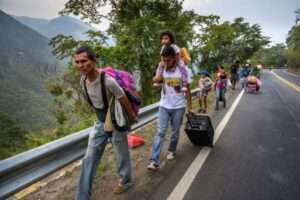
Venezuelans fleeing the socialist regime of Nicolas Maduro. (NA)


Last week, the Biden Administration Department of Homeland Security temporarily suspended the CNVH (AKA "CHNV") migrant sponsorship program, because of concerns about fraud. In an article for Reason, Cato Institute immigration policy experts David Bier and Alex Nowrasteh explain why this is a terrible decision:

President Joe Biden's Department of Homeland Security (DHS) paused a key component of its immigration agenda last week, which allowed immigrants from Cuba, Haiti, Nicaragua, and Venezuela to enter and work legally in the United States. Known as the CHNV parole process, this program has helped reduce illegal entries by hundreds of thousands since its launch. DHS should restart the CHNV program immediately.

CHNV has provided an important lifeline for migrants fleeing the horrors of totalitarian socialism and communism in Cuba, Nicaragua, and Venezuela, as well as the endemic chaos of Haiti. This process offers a lawful and orderly way for migrants to pursue the American dream. As these countries spiral further into political and economic dysfunction, CHNV has become more important than ever to prevent chaos at the border.

Under the CHNV process, immigrants required sponsorship from U.S. citizens or legal residents to lawfully enter the United States. DHS has halted the program in response to an internal report that allegedly found evidence of sponsor fraud. In fact, all it shows is the agency's anti-fraud directorate's ineptitude at analyzing big data.

Until now, nearly all immigration applications were filed on paper. For the first time in its history, DHS required all CHNV parole applications to be filed online, resulting in a monstrous data file of 2.6 million records. The agency's Fraud and National Security Directorate (FDNS) apparently took its first stab at assessing "potential fraud indicators" within it.

FDNS found blank entry fields, phone numbers that don't work, zip codes that don't exist, strange street addresses, Social Security numbers associated with dead people, repetitive text and repeat filers, and other similar anomalies. FDNS concluded that these issues indicate fraud.

But those oddities and errors are not evidence of fraud—they are part and parcel of large administrative datasets, especially those compiled by the government. Fraud involves intentional deception, deliberate misrepresentation, or omission by applicants to obtain benefits they do not qualify for. These issues are more likely due to changing circumstances between the time when the forms were filed and the FDNS analyzed them, copying-and-pasting between different types of electronic documents, and simple human error.

Finding mistakes like this in big data is absolutely normal. For starters, statistically, some sponsors have certainly died since filing their sponsorship applications. The bigger issue is that when 2.6 million people fill out a form—sometimes on behalf of a relative or client—errors such as transposing numbers and letters, writing their mailing address when they should write their physical address, or mixing up mailing and physical addresses are inevitable.

Errors can be introduced precisely because of the shortcomings of DHS's new online filing system. As one of us learned firsthand when sponsoring someone, DHS's system purges application drafts after 30 days. This means many applicants draft their responses on paper or in a separate electronic format and then paste the responses. This inevitably results in some answers being accidentally duplicated or put in the wrong field. These shortcomings can be easily understood as honest errors instead of fraud.

FDNS also inaccurately interprets repeat applications from sponsors as indicative of fraud. Yet the CHNV parole process explicitly allows sponsoring multiple applicants. Even when all the beneficiaries are from the same family, DHS requires the sponsor to submit separate applications for each person. Of course, there will be repetitive text and repeat filings—DHS mandates it. It's as if FDNS looked for evidence of fraud in the CHNV's data before understanding how CHNV works….

DHS should not overreact to the illusions of fraud inherent in big datasets. Any actual instances of fraud should be addressed through the agency's normal procedures, targeting individual fraudsters or reforming paperwork and electronic filing procedures and audits….

CHNV was the most novel and important part of Biden's immigration agenda. To undermine it now would be a catastrophic mistake that could undermine American border security, reduce the economic gains from immigration, and impose huge humanitarian burdens on migrants fleeing totalitarian socialism in Latin America and the Caribbean.

I would like to take this opportunity to expand on Bier and Nowrasteh's well-taken points a little.

First, as a sponsor in the Uniting for Ukraine program, which is very similar to CHNV and requires largely the same forms, I can testify from personal experience that the submission process can be clunky, and it is easy to make mistakes, especially if you are submitting multiple applications. I warned about this problem early on; in a January 2023 article generally praising U4U, I noted a few shortcomings, including that "[t]he program could… be improved by further simplifying the paperwork, some of which I found confusing and duplicative."  My impression is that this flaw has actually gotten worse, as forms have become more complicated over time.

It's important to keep in mind that most would-be sponsors are not lawyers and legal scholars (like me) or immigration policy experts (like Bier and Nowrasteh). Most don't have the same familiarity and comfort level with legalistic bureaucratic forms. Some are recent immigrants themselves.  Thus, it's easy for them to make inadvertent errors. That likely accounts for much of what FDNS found here.

Second, Cuba and Venezuela are facing intensifying repression, in the latter case because of the government's to suppress protests against it's recent falsification of election results. Conditions in Haiti and Nicaragua are also awful. It is wrong to close the door to migrants fleeing horrific oppression and violence merely because of flimsy suspicions about fraud by  some sponsors (as Bier and Nowrasteh note, DHS has no found no evidence of wrongdoing by the migrants themselves).

Third, as Bier and Nowrasteh note, the CNVH program plays a valuable role in reducing disorder at the border; it could be much more effective if the administration lifted the arbitrarily low 30,000 per month cap on participation (which is the total for all four countries combined). Bier and I expanded on this point in greater detail in a USA Today article. If the Administration wants to keep the number of illegal border crossings down, it should restart CNVH and expand it.

Finally, it's worth emphasizing that CNVH participants, like most other migrants, are an asset to the US, not a burden. They make valuable contributions to our economy, and reduce the federal budget deficit.

I do have one small disagreement with Bier and Nowrasteh: they advocate imposing a $575 fee on CNVH sponsorship applications. I oppose that for reasons explained here, in response to a similar proposal by Daniel Di Martino of the Manhattan Institute:

Social science evidence suggests that even modest bureaucratic obstacles can significantly reduce participation in various programs. Imposing a fee is likely to reduce the number of Americans willing to serve as sponsors, thereby diminishing the benefits of the program. People hate having to do paperwork, and they hate having to pay a fee for the "privilege" of doing it even more. The costs of processing the forms can instead be more than offset by the extra tax revenue produced by parolees who work in the US.

Free Speech

Interesting D.C. Circuit Dissent Regarding Computer Monitoring for Jan. 6 Trespasser

|

In U.S. v. Goodwyn, decided Tuesday, Judges Florence Pan and Bradley Garcia denied an emergency motion to stay the decision below, on the grounds that:

Appellant has not satisfied the stringent requirements for a stay pending appeal. See Nken v. Holder, 556 U.S. 418, 434 (2009); D.C. Circuit Handbook of Practice and Internal Procedures 33 (2021).

Judge Gregory Katsas dissented:

This appeal involves computer monitoring imposed as a special condition of supervised release for a defendant convicted of wrongfully entering the United States Capitol on January 6, 2021. Daniel Goodwyn pleaded guilty to one count of knowingly entering or remaining in a restricted building or grounds, in violation of 18 U.S.C. § 1752(a)(1). Goodwyn entered the Capitol and remained inside for a total of 36 seconds. He did not use force to enter, did not assault police officers, and neither took nor damaged any government property. When police instructed Goodwyn to leave the building, he did so.

The district court sentenced Goodwyn to 60 days of imprisonment followed by a one-year term of supervised release. As a special condition of supervised release, the court sua sponte ordered the probation office to monitor Goodwyn's computers for the transmittal of "disinformation" about January 6. To enforce this condition, the court further required the installation of software on Goodwyn's computers that would enable the probation office to conduct "periodic unannounced searches."

On appeal, this Court vacated the condition. We held that "[t]he district court plainly erred in imposing the computer-monitoring condition without considering whether it was 'reasonably related' to the relevant sentencing factors and involved 'no greater deprivation of liberty than is reasonably necessary' to achieve the purposes behind sentencing." We further instructed the district court, if it wished to impose a new computer- monitoring condition on remand, to "explain its reasoning," to "develop the record in support of its decision," and to ensure that the condition complies with section 3583(d) and with the Constitution.

Read More

The Precedential Value of Robinson, a Reply to Josh

It's a weird case, but Robinson's death before the case was heard is old news.

|

Like a lot of people, I think that the Supreme Court's ruling in Robinson v. California (1962) is a mess.  It's a due process decision presented as an Eighth Amendment ruling.  With that said, I disagree with my colleague Josh Blackman's view that the case is entitled to no precedential weight because it turned out that Robinson had died in 1961, before the Court took the case.  Josh writes:

Jurisdiction can be raised at any time, even after death. The Court lacked jurisdiction to decide Robinson v. California because there was no actual case or controversy. The state was prosecuting a dead body. Robinson gives new meaning to habeas corpus. That decision is entitled to no precedential weight. I think the California Attorney General could, in theory at least, petition to vacate Robinson on those grounds. That probably won't happen. But next time Robinson comes up, the government should flag the issue.

It seems worth noting that this issue was raised before the Supreme Court in 1962.  After the Supreme Court's ruling, the California Attorney General filed a motion to vacate the judgment or rehear the case that alerted the Court to Robinson's death.

According to California's petition, dated July 20, 1962, none of the counsel for the parties had known that Robinson was dead. (This is not entirely uncommon in criminal cases involving low-level charges; appellate counsel can have a hard time staying in touch with clients who are not being detained and who don't have a fixed address.)  California's motion states that the fact of Robinson's death was only revealed by reporters who were looking into the case after the Supreme Court ruled:

It should be noted, however, that the fact of the appellant's death was unknown to either counsel for appellee or counsel for Amicus Curiae until the public press brought the matter to the attention of counsel for Amicus Curiae on June 25, 1962, subsequent to the issuance of this court's opinion on that date.

The Supreme Court nonetheless denied California's motion on November 13, 1962. Justice Clark, joined by Justices Harlan and Stewart, objected to that denial:

In my view this action by the Court is but a meaningless gesture utterly useless in the disposition of the case—the appellant being dead—and, as I read our cases, is contrary to the general policy this Court has always followed in the issuance of its mandates. Under our decisions this appeal abated as moot upon the death of the appellant, Menken v. City of Atlanta, 131 U.S. 405, 9 S.Ct. 794, 33 L.Ed. 221 (1889), and the judgment should have been vacated and the case remanded to the state court for such proceedings as might be appropriate under state law.

This is true even though the opinion and judgment of June 25 had been handed down prior to the notice of appellant's * death. See Stewart v. Southern R. Co., 315 U.S. 784, 62 S.Ct. 801, 86 L.Ed. 1190 (1942), vacating the prior judgment in the same case, 315 U.S. 283, 62 S.Ct. 616, 86 L.Ed. 849. Moreover, there is no question of costs involved here as there was in Wetzel v. Ohio, 83 S.Ct. 111. I would therefore grant the petition for rehearing and vacate the judgment as moot.

Whether one agrees or disagrees with the Court's denial of California's motion, it seems to me that this issue was settled for Supreme Court purposes 62 years ago.  The Supreme Court is certainly free to recast Robinson as a due process case someday—which I personally think they should, as that's what Robinson really is.  But the motion to account for Robinson's untimely death was litigated a long time ago, back when Elvis Presley had a Top 10 hit with "Return to Sender."

Free Trade

Trade, Public Opinion, and Political Ignorance

A new Cato Institute/YouGov survey finds contradictory attitudes on trade policy, and widespread ignorance. The survey also suggests a potentially promising political strategy for free trade advocates.

|

NA

A new Cato Institute/YouGov survey sheds some interesting light on public attitudes towards international trade. It finds that most Americans seem to like international trade, but also that there are significant internal contradictions in their views, and that those views are often influenced by ignorance. Such results should not be surprising, given widespread public ignorance about a variety of other public policy issues. But they are nonetheless notable.

In some respects, the Cato surveys that the public is very supportive of free trade, despite recent trends towards protectionism in both major political parties. Some 53% have a favorable view of "free trade," compared to only 11% that have an unfavorable view. An impressive 63% say they favor "the United States increasing trade with other nations," while only 10% are opposed.

On the other hand, 62% favor "adding a tariff to blue jeans sold in the US that are manufactured in other countries to boost production and jobs in the American blue jean industry." Similarly, 62% favor reducing US tariffs "only if… other countries lower their trade restrictions on U.S. products because otherwise they will harm American businesses and jobs," and 15% oppose tariff reductions under all circumstances. Only 23% favor unilateral tariff reduction (the  position held by most economists).

It looks as if large majorities favor "free trade" in principle, but shift positions when jobs are mentioned. But that latter view in turn dissipates once respondents learn that tariffs increase prices. Thus, the survey finds that 66% oppose imposing a tariff on blue jeans if it makes a pair of blue jeans $10 more expensive than it would be otherwise (58% would accept a more modest $5 increase in prices).

Given that almost all effective tariffs are likely to lead to significant price increases (otherwise, there would be no point in imposing them, since this is the only way they could meaningfully help domestic producers by diminishing purchases of foreign products), one would think this price-sensitivity would lead most people to oppose tariffs and support unilateral free trade. Tellingly, however, another question on the survey finds that only 38% know that free trade agreements reduce "the price of products Americans purchase at the store"; 39% believe (wrongly!) that trade agreements actually increase prices. A plurality also believe  that trade agreements destroy more US jobs than they create. In reality, the opposite is true, and tariffs often destroy jobs by making production in the US more expensive. For example, Donald Trump's steel tariffs predictably led to job losses in industries that use steel as a production input.

The survey also finds that most Americans believe the trade deficit is harmful (a view overwhelmingly rejected by economists), and greatly overestimate the percentage of US imports that come from China (a view that sours opinions on trade generally, because most Americans view China with great suspicion). Interestingly, opinion about the trade deficit shifts when respondents learn the money paid for foreign goods is reinvested in the United States (as is overwhelmingly true, because Americans pay for the goods in dollars; thus, a trade deficit leads to a current-account surplus).

In sum, opinion on trade policy varies a lot depending on how questions are framed (depending on whether jobs or prices are mentioned). This is similar to public opinion on many other issues that most Americans don't know much about and don't necessarily have strong opinions on. The are similar contradictions and question-wording effects in public opinion on zoning and restrictions on housing construction.

Interestingly, the survey finds that only 1% of Americans consider trade to be one of the three most important policy issues for them (though for some, trade might be part of the broader issues of "jobs and the economy" and "inflation/prices," both of which rate among the most highly-rated issues in the survey). This low prioritization makes it even more likely that voters pay little attention to trade policy, and know little about it.

For free trade advocates, there is a major tactical takeaway: voters hate price increases, and will oppose tariffs if they think they cause such increases. The blue jean question is particularly telling - showing that most people won't tolerate modest price increases even if told doing so will increase jobs. The idea that tariffs increase prices is at least somewhat intuitive, and it may be possible to get it across even to relatively ignorant voters.

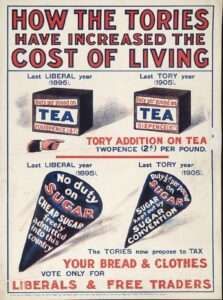
The idea of emphasizing the price-decreasing effects of free trade is far from a new one. It's how Richard Cobden, John Bright, and the British Anti-Corn Law League forged perhaps the most successful free trade movement in history, in nineteenth century Britain. After the repeal of the Corn Laws, the pro-free trade British Liberal Party successfully emphasized the issue of prices for decades to come.

British Liberal Party campaign poster (circa 1905-10). (LSE)


The Cato/YouGov survey suggests modern free-trade advocates would do well to try the same strategy. Maybe we can learn a lesson from Cobden, Bright, and other old-time British Liberals.

Cato public opinion analyst Emily Ekins outlines the significance of some of the survey's other findings here.

NOTE: In addition to my primary position at George Mason University, I am also the Simon Chair in Constitutional Studies at the Cato Institute. However, I had no role in developing this survey.

UPDATE: Cato international trade scholar Scott Lincicome, who helped create the survey offers some insights on the results here.

Politics

Short Circuit: A Roundup of Recent Federal Court Decisions

Arresting the wrong Jose Vasquez. Arresting the wrong Bethany Farber. Arresting the wrong Juan Martinez.

|

Please enjoy the latest edition of Short Circuit, a weekly feature written by a bunch of people at the Institute for Justice.

This week on the Short Circuit podcast: A dog named Thor not behaving as man's best friend and speculation as to why "bigamy" is in the Mississippi Constitution.

And, over at the Fed Soc teleforum, IJ's own Robert McNamara moderates a debate on the merits of qualified immunity between Michael Perloff, interim head of the ACLU, and Prof. Chris Walker of the University of Michigan. Click here to check that out.

Read More

The Warren Court's "Accidental Ruling" In California v. Robinson That Should Have No Precedential Weight

Nat Lewin relays the story from his 1962 clerkship with Justice Harlan.

|

In Grant's Pass v. Johnson, the Supreme Court upheld a local law prohibiting camping on public property. In doing so, the Court declined to extend California v. Robinson (1962). Here is how I described Robinson:

Robinson v. California (1962) may be peak Warren Court activism. California made it a crime to be addicted to narcotics–not simply to use drugs, but to be addicted to using them. Robinson argued that this law violates some sort of substantive due process right. This was three years before Griswold, so the Court still was stuck under the New Deal settlement that rejected substantive due process. So what does the Warren Court do? It manufactures a new standard based on the Eighth Amendment out of whole cloth. Sort of like a penumbra. (Griswold favorably cites Robinson.) The Robinson Court held that it would violate the Eighth Amendment to punish someone because of the "status" of being a drug addict. The Court ruled that when punishing "'status,'" "[e]ven one day in prison would be . . . cruel and unusual." Id., at 666–667.

Justice Gorsuch's majority opinion all-but-ruled that Robinson was wrongly decided. For sure, the Court declined to extend that precedent to the facts of Grants Pass.

Now, Nat Lewin writes in the Wall Street Journal how that "accidental ruling" came to be. Lewin clerked for Justice Harlan that term. Lewin and his co-clerk identified Robinson's petition from a stack of "flimsies" (cert petitions that were nor printed). Justice Harlan flagged the petition with his brethren, and said the case should be put on the "discuss" list. The Court then granted the petition.

At conference, it was expected that the Court would rule based on the Due Process Clause:

After the justices discussed the case at their Friday conference, Harlan told his clerks, with great satisfaction, that a majority had voted to vacate Robinson's conviction. Opinions were customarily assigned the following week. Much to our surprise, Chief Justice Earl Warren assigned Justice Stewart to write the majority opinion in Robinson. No explanation was usually given for these assignments, but Harlan and I had hoped he would get it and were disappointed not to be able to craft a decision explaining the "serious constitutional questions" that justified plucking it from the trash. Still, we were confident that Stewart's opinion would declare due process didn't allow criminalizing "the status of being a drug addict" rather than a defendant's conduct.

But, to Harlan's surprise, the circulated majority opinion instead relied on the Eighth Amendment--and issue that wasn't brief and was barely mentioned at oral argument.

It seems that Justice Douglas influenced Justice Stewart:

Then as now, the end of each Supreme Court term was chaotic. Confronted with an imminent deadline, the justices are writing, dispatching, receiving and joining majority opinions, concurrences and dissents. I recall receiving Stewart's Robinson majority opinion days before the end of the term and being startled by its reliance on the Eighth Amendment. Justice William O. Douglas, a frequent outlier, distributed a lengthy concurrence explaining why he believed it violated the Cruel and Unusual Punishments Clause "to treat as a criminal a person who is a drug addict." I speculated that Douglas or his law clerk had influenced Stewart to choose that unusual rationale.

As I noted in my prior post, 1962 was before Griswold, and the Justices were still laboring under the New Deal settlement. Justice Stewart would go on to dissent in Griswold. He was not comfortable with substantive due process. So perhaps this decision should not have been so surprising in hindsight.

Harlan personally wrote a two-paragraph concurrence that rejected the Eighth Amendment analysis:

Pressed for time, Harlan personally composed a two-paragraph concurrence expressing his disagreement with Stewart. He disclaimed reliance on the Eighth Amendment but observed that Robinson had been found guilty "on no more proof than that he was present in California while he was addicted to narcotics."

The Court would decide fifteen opinions on June 25, 1962. (Can you imagine the Justices nowadays handing down 15 opinions in a single session, with all of the dissents from the bench? It would take all day!) One of those cases was Engel v. Vitale! Robinson v. California was less noticed.

Finally, Lewin provides some fascinating, and disturbing insights into the facts of the case. Turns out Robinson was dead, from a drug overdose, as it were.

Neither Justice Harlan nor I knew that Lawrence Robinson was black (as were the other three occupants of the car). If his case had reached the Supreme Court today, he might have been celebrated in the media. Reporters would have discovered that Robinson had died of a drug overdose on Aug. 5, 1961, months before the court agreed to hear his case.

In the event, even the state's lawyers evidently didn't know. Only in mid-July (after I had finished my clerkship) did California's attorney general file a petition to rehear or dismiss the case because the petitioner had died while the case was pending. When the court reconvened in October 1962, it denied the motion. Justices Tom Clark, Harlan and Stewart noted their dissent.

Worse still, Robinson's lawyer likely knew of the death, but did not disclose those facts to the Court!

Robinson's lawyer was Samuel Carter McMorris, who later won some notoriety for representing the Black Panthers. During McMorris's oral argument, he told the justices that he had represented Robinson at trial, that he had "handled a great number of narcotics cases" in the Los Angeles courts, and that Robinson's was the "third such case" in which he personally participated.

Did McMorris know that his client was dead? Reported discipline decisions of the California Supreme Court point toward an answer. The state high court suspended McMorris's law license four times between 1977 and 1981 for failing to communicate with his clients. He was disbarred in 1983.

Not only did the Court make up a standard out of whole cloth, but it did so in a case where the defendant was dead! It has happened that Ninth Circuit judges signed opinions from the great beyond, but last time I checked, a criminal prosecution terminates at death.

Lewin ends with this question:

Did today's justices know any of this history when they considered and decided whether to retain Robinson v. California as a binding precedent?

Jurisdiction can be raised at any time, even after death. The Court lacked jurisdiction to decide Robinson v. California because there was no actual case or controversy. The state was prosecuting a dead body. Robinson gives new meaning to habeas corpus. That decision is entitled to no precedential weight. I think the California Attorney General could, in theory at least, petition to vacate Robinson on those grounds. That probably won't happen. But next time Robinson comes up, the government should flag the issue.

Update: I appreciate Orin's post which points out that California filed a motion for reconsideration after learning of Robinson's death. That petition was denied, over a dissent from Justices Clark, Harlan, and Stewart. This is especially curious since Justice Stewart wrote the majority opinion! He voted to vacate his own decision. I am happy to stand corrected.

Housing Policy

Pacific Legal Foundation Report on "Locking Squatters Out: How States Can Protect Property Owners From Squatters"

The report has useful data on the scope of the problem, and recommendations on what can be done about it.

|

Andrii Yalanskyi/Dreamstime.com

The Pacific Legal Foundation recently published  "Locking Squatters Out: How States Can Protect Property Owners From Squatters," a report authored  Kyle Sweetland and Mark Miller. It's a great summary of what we know of the scope of the squatter problem, what states have done (or not done) in response, and what reforms can help protect property owners more effectively. Here's an excerpt:

Squatting is the act of occupying someone else's property without any legal claim or title to it and without consent from the property owner. Beyond trespassing, squatters often cause other trouble by selling the owner's belongings, trashing the property, or using it for a prostitution ring or drug den.1

Removing squatters is difficult in most states. Although trespassing is a criminal offense, most state governments treat squatter removal as a landlord–tenant eviction—i.e., civil—dispute.

Law enforcement often tells property owners to file an eviction case and refuse to remove squatters so that officers avoid violence, legal mess, or additional work. Law enforcement cannot easily determine whether squatters who claim to have a lease are indeed tenants or are presenting a fraudulent lease—and may lack the resources to do so.2 Given this and "the increase in tenants' defenses to eviction and a growing sense that landlord–tenant confrontations often lead to violence," police departments may see it as unwise to get involved in removing a squatter.3 Law enforcement also encourages homeowners to use the eviction process "to ensure that any adverse claims filed [by squatters] are invalid."4

However, waiting for civil procedures to run their course can leave property owners unable to live in their own homes for months or years as they try to evict squatters and can cost thousands of dollars in repairs, increased utility bills, and legal fees. In Tennessee, it can take up to two years to evict a squatter, and in Maryland and Pennsylvania, it can cost $3,000 to $10,000 to get a squatter eviction case through the court system.5 During this time, squatters can wreak havoc on property owners' homes. In one egregious example, a Dallas woman sustained more than $150,000 in property damage from squatters. And a New York City homeowner saw his utility bill increase by more than $1,000 per month when squatters took over his home….6

In response to the rise in squatting, some states are using legislation to turn squatting into a criminal offense and make it easier for property owners to remove squatters. As of May 2024, Alabama, California, Florida, Georgia, Nevada, Tennessee, Washington, and West Virginia have passed laws that criminalize squatting, while eleven other states have introduced bills to do so (figure 2). Most states, however, have not yet addressed the issue legislatively, leaving property owners' doors wide open to squatters and requiring the civil court system to resolve the issue through the much-slower eviction process….

Conferring criminal status to squatting does not guarantee a sped-up process for removing squatters. California charges squatters with a trespassing misdemeanor if a property owner has filed a no-trespass letter with police in advance of a squatting incident, but eviction is still required if the property owner failed to file a letter.16 Conversely, the process of removing squatters can be sped up without criminalizing the activity. In Colorado, legislators created a special eviction process for squatters that takes significantly less time than normal evictions, but the activity is not considered criminal….

One of the most effective ways states can help protect property rights against squatters is by reforming laws to make it easier and faster for property owners to remove squatters from their property. Pacific Legal Foundation's model bill, the Stop Squatters Act, is a template for legislators to craft laws that would better protect property rights, give owners remedies against squatting, and penalize squatters as criminals.

In addition, states could bring greater awareness to the issue by collecting and publishing comprehensive data on squatting.

In a post written in March of this year, I explained why squatters' rights laws that make it difficult or impossible to quickly evict squatters violate the Takings Clause of the Fifth Amendment. But reasons outlined there, a takings lawsuit is often not the best way to deal with such cases. Swift eviction combined with criminal or civil penalties will often be preferable.

In the same post, I also explained why laws protecting squatters ultimately harms legitimate tenants, as well as property owners:

[S]quatters' rights laws end up harming the very people they are supposed to help: low-income tenants. If property owners have reason to fear that squatters can occupy their land without their consent, they will be less willing to rent property to begin with, charge higher rents, screen potential tenants more carefully (thereby potentially excluding those with low income, few or nor references, and the like), or some combination of all of these measures. They may also be incentivized to impose more costly and elaborate security restrictions on access to land (which in turn is likely to raise rents). All of this predictably reduces the availability of housing and increases its costs.

NOTE: My wife, Alison Somin, is an employee of the Pacific Legal Foundation, which published the report discussed in the post. She does not work on property rights issues, and  was not involved in the preparation of the report.

Free Speech

Comedian Hannibal Buress's False Arrest Lawsuit Can Go Forward

"Roast[ing]" police officers may not generally be wise, but it is still generally constitutionally protected.

|

From Tuesday's decision in Buress v. City of Miami (Judges Adalberto Jordan, Barbara Lagoa, and Susan Black):

Miami Police Department Officer Luis Verne appeals the district court's denial of qualified immunity and state-law immunity in his arrest of Hannibal Buress. The district court concluded there were genuine issues of material fact remaining regarding whether Officer Verne had arguable probable cause to arrest Buress for the crimes of (1) bribery and unlawful compensation or reward for official behavior; (2) disorderly intoxication; (3) disorderly conduct; (4) trespass; and (5) resisting an officer without violence. The district court similarly determined Buress raised a genuine issue of material fact regarding whether Officer Verne violated Buress's First Amendment rights and that Officer Verne was not entitled to state-law immunity on Buress's state law claims…. [W]e affirm ….

On December 9, 2017, Buress, a well-known stand-up comedian and actor, was visiting Miami for the Art Basel festival. Buress spent "substantial time" having drinks at Gramps Bar in the Wynwood area. At some point that night, Buress's phone died, and Buress walked toward the corner of NW 2nd Avenue and NW 20th Terrace to find a ride back to his hotel. Officer Verne was posted at that corner, and Buress walked up to him and said "call me an Uber and I'll give you $20." Verne said "no" to Buress's request.

At this point, the two parties' accounts of the facts diverge. Officer Verne states Buress got closer to him and began going back and forth with him and yelling a bunch of profanities. Buress states that after Officer Verne refused his request, he walked away and did not say anything. Buress then looked back and observed Officer Verne kissing a woman who came out of a bar. At that point, Buress "yelled back" at Officer Verne about how he was kissing this woman but could not call him an Uber. Buress and Officer Verne agree they had words back and forth. Buress admits using profanity, but states it was joking and lighthearted.

Buress walked away and into a bar. Officer Verne followed Buress into the bar and told him to leave. Buress complied, but the parties dispute how quickly he did so. Officer Verne asserts Buress was "belligerent," "visibly drunk," and "could barely walk." Buress denies being belligerent or unable to walk. Buress does not deny that he was visibly drunk and agrees that Officer Verne thought he was drunk.

Read More

YIMBY

YIMBYism is the Ultimate Localism

If you want "local control" of land use, the best way to do it is let property owners decide how to use their property for themselves.

|

Model houses
Andrii Yalanskyi/Dreamstime.com

Opponents of "YIMBY" ("Yes in my Backyard") zoning reform often emphasize the need for "local control" of land-use decisions. The state and federal governments, they say, should not override local decisions on zoning policy. After all, people within the community know more about their needs than remote authorities do. And different communities have diverse needs. This oft-heard mantra runs afoul of the reality that YIMBYism means more local control, not less. You can't get more local than letting each property owner control their own land.

The "local control" argument for zoning restrictions is deployed by both left and right. The housing chapter of the conservative Heritage Foundation's controversial Project 2025 avows that "It is essential that legislation provides states and localities maximal flexibility to pursue locally designed policies and minimize the likelihood of federal preemption of local land use and zoning decisions." For this reason, among others, it emphasizes that "a conservative Administration should oppose any efforts to weaken single-family zoning." Single-family zoning, of course, is the most restrictive type of exclusionary zoning blocking new housing construction in many parts of the country.

Yes, I know that Donald Trump has disowned Project 2025, and claims he "knows nothing about it." But the author of the housing chapter is Ben Carson, secretary of Housing and Urban Development in Trump's first administration. During the 2020 election, Carson and Trump coauthored a Wall Street Journal op ed attacking efforts to curb exclusionary single-family zoning, and emphasizing the need to preserve local control. Thus it's fair to say the Project 2025 housing chapter reflects a common view on the Trump-era right, even if Trump himself may not know much about what's in it.

Left-wing NIMBYs also often emphasize "local control," as well. It's a common refrain among blue-state defenders of single-family zoning and other land-use restrictions in places like California. Blue-state NIMBYs may not agree with Project 2025 on much else; but they're on the same page here.

Both left and right-wing defenders of zoning overlook the reality that abolishing zoning restrictions actually increases localism. Abolishing restrictions does not impose a single set of land uses on the entire community. Rather, it allows individual property owners to decide for themselves. You can build multi-family housing on your land. But you don't have to. You can instead stick with a single-family home, or use the land for something else. I don't control what you do with your land, and you don't control what I do with mine.  It's hard to be more localist than that.

YIMBY zoning reform allows land-uses decisions be more diverse and localized than they would be if a centralized zoning board mandated them. If you think it's important to take advantage of local knowledge, and account for diverse needs of different localities, letting property owners decide land uses for themselves is the way to go. The best use of my property may be very different from what's best for the one next door or down the street. And each owner might have local knowledge that city authorities cannot readily access.

This is especially true if we remember that most zoning rules are not simply a matter of neighbors making decisions for each other. In large cities and suburbs, there is often a single set of zoning rules imposed by the local government on tens or hundreds of thousands of properties. Localism this is not: it's a regional form of economic central planning.

Even if local-government zoning gets overridden by a higher-level government, such as the state, the net result is still an increase in local control, because the ultimate decisions about how to use a given piece of land is now in the hands of the property owner, not a state authority. And property owners are more decentralized and local than government zoning boards are.

It's also worth noting that YIMBYism backed by strong property rights doesn't preclude all local coordination. Property owners can still cooperate on a voluntary basis, and even form private planned communities if they want to coordinate on a larger scale. I have previously outlined why such private efforts are different from government-mandated zoning and do not share the major flaws of the latter. Voluntary private cooperation is more sensitive to local needs than zoning because property owners will only enter into such arrangements if they believe that's what's best for them and their land, utilizing local knowledge in making those decisions.

In sum, if you really believe in local control of land-use decisions, you should oppose zoning restrictions, and support YIMBYism. It's as localist as you can get!

The better argument for zoning restrictions is not localism, but its opposite: the concern that excessive localism in land-use decisions can harm outsiders. If I build an apartment complex on my land, that might annoy neigbhors, overburden regional infrastructure, or have other negative effects I might not take account of precisely because my focus is too local, concerned principally with my own self-interest. Even if my neigbhors get a say in the decision too, we might not take account of potential impact of new development on people in other parts of the region.

I will not address such anti-localist defenses of zoning here, beyond pointing out that zoning restrictions themselves impose great harm on outsiders, by raising housing costs, preventing people from "moving to opportunity," and lowering economic growth. Historically, they have also been used to maintain racial and ethnic segregation.

There are non-localist and even anti-localist rationales for various zoning restrictions. But if you care about "local control," you should be a YIMBY!

I criticized localist and federalism-based rationales for restricting constitutional property rights in greater detail in my 2011 article on "Federalism and Property Rights."

War on Drugs

My Jotwell Review of David Pozen's "The Constitution of the War on Drugs"

The book is the most extensive analysis to date of constitutional issues arising from the War on Drugs, and why the constitutional law largely failed to constrain its abuses.

|

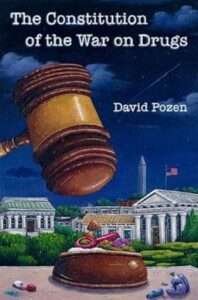
Oxford University Press.

Today, the Jotwell website (which reviews new legal scholarship) has published my review of Columbia law Professor David Pozen's important new book, The Constitution of the War on Drugs. The review is entitled "The War on Drugs as a Constitutional Failure." Here are some excerpts:

If one of the purposes of constitutional law is to protect liberty against abuses of government power, the War on Drugs must be regarded as one of America's greatest constitutional failures. Over the last century, and especially since its expansion beginning with the Controlled Substances Act of 1968, the War on Drugs has led to thousands of needless deaths, the imprisonment of hundreds of thousands of people, and severe violations of civil liberties—all without doing much to curb the social problems of drug abuse and addiction. With rare exceptions, constitutional law has done little to curb these great evils.

In The Constitution of the War on Drugs, David Pozen gives us the most through and insightful overview of this failure to date. As he demonstrates, there were a number of plausible constitutional arguments for curbing the War on Drugs that—if accepted by the courts—might have significantly limited at least the most severe abuses. But, for the most part, they were rejected. He also offers useful suggestions for future strategy by drug law reformers.

Pozen's book is an impressive achievement, and there are many valuable lessons in it for both constitutional law scholars and those interested in the War on Drugs and criminal justice. But I do have some reservations about both his historical and doctrinal analysis, and his normative prescriptions.

As Pozen ably documents, the constitutional stage for the modern War on Drugs was set by two major developments of the Progressive and New Deal eras. The first was an expansion in the understanding of state "police power." Previously, many paternalistic regulations were likely to be struck down under the Due Process Clause of the Fourteenth Amendment or its state equivalents. The rise of anti-gambling and alcohol prohibition movements helped change that, leading courts to give state governments more leeway. This undermined potential individual-rights challenges to drug prohibition.

The second big shift was the vast expansion of federal regulatory power under the Commerce Clause, with decisions like Wickard v. Filburn (1942), giving the government the power to regulate almost any seemingly commercial activity, no matter how local….

While these early twentieth century developments opened the door to drug prohibition, Pozen explains that some jurisprudential trends since the 1960s made constitutional challenges to the War on Drugs potentially feasible.

Beginning with Griswold v. Connecticut (1965), which struck down a state law banning distribution of contraceptives to married couples, the Supreme Court issued a series of decisions protecting various personal liberties under the Due Process Clause of the Fourteenth Amendment, particularly those relating to reproduction and bodily autonomy. This opened up the possibility that the right to take illegal drugs might be similarly protected.

Later, a more conservative Supreme Court once again began to enforce limits on federal Commerce Clause authority, starting with United States v. Lopez (1995). This created hope that at least some types of federal drug prohibition might be invalidated as beyond the scope of congressional power.

Sadly, neither approach had much success…..

Pozen's otherwise thorough account does unduly neglect one important aspect of the story: the fact that the most severe drug war penalties are usually reserved not for people guilty of mere use or possession of drugs, but for those who produce, sell, and distribute them. Since the New Deal era, left-liberal jurists—and even many conservatives—have been wary of strong judicial review of "economic" regulations. This was at the root of both the New Deal Commerce Clause revolution (breaking down federalism restrictions to congressional power) and the Supreme Court's rejection of judicial protection for most economic liberties and property rights.

Seriously curbing the War on Drugs would have required courts to overcome this allergy to scrutinizing "economic" regulation. Progressives who (rightly) seek stronger judicial scrutiny of the War on Drugs will need to overcome at least some of their scruples regarding judicial review of economic transactions….

In the review also note some potential pathways for future progress, and urge opponents of the War on Drugs to combine litigation with political action.

The War on Drugs is one of the greatest injustices in American public policy, and also one of the biggest constitutional issues in modern time. Pozen's book is a major contribution to our understanding of the relevant history and legal doctrine.

Free Speech

Response to My Motion to Unseal Material in Pennsylvania Sen. Douglas Mastriano's Lawsuit Related to His Ph.D. Thesis

Sen. Mastriano (who is running for reelection to the state senate, and who ran in 2022 for Governor) is suing for, among other things, libel—but trying to keep the allegedly libelous material under seal.

|

I wrote last month about my motion to intervene and unseal in this case, and Sen. Mastriano's lawyer (former Maryland House of Delegates member and former gubernatorial candidate Daniel Cox) just filed the response to my motion to intervene and unseal. Some excerpts:

Memorandum of Law …

Volokh, whose half-million annual salary is funded by a California University caught receiving dark money,1 seeks intervention apparently with such funded support and for their behalf in order to supply his benefactors with an expected written product for financial return. Volokh has no Article III or Rule 24(b) standing to intervene. Instead, he seeks to apparently advance a scheme to support Defendants herein with his own third-party financial support and has no valid "limited" third-party interest….

1 "Stanford's Settlement with the Justice Department Shows Just How Deep China Has Its Claws in Our Universities." Moore, Paul. The Hill news online, October 11, 2023. "Fudan University is a prominent Chinese research institution, and Stanford's ties with it are extensive. Stanford codirects the Fudan-Stanford Institute for China Financial Technology and Risk Analytics, and its Graduate School of Business partners with the Fudan School of Management. In 2019, Fudan University altered its charter by promising its adherence "to the leadership of the Chinese Communist Party (CCP)" and "the party's educational policy." The CCP's dominance of Fudan University assures that research developed there may be fully utilized in the CCP's military-civil fusion efforts that compose a critical part of China's efforts to eclipse the military and economic capabilities of the U.S. and its allies by 2025. Despite this, Stanford's ties with Fudan remain undiminished. Stanford failed to report more than $64 million in Chinese donor identities — disclosure failures that coincided with Stanford's unprecedented expansion of its Chinese operations." https://thehill.com/opinion/national-security/4246080-stanfords-settlement-with-dojshows-how-deep-china-has-its-claws-in-our-universities/ (accessed August 6, 2024 at 5:50 p.m.)….

Memorandum of Law

I. Volokh has no Article III standing to intervene.

While Volokh avers his own interest in intervention pro se, he does so speciously on behalf of the State of California-funded Stanford University (a University in partnership with the People's Republic of China, CCP2), and Reason Magazine. Volokh Mot. Interv. Pg. 1, ¶ 2. He does so using his Stanford University e-mail, funded in part by the taxpayers who pay his half-million annual salary. He seeks to intervene in order to not only advance his stated entities' economic interests, but his own economic interests.

Read More

Free Speech

VP Candidate Tim Walz on "There's No Guarantee to Free Speech on Misinformation or Hate Speech, and Especially Around Our Democracy"

|

Robby Soave at Reason writes about this 2022 quote from Walz (MSNBC):

[MARIA TERESA KUMAR, MNSBC HOST]: … I want to talk about what you just mentioned about misinformation, because, oftentimes before, in previous political chapters, disinformation, telling people were to vote the wrong way, that was kind of -- these were called -- considered shenanigans.

But it's becoming more ominous. Can you talk a little bit about that…

WALZ: Oh, yes.

KUMAR: … and what you will do to ensure that there are penalties for that?

WALZ: Yes.

Years ago, it was the little things, telling people to vote the day after the election. And we kind of brushed them off. Now we know it's intimidation at the ballot box. It's undermining the idea that mail-in ballots aren't legal.

I think we need to push back on this. There's no guarantee to free speech on misinformation or hate speech, and especially around our democracy. Tell the truth, where the voting places are, who can vote, who's able to be there….

Two thoughts:

[1.] Walz was quite wrong in saying that "There's no guarantee to free speech" as to "hate speech." The Supreme Court has made clear that there is no "hate speech" exception to the First Amendment (and see here for more details). The First Amendment generally protects the views that the government would label "hateful" as much as it protects other views.

[2.] As to "misinformation," the matter is much more complicated. Sometimes misinformation, especially deliberate misinformation, is constitutionally punishable: Consider libel, false state­ments to government investigators, fraudulent charitable fundraising, and more. (For more details on all these points, and citations, see When Are Lies Constitutionally Protected?.) But sometimes even deliberate lies are constitutionally protected. In New York Times v. Sullivan (1964), the Court held that even deliberate lies (said with "actual malice") about the government are constitutionally protected. And in United States v. Alvarez (2012), five of the justices agreed that lies "about philosophy, religion, history, the social sciences, the arts, and the like" are generally protected.

Read More

Free Speech

When Is Fighting Back Against a Police Dog Animal Abuse?

Detached reflection cannot be demanded in the presence of an open maw.

|

From Evans v. Commonwealth, decided Monday by the Virginia Court of Appeals, in an opinion by Judge Kimberley Slayton White, joined by Judges Daniel Ortiz and Frank Friedman:

Once Knox was in the home and Officer Reed was positioned in the door frame, the officer commanded the dog to apprehend Evans as the officer could no longer see Evans. Knox bit Evans's upper left leg. Evans repeatedly punched Knox in the head with a closed fist and then used both of his hands to pry Knox's jaws apart. {Officer Reed testified that he observed Evans punch Knox three to four times in the head with a closed fist. Officer Reed commanded Evans not to harm the dog.} Once the dog released his leg, Evans put one hand over Knox's nose causing Knox to gag. Officer Reed testified that the noise on the video was Knox gagging, or "back breathing," because he was being suffocated. Officer Reed then struck Evans thrice rendering Evans unconscious; Knox bit Evans's bicep and took him to the floor. Officer Reed stated that he struck Evans because Knox was struggling to breathe, and Evans was continuing to hit the dog. Evans was then handcuffed while face-down on the ground, unconscious….

After the incident, Officer Reed observed a small laceration that appeared to be new below Knox's bottom left canine tooth. Knox had no observable injuries before the incident, but Officer Reed admitted he had not evaluated Knox before the shift began. Evans himself received injuries that were enough to require hospital admission….

Evans challenges his conviction for animal cruelty because there was no evidence that Knox [the police dog ] was injured during the incident. He notes that although there was a laceration on the dog's gum, there was no testimony that Knox needed medical attention or was in pain. He argues that the evidence presented is not enough to sustain a conviction for animal cruelty.

To obtain a felony conviction for animal cruelty, the Commonwealth was required to prove the defendant "torture[d] any animal, willfully inflict[ed] inhumane injury or pain not connected with bona fide scientific or medical experimentation on any animal, or cruelly or unnecessarily beat[ ], maim[ed], mutilate[d], or kill[ed] any animal." "The Commonwealth can establish that a defendant willfully inflicted inhumane injury on an animal if it can present evidence that the defendant 'voluntarily acted with a consciousness that "inhumane injury or pain" would result.'"

This Court has struggled over the years to define and describe what it is to "willfully inflict inhumane injury" to an animal. "A voluntary act becomes willful, in law, only when it involves conscious wrong or evil purpose on the part of the actor, or at least inexcusable carelessness, whether the act is right or wrong." "The act [or omission] done must be intended or it must involve a reckless disregard for the rights of another and will probably result in an injury." …

Here, Evans struck Knox on the head after the dog began biting Evans's leg. This voluntary act of striking Knox does not rise to animal cruelty because Evans did not "willfully inflict inhumane injury" as defined under Virginia law. Evans's reflexive punches thrown at the dog were not intended to harm Knox and did not rise to the level of "willful." When deciding if an action is willful, we look at not only the circumstances surrounding the action, but the intent behind it.

Read More

Reconsidering United States v. Nixon

Maybe the Roberts Court was right and the Burger Court was wrong.

|

Fifty years ago today, President Richard Nixon resigned. His resignation came shortly after the Supreme Court unanimously decided United States v. Nixon. This decision is often held up as an exemplar of Supreme Court jurisprudence at its best. Justice Kavanaugh, for example, often stresses that Nixon was joined by three Nixon appointees. (Justice Rehnquist recused because former Attorney General John Mitchell, one of the defendants, had been Rehnquist's boss.)

But I'm not sure Nixon has stood the test of time. The argument that the Court had jurisdiction to resolve what was, in effect, a dispute within the executive branch, never persuaded me. This theory led inexorably to the concept of the independent counsel, an anathema to the separation of powers. Moreover, to the extent that Nixon said anything at all about the Appointments Clause, that analysis has been overcome by Buckley v. Valeo, Bowsher v. Synar, and other cases. (Seth Barrett Tillman and I explain why the holding of Nixon, whatever it is, was limited to some "unique" facts—which is precisely what the decision repeatedly stated.) I've long seen Nixon v. Fitzgerald as a something of a correction to Nixon. Fitzgerald was decided nearly a decade after Nixon during a more sober time.

There's more. Today's Wall Street Journal includes an Op-Ed by Kenneth L. Khachigian, who served as an aide to President Nixon. He argues, provocatively, that Nixon should not have resigned, and that he could have survived an impeachment vote--or at least that he should have taken a principled stand and forced Congress to impeach him. But more relevant for my purposes are behind-the-scene machinations. Khachigian speaks to some of the questionable legal issues lurking in the background:

I hope new generations are open to some different thinking—or at least a balanced treatment that goes beyond the story of bungling burglars and political damage control. It must include how the "Watergate affair" was also the culmination of Nixon's political opponents' long-yearned-for goal of destroying him. Nixon had a political target on his back from his congressional days of vanquishing the communist Alger Hiss, a favorite of Washington's intellectual left. Through his entire presidency, Congress was controlled by opposition Democrats, with confrontation aggravated further by Nixon's determination to end the Vietnam War he had inherited from the Kennedy and Johnson administration planners at the State and Defense departments.

Sen. Edward Kennedy set up the Senate Watergate Committee. Three months later John F. Kennedy's 1960 campaign director of opposition research against Nixon, Archibald Cox, was hired as Watergate special prosecutor with a staff seeded from the ranks of Robert F. Kennedy's Justice Department. The subsequent special prosecutor, Leon Jaworski, expressed concern in an internal memorandum that his chief deputy reflected "an attitude I discussed with you before—the subjective conviction that the president must be reached at all cost."

Watergate scholar Geoff Shepard has unearthed further damning evidence that the special prosecutors had several unethical private meetings with Judge John Sirica in the absence of attorneys for Nixon and Watergate defendants—each violating the most basic legal protections. Nixon's adversaries weren't looking only for the truth. They were looking for a scalp.

I didn't know these things. Did you?

There is also the entire fever pitch of the time. Every element of government was focused on getting Nixon out of office. And from what I've researched, we still have no idea what the burglars were looking for in the Watergate Hotel. Nixon had no role in, or even knowledge of, the break-in before it happened. But he later became aware of the break-in. My sense is that Nixon did the sorts of things that  many of his predecessors had done, and gotten away with, but Nixon was recorded. I was not alive at the time, but I have to imagine that Watergate felt something like the resistance to the Trump Presidency.

After half a century, perhaps the members of the Trump v. United States majority have come to second-guess the Nixon majority. The immunity case, I've written, culminated from years of lawfare against Trump. James Piereson makes this point at City Journal:

Pushback against the Watergate legacy is evident in efforts to curtail independent prosecutors and partisan "lawfare," conservative attacks on the politics of the nation's capital, and Trump's current presidential campaign, supported in great part by voters who believe that they have been shut out of influence in Washington and (inferentially) that Watergate promoted political rules that reward insiders. The Supreme Court recently broke new ground in ruling that a president is immune from criminal prosecution for acts undertaken while carrying out the core powers of the presidential office. That opinion may partly reflect a recognition of the lawfare that a Democratic administration is waging against its Republican opponent. It is, in addition, an opinion that works against Watergate sensibilities in regard to presidential conduct and accountability. It's a worthy question whether the current justices would have ruled as their predecessors did in 1974's United States v. Nixon regarding the White House tapes. Today's Court might have permitted Nixon to keep those tapes, in the belief that Watergate represented a form of lawfare against an elected president.

Maybe the Roberts Court was right and the Burger Court was wrong.

More