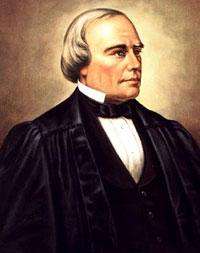
9/30/1857: Justice Benjamin Robbins Curtis resigns from the Supreme Court after Dred Scott v. Sandford (1857).

Mostly law professors | Sometimes contrarian | Often libertarian | Always independent | Est. 2002

9/30/1857: Justice Benjamin Robbins Curtis resigns from the Supreme Court after Dred Scott v. Sandford (1857).
The Supreme Court is set to decide whether the agency may expand criminal liability under the Gun Control Act.
On October 8, the Supreme Court will hear oral argument in Garland v. VanDerStok, a challenge to the Final Rule of the Bureau of Alcohol, Tobacco, Firearms & Explosives (ATF) from 2022 redefining and drastically expanding the meaning of the terms "firearm" and "firearm frame or receiver." This is the first of several posts in which I'd like to highlight some of the enlightening amici curiae briefs that have been filed in support of the respondents who challenged the rule.
The Gun Control Act defines "firearm" as "(A) any weapon (including a starter gun) which will or is designed to or may readily be converted to expel a projectile by the action of an explosive; (B) the frame or receiver of any such weapon…." 18 U.S.C. § 921(a)(3). An ATF regulation on the books from 1968 to 2022 defined a "frame or receiver" as "that part of a firearm which provides housing for the hammer, bolt or breechblock and firing mechanism" – in other words, to main part of the firearm to which the barrel and stock attach.
The Final Rule expanded "firearm" to include "a weapon parts kit that is designed to or may readily be completed, assembled, restored, or otherwise converted to expel a projectile by the action of an explosive." And it redefined "frame or receiver" to include "a partially complete, disassembled, or nonfunctional frame or receiver" that is "designed to or may readily be completed, assembled, restored, or otherwise converted to function as a frame or receiver."
The impetus for these new definitions is the political controversy over "ghost guns," a term used by the Administration and by gun-control advocates to refer to privately-made firearms fabricated from partially-machined raw material known as "80% receivers." Fabrication of this precursor material into an actual receiver requires precise drilling, milling, and other machining of metal and polymer with common and uncommon tools to make an actual receiver.
Federal law requires persons engaged in the business of manufacturing or importing firearms to engrave them with serial numbers. Private individuals have always been free to make their own firearms without such federal restrictions. The new definitions have the effect of subjecting hobbyists to federal controls.
The Fifth Circuit held that ATF may not change the definition of "firearm" enacted by Congress and that its redefinition of "frame or receiver" failed to reflect the original, common understanding of that term. It thus ruled the definitions to be beyond ATF's authority and arbitrary and capricious.
In the Supreme Court, the government begins its defense of the Rule by asserting that so-called "[g]host guns could be made from kits and parts that were widely available online and allowed anyone with basic tools and rudimentary skills to assemble a fully functional firearm in as little as twenty minutes." Not one of those italicized terms is even close to reality.
For a reality check, I refer you to the Amici Curiae Brief filed by Rick Vasquez, former Acting Chief of ATF Firearms Technology Branch, and by the Center for Human Liberty.
Vasquez served in the Marine Corps for 21 years during which he worked as a gunsmith at the precision weapons shop in Quantico, Virginia. He also served as a gunsmith and firearms instructor for the U.S. Department of State. Most notably, from 1999 to 2014, he served as a Firearms Enforcement Officer in ATF's Firearms Technology Branch (FTB), the division that determines whether partially-machined material that can later be manufactured into a firearm constitutes a "firearm" under the Gun Control Act.
In 2004, Vasquez was selected as the FTB's Assistant Branch Chief, and from 2008 to 2010, he held the Acting Chief and the Assistant Chief positions. He reviewed and approved hundreds of determinations of whether items were "firearms," the majority of which related to the manufacturing of receivers for AR-15 style firearms.
Quoting the government's brief in VanDerStok, Vasquez writes:
In reality, not just "anyone" with "basic tools" and "rudimentary skills" can take a parts kit and assemble a "fully functional firearm" at all, let alone in a "matter of minutes." Even assuming the hypothetical "anyone" had the tools needed to construct a firearm, they also need a level of skill, patience, and determination that eludes most non-experts.
The government focuses on the Polymer80 parts kit for a Glock-style semiautomatic pistol, but fails to explain the supposedly simple process. Vasquez provides a step-by-step summary of fabricating a functioning firearm from this parts kit. He notes: "On their first attempt, non-experts are frequently unable to even get their firearms to work after many hours of frustration. Many beginners don't know where to start."
The government also fails to discuss the complexity of building AR-15-style firearms from parts kits, which is a far more difficult task than building Glock-style handguns. As Vasquez explains, "Machining the fire control cavity of a lower receiver in particular," a task necessary to complete an unfinished receiver, "is a painstaking process that demands precision and requires technical expertise with uncommon tools."
Not surprisingly, Vasquez's explanations are highly technical and may be difficult to understand by persons who are not firearm experts. The illustrations in the brief are helpful. I won't even try to define all of the terms he uses. But that's why his brief is so significant. The Supreme Court should not be misled by the government's unrealistic claim that anyone can make a functioning firearm from a kit in minutes. The average person won't be able to make one at all.
Let's start with building a Glock-style handgun. As to the tools needed, Vasquez relates, "most everyday citizens (to say nothing of a prototypical street criminal), do not have all of them on hand." When California sued ATF in 2020 for not designating various "80-percent" parts kits as "firearms," the government stressed that tools such as end mills "are beyond the common household tools' that [California] repeatedly characterize as sufficient to complete this detailed work." California v. ATF, ECF No. 64, No. 20-cv-6761 (N.D. Cal. Jan. 11, 2021).
Austin Murphy, a California journalist, wrote an article "How easy is it to build a ghost gun?" The Press Democrat (Nov. 12, 2021). Vasquez quotes from the article in the various stages of the build to show it to be beyond the capabilities of non-experts without expensive, advanced tools. In fact, Murphy enlisted the aid of a gun machinist with expert knowledge and tools to do most of the work.
Murphy said he "felt a twinge of panic as he read the instructions," prompting him to seek the aid of an expert with a serious workshop. Vasquez writes that "even after turning the work over to experts three separate times—first to mill the frame, then to assemble the numerous parts, and finally to fix it when it jammed—it took the group more than seven hours to build a functioning firearm from a Polymer80 kit."
As Vasquez observes, "When the out-of-pocket cost of building a gun at home exceeds the cost of buying a new one, it bolsters the conclusion that homebuilding is an exercise mostly undertaken by hobbyists." For gangbangers with no skills or tools, the black market or theft does the trick instead.
To show how "anyone" can make a Glock-style pistol in minutes, the government refers to a video in which a skilled firearm expert uses a jig, drill bits, Dremel high-speed grinding tool, files, and sandpaper to fabricate a frame from a Polymer80 kit. That is followed by the installation of numerous intricate parts by use of roll pins.
It's not so easy. As described by Vasquez, one must first place the frame precursor in a jig in order to drill six holes; "if these opposite side pin holes are not aligned to within a few thousands of an inch, the firearm cannot be assembled." Next, one mills the top rail and then the barrel block, which is also difficult.
For those steps, Murphy enlisted a second firearm expert "to make sure I made no dumb, dangerous mistakes…." Murphy tried to install the slide lock spring and locking lever by himself, but that was "slapstick—witness my dozen or so attempts to drop the itty-bity slide lock into its elusive groove." Next came installation of the magazine release spring and button, combining the trigger assembly and dropping it into the frame, inserting the pins for the slide stop lever, and attaching the slide. (In the video cited by the government, the slide was already assembled.)
As Vasquez relates, "the moment the builder tries to rack the slide is often the first time that the builder learns something went wrong with the milling process." That happened to Murphy, who gave his malfunctioning pistol to his expert friend for a few more hours of troubleshooting.
Vasquez concludes the first part of the brief with the observation that "the central premise of the government's argument—that 'anyone' can build a fully functioning Glock-style handgun from a parts kit 'in a matter of minutes'—is simply wrong."
Part two of the brief describes the far more difficult process of building an AR-type firearm, which is why the government virtually neglects the subject. To complete an AR lower receiver from a partly completed "blank" that one purchases, the area that houses the trigger mechanism and hammer must be milled out and holes must be drilled for the selector, trigger, and hammer pins. As the government brief explained in California v. ATF, that requires "multiple drill bits strong enough to drill aluminum or polymer …, along with lubricants to reduce heat and prevent the drill bits from melting," as well as "specialized tools, such as end mills, [that] must be used to excavate the cavity to house the trigger and fire control mechanism." As Vasquez adds, one also needs a vise block, bench block, barrel rod, torque wrench, armorer's wrench, and more.
In response to California's argument that completing an AR-type receiver blank is just a "simple process," Daniel Hoffman, the then (and current) Chief of ATF's Firearm Technology Industry Services Branch (previously called the Firearms Technology Branch) explained how difficult it is. Hoffman is a retired Army Infantry sergeant with nearly thirty years technical experience in complex weapon platforms. He wrote:
I completed my first AR-type receiver in the fall of 2017, using a compatible AR-type fixture (e.g., a jig), a hand drill, and a drill press. The initial drilling of the fire control cavity took me approximately three hours. However, the dimensions on the cavity were not to specification, and I needed another hour and a half to get the receiver into a functional state. Even at four and a half hours, and with my considerable experience with firearms, the completed receiver build quality was substandard, with the fire control cavity not being cut to exact specifications.
Once the lower receiver is fabricated, there are over 100 parts to assemble to make a functional AR firearm. Expenses may cost anywhere from $500 to $3000, depending on the quality. As Vasquez concludes, "even if one spent the time and money to gather all of the necessary tools, equipment, and parts, they would still need the knowledge and skill to assemble a working AR-type firearm."
In sum, the government hopes to stampede members of the Court into believing that so-called "[g]host guns could be made from kits and parts that were widely available online and allowed anyone with basic tools and rudimentary skills to assemble a fully functional firearm in as little as twenty minutes." The brief of former Acting Chief of ATF Firearms Technology Branch Rick Vasquez explodes that fantasy.
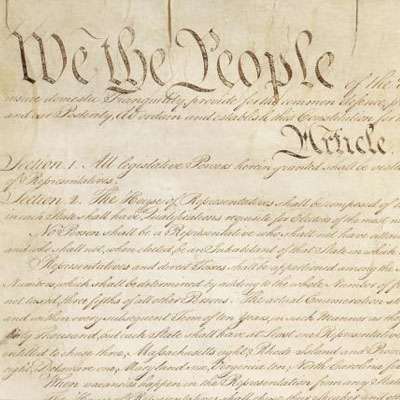
9/28/1787: Confederation Congress adopts Constitution and sends it to the states.
The case was brought by Turning Point USA over the University of New Mexico's decision to charge over $5K (originally planned to be over $10K).
From yesterday's decision by Judge David Herrera Urias in Leadership Institute v. Stokes (D.N.M.):
Kenna Fleig, one of TP-UNM's co-presidents, submitted an event request form indicating that TP-UNM expected around 100 attendees for an event that would last 3.5 hours. The form noted that [the speaker, Riley Gaines,] travels with her own security, and the students did not want to request additional security. A week later, TP-UNM received an email from UNM informing them that they were required to request and accept university security…. Defendant Stump of the UNM police department … provided the students an invoice that listed the cost of security for the event as $10,202.50….
[T]he quote of over $10,000 was for every officer UNM employed—thirty-three officers; nearly one for every three attendees the students expected. When TP-UNM asked why Defendant Stump intended to assign every officer to the Gaines event, and whether it was because of the speaker or the inviting organization, he responded that "it's all based on individual assessments," that they were looking at the "individual," and that "there is not a criteria [sic]."
He also told the students that if an organization were to screen the Barbie movie in a venue on campus, he likely would not require even a single officer because the UNM police were "not worried about the Barbie movie." He then said that security was "consistent" in how it assessed fees "to Turning Point" in the past. He described past TP-UNM events featuring other conservative speakers that generated protests at UNM. A few times during the meeting, he reiterated that UNM assesses security fees on a "case-by-case basis." …
Veterinary speech, inflation reduction, and Inspector Javert's playbook.
Please enjoy the latest edition of Short Circuit, a weekly feature written by a bunch of people at the Institute for Justice.
New cert petition! Friends, if an FBI SWAT team ever raids your home by mistake, terrifying your family, because they couldn't be bothered to double check they had the right address, you might like to sue over it. And you might think the Federal Tort Claims Act, which Congress amended in 1974 specifically to ensure there's a cause of action for federal police raids, lets you do just that. But you'd be wrong, at least in the Eleventh Circuit, which earlier this year ruled (unpublished and per curiam) that FBI agents have the discretion to do anything or nothing at all when it comes to making sure they raid the correct house. Today, IJ asked the Supreme Court to step in, resolve some circuit splits, and tell the Eleventh Circuit that the Supremacy Clause doesn't conflict with federal statutes.
New on the Short Circuit podcast: Michael Perloff of the ACLU joins us to discuss how the D.C. Circuit said your "effects" receive Fourth Amendment protection for as long as the police hold onto them.
The ruling highlights need for state-level zoning reform and stronger judicial protection of constitutional property rights.

Today, a Virginia state trial court ruled against Arlington County's "missing middle" zoning reform, which allows owners of land previously zoned for single-family homes only, to build multifamily residences, with up to four or six units. I previously wrote about the Arlington missing middle reforms (which I support) here and here. The new policy could do much to protect property rights, reduce housing costs, and make it possible for more people to move to Arlington and make use of the many job and education opportunities available in the area, thereby benefiting both themselves and the regional economy.
In addition to being a property and land-use scholar, I am also an Arlington County resident. When people claim I only advocate zoning deregulation in places where other people live, I respond by citing my support for "missing middle."
The Arlington Now website has a helpful summary of the ruling (the decision itself does not seem to be available online):
A circuit court judge has overturned Arlington's Missing Middle zoning changes.
Judge David Schell ruled against the county on four counts this morning (Friday), finding that the county failed to adequately consider localized impacts, failed to follow proper procedure and violated state tree canopy requirements when adopting the amendments.
As of today, the county cannot lawfully issue any more permits under the Expanded Housing Option, which allowed for the construction of up to six-unit buildings on properties that were previously zoned for only single-family homes…
Although a county expert testified that Arlington does, in fact, have sufficient infrastructure to support anticipated growth, the judge found "no evidence presented that the county considered likely overflows" and other localized impacts.
"It appears from the evidence that no consideration was given to the effect of additional sewage," he said.
On a more procedural note, the judge found that the County Board's original resolution to advertise zoning changes "contains no statement that the County Board is resolving to amend the zoning ordinance." He also found that the Board's ordinance "unlawfully delegated legislative responsibility" to county staff.
Finally, the judge found that EHO zoning fails to comply with tree planting and placement standards in the Virginia Code.
The ruling will almost certainly be appealed.
I won't comment on the merits of the decision, which largely turn on technical aspects of Virginia state law, many of which are outside my expertise. But I will note that rulings like this highlight the need for state-wide zoning reform, and for stronger judicial enforcement of constitutional protections for property rights. This is far from the only case where zoning reform has been undercut by state-law litigation. Another recent example is a dubious California court decision striking down SB 9—a significant law limiting single-family zoning
A statewide law could abrogate or at least limit the kinds of procedural hurdles relied on by the plaintiffs here. A state constitutional amendment would be even better. Sadly, Virginia has made little progress on statewide zoning reform, despite support from Gov. Glenn Youngkin.
Stronger judicial enforcement of state and federal constitutional takings clause protections for property rights would also be a big help. In "The Constitutional Case Against Exclusionary Zoning," a forthcoming Texas Law Review article, University of Wisconsin law Professor Josh Braver and I explain why most exclusionary zoning rules violate the Takings Clause of the Fifth Amendment. Part IV of the article explains how litigation to bolster judicial enforcement of the Takings Clause could work in tandem with political reform efforts. We published a shorter, nonacademic version of our argument in the Atlantic.
UPDATE: If you object to using state legislation or constitutional litigation to override zoning rules on the grounds that it undermines local autonomy, I refer you to my post on why "YIMBYism is the Ultimate Localism."
Revised versions of both publications are now up on SSRN.
I recently posted substantially revised versions of two new articles on land use and property rights issues to SSRN. The first is "The Constitutional Case Against Exclusionary Zoning" (coauthored with Josh Braver, forthcoming in the Texas Law Review). Here is the abstract:
We argue that exclusionary zoning—the imposition of restrictions on the amount and types of housing that property owners are allowed to build— is unconstitutional because it violates the Takings Clause of the Fifth Amendment. Exclusionary zoning has emerged as a major political and legal issue. A broad cross-ideological array of economists and land-use scholars have concluded that it is responsible for massive housing shortages in many parts of the United States, thereby cutting off millions of people – particularly the poor and minorities - from economic and social opportunities. In the process, it also stymies economic growth and innovation, making the nation as a whole poorer.
Exclusionary zoning is permitted under Euclid v. Ambler Realty, the 1926 Supreme Court decision holding that exclusionary zoning is largely exempt from constitutional challenge under the Due Process Clause of the Fourteenth Amendment, and by extension also the Takings Clause. Despite the wave of academic and public concern about the issue, so far, no modern in-depth scholarly analysis has advocated overturning or severely limiting Euclid. Nor has any scholar argued that exclusionary zoning should be invalidated under the Takings Clause, more generally.
We contend Euclid should be reversed or strictly limited, and that exclusionary zoning restrictions should generally be considered takings requiring compensation. This conclusion follows from both originalism and a variety of leading living constitution theories. Under originalism, the key insight is that property rights protected by the Takings Clause include not only the right to exclude, but also the right to use property. Exclusionary zoning violates this right because it severely limits what owners can build on their land. Exclusionary zoning is also unconstitutional from the standpoint of a variety of progressive living constitution theories of interpretation, including Ronald Dworkin's "moral reading," representation-reinforcement theory, and the emerging "anti-oligarchy" constitutional theory. The article also considers different strategies for overruling or limiting Euclid, and potential synergies between constitutional litigation and political reform of zoning.
The second is "Land-Use Regulation," a chapter in the forthcoming Routledge Handbook on Classical Liberalism (edited by Richard Epstein, Liya Palagashvili, and Mario Rizzo). Here is the abstract:
Land use regulation is a major function of every government in the world. It raises many issues for classical liberalism. This chapter provides an overview of three of the most important areas of land-use policy: the use of eminent domain to forcibly take property for government-approved projects, regulations that restrict property owners' use of their land, and the relationship between property rights in land and migration restrictions.
Part I covers the use of eminent domain to take private property, and arguments for its limitation to genuinely "public" projects, as opposed to coerced transfers between private owners. Advocates of the latter argue they are needed to overcome "holdout" problems. But unconstrained use of eminent domain is a serious threat to property rights and hampers economic development.
Part II considers regulatory restrictions on land use that do not involve physical occupation of property. There is a longstanding debate about the value of such restrictions and whether the government should pay owners compensation. The most significant regulatory restrictions of this type in many nations are zoning rules restricting housing construction.
Finally, Part III provides a critical overview of property-rights rationales for restricting mobility, particularly in the form of international migration. Such theories justify severely constraining the liberty and property rights of both migrants and natives.
In addition to contributing to this volume, I am also a contributor to Routledge Handbook of Libertarianism, edited by Jason Brennan, Bas van der Vossen, and David Schmidtz, and the Cambridge Handbook of Classical Liberal Thought, edited by M. Todd Henderson. Yet, I'm far from clear on what, if anything, differentiates libertarianism and classical liberalism. I explored that question in a previous post.
A panel examining what is in store for October Term 2024.
On Tuesday, October 1, I will be participating in the Federalist Society's annual Supreme Court term preview event in Washington, D.C. Those joining me in examining what is in store for October Term 2024 will include Paul Atkins, Lisa Blatt, Erin Hawley, and John Moran. Sarah Isgur will moderate. Registration info is here.
For those interested in a deeper dive in the term's first environmental case, City and County of San Francisco v. Environmental Protection Agency, I moderated this teleforum webinar previewing the case with Prof. Robin Kundis Craig and Andre Monette.
And for folks in Northeast Ohio, I'll be doing a program on the Court with Pete Williams, formerly of NBC News, at John Carroll University on Monday evening.
UPDATE: The Federalist Society has posted a video of the Supreme Court program.
From yesterday's decision in Hines v. Pardue, by Fifth Circuit Judge Don Willett, joined by Judges Cory Wilson:
Dr. Ronald S. Hines is a retired, physically disabled, Texas-licensed veterinarian who enjoys spending his golden years giving online pet-care advice to animal lovers around the world—often for free. Dr. Hines does not physically examine animals, perform surgeries, apply casts, splints, or bandages, administer vaccinations, or prescribe prescription medication. He merely sends emails. This would be no problem if the patients were people instead of pets. For humans, Texas law allows telemedicine without first requiring a face-to-face examination to establish a physician-patient relationship. Not so with animals, which require an in-person visit. Exam-free telehealth, turns out, is fine for your Uncle Bernard, but not for your Saint Bernard.
No one ever complained about Dr. Hines's online pet-care advice or alleged that it harmed a single animal. However, because Dr. Hines does not physically examine animals before sharing his expertise, the State of Texas considered some of his emails criminal offenses, going so far as penalizing him with a year of probation, fining him $500, and forcing him to retake the jurisprudence section of the veterinary licensing exam….
Today, we uphold Dr. Hines's First Amendment rights. We specifically conclude that the State of Texas is directly regulating Dr. Hines's speech and that this regulation fails to survive even intermediate scrutiny….
First things first, we must determine what the physical-examination requirement primarily regulates. The State does not dispute that Dr. Hines's speech is implicated. It contends that the physical-examination requirement restricts Dr. Hines's speech incidentally to the general regulation of conduct. So, we consider whether the requirement regulates Dr. Hines's speech directly or only incidentally to the regulation of his conduct. On the one hand, all Dr. Hines does is send emails—pure speech. But on the other, the law regulates his speech as part of the practice of veterinary medicine. {We are mindful that under "[Supreme Court] precedents, [s]tates may regulate professional conduct, even though that conduct incidentally involves speech."} …
[C]ircuit courts have, until recently, applied the so-called professional-speech doctrine to licensing regulations like this one. These courts, including our own, treated laws regulating professionals' speech as a separate category from non-professional speech, entitling them to less protection and exempting them from traditional First Amendment scrutiny. The Supreme Court, however, rejected this doctrine in NIFLA v. Becerra (2018), and instructed courts to apply the "traditional conduct-versus-speech dichotomy." But "[a]s it stands today, the relevant First Amendment doctrine is a mind-numbing morass of tangled precedents developed in contexts very different from professional licensing."
The discussion at today's AI Liability conference reminds me of one of my favorite stanzas from a poem (Kipling's Hymn of the Breaking Strain):
The careful text-books measure
(Let all who build beware!)
The load, the shock, the pressure
Material can bear.
So, when the buckled girder
Lets down the grinding span,
The blame of loss, or murder,
Is laid upon the man.
Not on the Stuff — the Man!
The rest of the poem, to be sure, isn't about tort liability.
I'm participating in this in-person event today at the Georgetown Law Center in D.C., and Lawfare is posting the articles here (the link also includes some other pieces on related topics). The articles all look very interesting; mine in particular is on AI and the First Amendment—readers of the blog might find it familiar, since it's based on past articles (including one cowritten with Mark Lemley and Peter Henderson), but it might still be a helpful shortish digest of those longer articles.
The Court's decision to overturn Chevron should be seen as more of a "course correction" than a revolution. (Updated with Video.)
Yesterday Justice Brett Kavanaugh spoke at Catholic University's Columbus School of Law as part of a program sponsored by the Center for the Constitution and the Catholic Intellectual Tradition. His remarks came in the form of an interview with Professor Joel Alicea.
As Bloomberg's Lydia Wheeler reports, the Justice had some interesting things to say about how to understand the Court's decision dispatching with Chevron deference in Loper Bright Enterprises. In particular, the Justice characterized the decision as "a course correction consistent with the separation of powers to make sure that the executive branch is acting within the authorization granted to it by Congress."
From the Bloomberg report:
"To be clear, don't over read Loper Bright," Kavanaugh said, while speaking at Catholic University of America Columbus School of Law in Washington on Thursday. "Oftentimes Congress will grant a broad authorization to an executive agency so it's really important, as a neutral umpire, to respect the line that Congress has drawn when it's granted broad authorization not to unduly hinder the executive branch when performing its congressional authorized functions, but at the same time not allowing the executive branch, as it could with Chevron in its toolkit, to go beyond the congressional authorization ."
This is consistent with my initial analysis of the decision.
In his remarks, Justice Kavanaugh seemed to confirm that the Court's majority was concerned about the increasing tendency of federal agencies to try and pour new wine out of old bottles and stretch pre-existing statutory authorizations into new areas. During the Bush Administration, Kavanaugh said "he saw firsthand how hard it is for presidents to get big legislation through Congress and the pressure there is on the agencies to 'push the envelope,' when it comes to regulating, which Chevron facilitated." In this regard, Loper Bright Enterprises can be seen as of a piece with the Court's major questions doctrine decisions that likewise seek to prevent agencies from exceeding the bounds of their delegated authority. (One might even say they combine to make something of a "delegation doctrine.")
Law.com also reported on Justice Kavanaugh's remarks.
UPDATE: Video of Justice Kavanaugh's remarks has now been posted. The discussion of Loper Bright occurs approximately 12 minutes in.
A sample list of reforms to reduce failures of justice.
This is the final post in a five-part series where we're guest blogging about our new book Confronting Failures of Justice: Getting Away With Murder and Rape, available here. In the previous posts we considered the frequency of failures of justice (instances of unpunished or inadequately punished crime), their costs, and the problem of balancing competing societal interests in criminal justice policy. Identifying problems is important, and our book identifies numerous problematic areas of the justice system where serious criminals either completely escape conviction or escape what society would see as a just punishment.
However, we also offer reform ideas for what a better balance of societal interests might look like in each area of the justice system. While we describe or suggest dozens of possible reforms to reduce failures of justice, consider an excerpt from the book listing ten reforms (not by order of importance) we think policymakers should particularly consider.
[1.] Abolish the Statutes of Limitation for Serious Felonies, and for Other Felonies Restart the Limitation Clock after Any New Felony (chapter 2). As discussed in chapter 2, while statutes of limitation might have had more justification when introduced centuries ago, the reasons for their continued use are lacking, especially when they regularly produce failures of justice for serious offenses.
[2.] Adopt a Fair Import Test in Place of a Strict Construction Test, after Adopting a Modern Criminal Code Format (chapter 2). As with statutes of limitation, the rule of strict construction might have made sense back when it was first adopted, but the advent of modern criminal codes with their careful drafting and defined terms have left it with little continuing justification.
[3.] Adopt a Desert-based Distributive Principle, as per the Model Penal Code (chapter 3). Half a century ago, when the Model Penal Code was first drafted by the American Law Institute, the state of criminal law theory left it unsettled as to whether criminal law ought to be primarily aimed at doing justice—giving offenders the punishment they deserve, proportionate to the seriousness of the offense and the blameworthiness of the offender—or in the business of avoiding future crime through general deterrence or incapacitation of the dangerous, even if doing so meant violating principles of deserved punishment. But as the 2007 amendment of the Model Code illustrates, it has now become clear that abandoning desert as the guiding principle for criminal liability and punishment creates its own enormous costs to effective crime control.
9/27/1787: First Anti-Federalist letter by "Cato" is published.
What's on your mind?
The N.J. intermediate appellate court held such publication wasn't protected by the First Amendment law; the state high court just agreed to reconsider that. The question presented is,
Is Daniel's Law, N.J.S.A. 56:8-166.1 and N.J.S.A. 2C:20-31.1, which prohibits disclosing the home addresses of certain public officials, including judges, prosecutors, and law enforcement personnel, unconstitutional as applied to plaintiff?
Here's an excerpt of the lower court opinion, Kratovil v. City of New Brunswick:
Plaintiff is a journalist who writes for and edits New Brunswick Today, an online publication…. Defendant Caputo is a retired police officer who then became Director of the City's Police Department. Caputo was also a Commissioner of the City's Parking Authority. He served in both those positions through 2023 and retired from those positions in early 2024.
In 2023, plaintiff noted that Caputo was not attending City Council meetings, nor was he regularly attending Parking Authority meetings in person. On March 14, 2023, plaintiff sent Caputo an email asking if Caputo still lived in the City. The Deputy Director of Police responded on Caputo's behalf, stating, in relevant part: "The public release of a law enforcement officer's place of residence is protected under Daniel's Law."
Plaintiff came to believe that Caputo was living in Cape May. To confirm that belief, plaintiff filed a request under the Open Public Records Act (the OPRA) with the Cape May County Board of Elections (the Cape May Board), requesting Caputo's voter profile. Initially, the Cape May Board provided a redacted version of Caputo's voting profile to plaintiff in March 2023. After follow-up communications from plaintiff, in April 2023, the Cape May Board produced a voter profile with fewer redactions. That voter profile included Caputo's home address.
At meetings of the City's Parking Authority and the City Council conducted on March 22, 2023 and April 5, 2023, respectively, plaintiff asked if Caputo still lived in the City. Neither Caputo nor anyone else from the City definitively responded to plaintiff's question.
On May 3, 2023, plaintiff attended another City Council meeting…. During the public comment portion of the meeting, plaintiff discussed Caputo's change of residence, that Caputo's residence in Cape May was approximately a two-hour drive from the City, and that Caputo was serving on the City's Parking Authority even though he was a non-resident. During that discussion, plaintiff stated the street name in Cape May where Caputo was registered to vote. He also provided City Council members with copies of Caputo's voter profile, which included Caputo's complete home address.
New York City requires a showing of "good moral character" to be issued a rifle and shotgun permit. In Srour v. New York City (2023), the Southern District of New York enjoined the enforcement of the "good moral character" requirement and a separate "good cause" requirement. I posted on the decision here.
After filing its appeal, the City adopted definitions of those previously-undefined terms, Srour reapplied, and the City granted the permit. On September 9, the Second Circuit held that he was granted the relief he sought, rendering the case moot and removing jurisdiction to hear the merits.
The City had based Srour's denial on his prior arrests (without convictions) and "derogatory" driving record. On the same day that Srour moved for summary judgment, the City adopted a definition of "good moral character" as "having the essential character, temperament and judgment necessary to be entrusted with a weapon and to use it only in a manner that does not endanger oneself or others." It also repealed the "good cause" requirement.
Following the Supreme Court's decision in New York State Rifle & Pistol Ass'n v. Bruen (2022), the district court found the character requirement facially unconstitutional, as the City had "not identified any historical analogue for investing officials with the broad discretion to restrict someone's Second Amendment right based on determining the person to lack good moral character." Srour then reapplied for a permit. Meanwhile, the City appealed.
Celebrate your independence with a subscription to Reason magazine, your most trusted source of honest, insightful news and analysis.