The Volokh Conspiracy

Mostly law professors | Sometimes contrarian | Often libertarian | Always independent | Est. 2002

The Volokh Conspiracy

Free Speech

"Inside State-Run 'Bias-Response Hotlines,' Where Fellow Citizens Can Report Your 'Offensive Joke'"

|

An interesting story by Aaron Sibarium in the Washington Free Beacon. It offers a good deal of fairly concrete detail, always helpful in such analyses.

Such hotlines aren't themselves First Amendment violations, of course, unless they lead to coercive or discriminatory action against constitutionally protected speech, or at least the threat of such action. Even if they create something of a chilling effect on some people who don't want to get reported (or don't want to get reported again), that by itself isn't enough to violate the First Amendment.

Still, they do create possibilities for abuse, for instance if the resulting data is indeed at some point used to threaten the accused speakers (or deny them jobs or other opportunities). And I think they tend to create unrealistic expectations: After all, if the state says it wants you to report certain behavior, and tells you that it's bad behavior and that you're the victim of such bad behavior, wouldn't you expect that the state will actually try to do something about it?

Read More

Acting SG Asks SCOTUS To Hold Briefing Schedules For Pending Cases

|

The Solicitor General has filed briefs in three cases, currently pending on the docket. First, in Diamond Alternative Energy v. EPA, SG Sarah Harris asked the Court to hold the briefing in abeyance, with the petitioners opposing the motion. Second, in Department of Education v. Career Colleges and Schools of Texas, Harris asked the Court to hold the briefing in abeyance, with the respondents consenting. Third, in EPA v. Calumet Shreveport Refining, Harris asked the Court to hold the briefing in abeyance, with respondents opposing the motion.

The government's cert petition in Oklahoma v. EPA is pending now. The government asked to hold the briefing in abeyance. Again, the petitions who represent states and industry groups opposed.

I think in the cases where the government is the petitioner, the SG will move to withdraw the cert petition. And they may try to knock the other cases off the docket by seeking to modify rules.

These sorts of presidential reversals happen every time a new administration comes to town. I wrote about this topic in my article, Presidential Maladministration. In February 2009, the Obama DOJ withdrew a pending cert petition filed by the Bush Administration in New Jersey v. EPA. The Court granted the motion to dismiss the petition. In 2017, Gloucester County School Board v. Grimm fell off the Court's docket after the Trump Administration changed the Title IX regulations. And in February 2021, the Biden SG withdrew the Trump SG's brief in California v. Texas. And in April 2021, the Biden SG filed an out-of-time brief in Terry v. United States.

The trickier option is for cases already argued, and a decision is pending like Skrmetti and Van Der Stock. The SG can't actually say anything to the Court, at least publicly.

Update: The SG also filed a letter in Louisiana v. Callais, a voting rights case.

Following the change in Administration, the Department of Justice has reconsidered the government's position in these cases. The purpose of this letter is to notify the Court that the previously filed brief no longer represents the position of the United States. In addition, the United States is withdrawing its pending motion to participate in the oral argument.

SCOTUS Grants Cert In Oklahoma Charter School Case, With Justice Barrett Recused

|

Today the Court granted review in Oklahoma Charter School Board v. Drummond. This is an important religious liberty case concerning "whether a state violates the First Amendment's free exercise clause by excluding privately run religious schools from the state's charter-school program solely because the schools are religious." The case should be argued in April.

However, Justice Barrett is recused. My best guess is the recusal is somehow related to Notre Dame Law Professor Nicole Garnett, who is Barrett's friend and colleague. Garnett has provided legal representation to the school, but as best as I can tell, her name does not appear on any Supreme Court brief. Justice Barrett did not explain the precise basis for the recusal, so we are left wondering.

I think this rationale matters. Is recusal justified solely based on a close friendship with someone who was represented a party in the case in unrelated matters, even if that friend is not counsel in the case? Or did Barrett have some personal connection with the school during her time?

Critics will seize on this precedent to attack Justices Thomas and Alito, without fail.

Update: I see that the Notre Dame Religious Liberty Clinic is on the brief for the St. Isidore plaintiff. Barrett is paid by Notre Dame University, but not the clinic. I don't see why this would force her recusal. Regrettably, this recusal may make it very difficult for the clinic to participate in other cases, because clients may fear that Justice Barrett will recuse should the case ever make it to the Supreme Court. And in any religious liberty case, Barrett's vote is likely needed.

Update (1/26/24): I offered some further thoughts on Justice Barrett's recusal here.

Politics

Short Circuit: A Roundup of Recent Federal Court Decisions

Hoary doctrines, lurking theories, and atomic bombs.

|

Please enjoy the latest edition of Short Circuit, a weekly feature written by a bunch of people at the Institute for Justice.

Friends, Short Circuit is turning 10, and we're having a party! Sláinte! Please come join us, retired judges Diane Wood and Kent Jordan, and a full cast of noteworthies on Thursday, April 3, 2025, at 7pm at the Studio Theatre in Washington, D.C. for lively discussion and a live recording of the Short Circuit podcast. Register here today!

Read More

Free Speech

Hiring a Research Fellow in Free Speech Law for 1 or 2 Years, at the Hoover Institution (Stanford)

One week left to apply.

|

This was announced back in August, but I thought I'd pass it along again; if you're interested, please apply, and if you know people who might be interested, please pass this along to them.

Opportunity for Post-JD Scholars

The Hoover Institution at Stanford University is seeking an outstanding early-career legal scholar interested in researching free speech law, in preparation for seeking an academic position at a law school or elsewhere.

If selected, you would work on your own research with the guidance and supervision of Senior Fellow Eugene Volokh, who has moved to Hoover after 30 years as a Professor of Law at UCLA School of Law. You would be appointed a Research Fellow with the Center for Free Expression, for one year from July 2025 through June 2026. The term may be renewed, if both you and Hoover agree, for one extra year. You would be expected to be physically present at the Institution, working full-time, with no competing major professional commitments.

There is no teaching obligation, so you would have maximum time to research and write. However, you would be expected to help organize and participate in occasional conferences, workshops, and lectures, and to work on occasional projects with Volokh or other Senior Fellows. These tasks would all be related to free speech law and are expected to help promote your own research and future career.

Eligibility Criteria:

  • You must have a JD or its equivalent by June 2025.
  • You must commit to staying for at least one year (July 2025 through June 2026). The date range might be moved back slightly if required because of a judicial clerkship that will keep you occupied until July to September 2025.
  • A judicial clerkship (past or upcoming) is not required, though it is a plus.
  • Work experience as a lawyer is not required, though some such experience is a plus.
  • A PhD in another discipline is not required, though neither is it frowned upon.
  • You must have written a publishable law journal article already while in law school or shortly after. Whether it has already been published or not does not matter, so long as it is essentially complete. That article need not have been on free speech law.
  • You must be planning to work on free speech law, understood broadly. This is not limited to First Amendment law, but includes federal or state statutes, common law rules, state constitutional provisions, transnational or international legal provisions, and rules of important private institutions—so long as they relate to the regulation (or deregulation) of speech, press, expression, assembly, expressive association, petition, and the like. Likewise, it includes doctrinal, historical, theoretical, and empirical scholarship.
  • We prefer projects on important but insufficiently studied topics, rather than on ones that have already been heavily researched by others.

To Apply, Please Submit:

Read More

Free Speech

Federal Prosecutors Dropping HIPAA Charges Against Dr. Ethan Haim, Stemming from Youth Gender Medicine Disclosures

|

From the Justice Department's press release about the charges in June:

A Houston doctor has been indicted for obtaining protected individual health information for patients that were not under his care and without authorization, announced Alamdar S. Hamdani….

The four-count indictment alleges Haim obtained personal information including patient names, treatment codes and the attending physician from Texas Children's Hospital's (TCH) electronic system without authorization. He allegedly obtained this information under false pretenses and with intent to cause malicious harm to TCH.

According to the indictment, Haim was a resident at Baylor College of Medicine and had previous rotations at TCH as part of his residency.

In April 2023, Haim allegedly requested to re-activate his login access at TCH to access pediatric patients not under his care. The indictment alleges he obtained unauthorized access to personal information of pediatric patients under false pretenses and later disclosed it to a media contact.

From the Free Press (Tom Bartlett):

Haim decided to tell the media what was happening at his hospital. He knew taking a public stance on such a divisive issue could undermine his medical career before it really started, so he was determined to remain anonymous. He told me he didn't present his findings to hospital administrators because it was obvious to him that what was happening had the approval of higher-ups.

Read More

AI in Court

AI Hallucinations in a Self-Represented Litigant's Brief in the Colorado Court of Appeals

|

Even lawyers have at times filed briefs containing AI-hallucinated citations; but the danger is likely especially great for the many self-represented litigants. Here, for instance, is a passage from the Dec. 26 decision of the Colorado Court of Appeals in Al-Hamim v. Star Hearthstone, LLC, written by Colorado Court of Appeals Judges Lino Lipinsky, joined by Judges Jerry Jones and Grant Sullivan; the underlying case was a landlord-tenant dispute, but I'm focusing here on the discussion of the AI hallucinations:

Al-Hamim's opening brief in this appeal contained hallucinations, as well as bona fide legal citations. This case provides the first opportunity for a Colorado appellate court to address the appropriate sanction when a self-represented litigant files a brief peppered with GAI-produced hallucinations…. We affirm the court's judgment against Al-Hamim and put him, the bar, and self-represented litigants on notice that we may impose sanctions if a future filing in this court cites "non-existent judicial opinions with fake quotes and citations." …

Al-Hamim's opening brief contains citations to [eight] fake cases …. After we attempted, without success, to locate these cases, we ordered Al-Hamim to provide complete and unedited copies of the cases, or if the citations were GAI hallucinations, to show cause why he should not be sanctioned for citing fake cases. In his response to our show cause order, Al-Hamim admitted that he relied on AI "to assist his preparation" of his opening brief, confirmed that the citations were hallucinations, and that he "failed to inspect the brief." He did not address why he should not be sanctioned….

Read More

Members of the International Criminal Court Need To Relearn The Lesson of Marbury v. Madison

Jefferson likely would have ignored any command from Chief Justice Marshall, and Marbury did not issue such a command.

|

Another semester, another section of constitutional law. This week I taught Marbury v. Madison for the umpteenth time. Beyond teaching the mechanics of the Original Jurisdiction clause and the Judiciary Act of 1789, I always try to convey to my students why Marshall wrote the opinion backwards: Why decide the merits question about the commission before the jurisdictional question? The answer, as all know, was that Marshall was trying to establish the principle of judicial review for federal legislation. (And no, he did not create judicial review; read Hamilton in Federalist No. 78.)

Yet, lurking in the background was a fear. If Marshall had in fact ordered Secretary of State James Madison, an appointee of President Thomas Jefferson, to deliver Marbury's commission, it is likely the order would have been disregarded. It is not a certainty, but there was definitely that risk. If so, Marshall recognized what would happen if his court issued an order that was ignored: the court, as an institution, would be diminished.

At this point in class, I always ask students why do people follow court orders. The usual answer is that if you ignore the court, you will go to jail. That's fine, but it is the executive branch that will actually arrest a person and incarcerate them. Judges do not get off their benches and place handcuffs on a person. As Hamilton explained in Federalist No. 78, courts have neither force nor will, only judgment. Courts depend on the executive branch to enforce their judgments.

I then ask why does the executive branch enforce a court's judgments. The usual answer is that without that sort of enforcement, there would be anarchy and chaos in society. Maybe that's right. But at bottom, the answer is that the executive branch enforces the court's judgments because the executive branch thinks the court plays a valid role in society, even if any particular decision might be right or wrong.

I then ask whether the President should enforce a blatantly unconstitutional ruling (you can think of what that would be). At that point, students get a bit queasy. Some judicial supremacists (even if they do not know the term yet) say that court judgments should be enforced no matter what. Other departmentalists (even if they do not know the term yet) say that the President can decide for himself whether the order is constitutional, and enforce accordingly. Most students are in the middle, and don't quite know what to think, at least during the first week of class.

This class helped me bring into context the International Criminal Court (ICC). This judicial body sits in the Hague. (I wrote about its jurisdiction here.) The ICC has asserted the power to issue arrest warrants for war criminals, including heads of state. The ICC has no actual power to command people to the Hague. Rather, signatories to the Rome Convention have a legal obligation to arrest anyone in their jurisdiction that is subject to an ICC warrant. So are member states actually enforcing these arrest warrants? No. Consider three examples.

Example #1. Russian President Vladimir Putin is subject to an arrest warrant. Yet he was welcomed with a state visit to Mongolia, a signatory to the Rome Convention. The ICC Pre-Trial Chamber (whatever that is) found that Mongolia failed to cooperate with the arrest warrant. But so what? Will there be any actual consequences? Putin has also visited China, and President Trump has announced that he will visit with Putin. The ICC's ruling are less than parchment barriers.

Example #2. The ICC issued an arrest warrant for Israeli Prime Minister Benjamin Netanyahu. Netanyahu was invited to Poland for the 80th anniversary of the liberation of the Auschwitz Concentration Camp. Poland is a signatory to the Rome Convention, but signaled that it would not arrest Netanyahu. Can you imagine the Poles putting handcuffs on the Israeli prime minister at the site of an actual genocide? Maybe they could have loaded him on a railcar--there are still tracks at the camp--through Germany onto the Netherlands? And what will the consequences of Poland's refusal to enforce the warrant be? Absolutely nothing. Other European nations like France and Italy said Netanyahu could visit, citing the fact that he is a current head of state and has diplomatic immunity. Legalistic distinctions without a difference. What is going on here? These nations have determined that their own diplomatic interests with Israel dwarf whatever manufactured claims of genocide have been brought forward.

Example #3. The ICC issued an arrest warrant for Osama Elmasry Njeem, a Libyan charged with war crimes. The Italian police actually arrested Njeem, but the government did not transport him to the Hague. Rather, two days later Italy escorted Njeem back to Libya. The Prime Minister of Italy cited "procedural" reasons for returning him. But there may be another reason. Italy needs Libya's cooperation to handle the migrant situation. Returning Njeem likely helped Italy's diplomatic relations with Libya. By contrast, sending Njeem to the Hague would have harmed those relations. Which did Italy choose? Which option would any sane country choose? The arrest warrant was disregarded.

The ICC is John Marshall's worst nightmare: a court that issues orders that are routinely flouted. This is not really a court. It is a body of progressive human rights lawyers who wear powdered wigs and robes. They are cosplaying as judges, but have no actual sovereign authority of their own. It's as if the Harvard Law Review editorial board ordered that certain scholars should be arrested for writing the wrong type of scholarship. (Maybe these are the sorts of "consequences" Seth Barrett Tillman worried about.)

The ICC is emblematic of my general view about international law. International law is designed to allow smaller, weaker countries to exert power over larger, stronger countries. In the normal course of things, larger, stronger counters can use their diplomatic or military clout to achieve their ends. Smaller, weaker countries do not have either diplomatic or military clout, so they have to dress up their demands in the fancy garb of "international human rights law" and other such abstract legalisms. But at bottom, any "court" decision must be backed up by political will. And absent that political will, ICC opinions are little more than window dressing for human rights lawyers without any actual mandate.

Every action has an equal and opposite reaction. In 2002, Congress enacted the American Service-Members' Protection Act, known informally as The Hague Invasion Act. The law gives the president the power to use "all means necessary and appropriate to bring about the release of any U.S. or allied personnel being detained or imprisoned by, on behalf of, or at the request of the International Criminal Court." This is effectively a declaration of war against the Hague if any American servicemember is detained.

In 2020, the ICC began an investigation of American troops in Afghanistan, and Congress imposed sanctions on the Chief Prosecutor and her aide. This month, the House voted to impose sanctions on the entire ICC, and the Senate likely will agree. The ICC is already preparing for the crushing financial consequences. Microsoft, for example, would likely have to stop working with the ICC.

The members of this court need to relearn the lesson from Marbury. If you issue orders that will be ignored, you will no longer be a court.

Three Notes on National Injunctions

|

Three notes on national injunctions. First, today the Court issued a stay of another universal injunction, this time in McHenry v. Texas Top Cop Shop, Inc. The Solicitor General had suggested that the Court could construe the stay request as a petition for certiorari before judgment, allowing the Court to directly address the universal injunction question. One reason that matters is that it would be good for the Court to tackle the universal-relief question directly, without the additional complexities that come from the context of the Administrative Procedure Act.

The Court did not grant certoriari before judgment, and Justice Gorsuch wrote a brief concurrence in the stay:

I agree with the Court that the government is entitled to a stay of the district court's universal injunction. I would, however, go a step further and, as the government suggests, take this case now to resolve definitively the question whether a district court may issue universal injunctive relief. See Labrador v. Poe, 601 U. S. ___, ___–___ (2024) (GORSUCH, J., concurring in grant of stay) (slip op., at 4–5, 11–13); Department of Homeland Security v. New York, 589 U. S. ___, ___–___ (2020) (GORSUCH, J., concurring in grant of stay) (slip op., at 1–5).

Second, I recently ran across a Supreme Court decision that has not featured in the debate over the national injunction, but it has language that is directly on point. The case is United States v. National Treasury Employees Union:

For three reasons, we agree with the Government's first suggestion—that the relief should be limited to the parties before the Court. First, although the occasional case requires us to entertain a facial challenge in order to vindicate a party's right not to be bound by an unconstitutional statute, see, e.g., Secretary of State of Md. v. Joseph H. Munson Co., 467 U.S. 947, 965–967, and n. 13, 104 S.Ct. 2839, 2851–2852, and n. 13, 81 L.Ed.2d 786 (1984), we neither want nor need to provide relief to nonparties when a narrower remedy will fully protect the litigants. See Board of Trustees of State Univ. of N.Y. v. Fox, 492 U.S. 469, 484–485, 109 S.Ct. 3028, 3037–3038, 106 L.Ed.2d 388 (1989). In this case, granting full relief to respondents—who include all Executive Branch employees below grade GS–16—does not require passing on the applicability of § 501(b) to Executive Branch employees above grade GS–15, including those high-level employees who received a 25% salary increase that offsets the honoraria ban's disincentive to speak and write.

United States v. Nat'l Treasury Emps. Union, 513 U.S. 454, 477–78 (1995).

Third, The Purpose of the Preliminary Injunction addresses trends in preliminary injunctions, especially the collapse of the four-factor test into the merits. It is not just about national injunctions. But it sheds light on a broader set of intersecting trends—the dominance of the merits, the rise of universal relief, and heightened judicial polarization and forum-shopping.

Free Speech

Google, as Non-Party, Not Subject to Injunction That Expressly Ordered It to Take Down YouTube Posts

|

In Future Motion, Inc. v. Lai, decided Jan. 7 by Judge Michael Simon (D. Or.) (appeal filed Wednesday), plaintiff sued defendant for patent infringement, and Judge Simon issued an injunction that purported to bind not just defendant but others:

[I]n accordance with the Court's inherent equitable power to issue provisional remedies ancillary to its authority to provide final equitable relief, any internet service provider including but not limited to any web hosting company, domain name registry, domain name registrar, e-commerce service provider, and/or video platform provider having notice of the Court's Order must (1) take any and all action necessary to remove the infringing content from websites having content controlled by Defendant, or alternatively to disable access to the website; and (2) provide notice of compliance to Future Motion's counsel within five (5) business days of receipt of notice of this Order. This includes but is not limited to the following specific examples: …

[6.] Any video platform provider, including but not limited to Google LLC doing business as YouTube, must promptly upon receipt of a copy of this Order either disable public access to (i) the entire Floatwheel YouTube channel at https://www.youtube.com/floatwheel or (ii) to all individual videos teaching viewers how to make and/or use a product that infringes Future Motion's patents, including but not limited to … 48 videos [listed below with titles and URLs] currently hosted at the YouTube channel https://www.youtube.com/floatwheel….

[8.] Pursuant to this Court's inherent powers, any person or entity failing to comply promptly with this Order, including but not limited to any domain name Registrar, e-commerce service provider, video platform service provider (including Google LLC doing business as YouTube), freight forwarding service provider, or logistics company (including but not limited to those enumerated above) shall be subject to sanctions for civil and/or criminal contempt

(As is not uncommon, the text of the injunction was submitted as a proposed order by the plaintiff, which the judge accepted.) Later, Judge Simon issued a follow-up injunction (again based on a proposed order) stating, in part,

Read More

Politics

Choice of Law in Takings Cases After Tyler v. Hennepin County (V)

A reader mailbag.

|

This week, I've blogged on a forthcoming article about the Supreme Court case Tyler v. Hennepin County, Minnesota. As I showed on Monday, in Tyler the U.S. Supreme Court held that surplus equity constitutes "private property" sufficient to support claims under the Takings Clause. As I showed on Tuesday and Wednesday, the Court reached that conclusion (primarily) by figuring out what the general law in England and the American states held at the Founding on surplus equity but (secondarily) also by checking how Minnesota (the defendant in Tyler) treated surplus equity when it wasn't foreclosing. Yesterday, I argued that this strategy makes practical sense in context. For originalists, the Tyler strategy provides a way to work out what "private property" means and covers when the historical record doesn't make explicitly clear whether a particular legal entitlement was understood to be property. For non-originalists, the Tyler approach provides a way for federal courts to steer between two dangers. The approach avoids overaggressiveness, in second-guessing state property law, and passivity, when states use their powers to define property to expropriate it.

Today, I'll devote this post to a "reader mailbag" day. Here's one reaction I've gotten: How far might federal courts go in relying on general law? To make the question more pointed, consider a hypothetical. Assume that English and American practice pre-1790 ruled out the possibility that surplus equity was property, but that American state courts and legislatures gradually came to regard it as property later. The hypothetical differs from what happened in Tyler. In Tyler the Court focused on general law sources before or only shortly after the ratification of the Fifth Amendment, and there was no tension between post-ratification general law and English and pre-ratification practice. But the hypothetical raises some important questions, about how much one can rely on general law.

I have two different answers depending on what you think is the right approach to constitutional interpretation. If you are not an originalist, in situations like my hypothetical, courts could and probably should follow general law. The general law provides a baseline. The baseline stands separate from judges' own views about whether a particular entitlement should or shouldn't be property (or, whether a state has good grounds to regulate it). And, the baseline allows for comparison of a state's law against the practices in other states.

Read More

Birthright Citizenship

Debating Birthright Citizenship (Again) [UPDATED]

The arguments are not new. The willingness of an Administration to act on them are.

|

During the first Trump Administration, some of the President's supporters urged him to embrace the view that the Fourteenth Amendment does not require recognition of birthright citizenship to those born in the United States to parents who were not legal residents.

As I noted at the time, some of the most thorough and comprehensive arguments to the contrary could be found in the work of Judge James Ho, who wrote several op-eds and a short law review article on the question before becoming a judge on the U.S. Court of Appeals for the Fifth Circuit.

The Fourteenth Amendment provides, in relevant part, "All persons born or naturalized in the United States, and subject to the jurisdiction thereof, are citizens of the United States . . ." This provision unquestionably provides that those born on U.S. soil to American citizens and lawful permanent residents are American citizens at birth. The relevant legal question with regard to the Trump Administration Executive Order is what it means for someone to not be "subject to the jurisdiction" of the United States at birth. The conventional account is that it excludes the children of foreign diplomats and invading armies. The revisionist account maintains that it also excludes the children of those unlawfully present in the country, and perhaps the children of non-citizen parents lacking lawful permanent residence as well.

There may well be a range of non-originalist arguments for the revisionist position, but as a matter of original public meaning, these arguments do not work.   Judge Ho explained why in a 2007 op-ed:

When a person is "subject to the jurisdiction" of a court of law, that person is required to obey the orders of that court. The meaning of the phrase is simple: One is "subject to the jurisdiction" of another whenever one is obliged to obey the laws of another. The test is obedience, not allegiance.

The "jurisdiction" requirement excludes only those who are not required to obey U.S. law. This concept, like much of early U.S. law, derives from English common law. Under common law, foreign diplomats and enemy soldiers are not legally obliged to obey our law, and thus their offspring are not entitled to citizenship at birth. The 14th Amendment merely codified this common law doctrine.

Members of the 39th Congress debated the wisdom of guaranteeing birthright citizenship — but no one disputed the amendment's meaning. Opponents conceded — indeed, warned — that it would grant citizenship to the children of those who "owe [the U.S.] no allegiance." Amendment supporters agreed that only members of Indian tribes, ambassadors, foreign ministers and others not "subject to our laws" would fall outside the amendment's reach.

The strongest counter-argument I have come across is that made by Peter Schuck and Rogers Smith (based on their 1985 book), but their argument does not vindicate the Trump Administration's position. Rather, their position is that Congress has "the power to regulate access to birthright citizenship for groups to whose presence or membership it did not consent" by defining what constitutes being "subject to the jurisdiction of the United States." And if one takes an expensive view of Congress's Section 5 power to implement and enforce the terms of the Fourteenth Amendment, this argument may have some force. But even if one accepts this argument (and I am unpersuaded), this would at most allow for Congress to enact legislation excluding some groups, such as those unlawfully present in the country, from conveying birthright citizenship. It would not provide adequate justification for unilateral action by the executive branch.

The above assumes that the question of birthright citizenship should be resolved by reference to the original public meaning of the Fourteenth Amendment. If one rejects this view, and believes either that courts should be particularly deferential to the political  branches or should embrace evolving constitutional meanings in response to political and other developments (such as an election in which a prevailing candidate advocated a contrasting constitutional interpretation), one might well reach a different conclusion.

UPDATE: For those interested in more on this subject, I recommend this essay by Paul Gowder from The UnPopulist, this John Yoo essay from Civitas Outlook, and this Michael Ramsey post from the Originalism Blog focused on the Trump EO (which links to this longer article).

Note that the Trump Administration position seeks to get around the Supreme Court's Wong Kim Ark decision by arguing that it implicitly accepted the requirement of domicile for one to be "subject to the jurisdiction of the United States." Andrew Hyman makes a version of that argument here. I remain unpersuaded and would note that, even were this argument correct, it would do more to support potential legislation defining the contours of U.S. jurisdiction over non-citizens (and thus the eligibility of their children for birthright citizenship) than it would unilateral executive action.

One additional reason legislative action is necessary is that the traditional understanding of what it means for a non-citizen to not be subject to U.S. jurisdiction is reflected in how the U.S. treats foreign diplomats: They are not subject to U.S. law and thus can be expelled, but not prosecuted for crimes. Asserting that individuals not lawfully present in the country are subject to U.S. jurisdiction for some purposes but not others is not something that can simply be decreed.

Birthright Citizenship

Federal Court Issues Temporary Restraining Order Blocking "Blatantly Unconstitutional" Trump Birthright Citizenship Order

The TRO blocks the order for 14 days and is a sign that courts are highly skeptical of Trump's position.

|

NA

Earlier today, a US federal district judge issued a temporary restraining order blocking implementation of Donald Trump's executive order denying birthright citizenship to children of undocumented immigrants and immigrants in the US on temporary visas:

A federal judge on Thursday temporarily blocked President Donald Trump's executive order redefining birthright citizenship, calling it "blatantly unconstitutional" during the first hearing in a multi-state effort challenging the order.

U.S. District Judge John Coughenour repeatedly interrupted a Justice Department lawyer to ask how he could consider the order constitutional…..

Coughenour, a Ronald Reagan appointee, grilled the DOJ attorneys, saying the order "boggles the mind."

"This is a blatantly unconstitutional order," Coughenour told Shumate. The judge said he's been on the bench for more than four decades, and he couldn't remember seeing another case where the action challenged so clearly violated the constitution.

This is just the start of what is likely to be a lengthy legal battle, in just one of several cases challenging the order. It also isn't a final ruling on the merits, even in this one case.

Nonetheless, Judge Coughenour's negative reaction to the administration's position is  sign the order is likely to face great skepticism in the judiciary, and is likely to ultimately be struck down. It is also significant that this judge is a Reagan appointee. That's an early indication that this issue may not split judges along left-right lines.

I previously outlined why the Trump position on birthright citizenship is badly wrong here and here.

Has Any Reporter Asked Justice Jackson To Comment On Her Talisman Worn To The Inauguration?

How many reporters asked Martha Ann Alito about her flags?

|

The inauguration was Monday. Today is Thursday. I have seen zero coverage in the mainstream media about Justice Jackson's attire. Has any reporter asked Justice Jackson if she realized she wore a symbol that has been widely recognized as a talisman to ward off evil?

ABA Journal provides links to some of the coverage:

As a fashion statement, there was some disagreement. Josh Blackman, a professor at the South Texas College of Law in Houston, initially called the cowrie shells a "fashion faux pas," while fashion historian Shelby Ivey Christie said the piece had undeniable visual impact.

The shell collar "brilliantly reinterprets the traditional judicial jabot through an African American cultural lens," Christie told HuffPost. The shell pattern suggests "ceremony and significance" along with "importance and intentionality," she said.

But there may have been a deeper meaning, according to HuffPost, Vogue, Ebony, the Root, Parade, Above the Law and a Volokh Conspiracy post by Blackman.

But silence from the large newspapers and media outlets.

This silence would be unremarkable, but for the persistent scrutiny attacks on Justices Thomas and Alito. ProPublica spent a year scrubbing through social media accounts to trace where in the world is Clarence Thomas. But no one has asked KBJ what she was wearing to the Capitol. Reporters have accosted the Alitos in their driveway, and interviewed their neighbors about flags. But has anyone sent a note to the Public Information Office?

I will continue to wait.

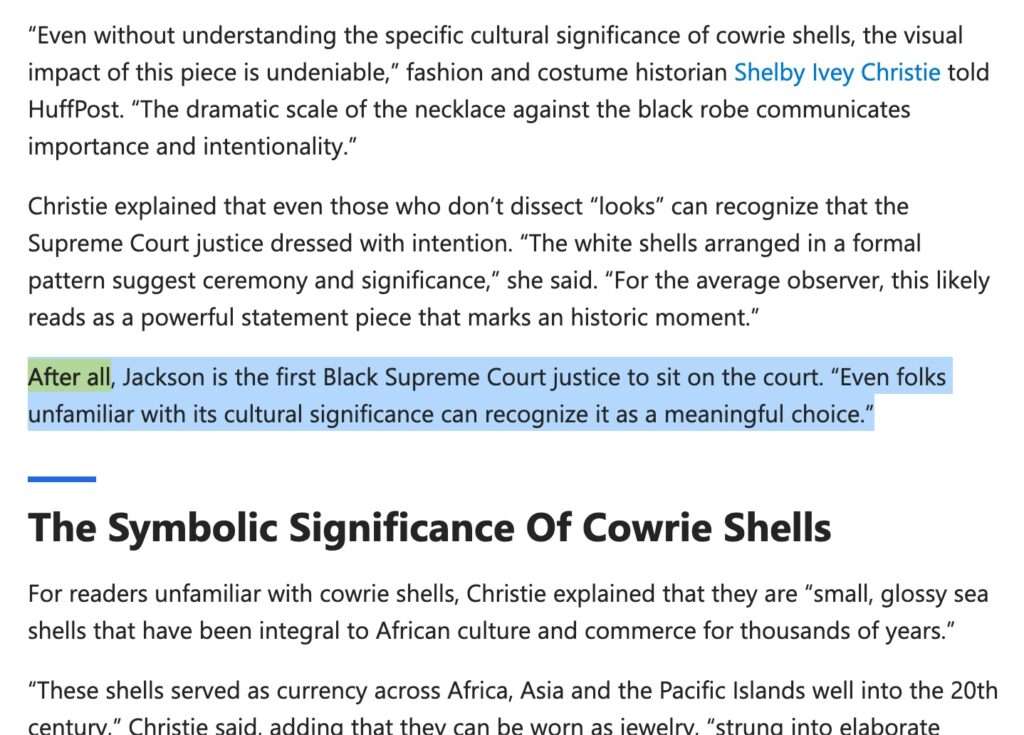
Update: An article on Huffington Post about Justice Jackson's talisman originally included this line:

After all, Jackson is the first Black Supreme Court justice to sit on the court. "Even folks unfamiliar with its cultural significance can recognize it as a meaningful choice."

I know that liberals do not believe that Clarence Thomas is actually black. For once, they wrote it! And what about Justice Thurgood Marshall?

The page was later fixed to say:

After all, Jackson is the first Black female justice to sit on the court. "Even folks unfamiliar with its cultural significance can recognize it as a meaningful choice."

I'm not sure what the addition of the word "female" does here. Clarence Thomas is also descended from African slaves.

More