The Volokh Conspiracy

Mostly law professors | Sometimes contrarian | Often libertarian | Always independent | Est. 2002

The Volokh Conspiracy

President Trump's Removal Letter of NLRB Member Gwynne Wilcox

The President did offer some potential causes for removal.

|

Shortly after President Trump removed NLRB Member Gywnne Wilcox, I wrote that the Supreme Court will not repudiate Humphrey's Executor. Now, having read Trump's removal letter, the Court may not have to.

Wilcox has moved for expedited summary judgment in D.D.C. on the same schedule as a preliminary injunction. In a declaration, Wilcox states that Trump did not "justify my removal on the ground that I committed any neglect of duty or malfeasance in office." The motion includes an exhibit I had not yet seen: President Trump's removal letter.

The letter offers two paragraphs to explain the removal. I see at least one passage that could rise to the level of "neglect of duty or malfeasance in office." Trump stated:

In my judgment, Members Wilcox and General Counsel Abruzzo have adopted a host of decisions that have improperly cabined employers' rights to speak on the subject of unionization, raising serious First Amendment concerns about the censorship of important speech. Several such decisions were issued on the eve of the new Administration. They have also issued decisions that, in my judgment, have vastly exceeded the bounds of the National Labor Relations Act. To take just one example, they supported a new joint employer rule—a rule that courts then invalidated and the Board seemingly acknowledged could not go forward.

Trump alleges Wilcox's may have violated the Free Speech Clause, exceeded the statutory authority of the agency, and proposed a rule that was declared unlawful by courts. To be sure, Wilcox would argue that her actions were consistent with the Constitution and the NLRA, and the courts were mistaken. But the President has the duty to take care that the laws are faithfully executed. I would think that obligation entails the power to decide that someone in an agency has violated the Constitution, or at least came close to violating it.

The last sentence of the letter states, "you are removable with or without statutory cause by the President." Trump may argue these steps triggered a for-cause removal. (The statute also requires a notice and hearing before removal; I am reasonably confident that the Court would not uphold these sorts of dilatory procedural requirements.)

Seila Law did not have occasion to define what "neglect of duty or malfeasance in office" means. However, Judge Griffith's concurrence in PHH v. CFPB did address these terms. He wrote:

Read More

A Very Different Constitutional Immunity Amendment

The "forgiveness doctrine" should be the basis for continued immunity while in office.

|

Today, Acting Deputy Attorney General Emil Bove instructed the Acting U.S. Attorney for SDNY to dismiss the indictment against New York City Mayor Eric Adams without prejudice. This decision was made without regard to the "strength of the evidence or the legal theories on which the case is based." Rather, the ADAG found the prosecution has "improperly interfered with Mayor Adams' campaign in the 2025 mayoral election." Moreover, Bove wrote that "the pending prosecution has unduly restricted Mayor Adams' ability to devote full attention and resources to the illegal immigration and violent crime that escalated under the policies of the prior Administration."

Both of these rationales only make sense so long as Adams is in office. If he loses re-election, then both of these rationales drop out. Importantly, a former mayor is no longer of use of the executive branch. Adams can then be recharged. The memo states that the confirmed U.S. Attorney can review the matter following the November 2025 election. In other words, the Trump-appointed prosecutor can decide whether to re-indict Adams based on the outcome of the election. Presumably, if Adams loses election, he will be indicted. Or he might be pardoned. But if Adams wins re-election, he will not be indicted.

Critics have cited this decision as yet another example of lawlessness by the Trump Administration. I approach the situation differently. In fact, this memorandum crystalizes something I have been toying with for some time.

There was a time when an indicted elected official would immediately resign in shame. The stigma of holding office in the face of a criminal indictment was too great. Today, that stigma is long gone. Politicians now routinely serve while under indictment. George Santos did not resign, but was expelled. Senator Robert Menendez did not resign until he was convicted. Mayor Adams has not resigned, and apparently made the right judgment. Relatedly, Donald Trump ran for President, successfully, while under several indictments.

These politicians have argued, fairly or unfairly, that the indictments are partisan witch hunts. And at least to some degree, these politicians have maintained some popular support. Their supporters agree that politics went into their prosecutions. Indeed, President Biden said as much about the prosecution of his son Hunter. Who is the ultimate arbiter of these sorts of crimes? I would wager it is not the jury. Rather, it is the voters.

This dynamic reflects the Texas "forgiveness doctrine." Under that doctrine, an official cannot be impeached for conduct that was known when the official was elected to his current term. In effect, the voters forgave the official for his transgressions. Trump was convicted by twelve Manhattanites, but was acquitted by 77 million voters.

I would propose a 28th constitutional amendment that would overrule Trump v. United States, at least in part, but would extend immunity far more broadly. In short, federal and state elected officials can be indicted while in office, but cannot be tried for those indicted offenses until after they no longer in that elected office. All applicable statutes of limitation would be tolled while the official remains in office.

There are several options. First an indicted elected official can resign, in which case he can be tried immediately. Second, the indicted elected official can be impeached, removed, expelled, recalled, or whatever process is available under law, and then tried immediately. Third, the indicted elected official can choose to serve out his term, and not run for re-election; when his term concludes, he can be tried. Fourth, the indicted elected official can run for re-election; if the voters re-elect him, then he cannot be tried until he no longer holds that position. In effect, this amendment would eliminate all immunity for indictments, but grant temporary immunity against trials for current office-holders.

I can already hear the howls! Josh, how can you do this?! Indicted officials would have every incentive to stay in office so they do not face a criminal trial. And they could use the powers of their office to stay in power to forestall a criminal trial. Indeed, the politician can violate election laws as a means to secure their re-election, and those offenses could not be subject to a criminal prosecution.

Read More

Free Speech

Race Discrimination/Harassment Lawsuit Against Seattle Related to Its "Race and Social Justice Initiative" Thrown Out

|

From Judge Jamal Whitehead's opinion today in Deimert v. City of Seattle(W.D. Wash.):

It is unlawful for an employer to discriminate against any employee because of their race. Recognizing the stubborn and pernicious effect of racism against minorities, many employers have adopted Diversity, Equity, and Inclusion ("D.E.I.") initiatives to combat discrimination and harassment in the workplace.

Plaintiff Joshua Diemert, a white man, alleges that his employer, Defendant City of Seattle ("City"), discriminated against him because of his race. He argues that the City's Race and Social Justice Initiative ("RSJI")—the City's D.E.I. program—created a hostile-work environment by "infusing race into all City functions" and "reduc[ing] [him] to an embodiment of his race."  He also alleges the City retaliated against him when he opposed the supposed harassment.

Controlling precedent makes clear that the legal protections against workplace discrimination apply with equal force regardless of the plaintiff's race. Yet we must acknowledge what history and common sense tell us: instances of discrimination against the majority are rare and unusual. Diemert does not present that rare and unusual case here. Contrary to his claims, D.E.I. programs aimed at addressing racial inequalities against Black people and other minorities are not by their very nature discriminatory against whites. And while it is apparent that Diemert personally rejects the RSJI, as is his right, the details he alleges about its discriminatory effect are not so objectively severe or pervasive as to create a racially hostile-work environment against white people in general or him in particular. The same is true about the sweeping claims Diemert makes about his co-workers' and supervisors' alleged race-based conduct, which lack specificity and factual support. Put plainly, more is required of Diemert under the law to demonstrate an unlawful hostile-work environment.

Because Diemert's claims do not stack up against the time-honored tests for proving unlawful employment discrimination and retaliation, the Court must grant the City's summary judgment motion and dismiss Diemert's case.

Read More

Free Speech

Journal of Free Speech Law: "Beyond the Editorial Analogy: First Amendment Protections for Platform Content Moderation After Moody v. NetChoice,"

by Kyle Langvardt & Alan Z. Rozenshtein.

|

The article is here; the Introduction:

Over the past several decades, a combination of a laissez-faire regulatory environment and Section 230's statutory protections for platform content-moderation decisions has mostly foreclosed the development of First Amendment doctrine on platform content moderation. But the conventional wisdom has been that the First Amendment would protect most platform operations even if this regulatory shield were stripped away. The simplest path to this conclusion follows what we call the "editorial analogy," which holds that a platform deciding what content to carry, remove, promote, or demote is in basically the same position—with the same robust First Amendment protections—as a newspaper editorial board considering which op-eds to carry.

While formally appealing, this analogy operates at such a high level of abstraction that one might just as plausibly characterize platforms as more akin to governments—institutions whose power over speech requires democratic checks rather than constitutional protection. These competing analogies point in opposite directions: one treats platforms as democracy-enhancing speakers deserving autonomy; the other as institutional censors warranting regulation.

A circuit split over which analogy to follow prompted the Supreme Court's decision last Term in Moody v. NetChoice, LLC. The Eleventh Circuit had invalidated Florida's content-moderation law as an unconstitutional interference with platforms' editorial discretion. The Fifth Circuit upheld Texas's similar law based on the traditional understanding that common carriers—in this case social platforms—are appropriately subject to anti-discrimination requirements.

The Court found both of these stories too tidy.

Read More

The Kennedy Center? Really?

Why does our President care about the makeup of the Kennedy Center Board?

|

The VSG (Very Stable Genius) has indicated that he is planning on (and may perhaps have already begun?) firing the members of the Kennedy Center Board of Trustees (including chairman David Rubinstein), replacing them with his own appointees, and naming himself as Chairman of the Board. [See the KC Board Statement here]

As originally reported in The Atlantic:

His posting on Truth Social indicated that he planned to make the Kennedy Center "GREAT AGAIN" by terminating "multiple individuals from the Board of Trustees, including the Chairman, who do not share our Vision for a Golden Age in Arts and Culture," and that he would announce a "new Board, with an amazing Chairman, DONALD J. TRUMP!" adding, "For the Kennedy Center, THE BEST IS YET TO COME!").

One might have thought, what with war in Ukraine and Congo, the freeze in federal DEI spending, bird flu outbreaks, growing global trade tensions over tariffs, the immigration crisis, the plans to eliminate US AID and the Department of Education, the alarming rise in fentanyl-related deaths, Elon Musk's 20-somethings poking around inside the Treasury Department's payment systems, …  that the composition of the Kennedy Center Board would be rather low down on the VSG's priority list, and not something one would have expected him to act upon during his third week in office.

Here are two things on which I think we can all agree: that the US faces many pressing problems, and that changing the management of the Kennedy Center will not address any of them. Read More

Due Process

Due Process Is Timely

The Supreme Court's recent civil forfeiture ruling and why due process matters today.

|

Halima Culley's college-aged son was driving her car, and was pulled over by Satsuma, Alabama police. After a search, the officers discovered marijuana, arrested him and charged him with minor drug violations. And they seized the car as incident to arrest. Culley herself had done nothing wrong, but prosecutors filed a claim in a civil court to acquire her car, arguing that it was implicated in her son's criminal conduct. It took her almost two years to finally get that case dismissed—a long time to be left without one's vehicle.

Culley argued that due process should entitle people like her to a fair, prompt hearing, before the property was taken by the government. It should not take two years to regain one's property. In Culley's case, when it reached the Supreme Court last term, the Justices concluded that people like Culley had no due process right to such a preliminary hearing, pending the longer process to consider the forfeiture claim. The Justice did not disagree that notice and a hearing must be provided if states seize real property. In an opinion by Justice Brett Kavanaugh, they ruled, however, that no expedited or preliminary hearing was required by the Due Process Clause.

In ruling, the Justices emphasized "historical practice," like they have in so many opinions in recent years. But modern civil forfeiture practices are totally different from anything historically used in form and in scale; Justice Neil Gorsuch emphasized those "profound" departures in a concurring opinion. Now, people who are not even accused of a crime can have their property taken, without any trial, but also without any exigent circumstances. Five of the Justices raised real fairness concerns about such forfeiture practices. They also emphasized that the forfeiture hearing that is provided must be "timely." And that this due process protection protects important personal and government interests at the same time—a very important point. Perhaps future rulings will more directly tackle the due process concerns that untimely forfeiture practices can raise.

Read More

Second Amendment Roundup: 5th Circuit Nixes Ban on Gun Sales to 18 to 20 Age Group

The original understanding in 1791, not that in 1868, governs.

|

On January 30, the Fifth Circuit decided Reese v. Bureau of Alcohol, Tobacco, Firearms, & Explosives, holding that the federal Gun Control Act's prohibition on the sale of firearms to persons under 21 years old, as applied to adults aged 18 to 20 years old, violates the Second Amendment.  The law effectively banned handgun sales, as it has an exception for rifles and shotguns, which may be sold to persons 18 and older.

The opinion was authored by Judge Edith H. Jones and was joined by Chief Judge Elrod and Judge Barksdale.  The provisions at issue are 18 U.S.C. § 922(b)(1), which governs in-person sales from a federally-licensed firearm dealer (FFL), and § 922(c)(1), a little-used provision which applies to sales in which the buyer does not appear at the FFL's premises in-person.  Ironically, the court notes, "The Act and regulations do nothing to prohibit eighteen-to-twenty-year-olds from owning, possessing, or carrying handguns, nor does it prohibit them from buying handguns in the unlicensed, private market or receiving handguns as gifts."

While the words "purchase" and "sale" do not appear in the Second Amendment, the court noted that the right to "keep and bear arms" "surely implies the right to purchase them."  Applying the first step of the analysis as directed by the Supreme Court in Bruen and Rahimi, the court stated: "The threshold textual question is not whether the laws and regulations impose reasonable or historically grounded limitations, but whether the Second Amendment 'covers' the conduct (commercial purchases) to begin with."  Like the First and Fourth Amendments, the Second Amendment refers to "the people" without mention of age or maturity restrictions.

The court rejected the government's further textual argument that eighteen-to-twenty-year-olds lacked certain "civic rights" at the founding, such as jury service and suffrage, and thus were not part of "the people" protected by the Amendment.  Women, not to mention African Americans, did not have such civic rights either.  As the court continued:

Thus, to say that "the people" covered by the Second Amendment is limited to those who were a part of the "political community" at the founding would imply excluding "law-abiding, adult citizens" based on property ownership, race, or gender…. Just as defining "arms" as "only those arms in existence in the 18th century" "border[s] on the frivolous," likewise, attempting to limit "the people" to individuals who were part of the "political community" at ratification is ludicrous.

The reference to arms not being limited to those from the 18th century comes from the Supreme Court's decision in Heller holding that modern firearms are protected by the Amendment.  As an aside, circuits covering states with prohibitions on modern firearms such as the AR-15 disregard what Heller said in upholding the bans.  It's unlikely that the Fifth Circuit will have occasion to consider and weigh in on such bans because the states it covers are unlikely to enact them.  That's why there is no circuit conflict on the issue and also why the Supreme Court should grant cert in Snope  and Ocean State Tactical to resolve the issue without a circuit conflict.

In contrast to civic rights, the Reese court explained that the Second Amendment protects an individual right founded on the right to self-defense.  At the founding, not only were there no age restrictions on the purchase of firearms, but eighteen-to-twenty-year-olds were required by both state and federal militia laws to obtain and keep firearms.  The federal Militia Act of 1792 mandated "that each and every free able-bodied white male citizen" aged 18 to 44 must enroll in the militia and "provide himself with a good musket or firelock, … or with a good rifle…."  Also, in view of the Second Amendment's "well regulated militia" clause, the court stated: "Eighteen-to-twenty-year-olds therefore must be covered by the plain text of the Second Amendment, as they were compulsorily enrolled in the regiments that the Amendment was written to protect."

The Fifth Circuit thus joined two other circuits in holding that eighteen-to-twenty-year-olds are part of "the people" protected by the Amendment.  The Eighth Circuit, in Worth v. Jacobson, invalidated a Minnesota law barring 18-to-20-year-olds from carrying handguns in public.  And the Third Circuit, in Lara v. Commissioner, invalided a Pennsylvania law prohibiting persons aged 18 to 20 from carrying firearms on public streets and property during a declared state of emergency.

The Reese court next applied step two of the Bruen/Rahimi analysis, asking whether the age ban is consistent with the Nation's historical tradition of firearm regulation.  It is here where the government sought to turn that analysis upside down:

The government's theory inverts historical analysis by relying principally on mid-to-late-19th century statutes (most enacted after Reconstruction) that restricted firearm ownership based on age. Then the government works backward to assert that these laws are consistent with founding-era analogues focusing on the minority status and general "irresponsibility" of eighteen-to-twenty-year-olds. The government thus confects a longstanding tradition of firearm restrictions imposed on individuals under twenty-one.

The government presented nothing pertinent from the founding period.  Two antebellum public universities were cited that prohibited students (without regard to age) from possessing firearms (but only on campus).  A state law about constables cited by the government is almost laughable – as the court puts it, "Although 'infants,' i.e., legal minors under the age of 21, were categorically excluded from serving as constables, so also were justices of the peace, lawyers, attorneys, physicians, the poor, the sick, and the elderly."

By contrast, "eighteen-to-twenty-year-olds could be obliged to join the posse comitatus…. Instead of refusing to arm young Americans for fear of their irresponsibility, founding-era regulations required them to be armed to secure public safety."

The government made the further argument that the class of persons under 21 is more prone to being dangerous (I've never understood why the low rate of violence by females never gets mentioned).  As the court rejoined, the handgun purchase ban requires no "judicial determinations of whether a particular defendant likely would threaten or had threatened another with a weapon."  That's a quote from Rahimi about the federal ban on possession of a firearm by a person with a domestic violence restraining order.  Contrary to those who think that Rahimi weakens Bruen, that shows that Rahimi has teeth in support of Second Amendment rights.

Next, the government cited a number of mostly late 19th century state laws that restricted the subject age group's ability to purchase firearms, but Reese found that these laws "were passed too late in time to outweigh the tradition of pervasively acceptable firearm ownership by eighteen-to-twenty-year-olds at 'the crucial period of our nation's history.'"

To be sure, Bruen acknowledged an "ongoing scholarly debate" regarding the most relevant period of history for issues arising under the Fourteenth Amendment, but as Reese notes, Bruen clarified that "post-ratification adoption or acceptance of laws that are inconsistent with the original meaning of the constitutional text obviously cannot overcome or alter that text."  In Reese, the government presented "scant evidence" that persons 18 to 20 at the founding "were restricted in a similar manner to the contemporary federal handgun purchase ban," and its 19th century evidence, as Bruen (and Heller before it) said, "cannot provide much insight into the meaning of the Second Amendment when it contradicts earlier evidence." The federal sale ban was thus held to be unconstitutional.

In a case like Reese involving a federal law, it should never be an issue whether the original public understanding of the Second Amendment governs.  But following its practice in other cases, amicus Everytown for Gun Safety actually argues that the 1868 understanding overcomes that of 1791, even in cases that are purely federal and involve no state action.  Latching on to Bruen's comment that the Court has "assumed" that the scope for both state and federal governments "is pegged to the public understanding … in 1791," the brief asserts that "the Court expressly left open the question whether 1868 or 1791 is the relevant focus," and it pointed to "ongoing scholarly debate" mentioned above.  Given what the Court has "assumed" in countless Bill of Rights cases, it is hardly the case that the Court "expressly" left the issue open based merely on the scholarly book and the law review article that the Court cited.

The Everytown brief goes on to argue: "If the Court decides to resolve the issue for future cases, … it should conclude that 1868 is the correct focus in cases challenging both federal and state laws."  That's completely upside down.  Heller teaches that the meaning of the Second Amendment is based on the 1791 understanding.  McDonald teaches that the Fourteenth Amendment was understood to incorporate the Second Amendment, not to change the original meaning of the Second Amendment.  For the definitive analysis of the subject, see Mark Smith's "Attention Originalists: The Second Amendment was adopted in 1791, not 1868" in Harv. J.L. & Pub. Pol'y Per Curiam. 

The Reese case was argued by John Ohlendorf of Cooper & Kirk.  It remains to be seen what will become of the ruling.  As Prof. Jonathan Turley notes, "Had this decision come down under the Biden Administration, an appeal would likely have been taken and this could have strongly reinforced the Court's Second Amendment jurisprudence."  One can only guess whether the Trump Administration will file a cert petition or let well enough alone.

But even if the Administration does not seek review, this issue likely is headed to the Court soon.  On the same day Reese was decided, a panel of the Fourth Circuit heard McCoy v. ATF, a challenge to the same law.  The questioning was very hostile to the Second Amendment challengers, so it appears likely that the Fourth Circuit will create a circuit split.  If that happens, the likelihood of Supreme Court review would be high.

 

The Flip-Side to CFPB v. CFSAA: What if the Director Requests $0 in appropriations?

Congress has no role in funding the CFPB. The Director can request as much as is "reasonably necessary." What if he decides that amount is $0?

|

The Consumer Finance Protection Bureau was structured to give its director independence from the executive branch and Congress. The CFPB Director served a fixed-term, and could only be removed by the President for proper cause. And the CFPB did not have to ask Congress for appropriations. Rather, the Director could request funds from the Federal Reserve that he deemed "reasonably necessary." And if the agency has a budget surplus, it could maintain and even invest those funds. From its inception, the CFPB was a separation of powers abomination.

Yet, despite the best efforts of regulated parties, the CFPB has survived to this day. Seila Law v. CFPB (2020) found the for-cause protection to be unconstitutional, but saved the agency by making the director removable at will. However, CFPB v. CFSAA (2024) upheld the funding scheme. As a result, Congress has not actually appropriated a penny for the CFPB. This sort of independence made sense when the director sought to maximize the agency's effectiveness. But this independence will have a very different effect with a director who seeks to defenestrate the agency.

Ross Vought, the acting director of the CFPB, announced that the agency will take no further money from the Federal Reserve.

Instead, Vought will rely on the $700+ million budget surplus. If he even uses that money. Vought has effectively shut down operations and told workers to stay home. However, I don't think anything would stop Vought from transferring that amount back to the federal reserve.

What happens going forward? Vought can starve the agency of funding if he deems the money not "reasonably necessary." And Congress can't do a damn thing about it. I don't even know if there is some mechanism by which Congress could force the agency to take appropriated funds. I'm sure some D.C. Circuit panel could try to force Vought to request funding from the Federal Reserve. But that would be a striking and novel interference with executive power. Again, if the CFPB was a normal agency, the failure to spend money would raise impoundment concerns. But the CFPB was made above the appropriation power.

Elizabeth Warren and her colleagues sought to create an agency insulated from the President and Congress. That strategy may have made sense with Barack Obama in office and Mitt Romney on the horizon. But this approach is quite different with President Trump.

Due Process

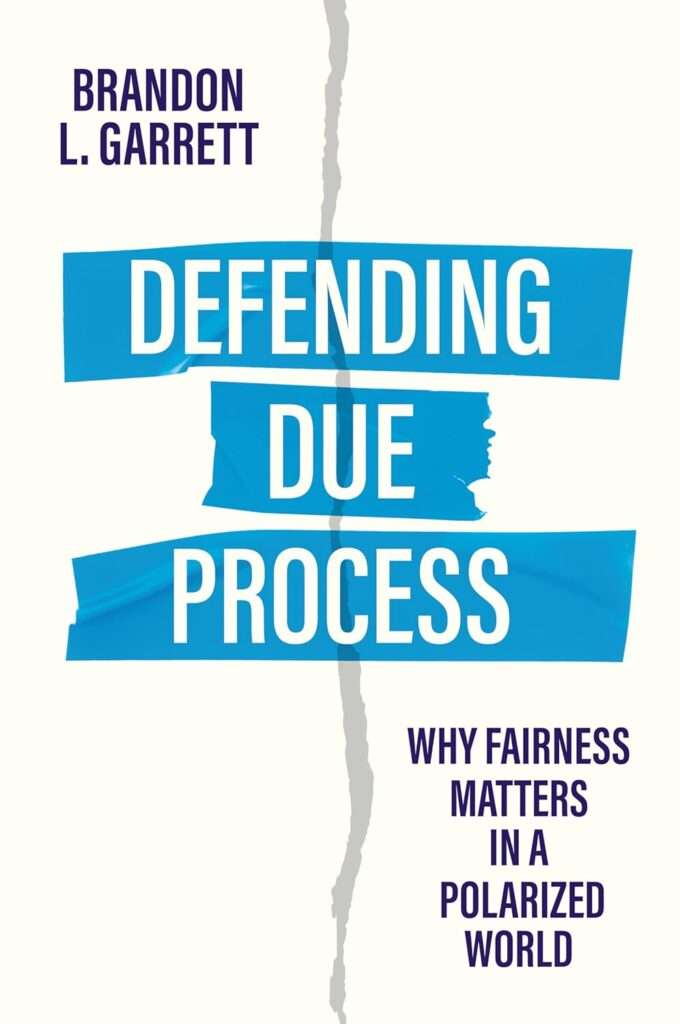
Brandon Garrett Guest-Blogging About "Defending Due Process: Why Fairness Matters in a Polarized World"

|

I'm delighted to report that Prof. Brandon Garrett (Duke Law School) will be guest-blogging this week about his new book. The publisher's summary:

We all feel unfairness deeply when treated in rash ways. We expect, and the law requires, government officials to take fairness seriously, giving us notice and an opportunity to be heard before taking our rights away. That is why the U.S. Constitution commands, twice, that no one shall be deprived of life, liberty, or property without due process of law. Yet, in overheated debates, people argue that others do not deserve any presumption of innocence. In courtrooms and colleges, police stations and jails, restaurants and libraries, print and online, the democratic value of due process is up for grabs.

Why is due process under so much pressure? Brandon Garrett exposes widening fault lines. One division lies within our own attitudes, and he explores why we are tempted to put desired outcomes before fair process. Another lies in government, as judges adopt toothless due process rules. People are trapped in debt for unpaid traffic fines; sheriffs seize and forfeit belongings; algorithms suspend teachers' employment; officials use flawed data to cancel healthcare; and magistrates order arrestees to be jailed because they cannot pay cash bail. Meanwhile, the rise of AI threatens what remains of due process with black-box technology.

To fight against such unfairness, lawyers try to challenge unjust systems, researchers demonstrate why such processes are so counterproductive, and lawmakers try to enact new protections. Common ground matters now more than ever to mend political polarization, cool simmering distrust of government, prevent injudicious errors, and safeguard constitutional rights. A revival of due process is long overdue.

And the blurbs:

Read More

Trump Administration

Can the Trump Administration Unilaterally Cut Indirect Costs for NIH Grants?

As with some other recent executive branch actions, the Trump Administration appears to have overreached.

|

On Friday, the Trump Administration announced that it would cap the indirect cost rate for federal grants from the National Institutes of Health at fifteen percent. According to the Administration, this cap is justified because the federal government often pays far higher indirect cost rates than do private foundations that fund health research, and that the generous reimbursement of such costs subsidizes administrative bloat at universities and other grant recipients.

However justified the Trump Administration's move may be as a matter of policy, it has significant legal problems, not least because it purports to apply to existing grants and appears to contravene an appropriations rider that remains in force for the current fiscal year. These and other legal short-comings are detailed by former HHS General Counsel Sam Bagenstos in his Inside/Outside newsletter. Bagenstos disagrees with policy on the merits, to be sure, but his legal analysis is persuasive whether or not one agrees with his policy priors.

So, for instance, I do not equate the Trump Administration's efforts to "reduce federal taxpayer subsidization of leftist agendas" with an "attack" on "independent institutions," as I do not agree with Bagenstos that all of the institutions he has in mind should be considered "independent," or that they are deserving of federal support. I also think it's quite reasonable for the federal government to be more deliberate about the degree of indirect costs that should be included in research grants, particularly given the way administrative costs and staffing have exploded at many universities. But I agree that these propositions should be debated, and that any unilateral action taken by the executive branch on such matters should comply with the law.

Supreme Court

Calls for Popular Constitutionalism in the Rear-View Mirror

Suggestions that the Executive Branch Ignore Federal Court Rulings May Look Different Today than When They Were Proposed.

|

In 2023, Mark Tushnet and Aaron Belkin published an "Open Letter to the Biden Administration on Popular Constitutionalism" making recommendations on how the Biden Administration should respond to the "not . . . normal" Supreme Court. It read in part:

We urge President Biden to restrain MAGA justices immediately by announcing that if and when they issue rulings that are based on gravely mistaken interpretations of the Constitution that undermine our most fundamental commitments, the Administration will be guided by its own constitutional interpretations. . . .

The central tenet of the solution that we recommend—Popular Constitutionalism—is that courts do not exercise exclusive authority over constitutional meaning. In practice, a President who disagrees with a court's interpretation of the Constitution should offer and then follow an alternative interpretation. If voters disagree with the President's interpretation, they can express their views at the ballot box. Popular Constitutionalism has a proud history in the United States, including Abraham Lincoln's refusal to treat the Dred Scott decision as a political rule that would guide him as he exercised presidential powers.

The premise of this letter was that the Supreme Court's conservative jurisprudence is and would be at odds with popular opinion, and that the political branches could enlist popular support to resist the Court's decisions. However true that premise was at the moment the letter was written, it was a grave error to assume that premise would hold. Today courts will be called upon to constrain MAGA initiatives, and there will be pressure for the Trump Administration to resist decisions that do not go its way. (And, if the first term is a harbinger of things to come, there will be many such decisions.)

President Biden never heeded Tushnet and Belkin's advice. Can we be so sure that a Trump Administration will be so reticent? Particularly in areas on which the administration was quite clear about its intentions during the campaign, such as immigration, does popular constitutionalism lead in the direction Tushnet and Belkin want it to go?

This is not the first time Tushnet has suggested breaking norms to advance progressive aims, only to find it is conservatives (not progressives) who are poised to act on Tushnet's recommendations. Recall how he suggested the Supreme Court should abandon a "defensive crouch" posture once Justice Scalia's replacement was confirmed.

These episodes remind us that opportunistic calls to abandon norms can be quite short-sighted--sometimes dangerously so.

Can President Trump Appoint Himself Chairman of the Kennedy Center Board of Trustees?

There is no Incompatibility Clause problem. And so long as the position is uncompensated, there would be no problem with the Domestic Emoluments Clause.

|

President Trump announced that he would appoint himself as chairman of the Kennedy Center Board of Trustees. 20 U.S.C. § 76h provides that "The general trustees shall be appointed by the President of the United States." As a statutory matter, Trump seems to have this authority. I am unaware of any instance in which any President has ever appointed himself to an office. (Here, I will assume that the chairman position is in fact an office, but I haven't thought the issue through fully; indeed, the precise status of the Kennedy Center is apparently an open question.)

Is such a self-appointment constitutional? First, in the abstract, government officials have used their authority to obtain new offices. Governors have appointed themselves to fill Senate vacancies. As best as I can recall, these governors also resigned from their state position to avoid dual-office holding. But such a resignation was not required by the Constitution. Perhaps a related issue occurred during the impeachment of President Andrew Johnson. At the time, Benjamin Wade, the Senate President Pro Tempore, was next in line for the presidency. Wade voted to convict Johnson, though Johnson was ultimately acquitted.

Second, Trump's self-appointment does not violate the Incompatibility Clause. That provision states that "and no Person holding any Office under the United States, shall be a Member of either House during his Continuance in Office." This clause does not prohibit dual office-holding within the executive and/or judicial branches. Chief Justice Marshall concurrently served as Secretary of State in the final days of the Adams Administration. (Marshall was at fault for not delivering William Marbury's commission).

Third, the Constitution does impose a limit on the President's ability to hold other offices. The Foreign Emoluments Clause provides that the President can accept an "Office . . . from any King, Prince, or foreign State" only with the consent of Congress. And the Domestic Emoluments Clause provides that the President "shall not receive within that Period any other Emolument from the United States." But this text only applies to a position that provides emoluments, or compensation. By contrast, the Impeachment Disqualification Clause extends to an "Office of honor, Trust or Profit under the United States." Tillman and I have written that an office of honor refers to an uncompensated position. As I understand it, the chairman position is uncompensated, so there is no emolument problem. I do not think the Framers who drafted this provision considered the President appointing himself to an unpaid position, but that is a separate question.

Fourth, there may be a structural problem with this appointment. The President has the duty to take care that the laws are faithfully executed. This obligation is supervisory in nature. That is, the President supervises that his subordinates execute their statutory authorities. The President generally does not execute statutory authority. I am not sure how the President could exercise this supervisory function while at the same time executing the statutory duties himself. No man should be a judge in his own cause; I would think a similar standard applies to the duty of faithful execution. But I am tentative on this last point.

Once again, President Trump brings obscure constitutional provisions and questions to the fore. Do not think for a moment these questions have easy answers.

Muskgate

Another week, another court order restraining the President from violating the law - only 205 more weeks to go!

|

Last night, the federal district court in New York (SDNY) issued a temporary restraining order in State of New York et al. v. Donald J Trump et al., a lawsuit filed by the AGs of 19 States against Trump and Treasury Secretary Scott Bessent.

The suit (and a separate lawsuit filed by Public Citizen in D.D.C.) challenges one of the more outrageous actions taken by President Trump in his first three weeks: granting Elon Musk and members of the "Department of Government Efficiency" - private citizens, all - full access to the Treasury Department's main payment system, the one through which virtually all of the $6 trillion or so disbursed by the federal government each year - to bondholders, social security recipients, NIH grantees, Medicare providers, university laboratories and hospitals, military contractors, armed services personnel,  etc. - is channeled.

Is anyone not riled up about this? The President simply picks one of his cronies - one who just happened to have contributed tens of millions of dollars to his successful campaign for office - and says "Go at it"? Can he really do that? Lawfully? Read More

Birthright Citizenship

Two Federal Courts Issue Injunctions Against Trump's Birthright Citizenship Executive Order

The two rulings highlight the weaknesses of Trump's legal position.

|

NA

Two federal district courts - one in Maryland and one in Washington - recently issued injunctions blocking Donald Trump's executive order denying birthright citizenship to children of undocumented immigrants and those in the US on temporary visas. The Washington decision was written by Judge John Coughenour (a Reagan appointee), and the Maryland one by Judge Deborah Boardman (appointed by Biden). Between them, the two rulings do a good job of highlighting the weaknesses of Trump's position on this issue, which goes against the text and original meaning of the Fourteenth Amendment, and longstanding precedent. As Judge Boardman summarizes, "[t]he Executive Order flouts the plain language of the Fourteenth Amendment to the United States Constitution, conflicts with binding Supreme Court precedent, and runs counter to our nation's 250-year history of citizenship by birth."

Reason's Jacob Sullum has a helpful summary and discussion of the two rulings here.

I have previously written about this issue here, here, and here. One key point worth reiterating is that many of the arguments put forward by the administration and its supporters would also have allowed denial of birthright citizenship to many formerly enslaved blacks (even though giving them citizenship was the main purpose of the Birthright Citizenship Clause), and to children of permanent resident legal immigrants, as well. The latter is a logical implication of the administration's argument that birthright citizenship is denied to children of parents who, by virtue of being citizens of another nation, owe that government "allegiance."

The administration will appeal these rulings and the legal battle will continue, possibly all the way to the Supreme Court. So far, however, courts have forcefully rejected the government's weak arguments.


More