The Volokh Conspiracy

Mostly law professors | Sometimes contrarian | Often libertarian | Always independent | Est. 2002

The Volokh Conspiracy

Florida Judge Seeks To Enjoin Parties Not Before Her Court

And she is considering holding the Florida Attorney General in contempt for pointing out the limits of the judge's order

|

Florida enacted a law that permits law enforcement officials to arrest illegal aliens who enter the state. The ACLU filed suit against the state Attorney General, statewide prosecutors, and state attorneys, from enforcing the law. But the complaint did not name Florida law enforcement officials. Two days later, the District Court Judge entered an Ex Parte TRO "prohibiting Defendants and their officers, agents, employees, attorneys, and any person who are in active concert or participation with them from enforcing" the Florida Law. At a subsequent hearing, the Judge asked if she could bind all law enforcement officials, even if they are not parties or subject to the Defendants' control.

Attorney General James Uthmeier sent an email to state law enforcement officials. The email stated, in part, "It is my view that no lawful, legitimate order currently impedes your agencies from continuing to enforce Florida's new illegal entry and reentry laws."

The Attorney General's brief explains the position:

Those law-enforcement officers do not fit into the "traditional understanding of whom a federal injunction binds." Robinson, 83 F.4th at 878. They are not parties. Nor are they Defendants' "officers or agents," for Defendants have no power to control or direct their behavior. Fed. R. Civ. P. 65(d)(2)(B). And they are not invariably "in active concert or participation" with the Defendants, Robinson, 83 F.4th at 878, because independent law-enforcement officers are not "in privity" with Defendants, id. at 881. While the Attorney General communicated the Court's view that law enforcement should not make arrests under SB 4-C, he did so solely to comply with this Court's order—which Defendants maintain is unlawful. At most, this Court's injunction may extend only to non-party law-enforcement officers that "aid and abet" Defendants in violating the injunction, id. at 879—a vanishingly narrow group, seeing that Defendants have committed to abide by this Court's orders. The Court's injunction is overbroad to the extent it declares otherwise.

This is quite right. If the Plaintiffs sued the wrong defendants, that was their choice. We saw something similar during the same-sex marriage litigation in Alabama. The plaintiffs did not sue all of the probate judges, and as a result, judges who were not sued could not be subject to the injunction. The judge in that case acknowledged that the injunctions did not compel any nondefendant officers to issue licenses and did not compel issuance of licenses to any nonplaintiff couples. It took a class certification to bring in all of the probate judges and plaintiffs. (I discuss this history at pages 272-276 of this article.)

People often complain about universal injunctions against the federal government. But there are similar injunctions against state governments. The District Court cannot enter a "universal injunction" against all officials in the state. Justices Gorsuch and Kavanaugh made this point clear in Labrador v. Poe. The correct approach would be to certify a class of all named law enforcement officials. Of course, I don't think you can certify a class with an ex parte TRO, but D.C. federal judges do so consistently now.

The District Court judge is also determining whether to hold the Attorney General in contempt.

A Miami federal judge said Tuesday she was "surprised and shocked" when state Attorney General James Uthmeier first told police officers to obey her order not to arrest undocumented immigrants entering Florida but later said he "cannot prevent" them from making arrests under a new state law. U.S. District Judge Kathleen Williams is considering whether to find Uthmeier in contempt of court.

…

"What I am offended by is someone suggesting you don't have to follow my order, that it's not legitimate," Williams said.

The judge's order with regard to the named parties, and those under their supervision, was legitimate. But courts cannot issue orders against unrelated parties. The Attorney General, as the chief legal officer of the state, gave legal advice to the state. That is not a contemptible offense. I see shades of Judge Boasberg here, who urged the plaintiffs to replead their case, certified a class, ordered the planes to turn around, and then sought to hold the executive branch in contempt.

Worse still, this was all done following an Ex Parte TRO where an appeal is not even possible. I think contempt proceedings during these fast-moving proceedings, where there is not even an opportunity for an appeal, are a mistake.

The real issue, I think, is that judges have become too confident in their power to issue universal ex parte TROs. But when the executive branch seeks to hold a court to the conventional rules, the judges recoil.

To quote Justice Alito, "Both the Executive and the Judiciary have an obligation to follow the law." The executive branch has to enforce orders that bind the executive branch. And Courts cannot enjoin non-parties. Each branch must stay in their lane.
Second Amendment Roundup: National Firearms Act Constitutional Issues

Wyoming Law Review publishes special issue on the NFA.

|

The Wyoming Law Review's Special Edition on the National Firearms Act is now available.  Last fall, the Firearms Research Center at the University of Wyoming College of Law hosted a symposium on historical, statutory, and constitutional issues involving the NFA.  The papers stemmed from that conference.

Here's the abstract from my contribution, The Power to Tax, The Second Amendment, and the Search for Which "Gangster Weapons" To Tax:

Congress does not have the power to ban firearms. The National Firearms Act (NFA) is based on the power of Congress to lay and collect taxes. In 1937, the Supreme Court upheld the NFA as purely a revenue measure. When it banned possession of machineguns in 1986, Congress undercut that constitutional basis. The Supreme Court has held that any ambiguities in the NFA must be read narrowly according to the rule of lenity.

The 1934 House hearings barely mentioned the Second Amendment. A federal district judge upheld the NFA under the theory that the Amendment does not protect individual rights. In 1939, the Supreme Court declined to take judicial notice that a short-barreled shotgun is "ordinary military ordnance" protected under the Second Amendment.

Recently, the Court has adopted the test that the Amendment protects arms that are in common use. The initial NFA bill, and the bill as enacted, arbitrarily included some firearms and excluded others. After enactment, the Attorney General went on a failed crusade to require all firearms to be registered.

Short-barreled rifles and silencers should be removed from the NFA. Neither was identified in the 1934 hearings as desirable to criminals. Today, registered short-barreled rifles and silencers are in common use and are rarely used in crime. Removing them from the NFA would leave them still regulated under the Gun Control Act.

When I say that "Congress does not have the power to ban firearms," I am referring to constitutional power set forth in Article I, § 8.  There have been times, of course, when it has exercised power coercively without constitutional authorization, such as in enacting the ban on semiautomatic firearms in 1994.

The other articles in the issue, all of them thought-provoking, are as follows:

Michael Patrick, Bruen: The Court's Announcement of the Historical Analogy Test and the Aftermath Thereof

David B. Kopel, Machine Gun History and Bibliography

Joseph G.S. Greenlee, The Tradition of Short-Barreled Rifle Use and Regulation in America

Charles K. Eldred, The National Firearms Act is an Unconstitutional Tax

Tom W. Bell, The Counter-Militia Second Amendment

Like Rodney Dangerfield, NFA firearms "Don't Get No Respect" by many courts.  Single-shot .22 rifles are the favorite tool of drug traffickers if they have a 15-inch barrel, and a sound moderator is an assassin's best friend if it reduces decibels just a tad.  They have guilt by association because Congress put them on the same list as Tommy Guns.  But not all NFA firearms are created equal.

Kudos to George Mocsary, Director, and Ashley Hlebinsky, Executive Director, of the Firearms Research Center for making the symposium a success.

Free Speech

Deportation for "Pro-Palestine or Anti-Israel Political Speech" May Violate the First Amendment, Court Holds

|

[1.] From today's decision by Judge William Young (D. Mass.) in American Ass'n of Univ. Profs. v. Rubio:

This case raises the issue of whether certain Public Officials can enforce a policy of arresting, detaining and deporting non-citizens who are otherwise here legally based solely upon their pro-Palestine or anti-Israel political speech….

The court allowed plaintiffs' First Amendment challenges to go forward:

Although this case raises novel First Amendment issues and the precise scope of the ideological-deportation policy challenged by the Plaintiffs is not yet clear, at the motion to dismiss stage the Plaintiffs' First Amendment claims survive.

It is well established that noncitizens have at least some First Amendment rights, see Bridges v. Wixon (1945), and political speech is "at the core of what the First Amendment is designed to protect." Although case law defining the scope of noncitizens' First Amendment rights is notably sparse, the Plaintiffs have at least plausibly alleged that noncitizens, including lawful permanent residents, are being targeted specifically for exercising their right to political speech. See American-Arab Anti-Discrim. Comm. v. Reno (9th Cir. 1995), rev'd on other grounds ("The Supreme Court … has accorded to aliens living in the United States those protections of the Bill of Rights that are not, by the text of the Constitution, restricted to citizens."); OPAWL – Building AAPI Feminist Leadership v. Yost (6th Cir. 2024) ("Lawful permanent residents have First Amendment rights…. [T]hey have developed sufficient connections with the United States to be considered part of the national community: They live and work here lawfully, and they can serve in the military."); United States v. Verdugo-Urquidez (1990) ("[A]liens receive constitutional protections when they have come within the territory of the United States and developed substantial connections with this country."); but see Price v. United States Immigr. & Naturalization Serv. (9th Cir. 1991). The Plaintiffs have also clarified that they do not mean to bring a selective prosecution challenge, but rather contend "that Defendants are deporting people on the basis of their viewpoints alone."

Read More

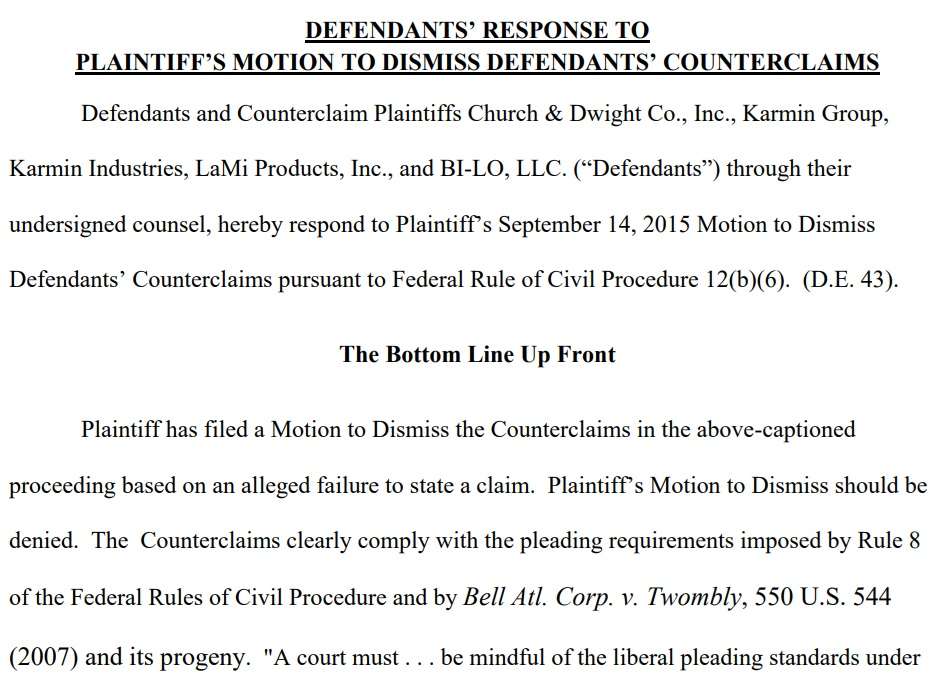
"Bottom Line Up Front"

|

I just came across this section heading in a federal filing; an excerpt:

The principle that one should include at the very beginning a quick summary of what the filer is asking for and why is familiar; usually the Introduction or Summary of Argument does that. But this is the first time I've seen it expressly labeled that way, and it turns out to be fairly common at least in federal courts in the Western District of North Carolina, likely because of this Standing Order:

Read More

Does a "More Honest" Discussion about Antisemitism on College Campuses Require an Honest and Unsanitized Account of October 7?

A recent blog post at AAUP's Academe is attracting notice for the way it characterizes the October 7 attack.

|

A recent post on the Academe blog, published by the American Association of University Professors, is attracting some notice--but perhaps not the sort of notice AAUP would prefer. The essay, "It's Not Too Late to Tell the Truth About Antisemitism on Campus" by Brooke Lober, Eli Meyerhoff, and Emily Schnieder, argues that claims of rampant antisemitism on college campuses are a variant of the "big lie" and "an effort to silence dissent and smear protesters."

Whether American college campuses have a serious antisemitism problem is a subject upon which reasonable people may disagree. There is also reasonable disagreement on when criticism of Israel is evidence of antisemitism, and many reasonable people are justifiably concerned that some universities have responded to anti-Israel protests with measures that unduly restrict free expression on college campuses.

What seems less reasonable is how the authors characterize the October 7 atrocities.  Calling for a "more honest story about campus climate" that considers the "larger context" of the war in Gaza, they characterize October 7 as a "revolt" by "Palestinian militant groups" targeting "the infrastructure of occupation," and suggest that campus protest and activism did not arise until after Israel launched its offensive against Hamas in Gaza.

Here is the full passage:

A better model—and a more honest story about campus climate—would look at the larger context of the war and how it has increased tensions across the board. On October 7, 2023, Palestinian militant groups staged a revolt against the seventeen-year blockade. They attacked the infrastructure of occupation and kidnapped and killed Israelis, among others. As the US and Israeli media dehumanized Palestinian people and repeatedly characterized this politically motivated attack as "senseless violence" or motivated by "antisemitism," they paved the way for Israel's disproportionately harsh retaliation; unsurprisingly, harassment and violence toward Palestinians, Arabs, and Muslims ensued. Israel responded to the attack with a genocidal campaign, while marking their conquered territory with holy Jewish symbols and justifying their assault in the name of collective Jewish safety. It is this violent instrumentalization of Jewish identity, a longstanding project of the Israeli state, that has provoked renewed harassment of Jews around the world. [Emphasis added.]

It seems to me that if the aim is a "more honest" discussion about the campus climate and antisemitism--and the related threat to free expression on college campuses--it might help to provide a more honest and less sanitized description of what occurred on October 7.

Free Speech

N.Y. Decision on Showing Required for #TheyLied Defamation Claims Based on Allegations of Sexual Assault

|

In Friday's decision in Vitagliano v. Weiner, by N.Y. appellate judges Gerald Whalen, John Curran, Donald Greenwood, and Lynn Keane, Vitagliano sued alleging that Weiner had sexually assaulted her; Weiner counterclaimed "for defamation premised on a social media 'story' posted by [Vitagliano] in which she asserted that defendant 'is a rapist.'" Vitagliano tried to get Weiner's counterclaim dismissed early, under New York's anti-SLAPP statute, which is designed to quickly dispose of legally insufficient claims based on speech on matters of public concern. No, says the appellate court:

Initially, we note that the parties do not dispute on appeal that the "counterclaim subject to the motion is an action involving public petition and participation …," i.e., one subject to the protections of New York's anti-SLAPP statutes. Thus, as relevant here, the limited issue before this Court is whether defendant, as "the party responding to the motion[,] demonstrate[d] that the cause of action has a substantial basis in law." …

The court concluded that under New York procedure, a defamation case can proceed (despite an anti-SLAPP motion) if there's a "substantial basis" for the underlying defamation claim, with no need to show "clear and convincing evidence" at that stage of the litigation. And the court continues,

Read More

Donald Trump

New York Times Symposium on "A Road Map of Trump's Lawless Presidency"

I was one of 35 legal scholars who took part.

|

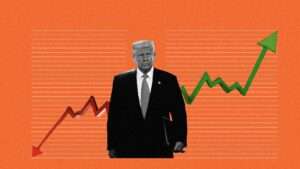
President Donald Trump, with line graphs on either side of him. On one side, a red arrow is going down, while on the other side, a green arrow is going up.
Donald Trump. (llustration: Eddie Marshall | ALEXANDER DRAGO | UPI | Newscom | Midjourney)


Earlier today, the New York Times published a symposium entitled "A Road Map of Trump's Lawless Presidency." Thirty-five legal scholars took part, including myself. Here is an excerpt from the editors' summary:

Times Opinion recently reached out to dozens of legal scholars and asked them to identify the most significant unconstitutional or unlawful actions by Mr. Trump and his administration in the first 100 days of his second presidency and to assess the damage. We also asked them to separate actions that might draw legal challenges but are, in fact, within the powers of the president. And we asked them to connect the dots on where they thought Mr. Trump was heading.

We heard back from 35 scholars — a group full of diverse viewpoints and experiences, including liberals like U.C. Berkeley's Erwin Chemerinsky and Harvard's Jody Freeman; the conservatives Adrian Vermeule at Harvard and Michael McConnell, a former federal appeals court judge who directs Stanford's Constitutional Law Center and is a member of the Federalist Society; and the libertarians Ilya Somin at George Mason University and Evan Bernick at Northern Illinois University….

From all of their responses, we constructed a road map through Mr. Trump's first 100 days of lawlessness, including his defiance of our judiciary and constitutional system; the undermining of First Amendment freedoms and targeting of law firms, universities, the press and other parts of civil society; the impoundment of federal funds authorized by Congress; the erosion of immigrant rights; and the drive to consolidate power.

This road map largely draws on the scholars' words, which serve as bright red warning lights about the future of America….

Not all of our legal scholars saw every Trump action the same way, and one saw the problem as lying more with the courts than with the administration. But there was abundant assent that the president is trying to operate without limits and that the rule of law and especially due process are being profoundly tested and challenged. This guide through the first 100 days is by no means exhaustive but rather reflects legal issues our 35 scholars highlighted repeatedly or with the gravest concern.

Two of my statements made it into the symposium. Here is the first, which gives my overall assessment of the administration's agenda:

They seek a massive increase in presidential power, which if fully achieved would potentially undermine most of the constitutional separation of powers and create an elective monarchy or a quasi-authoritarian state. If they prevail, it would be terrible for the rule of law and liberal democratic values generally. But they can be stopped and hopefully will be.

There is also this on Trump's usurpation of the spending power:

No other modern president has tried this on such an enormous scale. If allowed to stand, it would enable the president to both seize control over hundreds of billions of dollars in federal funds and coerce state and local governments by imposing grant conditions not authorized by Congress. All of this also violates the Constitution — both federalism and the separation of powers.

I expounded on my concerns in greater detail in the similar recent Free Press symposium, which had fewer participants and therefore gave each person more space. For those keeping track, I was also highly critical of Joe Biden's usurpations of the spending power, as with his student loan forgiveness power grab. But Trump's abuses are more systematic far-reaching.

As in the Free Press symposium, there was a lot of cross-ideological agreement between the NY Times participants. For example, I agree with nearly all the comments made by big-name conservative constitutional law scholar Michael McConnell (Stanford) who participated in both symposia. I also agree with the majority of points made by liberal/progressive participants, though by no means all.

The NY Times symposium is somewhat less  ideologically balanced than the FP one. NYT has a large preponderance of left-of-center participants (all but about four or five, by my count, though I could have missed some, because not every participant got quoted), while FP had three conservatives (including two who are very far to the right of me), two progressives, and two libertarians (Jonathan Adler and myself). One possible explanation for difference is that the NYT piece was limited to law professors, while FP featured two non-academic commentators among its total of seven (both conservatives). Lawprofs are, on average, a much more left-wing group than non-academic legal commentators.

Nonetheless, it is noteworthy that, between them, these symposia show a wide range of agreement that Trump 2.0 is engaging in numerous illegal actions and threatening the constitutional system in various ways. And many of these concerns go far beyond the academic left.

There are. admittedly, a few MAGA-friendly legal scholars (or those who back nearly unlimited executive power), represented in the NYT symposium by Harvard law Prof. Adrian Vermeule. But such people are a minority even among non-left wing experts in thfield.

A minority view can, of course, still be right (I hold many minority views myself!). But in this case, it just isn't. The scope and magnitude of Trump 2.0 illegality are too great for any plausible defense.

The Supreme Court's Order for Supplemental Briefing in Kennedy v. Braidwood and the Reorganization Plan of 1966

The Reorganization Plan of 1966, standing by itself, is not a statute that could vest "by law" the appointment power authority in the Secretary.

|

[This post is co-authored with Professor Seth Barrett Tillman.]

On Monday, April 21, the Supreme Court heard oral argument in Kennedy v. Braidwood Management. On April 25, the Supreme Court requested supplemental briefing in the case:

The parties are directed to file supplemental letter briefs addressing the following question: Whether Congress has "by Law" vested the Secretary of the Department of Health and Human Services with the authority to appoint members of the United States Preventive Services Task Force. U. S. Const. art. II, §2, cl. 2. The briefs should address this Court's decisions in United States v. Hartwell, 6 Wall. 385 (1868), and United States v. Smith, 124 U. S. 525 (1888).

In this case, first the Biden and now the Trump Administration have asserted that the Secretary of HHS has the statutory authority to appoint members of a Task Force. And both administrations have asserted these positions are inferior officers. The government has cited several sources of authority to support its position that the Secretary of HHS has been vested with the power to appoint Task Force members.

One of these sources is Reorganization Plan No. 3 of 1966, 80 Stat. 1610. For example, Secretary Becerra's order appointing members of the Task Force provides:

Consistent with Article II, § 2, cl. 2 of the Constitution, and by virtue of the authority vested in the Secretary of Health and Human Services, including but not limited to Section 6 of Reorganization Plan No. 1 of 1953, and Sections 1 and 2 of Reorganization Plan No. 3 of 1966, the Secretary of Health & Human Services, Xavier Becerra, hereby ratifies the prior appointment of, and prospectively appoints:

The government cites the 1966 Reorganization Plan at pages 7-8 of its merits brief:

In addition, Congress has vested the Secretary with significant supervisory authority over the Public Health Service, which includes AHRQ and the Task Force. In Reorganization Plan No. 3 of 1966, 80 Stat. 1610 (Reorganization Plan), "all functions of the Public Health Service" and of its "officers," "employees," and "agencies" were transferred to the Secretary, § 1(a), 80 Stat. 1610; see Act of Oct. 19, 1984, Pub. L. No. 98-532, 98 Stat. 2705 (ratifying the Reorganization Plan as law). Congress has also empowered the Secretary to "make such provisions as he shall deem appropriate authorizing the performance of any of the functions transferred to him by the provisions of this reorganization plan by any officer, employee, or agency" of the Public Health Service or HHS. Reorganization Plan § 2, 80 Stat. 1610. [bold added]

The Reorganization Plan of 1966 was also raised at the outset of oral arguments:

JUSTICE THOMAS: Before we get to the constitutional problems, what's the statutory authority to appoint the Task Force?

MOOPPAN: So there are two sources of authority, Your Honor. The first is that under the Reorganization Act, the Secretary has the power to exercise all functions and duties of the director, and the director, under 299, has the authority to convene the Task Force.

JUSTICE THOMAS: Isn't that an odd delegation? Normally, it would be the superior or the principal officer who would have the authority who would delegate it to subordinates.

MOOPPAN: Well, it's not just a delegation, Your Honor. The Reorganization Act was in place when 299 was enacted. And so, when Congress passed 299 and said that the director could convene the Task Force, that meant that the Secretary could convene the Task Force.

It seems the government's statutory argument turns on the Reorganization Plan. Several other Justices asked about the Reorganization Plan of 1966.

Mooppan refers to the Reorganization Plan of 1966 as an "Act." But it is not an Act of Congress. So what is the Reorganization Plan of 1966? And does it vest the Secretary with the power to appoint Task Force members? The answer is a bit complicated.

Read More

Exit the Dragon

|

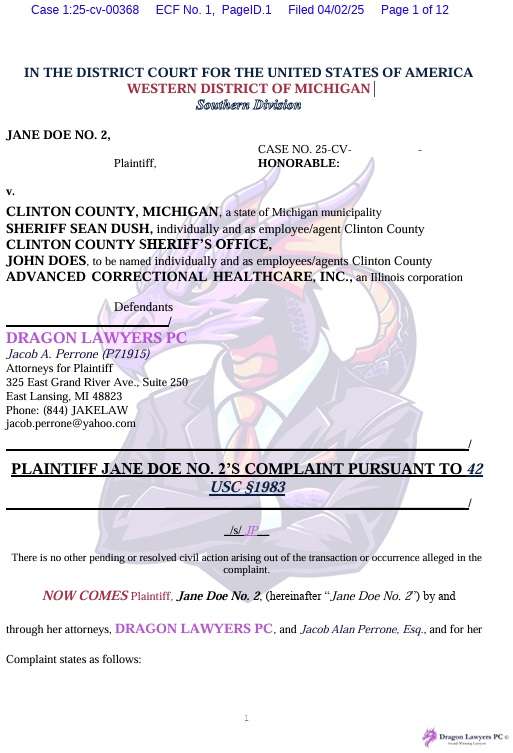
From Magistrate Judge Ray Kent's Order Striking Complaint today in Doe No. 2 v. Clinton County (W.D. Mich.):

Each page of plaintiff's complaint appears on an e-filing which is dominated by a large multi-colored cartoon dragon dressed in a suit, presumably because she is represented by the law firm of "Dragon Lawyers PC © Award Winning Lawyers". See Compl. (ECF No. 1). Fed. R. Civ. P. 12(f)(1) allows a court to "strike from a pleading an insufficient defense or any redundant, immaterial, impertinent, or scandalous matter." Use of this dragon cartoon logo is not only distracting, it is juvenile and impertinent. The Court is not a cartoon. Accordingly,

IT IS ORDERED that plaintiff's complaint (ECF No. 1) is STRICKEN. Plaintiff is directed to file an amended complaint, containing the same allegations as the original complaint, without the cartoon dragon by no later than May 5, 2025.

IT IS FURTHER ORDERED that plaintiff shall not file any other documents with the cartoon dragon or other inappropriate content.

See for yourself:

Trump's fake emergencies are the real crisis

My co-authored Washington Post op-ed today: "His vague national security claims chill speech and action far beyond his individual targets."

|

I have an op-ed out in the Washington Post today: "Trump's fake emergencies are the real crisis," co-authored with Serena Mayeri (Penn Law) and Amanda Shanor (Wharton). Here's an excerpt:

The Trump administration has doubled down on its refusal to remedy its mistaken deportation of Kilmar Armando Abrego García, a Maryland father, to a notorious prison in El Salvador — despite a federal court order to facilitate his return. This case is one of many recent presidential actions that cloak flagrant violations of core constitutional rights in spurious claims of emergency power.

Alleging an "invasion" or "predatory incursion" of terrorists and foreign criminals, President Donald Trump is removing and imprisoning noncitizens without due process, asserting he is authorized to do so by the Alien Enemies Act. The administration invokes "foreign policy" to seize and detain students, including legal permanent residents, conflating political speech and peaceful protest with "terrorism." Citing "national security," the president has sought to revoke security clearances, order investigations into, and otherwise threaten and punish lawyers, law firms and former government officials who have opposed Trump in court or publicly criticized him.

In each instance, Trump asserts that the courts cannot stop him because, he says, these "emergencies" give him exclusive presidential power under Article II of the Constitution. But his true motive appears to be liberating the executive from all accountability to constitutional law.

The three of us have divergent views on many legal and political questions, but we all agree that the unchecked executive power the president claims poses an existential threat to liberty and constitutional democracy. . . .

As they say, Read the Whole Thing.

Free Speech

First Annual Hoover Institution (Stanford) / ASU Law Aspiring Free Speech Scholars Workshop

Please feel free to forward this to anyone you think might be interested.

|

Are you a law student, judicial law clerk, or lawyer hoping to publish your first, second, or third law review article related to free speech law? Would you like the opportunity to get advice about your draft from leading free speech scholars?

If so, send us your draft by May 15, 2025. (This should still be a draft article, not an article that's already published or expected to be published within six months or less. Naturally, as a draft, it need not be entirely complete and polished.) We plan to select the submissions that we think are particularly promising, and invite their authors to a workshop—planned for early in the Fall—where they can present their papers and get helpful feedback on them. We have funds to pay for transportation and lodging for the selected authors' trips.

We also plan to officially recognize up to three of the top articles among those we review, and possibly give honorable mention to some additional number as well. If the authors wish, they can also have their articles reviewed for publication in the Journal of Free Speech Law (http://JournalOfFreeSpeechLaw.org), presumably after they revise the articles in light of the workshop feedback.

Read More

"Can Speech Policy Protect Public Health?" to Appear in Utah Law Review

Using Speech to Address Public Choice Problems

|

Together with Cassandra Burke Robertson and Zoe Robinson, I wrote a new piece forthcoming in the Utah Law Review and whose draft is available here. The abstract is as follows:

Government speech shapes public health outcomes, yet political incentives often lead officials to either remain silent about emerging threats or subordinate scientific evidence to partisan goals. This Essay examines how three factors interact to influence public health: the constitutional status of health-related speech, the political economy of public health policymaking, and the modern information environment. Drawing on insights from public choice theory, we demonstrate how misaligned incentives lead political actors to avoid communicating about health risks or spread misinformation that serves their short-term interests at the expense of population health. The conventional tools of public health policy were developed when official sources could effectively shape public understanding, but today's fragmented information landscape demands new approaches to health communication.

This Essay analyzes both the constitutional framework governing health-related speech and the practical dynamics that complicate effective public health messaging. We propose specific mechanisms to combat harmful misinformation while creating stronger incentives for accurate government communication about health threats. Throughout, we move beyond binary debates about censorship versus free speech to develop approaches that reflect the complex relationship between information flows, political incentives, and public health outcomes. The history of public health challenges—from the AIDS crisis of the 1980s to today's emerging strains of avian influenza—shows how institutional responses often falter. Understanding these dynamics can help shape better responses to current and future health crises.

Immigration

More Evidence that Immigrants - Including Illegal Ones - Have Much Lower Crime Rates than Natives

A new Cato Institute study further refutes claims that illegal migration is somehow causing a crime wave.

|

Claims that illegal immigration is causing a crime wave are ubiquitous on the political right, and likely helped Trump win the 2024 election. But social science studies consistently show that immigrants - including illegal ones - actually have much lower crimes than native-born Americans. A new analysis by my Cato Institute colleague Alex Nowrasteh and political scientist Michelangelo Landgrave is the most thorough and up-to-date assessment yet.

Alex summarizes their findings here:

Our consistent finding is that legal immigrants have the lowest incarceration rates, followed by illegal immigrants, and that native-born Americans have the highest. Illegal immigrants are half as likely to be incarcerated as native-born Americans, and legal immigrants are 74 percent less likely to be incarcerated….

A persistent criticism of Cato's paper in this series is that the native-born incarceration rate is only higher because black native-born Americans have a high incarceration rate (see Table 1 from our paper). It's certainly true that black native-born Americans have the highest incarceration rates of any ethnic or racial group in any immigrant category. However, the high black American incarceration rate does not overturn our results. It merely narrows them. Immigrants have lower incarceration rates even without considering black native-born rates….

Excluding black native-born Americans and black immigrants reduces the native-born incarceration rate by 27 percent, from 1,221 to 891 per 100,000 in 2023 (see Table 1 for reference). Excluding black immigrants barely reduces the legal immigrant incarceration rate to 312 per 100,000, but increases the illegal immigrant incarceration rate to 626 per 100,000. Excluding blacks increases the illegal immigrant incarceration rates because their rate is below that of the rest of the population. The legal and illegal immigrant incarceration rate gap with natives also narrows to 65 percent and 30 percent lower, respectively. Excluding only black native-born Americans and keeping black immigrants in the sample, which doesn't make sense but critics have brought it up, produces almost identical results.

It's worth pointing out that legal and illegal immigrants have lower incarceration rates than their ethnic and racial counterparts in the native-born population in every case. Furthermore, black legal or illegal immigrants do not have the highest incarceration rates. Immigrants don't just have lower incarceration rates than native-born Americans because black Americans have such a high rate, but because immigrants of every racial and ethnic group have lower incarceration rates than their native-born ethnic and racial counterparts.

Nowrasteh and Landgrave find that both legal and illegal immigrants of every racial/ethnic group (black, white, Asian, Hispanic) have lower crime rates than native-born Americans generally, and (with one exception) also much lower rates than native-born whites. The one exception is Hispanic illegal immigrants (incarceration rate of 879 per 100,000), which is modestly higher than native-born whites (741). But even that exception is likely driven by the fact that these figures don't fully control for the fact that illegal migrants are younger and have a higher percentage of males than native-born citizens (young people and men have much higher crime rates than older people and women). Moreover, some crime committed by illegal migrants is a consequence of their illegal status: difficulty finding legal employment likely incentivizes some to participate in illegal markets, where there is more violence than in the legal sector.

In sum, immigration - including the illegal kind - is actually reducing our crime rate, not raising it. There is no immigrant-driven crime wave. Much the contrary.

A common response to such data is to say that any immigrant-driven crime is intolerable, especially if committed illegal migrants. Even one additional murder or rape is one too many!

But this logic implies that any significant population increase is bad. After all, any large group of people inevitably includes at least a few violent criminals. That suggests increases in the birth rate (a high priority for many right-wing pro-natalists) are bad. After all, some of these children will grow up to be criminals! It also indicates the US was wrong to accept the ancestors of most native-born Americans. Some of them were criminals, too!

Claims that crimes committed by illegal migrants are in a different moral universe from those committed by other people are flawed for the same reasons that "I'm for legal immigration" arguments are generally defective. See my discussion of that fallacy here. A murder or rape committed by an illegal migrant is no worse (and no better) than one committed by anyone else.

Ultimately, we should focus on reducing crime rates, not absolute amounts of crime. The latter objective has the perverse implication that a larger population is generally worse than a smaller one, since, other things equal, more people means more crime.

But even if our goal is to reduce the absolute amount of crime rather than the rate, immigration restrictions are the wrong approach to achieving that objective. Resources devoted to deporting people with a low crime rate can be more profitably devoted to targeting actual criminals, thereby by deterring and otherwise preventing many more crimes. In Chapter 6 of my book Free to Move: Foot Voting, Migration, and Political Freedom, I estimate that transferring the tens of billions of dollars currently spent on immigration enforcement to ordinary law enforcement would enable us to put tens of thousands of additional police officers on the streets; social science evidence indicates that can greatly lower crime rates, thereby preventing vastly more crime than enforcement of immigration restrictions does.

Moreover, immigration restrictions - like other laws that create a black market, such as that in alcohol during Prohibition - actually increase violent crime, by creating opportunities or organized criminals. Reducing or eliminating restrictions can reducs that problem, just like the end of Prohibition reduced violent crime associated with Al Capone and other participants in the illegal alcohol industry.

In addition, increased immigration creates vast new wealth, and improves the government's fiscal position (reducing budget deficits). If necessary, some of that extra wealth can be invested in expanding law enforcement budgets.

In sum, if crime is your concern, immigration restrictions are part of the problem, not part of the solution. It would be better to make legal migration easier, and transfer resources from immigration enforcement to ordinary police.

Legal Ethics

Maine Lawyer Tries to Get Federal Government Lawyer Investigated for Litigating Government's Claim Related to Transgender Athletes

The federal judge rightly rejects the request.

|

From WMTW:

A federal judge has denied a motion from a Maine lawyer asking for a special counsel to investigate the attorney representing the federal government in its Title IX lawsuit against the Maine Department Education.

{On April 16, U.S. Attorney General Pam Bondi announced the Department of Justice was suing the Maine DOE for violating Title IX by allowing transgender athletes who were assigned male at birth to compete in girls' sports.}

Randy Creswell … filed a motion in federal court Thursday that accuses U.S. Department of Justice attorney Matthew Donnelly of discriminating against Maine students on the basis of gender identity by continuing to pursue the case.

No, said Judge Stacey Neumann (D. Me.):

ORDER re 9 NOTICE to Appoint Special Counsel to Investigate and Prosecute, as Necessary, Formal Disciplinary Proceedings Against Matthew J. Donnelly, Esq. for Professional Misconduct …. I conclude the appointment of special counsel is not warranted, and no further action on this filing is necessary.

You can read Creswell's motion here, and here's the relevant professional conduct rule:

Read More

More