The videos [of the arrest] showed the defendant and [redacted] on top of each other, falling down the stairs while being tackled by police officers. While they all were tumbling down, a gun fell from their area. Defendant's [redacted] exclaimed right away that the gun was [redacted]. The gun was in fact registered to [redacted] and [redacted] had a license to carry it.
The underlying criminal prosecution of the defendant was for that defendant's allegedly possessing a firearm as a felon, but the government applied for a search warrant seeking, among other things, [redacted]'s DNA, which in context appears to be the DNA of the person who was fighting with defendant. (As is often the case with opinions that contain multiple redactions, one needs to guess at what each redaction relates to.)
[Redacted] has lived, worked, and survived in challenging circumstances. [Redacted] testified at the detention hearing why [redacted] obtained the firearm in question: to protect [redacted] and [redacted] home. In so doing, [redacted] dutifully followed the Supreme Court's direction that the Second Amendment "elevates above all other interests the right of law-abiding, responsible citizens to use arms in defense of hearth and home."
But despite [redacted] doing things the right way—legally purchasing and licensing [redacted] firearm—the government seeks court authorization to violate [redacted] bodily autonomy for DNA evidence. But evidence of what? A crime? There is no cause to believe [redacted] has committed or participated in a crime. The only purpose of the search is to disprove [redacted] possession of the firearm [redacted] is authorized to carry.
Please enjoy the latest edition of Short Circuit, a weekly feature written by a bunch of people at the Institute for Justice.
Victory! Five years ago, a SWAT team blew up Vicki Baker's house in an attempt to apprehend a fugitive. But, sad news, last year SCOTUS declined to take up the question of whether destroying an innocent person's house is a Fifth Amendment taking requiring just compensation. (Two justices called for more percolation below.) But now! Thrilling news! This week, a federal court reentered judgment in Vicki's favor under the Texas Constitution. Click here to learn more.
New on the Short Circuit podcast: Scott Lincicome of Cato breaks down what's up at the Court of International Trade and IJ's Jeff Rowes breaks down the Texas attorney general.
In 2019, New York decriminalized abortion, authorized them throughout pregnancy (limiting them after 24 weeks to circumstances with a non-viable fetus or when the mother's life/health is at risk), and eliminated fetal homicide from the state's criminal laws. This, claims a social worker and a viable fetus dubbed Baby Nicholas, violates fetuses' constitutional rights to life and equal protection. Second Circuit: No standing. The social worker has only speculated that, at some point in the future, an unidentified woman may seek to obtain an abortion of an unidentified fetus from an unidentified abortion provider—and that isn't enough. As for Baby Nicholas, the risk of harm is too attenuated to provide standing, whether for damages (a risk of future harm that never materialized) or injunctive/declaratory relief (insufficiently imminent harm).
Atlantic City, N.J. fire dept. prohibits employees from having beards because they inhibit the seal on protective breathing masks used while fighting fires. But Mr. Smith, the technician who maintains the masks, says his Christianity requires a beard and that nobody in his role has had to do fire suppression for decades. Third Circuit (via shifting majority over two partial dissents): Unlike the more famous Smith, this Smith has a viable religious liberty violation. Read More
"Unsealing the May 6 Order is essential for the public to see the government's overreach in searching cellphones without probable cause and [is essential for] publishing precedent as courts unpack future such requests."
From the introduction and conclusion of a decision by Magistrate Judge Zia Faruqui (D.D.C.) in In re: Search of One Device and Two Individuals (decided last week but just released Wednesday):
The government has moved to seal seemingly forever an order of the Court. But this is the Court's order, not the Executive's order. So the Court, not the Executive, decides unsealing. For the reasons stated below, the Court DENIES the government's attempt to muzzle the Court….
No secret courts. This means no forever sealed judicial decisions—including warrants—as they are the foundation for secret courts. Without visibility, the public cannot hold courts or the government accountable. The Framers knew this. Thomas Jefferson said "wherever the people are well informed they can be trusted with their own government; that whenever things get so far wrong as to attract their notice, they may be relied on to set them to rights." Transparency is foundational to what makes America great.
Transparency requires courts to timely unseal—with redactions if needed—every judicial decision, including search warrants. Courts abdicate their duty to ensure transparency if they only monitor unsealing in high profile warrants.
The largely unsealed May 6 order appears to be here; here's an excerpt from the long May 29 decision justifying the unsealing (with redaction) of the order:
This crucial procedural issue is now before the US Court of Appeals for the Federal Circuit. Its resolution will determine whether the tariffs are immediately suspended, or get to continue so long as the case is stil being litigated.
President Donald Trump signed two executive orders on April 2 instituting tariffs on a wide range of countries. ( Andrew Leyden/ZUMAPRESS/Newscom)
Last week, the US Court of International Trade issued a major ruling striking down Trump's massive "Liberation Day" tariffs and other tariffs imposed under the the International Emergency Economic Powers Act of 1977 (IEEPA). The ruling came in a case filed by Liberty Justice Center and myself on behalf of five US businesses harmed by the tariffs, and also covers a related case filed by twelve states led by Oregon. The case is now on appeal to the US Court of Appeals for the Federal Circuit, and that court has issued a brief "administrative stay" temporarily blocking enforcement of the CIT decision to give time to consider whether there should be a more permanent stay pending appeal.
The stay question may seem like one of those technical legal issues of interest only to lawyers and academics. But, in this case, it has great practical significance. If we defeat the government's motion for a stay pending appeal, the tariffs will be quickly lifted (probably within a few days after the administrative stay ends), and businesses that have previously paid IEEPA tariffs can begin the process of getting them refunded. That would stop the vast damage these tariffs are inflicting on many thousands of businesses (like our clients) who depend on imports, and tens of millions of consumers who face higher prices on a vast range of goods. If, on the other hand, the Federal Circuit grants the motion for a stay pending appeal, the tariffs will stay in place until the appellate process is over, which could take months, or even a year or more (if the case gets to the Supreme Court).
I won't go over the arguments on the stay issue in detail here. But those interested can read the government's motion for a stay here, and our response here.
One factor courts consider in assessing a motion to stay is which side is likely to ultimately prevail on the merits. I've written about the merits at length elsewhere (e.g. here), and obviously I think we deserve to win! I will merely note that the Trump administration continues to claim IEEPA gives the president virtually unlimited power to impose any tariffs he wants, on any nation, for any reason, for any length of time. I am hopeful that appellate judges will find that unacceptable, just like the CIT panel did.
Another key factor is which side is likely to suffer "irreparable harm" if they lose on the stay issue. We argue that our clients - and thousands of other businesses - will suffer great irreparable harm if a stay is imposed. They will lose sales due to higher prices, good will can be lost, relationships with suppliers and investors will be disrupted, and more. Those harms can't be made up merely by refunding tariff payments months from now, after the appellate process concludes. On the other hand, as explained in our brief, the government doesn't suffer any legally cognizable harm from being denied the right to impose illegal tariffs. And US credibility on the international stage will, we explain, suffer more damage if the administration continues to try to use illegal tariffs as leverage in negotiations with trading partners than if that travesty is ended immediately.
Another issue at stake here is whether the CIT injunction should be stayed with respect to non-parties, but immediately implemented with respect to the plaintiffs in the two cases. We argue that only universal implementation can fully prevent irreparable harm to our clients. In addition, a partial stay would be unconstitutional, violating the Constitution's requirement that tariffs be uniform, as explained in this passage from our brief:
As the CIT observed in its ruling granting summary judgment:
There is no question here of narrowly tailored relief; if the challenged Tariff Orders are unlawful as to Plaintiffs they are unlawful as to all. "[A]ll Duties, Imposts and Excises shall be uniform throughout the United States," U.S. Const. art. I, § 8, cl. 1, and "[t]he tax is uniform when it operates with the same force and effect in every place where the subject of it is found." Slip Op. 48–49 (quoting Head Money Cases, 112 U.S. 580, 594 (1884)).
A non-uniform tariff imposed as a result of a ruling staying the injunction for nonparties would be unconstitutional, since it would, by definition, not "operate with the same force and effect" everywhere. Id. In addition, it would necessarily create a highly non-uniform tariff schedule, thus rendering that schedule unconstitutional.
If the Federal Circuit denies the government's motion for a stay, they could potentially ask the Supreme Court to impose one. I will have more to say about that eventuality when and if it occurs.
That's from Magistrate Judge Zia Faruqui (D.D.C.) last week in In re: Search of One Device and Two Individuals. The context is the government's request to seal a court order—see this post for more—and the government's argument, in the process, "that courts must be highly deferential to the government's determination that unsealing would impede its investigation." But I take it that the judge's sentiment would carry over into other decisions as well, especially if other judges take a similar view:
Blind deference to the government? That is no longer a thing. Trust that had been earned over generations has been lost in weeks. Numerous career prosecutors have had to resign instead of taking actions that they believe violated their oath of office, or worse, were fired for upholding that oath. See, e.g., Tom Dreisbach, Why a DO J prosecutor resigned, telling coworkers and bosses 'you serve no man', NPR (Mar. 20, 2025) (noting that seven federal prosecutors resigned from Justice Department due to conflicts between administrative directives and their ethical and legal obligations); Glenn Thrush & Adam Goldman, Justice Dept. Fires Prosecutors Who Worked on Trump Investigations, N.Y. Times (Jan. 27, 2025) (stating that more than a dozen prosecutors were dismissed in "an egregious violation of well-established laws meant to preserve the integrity and professionalism of government agencies"). On the flip side, Department of Justice leaders have decried criminal investigations from the prior administration as ranging from witch hunts to illegal. See, e.g., Spencer S. Hsu, Keith L. Alexander & Tom Jackman, Interim D.C. U.S. attorney Ed Martin launches probe of Jan 6. prosecutions, Wash. Post (Jan. 27, 2025) (reporting that Justice Department is reviewing Jan. 6 prosecutors for "ruthlessly" prosecuting more than 1,500 individuals which was "an unprecedented, third-world weaponization of prosecutorial power.").
So which prosecutors does the court defer to? The number continues to shrink. Judges have had to reprimand government attorneys for a lack of candor to the court, and worse, probe failures to comply with court orders. See, e.g., Jess Bravin, Trump Has a Trust Problem in Court, Wall St. J. (Apr. 28, 2025) (describing how several judges have expressed doubts about whether government officials are faithfully complying with court orders, with some taking actions such as "excoriat[ing]" officials and "hold[ing] the government in contempt."); Mattathias Schwartz, White House Failed to Comply With Court Order, Judge Rules, N.Y. Times (Feb. 12, 2025) (discussing how Judge McConnell Jr.'s ruling that the Trump administration failed to comply with a court order to release billions of dollars in federal grants signals a rise in defiance against court rulings). These norms being broken must have consequences. High deference is out; trust, but verify is in.}
On Tuesday, I testified before the Senate Judiciary Committee for a hearing about the current conflicts between the district courts and the President. You can watch the video here. The hearing was co-chaired by Senator Eric Schmitt of Missouri. On Wednesday, I met with Senator Schmitt to talk about judicial nominations in President Trump's second term. In particular, we focused on the four picks for the Eastern District of Missouri, who were President Trump's first district court nominees: Cristian Stevens, Maria Lanahan, Zachary Bluestone, and Joshua Divine. All four of these nominees had worked with Senator Schmitt when he was Missouri Attorney General. We also chatted about judicial courage, the role of the Federalist Society, and what lies ahead for the Eighth Circuit.
I've lightly edited the transcript for length and clarity.
JB: Let's start with talking about the first four judges from the Eastern District of Missouri (EDMO). How did you get to be first? I'm from Texas and we still don't have any Texas nominees. Florida just came out a few weeks ago. Missouri was first, right out of the gate.
ES: Well, I think we were ready. The Biden administration halfway attempted to fill some spots, but never really negotiated in good faith. And then, of course, when President Trump won, we knew there would be four openings.
Vice President [Vance is a] very good friend of mine, I spent a lot of time with President Trump on the campaign trail. [I] got to know him and contact frequently. [I made] very clear my interest in in making sure we've got good conservative judges across the country, particularly in my home state, I think that led to us being ready to roll on this, and working really well with the White House team to get these people queued up.
What's really interesting is each of [the four nominees] worked in [the Attorney's General office] when I was attorney general. I think it's a great kind of training ground now for conservative lawyers to get good experience. You view the laws as it's written, not how it should be. We were ready and we wanted to move quickly. We're going to have seven out of the eight eastern District Court [of Missouri] judges now as Trump appointees. The Eighth Circuit is always very solid. I think there are going to be some opportunities within the Eighth Circuit to get some additional appointments in the next three and a half years. In my view, we have really the strongest from a District Court level all the way up to the Circuit in the country, and that's something we proud of.
JB: What is your process for picking judges? Is there a committee with both senators from the state?
ES: Senator [Josh] Hawley and I both have the background of being Attorney General, and knowing some of the people, we had a conversation. Ethan Harper, my general counsel, will interview candidates, and I had conversations with them as well. This [process] was especially unique because I was very familiar with all four of them. They've worked in my office, and they're exceptionally qualified. They've got the right temperament. They were in a lot of the important fights that define my tenure. But this was particularly unique because of the personal connection and having seen them in action and how they handle situations. And their competencies [were] off the charts.
JB: President Trump and Vice President Vance have said courage is an important facet of being a judge. I've heard you refer to fights. We saw soon-to-be judge Hermandorfer, who has engaged in these contentious cases. Why is it so important that judicial nominees have this sense of fight, this sort of backbone, this willingness to engage in this sort of battle? Why is this a good facet to have?
ES: I think there's tremendous amount of pressure from the left, as we've seen, to try to intimidate judges. Look at what they've done before the Supreme Court ruled on Dobbs, and the public pressure from people like Chuck Schumer calling for a whirlwind to be visited upon them, and assassination attempts. I think in many ways, the left wants to operate outside of our judicial system. It's just this sort of Marxist ideology that's captured, sadly, the Democrats and how they view all of these legal fights. And so I feel like I gained a really interesting perspective having been Attorney General in the state during COVID, having had the student loan debt forgiveness case, having had the misinformation case, and the vaccine mandate cases. I certainly learned something in that time, sort of this sort of forging, of being in that kind of position. And you certainly appreciate people who are going to do the right thing, no matter what kind of pressure is out there. And I think that for a judge in particular, especially in this day and age, when there's access to so much more information, I think that's an important quality.
JB: Do you think there's some judicial conservatives who kind of know the right answer, but pull back and say, "I don't know. Maybe we shouldn't do this." Is that something that you've seen or that you that you suspect goes on?
ES: My hope is that President Trump sort of writ large for conservatives, has really taught everybody an important lesson about how to fight back and not to back down. What he went through to get back to this is incredible. [Trump had] a historically unique, a monumental accomplishment for that kind of comeback in the face of the Lawfare [and] the weaponization of the Justice Department. It's really important to have people who appreciate the rule of law and understand what that weaponization would look like.
I do think that kind of courage and grit, the willingness to sort of to stick to your guns, even when there's a lot of public pressure pushing you in a direction, is important. I don't think President Trump gets enough credit for this. Sixty years ago, Republicans made a lot of these judicial appointments based on purely relationships, right? And we ended up with some swings and misses. People that ended up not what you expected them to be on the Supreme Court. I think there's a conservative ecosystem now that's really important, of helping us identify people who can be great candidates. And then you add that onto personal experience, which is a little bit unique [witch leads to] four outstanding candidates.
Yesterday's unanimous Supreme Court decision in Ames v. Ohio Department of Youth Services is primarily notable for the ruling that members of "majority" groups alleging employment discrimination under Title VII of the Civil Rights Act of 1964 must not be held to a higher standard of proof than members of "minority" groups. That holding is correct for both the reasons advanced by Justice Ketanji Brown Jackson's opinion for the Court, and the additional points made in Clarence Thomas's concurring opinion (joined also by Neil Gorsuch). But there is another noteworthy element of the ruling that also deserves attention: it reaffirms the rule that discrimination based on sexual orientation is a form of sex discrimination.
Marlean Ames, the plaintiff in the case, explicitly argued that she was a victim of discrimination based on sexual orientation, not generalized discrimination against women, as such. She claims she got passed over for a promotion and then later demoted because she is a heterosexual woman, and her employer - the Ohio Department of Youth Services - discriminated against her in favor of gays and lesbians (first, a lesbian woman, and then a gay man). Nonetheless, all nine justices appear to agree this is a form of discrimination covered by Title VII's ban on discrimination based on sex.
In this case, the sexual orientation discrimination was discrimination against heterosexuals. But, obviously, the same logic applies to the far more common type of sexual orientation discrimination aimed at LGBT people.
The Supreme Court first ruled that sexual orientation discrimination qualifies as sex discrimination under Title VII in Bostock v. Clayton County (2020) (see my analysis of the ruling here and here). At that time, the ruling was highly controversial and three conservative justices (Kavanaugh, Thomas, and Alito) forcefully dissented. In Ames, by contrast, there is not so much as a hint of disagreement. That doesn't mean the Bostock dissenters have changed their minds. But it does suggest there is little or no support on the Court for trying to overrule that decision, or the general principle underlying it. Otherwise, I would have expected one or more conservative justices to at least write a concurring opinion indicating they are backing the majority only because of adherence to stare decisis.
The principle that sexual orientation is sex discrimination goes beyond the Title VII employment context. It also applies to the issue of discrimination under the Equal Protection Clause of the Fourteenth Amendment. Back in 2015, Northwestern University law Prof. Andrew Koppelman and I filed an amicus brief in Obergefell v. Hodges (see also shorter summary of our argument here), urging the Court to strike down laws banning same-sex marriage on that basis. The Court instead invalidated them on different, more dubious, grounds. It is not clear to what extent those grounds also invalidate other types of state discrimination against LGBT people.
But if the Court - including all or most of the conservative justices - now accepts that sexual orientation discrimination is sex discrimination, that logic covers discrimination outside the marriage context. And, as Justice Gorsuch's majority opinion in Bostock holds, it applies to discrimination against transgender people, as well as discrimination against gays and lesbians.
As I argued back when Obergefell was decided, the sex discrimination approach offers a much clearer and more generally applicable standard for assessing sexual orientation discrimination claims than the hodgepodge of reasoning advanced by Justice Anthony Kennedy's opinion for the Court. It renders all state-enforced discrimination against LGBT people presumptively unconstitutional.
That doesn't necessarily mean all such discrimination must be struck down. Sex discrimination is subject to heightened "intermediate" scrutiny under which laws that discriminate on that basis can only be upheld if they are "substantially related" to an "important state interest." In some situations - most obviously segregated bathrooms and sports teams - courts generally accept sex discrimination in contexts where racial discrimination (subject to "strict" scrutiny) is forbidden. That has potential implications for situations where, e.g., transgender women seek to play on women's sports teams.
But when governments discriminate against LGBT people in situations where more conventional sex discrimination against men or women is forbidden, the anti-LGBT discrimination must also be struck down. If Marlean Ames qualifies as a victim of sex discrimination, the same is true of, for example, LGBT people discriminated against in state education programs, denied adoption rights available to heterosexuals, and so on.
The Press Movants rightly contend that, at common law, the public enjoys a presumptive right to access court records, overcome only when outweighed by competing interests. The First Amendment, too, accords the public access, unless there has been a showing of "compelling governmental interest, and only if the denial is narrowly tailored to serve that interest." The right to public access of court records remains critical to promoting "trustworthiness of the judicial process, to curb judicial abuses, and to provide the public with a more complete understanding of the judicial system, including a better perception of fairness." Thus, before allowing records to remain sealed the Court must (1) give the public a reasonable opportunity to be heard; (2) consider less drastic alternatives to sealing such as redactions; and (3) explain publicly and with specificity its decision to seal some or all of the challenged documents.
Defendants oppose unsealing on two grounds. Neither withstand scrutiny. First, Defendants wrongly cast all challenged filings as "discovery materials" which have not "historically been open to the press and public." They then contend, essentially, that no good can come to the case by affording the public access to "discovery."
At best, the only "discovery" potentially subject to disclosure are the attachments at ECF No. 98-1 and 98-2 [Defendants' objections and responses to plaintiffs' interrogatories and requests for production]. But these documents had already been filed on the open record [on April 22] where they remained before the Court had been asked to seal them during the April 23, 2025 hearing, and without the benefit of full briefing and consideration. However, upon consideration of the Press Movants' position, the Court recognizes that judges simply "do not have the power, even were we of the mind to use it if we had, to make what has thus become public private again," Thus, the Court will unseal those documents.
Defendants next contend that continued sealing is necessary to "protect[ ] national security" and "prevent[ ] the dissemination of sensitive information." They relatedly contend that redaction is practically unavailable because "it is unclear that the sensitive information could readily be disentangled from non-sensitive information such that redactions would be a feasible less restrictive approach to protecting the sensitive information."
I'm delighted that Jed Rubenfeld and Philip Zelikow decided to engage further on this matter. (For the original post laying out Prof. Rubenfeld's position, see here; for Prof. Zelikow's position, see here.) First, from Prof. Rubenfeld:
Let me first thank Hoover Senior Fellow Philip Zelikow for this. It's important for everyone to see forceful arguments on both sides of such an important matter. That said, I think Prof. Zelikow overplays his hand—considerably.
To make the issue clear: I've written that most of Trump's tariffs seem to fall squarely within the language of Section 338 of the Tariff Act of 1930 and that they can be upheld under that Section 338 even though the tariff executive orders don't cite it. (It's well established that executive orders can be upheld under statutes they don't cite.) Prof. Zelikow doesn't take issue with any of that.
Rather, Prof. Zelikow claims that Section 338, which remains on the books today at 19 U.S.C. § 1338, was implicitly repealed by subsequent tariff statutes. Or at least that Section 338(d)—a provision I quoted—has been so repealed.
But "repeals by implication," as Justice Scalia once wrote, "are disfavored—'very much disfavored.'" Here's the Supreme Court's 2020 pronouncement on implicit repeals:
Just a mildly interesting result, I thought, which helps show that even on questions related to religion, guns, and discrimination against majority group members, both conservative and liberal Justices can agree. In close cases, Justices' ideological positions certainly may affect their view of the law; but in many cases, the legal analysis isn't really affected by such ideological divides.
I use the "ish" advisedly, precisely because the results don't necessarily have to be viewed as conservative: Equal treatment of religious groups, for instance, is a broadly accepted view among the Justices, and the gun case can equally be seen as a matter of Congress deciding to shift questions to the legislative process from the judicial. Still, I think that those cases may have at first appeared to some as likely to yield a potential conservative/liberal divide—yet the Court's opinions in them were all unanimous.
The other two opinions, on foreign sovereign immunity and civil procedure, were also unanimous (except that in the latter case, Justice Jackson joined the Court's opinion only in part and concurred separately in part), but they struck me as both lower-profile and less likely to be seen as ideologically inflected.
Wisconsin, like many other States, exempts certain religious organizations from paying taxes into the State's unemployment compensation system. One such exemption covers nonprofits "operated primarily for religious purposes" and controlled, supervised, or principally supported by a church. Wis. Stat. §108.02(15)(h)(2) (2023–2024). Petitioners, Catholic Charities Bureau, Inc., and four of the entities that it operates, claimed that they qualify for the exemption as religious organizations controlled by the Roman Catholic Diocese of Superior, Wisconsin. The Wisconsin Supreme Court disagreed, holding that petitioners are not "operated primarily for religious purposes" because they neither engage in proselytization nor serve only Catholics in their charitable work….
The First Amendment mandates government neutrality between religions and subjects any state-sponsored denominational preference to strict scrutiny. The Wisconsin Supreme Court's application of §108.02(15)(h)(2) imposed a denominational preference by differentiating between religions based on theological lines….
"The clearest command of the Establishment Clause" is that the government may not "officially prefe[r]" one religious denomination over another. This principle of denominational neutrality bars States from passing laws that "'aid or oppose'" particular religions, or interfere in the "competition between sects." The Establishment Clause's "prohibition of denominational preferences is inextricably connected with the continuing vitality of the Free Exercise Clause," too.
A law that differentiates between religions along theological lines is textbook denominational discrimination. Take, for instance, a law that treats "a religious service of Jehovah's Witnesses … differently than a religious service of other sects" because the former is "less ritualistic, more unorthodox, [and] less formal." Or consider an exemption that applies only to religious organizations that perform baptisms, engage in monotheistic worship, or hold services on Sunday. Such laws establish a preference for certain religions based on the content of their religious doctrine, namely, how they worship, hold services, or initiate members and whether they engage in those practices at all. Such official differentiation on theological lines is fundamentally foreign to our constitutional order, for "[t]he law knows no heresy, and is committed to the support of no dogma."
This case involves that paradigmatic form of denominational discrimination. In determining whether petitioners qualified for the tax exemption under §108.02(15)(h)(2), the Wisconsin Supreme Court acknowledged that petitioners are controlled by a church, … thereby satisfying one of the exemption's two criteria. The court's inquiry instead turned on whether petitioners are "operated primarily for religious purposes." On that criterion, the court recognized that petitioners' charitable works are religiously motivated. The court nevertheless deemed petitioners ineligible for the exemption under §108.02(15)(h)(2) because they do not "attempt to imbue program participants with the Catholic faith," "supply any religious materials to program participants or employees," or limit their charitable services to members of the Catholic Church. Put simply, petitioners could qualify for the exemption while providing their current charitable services if they engaged in proselytization or limited their services to fellow Catholics.
The Government of Mexico brought this lawsuit against seven American gun manufacturers. As required by a federal statute, Mexico seeks to show (among other things) that the defendant companies participated in the unlawful sale or marketing of firearms. See [Protection of Lawful Commerce in Arms Act,] 15 U.S.C. §7903(5)(A)(iii). More specifically, Mexico alleges that the companies aided and abetted unlawful sales routing guns to Mexican drug cartels. The question presented is whether Mexico's complaint plausibly pleads that conduct. We conclude it does not….
[T]his Court has developed several … principles [defining aiding and abetting law]. First, aiding and abetting is most commonly "a rule of secondary liability for specific wrongful acts." It is possible for someone to aid and abet a broad category of misconduct, but then his participation must be correspondingly "pervasive, systemic, and culpable."
Second, aiding and abetting usually requires misfeasance rather than nonfeasance. Absent an "independent duty to act," a person's "failure[s]," "omissions," or "inactions"—even if in some sense blameworthy—will rarely support aiding-and-abetting liability.
And third, routine and general activity that happens on occasion to assist in a crime—in essence, "incidentally"—is unlikely to count as aiding and abetting. So, for example, an "ordinary merchant[]" does not "become liable" for all criminal "misuse[s] of [his] goods," even if he knows that in some fraction of cases misuse will occur. The merchant becomes liable only if, beyond providing the good on the open market, he takes steps to "promote" the resulting crime and "make it his own."
The Court rejected some federal circuits' rules that a majority-group plaintiff must "present[] evidence of 'background circumstances' suggesting that the [defendant] was the rare employer who discriminates against members of a majority group."
The Ohio Department of Youth Services operates the State's juvenile correctional system. In 2004, the agency hired petitioner Marlean Ames, a heterosexual woman, to serve as an executive secretary. Ames was eventually promoted to program administrator and, in 2019, applied for a newly created management position in the agency's Office of Quality and Improvement. Although the agency interviewed her for the position, it ultimately hired a different candidate—a lesbian woman—to fill the role.
A few days after Ames interviewed for the management position, her supervisors removed her from her role as program administrator. She accepted a demotion to the secretarial role she had held when she first joined the agency—a move that resulted in a significant pay cut. The agency then hired a gay man to fill the vacant program-administrator position. Ames subsequently filed this lawsuit against the agency under Title VII, alleging that she was denied the management promotion and demoted because of her sexual orientation….
The [trial] court analyzed Ames's claims under McDonnell Douglas Corp. v. Green (1973), which establishes the traditional framework for evaluating disparate-treatment claims that rest on circumstantial evidence. At the first step of that framework, the plaintiff must make a prima facie showing that the defendant acted with a discriminatory motive. Relying on Circuit precedent, the District Court concluded that Ames had failed to make that showing because she had not presented evidence of "'background circumstances'" suggesting that the agency was the rare employer who discriminates against members of a majority group. Without that evidence, the court held, plaintiffs who are members of majority groups—including heterosexual plaintiffs, like Ames—could not discharge their evidentiary burden at the first step of the McDonnell Douglas inquiry. The Sixth Circuit affirmed….
[This is an excerpt from my 1995 Yale Law Journal article "Cheap Speech and What It Will Do," written for a symposium called "Emerging Media Technology and the First Amendment.) Thirty years later, I thought I'd serialize the piece here, to see what I may have gotten right—and what I got wrong. Here is the final section.]
[S]ome of the other [First Amendment] assumptions that the new technologies will upset may lead to more trouble. Missouri Knights of the KKK v. Kansas City tells a cautionary tale. In exchange for giving a franchise to a cable company, Kansas City demanded that the company provide a public-access channel. Everything went well until the Ku Klux Klan decided to put on its own show, which offended the city government so much that it authorized the cable system to shut the entire channel down.
A court ultimately overturned the city's action on First Amendment grounds, but the story shows what can happen when the assumptions underlying certain rules are changed. The city's willingness to provide a forum for the little guy, it turned out, was based (perhaps unconsciously) on the supposition that the little guys would either provide a public service or at worst be harmless eccentrics. When the assumption proved false, the consensus behind the rule evaporated.
As the new media arrive, they may likewise cause some popular sentiment for changes in the doctrine. Today, for instance, the First Amendment rules that give broad protection to extremist speakers—Klansmen, Communists, and the like—are relatively low-cost, because these groups are politically rather insignificant. Even without government regulation, they are in large measure silenced by lack of funds and by the disapproval of the media establishment. What will happen when the KKK becomes able to conveniently send its views to hundreds of thousands of supporters throughout the country, or create its own TV show that can be ordered from any infobahn-connected household?
Likewise, the broad protection for false speech evolved in a time when the main suppliers of news and opinion were large, ostensibly nonpartisan, media organizations. Obviously these broadcasters and publishers weren't entirely reliable—they still lost some libel lawsuits even after New York Times v. Sullivan—but they were the sort of speakers that people could feel relatively comfortable with.
In yesterday's decision by the Texas Court of Criminal Appeals (written by Judge Mary Lou Keel) in Owens v. State, Owens had been found guilty of criminal harassment and sentenced "to 180 days in jail and a $500 fine"; the law outlaws "send[ing] repeated electronic communications in a manner reasonably likely to [and intended to] harass, annoy, alarm, abuse, torment, embarrass, or offend another." His conduct consisted of "sending about three dozen electronic messages to his former therapist [at her professional accounts] during a 15-week period," mostly via email but some via text and Facebook.
The court held this unconstitutionally punished Owens for his speech:
Sending messages is an act, but the messages themselves are speech, and the prosecution in this case was based on Appellant's speech, not his action. It was the content of the messages, not the manner of their sending, that drove the prosecution. Bira called the police on receipt of the first message—not after the receipt of repeated messages. She was disturbed by the content of the first and subsequent messages, not merely the manner in which they were sent. She admitted that both the "repeated forced contact" and the content of the communications were harassing.
Appellant would not have been prosecuted if his messages had expressed a different tone or message; he would have avoided prosecution if he had said "good morning" instead of accusing Bira of raping him. Bira and the judge both said so; if Appellant's first email had been worded differently, if he had reached out politely asking to speak with her, she would have obliged, and he would not have been prosecuted and punished. Instead, she contacted SAPD because of the content of the first message. She "felt abused from that very first email. Highly harassed."
As the trial judge pointed out when assessing Appellant's punishment, "Of course it's punishment for speech … if you're saying good morning in an e-mail, it's not the same thing as calling someone a name like a whore in an e-mail." The manner of the communications was immaterial; it was their content that drove the prosecution.
We acknowledge Bira's right to be free from unwelcome ideas invading her substantial privacy rights in an essentially intolerable manner…. But here section 42.07(a)(7) was used to regulate Appellant's speech, not his conduct. Appellant's First Amendment right to communicate must be delicately balanced with Bira's privacy rights, and the scale is tipped in Appellant's favor in this case for three reasons.
President Trump announced that he's banning almost all travel and immigration from Afghanistan, Burma, Chad, the Republic of Congo, Equatorial Guinea, Eritrea, Haiti, Iran, Libya, Somalia, Sudan, and Yemen for "terrorism-related and public-safety risks." There are some exceptions for adoptions, immediate family members of US citizens, and a handful of other visas. A single terrorist from those countries murdered one person in an attack on US soil: Emanuel Kidega Samson from Sudan, who committed an attack motivated by anti-white animus in 2017. The annual chance of being murdered by a terrorist from one of the banned countries from 1975 to the end of 2024 was about 1 in 13.9 billion per year….
Trump also restricted travel from Burundi, Cuba, Laos, Sierra Leone, Togo, Turkmenistan, and Venezuela, albeit less severely than from the dozen countries above. Terrorists from those countries murdered five people in attacks on US soil since 1975, the last one in 1980. Cuban terrorists were the only perpetrators of attackers during that period who murdered people in their attacks.
The threat of foreign-born terrorism on US soil is above zero but also small and manageable without further government interventions. The government spends much more on anti-terrorism activities than would pass a cost-benefit test. The last person murdered in an attack committed by a foreign-born terrorist was in 2019 when Saudi-born Mohammed Saeed Alshamrani murdered three in a shooting at the Pensacola Naval Air Station. He was here on a visa training with the US military. Zero Americans were murdered in attacks on US soil committed when President Biden was in office, the first administration in my data set not to have a single American die in such an attack.
As Alex explains, immigrants from the affected countries also have lower crime rates than native-born Americans. Barring them will not improve public safety:
Trump also justified the country-level travel and immigration restrictions to prevent immigrant criminality on the assumption that travelers and immigrants from those countries are serious sources of crime. According to the US Census and American Community Survey Data, travelers and immigrants from the dozen banned countries have a nationwide incarceration rate of 370 per 100,000 in 2023 for the 18-54 aged population – 70 percent below that of native-born Americans. Their incarceration rate is about 16 percent higher than for all legal immigrants and 40 percent below all illegal immigrants. The incarceration rate for the visa-restricted countries of Burundi, Cuba, Laos, Sierra Leone, Togo, Turkmenistan, and Venezuela was almost identical at 369 per 100,000.
As the American Immigration Council explains, barring nearly all migrants from these countries will significantly damage the US economy, and have negative humanitarian effects, as well. I would add that migrants from many of these countries - including Afghanistan, Cuba, Iran, and Venezuela - are fleeing horrific poverty and oppression by communist, radical Islamist, and other authoritarian regimes. If Republicans truly cared about combating communism and radical Islamism, they wouldn't shut America's doors to their victims.
Thanks in large part to the Supreme Court's badly flawed 2018 ruling upholding an earlier Trump travel ban in Trump v. Hawaii, it will be nearly impossible to challenge this new travel ban on the grounds that it is motivated by ethnic or other bigotry. But it may be possible to challenge on other grounds.
Back in 2020, I outlined how an earlier Trump travel ban could potentially be challenged under the nondelegation doctrine, which constrains the transfer of legislative power to the executive. As interpreted by the Supreme Court in Trump v. Hawaii, 8 U.S.C. Section 1182(f) - the statute underlying both the first term travel bans and this new one - seems to give the president nearly unlimited discretion to restrict any and all immigration. Today's gargantuan travel ban, based on little or no justification, reflects that understanding. That sure seems like the very sort of "unlimited" grant of authority two courts just struck down as unconstitutional in last week's rulings against Trump's tariffs (including in a case brought by the Liberty Justice Center and myself).
The immigration situation is more complicated than that of tariffs. Among other things, Article I of the Constitution specifically gives Congress power over tariffs, while the Constitution does not clearly indicate which branch of government has the power to restrict immigration (most likely because the federal government wasn't supposed to have that power at all). But in the 1889 Chinese Exclusion Case - the awful decision establishing that the federal government does have power over immigration - the Supreme Court states that the authority belongs to "the legislative department."
I will likely have more to say about possible legal challenges in future posts.


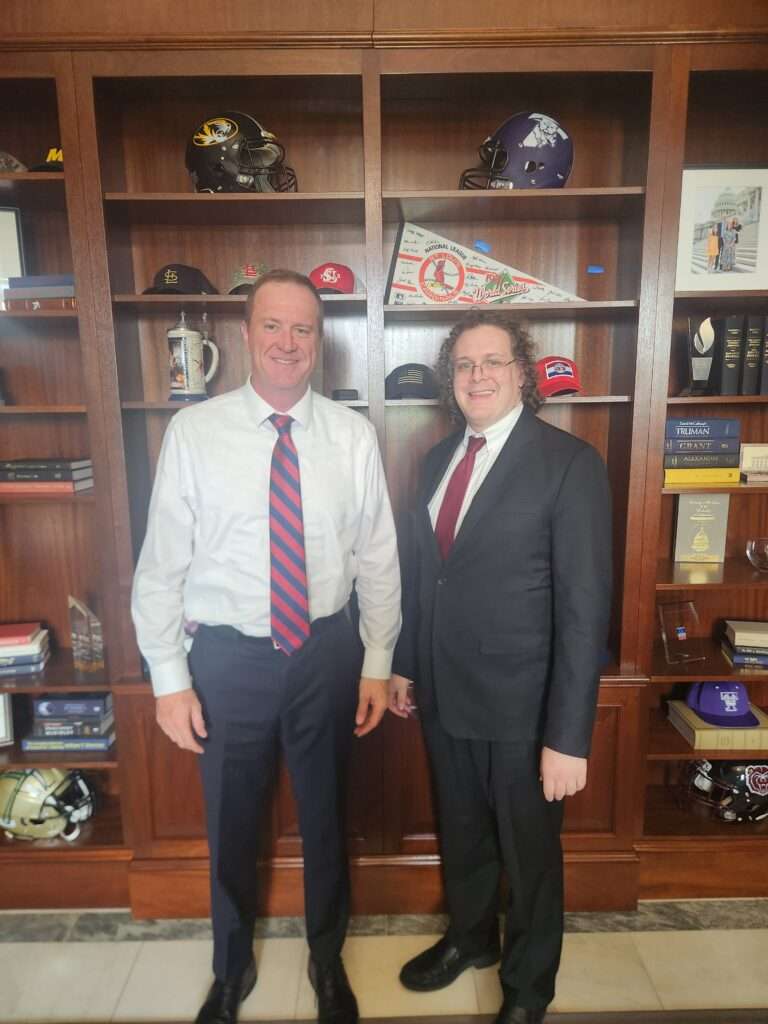 On Tuesday, I testified before the Senate Judiciary Committee for a