The Volokh Conspiracy

Mostly law professors | Sometimes contrarian | Often libertarian | Always independent | Est. 2002

The Volokh Conspiracy

Statement From The Dean At The University of Florida College of Law

|

Merrit E. McAlister, the Interim Dean at the University of Florida College of Law, released this statement to the UF Law Community:

Dear UF Law Community:

Many of you may have seen the recent New York Times article about a student at the law school.  The article stated that the student—who told the Times it "would not be manifestly wrong" to call him a Nazi—received a recognition through a "book award," which is given to the highest overall grade in a law school class.  The paper he wrote, which counted for 65% of the final grade in the small seminar course, argued for constitutional "nationalism" based on an understanding of the Constitution that excluded non-white people from legal and civil participation in America.  Although the law school is limited by what it can say about these events under federal and state law that protects the privacy of student record information, that student has now disclosed some information publicly.

Let me state unequivocally: the student's views are revolting and do not reflect the values of UF Law, its faculty, or its administration.  We welcome all, we discriminate against none, and we aim to create a community where students feel a sense of belonging and connection—without experiencing fear or threats or hatred.

The paper's views also in no way reflect the views of the professor in this course.  The professor had no knowledge of this student's history at the law school or his deeply held personal views.  The professor took the paper on its face—as a student paper attempting to use originalist methodology to reach a detestable and extreme position.  As abhorrent as the paper's thesis may be, that work still falls within the bounds of academic freedom and the First Amendment, and, as such, was graded consistent with the grading standard for the course.

As a matter of practice at UF Law and most other law schools across the nation, the highest-performing student in any class receives a "book award" during the grading process.  Indeed, the professor believed that recognition was mandatory for the top scoring student.

I understand that these events and this article have caused many in our community pain, disappointment, and fear.  I know that many of you are outraged at the law school for not taking the book award away from the student.  But the administration does not second-guess grading decisions at the law school, except in very narrow circumstances, and those circumstances did not apply here.  Upholding academic freedom and the student's First Amendment right to express even odious ideas is the harder path, but it is the path our principles require.

Rescinding the honor might feel righteous, but it would betray those principles and set a dangerous precedent in a law school that trains students to confront unpopular ideas and represent unpopular clients.  Defending free expression is easiest when we approve of the speech; it is hardest when, as in this instance, the speech tears at the fabric of our community.  But that is precisely when our commitment must hold.

We have protected academic freedom and the student's First Amendment rights while also prioritizing the safety and security of our community.  As soon as the student's conduct became threatening and substantially disruptive, in collaboration with UFPD and UF administration, the student was barred from campus.  We heightened security across the college.  It is important to note that the escalation in the student's conduct that led to his trespass happened three months after the book award had been announced in January.

Sadly, this article has given an extremist provocateur exactly what he wanted: a platform for greater visibility.  And it has caused hurt and pain within our community in the process.  I also regret that this has led an honorable public servant—one who has served his country for decades as a federal public defender and a federal judge—to receive death threats because of an impartial grading decision he made.  No one deserves that treatment for selflessly teaching as a part-time instructor in a law school.

The decisions we've made in this instance reflect the best efforts of dedicated professionals to protect students' First Amendment rights and embody the principles of academic freedom in grading, administering, and guiding a law school.  Not everyone will agree with our judgment, and I respect that.  But I hope we can begin to move forward together recognizing that, collectively, we share commitments to uphold the First Amendment, academic freedom, and our shared sense of humanity.

I think this statement largely strikes the right tone, and makes several important points. First, and most importantly, when the grade was given, the student had not yet made the statements on social media. Second, the grade given was well within the bounds of reasonableness. Third, regrettably, Judge Badalamenti was subjected to death threats. There is so much outrage about pizzas, but here the New York Times unfairly tarred a good judge's reputation to no end. These threats were entirely predictable.

Fourth, the Dean wrote "No one deserves that treatment for selflessly teaching as a part-time instructor in a law school." Selfless is exactly the right word. It is no secret that academia is hostile to conservatives. UF is very fortunate to have originalists on the faculty like Gary Lawson and Judge Badalamenti. Other schools are not nearly as fortunate. The foreseeable consequence of this expose is that other judges may find the risk of teaching simply too high, and they'll sit on the sidelines. Make no mistake, this is a feature, and not a bug about these attacks on originalism.

Let me add some more positivity. I've spoken with several of Judge Badalementi's students, and they sing his praises. One wrote:

Hi Professor. There was absolutely no indication that [NAME] was a white supremacist. In fact, everybody at the school knew the story about a white supremacist student the year below us. I had even read another paper he had authored that was spread by concerned students. Despite this foreknowledge, during the class there was absolutely ZERO indication at any time Mr. [Name] was the one who held those beliefs, and I did not even realize he was the rumored white supremacist and in the same class as me until after the paper story blew up. Whenever I was asked by fellow students about what the class was like and what kind of person the Judge was, I always responded in the same way. "I am beyond certain from my time spent with Judge Badalamenti that he grades papers as impartially as any human possibly could, even if he has to hold his nose at some of the views espoused to recognize a well written, researched, and organized paper, regardless of how abhorrent the argument furthered is. For this reason, due to the criteria on the syllabus, Judge granted the paper an A, the highest in the class, which the school then automatically designated as earning a book award." Judge Badalamenti is one of the most kind, respectful, and judicious people I have ever met, and words cannot properly effectuate how much respect I hold for him both as a human being and a Federal Judge. The attacks on him by this "journalist" are disgusting, unfounded in reality, and highlight the absolute lowest forms of sensational tabloid click bait. Furthermore, I feel it necessary to add that I was particularly disgusted by the author of the article bringing in our co-Professor and using her name. She assisted the class on an administrative level and helped with discussions, but had no knowledge of this situation, nor did she help with grading the paper in any way. Attempting to bring her name into this was disgusting, unfounded, and the author should issue a retraction and an apology.

And another student wrote:

[The student] presented a thesis that critically examined originalism. It demonstrated how the doctrine when weaponized or applied in bad faith, can lead to deeply harmful and unjust consequences. You may also find it relevant that I emigrated to the United States at the age of 7 and am a first-generation law school graduate. Judge B always seemed to value that aspect of my background and fostered an environment that encouraged intellectual independence and a deep respect for diversity.

My earlier posts on this topic can be found here and here.

Update: The student posted on X that he received three other book prizes from the Spring 2025 semester in "Advanced Legal Thought," "Criminal Procedure-Adversary System," and "Mental Health Law." All of these grades were given after the student's incendiary social media postings. This history suggests that Judge Badalamenti's grade was entirely consistent with how other professors at the University of Florida graded the student. The New York Times's story was truly a non-story. It is regrettable that so many hours were wasted on a mistake.

Gun Control

Big Business as Gun Control

Partly from coercion and partly by choice, many banks and social media businesses impose severe gun controls

|

On July 6, 1775, the great Pennsylvania lawyer John Dickinson coauthored the Continental Congress' Declaration of Causes and Necessity of Taking Up Arms. Among the grievances in the Declaration were the British government's gun control program, namely having "murdered" people in attempting to confiscate arms and gunpowder at Lexington and Concord, and the disarmament of the people of Boston. Known as the "Penman of the Revolution," Dickinson is the namesake of Penn State Dickinson Law school. Fittingly for the 250th anniversary of John Dickinson's immortal declaration, the Dickinson Law Review has published a symposium issue on arms rights and arms controls.

My article, coauthored with George Mocsary and Bhav Ninder Singh, addresses a form of constriction on the right to arms that was unknown to John Dickinson: Big Business as Gun Control. Here's the abstract:

Gun control increasingly bypasses direct legislative enactments by co-opting the commercial marketplace. Financial institutions and insurers often face regulatory pressures, frequently articulated through vague notions of "reputational risk," to terminate or restrict services for lawful firearms businesses and advocacy groups. The debanking tactic, seen in initiatives such as Operation Choke Point, can deny essential financial products to firearm owners, merchants, and organizations, curtailing the practical exercise of constitutionally protected rights. Simultaneously, government agencies sometimes pursue warrantless data collection from bank records and merchant category codes, building profiles of lawful purchasers and eroding privacy and due-process norms.

Social media platforms compound these problems by removing or limiting firearms-related content under opaque or inconsistently applied standards. Although they occasionally frame their policies as safeguards against violence, enforcement often removes instruction, historical discussion, and other legitimate forms of speech. The censorship distorts public debate about firearms, stifling conversations on safety, training, and responsible ownership.

This Article describes the significant shift toward privatized gun control, in which government entities and large corporations converge to limit access to banking, insurance, and information platforms. The outcome is a new type of regulatory regime that can subvert constitutional checks, undermine lawful enterprise, and chill lawful speech. Curbing abuses requires a combination of targeted legislation, judicial oversight, and self-restraint by private institutions to ensure that neither lawful commerce nor individual liberty are sacrificed to hidden agendas.

Part I of the Article examines debanking and other financial blacklisting, and explains how the financial regulatory environment enables abuse. When a regulator illegally says "jump," many banks and insurance companies tend to believe that the only response that will save their business from being destroyed is to respond "Yes, sir!" A case in point is the Obama administration's Operation Choke Point, which was an effort to debank the entire firearms industry. While that particular program was thwarted by its exposition in congressional hearings, debanking continues to be a growing problem. Abuses have been particularly severe in New York State. There, the Governor, the head of the Department of Financial Services, and the Attorney General engaged in egregious misconduct to attempt to destroy the National Rifle Association (NRA) for political reasons.

Part II turns to forced disclosure of private banking information. Section A briefly surveys the widespread problem of administrative subpoenas, including for banking data relating to firearms purchases. Section B addresses legislation to create separate merchant category codes for firearms business.

Social media censorship of firearms-related content is the subject of Part III. Based on examination of the policies and practices of six leading social media businesses, the worst offenders are Meta and YouTube. While these companies have published detailed policies, the companies' censors act arbitrarily, capriciously, and contrary to the published policies.

In each of Parts I–III, a final section examines potential solutions for the problems described in the relevant part. There are multiple ways to deal with debanking and other financial blacklisting, but many suffer from the penchant of some financial regulators to act as a law unto themselves, regardless of their statutory or regulatory authority. Financial privacy is the easiest issue to address, using the model of several states that have already enacted legislation against turning credit card transactions into gun registries. As for social media, the problem may be unsolvable by legislation, lawsuits, or antitrust.

Civil Procedure

Court Dismisses Vexatious Litigant's Sexual Assault Lawsuit, Noting Inconsistencies with Evidence, Claims in Other Cases

|

When plaintiffs file enough cases that courts view as frivolous, the courts can generally declare the plaintiffs to be "vexatious litigants," and thus limit their ability to litigate future cases unless there's a preliminary showing that the cases are likely to be meritorious. The rules vary from state to state, but California has a pretty well worked out system for dealing with such matters, and a list of thousands of vexatious litigants.

The March 6, 2025 decision by Judge Sarah Heidel in Doe v. Suarez (appeal pending) illustrates how this system can work in getting vexatious litigants' cases dismissed. And the case also shows the value to opposing parties of being able to find a vexatious litigant's past cases—and therefore one reason to forbid pseudonymous litigation by litigants who appear likely to be potentially vexatious. (Disclosure: The Jane Doe in this case had unsuccessfully sued me for having identified some of her past pseudonymous lawsuits.) Here's an excerpt from the case:

This case arises from an allegation of sexual assault. According to the complaint, plaintiff Jane Doe met defendant online and the two arranged to meet for dinner. Following dinner, and after an evening of heavy drinking, plaintiff alleges defendant raped her. After that encounter the two exchanged texts for another month and a half. Plaintiff alleges that during this time she came to believe that defendant had supplied her with alcohol at their first date "with the intention of raping her.["] …

[Plaintiff] had been placed on the list of vexatious litiga[nts] by the Judicial Coun[cil] …. A vexatious litigant is "a person who has, while acting in propria persona, initiated or prosecuted numerous meritless litigations, relitigated or attempted to relitigate matters previously determined against him or her, repeatedly pursued unmeritorious or frivolous tactics in litigation, or who has previously been declared a vexatious litigant in a related action." …

{"In any litigation pending in any court of this state, at any time until final judgment is entered, a defendant may move the court, upon notice and hearing, for an order requiring the plaintiff to furnish security or for an order dismissing the litigation …. The motion for an order requiring the plaintiff to furnish security shall be based upon the ground, and supported by a showing, that the plaintiff is a vexatious litigant and that there is not a reasonable probability that they will prevail in the litigation against the moving defendant."}

Read More

Free Speech

No Pseudonymity for Vexatious Litigant, Even When She Is Alleging Sexual Assault

"[A]llowing plaintiff to proceed under a pseudonym could enable her to evade judicial oversight under the vexatious litigant rules by obscuring her litigation history and identity across multiple cases."

|

From the decision last month in Doe v. Suarez by L.A. Superior Court Judge Sarah Heide (appeal pending):

This case arises from an allegation of sexual assault. According to the complaint, plaintiff Jane Doe met defendant online and the two arranged to meet for dinner. Following dinner, and after an evening of heavy drinking, plaintiff alleges defendant raped her…. On April 10, 2024, plaintiff was placed on the Judicial Council's list of Vexatious Litigants [based on her previous, unrelated lawsuits -EV] ….

Plaintiff requests a protective order granting her leave to proceed under a pseudonym in this action on the grounds that plaintiff's need for anonymity outweighs any prejudice to defendant and the public's interest is served by protecting plaintiff's identity…. Plaintiff argues that the sensitive and personal nature of her claims justify the protection of her privacy and psychological well-being. She maintains that disclosure of her identity could not only embarrass her but cause her more emotional harm, affect her job prospects, and bring unwanted attention to herself.

Plaintiff states that in July 2022, her identity was involuntarily disclosed in connection with sexual assault which led to death threats and harassment; she has felt compelled to change her place of residence and her phone number out of concern for safety.  She argues that defendant will not be prejudiced if plaintiff proceeds under a pseudonym because plaintiff's identity is already known to defendant, as he filed his answer including her true name; therefore, his ability to mount a defense would not be obstructed by her identity being shielded from the public.

Defendant argues that plaintiff's true name is already a matter of public record in several matters. For example, in the Doe v. Newsom complaint, plaintiff references the sexual assault allegations against defendant, and in the matter of Doe v. County of Los Angeles, plaintiff is identified as the same plaintiff from Doe v. Newsom. In professor Volokh's article, The Law of Pseudonymous Litigation (2022) 73 Hastings L.J. 1353, plaintiff's name was included as an example of a litigant whose use of pseudonymity impedes investigation into her trustworthiness and past litigation. After that, plaintiff sued professor Volokh. (Luo v. Volokh (2024) 102 Cal.App.4th 1312.)

Read More

Free Speech

No Preliminary Injunctions Against Penn's Sanctions on Prof. Amy Wax

"[W]hatever harm she claims, it is not imminent, irreparable harm. Her damages, if any, are monetary damages."

|

From today's decision by Judge Timothy Savage (E.D. Pa.) in Wax v. Univ. of Pa.:

After a lengthy disciplinary process, the University of Pennsylvania ("Penn") found that longtime law professor Amy Wax had engaged in "flagrant unprofessional conduct." It imposed sanctions of a one-year suspension at half pay, loss of summer pay in perpetuity, loss of her named chair, and a public reprimand.

Wax brought this action asserting breach of contract (failure to adhere to the disciplinary process prescribed in the Faculty Handbook); racial discrimination under Title VI, Title VII, and 42 U.S.C. § 1981; and false light invasion of privacy. She seeks a preliminary injunction enjoining Penn from implementing the sanctions….

Wax joined the faculty of Penn Carey Law School as a tenured professor on July 1, 2001. Five years later, she was named the Robert Mundheim Professor of Law. On March 2, 2022, Dean Theodore W. Ruger sent Wax a letter charging that she had "shown a callous and flagrant disregard for [the] University community" and inviting an informal resolution. The letter cited the following instances of Wax's conduct:

Read More

Senate

Senate Parliamentarian Rejects Dangerous Provision of "Big Beautiful Bill" that Undermines Judicial Protection for Constitutional Rights

The parliamentarian ruled it cannot be enacted as part of a reconciliation bill not subject to the filibuster.

|

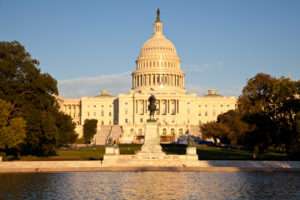
The U.S. Capitol
Photo 27165352 © Valentin M Armianu | Dreamstime.com

In two previous posts, I critiqued a dangerous provision of the Senate version of Trump's "Big Beautiful Bill," which - if enacted - would severely undermine judicial protection against unconstitutional federal government actions (see here and here). In the process, I highlighted critiques by Arizona Supreme Court Justice Clint Bolick, and a coalition of conservative and libertarian public interest groups, led by the Firearms Policy Coalition. The provision would require litigants seeking preliminary injunctions against illegal federal government actions to post potentially enormous bonds.

Fortunately, the Senate parliamentarian has now ruled that this provision cannot be enacted as part of a reconciliation bill exempt from Senate filibuster rules:

A U.S. Senate official has concluded that a Republican-drafted provision in President Donald Trump's massive tax and spending bill that would restrict the ability of judges to block government policies violates budgetary rules.

The Senate's parliamentarian, Elizabeth MacDonough, advised over the weekend that the provision ran afoul of a Senate rule governing what can be included in budget reconciliation legislation that can be passed with a simple-majority vote and would instead need to be subject to a 60-vote threshold if it remained in the bill.

Republicans, who control the Senate 53-47, intend to use complex budget rules to pass the so-called "One Big Beautiful Bill Act" with a simple majority vote.

The parliamentarian is a nonpartisan referee. Her decision could spell doom for the provision's inclusion in the ultimate legislation Congress passes because it would allow Democrats to challenge the vote on the floor and require Republicans to muster 60 votes to pass it. Congressional leaders hope to enact the overall bill in the coming days so Trump can sign it into law before July 4.

The GOP-controlled Senate could potentially override the parliamentarian on a majority vote. But, at least at this point, they do not seem to have any plans to do so. If they don't, that spells the end of this dangerous proposal - at least for now. There is virtually no chance it could secure the 60 votes needed to enact it as stand-alone ordinary legislation.


Executive Power

Prof. Jack Goldsmith (Harvard) on "Was the Iran Strike Constitutional?"

|

A characteristically excellent analysis, from a leading scholar of the subject, at his Executive Functions substack. An excerpt:

A lot of people over the next few days are going to argue with confidence that President Trump violated, or didn't violate, the Constitution when he bombed Iran over the weekend without congressional authorization.

You might think that the Constitution would provide a clear answer to such a momentous question. But it doesn't.

Or you might think I would know the answer, since I (with Curt Bradley and Ashley Deeks) have a casebook that covers the issue; I have written about it for decades; and I served in the Office of Legal Counsel that is the storehouse of executive branch legal opinions on the topic, one of which has my name on it. But I don't know the answer.

I don't know the answer because I do not think there is anything approaching a settled or clear normative framework for analysis.

Read More

Corporate Welfare

Negating Democratic Consent

How the Colorado Supreme Court has nullified Colorado constitutional limits on taxes, debt, and corporate privilege.

|

Colorado's 1876 Constitution is replete with provisions to prohibit corporate welfare, special privileges for government-favored big business, and government debt without voter consent. The protections have been fortified and extended by constitutional amendment, most notably in the 1992 Taxpayer's Bill of Rights. Yet for the past century, the Colorado Supreme Court, usually in cooperation with the other two branches, has nullified the taxpayer protections of the Colorado Constitution. This sad story is told in my new article for the Denver University Law Review's annual Tenth Circuit Symposium, Negating Democratic Consent: How the Colorado Supreme Court has Nullified Colorado Constitutional Limits on Taxes, Debt, and Corporate Privilege, 102 Denver Univ. Law Review 449 (2025). (The symposium includes states law articles on 10th Circuit states.)

For example, Colorado Constitution article XI, section 1, forbids government debt on behalf of corporations in the most comprehensive language possible:

Neither the state, nor any county, city, town, township or school district shall lend or pledge the credit or faith thereof, directly or indirectly, in any manner to, or in aid of, any person, company or corporation, public or private, for any amount, or for any purpose whatever; or become responsible for any debt, contract or liability of any person, company or corporation, public or private, in or out of the state.

The next section of the Constitution, article XI, section 2, also uses the broadest language possible to outlaw government aid to corporations:

Neither the state, nor any county, city, town, township, or school district shall make any donation or grant to, or in aid of, or become a subscriber to, or shareholder in any corporation or company or a joint owner with any person, company, or corporation, public or private, in or out of the state . . .

The statutory text contains certain narrow exceptions. For example, a government might acquire ownership of a corporation by forfeiture or escheat. By constitutional amendment, the people have created other exceptions, allowing for a government student loan programs and for government investment in energy industries.

The Colorado Supreme Court, however, has usurped for itself the power of constitutional amendment. Today, the Court does not enforce the text of the anti-corporate welfare sections of the Colorado Constitution, with their blanket language such as "directly or indirectly, in any manner to, or in aid of." Instead, according to the court, all corporate welfare is permissible whenever the legislature rationally believes that the welfare might have some beneficial effects. The plain text of the Colorado Constitution has in effect been replaced by the court's lawless imposition of a rational basis test that legalizes precisely what the Colorado Constitution was enacted to forbid.

Read More

Arkes: Is Skrmetti "The Best That Conservative Jurisprudence Can Really Serve Up Now, A Concurring Opinion in Buck v Bell?"

The conservatives "thought they were constrained from speaking by a jurisprudence that bars them from invoking truths beyond the text of the Constitution."

|

In Civitas Outlook, I discussed how the Skrmetti majority refused to even acknowledge the right of the people to govern based on morality. Instead, the Court hid behind technical and legal formalisms. Hadley Arkes states the issue far better than I ever could. Here is a snippet:

The truth that dares not speak its name here is that this wide array of gender-affirming therapies and surgeries is simply predicated on a falsehood. And yet those are the words that the conservative justices apparently see themselves as barred from speaking. Something in conservative jurisprudence holds them back from appealing to the inescapable and objective truth that lies at the heart of these cases. But without it, what were these accomplished jurists able to explain here? What was their ground of justification in overriding the judgments of those parents who were absorbed in the grief and confusion that seized their children? . . . .

The only "instruction" that would be relevant, Justice Thomas, is the unyielding fact that the child is in a state of confusion: he is not occupying some body apart from his own; his sex was not "assigned" at birth but marked inescapably in the organs of reproduction, in the arrangement of his body. His sex is immutable and printed plainly upon him.

Those were the words that Chief Justice Roberts and five colleagues could not move themselves to speak. Or they thought they were constrained from speaking by a jurisprudence that bars them from invoking truths beyond the text of the Constitution—even on the question of what is a human being, the bearer of rights, and when does that "human person" begin? . . .

Without those points in place, the judgment of the Court simply dissolves into a chain of ipse dixits. Why was it not legitimate for the parents of stricken youngsters to order the procedures that might relieve their "gender dysphoria?" Answer: The legislature of Tennessee did not think it a legitimate medical remedy to choose—even though the children and the parents did not share that judgment and were willing to take their risks. One judgment had to prevail, and it was the judgment backed by the power of the State. To put a high finish on it, that "power" represented the authority of a people to govern itself through elected representatives. But when the people speak through their representatives, and override the judgments of parents about their children, they are still obliged to say something more than "we have brute the power to impose this judgment through brute enactment of the law."

Hadley closes by comparing Chief Justice Roberts's decision to Justice Holmes's majority decision in Buck v. Bell.

Unless the Court can explain the grounds that truly compelled its judgment in this case, conservative jurisprudence falls back, as it ever has, on nothing more, as Justice Holmes had it, than the power of the majority to rule and get its way.

Roberts is fond of citing Holmes's Lochner dissent. I don't think the Chief will appreciate the apt comparison to one of Holmes's other decisions that did not age so well.

We should recall that Holmes's grand opinion quickly drew the accolades of the academy and the educated class, quite as enthralled with the romance of euthanasia, as their latter-day counterparts have been about climate change. And all of the ingredients are now again in place: a "controversial medical" procedure, along with people with medical degrees more than eager to show just how they do it; and the case for it seems compelling enough to be enacted into law by those educated people, often with law degrees, who fill out the legislature. But might we not be forgiven for asking: Is this the best that conservative jurisprudence can really serve up now, a concurring opinion in Buck v Bell?

I think my piece, Arkes's piece, and some other emails I've received, reflect a growing awareness of the current Court's deficiency. Since Justice Scalia's passing, I think the Court has lost its way. The fixation on installing Justices who will overrule Chevron has neglected moral foundation that Justice Scalia brought to the Court. Well, Chevron is gone and Roe is overruled. What's next? I think the answer is letting the people govern themselves once again. I do not think it is necessary for the Justices to themselves judge based on any sense of natural law. Unlike Arkes, I do not consider myself a natural law theorist--though I am JWI-curious. Rather, it is enough for judges to be comfortable letting the people govern based on these principles--even when laws might offend modern sensibilities of individual autonomy. I'll admit my views on this topic have changed over the years. I was always persuaded by Scalia over Kennedy as a legal matter, but I didn't quite fully understand why till I read Skrmetti. Now, with the emptiness of Chief Justice Robert's decision, things seem far clearer.

The Court seems open to that end in the Establishment Clause context, such as in Kennedy v. Bremerton and Carson v. Maikin. But the Court is still living in Justice Kennedy's shadow with regard to the Due Process and Equal Protection Clauses. Current discussions about overruling Obergefell miss the point. If the people wish to maintain same-sex marriage, they can make that choice. But, the Court should allow the people to make that choice. As Scalia wrote in Obergefell, the Court disregarded "the freedom [of the people] to govern themselves."

I'll keep writing on this subject.

Free Speech

Did Elected Officials Violate First Amendment by Orchestrating Public Criticism of (and Racism Allegations Against) Their Critic?

"[P]ublic condemnations, op-eds, and official complaints ... through proxies are independent constitutional violations" if the officials "engaged in conduct that was motivated by the plaintiff's protected speech and had the requisite chilling effect on First Amendment activity."

|

Jack Lipton was a prominent professor and administrator at Michigan State University, and in 2023-24 "he served as the Faculty Senate Chair," "the liaison between the MSU faculty" and the MSU Board of Trustees, which is elected statewide. He got into a dispute with two members of the BOT, Chair Rema Vassar and member Dennis Denno. Here's the backstory, from the May 28 decision by Chief Judge Hala Jarbou (W.D. Mich.) in Lipton v. Mich. State Univ. Bd. of Trustees (appeal pending):

[According to the Complaint, on] October 20, 2023 (the early days of Lipton's tenure as the Faculty Senate Chair), [BOT member Brianna] Scott sent an open letter to her fellow BOT members. The letter accused BOT Chair Vassar of ethical violations and called for Vassar's resignation. A week later, on October 27, 2023, the BOT held a highly attended meeting to discuss Vassar's alleged misconduct and whether she should resign. Lipton spoke at this meeting in his capacity as Faculty Senate Chair, reading a resolution the Faculty Senate passed that called for Vassar's resignation.

According to the amended complaint, the meeting was contentious and chaotic, and whenever "any meeting attendee spoke in support of holding Vassar accountable for her actions as outlined in Scott's letter, Vassar supporters interrupted and jeered them and attempted to prevent them from completing their statements." The typical rules regarding permission to speak were ignored, and the BOT Secretary was pressured to allow nonregistered speakers to voice their support for Vassar. There was a lack of order, culminating in police officers escorting at least one attendee from the meeting.

After the meeting, a reporter asked Lipton whether he thought the faculty's concerns, and the general allegations against Vassar, had been sufficiently addressed. Lipton, clarifying that "he would speak [to the reporter] as a private individual and not on behalf of the Faculty Senate," said: "The board meeting yesterday, filled with Chair Vassar supporters, demonstrated Trustee Scott's charges of intimidation and bullying in action. The chaos brought and disrespect shown by her supporters could have been stopped by a single statement from Chair Vassar, yet she elected to let the mob rule the room."

In the wake of Lipton's comment, Vassar and her BOT colleague Denno allegedly began a retaliation campaign against Lipton. Vassar and Denno met with MSU students, encouraging them to publicly condemn Lipton and file complaints of racial discrimination against him. Vassar's supporters and associates published statements and op-eds calling Lipton racist, anti-Palestinian, and anti-Muslim, citing his use of the term "mob" to describe the crowd. According to a third-party investigator that MSU hired, Vassar and Denno advised students and supporters on how to attack Lipton for his statement, coordinating with them on the phrasing of these public condemnations and complaints.

Read More

"What Skrmetti Should Have Said"

"Yet, Dobbs did not repudiate the basis of Roe and Casey, the notion that legislatures are not empowered to enact laws based on public notions of morality. And Skrmetti refused to acknowledge that foundational basis of our republic."

|

Civitas Outlook has published my new essay, titled What Skrmetti Should Have Said. It begins:

I often ask students two questions inspired by Justice Antonin Scalia: identify a decision where you disagree with the outcome, but agree with the reasoning, and identify a decision where you agree with the outcome, but disagree with the reasoning. These questions serve as a gut-check to ensure that their reasoning does not simply follow their policy preferences. Students generally answer the first question with ease. Justice Scalia, for example, often cited his vote to protect a protester's First Amendment right to burn an American flag. But students have a much tougher time with the second question. Usually, if they agree with the bottom line of an opinion, they find a way to accept the reasoning, even if not perfectly.

For me, United States v. Skrmetti falls into the second category. The Court, by a 6-3 vote, held that Tennessee can ban doctors from "transitioning" minors to the opposite sex. This holding would have seemed so obvious only a generation ago. Yet, in a short span, elite opinion shifted such that lower court judges and members of the Supreme Court came to believe this law was clearly unconstitutional. The majority opinion by Chief Justice John Roberts, as well as concurrences by Justices Clarence Thomas, Amy Coney Barrett, and Samuel Alito, got the bottom line correct. But upon reflection, I have doubts they had the best legal argument. Justice Sonia Sotomayor's dissent proved more persuasive than I expected–not a sentence I write very often. In short, Tennessee denied certain medical treatment to minors in large part based on their biological sex, and under longstanding precedent, sex-based classifications are reviewed more stringently.

That doesn't mean the Tennessee law was unconstitutional. Indeed, I think the state has such a strong interest in protecting children — especially from harm by their parents and doctors — that the law would still pass constitutional muster. But the majority opinion, and to a lesser extent the concurrences, engaged in hyper-technical readings of the statute that distracted from the real legal issues. To hear Chief Justice Roberts tell it, Tennessee simply issued a mundane regulation about which medical treatments are available for minors. But this approach ignored the real reason why Tennessee and so many other states have enacted such laws: the legislatures morally disapprove of transgenderism for minors, and sought to prevent children from medically transitioning to another sex. Full stop.

Here, I think, is the key paragraph:

Dobbs v. Jackson Women's Health Organization (2022) rightly overruled Roe and Casey. This decision returned the question of abortion to the elected branches. Yet, Dobbs did not repudiate the basis of Roe and Casey, the notion that legislatures are not empowered to enact laws based on public notions of morality. And Skrmetti refused to acknowledge that foundational basis of our republic. Indeed, Justice Barrett paid homage to Justice Kennedy. She wrote, "an individual law 'inexplicable by anything but animus' is unconstitutional." This was the essence of the line of cases stretching from Romer to Obergefell. It is dispiriting that a former Scalia clerk has abandoned her old boss's mantle and taken up with his jurisprudential nemesis. And I cannot fathom why Justice Thomas signed onto Barrett's concurrence. (There is still time for him to change his vote before the opinion is officially reported.) The right answer, as Thomas and Scalia argued for decades, is that unless the Constitution expressly protects a constitutional right or class, a law motivated by moral disapproval is valid.

I hope this essay will stimulate discussion about how the Court--an even apparently Justice Thomas--has lost its way since Justice Scalia's passing.

Politics

Names You Might Not Want to Call a Judge in Court

Django Unchained: An enjoyable movie, but not always the best source of references in the courtroom.

|

Sunday's Judicial Notice (David Lat) reminds us that lawyers shouldn't call the judge "honey." But there are other names you might also want to avoid—perhaps even more so—as we learn from Tuesday's opinion by Connecticut Supreme Court Chief Justice Raheem Mullins in Johnson v. Superior Court:

As a self-represented party, the plaintiff filed a petition for a writ of habeas corpus, alleging issues with his medical treatment while in the custody of the respondent, the Commissioner of Correction. After it addressed various pretrial motions, the trial court conducted the first day of the habeas trial on April 4, 2023.

On May 4, 2023, the trial court resumed the plaintiff's habeas trial. The hearing was held virtually, with the plaintiff, counsel and the witnesses all appearing onscreen. Several witnesses were present virtually and were prepared to testify. After the court asked the parties to identify themselves, the plaintiff identified himself as "Gregory Johnson, man. Everybody know[s] who I am. I don't got time for that." Thereafter, the following colloquy occurred:

"The Court: Mr. Johnson, I'm going to tell you right now. You've been here. You know you need to identify yourself.
"The [Plaintiff]: I identified myself (indiscernible).
"The Court: Just do what you need to do, Mr. Johnson.
"The [Plaintiff]: I identified myself already, man. I ain't got time for that….
"The Court: All right. Mr. Johnson, one more, and the hearing is over for the day. You understand? You're not at—
"The [Plaintiff]: I don't care.
"The Court: You're not out in the yard, Mr. Johnson—
"The [Plaintiff]: I don't care.
"The Court: —with your buddies….
"The Court: [The plaintiff], clearly, has forgotten the decorum of the courtroom. It's a regular context with [the plaintiff's] believing he is talking to one of his friends in the yard as opposed to the court.

Read More

Free Speech

Decisions to Restrict Online Access to Eviction Records Are for Judges, Not for Clerks of Court

So holds the Ohio Supreme Court.

|

From State ex rel. Parikh v. Berkowitz, decided Wednesday:

Parikh is the elected Hamilton County clerk of courts…. In May 2022, Parikh issued a policy eliminating remote online access to court records in residential-eviction cases older than three years from the date of judgment satisfaction. He states that the purpose of the policy is to prevent members of the public, such as employers and landlords, from inappropriately relying on court documents when considering employment, housing, and other needs of individuals. "[I]t was and remains the belief of the Clerk's Office," he explains, "that these online inquiries led to misidentification of parties with similar names and produced inaccurate and unfair results that harmed citizens." The public remains able to access the records in person at the clerk's office during regular business hours.

The Hamilton County Municipal Court judges objected, and the Ohio Supreme Court sided with the judges:

Parikh restricted online access to court records for the policy reason of protecting what he viewed as the best interests of defendants in closed eviction cases. As discussed below, such a decision may be made only by the municipal-court judges, and they may order the clerk to rescind actions that intrude upon their judicial discretion.

Access to court records promotes openness, transparency of process, and accountability. This principle underlies  which states that "[c]ourt records are presumed open to public access." … [A]lthough the Rules of Superintendence do not require that courts or clerks make all case records available online, the rules recognize that the public can access records more easily online than in person at the clerk's office, and they treat discontinuing online access as a means of restricting access to records….

Read More

More