The Volokh Conspiracy

Mostly law professors | Sometimes contrarian | Often libertarian | Always independent | Est. 2002

The Volokh Conspiracy

Religion and the Law

2026 Church, State & Society Writing Competition for Law Students and Law Clerks

|

Passing this along, for readers who fit the criteria (or who know those who do):

The Program on Church, State & Society at Notre Dame Law School is pleased to announce a writing competition on topics and questions within the Program's focus. This writing competition requests student-authored scholarly papers and will honor winners with cash awards. The purpose of this writing competition is to encourage scholarship related to the intersections of church, state & society and, in particular, how the law structures and governs that intersection.

Topic and Form: Papers should be focused, broadly, on topics related to church, state & society. For guidance on selecting a topic, students may wish to view our Program website and mission statement: https://churchstate.nd.edu/

Papers must be between 9,000-13,000 words, including footnotes and/or endnotes.

Eligibility: The competition is open to law students in good standing, enrolled in a traditional law degree (J.D. or LL.B.), a Master's degree (LL.M.), or a doctoral degree (S.J.D./J.S.D. or Ph.D.) program at an ABA-accredited law school within the United States. The competition is also open to recent graduates not yet practicing law (i.e., those completing clerkships or engaged in similar pursuits are eligible). Co-authored papers will not be accepted.

Submissions: Papers must be submitted by April 30, 2026.

Read More

Civil Procedure

Diversity (the Civil Procedure Kind) and Self-Identification

"Courts cannot accept a model where an entity has a public-facing identity which it then renounces based on its behind-the-scenes activity."

|

From Judge Gerald McHugh's opinion Friday in Sherman v. American Ass'n of Suicidology, Inc. (E.D. Pa.), an interesting illustration of how courts interpret rules to prevent improper manipulation by the parties and undue confusion for adversaries:

This is an action brought against an association incorporated in Washington D.C., which operates remotely, with no fixed physical location. For practical purposes it operates wherever its executive director is located.

When the action was filed in state court, there is no dispute that its executive director, Denise Hyater, was a resident of the District of Columbia, and discharged her duties there. This would have supported diversity jurisdiction if the case had been removed then, because the "nerve center" for remote entities is the state from which its activities are being directed. But the parties agree that diversity must continue to exist at the time of removal.

Removal here occurred on December 30, 2025. Plaintiff has moved to remand, because, as of that date, Defendant's website represented that the executive director of the association was Jenna Baker, who the parties agree was a resident of Pennsylvania, the same as Plaintiff. Defendant responded with an affidavit representing that the formal transition of authority did not occur until the following day, with the result that the association should be deemed a citizen of the District of Columbia on the date of removal. That response has in turn prompted Plaintiff to seek limited discovery on the issue of diversity.

Read More

What About Nixon?

How many Presidents make a precedent?

|

In Learning Resources, Chief Justice Roberts found that President Trump's tariffs lacked sufficient precedent. As a result, under the major questions doctrine, this novel exercise of power based on an old statute was unlawful. Yet, there was one President who did something similar, that the Chief Justice simply did not want to talk about. Of course, I speak of Richard Nixon.

Roberts acknowledged that President Nixon relied on the Trading with the Enemies Act (TWEA) to impose tariffs. And he further acknowledged that the Court of Customs and Patent Appeals (the predecessor of the Federal Circuit) upheld those tariffs. Yet, the Court found that Nixon's actions were not enough to establish a precedent.

Here, Nixon is relegated to a footnote:

It is also telling that in IEEPA's "half century of existence," no President has invoked the statute to impose any tariffs—let alone tariffs of this magnitude and scope. FN2

FN2: Indeed, even before IEEPA was enacted, only one President [Nixon] relied on its predecessor, the Trading with the Enemy Act (TWEA), to impose tariffs—and then only as a post hoc defense to a legal challenge.; United States v. Yoshida Int'l, Inc.(CCPA 1975). Those tariffs were also of limited amount, duration, and scope.

Roberts also tries to distinguish the Nixon tariffs from the Trump tariffs.

Finding no support in the statute the President invoked, the Government turns to one he did not: IEEPA's predecessor, TWEA. In 1975, the Court of Customs and Patent Appeals held that the authority to "regulate … importation" in TWEA authorized President Nixon to impose limited tariffs. United States v. Yoshida Int'l, Inc.. When Congress enacted IEEPA two years later, the Government contends, it conveyed that same authority (except without the limits).

This argument cannot bear the weight the Government places on it. While this Court sometimes assumes that Congress incorporates judicial definitions into legislation, we do so "only when [the] term's meaning was 'well-settled'" before the adoption. A single, expressly limited opinion from a specialized intermediate appellate court does not clear that hurdle. The tariff authority asserted by President Nixon, moreover, was "far removed" from TWEA's "original purposes" of sanctioning foreign belligerents. We are therefore skeptical that Congress enacted IEEPA with an eye toward granting that novel power.

Justice Gorsuch likewise thinks that the Nixon practice does not count for much:

And, once more, it points to President Nixon's invocation of TWEA to support his 1971 tariffs during lower court proceedings . . .. Whatever one makes of this history, it hardly reveals the kind of contemporaneous and consistent executive interpretation that might advance the dissent's cause. To the contrary, the fact that no President until now has invoked IEEPA to impose a duty—even one percent on one product from one country—is telling.

By contrast, Justice Kavanaugh mention Nixon nearly thirty times. Kavanaugh suggests the Court was trying to "dodge" Nixon tariffs:

The Court tries to dodge the force of the Nixon tariffs by observing that one appeals court's interpretation of "regulate … importation" to uphold President Nixon's tariffs does not suffice to describe that interpretation as "well-settled" when IEEPA was enacted in 1977. Fair enough. But that is not the right question. The question is what Members of Congress and the public would have understood "regulate … importation" to mean when Congress enacted IEEPA in 1977. Given the significant and well-known Nixon tariffs, it is entirely implausible to think that Congress's 1977 re-enactment of the phrase "regulate … importation" in IEEPA was somehow meant or understood to exclude tariffs. 12

FN12: THE CHIEF JUSTICE's opinion also tries to dismiss President Nixon's tariffs as being of "limited amount, duration, and scope." That claim appears incorrect on all three points, as Judge Taranto carefully explained in his Federal Circuit opinion. President Nixon imposed 10 percent tariffs on virtually all imports from every country in the world for an unspecified duration.

What is the Court's aversion to President Nixon? Is it simply the fact that one President is not enough to establish a "longstanding" practice, as that term was used in Noel Canning? Or is it the fact that President Nixon was not a good President that the Court would rely upon?

I've written that Trump is refighting the war that Congress and the Burger Court waged against President Nixon. I think the Chief Justice's blithe dismissal of the Nixon precedent reflects those battle lines.

Justice Gorsuch's Campy Concurrence

Justice Gorsuch takes us on visit of Camp Barrett, Camp Kagan, Camp Kavanaugh, and Camp Thomas.

|

Learning Resources had seven separate opinions. Everyone wrote something, except for Justices Alito and Sotomayor. For a regular merits decision, where time is not of the essence, publishing seven separate opinions may be overkill, but does little harm. But for a quasi-emergency-docket case, where an emergency stay is in place, the Court should proceed with all deliberate speed. Such promptness was especially appropriate because tariffs were being collected every day. Indeed, even as the Court managed to produce 170 pages in about five months, they failed to write a single sentence about the remedy, as the President pointed out in his press conference. Chief Justice Roberts insisted "We do not speculate on hypothetical cases not before us." Yet they also don't decide the actual remedial issue that is squarely before the Court.

What took so long? The Chief probably wrote his majority opinion before breakfast. Justice Kavanaugh articulated almost every point from his dissent at oral argument. That analysis was developed some ago, perhaps even when Judge Taranto wrote his Federal Circuit dissent. And Justice Thomas appears to have been thinking about this topic for some time. I think the reason for the delay has to be Justice Gorsuch. He decided to write a forty-six page concurrence, even though he joined the majority opinion in full. The concurrence was entirely a response to what everyone else wrote. And by writing this behemoth, Gorsuch forced Justices Barrett, Kagan, Thomas, and Kavanaugh to respond to him. And in turn, Gorsuch would have to reply to their responses. There are footnotes upon footnotes.

Yet, Justice Gorsuch's colleagues did not give him nearly as much attention as he gave them. Justice Barrett dispatched with Justice Gorsuch's "straw man" argument in a few pages.

To the extent that Justice Gorsuch attacks the view that "common sense" alone can explain all our major questions decisions, he takes down a straw man. I have never espoused that view.

Barrett also has a first with using the phrase "judicial flex" in an opinion:

I would not treat this evidence as precedent for a judicial flex. Justice Gorsuch proposes to do something new. The innovation is in significant tension with textualism, so I do not support the project.

Ouch.

And Justice Kagan insisted that she is not actually a convert to the major questions doctrine, and would not "relitigate" the issue further.

JUSTICE GORSUCH claims not to understand this statement, insisting that I now must be applying the major-questions doctrine, and his own version of it to boot. Given how strong his apparent desire for converts, I almost regret to inform him that I am not one. . . . I'll let JUSTICE GORSUCH relitigate on his own our old debates about other statutes, unrelated to the one before us.

Though I am critical of Justice Gorsuch's approach, I feel a certain kinship. I write what I believe, without regard to what others might think. Indeed, as I noted recently, I write what I write mostly for myself. It matters little to me whether people respond to me, either positive or negative. Justice Gorsuch cares about these issues profoundly. He has given them a lot of thought. He is, as we often are, entirely convinced he is correct. Gorsuch also thinks that some of his colleagues are being inconsistent. Gorsuch rightly calls Justice Kagan out for flip-flopping (see Jason Willick's essay), and suggests that Justice Kavanaugh has not made his case. But in the end, Justice Gorsuch does not seem to persuade anyone else. I can relate.

The styling of the concurrence is unusual. He refers to the four separate writings as camps: Camp Kagan, Camp Barrett, Camp Kavanaugh, and Camp Thomas.

Past critics of the major questions doctrine do not object to its application in this case, and they even join much of today's principal opinion. But, they insist, they can reach the same result by employing only routine tools of statutory interpretation. Post (Kagan, J., joined by Sotomayor and Jackson, JJ., concurring in part and concurring in judgment). Meanwhile, one colleague who joins the principal opinion in full suggests the major questions doctrine is nothing more than routine statutory interpretation. Post (Barrett, J., concurring). Still others who have joined major questions decisions in the past dissent from today's application of the doctrine. Post (Kavanaugh, J., joined by Thomas and Alito, JJ., dissenting). Finally, seeking to sidestep the major questions doctrine altogether, one colleague submits that Congress may hand over to the President most of its powers, including the tariff power, without limit. Post (Thomas, J., dissenting). It is an interesting turn of events. Each camp warrants a visit.

And here, "interesting" does not mean of interest. It means inconsistent, or even hypocritical. See my post from 2016 on the meaning of "interesting." I recalled that Justice Kagan used a similar phrasing in Seila Law. She wrote, "For those in the majority's camp, that [Opinion] Clause presents a puzzle."

In a case with this many opinions, I suppose it is useful to label an opinion by the authoring Justice's name. But I don't quite get "camp." It comes off a bit, well, campy.

Learning Resources for Learning Resources

How to teach the tariffs case?

|

Learning Resources v. Trump may seem like a very important decision today, but I'm not sure how much it will matter in the near future.

First, Chief Justice Roberts wrote the majority opinion. The Chief, per his usual style, said very little. He purported to simply apply longstanding doctrine, even where he broke new ground, especially on the application of the major questions doctrine for foreign affairs. Moreover, Roberts did not fully engage with most of the historical precedents advanced in Justice Kavanaugh's dissent. Roberts opinions are, as a general matter, not good teaching tools. Students invariably are left feeling unfulfilled.

Second, it isn't clear to me whether this case even belongs in a constitutional law casebook. I think classes on statutory interpretation could benefit from this decision. The major questions doctrine also makes sense for an administrative law class. But the majority opinion says very little about constitutional law. Sure, the Chief Justice gestures to Article I, which reserves the taxing power to Congress. And that principle does some work with the major questions doctrine. But the real work is not based on the text of the Constitution, but instead on how Congress over time delegated the power to impose taxes to the President. Again, this is not really about constitutional law. (I suspect the birthright citizenship will also be resolved on statutory grounds, removing another possible entry to a constitutional law casebook.)

Third, what should students make of the disagreement between Justice Gorsuch and Justice Barrett? I feel like not much new is added from Biden v. Nebraska. Indeed, Justice Barrett, as well as Justice Kagan, seem annoyed that Justice Gorsuch is still making them expend time on this dispute. Is any of this back-and-forth helpful to students in a class on statutory interpretation? I am doubtful. This opinion took nearly five months after oral argument to publish. Query how much of that delay was caused by Justice Gorsuch responding to the four "camps."

Fourth, what about the non-delegation doctrine? After oral argument, I suspected that Justice Gorsuch would at least discuss the non-delegation doctrine, but ultimately it made only a few brief appearances in his opinion. By contrast, Justice Thomas introduced an entirely new line of thought: the non-delegation doctrine only applies to core legislative powers that affect life, liberty, and property. But powers outside that core, that do not affect public rights, can be delegated without limitation. Is Justice Thomas right? I need to think about it some more. Justice Gorsuch raises some questions, but he doesn't really have a strong response. The Thomas dissent may be the only part of the entire case that belongs in a constitutional law casebook. I'll admit it is strange to only include a dissent, but students will benefit from Thomas's careful study.

Fifth, what about Justice Kavanaugh's dissent? It is nearly twice the length of the majority opinion. I found it more persuasive than I expected. Even though I have been following this issue for the past year, I never took the time to carefully walk through the statutory history. I don't think the issue is as "clear" as Kavanaugh said, but I am convinced this issue is close. There is no way that Justice Kagan could be right that the government loses based solely on the statute. I think the government loses only through an application of the major questions doctrine. And I need to think a bit more about Justice Kavanaugh's historical account of the tariff power controls. I almost wish that the Chief assigned the majority opinion to Justice Barrett, as she would have taken the time to fully engage the dissent. But Roberts kept this one for himself.

Ultimately, like much of Trump law, I don't think this decision will have much staying power. It is just another application of the major questions doctrine, even if the Justices still do not agree what that doctrine is.

Putting Trump's Backlash Against The Tariff Ruling In Context

|

In Learning Resources v. Trump, the Supreme Court invalidated President Trump's global tariffs by a 6-3 vote. Almost immediately, Trump held an impromptu press conference, in which he lashed out at the Court, and in particular two of his appointees, Justices Neil Gorsuch and Amy Coney Barrett, who joined the majority. The presser was classic Trump: angry, winding, but direct. First, he conveyed a truth that Republican presidents have known for nearly a century, but have rarely said aloud: progressive justices never break ranks when it counts, but conservative justices will invariably find the principle to do so. Second, Trump uttered another unspoken truth: Presidents fear that criticizing the Supreme Court may result in the Justices ruling against them. The Justices are supposed to rule without fear or favor, but they are still human and will invariably react to what they see as an overbearing president. Third, Trump now sees clearly the problem with those who advised him on his first batch of Supreme Court nominees. Rather than focusing on nominees who favored a strong, robust executive, they supported nominees who actually wanted to transfer power from the executive to Congress and to the courts. Should Trump have another Supreme Court vacancy, these three important lessons will inform his future decision.

Since the 1970s, the Supreme Court has had a majority of Republican-appointed Justices. Indeed, in 1991, eight of the nine Justices had been appointed by Republican presidents. Only Justice Byron White, a Kennedy appointee, was on the other side. Yet, the Court still leaned to the left. In Planned Parenthood v. Casey (1991), five Republican appointees voted to reaffirm Roe v. Wade. And even when the Court found a conservative majority, swing votes like Justices Sandra Day O'Connor and Anthony Kennedy moderated the outcome to the left. But the opposite effect seldom, if ever, happened. Over the past two decades, I have struggled to think of a decision where a Democratically appointed Justice cast the decisive fifth vote for a conservative victory. Justice Stephen Breyer, to his credit, cast an important vote to save a Ten Commandments monument at the Texas Capitol, but that narrow ruling was overwhelmed by a companion case from Kentucky that broadly expanded the Court's power to scrutinize religious displays. Justice Breyer also cast a key vote in a pair of affirmative action cases from Michigan, but there, too, racial preferences were largely upheld. And in NFIB v. Sebelius (2012), Justices Breyer and Elena Kagan joined the Chief Justice in holding that states could opt out of the Affordable Care Act's Medicaid expansion. But it has been reported that they did so as part of a compromise to avoid invalidating the entire program. Since Justice Breyer's retirement, I think the odds of compromises from the left are slim. 

President Trump's press conference described this dynamic and used his own appointees as examples. Trump said, "The Democrats on the court are thrilled, but they will automatically vote no." Trump added that the Democratic appointees are "an automatic no, just like in Congress." How often do Democratic politicians break ranks and vote on principle? Republicans in Indiana voted against redistricting. Will any Democratic state legislatures actually vote against a Democratic gerrymander? Trump's analogy between Democratic politicians and Democratic-appointed judges has some merit. I struggle to think of any significant case where the Court's progressive justices cast a dispositive vote against the progressive side. 

Trump continued that the Democratic appointees are "an automatic no, no matter how good a case you have, it's a no." I think Trump is saying what every Supreme Court litigator would quietly admit: in an ideological case, only three or four votes are really ever up for grabs, and they are all on the right. But Trump drew a contrast: "You can't knock their loyalty, one thing you can do with some of our people." In other words, the progressive justices never break ranks when it counts, but "some of our people," that is, the conservative Justices, do.

Trump also shone a light on an unspoken element of Supreme Court advocacy: you cannot say or do anything that could offend the Justices. Trump explained he kept his mouth shut: "I wanted to be very well-behaved because . . . I didn't want to do anything that would affect the decision of the Court, because I understand the Court." He does understand the Court better than most people might think. Trump continued, "I understand how they are very easily swayed. I want to be a good boy."

Trump, likely on the advice of counsel, was told not to say anything negative about the Court while the case was pending, lest he sway the decision. The implication here was clear: if Trump criticizes the Court, he is more likely to lose. Trump even acknowledged this point in his roast at the Alfalfa Club earlier this month. He quipped, "I had the nastiest, most vicious joke about John Roberts," but "if you think I'm going to tell that joke you can forget it." Trump said the quiet part out loud: "I'm going to kiss his ass for a long time." Well, at least for a few weeks. Now Trump can tell the joke.

Do you see the problem? Judges are supposed to decide cases without fear or favor. Whatever a litigant says about the judge should have no bearing whatsoever on the outcome of the case. But of course, every first-year law student knows this isn't actually true. The clear import of some of the commentary about Trump's press conference is that he made it less likely that the Justices will rule in his favor in future cases. Judges are human. Indeed, judges are even more sensitive than mere mortals. One does not become a judge by ignoring how the public perceives them. And even if the justices tell themselves that Trump's comments have no effect on their ruling, the public perception is that there is such an effect. And where did this perception come from?

I'll let you in on a little secret. Much of the commentary you read about the Supreme Court involves obsequiousness in an attempt to curry favor. Law professors, in particular, want to be held in high regard by the justices. After all, they want to be cited and have their students hired as law clerks. (I, for one, never hold back, even if there are consequences for my candor.) You wonder why Trump's lawyer told him to put a muzzle on it?

Finally, I think Trump is having a rude awakening about the Supreme Court nominees from his first term. While Trump is angry at Justices Gorsuch and Barrett, I think his ire should be directed at the lawyers who advised Trump to pick them. A flashback is helpful. Immediately after Justice Scalia died, Trump realized he had an opening. If Trump could convince conservatives that he could be trusted to appoint a conservative to replace Scalia, he could win the primary. Trump innovated the process by releasing several lists of potential nominees. (It is noteworthy that Gorsuch and Kavanaugh were not on the initial list.) But let's be frank. Trump didn't know the people on the lists. He worked with the names given to him. And Trump, unlike prior presidents, didn't have a firm grounding in constitutional law or what the Supreme Court did.

Read More

Climate Change

A Conversation about the Endangerment Finding Rescission

A couple of lawyers and a couple of scribes discuss the legal challenges to come.

|

On Friday afternoon I took a break from reading the Supreme Court's tariff ruling to talk about the EPA's final rule rescinding the "endangerment finding," which serves as the basis for regulating greenhouse gases under the Clean Air Act, on Andrew Revkin's "Sustain What" podcast. We were joined by environmental attorney Sean Donohue (who will be among those challenging the EPA's final rule) and Jean Chemnick of E&E News/Politico.

It was a fun discussion which highlighted some of the legal issues that will arise as courts (first the D.C. Circuit and then, some expect, the Supreme Court) consider the question, even if Sean Donohue was somewhat constrained in what he could say given the pending litigation. Here's a video:

The EPA's final rule, as published in the Federal Register, is here. Additional materials and supporting documents are available on the EPA website here. And the first petition for review of the rescission filed in the D.C. Circuit on behalf of multiple environmentalist, public health, and other public interest organizations is here. (And, yes, Donohue is one of the attorneys listed.)

For more background on the legal issues and what may be in store, here are some of my posts on the subject:

Annotating President Trump's Press Conference About The Tariffs Ruling

|

Much has been written about President Trump's press conference in the wake of Learning Resources. The Wall Street Journal Editorial Board charged that the "rant in response to his tariff defeat at the Court was arguably the worst moment of his Presidency." Ed Whelan said the speech was "stupid and vile."

I quite deliberately waited a bit to watch Trump's remarks. I wanted to actually read the opinion first, and let the tumult of Friday settle down. It helps that I am not on social media, and completely turn off the internet on shabbat.

Now, with some distance from Friday, I watched the press conference. This might be one of the most important presidential remarks about the Supreme Court since FDR's Court-Packing address. Of course, it is done in Trump's inimitable style with dripping vitriol, but as Trump often does, he says the things we all think but are simply unsayable in polite company. People need to focus less on how Trump says things and more on what he actually says.

Rather than trying to summarize it, I will offer a passage-by-passage annotation.

Read More

An Edited Version Of Learning Resources

I've finished reading the entire tariff decision, and editing it down for the Barnett/Blackman casebook.

|

I realize I am unorthodox. I avoid commenting on a Supreme Court opinion till I've read the entire thing from front to back. I find the experience far more rewarding. I also avoid reading takes by people who almost certainly did not read the entire decision, or perhaps just skimmed the syllabus. Of course, the fact that Learning Resources had seven separate opinions, and stretched more than 170 pages, made the experience a bit unpleasant, but persevere I did.

Here is my first stab at an edited version for the Barnett/Blackman supplement, down to about 50 pages.

The majority opinion is very short, about 6 pages. The Roberts opinion can be stated very simply. As I've said before, the shorter a Roberts decision is, the more he is concealing.

The Gorsuch opinion, which stretches nearly 50 pages in the reported version, is cut down to 14 pages. For the most part, Gorsuch is responding to Barrett, Kagan, and Kavanaugh/Thomas. I feel like the only person on planet Earth who truly needs to read the entire Justice Gorsuch opinion is Justice Gorsuch. This was for him, not his colleagues, or anyone else for that matter. Depending how much of the other four opinions you assign, you can probably skip around the Gorsuch opinion.

The Barrett concurrence is thankfully short, and I shortened it further to two pages.

I cut most of the Kagan concurrence to a page, only including the parts where she throws shade at Justice Gorsuch.

The Jackson concurrence on legislative history can be eliminated altogether. I kept a really short segment.

The Thomas dissent is about six pages. It reminds me a bit of Zivotofsky. He has very deep views on the President's powers with regard to foreign policy. In Zivotofsky, Scalia challenged him. Here, Gorsuch doesn't really try.

The Kavanaugh dissent is 23 pages long, much longer than the majority. This extended excerpt is justified, at least in part, because Kavanaugh goes deep into issues that Roberts glosses over. Justice Kavanaugh also tends to use theme and variation. He will state a point, develop it, then restate the point in a different way, and then restate it again. As Justice Scalia would say, repetition is afoot.

I will probably cut this excerpt down further to about 35 or 40 pages for the supplement, and under 30 pages for the casebook. It still isn't clear to me exactly how to teach the Major Questions Doctrine in ConLaw, as this is more of a statutory interpretation/admin principle. I had hoped to include it in a section on non-delegation, but the Court assiduously avoided that issue.

Enjoy! I will have a lot of commentary on this case in the coming days.

Tariffs

Andrew McCarthy on "Why Trump's Section 122 Tariffs Are Illegal"

The prominent conservative legal commentator outlines the case against Trump's latest tariff power grab.

|

NA

Within hours of the Supreme Court's decision striking down his massive IEEPA tariffs in our case challenging them, Donald Trump issued an executive proclamation invoking Section 122 of the Trade Act of 1974 to impose 10% global tariffs, and then upped the rate to 15%. Prominent conservative legal commentator Andrew McCarthy has an insightful National Review article explaining why these new tariffs are also illegal. McCarthy and I differ over many issues. But we agree on this one. Here's an excerpt:

These new tariffs are even more clearly illegal than Trump's IEEPA tariffs…..

In Section 122, Congress endowed the president with narrow, temporary authority to impose tariffs "to deal with large and serious United States balance-of-payments deficits" (emphasis added). What Trump is complaining about — something he insists is a crisis but is not — is the balance of trade, not of payments. The United States does not have an overall balance of payments deficit, much less a large and serious one.

A trade deficit between the U.S. and a foreign nation occurs, mainly in connection with goods (which is just one aspect of international commerce), when imports are greater than exports. This is not really a problem for a variety of reasons — e.g., a trade deficit results in an investment surplus, the U.S. is a major services economy and often runs exported services surpluses that mitigate the imports deficit in goods, etc.

The balance of payments is a broader concept than the balance of trade. It accounts for all the economic transactions that take place between the United States and the rest of the world. Even without getting into every kind of transaction that entails, suffice it to say that foreign investment in the United States, coupled with the advantages our nation accrues because the dollar is the world's reserve currency, more than make up for the longstanding trade deficit in goods.

Our overall payments are in balance. There is no crisis.

It's vital to understand why Section 122 was enacted. There was a financial crisis in the late 60s and early 70s under the Bretton Woods system, when the dollar was tied to gold. Foreign countries that held dollar reserves could exchange them for gold at a fixed rate. Meanwhile, our government was spending at a high clip due to the Vietnam War and Great Society programs. This and the obligation to pay out gold put enormous pressure on the dollar…

Now, over a half century later, these conditions no longer obtain. The dollar floats and the government does not concern itself with gold parity. The dollar is the global reserve currency, so demand for dollars by foreign nations is robust. We have strong capital inflows and our highly liquid financial markets are the envy of the world. Notwithstanding trade deficits, there is no balance of payments problem.

Nor is it necessary, as Section 122 puts it, to impose temporary tariffs in order "to prevent an imminent and significant depreciation of the dollar in foreign exchange markets[.]"

There is no rationale under Section 122 to impose tariffs. Because President Trump has no unilateral authority to order tariffs, he must meet the preconditions of Section 122 to justify levying them. He cannot. Not even close.

I agree. And I think there are additional reasons why the new Section 122 tariffs are illegal. I will have more to say about them in the coming days.

Supreme Court

A Puzzle about Learning Resources v. Trump

Why is the decision named what it is?

|

Yesterday's Supreme Court decision rejecting President Trump's use of the International Emergency Economic Policy Act (IEEPA) to impose tariffs is styled Learning Resources v. Trump. But why?

The tariff case was actually two cases. Learning Resources, which had been filed in a federal district court, and Trump v. V.O.S. Selections, which was filed in the Court of International Trade and then appealed to the U.S. Court of Appeals for the Federal Circuit. One question before the Court was which of these litigation pathways was the right one.

Here is what the Court said on that point in a footnote:

We agree with the Federal Circuit that the V.O.S. Selections case falls within the exclusive jurisdiction of the CIT. The plaintiffs' challenges "arise[] out of " modifications to the HTSUS. 28 U. S. C. §1581(i)(1). Where, as here, such modifications are made under an "Act[] affecting import treatment," 19 U. S. C. §2483, they are "considered to be statutory provisions of law for all purposes," §3004(c)(1)(C). Thus, the plaintiffs' challenges "arise[] out of [a] law of the United States providing for . . . tariffs." 28 U. S. C. §1581(i)(1). For the same reasons, the United States District Court for the District of Columbia lacked jurisdiction in the Learning Resources case.

Based upon this, it seems to me the decision should be captioned Trump v. V.O.S. Selections, not Learning Resources. After all, if the district court lacked jurisdiction in Learning Resources, that case should have been dismissed and the Supreme Court would not have had jurisdiction to review that case on the merits. It did, however, have jurisdiction to reach the merits in V.O.S. Selections, so that is the case on which the Court actually ruled. But that is not what the Court did.

Donald Trump

Trump on the Supreme Court's Tariff Decision

It wasn't the Court's opinion that is an "embarrassment."

|

After the Supreme Court ruled (correctly) that the International Emergency Economic Powers Act (IEEPA) does not authorize the imposition of tariffs, President Trump issued remarks on the decision. It was quite something.

Here are some excerpts form the transcript:

The Supreme Court's ruling on tariffs is deeply disappointing, and I'm ashamed of certain members of the court, absolutely ashamed, for not having the courage to do what's right for our country.

I'd like to thank and congratulate Justices Thomas, Alito and Kavanaugh for their strength and wisdom and love of our country, which is right now very proud of those justices. . . .

The Democrats on the court are thrilled, but they will automatically vote no. They're an automatic no, just like in Congress, they're an automatic no. They're against anything that makes America, strong, healthy and great again. They also are a, frankly, disgrace to our nation, those justices. . . .

Others think they're being politically correct, which has happened before far too often with certain members of this court, and it's happened so often with this court — what a shame — having to do with voting in particular, when in fact they're just being fools and lapdogs for the RINOs and the radical left Democrats and, not that this should have anything at all to do with it, they're very unpatriotic and disloyal to our Constitution.

It's my opinion that the court has been swayed by foreign interests and a political movement that is far smaller than people would ever think. It's a small movement. I won by millions of votes, we won in a landslide. With all the cheating that went on, there was a lot of it, we still won in a landslide. Too big to rig.

But these people are obnoxious, ignorant and loud. They're very loud. And I think certain justices are afraid of that. They don't want to do the right thing. They're afraid of it. . . .

I understand how they are very easily swayed. I want to be a good boy. . . .

To show you how ridiculous the opinion is, however, the court said that I'm not allowed to charge even one dollar. I can't charge one dollar, can't charge a dollar. I would have used one penny, but we don't make the pennies anymore. We save money.

Can't charge one dollar to any country under IEEPA, not one dollar, I assume to protect other countries. This must have been done to protect those other countries. Certainly not the United States of America, which they should be interested in protecting. That's what they're supposed to be protecting. . . .

Our country is the hottest country anywhere in the world right now, and it was a dead country one-and-a-half years ago under an incompetent president. But now I'm going to go in a different direction, probably the direction that I should have gone the first time.

But I read the language. I'm very good at reading language, and it read our way 100 per cent. But now I'll go the way I could have gone originally, which is even stronger than our original choice.

As Justice Kavanaugh — whose stock has gone so up, you have to see, I'm so proud of him — wrote in his dissent, "Although I firmly disagree with the court's holding today, the decision might not substantially constrain a president's ability to order tariffs going forward." So think of that, "the decision might not substantially constrain." And it doesn't. He's right. In fact, I can charge much more than I was charging. So I'm going to just start. . . .

And from the Q&A at the press conference:

Question:  Mr. President. What will you say to foreign nations who seek to renegotiate their deals? And what did you mean a moment ago when you said that the Supreme Court has been swayed by foreign interests?

Trump: Well, I think that foreign interests are represented by people that I believe have undue influence. They have a lot of influence over the Supreme Court, whether it's through fear or respect or friendships, I don't know. But I know some of the people that were involved on the other side and I don't like them.

I think they're real slimeballs. And, uh, got to do what's right for the country. You got to do what's right for the Constitution. That's why I respect so much, Justice Thomas and Alito, Kavanaugh, because they not only dissented, their dissent is so strong. When you read their dissent, you know, a lot of times you'll read a dissent and it's like, well, you don't know.

It could go either way. There's no other way. The good news is it's like Justice Kavanaugh said, very strongly said, you have other ways you can go. You don't have to go that way. You can go other way. There are numerous other ways you can go. And frankly, this should have been done by presidents many years ago.

They allowed our country to be eaten alive. We lost 50 percent of our car business. We used to make cars. We made all cars. And then Mexico came, Canada came, Japan, and Germany, but they're all coming back now. They're all coming back at record levels. . . .

And on his appointments to the Court:

Question: Mr. President, Justices Gorsuch and Barrett, are you surprised in particular by their decision today?

Trump: I am.

Question: And do you regret nominating them?

Trump: I don't want to say whether or not I regret. I think their decision was terrible. Yeah. I think it's an embarrassment to their families, you want to know the truth, the two of them. Yeah.

Supreme Court

An MQD Receipt Justice Gorsuch Overlooked

Justices Kagan and Sotomayor have signed on to at least one opinion that expressly relied upon the major questions doctrine.

|

Justice Gorsuch's concurrence in Learning Resources v. Trump is something of a Godfather-esque settling of family business. He challenges and critiques all of his colleagues (save for the Chief) and brings receipts. As one would expect, his opinion draws tart responses from other justices (which could explain why it took so long for the Court to release the opinion).

Whatever one concludes about Justice Gorsuch's exchange with Justice Kagan, and whether the progressive justices implicitly adopted arguments embracing the major questions doctrine in this case, he is correct that Justices Kagan and Sotomayor have signed on to MQD-reasoning in the past, he just forgot to include one of the most salient receipts.

In 2015, both Justices Kagan and Sotomayor signed on to Chief Justice Roberts' opinion for the Court in King v. Burwell. Of note, that opinion relied upon MQD reasoning in concluding that Congress had not delegated authority to the Internal Revenue Service to determine whether tax credits would be available in federal exchanges. Here's the relevant passage:

Read More

Tariffs

My New Atlantic Article About Our Win in the Tariff Case

It covers many issues raised by the decision.

|

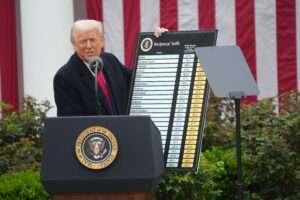
President Donald Trump holds up the chart of "reciprocal" tariffs he pledged to impose on other nations, during an event in the Rose Garden.
Trump announces his "Liberation Day" tariffs. April 2025. (CNP/AdMedia/Newscom)

The Atlantic just published my article  (gift link) about the tariff ruling decided by the Supreme Court yesterday, in which I was co-counsel for the plaintiffs in one of the three cases before the justices. The article covers many issues raised by the case, including major questions, nondelegation, implications for the rule of law, and Trump's plan to use Section 122 to impose massive new tariffs. Here is an excerpt:

In a 6–3 decision yesterday, the Supreme Court rightly ruled that, under the International Emergency Economic Powers Act of 1977, the president does not have the power to "impose tariffs on imports from any country, of any product, at any rate, for any amount of time." The ruling is a major victory for the constitutional separation of powers, rule of law, and millions of American consumers and businesses harmed by these tariffs.

This decision spared America from a dangerous, unconstitutional path. Under President Trump's interpretation of the law, the president would have had nearly unlimited tariff authority, similar to that of an absolute monarch. That undermines basic constitutional principles. The Framers of the Constitution had sought to ensure that the president would not be able to repeat the abuses of English kings, who imposed taxes without legislative authorization….

Trump's position had multiple flaws. IEEPA does not even mention tariffs, nor any synonyms such as duties and imposts. The law does authorize the president to "regulate" certain types of international transactions in the event of an "emergency" that amounts to an "unusual and extraordinary threat" to the United States. But the tariff authority and the power to "regulate" foreign commerce are listed in separate clauses of the Constitution. And, as Chief Justice John Roberts noted in his opinion for the Court, the tariff authority is part of the power to tax, an authority the Framers of the Constitution carefully reserved to Congress because they had "just fought a revolution motivated in large part by 'taxation without representation.'" Furthermore, during the previous nearly 50-year history of IEEPA, Roberts continued, "no President has invoked the statute to impose any tariffs—let alone tariffs of this magnitude and scope…."

Three of the justices in the majority—Roberts, Neil Gorsuch, and Amy Coney Barrett—also concluded that the Trump administration's interpretation of IEEPA goes against what has become known as the "major questions" doctrine, which requires Congress to "speak clearly" when authorizing the executive to make "decisions of vast economic and political significance…."

In addition to upholding the separation of powers, the decision is a victory for the rule of law, which requires that major legal rules be clearly established by legislation, not subject to the whims of one person. Since first imposing the Liberation Day tariffs, Trump has repeatedly suspended and reimposed various elements of them. He has also imposed or threatened to impose IEEPA tariffs for a variety of other purposes, such as countering the supposed threat of foreign-made movies, punishing Brazil for prosecuting its former president for attempting to launch a coup to stay in power after losing an election, and most recently castigating eight European nations opposed to his plan to seize Greenland. Such gyrations undermine the stable legal environment essential for businesses, consumers, and investors, and create endless opportunities to reward cronies and punish political adversaries. Studies show that firms contributing to the Republican Party were disproportionately likely to receive exemptions from tariffs imposed during Trump's first term, while firms contributing to Democrats were more likely to have to pay. If allowed to stand, the IEEPA tariffs would have created much greater opportunities for such corruption….

The administration may try to reimpose many of the tariffs using other statutes… But those laws have various constraints that would make it hard for the president to simply impose unlimited tariffs, as he could have done under his interpretation of IEEPA. As Chief Justice Roberts noted in his opinion yesterday, "When Congress has delegated its tariff powers, it has done so in explicit terms, and subject to strict limits…" If Trump or a future president does claim that those other statutes give him unlimited power, tariffs imposed based on any such theory would themselves be subject to legal challenges. Yesterday's decision signals that a majority of the Court is seriously skeptical of claims of sweeping executive tariff authority.

For a compendium of  all my writings about the tariff litigation, see here.

More