

The Volokh Conspiracy
Mostly law professors | Sometimes contrarian | Often libertarian | Always independent
My New Atlantic Article About Our Win in the Tariff Case
It covers many issues raised by the decision.
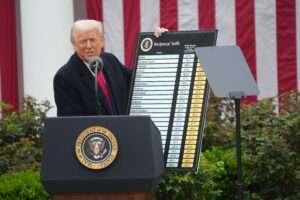
The Atlantic just published my article (gift link) about the tariff ruling decided by the Supreme Court yesterday, in which I was co-counsel for the plaintiffs in one of the three cases before the justices. The article covers many issues raised by the case, including major questions, nondelegation, implications for the rule of law, and Trump's plan to use Section 122 to impose massive new tariffs. Here is an excerpt:
In a 6–3 decision yesterday, the Supreme Court rightly ruled that, under the International Emergency Economic Powers Act of 1977, the president does not have the power to "impose tariffs on imports from any country, of any product, at any rate, for any amount of time." The ruling is a major victory for the constitutional separation of powers, rule of law, and millions of American consumers and businesses harmed by these tariffs.
This decision spared America from a dangerous, unconstitutional path. Under President Trump's interpretation of the law, the president would have had nearly unlimited tariff authority, similar to that of an absolute monarch. That undermines basic constitutional principles. The Framers of the Constitution had sought to ensure that the president would not be able to repeat the abuses of English kings, who imposed taxes without legislative authorization….
Trump's position had multiple flaws. IEEPA does not even mention tariffs, nor any synonyms such as duties and imposts. The law does authorize the president to "regulate" certain types of international transactions in the event of an "emergency" that amounts to an "unusual and extraordinary threat" to the United States. But the tariff authority and the power to "regulate" foreign commerce are listed in separate clauses of the Constitution. And, as Chief Justice John Roberts noted in his opinion for the Court, the tariff authority is part of the power to tax, an authority the Framers of the Constitution carefully reserved to Congress because they had "just fought a revolution motivated in large part by 'taxation without representation.'" Furthermore, during the previous nearly 50-year history of IEEPA, Roberts continued, "no President has invoked the statute to impose any tariffs—let alone tariffs of this magnitude and scope…."
Three of the justices in the majority—Roberts, Neil Gorsuch, and Amy Coney Barrett—also concluded that the Trump administration's interpretation of IEEPA goes against what has become known as the "major questions" doctrine, which requires Congress to "speak clearly" when authorizing the executive to make "decisions of vast economic and political significance…."
In addition to upholding the separation of powers, the decision is a victory for the rule of law, which requires that major legal rules be clearly established by legislation, not subject to the whims of one person. Since first imposing the Liberation Day tariffs, Trump has repeatedly suspended and reimposed various elements of them. He has also imposed or threatened to impose IEEPA tariffs for a variety of other purposes, such as countering the supposed threat of foreign-made movies, punishing Brazil for prosecuting its former president for attempting to launch a coup to stay in power after losing an election, and most recently castigating eight European nations opposed to his plan to seize Greenland. Such gyrations undermine the stable legal environment essential for businesses, consumers, and investors, and create endless opportunities to reward cronies and punish political adversaries. Studies show that firms contributing to the Republican Party were disproportionately likely to receive exemptions from tariffs imposed during Trump's first term, while firms contributing to Democrats were more likely to have to pay. If allowed to stand, the IEEPA tariffs would have created much greater opportunities for such corruption….
The administration may try to reimpose many of the tariffs using other statutes… But those laws have various constraints that would make it hard for the president to simply impose unlimited tariffs, as he could have done under his interpretation of IEEPA. As Chief Justice Roberts noted in his opinion yesterday, "When Congress has delegated its tariff powers, it has done so in explicit terms, and subject to strict limits…" If Trump or a future president does claim that those other statutes give him unlimited power, tariffs imposed based on any such theory would themselves be subject to legal challenges. Yesterday's decision signals that a majority of the Court is seriously skeptical of claims of sweeping executive tariff authority.
For a compendium of all my writings about the tariff litigation, see here.

Editor's Note: We invite comments and request that they be civil and on-topic. We do not moderate or assume any responsibility for comments, which are owned by the readers who post them. Comments do not represent the views of Reason.com or Reason Foundation. We reserve the right to delete any comment for any reason at any time. Comments may only be edited within 5 minutes of posting. Report abuses.
Please to post comments
Two words: Phyrric Victory.
You’re playing checkers while Trump plays three-dimensional chess.
I’m not sure what Trump’s strategy is, but I can see this winning the midterm elections for him. And I can see this also be the vehicle he uses to purge the rhinos.
"Two words: Phyrric Victory."
As Justice Kavanagh noted at the end of his dissent, "the Court’s decision is not likely to greatly restrict Presidential tariff authority going forward." "[T]he Court’s decision might not prevent Presidents from imposing most if not all of these same sorts of tariffs under other statutory authorities" some of which he names. And while their particular requirements make them (somewhat) more difficult to apply, those same requirements go a long way toward address a "major questions" problem.
And as footnote 1 makes clear, any future dispute about whether such tariffs are proper falls within the exclusive jurisdiction of the [Court of International Trade]" and, on appeal, the Federal Circuit. Not some district court judge who might be sympathetic to the “Trump resistance.”
Finally, as Justice Kagan notes, “the statute authorizes 99 actions a President can take to address a foreign threat” that don’t involve tariffs. These can involve, for example, quotas that block importation, perhaps phased in over time so that domestic manufacturing can develop as a replacement knowing that it can develop without foreign competition.
As Cato’s Scott Lincicome noted in today’s Wall Street Journal, “It’s [just] the End of the Beginning of the Tariff War.”
"I’m not sure what Trump’s strategy is"
In many instances, it isn't clear how a statute or opinion applies to a situation, such as whether "brithright citizenship" applies to "birth tourism." Since courts are forbidden from giving advisory opinions, what you have to do is force an actual case on that issue to see what (in many cases) the Supreme Court says. This may have been one of those instances.
Trump is senile and sits in his own crap.
"Trump plays three-dimensional chess"
Normal chess is 4-dimensional. (The board is 2-d, knights can move orthogonally to that, and move order is a dimension.)
“The board is 2-d, knights can move orthogonally to that”
Oh FFS. No. Knights still move in the same plane as the other pieces. An L-shaped move is no more a different dimension than a diagonal move. “Orthogonal” to the plane of the other pieces would be vertically up and down.
Knights can move over other pieces, you drooling moron.
you said "Pyrrhic [sic] victory" yesterday as well. You're doing a fine job of demonstrating the gap between rationality and rationalisation.
Please, Ed Trump will certainly attempt to reimpose these tariffs, but his options are now much more limited. His 15% for 150 days is one such attempt, but doesn't restore his much higher previous tariffs on several trade-critical countries.
And there's a big difference in getting an indefinate-term, already-in-effect tariff action reversed by majority vote both houses of congress and not vetoed by the president, that getting a legally-imposed 150-day tariff extended by affirmative vote of both houses of congress.
Further legal tariff actions under other statutes require require more evidence before being imposed, including verifiable justification that will be easier rebut. If he tries to go around the legal requirements again, the courts (including SCOTUS) will be far more likely to enjoin them and issue immediate TRO's than in the past.
This is, of course, why Trump did not try to choose those other mechanisms in the first place. I think November was probably the peak of Donald Trump's meaningful influence. He's now on a long, irreversible downhill slide and the remaining nation-damaging victories of this small, demented old man, though no less damaging, will be far fewer.
Law School taught me that lawyers have the ability to argue both sides of every legal controversy; practicing law taught me that a very few very smart lawyers had the intelligence and dispassionate genius to understand every complication in the adversary's arguments as well as their own. I am forever thankful for such teachings.
Ilya doesn’t.
Congrats.
I'm interested to see how lawsuits against the Section 122 tariffs fare. I'm sympathetic to the balance-of-payments language being about managing risks from currency devaluation, but I will note that during VOS oral arguments at the Federal Court of Appeals, all of plaintiffs, defendants (government), and judges seem to agree that 122 covers trade deficits. The govt's position was that 122 was insufficient to meet their needs while plaintiffs argued it was.
At least now we have an effective overall reduction in tariff rates thanks to the 15% cap in 122. And after the 150 days, the remaining tools are nearly impossible to use for the "entire world."
So, again Trump has attempted to seize powers that he has not been elected to hold. Another coup attempted. When will he be held to account for his treason?
Before the Supreme Court issued its decision, it was not definite that Trump "attempted to seize powers that he has not been elected to hold." Just because a law professor says that IEEPA doesn't allow the tariffs doesn't make it so.
As I pointed out earlier, since courts can't issue advisory opinions the only way to resolve whether something is allowed if that particular thing hasn't been previously adjudicated is to take the action to force a court case. That's certainly not what any sensible person would regard as a coup or treason.
There is no indication that Trump intends to disregard the decision of the Supreme Court, much as he disagrees with it.
All the lower courts that considered the issue had ruled against the tariffs, so that has been the law for many months. If the Supreme Court had declined to take the case, those decisions would have been the final word.
It obviously isn't the final word until any appeals are concluded. And any orders to stop collecting the tariffs were stayed pending final resolution, so Trump wasn't disobeying them.
As for what the DC lower courts said, the Supreme Court made it pretty clear that the trial court had no jurisdiction, so what they say has about as much legal value as what some law professor says.
So, good for SCOTUS and good for Ilya—but the chaos continues. In one year, Donald Trump has destroyed 80 years of work that, since Bretton Woods and the General Agreement on Tariff and Trade, made us the safest place in the world to do business.
Investment is inherently risky—but America had the lowest level of risk on the planet. America's economic ground rules remained consistent and any needed change, slow and transparent. Our government, legal system, and business community worked hard in mostly transparent coordination. The United States became the center of global finance, its economy, the strongest in the world, and the dollar, the world's reserve currency.
Now, as we devolve to a nation incapable of developing rational, consistent policies or establishing trustworthy, lasting agreements (either among ourselves or with other countries), that's changing. Now, America mirrors China, where the rules change enigmatically from day to day, where no business can trust in the stability of its long-term plans or count on good-faith economic metrics, projections and actions. Now, as America bets its future on the whims of an increasingly demented old man, we're choosing to place ourselves among the developed world's riskiest places to do business.
What Trump is destroying will not easily be rebuilt. Damage to the U.S. will be greater and far longer lasting than any 1st-order 2026 financial consequences—what will be the 2nd- and 3rd-order impact of such government and economic instability to producers, consumers, and traders of goods in my own strongly import/export-dependent state of Washington, the rest of the United States, and the world?
I think November was probably the peak of Donald Trump's meaningful influence. He's now on a long, irreversible downhill slide. That doesn’t mean he's less dangerous, or the damage he will still cause is more limited. The realization of his waning power and his loosening hold on underlings and the crazed old MAGA base, makes more extreme, more damaging, more demented action by this small old man—while he still can take it—increasingly likely. (Wag the Dog in Iran, anyone?)
If we do recover, history’s view of America's 21st century Trump Interregnum will be the same as its view of China’s 20th century Mao’s Great Leap Forward: two of the worst periods in human history, of a major world power's intentionally-pursued decivilization.
Now in my 70's, I doubt I'll live to see us fully recover. But I hope you will, and by taking back Congress in the mid-terms, we can limit the degree of further Trump damage and start laying the groundwork for recovery. We have to. We must.
Yep. Come time and distance, this will become seen as a time of de-civilizing in the US. Not becoming less civil, exactly, just a project to dismantle a lot of what kept our society functioning well for it's people.
A project lead largely by those who were well served by that system, but nevertheless suffering some kind of status injury and lashing out.
I'm a lot younger than you, and I am going to be interested to see what the perspective becomes once millennials take leadership positions from those who lead us into MAGA, though intent or ineptitude.
Scotus just created a great deal of uncertainty about tariffs.


