
The Supreme Court Didn't Destroy the Regulatory State. It Stood Up for Due Process.
Justice Ketanji Brown Jackson says these cases will "devastate" the regulatory state. Good.


Justice Ketanji Brown Jackson says these cases will "devastate" the regulatory state. Good.

The surveillance company mSpy just suffered its third data breach in a decade, exposing government officials snooping for both official and unofficial reasons.
Justice Alito takes a similar view, but, at least in this case, this view didn't get the four votes necessary to grant review.
Plus: A disappointing first round of "Baby YIMBY" grant awards, President Joe Biden endorses rent control, and House Republicans propose cutting housing spending.
But, at least in this case, this view didn't get the four votes necessary to grant review.
The defendant had alleged that he, his family, and his lawyer had been threatened by the public, but the Ohio Supreme Court concluded that the trial court wasn't given adequate evidence to justify sealing.

And a grand jury says that's illegal.

The Court is remanding these two cases for more analysis—but it made its views on some key issues clear.

China's free speech record is bad, but the federal government's isn't so great either.

The Court says Chevron deference allows bureaucrats to usurp a judicial function, creating "an eternal fog of uncertainty" about what the law allows or requires.

Justice Sonia Sotomayor called the Supreme Court ruling in SEC v. Jarkesy "a power grab." She's right, but in the wrong way.

Americans shouldn’t count on the department to use the technology responsibly or in a limited way.

Assange's plea deal sets a threatening precedent for free speech and journalism.
The decision rejects a system in which the agency imposes civil penalties after investigating people and validating its own allegations.

A year after a court told Maryland police that Cellebrite searches were too broad, Baltimore quietly resumed using the software.

Although the FBI never produced evidence that Ali Hemani was a threat to national security, it seems determined to imprison him by any means necessary.
The real dissents are the concurrences by Justices Sotomayor and Jackson.
The standing requirements laid down by the majority might make it extremely difficult or impossible for victims of indirect goverment censorship to get their cases to court.

The verdict in Murthy v. Missouri is a big, flashing green light that jawboning may resume.

It's a classic case of jawboning.

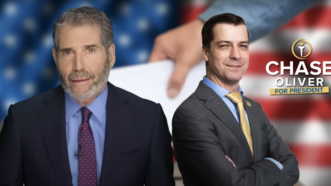
The candidate makes the case against the two-party system.

Murthy v. Missouri challenges government efforts to suppress dissenting viewpoints on social media.
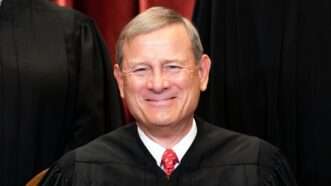
Although critics say the Court’s current approach is unworkable, it has been undeniably effective at defeating constitutionally dubious gun regulations.
There is a great deal of panic surrounding the "extreme" nature of the current Court. But that is often not based in reality.
Should pseudonymous litigants, and any precedents set in their cases, be known by the initials of the law firms that represent them?

"It’s not like public health is infallible," the Stanford professor and Great Barrington Declaration author tells Reason's Nick Gillespie.
The Town of Rose Bud restriction appears aimed at a particular proposed constitutional amendment, which would "require all schools receiving public funds to meet identical standards and would require universal access to pre-K education."
and continuing the conduct while following those employees."

A proposed USDA rule would require RFID tagging of all cattle and bison that move across state lines.
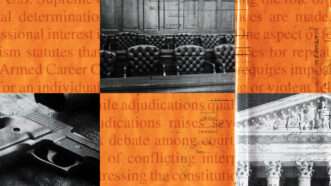
Paul Erlinger was sentenced to 15 years in prison based largely on a determination made by a judge—not a jury.
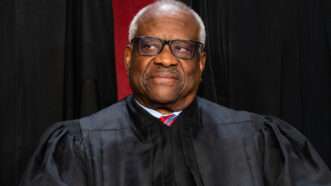
The Court says "a credible threat" justifies a ban on gun possession but does not address situations where there is no such judicial finding.


New from Reason: a look into what Javier Milei has accomplished and what it will take to make the most of Argentina’s window for real change. Out now for subscribers.

