MENU

Reason.com

Free Minds & Free Markets

Article Thumbnail

Don't Blame Karl Marx for 'Cultural Marxism': New at Reason

Political correctness isn't a communist plot.

Karl Marx Saratm/FiverrKarl Marx Saratm/FiverrThe list of developments for which "cultural Marxism" has been blamed includes the following: the LGBT rights movement, especially the legal push to eliminate sodomy laws and legitimize gay marriage; activism for transgender acceptance and recognition; the increase in divorce at the end of the 20th century and a decrease in nuclear family formation; African Americans protesting police abuse; art and music that fails to follow familiar genre conventions; increased depictions of a variety of races, genders, and sexualities in popular media; acceptance of immigrants and the cultural pluralism they bring; a lack of tolerance for nonliberal ideas on college campuses.

This bill of particulars is not new, especially from conservatives. The twist was to begin dragging Karl Marx into it. Here's how the narrative goes: After the horrific deaths of millions, global communism may have been discredited as a viable economic system, but its proponents want to sneak it perniciously through the back door via cultural decadence. Thus, political correctness is part of a lefty long con to take over America.

You have to give the conspiratorial right credit for clever rhetorical deck-stacking, at least. How can you approve of sympathetic gay people appearing in yogurt commercials if it's all a commie plot?

It may be comforting to believe your ideological foes are dupes of manipulative intellectual fiends. But declaring that advocates of multiculturalism, feminism, and gay rights are the pawns of dead Jewish communists is both mistaken as a matter of cultural history and foolish as a way to sell an alternate ideology. You won't win the day by treating people who merely disagree with you as stalking horses for socialist tyranny, writes Brian Doherty.

View this article
Article Thumbnail

California Adopts a Mixed Bag of Food Laws: New at Reason

Governor Jerry Brown, right, reviews legislation in his office on Sept. 30. Renee C. Byer/ZUMA Press/NewscomGovernor Jerry Brown, right, reviews legislation in his office on Sept. 30. Renee C. Byer/ZUMA Press/NewscomA trio of new laws recently passed in California should make life easier for home food entrepreneurs, street vendors, and craft distillers in the state. That's great news for food freedom and the entrepreneurs and consumers who drive its spread. But as with so many bursts of law-signing, there was some awful with the good.

On September 18, the same day he signed the homemade food law, Gov. Jerry Brown also signed a new law that will crack down on people who want to share food with the homeless and others in need. Baylen Linnekin explains how California may have set a troubling new precedent in regulating kindness.

View this article
Article Thumbnail

Freeborn Frank Turner: New at Reason

The British musician brings a libertarian sensibility to his new folk-punk album.

Frank Turner/Ben MorseFrank Turner/Ben MorseBe More Kind is the seventh studio album by the British singer-songwriter Frank Turner. The title is based on a Clive James poem published in The New Yorker, and like many of Turner's previous works, the record blends elaborate folk storytelling with a punk rock attitude, overtly political themes, and pleas for social decency. With song titles like "Make America Great Again" and "21st Century Survival Blues," Be More Kind is an album full of literary, political rock 'n' roll. It has also been a critical and commercial hit, pulling rave reviews at publications such as NME, topping the British charts, and rising to 90th on Billboard's top-200 album list.

Turner has described himself as both a libertarian and a classical liberal—ideological descriptors that are rare in his corner of the music world—and has reportedly received death threats for talking candidly about his politics.

In June, Reason's Nick Gillespie spoke with Turner about his new album, his idiosyncratic politics, punk rock's liberal slant, and why the most important debate isn't between left and right but between authoritarian and libertarian.

View this article
Article Thumbnail

M*A*S*H Goes to the Junkyard

Friday A/V Club: The byproducts of a cultural juggernaut

William Morrow & Co.William Morrow & Co.Fifty years ago this month, William Morrow & Co. published MASH: A Novel About Three Army Doctors. Attributed to "Richard Hooker," the book was actually composed by Richard Hornberger, a doctor who had served in Korea, and W.C. Heinz, a sportswriter who spruced up the doctor's prose. A couple years later, Robert Altman adapted the novel into a movie, and a couple years after that, the movie's success spawned a long-running TV show.

If you're an American born between the beginning of the Cold War and the end of disco, you probably have an opinion or three about the M*A*S*H franchise. In my case, I think the book is fun but unexceptional, the movie is great, and the TV show ranges from very good to terrible, with most of the good episodes concentrated in the period before B.J. grew a mustache. (Credit where it's due: I stole the mustache thesis from Bill Geerhart.) Whether or not you agree about any of that, it's undeniable that Hawkeye Pierce, Trapper John McIntyre, Radar O'Reilly, and the rest of the M*A*S*H crew were a cultural juggernaut.

But you're reading the Friday A/V Club, where we take pleasure in slipping past the juggernauts to peer at the junk left in our cultural attic. If you want a detailed take on the main stream of M*A*S*H history, Howard Fishman wrote a pretty good article about it for The New Yorker this past July. (I especially liked his observation that the M*A*S*H doctors come across as frat boys in the book and as hipsters in the movie; on TV, he could have added, their mixture of progressive politics and serial sexual harassment resembles a certain sort of college professor.) Fishman can handle the M*A*S*H that mattered. We'll look at the detritus—at the sequels to the novel and the spinoffs from the TV show.

First the novels. Two of these, M*A*S*H Goes to Maine and M*A*S*H Mania, were written by Hornberger; they feature the M*A*S*H doctors working at a hospital in Maine in the 1970s. These books may shock people raised on the TV series, since Hawkeye here is a rock-ribbed Republican who throws around racial slurs and at one point declares that you "oughta kick the bejesus out of a liberal now and then just to stay in shape." The Maine books aren't great literature, but they have a sort of lived-in authenticity to them; they're stories about small-town doctors from Maine that were written by a small-town doctor from Maine, and they can't help picking up some texture along the way. If nothing else, I can recommend "Dragons," a chapter of M*A*S*H Mania where Hawkeye, having been dragged before a judge who's in on the joke, spins a tall tale in which the atom bomb wasn't invented until 1950 and it was a dragon named Sid who actually destroyed Hiroshima.

Pocket BooksPocket BooksBut then there are the other books. William Butterworth wrote these, and he churned out around a dozen of them. M*A*S*H Goes to New Orleans. M*A*S*H Goes to Las Vegas. M*A*S*H Goes to Vienna. M*A*S*H Goes to Morocco. In these the swamp doctors still work at that hospital in Maine, but now they're constantly getting drawn into allegedly high-comic adventures around the world, with a recurring cast of guest stars with names like Boris Korsky-Rimsakov, Horsey de la Chevaux, and Wrong-Way Napolitano. Sometimes the book characters' backstories are adjusted to fit the TV series; other times the books go out of their way to contradict the TV series. (Col. Henry Blake, famously killed off on the show, periodically pops in to say hello.) I cannot in good conscience recommend reading two or more of these, but every student of '70s kitsch should try to make it through one.

And the TV spinoffs? There were three of those. Trapper John, M.D. was a standard medical drama set in what was then the present day, with the title character now employed at a hospital in San Francisco. (It must have been a tough commute to work both there and in Maine.) AfterMASH was set in Missouri in the 1950s, with three characters from the old show adjusting to civilian life at yet another hospital.

Finally, there's W*A*L*T*E*R, in which Gary Burghoff reprises his role as Radar O'Reilly and a very young Victoria Jackson plays the ditzy drugstore clerk who befriends him. There was only one episode. It aired in only half the country. It is the most godawful piece of crap ever excreted by the M*A*S*H multiverse—and yes, I've seen the episode of the original show where they spend the whole story organizing a surprise party for Col. Potter. That one is Citizen Kane compared to W*A*L*T*E*R. If the novel published in October 1968 is the place where this franchise was born, then this half-hour of television that aired in July 1984 is where it went to die. (*) Enjoy!

(* I mean "went to die" figuratively, of course. W*A*L*T*E*R was followed by one more season of AfterMASH and two more seasons of Trapper John, M.D. America still has troops in Korea, too. Apparently it's really hard to wind these things down.)

Article Thumbnail

FDA Threatens E-Cigarette Companies With Product Removal

It's just the latest development in the FDA's war on vaping.

Gawriloff/Dreamstime.comGawriloff/Dreamstime.comThe Food and Drug Administration gave 21 electronic-cigarette companies a choice today: Either prove their products aren't breaking FDA rules, or be forced to stop selling them.

The agency's latest crackdown against vaping manufacturers is not particularly surprising. Rather, it's just the latest development in the FDA's war on vaping.

In a press release, the agency said it sent letters to 21 companies "about whether more than 40 products—including some flavored e-cigarette products—are being illegally marketed and outside the agency's current compliance policy." As CNBC notes, e-cigarette products introduced after August 8, 2016 need FDA approval before they can go on the market. The agency apparently believes some products are being sold without the relevant approval.

FDA Commissioner Scott Gottlieb has now threatened the companies with enforcement actions. "Companies are on notice—the FDA will not allow the proliferation of e-cigarettes or other tobacco products potentially being marketed illegally and outside of the agency's compliance policy, and we will take swift action when companies are skirting the law," he says. "If products are being unlawfully marketed and outside the FDA's compliance policy, we'll act to remove them."

The companies warned included three major players in the industry: British American Tobacco (BAT), Imperial Brands, and Japan Tobacco. Spokespeople for BAT and Japan Tobacco both tell CNBC that their products are in compliance with FDA rules. An Imperial Brands spokesperson, meanwhile, tells Reuters that its "myblu" e-cigarette products are in compliance as well. Juul Labs Inc., easily the most popular e-cigarette manufacturer in the U.S., did not receive a letter. That's because the FDA recently conducted an "unannounced on-site inspection of its corporate headquarters, which sought similar information about its marketing practices," the agency says.

The FDA has been regulating tobacco products since 2009, but only since 2016 has the agency also had authority over the e-cigarette industry, according to Bloomberg. Gottlieb is particularly worried about the effect of vaping on teenagers. Last month, in fact, his agency threatened to ban vaping products unless manufacturers could figure out how to stop teens from using them. "Given the explosive growth of e-cigarette use by kids, we're committed to taking whatever measures are appropriate to stem these troubling use trends," Gottlieb said Friday.

But Gottlieb's crusade against vaping is misguided. As Reason's Jacob Sullum explained last month, what Gottlieb refers to as an "unfortunate tradeoff" is potentially deadly. Research shows that often it's the various flavors that help adults make the switch from combustible tobacco to e-cigarettes. By impeding adults' access to e-cigarettes in an effort to stop teens from vaping, the FDA is deterring smokers from choosing the safer alternative.

Plus, while teenage use of e-cigarettes among teenagers seems to be on the rise, adolescent smoking rates are actually going down.

Article Thumbnail

San Francisco Is About to Let Electric Scooters Back on the Streets. But One Scooter Company Isn't Happy.

Scooter giant Lime claims the city's permitting process was biased and arbitrary.

Benoit Tessier/REUTERS/NewscomBenoit Tessier/REUTERS/NewscomAfter months of hostility, harassment, and the outright seizure of their vehicles by city officials, San Francisco may finally allow dockless electric scooter companies back onto city streets. Come Monday, SFMTA—the city's transit agency—plans to allow local scooter start-ups Scoot and Skip to begin operations in the city once again under heavily-conditioned circumstances.

Threatening the return of scooter service however is none other than scooter giant Lime, which was denied a permit and is now suing the city, claiming the process by which these permits were awarded was biased.

"Lime believes that after selecting two other less experienced electric scooter companies and comparatively weaker applications in a process that was riddled with bias, the SFMTA should revisit the decision and employ a fair selection process," said the company in a statement.

Lime had been one of the initial companies to drop its scooters on San Francisco's streets back in March 2018, along with other early entrants Bird and Spin, and thus was on the receiving end of San Francisco's early efforts to quash their permissionless innovation.

Despite their being no prohibition on these dockless e-scooters at the time, San Francisco officials took the view that they were public nuisances, impounding over 500 of the vehicles (including 130 from Lime alone) and sending cease-and-desist letters to the three companies.

What followed was a months-long process by which city hall and SFMTA cobbled together a pilot program that would issue permits to five companies and allow up to 2,500 scooters back onto city streets. At the time Lime, agreed to comply with the new regulations, and along with eleven other scooter companies, applied for a permit.

When permits were finally issued at the end of August, the city inexplicably decided to award them to only two companies—the aforementioned Scoot and Skip—and allow them to only deploy 1,250 scooters.

Neither Lime, nor Bird or Spin, were given permits, in what the company is now claiming is an attempt to unfairly penalize them for operating a lawful, but not explicitly-allowed transit service.

"SFMTA's development of the pilot program and permitting process was biased and flawed from the outset, and aimed to punish companies that lawfully deployed scooters earlier this year," said Lime.

All companies applying for permits to operate in San Francisco were evaluated on a number of categories, including safety, community outreach, plans for low-income and disabled access, and crucially each company's "experience and qualifications" operating scooter programs.

Lime, Bird, and Spin—the three companies to put vehicles out on the street before the city's big scooter crackdown—were all given a 'poor' grade for this last metric, with SFMTA officials claiming that their jumping the gun on providing scooter service meant these companies could not be trusted to follow city regulations going forward.

Also downgraded in this category was ride-sharing company Lyft, a new player in the scooter market, who—despite never having deployed a single scooter on San Francisco's streets—was dinged for the traffic violations its drivers had racked up over the years.

Lyft has also raised complaints about the arbitrary and biased nature of San Francisco's scooter permitting process. In a late September letter sent to San Francisco Mayor London Breed and SFMTA Director Ed Reiskin, Lyft President John Zimmer claimed that initial analysis by city staff ranked his company's application higher, but was then downgraded when the final analysis was released.

"The fact that the final result differed substantially from the initial analysis is indicative of a larger frustration with the process. Scoring criteria was not published in advance, and the scoring analysis that was released afterwards was not tied to the requirements set forth in [permit program regulation]" wrote Zimmer. "This led to what appears to be more arbitrary and inconsistent scoring results."

Zimmer's letter asks the city to reconsider granting only two permits. Lime is going further, demanding that all scooter operations be halted until a fairer appraisal of its application can be conducted.

San Francisco city officials have so far shrugged off Lime's lawsuit, telling the company to work within the system, which they insist was totally above board.

"The SFMTA's permitting process for the pilot program was thoughtful, fair and transparent. It includes an appeal process that Lime should be pursuing instead of wasting everyone's resources by running to court," said City Attorney spokesperson John Cote to the San Francisco Examiner.

While one can quibble with Lime's attempt to temporarily stop scooters' return to San Francisco, one can hardly blame them for not trusting the official appeals process given the continual hostility of city government to scooters.

Indeed, SFMTA's refusal to even issue the maximum number of permits allowed by law shows the degree to which San Francisco officials see e-scooter companies, not as valuable partners offering an innovative new service, but instead as hostile invaders that must be kept at bay.

Article Thumbnail

'Fight for Justice' With Students for Liberty at Harvard Tomorrow

Come hear students, scholars, activists, and Reason editors talk about ending the drug war and authoritarianism here and abroad.

SFLSFLI'm appearing tomorrow in Boston at Students for Liberty's regional conference at Harvard. The theme is "Fight for Justice," the conference is free and open to the public, and here's the lineup:

9:00 AM – Registration & Breakfast

10:00 AM – 10:45 AM – Opening Keynote / Drug War – Dr. Jeffrey Miron, the Director of Undergraduate Studies in the Department of Economics at Harvard University and the Director of Economics Studies at the Cato Institute

11:00 AM – 11:45 AM – "Freedom from Extremism: How an Ex-Hasidic Jew and the Ex-Wife of Jihadi Fought for Freedom" – Yasmine Mohammed, Founder of Free Hearts Free Minds; and Ari Hershkowitz from the acclaimed Netflix feature documentary, "One of Us"

12:00 PM – 12:45 PM – Group Pic, Lunch & Meet Partner Orgs

1:00 PM – 1:45 PM
Breakout #1 – Criminal Justice Reform Panel – Victor Agbafe from Harvard College; Rachael Rollins, Suffolk DA candidate and board member of the NAACP Boston; and Matthew Allen, Field Director of the ACLU of Massachusetts
Breakout #2 – John Paul, Founder of Grand Opportunity USA

2:00 PM – 2:45 PM
Breakout #1 – Jorge Jraissati, Freedom Fighter from Venezuela
Breakout #2 – Will Creeley, Senior Vice President of Legal and Public Advocacy of FIRE

3:00 PM – 3:45 PM – "Ayn Rand: Hater or Heroine?" – Jennifer Grossman, CEO of Atlas Society

4:00 PM – 4:45 PM – Closing Keynote / "Escaping from Authoritarianism" – Nick Gillespie, the Editor-at-Large at Reason Magazine; Faisal Saeed Al Mutar, CEO and Founder of Ideas Beyond Borders; and Laura Nicolae, President of the Harvard Libertarian Club

5:00 PM – After-Social Dinner at Charlie's Kitchen

For more information on the speakers, panels, and registration, go here.

Article Thumbnail

Most Libertarians Don't Understand Friedrich Hayek, Says Peter Boettke: Podcast

In a bold new book about Hayek, the George Mason economist says "too much time and effort has been put into repackaging and marketing a fixed doctrine of eternal truths."

With populism on the rise, capitalism under attack, and socialism back in vogue, the work of Austrian economist Friedrich Hayek (1899–1992) is more relevant than ever. Hayek started his career as a wunderkind professor, joining the faculty of the London School of Economics in his early thirties, and was a central figure in the debates that consumed the profession during the Great Depression. He would go on to spend most of his seven-decade long career as an outsider, his work diverging from the mainstream following the Keynesian revolution of the 1930s and '40s. Eventually the world circled back to Hayek's ideas, and he was one of two recipients of the 1974 Nobel Memorial Prize in Economics.

Today, Hayek is best known for his enduring insights on emergent order, for his critique of central planning, and for his argument that all knowledge in society is decentralized and that a modern economy thus relies the coordinating role of prices and private property. In his final book, The Fatal Conceit, Hayek attacked wrote that "the curious task of economics is to demonstrate to men how little they really know about what they imagine they can design."

Hayek's enormous body of work is the subject of a new book by the George Mason University economist Peter Boettke, which takes a deep dive into Hayek's writing and serves as a rousing call for a serious rethinking of libertarian and classical liberal thought.

"Liberalism is in need of renewal," writes Boettke, who started his career as an expert on post-communist economics in the former Soviet Union. "Too much time and effort has been put into repackaging and marketing a fixed doctrine of eternal truths, rather than rethinking and evolving to meet the new challenges." Even Hayek, Boettke notes, made mistakes late in his career, such as his kind words for the Chilean dictator Augusto Pinochet. Hayek's great legacy is his understanding of economics and liberal political theory as a process for creating a world in which individuals and society could become more free, equal, and prosperous over time.

In this Reason Podcast, I talk with Boettke about the historical and intellectual context of Hayek's thought, the influence of Hayek's mentor Ludwig von Mises on his work, and how libertarians can follow Hayek's dictum that "we must make the building of a free society once more an intellectual adventure, a deed of courage."

Subscribe, rate, and review our podcast at iTunes. Listen at SoundCloud below:

Audio production by Ian Keyser.

Don't miss a single Reason Podcast! (Archive here.)

Subscribe at iTunes.

Follow us at SoundCloud.

Subscribe at YouTube.

Like us on Facebook.

Follow us on Twitter.

Article Thumbnail

Libertarian and Police Accountability Pages Deleted in Facebook Purge

Hundreds of pages and accounts have been purged over accusations that they were "inauthentic." The page operators disagree.

"I contributed to Facebook's success and growth!" Jason Bassler said with some frustration this morning, a day after the social media giant unpublished the page for a media site he founded, The Free Thought Project. "I decided to create content day after day. Now they piss on us."

Facebook announced Thursday that it was deleting 559 pages and 251 accounts that it claims were breaking Facebook's rules against spam and "inauthentic" behavior. The Free Thought Project was one of the demolished pages, along with another of Bassler's efforts, Police the Police. Both pages that produced content—stories, memes, and videos—that focused on government behavior and were shared widely among fans, particularly libertarians.

Nathaniel Gleicher, Facebook's head of cybersecurity policy, and Oscar Rodriguez, a Facebook product manager, have explained the purge by writing that they don't think these sites were really trying to engage in political debate but were in fact spam factories trying to make money:

Many were using fake accounts or multiple accounts with the same names and posted massive amounts of content across a network of Groups and Pages to drive traffic to their websites. Many used the same techniques to make their content appear more popular on Facebook than it really was. Others were ad farms using Facebook to mislead people into thinking that they were forums for legitimate political debate.

Bassler says that's not what was happening. Bassler has editing privileges on a bunch of pages that were affected by the ban, and he shared a picture on Facebook on what it looked like to see all these pages depublished:

Unpublish noticeScreenshot courtesy of Jason Bassler


Bassler explains though that this was the result of networking between pages of similar interest, not a handful of people trying to artificially inflate their own popularity. He has made five pages himself, and he was assisting with these others.

"When we first started these pages in 2012, we started networking with different page owners realized we could do more to benefit each other by helping each other," he says. "What we did and what we've done for the past six years is help each other out by giving each other information."

Bassler isn't the only one confused. Over at the Washington Post, James Reader, who runs a progressive site and page called Reverb Reader, complains about Facebook "changing the rules as they went." Many of them, like Bassler, used networking to build a community to reach a larger audience—a normal sort of organizing that Facebook now deems "inauthentic."

The Free Thought Project had 3 million followers and Police the Police nearly 2 million. Some of the stories highlighted and shared on their website will be familiar to Reason readers, like the recent case of the Kansas man handcuffed on his own property by police who had confused him with a burglar. Bassler says he also got stories from people reaching out to them, upset when the general media reported only the police's side of the story. Bassler describes himself as a libertarian anarchist, but he says he's tried hard not to push an ideological agenda onto his pages, focusing instead on government accountability.

But The Free Thought Project also ran afoul of fact-checkers, particularly Snopes, which has accused them of misrepresenting stories on several occasions and which frequently describes them as a conspiracy site. The Free Thought Project provided coverage of veterans group in Arizona that claimed to have found a "bunker" being used for child trafficking. It was actually an abandoned homeless camp, and there's no evidence that there was any sort of human trafficking happening there.

After Snopes and the Associated Press reported that the claims were fake, The Free Thought Project defended itself by saying it never actually said the child trafficking claims were true in the first place. And it has struck back at Snopes for "debunking" claims from The Free Thought Project that it didn't actually make.

Bassler says he's had four stories pulled from Facebook after fact-checkers deemed them inaccurate. He has had two of those decisions reversed. He claims that Snopes has a grudge against them after The Free Thought Project delved into the site's finances. Snopes, meanwhile, has put up a page debunking claims from the Free Thought Project that Snopes is trying to "shut down conversation" about child sex trafficking.

It's all very messy, but even though Facebook is turning to Snopes to assist with fact-checking what gets shared on the platform, Facebook's latest round of page deletions makes no mention of fact-checking problems as a justification. Reason has reached out to both Facebook and Snopes to see if this fact-checking fight played any role the decision to shut down The Free Thought Project's page or any others affected by the purge. We have not yet gotten a response.

In the meantime, Bassler says he's going to "fight tooth and nail" to try to get his Facebook pages restored. The Free Thought Project has officially responded to having its Facebook page deleted here.

Article Thumbnail

No Charm in This Reboot of Charmed: New at Reason

Fans of Nathan Fillion, though, should enjoy The Rookie.

'Charmed''Charmed,' CWThe newest TV programming axiom seems to be, "Save the weirdest for the last." In the final gasp of the fall broadcast rollout—only a couple of new shows remain to be seen when the upcoming week is over—we have a rookie cop who is also deep in the throes of middle-aged angst; three hyper-woke young witches; and an oddball sitcom about working-class Catholic families that's either sweetly nostalgic or witheringly contemptuous. It's hard to tell.

Television critic Glenn Garvin takes a closer look at The Rookie, The Kids Are Alright, and CW's reboot of Charmed.

View this article
Article Thumbnail

Ohio Will Vote on a Sentencing Reform Bill in November

What you need to know about Issue 1

|||Stefano Ember/Dreamstime.comStefano Ember/Dreamstime.comWhen Ohio voters head to the polls next month, they will have the opportunity to pass or reject Issue 1, a state constitutional amendment. As the Dayton Daily News sums it up, Issue 1 would do the following:

—Convert felony 4 and felony 5 drug possession and drug use crimes to misdemeanors with no jail time for first and second offenses committed within a 24-month period;
— Keep drug trafficking crimes as felonies;
— Prohibit judges from sending people to prison if they violate probation with something other than a new crime, such as missing an appointment;
— Cut prison time for offenders who complete rehabilitation programs, except those convicted of murder, rape or child molestation;
— Put money saved by fewer people going to prison into drug treatment and crime victim programs;
— Allow people convicted of certain drug crimes to petition the court for re-sentencing or release or to have the charge changed.

Travis Irvine, Ohio's Libertarian candidate for governor, has come out for the amendment, saying: "Even though it is far from perfect, I fully support Issue 1 because it moves the needle in the right direction—away from prosecuting and punishing non-violent people for behavior that doesn't harm their neighbors. I want to work steadily toward full legalization and decriminalization of the personal use of marijuana by adults." His Democratic challenger, Richard Cordray, also supports the amendment. His Republican challenger, Mike DeWine, is opposed.

Supporters of the amendment say it will save "tens of millions of dollars" out of the $1.8 billion-plus that Ohio spends on its "revolving prison door." They expect approximately $136 million to be redirected to treatment. Ohio Justice and Policy Center Deputy Director Stephen Johnson Grove, who helped draft the bill, estimates that 2,600 of the state's 50,000 prison population were convicted for lower-level drug offenses. Supporters also note that the relevant data show no correlation between imprisonment and lower drug use.

Opponents, such as the Ohio Prosecuting Attorneys Association and the Ohio Judicial Conference, argue that it is actually a negative to make the punishment for possession lower than the punishment for crimes such as "disorderly conduct and reckless operation." They also cite a state Office of Budget Management report that claims that the suggested savings will be only $1.3 million a year. And they claim the measure will cause children to believe that fentanyl, heroin, and meth are not dangerous.

The measure requires a majority yes vote to pass.

Bonus link: Florida's Amendment 4 seeks to restore the voting rights of ex-felons who have served their time.

Article Thumbnail

Quebec Nationalists: Teachers Shouldn't Wear 'Religious Signs,' But a Crucifix Hanging in the Legislature Is OK

The Coalition Avenir Quebec claims the crucifix hanging in the National Assembly isn't a religious symbol.

Wikimedia CommonsWikimedia CommonsThe ethnic-nationalist party about to take power in Quebec wants to ban many government employees—including teachers—from wearing religious symbols to work. But the Coalition Avenir Quebec (CAQ) has no problem with one glaring religious symbol currently hanging in the provincial legislature.

The party's platform states that "religious signs will be prohibited for all persons in position of authority, including teachers." Incoming Premier François Legault has echoed that sentiment, saying, "I think if we compare to what's happening in many countries, it's reasonable for neutrality reasons—we want to make sure that a policeman or a policewoman doesn't show a religious sign in case the man or woman in front of him is from another religion."

The proposal's critics argue that it's an unconstitutional violation of freedom of religion. Canadian Prime Minister Justin Trudeau, for one, says he doesn't want the state to "tell a woman what she can or cannot wear." But if the proposed ban is found unconstitutional, Legault has suggested deploying the notwithstanding clause of the Canadian Charter of Rights and Freedom, which permits provincial legislatures to override a court's decision on what is and is not constitutional.

Count me with the critics. The CAQ says it wants to ensure "the secularity of the state," and that's a worthy goal: Separation of church and state—and mosque and state, and synogogue and state—is certainly a good thing. But this ban would simply prohibit workers whose religions require them to wear certain clothing (like kippahs for Jewish men and hijabs for Muslim women) from being able to do so.

Plus, the party's stance is more than a little hypocritical.

For more than 80 years, a crucifix has hung above the speaker's chair in Quebec's legislature, the National Assembly. One might think that a party eager to secularize the state would call for the crucifix's removal. But the CAQ insists that this cross is a cultural symbol, not a religious one. "We have to understand our past," Legault told reporters this week. The French Catholics and British Protestants who settled the province "built the values we have in Quebec," he said. "We have to recognize that and not mix that with religious signs." A CAQ spokesperson tells The Globe and Mail that as a "heritage object," the crucifix is "part of our history" and thus shouldn't be removed.

That crucifix may indeed be an important symbol of Quebec's history. But there is no coherent way to claim that it isn't any less religious than the crucifixes, kippahs, and turbans worn by various public employees. And it looks a lot more like an official endorsement.

Article Thumbnail

Pew Map Shows One Reason a National $15 Minimum Wage Won't Work

The value of $15 varies greatly across the country and even within the same states.

2016 Marilyn Humphries/Newscom2016 Marilyn Humphries/Newscom

Here's a thought: Maybe the federal government shouldn't be in the business of mandating a one-size-fits-all minimum wage.

That's the main takeaway from a Pew Research Center article published Wednesday. "The real value of a $15 minimum wage depends on where you live," the headline notes. The cost of living is much higher in some parts of the United States, such as New York or the San Francisco Bay Area, than it is in other, such as Beckley, West Virginia.

Pew used federal government data to calculate the real purchasing power of a $15/hour minimum wage in hundreds of urban areas:

These estimates are calculated by using data on "regional price parities," or RPPs, for the nation's 382 metropolitan statistical areas. The RPPs, developed by the federal Bureau of Economic Analysis, measure the difference in local price levels of goods and services across the country, relative to the overall national price level (set at 100).

The result was this handy map:

In the San Francisco Bay area, the real purchasing power of $15 is closer to $12. A $15/hour minimum wage would go the farthest in Beckley, where the purchasing power of $15 translates to $19.04.

In some places, raising the minimum wage to $15/hour means workers in low-skill jobs will be making the same money or close to it as trained professionals. Axios notes that in El Centro, California, the median wage for nursing assistants is $15.07. That money goes farther than it seems at first glance, since the purchasing power of $15 is about $16.80 in El Centro. But a $15/hour minimum wage means many nursing assistants will earn roughly the same as fast-food employees.

This isn't just a problem for a federal minimum wage—it's an issue for state governments too. California's minimum wage will reach $15/hour in 2022. This will have a drastically different effect on El Centro than it will on the San Jose metropolitan area, where the cost of living is 42.3 percent higher. Similarly in New York State, a statewide minimum wage of $15/hour (set to take effect over the next few years) will impact NYC residents much differently than workers in the Utica-Rome region. That's because the cost of living is 30.2 percent higher in New York City, according to Pew.

"Fight for $15" might be a catchy motto, but it doesn't take into account cost of living realities. This is just one reason why the federal government—and state and local governments too—should let the free market do its job.

While minimum wage hikes increase workers' hourly earnings, they also reduce the amount of work available. That's partly why, as Reason's Scott Shackford pointed out in December, the Employment Policy Institute predicted that California's $15/hour minimum wage could cost 400,000 jobs. In Seattle, workers' hours at low-wage jobs went down while the minimum wage went up, leading to a decrease in overall earnings.

Bonus link: Reason TV's Jim Epstein takes a look at how minimum wage increases in New York City have turned car wash workers "into black market lawbreakers":

Article Thumbnail

'Florida's Worst Cop' is Back on the Job...Again

Three arrests and six firings are not enough to keep Sgt. German Bosque from police work.

|||Joe Sohm/Dreamstime.comJoe Sohm/Dreamstime.com"Florida's Worst Cop" is back on the job again. The infamous Opa-locka police sergeant German Bosque has graced Reason headlines for at least six years now: As we've reported, he's been arrested three times and fired six times over the course of 20 years, for "stealing drugs, possessing counterfeit cash, brutalizing suspects and bystanders, lying, insubordination, sexual assault," and more. Now a magistrate has ruled that he can return to work on the Opa-locka police force.

The decision came after a jury acquitted Bosque of a battery charge. In 2011, a youth counselor testified that Bosque punched him while trying to take a baby out of his hands during a domestic-dispute call. After the youth counselor filed a complaint, Bosque reportedly reacted physically, pushing him up against the wall and arresting him. Prosecutors said Bosque acted without "probable cause," and he himself was arrested on battery, witness tampering, and false imprisonment. Though aquitted of the battery charge, Bosque was still convicted on the other two counts, both felonies. A Miami-Dade judge eventually dismissed the false imprisonment charge.

Even when he's off the clock, Bosque is a burden on the taxpayers. In 2012, it came out that he was collecting $60,000 a year essentially to sit at home and do nothing, thanks to back pay following his numerous reinstatements.

Bosque has claimed that his bad reputation is a conspiracy in the media to get rid of him. But he apparently needn't worry about ever losing his job. As he once told a teenager: "I am the law. If I feel like it right now, I can fuck you up and no one will say anything about it."

Article Thumbnail

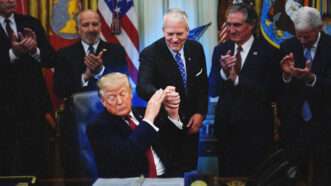
Donald Trump Defends Medicare, a Socialist Program, from the Threat of Socialism

In a new op-ed attacking single-payer, Trump inadvertently reveals that he's in favor of socialism—as long as it's for his supporters.

Polaris/SIPA/NewscomPolaris/SIPA/NewscomOver the past few months, Donald Trump has staked out an aggressive opposition to "Medicare-for-all," an increasingly popular liberal slogan that has multiple meanings but usually refers to some sort of single-payer health care system.

This is rather rich coming from a candidate who touted single-payer's virtues during the Republican presidential primaries. But Trump's opposition is not merely ironic. It is self-contradicting. The president's primary argument against Medicare-for-all is that it is a socialist scheme that would ruin Medicare, the nation's largest socialist health care program.

That contradiction is apparent in a Trump-bylined op-ed for USA Today in which the president positions himself as defender of Medicare, a $700 billion federal health care entitlement that benefits seniors. Early in the piece, he—or his ghost writer, as it is far too cogent for Trump to have written it himself—writes:

I also made a solemn promise to our great seniors to protect Medicare. That is why I am fighting so hard against the Democrats' plan that would eviscerate Medicare. Democrats have already harmed seniors by slashing Medicare by more than $800 billion over 10 years to pay for Obamacare. Likewise, Democrats would gut Medicare with their planned government takeover of American health care.

Later in the piece, Trump warns that "if Democrats win control of Congress this November, we will come dangerously closer to socialism in America. Government-run health care is just the beginning." Trump does not seem to realize, or at the very least he does not care, that Medicare, the program he swore to protect just a few paragraphs earlier, is a massive government-run health care financing program.

The pro-Medicare framing is hardly unique to Trump; Republicans have argued against expansions of government-run health care by saying they would harm Medicare for the better part of the decade.

MORE »

GET REASON MAGAZINE

Get Reason's print or digital edition before it’s posted online